INTRODUCTION TO
ORGANIZATIONAL CHANGE
AND MODELS OF CHANGE
UNIT 1 – INTRODUCTION TO ORGANIZATIONAL CHANGE AND MODELS OF
CHANGE: INTRODUCTION TO ORGANIZATIONAL CHANGE, NATURE OF
CHANGE,TYPES OF CHANGE, MODELS OF CHANGE – LEWIN’S MODEL, KOTTER’S
MODEL, ACTION RESEARCH MODEL, THEORIES OF PLANNED CHANGE
INTRODUCTIONTO ORGANIZATIONAL CHANGE
• Organizational change refers to the process through which an
organization undergoes a transformation in its structure,
strategies, processes, or culture to adapt to internal and
external pressures and achieve its goals.
DEFINITIONS
• Kurt Lewin: "Organizational change is a process of transformation in the behavior of individuals and
groups within an organization.
• "Harvard Business Review: "Organizational change encompasses the activities, processes, and
outcomes of making organizational adjustments to better meet external or internal demands.
• "John Kotter: "Organizational change involves creating a sense of urgency, forming a powerful
guiding coalition, and anchoring new approaches in the culture to achieve sustainable success.
• "Society for Human Resource Management (SHRM):"Organizational change is the process of
aligning an organization’s people and culture with changes in business strategy, organizational
structure, and processes to effectively manage transitions and transformations.“
CASE: STARBUCKS' ORGANIZATIONAL
TRANSFORMATION
• Starbucks, the global coffee giant, experienced rapid growth and success since its founding in 1971. However, by 2008,
the company faced significant challenges, including overexpansion, declining customer experience, and the economic
recession, which impacted its profitability and brand image. In response, Howard Schultz, the former CEO, returned
to lead the company through a major transformation.
• Overexpansion: Starbucks had rapidly opened new stores, leading to market saturation and dilution of the brand
experience. Declining Customer Experience: Focus on expansion led to a decline in the quality of customer service
and product offerings.
• Economic Recession:The 2008 financial crisis reduced consumer spending, impacting Starbucks’ sales and profitability.
Strategic Change Initiatives Store Closures: Starbucks closed 600 underperforming stores in the U.S. and 61 in
Australia to eliminate excess capacity and focus on profitable locations.
• Reinvestment in Core Values: Schultz emphasized a return to the company's core values of providing high-quality
coffee and a unique customer experience. Employee Engagement:The company launched a “Mission Review” program
to engage employees in decision-making and enhance their connection to Starbucks’ mission.
CASE: STARBUCKS' ORGANIZATIONAL
TRANSFORMATION (CONTD.)
• Innovation and Technology: Starbucks introduced new products, like the VIA instant coffee
line, and invested in digital initiatives, including a loyalty program and mobile ordering.
• Cultural Change Barista Training: Starbucks temporarily closed all U.S. stores to retrain
baristas on the art of espresso making, reinforcing the company’s commitment to quality.
Leadership Communication: Schultz conducted regular town hall meetings and
communicated openly with employees, fostering a culture of transparency and trust.
• Financial and Operational Changes Cost Management: The company implemented cost-
saving measures, including supply chain optimization and waste reduction. Focus on Key
Markets: Starbucks concentrated efforts on key markets, such as the U.S. and China, while
streamlining operations in other regions.
CASE: STARBUCKS' ORGANIZATIONAL
TRANSFORMATION (CONTD.)
• Outcomes:
• Improved Financial Performance: By 2010, Starbucks reported a significant increase in
revenue and profitability, with a 9.5% increase in global same-store sales.
• Enhanced Brand Image: The focus on quality and customer experience helped restore
Starbucks’ brand image and customer loyalty.
• Growth in Digital Engagement:The introduction of the mobile app and loyalty program
led to increased customer engagement and convenience.
CASE: STARBUCKS' ORGANIZATIONAL
TRANSFORMATION (CONTD.)
• Discussion Questions
• Strategic Change: How did Starbucks’ strategic changes contribute to its turnaround? What
other strategic options could they have considered?
• Cultural Change: What role did cultural change play in Starbucks' transformation? How
important is leadership in driving cultural change?
• Employee Engagement: How did involving employees in the transformation process impact the
overall success of Starbucks' change initiatives?
• Customer Experience: In what ways did Starbucks improve the customer experience, and how
did this contribute to its recovery?Innovation and Technology: How did innovation and the
adoption of new technology support Starbucks’ turnaround efforts?
IMPORTANCE OF ORGANIZATIONAL CHANGE:
• Adaptability: Helps organizations stay relevant in a rapidly changing
environment.
• Innovation: Drives the creation of new products, services, and business
models.
• Efficiency: Improves operational efficiency and eliminates waste.
• Employee Engagement: Involves employees in meaningful work and
development opportunities.
DRIVERS OF ORGANIZATIONAL CHANGE
• External Drivers: Market trends, competition, technology advancements, regulatory
changes.
• Internal Drivers: Leadership changes, employee feedback, internal performance
metrics, company growth or downsizing.
THE NATURE OF ORGANIZATIONAL CHANGE
• The Nature of Organizational Change Organizational change is multifaceted and can vary
in scope, speed, and impact. Understanding the nature of change is crucial for effective
change management. Here are key aspects of organizational change:
• Planned Change v/s Unplanned Change
• Incremental vs. Radical Change
• Top-Down vs. Bottom-Up
THE NATURE OF ORGANIZATIONAL CHANGE (CONTD.)
• Planned ChangeV/s Unplanned Change
• Deliberate and strategic efforts to make changes within the organization. Example: IBM’s strategic shift in the 1990s to
focus on services and solutions instead of hardware manufacturing.This planned change involved a series of calculated
steps to transform the company’s direction.
• Changes that occur in response to unforeseen circumstances or crises. Example:The COVID-19 pandemic forced many
organizations to rapidly adopt remote work practices, an unplanned change driven by external health and safety concerns.
• Incremental vs. Radical Change
• Incremental Change: Small, continuous improvements or adjustments made over time. Example:Toyota’s Kaizen approach,
which emphasizes continuous, incremental improvements in manufacturing processes to enhance efficiency and quality.
• Radical Change: Significant, transformative changes that fundamentally alter the organization. Example: Netflix’s pivot from
DVD rentals to streaming services and original content production, which radically transformed its business model and
market position.
THE NATURE OF ORGANIZATIONAL CHANGE (CONTD.)
• Top-Down vs. Bottom-Up
• Top-Down Change: Initiatives driven by senior leadership and management. Example: Microsoft’s
cultural transformation under CEO Satya Nadella, who spearheaded a shift towards a more
collaborative and innovative work environment.
• Bottom-Up Change: Change initiatives that originate from employees at various levels of the
organization. Example: Google
FEW MORE EXAMPLES
• Planned Change v/s Unplanned Change
• Apple’s Transition to New Leadership: In 2011, Apple planned a major change when Steve Jobs, the co-founder and then CEO,
resigned due to health issues. Apple’s board had been preparing for this transition for years, selecting Tim Cook as the successor. The
company had a well-thought-out succession plan to ensure a smooth leadership transition, preserving its innovative culture and
operational stability.This planned change involved strategic preparation, communication, and the gradual introduction of Cook into more
prominent roles before Jobs' departure, enabling a seamless leadership handover.
• Unplanned Change Example: Volkswagen Emissions Scandal: In 2015,Volkswagen faced an unplanned change when it was discovered
that the company had installed software to cheat emissions tests.This scandal led to immediate and unforeseen repercussions, including
legal challenges, financial penalties, and a significant impact on its reputation.The crisis was not anticipated and required the company to
respond quickly with damage control measures, such as recalling affected vehicles, cooperating with regulatory authorities, and overhauling
its emissions testing practices. This unplanned change necessitated rapid, reactive adjustments to address the fallout and restore
stakeholder trust.
FEW MORE EXAMPLES (CONTD.)
• Top-Down vs. Bottom-Up
• Top-Down: General Electric’s (GE) Transformation under Jack Welch: In the 1980s and 1990s, Jack Welch, then CEO of
General Electric (GE), led a top-down approach to change within the company. Welch implemented the “boundaryless
organization” concept, which aimed to reduce hierarchy and foster a more collaborative environment. He also introduced
the “Six Sigma” quality management initiative to improve operational efficiency and product quality.These changes were
mandated from the top executive level and cascaded down through the organization. Welch’s approach involved setting
clear objectives and expectations, and the changes were implemented throughout the company according to his vision.
• Bottom-Up Approach: Google’s “20% Time” is an example of a bottom-up approach to change. This policy allowed
employees to spend up to 20% of their workweek on projects of their choosing, even if they were outside their primary
job responsibilities.This approach encouraged employees to innovate and pursue ideas they were passionate about, leading
to the development of successful products such as Gmail and Google News.The initiative originated from the employees
and was supported by management, illustrating how grassroots ideas can drive significant organizational change.
THE NATURE OF ORGANIZATIONAL CHANGE: SIX KEY FACTORS
ASSOCIATED WITH SUCCESSFUL CHANGE CLASSIFICATION
1. The selection and role of the problem owner The right person for the job in terms of their
managerial skills, involvement and commitment to the problem or project.
2. Locating change on the change spectrum Determining the nature of the change with regard to both
its physical and organizational impact. Is it, for example, a purely technical or a more complex people
related change?
3. The TROPICS test A quick, yet effective, means of addressing the following key factors affecting the
classification of a change situation: time scales, resources, objectives, perceptions, interest, control and
source. By considering the change in relation to the above factors the manager responsible may determine,
through an enhanced knowledge of the nature of the change, the optimal route forward.
4. Force field analysis: a positioning tool A diagramming technique that assists in answering questions such
as: what forces are at play and what is their likely magnitude? Who is for the change and who is against?
4. Can a proactive stance be adopted? The aim is to determine the nature and magnitude of the forces acting
upon the change environment.
5. Success guarantors: commitment, involvement and the shared perception Successful change management
requires an understanding of the likely impact of the change on those systems most affected by it, and thereafter
the development of a means of establishing a shared perception of the problem amongst all concerned. The
visible commitment and involvement of those charged with managing the change and those affected by it are
crucial to achieving effective transition management.
6. Managing the triggers Change, as discussed, it can be triggered by either internal or external events. The
problem owner, or change agent, must understand both the likely impact of the trigger and how best to handle
its subsequent, post-impact, management. The nature of the ‘trigger’ will influence the reaction of the
organization and its staff, along with the associated supply chains, to the impending change, as well as assist in
determining the appropriate course of action to follow.
THE NATURE OF ORGANIZATIONAL CHANGE: SIX KEY FACTORS
ASSOCIATED WITH SUCCESSFUL CHANGE CLASSIFICATION (CONTD.)
TYPES OF ORGANIZATIONAL CHANGE
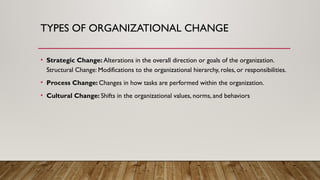
• Strategic Change: Alterations in the overall direction or goals of the organization.
Structural Change: Modifications to the organizational hierarchy, roles, or responsibilities.
• Process Change: Changes in how tasks are performed within the organization.
• Cultural Change: Shifts in the organizational values, norms, and behaviors
TYPES OF ORGANIZATIONAL CHANGE
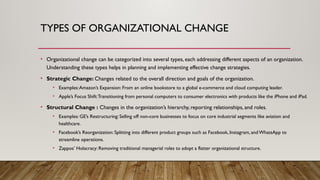
• Organizational change can be categorized into several types, each addressing different aspects of an organization.
Understanding these types helps in planning and implementing effective change strategies.
• Strategic Change: Changes related to the overall direction and goals of the organization.
• Examples:Amazon’s Expansion: From an online bookstore to a global e-commerce and cloud computing leader.
• Apple’s Focus Shift:Transitioning from personal computers to consumer electronics with products like the iPhone and iPad.
• Structural Change : Changes in the organization’s hierarchy, reporting relationships, and roles.
• Examples: GE’s Restructuring: Selling off non-core businesses to focus on core industrial segments like aviation and
healthcare.
• Facebook’s Reorganization: Splitting into different product groups such as Facebook, Instagram, and WhatsApp to
streamline operations.
• Zappos’ Holacracy: Removing traditional managerial roles to adopt a flatter organizational structure.
TYPES OF ORGANIZATIONAL CHANGE (CONTD.)
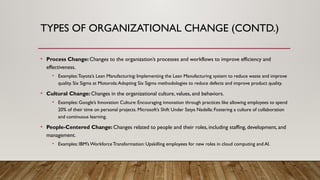
• Process Change: Changes to the organization’s processes and workflows to improve efficiency and
effectiveness.
• Examples:Toyota’s Lean Manufacturing: Implementing the Lean Manufacturing system to reduce waste and improve
quality. Six Sigma at Motorola:Adopting Six Sigma methodologies to reduce defects and improve product quality.
• Cultural Change: Changes in the organizational culture, values, and behaviors.
• Examples: Google’s Innovation Culture: Encouraging innovation through practices like allowing employees to spend
20% of their time on personal projects. Microsoft’s Shift Under Satya Nadella: Fostering a culture of collaboration
and continuous learning.
• People-Centered Change: Changes related to people and their roles, including staffing, development, and
management.
• Examples: IBM’s Workforce Transformation: Upskilling employees for new roles in cloud computing and AI.
TYPES OF ORGANIZATIONAL CHANGE (CONTD.)
• Technological Change: Changes related to the adoption and implementation of new
technologies.
• Examples: Netflix’s Streaming Technology:Transitioning from DVD rentals to online streaming.
Tesla’s AutonomousVehicles: Integrating advanced AI and sensor technology to develop self-
driving cars.Visual: Infographic illustrating the technology adoption process and its impact.
• Mergers and Acquisitions (M&A): Changes resulting from the merging of two
companies or the acquisition of one company by another.
• Examples: Disney’s Acquisition of Pixar: Combining resources to enhance animation
capabilities and market reach.Amazon’s Acquisition of Whole Foods: Expanding into the
grocery retail market.
ADOBE- A TRANSFORMATION OF HR FUNCTIONS
TO SUPPORT STRATEGIC CHANGE
• Many a times external factors lead to changes in organisational structures and culture.This truly happened at Adobe which
has 11,000 employees worldwide with 4.5 billion $ yearly revenue.
• Acrobat, Flash Player, and Photoshop are among the well-known products of Abode.
• Due to new emerging technologies and challenges posed by small competitors Adobe had to stop selling its licensed goods
in shrink-wrapped containers in 2011 and switched to offering digital services through the cloud.They gave their customers
option of downloading the necessary software for free or subscribing to it every month rather than receiving a CD in a box.
• The human resource (HR) function also took on a new role, which meant that employees had to adjust to new working
practices.A standard administrative HR function was housed at Adobe’s offices. However, it was less suitable for the cloud-
based strategy and performed well when Adobe was selling software items.
• HR changed its role and became more human centric and reduced its office based functions.
ADOBE (CONTD.)
• The HR personnel did “walk-ins,” to see what assistance they might offer, rather than waiting for calls.With a focus
on innovation, change, and personal growth,Adobe employed a sizable percentage of millennials.
• Instead of having an annual reviews, staff members can now use the new “check-in” method to assess and define
their own growth goals whenever they find it necessary, with quick and continuous feedback.
• Managers might receive constructive criticism from HR through the workshops they conduct.The least number of
employees have left since this changed approach of HR.
Why did Adobe’s HR department make this change? Since the company’s goals and culture have
changed, HR discovered new ways to operate to support these changes.
INTUIT – APPLYING 7S FRAMEWORK OF CHANGE
MANAGEMENT
• Steve Bennett, a vice president of GE Capital, was appointed CEO of Intuit in 2000. Intuit is a provider of
financial software solutions with three products: Quicken, TurboTax, and QuickBooks, which have respective
market shares of 73 percent, 81 percent, and 84 percent.
• Despite this market domination, many observers believed Intuit was not making as much money as it could.
• Additionally, the business was known for making decisions slowly, which let rivals take advantage of numerous
market opportunities. Bennett desired to change everything.
• In his first few weeks, he spoke with each of the top 200 executives, visited the majority of Intuit’s offices, and
addressed the majority of its 5,000 employees.
• He concluded that although employees were enthusiastic about the company’s products, internal processes
weren’t given any thought (based on Higgins, 2005).
INTUIT – APPLYING 7S FRAMEWORK OF CHANGE
MANAGEMENT (CONTD.)
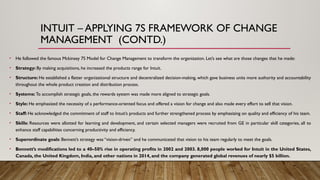
• He followed the famous Mckinsey 7S Model for Change Management to transform the organization. Let’s see what are those changes that he made:
• Strategy: By making acquisitions, he increased the products range for Intuit.
• Structure: He established a flatter organizational structure and decentralized decision-making, which gave business units more authority and accountability
throughout the whole product creation and distribution process.
• Systems: To accomplish strategic goals, the rewards system was made more aligned to strategic goals.
• Style: He emphasized the necessity of a performance-oriented focus and offered a vision for change and also made every effort to sell that vision.
• Staff: He acknowledged the commitment of staff to Intuit’s products and further strengthened process by emphasizing on quality and efficiency of his team.
• Skills: Resources were allotted for learning and development, and certain selected managers were recruited from GE in particular skill categories, all to
enhance staff capabilities concerning productivity and efficiency.
• Superordinate goals: Bennett’s strategy was “vision-driven” and he communicated that vision to his team regularly to meet the goals.
• Bennett’s modifications led to a 40–50% rise in operating profits in 2002 and 2003. 8,000 people worked for Intuit in the United States,
Canada, the United Kingdom, India, and other nations in 2014, and the company generated global revenues of nearly $5 billion.
MODELS OF CHANGE
• Lewin’s model
• Kotter’s model
• Action Research Model
LEWIN’S MODEL
• Kurt Lewin (1951) developed his ideas about organizational change from
the perspective of the organism metaphor. His model of organizational
change is well known and much quoted by managers today.
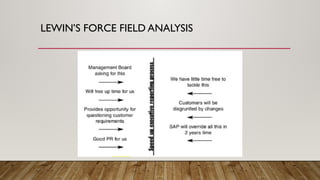
• Lewin is responsible for introducing force field analysis, which examines
the driving and resisting forces in any change situation. The underlying
principle is that driving forces must outweigh resisting forces in any
situation if change is to happen.
LEWIN’S FORCE FIELD ANALYSIS
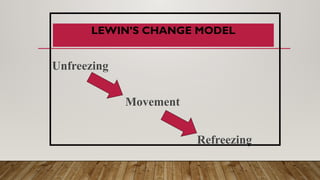
LEWIN’S CHANGE MODEL
Unfreezing
Movement
Refreezing
KOTTER’S MODEL
• The model addresses some of the power issues around making change
happen, highlights the importance of a ‘felt need’ for change in the
organization, and emphasizes the need to communicate the vision and
keep communication levels extremely high throughout the process.
CASE
• A mid-sized manufacturing company, facing inefficiencies due to outdated technology, decides to implement a new,
advanced system.The CEO initiates the change by presenting data that shows competitors with more advanced systems
outperforming the company. Recognizing the urgency, the CEO forms a coalition of influential leaders from IT, Operations,
and HR to drive the initiative.The coalition develops a vision: "To become the industry leader by leveraging cutting-edge
technology to improve efficiency, reduce costs, and enhance customer satisfaction." This vision is communicated through
town hall meetings, emails, newsletters, and the company intranet. Leaders consistently reinforce the vision in their
interactions with staff.To remove obstacles, the coalition addresses resistance from long-term employees by providing
training sessions that demonstrate the benefits of the new system and offering support to ease the transition.The
company then rolls out the new technology in phases, starting with a small area of the business. Early successes, such as
noticeable improvements in efficiency and cost savings, are celebrated and widely communicated.Building on this initial
success, the company gradually implements the new technology in other areas, collecting feedback to refine the process
and providing additional training and support.To anchor the changes, the company incorporates the new technology into
its core business processes. Success stories are shared, and employees who embrace the new system are recognized and
rewarded.The importance of the new technology is emphasized in training programs and performance evaluations.
KOTTER’S EIGHT-STEP MODEL
1. Establish a sense of urgency. Discussing today’s competitive realities, looking at potential future
scenarios. Increasing the ‘felt-need’ for change.
2. Form a powerful guiding coalition.Assembling a powerful group of people who can work well
together.
3. Create a vision. Building a vision to guide the change effort together with strategies for achieving this.
4. Communicate the vision. Kotter emphasizes the need to communicate at least 10 times the amount
you expect to have to communicate.The vision and accompanying strategies and new behaviours
needs to be communicated in a variety of different ways.The guiding coalition should be the first to
role model new behaviours.
KOTTER’S EIGHT-STEP MODEL (CONTD.)
5. Empower others to act on the vision. This step includes getting rid of obstacles to
change such as unhelpful structures or systems.Allow people to experiment.
6. Plan for and create short-term wins. Look for and advertise short-term visible
improvements. Plan these in and reward people publicly for improvements.
7. Consolidate improvements and produce still more change. Promote and reward those
able to promote and work towards the vision. Energize the process of change with
new projects, resources, change agents.
8. Institutionalize new approaches. Ensure that everyone understands that the new
behaviours lead to corporate success.
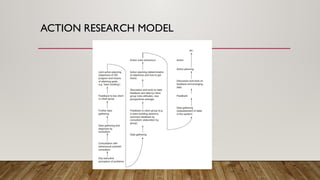
ACTION RESEARCH MODEL
• Action Research is a useful method for facilitating organizational change by collaborating
and involving the client in the entire process of diagnostic, problem identification,
experiential learning, and problem-solving process.
• The Action Research model is a collaborative approach to problem-solving and
improvement. It involves a cyclical process where researchers and practitioners work
together to identify issues, develop and implement solutions, and then assess the
outcomes.
STAGES INTHE ACTION RESEARCH MODEL
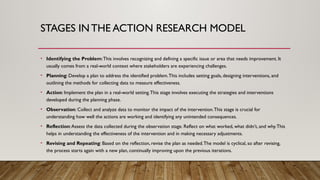
• Identifying the Problem:This involves recognizing and defining a specific issue or area that needs improvement. It
usually comes from a real-world context where stakeholders are experiencing challenges.
• Planning: Develop a plan to address the identified problem.This includes setting goals, designing interventions, and
outlining the methods for collecting data to measure effectiveness.
• Action: Implement the plan in a real-world setting.This stage involves executing the strategies and interventions
developed during the planning phase.
• Observation: Collect and analyze data to monitor the impact of the intervention.This stage is crucial for
understanding how well the actions are working and identifying any unintended consequences.
• Reflection:Assess the data collected during the observation stage. Reflect on what worked, what didn’t, and why.This
helps in understanding the effectiveness of the intervention and in making necessary adjustments.
• Revising and Repeating: Based on the reflection, revise the plan as needed.The model is cyclical, so after revising,
the process starts again with a new plan, continually improving upon the previous iterations.
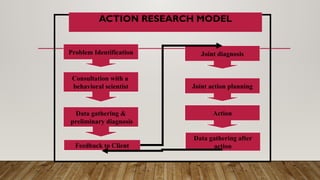
ACTION RESEARCH MODEL
Feedback to Client
Data gathering after
action
Problem Identification
Joint action planning
Consultation with a
behavioral scientist
Data gathering &
preliminary diagnosis
Joint diagnosis
Action
ACTION RESEARCH MODEL
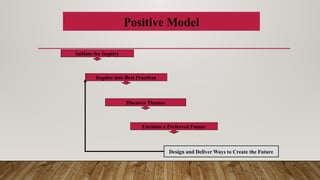
Initiate the Inquiry
Inquire into Best Practices
Discover Themes
Envision a Preferred Future
Design and Deliver Ways to Create the Future
Positive Model
CASE STUDY: THE TRANSFORMATION OF ROADWAY EXPRESS
• Roadway Express, a large U.S. freight transportation company, was facing challenges in the late 1990s.The industry was becoming
increasingly competitive, and Roadway Express needed to improve its operational efficiency, customer service, and employee engagement
to remain competitive. Instead of focusing solely on the problems, the company decided to implement a positive change approach using
Appreciative Inquiry (AI).
• Roadway Express started by conducting interviews and focus groups with employees across all levels.The goal was to discover and
highlight stories of success and instances where the company excelled in customer service, operational efficiency, and employee
collaboration.
• Employees shared numerous success stories, such as instances of exceptional teamwork during peak seasons and innovative solutions
developed on the ground by frontline workers.This phase helped build a positive narrative and reinforced a sense of pride among
employees. Envision the future by imagining what the organization could become if it were to build on its strengths.
Based on the insights from the Discovery Phase, employees at all levels were encouraged to imagine the future of Roadway Express.They
asked questions like, "What would Roadway Express look like if we were at our best every day?" and "How can we replicate our greatest
successes across the entire organization?"
CONTD.
• Employees collectively envisioned a future where Roadway Express was known for industry-leading customer
service, a highly engaged workforce, and cutting-edge operational efficiency.This shared vision energized the
workforce and aligned everyone towards a common goal.
• Co-create the ideal organization by designing the systems and processes needed to achieve the envisioned future.
• Cross-functional teams were formed to design initiatives that would help achieve the desired future state.These
teams focused on areas such as customer service enhancement, process improvement, and employee engagement.
• Outcome: Several initiatives were launched, including a new customer service training program, an employee
recognition system, and the introduction of lean operational practices.These initiatives were directly tied to the
strengths identified in the Discovery Phase.
• Roadway Express implemented the initiatives with a strong focus on sustaining the positive momentum. Regular
follow-ups, continued employee involvement, and celebrations of success helped maintain the change.
CONTD.
• Over time, Roadway Express saw significant improvements in operational efficiency, customer satisfaction, and employee
morale.The positive model of change had not only helped the company overcome its challenges but also positioned it as a
leader in the industry.
• The company experienced a measurable improvement in its delivery times and overall operational efficiency, which enhanced
its competitiveness in the market.
• Customer satisfaction scores increased, as the company was able to deliver on its promise of exceptional service.
• Employee Engagement: Employee engagement and morale improved significantly, leading to lower turnover rates and a more
committed workforce.
• Roadway Express successfully used the positive model of change, specifically Appreciative Inquiry, to transform its
organization. By focusing on what was working well and building on those strengths, the company was able to create a
positive and sustainable change that benefited both the organization and its employees.This case illustrates the power of a
strengths-based approach to change management, where the focus is on leveraging existing successes to inspire and guide
the organization towards a brighter future.
CHANGE THEORY
• Lippitt’s Phases of ChangeTheory
• Prochaska and DiClemente’s ChangeTheory
LIPPITT’S PHASES OF CHANGE THEORY
• Lippitt,Watson, and Westley (1958) extended Lewin’sThree-Step
Change Theory and proposed a seven-step theory of change.
• This theory rather than putting forth the evolution of the
change focuses on the roles and responsibilities of the change
agent in the process of change.
• Role of change agent is very important in this theory.
THE STAGES IN LIPPITT,WATSON ANDWESTLEY’S
SEVEN-STEP THEORY ARE:
1. Development of a need for change,
2. Establishment of a change relationship,
3. Working toward change,
4. The clarification or diagnosis of client systems problem,
5. The examination of alternative routes and goals/establishing goals and intentions of action,
6. Transformation of intentions into actual change efforts, and
7. The generalization and stabilization of change and achieving a terminal relationship.
STAGES OF CHANGE MODEL/ TRANSTHEORETICAL MODEL
(TTM) BY PROCHASKA AND
DICLEMENTE
• Prochaska &DiClemente (1983) gave the "stages of change" model which is one of the components of "Transtheoretical model of
behaviour change".
• The TTM is a model of intentional change that focuses on the individual’s decision making process. It describes how people modify
problem behaviour or acquire a positive behaviour.
• Since it integrates key constructs from other theories it is called the "transtheoretical model".
• This "Stages of Change" model was identified and developed during a study of ‘smoking cessation’ by Prochaska &DiClemente.
• Thereafter this model has been applied to studies focussing on bio-psycho-social problems, including domestic violence, HIV prevention,
alcohol, drug and child abuse, weight control (Prochaska & Prochaska, 2009) and has been used for developing effective interventions for
health behaviour change.This model has been widely applied in behaviour modification techniques.
• In order to move through the change process everyone has to accomplish the same stage-specific tasks although the amount of time an
individual spends in a specific stage varies from one to another.
STAGES OF CHANGE
According to Prochaska &DiClemente (1983) there are five stages of change.These stages
are:
1. Precontemplation
2. Contemplation
3. Preparation
4. Action, and
5. Maintenance
COMPARISON OF
PLANNED CHANGE MODELS
• Similarities
• Change preceded by diagnosis or preparation
• Apply behavioral science knowledge
• Stress involvement of organization members
• Recognize the role of a consultant
• Differences
• General vs. specific activities
• Centrality of consultant role
• Problem-solving vs. social constructionism
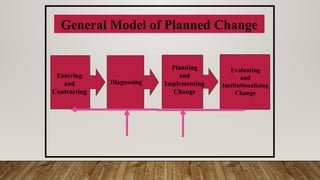
General Model of Planned Change
Evaluating
and
Institutionalizing
Change
Planning
and
Implementing
Change
Diagnosing
Entering
and
Contracting
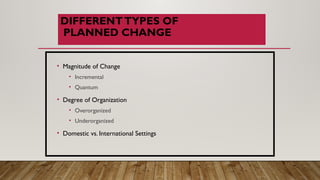
DIFFERENTTYPES OF
PLANNED CHANGE
• Magnitude of Change
• Incremental
• Quantum
• Degree of Organization
• Overorganized
• Underorganized
• Domestic vs. International Settings
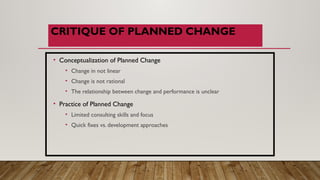
CRITIQUE OF PLANNED CHANGE
• Conceptualization of Planned Change
• Change in not linear
• Change is not rational
• The relationship between change and performance is unclear
• Practice of Planned Change
• Limited consulting skills and focus
• Quick fixes vs. development approaches

Organizational change and development models

  • 1.
    INTRODUCTION TO ORGANIZATIONAL CHANGE ANDMODELS OF CHANGE UNIT 1 – INTRODUCTION TO ORGANIZATIONAL CHANGE AND MODELS OF CHANGE: INTRODUCTION TO ORGANIZATIONAL CHANGE, NATURE OF CHANGE,TYPES OF CHANGE, MODELS OF CHANGE – LEWIN’S MODEL, KOTTER’S MODEL, ACTION RESEARCH MODEL, THEORIES OF PLANNED CHANGE
  • 2.
    INTRODUCTIONTO ORGANIZATIONAL CHANGE •Organizational change refers to the process through which an organization undergoes a transformation in its structure, strategies, processes, or culture to adapt to internal and external pressures and achieve its goals.
  • 3.
    DEFINITIONS • Kurt Lewin:"Organizational change is a process of transformation in the behavior of individuals and groups within an organization. • "Harvard Business Review: "Organizational change encompasses the activities, processes, and outcomes of making organizational adjustments to better meet external or internal demands. • "John Kotter: "Organizational change involves creating a sense of urgency, forming a powerful guiding coalition, and anchoring new approaches in the culture to achieve sustainable success. • "Society for Human Resource Management (SHRM):"Organizational change is the process of aligning an organization’s people and culture with changes in business strategy, organizational structure, and processes to effectively manage transitions and transformations.“
  • 4.
    CASE: STARBUCKS' ORGANIZATIONAL TRANSFORMATION •Starbucks, the global coffee giant, experienced rapid growth and success since its founding in 1971. However, by 2008, the company faced significant challenges, including overexpansion, declining customer experience, and the economic recession, which impacted its profitability and brand image. In response, Howard Schultz, the former CEO, returned to lead the company through a major transformation. • Overexpansion: Starbucks had rapidly opened new stores, leading to market saturation and dilution of the brand experience. Declining Customer Experience: Focus on expansion led to a decline in the quality of customer service and product offerings. • Economic Recession:The 2008 financial crisis reduced consumer spending, impacting Starbucks’ sales and profitability. Strategic Change Initiatives Store Closures: Starbucks closed 600 underperforming stores in the U.S. and 61 in Australia to eliminate excess capacity and focus on profitable locations. • Reinvestment in Core Values: Schultz emphasized a return to the company's core values of providing high-quality coffee and a unique customer experience. Employee Engagement:The company launched a “Mission Review” program to engage employees in decision-making and enhance their connection to Starbucks’ mission.
  • 5.
    CASE: STARBUCKS' ORGANIZATIONAL TRANSFORMATION(CONTD.) • Innovation and Technology: Starbucks introduced new products, like the VIA instant coffee line, and invested in digital initiatives, including a loyalty program and mobile ordering. • Cultural Change Barista Training: Starbucks temporarily closed all U.S. stores to retrain baristas on the art of espresso making, reinforcing the company’s commitment to quality. Leadership Communication: Schultz conducted regular town hall meetings and communicated openly with employees, fostering a culture of transparency and trust. • Financial and Operational Changes Cost Management: The company implemented cost- saving measures, including supply chain optimization and waste reduction. Focus on Key Markets: Starbucks concentrated efforts on key markets, such as the U.S. and China, while streamlining operations in other regions.
  • 6.
    CASE: STARBUCKS' ORGANIZATIONAL TRANSFORMATION(CONTD.) • Outcomes: • Improved Financial Performance: By 2010, Starbucks reported a significant increase in revenue and profitability, with a 9.5% increase in global same-store sales. • Enhanced Brand Image: The focus on quality and customer experience helped restore Starbucks’ brand image and customer loyalty. • Growth in Digital Engagement:The introduction of the mobile app and loyalty program led to increased customer engagement and convenience.
  • 7.
    CASE: STARBUCKS' ORGANIZATIONAL TRANSFORMATION(CONTD.) • Discussion Questions • Strategic Change: How did Starbucks’ strategic changes contribute to its turnaround? What other strategic options could they have considered? • Cultural Change: What role did cultural change play in Starbucks' transformation? How important is leadership in driving cultural change? • Employee Engagement: How did involving employees in the transformation process impact the overall success of Starbucks' change initiatives? • Customer Experience: In what ways did Starbucks improve the customer experience, and how did this contribute to its recovery?Innovation and Technology: How did innovation and the adoption of new technology support Starbucks’ turnaround efforts?
  • 8.
    IMPORTANCE OF ORGANIZATIONALCHANGE: • Adaptability: Helps organizations stay relevant in a rapidly changing environment. • Innovation: Drives the creation of new products, services, and business models. • Efficiency: Improves operational efficiency and eliminates waste. • Employee Engagement: Involves employees in meaningful work and development opportunities.
  • 9.
    DRIVERS OF ORGANIZATIONALCHANGE • External Drivers: Market trends, competition, technology advancements, regulatory changes. • Internal Drivers: Leadership changes, employee feedback, internal performance metrics, company growth or downsizing.
  • 10.
    THE NATURE OFORGANIZATIONAL CHANGE • The Nature of Organizational Change Organizational change is multifaceted and can vary in scope, speed, and impact. Understanding the nature of change is crucial for effective change management. Here are key aspects of organizational change: • Planned Change v/s Unplanned Change • Incremental vs. Radical Change • Top-Down vs. Bottom-Up
  • 11.
    THE NATURE OFORGANIZATIONAL CHANGE (CONTD.) • Planned ChangeV/s Unplanned Change • Deliberate and strategic efforts to make changes within the organization. Example: IBM’s strategic shift in the 1990s to focus on services and solutions instead of hardware manufacturing.This planned change involved a series of calculated steps to transform the company’s direction. • Changes that occur in response to unforeseen circumstances or crises. Example:The COVID-19 pandemic forced many organizations to rapidly adopt remote work practices, an unplanned change driven by external health and safety concerns. • Incremental vs. Radical Change • Incremental Change: Small, continuous improvements or adjustments made over time. Example:Toyota’s Kaizen approach, which emphasizes continuous, incremental improvements in manufacturing processes to enhance efficiency and quality. • Radical Change: Significant, transformative changes that fundamentally alter the organization. Example: Netflix’s pivot from DVD rentals to streaming services and original content production, which radically transformed its business model and market position.
  • 12.
    THE NATURE OFORGANIZATIONAL CHANGE (CONTD.) • Top-Down vs. Bottom-Up • Top-Down Change: Initiatives driven by senior leadership and management. Example: Microsoft’s cultural transformation under CEO Satya Nadella, who spearheaded a shift towards a more collaborative and innovative work environment. • Bottom-Up Change: Change initiatives that originate from employees at various levels of the organization. Example: Google
  • 13.
    FEW MORE EXAMPLES •Planned Change v/s Unplanned Change • Apple’s Transition to New Leadership: In 2011, Apple planned a major change when Steve Jobs, the co-founder and then CEO, resigned due to health issues. Apple’s board had been preparing for this transition for years, selecting Tim Cook as the successor. The company had a well-thought-out succession plan to ensure a smooth leadership transition, preserving its innovative culture and operational stability.This planned change involved strategic preparation, communication, and the gradual introduction of Cook into more prominent roles before Jobs' departure, enabling a seamless leadership handover. • Unplanned Change Example: Volkswagen Emissions Scandal: In 2015,Volkswagen faced an unplanned change when it was discovered that the company had installed software to cheat emissions tests.This scandal led to immediate and unforeseen repercussions, including legal challenges, financial penalties, and a significant impact on its reputation.The crisis was not anticipated and required the company to respond quickly with damage control measures, such as recalling affected vehicles, cooperating with regulatory authorities, and overhauling its emissions testing practices. This unplanned change necessitated rapid, reactive adjustments to address the fallout and restore stakeholder trust.
  • 14.
    FEW MORE EXAMPLES(CONTD.) • Top-Down vs. Bottom-Up • Top-Down: General Electric’s (GE) Transformation under Jack Welch: In the 1980s and 1990s, Jack Welch, then CEO of General Electric (GE), led a top-down approach to change within the company. Welch implemented the “boundaryless organization” concept, which aimed to reduce hierarchy and foster a more collaborative environment. He also introduced the “Six Sigma” quality management initiative to improve operational efficiency and product quality.These changes were mandated from the top executive level and cascaded down through the organization. Welch’s approach involved setting clear objectives and expectations, and the changes were implemented throughout the company according to his vision. • Bottom-Up Approach: Google’s “20% Time” is an example of a bottom-up approach to change. This policy allowed employees to spend up to 20% of their workweek on projects of their choosing, even if they were outside their primary job responsibilities.This approach encouraged employees to innovate and pursue ideas they were passionate about, leading to the development of successful products such as Gmail and Google News.The initiative originated from the employees and was supported by management, illustrating how grassroots ideas can drive significant organizational change.
  • 15.
    THE NATURE OFORGANIZATIONAL CHANGE: SIX KEY FACTORS ASSOCIATED WITH SUCCESSFUL CHANGE CLASSIFICATION 1. The selection and role of the problem owner The right person for the job in terms of their managerial skills, involvement and commitment to the problem or project. 2. Locating change on the change spectrum Determining the nature of the change with regard to both its physical and organizational impact. Is it, for example, a purely technical or a more complex people related change? 3. The TROPICS test A quick, yet effective, means of addressing the following key factors affecting the classification of a change situation: time scales, resources, objectives, perceptions, interest, control and source. By considering the change in relation to the above factors the manager responsible may determine, through an enhanced knowledge of the nature of the change, the optimal route forward. 4. Force field analysis: a positioning tool A diagramming technique that assists in answering questions such as: what forces are at play and what is their likely magnitude? Who is for the change and who is against?
  • 16.
    4. Can aproactive stance be adopted? The aim is to determine the nature and magnitude of the forces acting upon the change environment. 5. Success guarantors: commitment, involvement and the shared perception Successful change management requires an understanding of the likely impact of the change on those systems most affected by it, and thereafter the development of a means of establishing a shared perception of the problem amongst all concerned. The visible commitment and involvement of those charged with managing the change and those affected by it are crucial to achieving effective transition management. 6. Managing the triggers Change, as discussed, it can be triggered by either internal or external events. The problem owner, or change agent, must understand both the likely impact of the trigger and how best to handle its subsequent, post-impact, management. The nature of the ‘trigger’ will influence the reaction of the organization and its staff, along with the associated supply chains, to the impending change, as well as assist in determining the appropriate course of action to follow. THE NATURE OF ORGANIZATIONAL CHANGE: SIX KEY FACTORS ASSOCIATED WITH SUCCESSFUL CHANGE CLASSIFICATION (CONTD.)
  • 17.
    TYPES OF ORGANIZATIONALCHANGE • Strategic Change: Alterations in the overall direction or goals of the organization. Structural Change: Modifications to the organizational hierarchy, roles, or responsibilities. • Process Change: Changes in how tasks are performed within the organization. • Cultural Change: Shifts in the organizational values, norms, and behaviors
  • 18.
    TYPES OF ORGANIZATIONALCHANGE • Organizational change can be categorized into several types, each addressing different aspects of an organization. Understanding these types helps in planning and implementing effective change strategies. • Strategic Change: Changes related to the overall direction and goals of the organization. • Examples:Amazon’s Expansion: From an online bookstore to a global e-commerce and cloud computing leader. • Apple’s Focus Shift:Transitioning from personal computers to consumer electronics with products like the iPhone and iPad. • Structural Change : Changes in the organization’s hierarchy, reporting relationships, and roles. • Examples: GE’s Restructuring: Selling off non-core businesses to focus on core industrial segments like aviation and healthcare. • Facebook’s Reorganization: Splitting into different product groups such as Facebook, Instagram, and WhatsApp to streamline operations. • Zappos’ Holacracy: Removing traditional managerial roles to adopt a flatter organizational structure.
  • 19.
    TYPES OF ORGANIZATIONALCHANGE (CONTD.) • Process Change: Changes to the organization’s processes and workflows to improve efficiency and effectiveness. • Examples:Toyota’s Lean Manufacturing: Implementing the Lean Manufacturing system to reduce waste and improve quality. Six Sigma at Motorola:Adopting Six Sigma methodologies to reduce defects and improve product quality. • Cultural Change: Changes in the organizational culture, values, and behaviors. • Examples: Google’s Innovation Culture: Encouraging innovation through practices like allowing employees to spend 20% of their time on personal projects. Microsoft’s Shift Under Satya Nadella: Fostering a culture of collaboration and continuous learning. • People-Centered Change: Changes related to people and their roles, including staffing, development, and management. • Examples: IBM’s Workforce Transformation: Upskilling employees for new roles in cloud computing and AI.
  • 20.
    TYPES OF ORGANIZATIONALCHANGE (CONTD.) • Technological Change: Changes related to the adoption and implementation of new technologies. • Examples: Netflix’s Streaming Technology:Transitioning from DVD rentals to online streaming. Tesla’s AutonomousVehicles: Integrating advanced AI and sensor technology to develop self- driving cars.Visual: Infographic illustrating the technology adoption process and its impact. • Mergers and Acquisitions (M&A): Changes resulting from the merging of two companies or the acquisition of one company by another. • Examples: Disney’s Acquisition of Pixar: Combining resources to enhance animation capabilities and market reach.Amazon’s Acquisition of Whole Foods: Expanding into the grocery retail market.
  • 21.
    ADOBE- A TRANSFORMATIONOF HR FUNCTIONS TO SUPPORT STRATEGIC CHANGE • Many a times external factors lead to changes in organisational structures and culture.This truly happened at Adobe which has 11,000 employees worldwide with 4.5 billion $ yearly revenue. • Acrobat, Flash Player, and Photoshop are among the well-known products of Abode. • Due to new emerging technologies and challenges posed by small competitors Adobe had to stop selling its licensed goods in shrink-wrapped containers in 2011 and switched to offering digital services through the cloud.They gave their customers option of downloading the necessary software for free or subscribing to it every month rather than receiving a CD in a box. • The human resource (HR) function also took on a new role, which meant that employees had to adjust to new working practices.A standard administrative HR function was housed at Adobe’s offices. However, it was less suitable for the cloud- based strategy and performed well when Adobe was selling software items. • HR changed its role and became more human centric and reduced its office based functions.
  • 22.
    ADOBE (CONTD.) • TheHR personnel did “walk-ins,” to see what assistance they might offer, rather than waiting for calls.With a focus on innovation, change, and personal growth,Adobe employed a sizable percentage of millennials. • Instead of having an annual reviews, staff members can now use the new “check-in” method to assess and define their own growth goals whenever they find it necessary, with quick and continuous feedback. • Managers might receive constructive criticism from HR through the workshops they conduct.The least number of employees have left since this changed approach of HR. Why did Adobe’s HR department make this change? Since the company’s goals and culture have changed, HR discovered new ways to operate to support these changes.
  • 23.
    INTUIT – APPLYING7S FRAMEWORK OF CHANGE MANAGEMENT • Steve Bennett, a vice president of GE Capital, was appointed CEO of Intuit in 2000. Intuit is a provider of financial software solutions with three products: Quicken, TurboTax, and QuickBooks, which have respective market shares of 73 percent, 81 percent, and 84 percent. • Despite this market domination, many observers believed Intuit was not making as much money as it could. • Additionally, the business was known for making decisions slowly, which let rivals take advantage of numerous market opportunities. Bennett desired to change everything. • In his first few weeks, he spoke with each of the top 200 executives, visited the majority of Intuit’s offices, and addressed the majority of its 5,000 employees. • He concluded that although employees were enthusiastic about the company’s products, internal processes weren’t given any thought (based on Higgins, 2005).
  • 24.
    INTUIT – APPLYING7S FRAMEWORK OF CHANGE MANAGEMENT (CONTD.) • He followed the famous Mckinsey 7S Model for Change Management to transform the organization. Let’s see what are those changes that he made: • Strategy: By making acquisitions, he increased the products range for Intuit. • Structure: He established a flatter organizational structure and decentralized decision-making, which gave business units more authority and accountability throughout the whole product creation and distribution process. • Systems: To accomplish strategic goals, the rewards system was made more aligned to strategic goals. • Style: He emphasized the necessity of a performance-oriented focus and offered a vision for change and also made every effort to sell that vision. • Staff: He acknowledged the commitment of staff to Intuit’s products and further strengthened process by emphasizing on quality and efficiency of his team. • Skills: Resources were allotted for learning and development, and certain selected managers were recruited from GE in particular skill categories, all to enhance staff capabilities concerning productivity and efficiency. • Superordinate goals: Bennett’s strategy was “vision-driven” and he communicated that vision to his team regularly to meet the goals. • Bennett’s modifications led to a 40–50% rise in operating profits in 2002 and 2003. 8,000 people worked for Intuit in the United States, Canada, the United Kingdom, India, and other nations in 2014, and the company generated global revenues of nearly $5 billion.
  • 25.
    MODELS OF CHANGE •Lewin’s model • Kotter’s model • Action Research Model
  • 26.
    LEWIN’S MODEL • KurtLewin (1951) developed his ideas about organizational change from the perspective of the organism metaphor. His model of organizational change is well known and much quoted by managers today. • Lewin is responsible for introducing force field analysis, which examines the driving and resisting forces in any change situation. The underlying principle is that driving forces must outweigh resisting forces in any situation if change is to happen.
  • 27.
  • 28.
  • 29.
    KOTTER’S MODEL • Themodel addresses some of the power issues around making change happen, highlights the importance of a ‘felt need’ for change in the organization, and emphasizes the need to communicate the vision and keep communication levels extremely high throughout the process.
  • 30.
    CASE • A mid-sizedmanufacturing company, facing inefficiencies due to outdated technology, decides to implement a new, advanced system.The CEO initiates the change by presenting data that shows competitors with more advanced systems outperforming the company. Recognizing the urgency, the CEO forms a coalition of influential leaders from IT, Operations, and HR to drive the initiative.The coalition develops a vision: "To become the industry leader by leveraging cutting-edge technology to improve efficiency, reduce costs, and enhance customer satisfaction." This vision is communicated through town hall meetings, emails, newsletters, and the company intranet. Leaders consistently reinforce the vision in their interactions with staff.To remove obstacles, the coalition addresses resistance from long-term employees by providing training sessions that demonstrate the benefits of the new system and offering support to ease the transition.The company then rolls out the new technology in phases, starting with a small area of the business. Early successes, such as noticeable improvements in efficiency and cost savings, are celebrated and widely communicated.Building on this initial success, the company gradually implements the new technology in other areas, collecting feedback to refine the process and providing additional training and support.To anchor the changes, the company incorporates the new technology into its core business processes. Success stories are shared, and employees who embrace the new system are recognized and rewarded.The importance of the new technology is emphasized in training programs and performance evaluations.
  • 31.
    KOTTER’S EIGHT-STEP MODEL 1.Establish a sense of urgency. Discussing today’s competitive realities, looking at potential future scenarios. Increasing the ‘felt-need’ for change. 2. Form a powerful guiding coalition.Assembling a powerful group of people who can work well together. 3. Create a vision. Building a vision to guide the change effort together with strategies for achieving this. 4. Communicate the vision. Kotter emphasizes the need to communicate at least 10 times the amount you expect to have to communicate.The vision and accompanying strategies and new behaviours needs to be communicated in a variety of different ways.The guiding coalition should be the first to role model new behaviours.
  • 32.
    KOTTER’S EIGHT-STEP MODEL(CONTD.) 5. Empower others to act on the vision. This step includes getting rid of obstacles to change such as unhelpful structures or systems.Allow people to experiment. 6. Plan for and create short-term wins. Look for and advertise short-term visible improvements. Plan these in and reward people publicly for improvements. 7. Consolidate improvements and produce still more change. Promote and reward those able to promote and work towards the vision. Energize the process of change with new projects, resources, change agents. 8. Institutionalize new approaches. Ensure that everyone understands that the new behaviours lead to corporate success.
  • 33.
    ACTION RESEARCH MODEL •Action Research is a useful method for facilitating organizational change by collaborating and involving the client in the entire process of diagnostic, problem identification, experiential learning, and problem-solving process. • The Action Research model is a collaborative approach to problem-solving and improvement. It involves a cyclical process where researchers and practitioners work together to identify issues, develop and implement solutions, and then assess the outcomes.
  • 34.
    STAGES INTHE ACTIONRESEARCH MODEL • Identifying the Problem:This involves recognizing and defining a specific issue or area that needs improvement. It usually comes from a real-world context where stakeholders are experiencing challenges. • Planning: Develop a plan to address the identified problem.This includes setting goals, designing interventions, and outlining the methods for collecting data to measure effectiveness. • Action: Implement the plan in a real-world setting.This stage involves executing the strategies and interventions developed during the planning phase. • Observation: Collect and analyze data to monitor the impact of the intervention.This stage is crucial for understanding how well the actions are working and identifying any unintended consequences. • Reflection:Assess the data collected during the observation stage. Reflect on what worked, what didn’t, and why.This helps in understanding the effectiveness of the intervention and in making necessary adjustments. • Revising and Repeating: Based on the reflection, revise the plan as needed.The model is cyclical, so after revising, the process starts again with a new plan, continually improving upon the previous iterations.
  • 35.
    ACTION RESEARCH MODEL Feedbackto Client Data gathering after action Problem Identification Joint action planning Consultation with a behavioral scientist Data gathering & preliminary diagnosis Joint diagnosis Action
  • 36.
  • 37.
    Initiate the Inquiry Inquireinto Best Practices Discover Themes Envision a Preferred Future Design and Deliver Ways to Create the Future Positive Model
  • 38.
    CASE STUDY: THETRANSFORMATION OF ROADWAY EXPRESS • Roadway Express, a large U.S. freight transportation company, was facing challenges in the late 1990s.The industry was becoming increasingly competitive, and Roadway Express needed to improve its operational efficiency, customer service, and employee engagement to remain competitive. Instead of focusing solely on the problems, the company decided to implement a positive change approach using Appreciative Inquiry (AI). • Roadway Express started by conducting interviews and focus groups with employees across all levels.The goal was to discover and highlight stories of success and instances where the company excelled in customer service, operational efficiency, and employee collaboration. • Employees shared numerous success stories, such as instances of exceptional teamwork during peak seasons and innovative solutions developed on the ground by frontline workers.This phase helped build a positive narrative and reinforced a sense of pride among employees. Envision the future by imagining what the organization could become if it were to build on its strengths. Based on the insights from the Discovery Phase, employees at all levels were encouraged to imagine the future of Roadway Express.They asked questions like, "What would Roadway Express look like if we were at our best every day?" and "How can we replicate our greatest successes across the entire organization?"
  • 39.
    CONTD. • Employees collectivelyenvisioned a future where Roadway Express was known for industry-leading customer service, a highly engaged workforce, and cutting-edge operational efficiency.This shared vision energized the workforce and aligned everyone towards a common goal. • Co-create the ideal organization by designing the systems and processes needed to achieve the envisioned future. • Cross-functional teams were formed to design initiatives that would help achieve the desired future state.These teams focused on areas such as customer service enhancement, process improvement, and employee engagement. • Outcome: Several initiatives were launched, including a new customer service training program, an employee recognition system, and the introduction of lean operational practices.These initiatives were directly tied to the strengths identified in the Discovery Phase. • Roadway Express implemented the initiatives with a strong focus on sustaining the positive momentum. Regular follow-ups, continued employee involvement, and celebrations of success helped maintain the change.
  • 40.
    CONTD. • Over time,Roadway Express saw significant improvements in operational efficiency, customer satisfaction, and employee morale.The positive model of change had not only helped the company overcome its challenges but also positioned it as a leader in the industry. • The company experienced a measurable improvement in its delivery times and overall operational efficiency, which enhanced its competitiveness in the market. • Customer satisfaction scores increased, as the company was able to deliver on its promise of exceptional service. • Employee Engagement: Employee engagement and morale improved significantly, leading to lower turnover rates and a more committed workforce. • Roadway Express successfully used the positive model of change, specifically Appreciative Inquiry, to transform its organization. By focusing on what was working well and building on those strengths, the company was able to create a positive and sustainable change that benefited both the organization and its employees.This case illustrates the power of a strengths-based approach to change management, where the focus is on leveraging existing successes to inspire and guide the organization towards a brighter future.
  • 41.
    CHANGE THEORY • Lippitt’sPhases of ChangeTheory • Prochaska and DiClemente’s ChangeTheory
  • 42.
    LIPPITT’S PHASES OFCHANGE THEORY • Lippitt,Watson, and Westley (1958) extended Lewin’sThree-Step Change Theory and proposed a seven-step theory of change. • This theory rather than putting forth the evolution of the change focuses on the roles and responsibilities of the change agent in the process of change. • Role of change agent is very important in this theory.
  • 43.
    THE STAGES INLIPPITT,WATSON ANDWESTLEY’S SEVEN-STEP THEORY ARE: 1. Development of a need for change, 2. Establishment of a change relationship, 3. Working toward change, 4. The clarification or diagnosis of client systems problem, 5. The examination of alternative routes and goals/establishing goals and intentions of action, 6. Transformation of intentions into actual change efforts, and 7. The generalization and stabilization of change and achieving a terminal relationship.
  • 44.
    STAGES OF CHANGEMODEL/ TRANSTHEORETICAL MODEL (TTM) BY PROCHASKA AND DICLEMENTE • Prochaska &DiClemente (1983) gave the "stages of change" model which is one of the components of "Transtheoretical model of behaviour change". • The TTM is a model of intentional change that focuses on the individual’s decision making process. It describes how people modify problem behaviour or acquire a positive behaviour. • Since it integrates key constructs from other theories it is called the "transtheoretical model". • This "Stages of Change" model was identified and developed during a study of ‘smoking cessation’ by Prochaska &DiClemente. • Thereafter this model has been applied to studies focussing on bio-psycho-social problems, including domestic violence, HIV prevention, alcohol, drug and child abuse, weight control (Prochaska & Prochaska, 2009) and has been used for developing effective interventions for health behaviour change.This model has been widely applied in behaviour modification techniques. • In order to move through the change process everyone has to accomplish the same stage-specific tasks although the amount of time an individual spends in a specific stage varies from one to another.
  • 45.
    STAGES OF CHANGE Accordingto Prochaska &DiClemente (1983) there are five stages of change.These stages are: 1. Precontemplation 2. Contemplation 3. Preparation 4. Action, and 5. Maintenance
  • 46.
    COMPARISON OF PLANNED CHANGEMODELS • Similarities • Change preceded by diagnosis or preparation • Apply behavioral science knowledge • Stress involvement of organization members • Recognize the role of a consultant • Differences • General vs. specific activities • Centrality of consultant role • Problem-solving vs. social constructionism
  • 47.
    General Model ofPlanned Change Evaluating and Institutionalizing Change Planning and Implementing Change Diagnosing Entering and Contracting
  • 48.
    DIFFERENTTYPES OF PLANNED CHANGE •Magnitude of Change • Incremental • Quantum • Degree of Organization • Overorganized • Underorganized • Domestic vs. International Settings
  • 49.
    CRITIQUE OF PLANNEDCHANGE • Conceptualization of Planned Change • Change in not linear • Change is not rational • The relationship between change and performance is unclear • Practice of Planned Change • Limited consulting skills and focus • Quick fixes vs. development approaches