Information Use and Student Success
 What sort of information do you organize?
How do you determine what goes where?
 Each group will receive 16 notecards with
book titles on them
 Sort the book titles into topics/subjects that
you think go together
 You come up with what topics you think are
useful
 What sorts of topics did you organize your
book titles into?
 What books were sorted into each topic?
Were there any disagreements about where
to put them?
 Did some of the books seem like they could
fit under multiple topics?
 Different people can have different
interpretations about what the subject of a
book is
 In order to keep their collections as
organized as possible, librarians use
controlled systems to determine what goes
where. Academic libraries like at Mizzou use
Library of Congress
 Library of Congress sorts books two ways:
call numbers and subject headings
 Every book in the library is assigned a unique
string of letters and numbers called a call
number
 Since no books share a call number, they
work as an address to help you locate a
particular book in the library
 Take a few minutes and complete the
following tutorial (link available in Course
Materials)
http://www.clark.edu/Library/iris/start/boo
ks_organized/books_organized.shtml
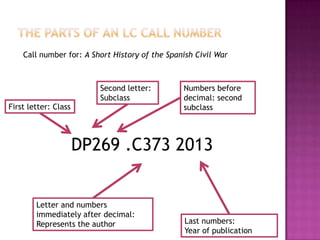
DP269 .C373 2013
First letter: Class
Second letter:
Subclass
Numbers before
decimal: second
subclass
Letter and numbers
immediately after decimal:
Represents the author Last numbers:
Year of publication
Call number for: A Short History of the Spanish Civil War
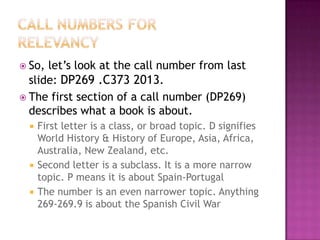
 So, let’s look at the call number from last
slide: DP269 .C373 2013.
 The first section of a call number (DP269)
describes what a book is about.
 First letter is a class, or broad topic. D signifies
World History & History of Europe, Asia, Africa,
Australia, New Zealand, etc.
 Second letter is a subclass. It is a more narrow
topic. P means it is about Spain-Portugal
 The number is an even narrower topic. Anything
269-269.9 is about the Spanish Civil War
 Since call number are assigned partially
based on what the book is about and books
are placed in the library based on call
numbers, books on similar topics are located
near each other
 Therefore, if you find one good book on your
topic, it’s likely there is another one nearby
 So the call numbers represent a way of
describing the subject of a book. But what if
the book could be described multiple ways?
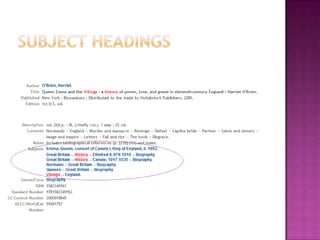
 Subject headings are alternate ways to
identify what a book is about. Unlike a call
number, a book can have more than one
subject heading
 Using keywords to Identify Subject Headings
 The subject headings given to a book are not
random. There is a set list of terms that
librarians pick from when trying to describe a
book. Sometimes the official term is
different from the term you are likely to use.
 So, your topic is the death penalty. However,
there is no LC heading for “death penalty.”
The vocabulary used in LC is “capital
punishment.” This is why it’s good to start
with a keyword search: it helps you find the
subject headings that are actually used.
 When you have a long research project (and
you do), you need to keep track of what
resources you are using
 Especially if you are working on more than one
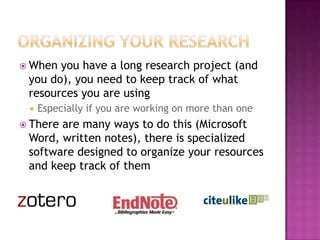
 There are many ways to do this (Microsoft
Word, written notes), there is specialized
software designed to organize your resources
and keep track of them
 Assignment: Identifying Subjects by Call
Number
 We will be meeting in Ellis Library at the
reference desk
 Bring your student ID and a list of the books
you found on your topic so that you can
check them out
 Go to the BlackBoard page
 In the left column find and click on the tab
that says “Exit Slips”
 Click on the link that says “Exit Slip:
Organization of Information
 Fill out the survey on this week’s lesson

Organization of information

  • 1.
    Information Use andStudent Success
  • 2.
     What sortof information do you organize? How do you determine what goes where?
  • 3.
     Each groupwill receive 16 notecards with book titles on them  Sort the book titles into topics/subjects that you think go together  You come up with what topics you think are useful
  • 4.
     What sortsof topics did you organize your book titles into?  What books were sorted into each topic? Were there any disagreements about where to put them?  Did some of the books seem like they could fit under multiple topics?
  • 5.
     Different peoplecan have different interpretations about what the subject of a book is  In order to keep their collections as organized as possible, librarians use controlled systems to determine what goes where. Academic libraries like at Mizzou use Library of Congress  Library of Congress sorts books two ways: call numbers and subject headings
  • 6.
     Every bookin the library is assigned a unique string of letters and numbers called a call number  Since no books share a call number, they work as an address to help you locate a particular book in the library
  • 7.
     Take afew minutes and complete the following tutorial (link available in Course Materials) http://www.clark.edu/Library/iris/start/boo ks_organized/books_organized.shtml
  • 8.
    DP269 .C373 2013 Firstletter: Class Second letter: Subclass Numbers before decimal: second subclass Letter and numbers immediately after decimal: Represents the author Last numbers: Year of publication Call number for: A Short History of the Spanish Civil War
  • 9.
     So, let’slook at the call number from last slide: DP269 .C373 2013.  The first section of a call number (DP269) describes what a book is about.  First letter is a class, or broad topic. D signifies World History & History of Europe, Asia, Africa, Australia, New Zealand, etc.  Second letter is a subclass. It is a more narrow topic. P means it is about Spain-Portugal  The number is an even narrower topic. Anything 269-269.9 is about the Spanish Civil War
  • 10.
     Since callnumber are assigned partially based on what the book is about and books are placed in the library based on call numbers, books on similar topics are located near each other  Therefore, if you find one good book on your topic, it’s likely there is another one nearby
  • 11.
     So thecall numbers represent a way of describing the subject of a book. But what if the book could be described multiple ways?  Subject headings are alternate ways to identify what a book is about. Unlike a call number, a book can have more than one subject heading
  • 13.
     Using keywordsto Identify Subject Headings
  • 14.
     The subjectheadings given to a book are not random. There is a set list of terms that librarians pick from when trying to describe a book. Sometimes the official term is different from the term you are likely to use.  So, your topic is the death penalty. However, there is no LC heading for “death penalty.” The vocabulary used in LC is “capital punishment.” This is why it’s good to start with a keyword search: it helps you find the subject headings that are actually used.
  • 15.
     When youhave a long research project (and you do), you need to keep track of what resources you are using  Especially if you are working on more than one  There are many ways to do this (Microsoft Word, written notes), there is specialized software designed to organize your resources and keep track of them
  • 16.
     Assignment: IdentifyingSubjects by Call Number  We will be meeting in Ellis Library at the reference desk  Bring your student ID and a list of the books you found on your topic so that you can check them out
  • 17.
     Go tothe BlackBoard page  In the left column find and click on the tab that says “Exit Slips”  Click on the link that says “Exit Slip: Organization of Information  Fill out the survey on this week’s lesson