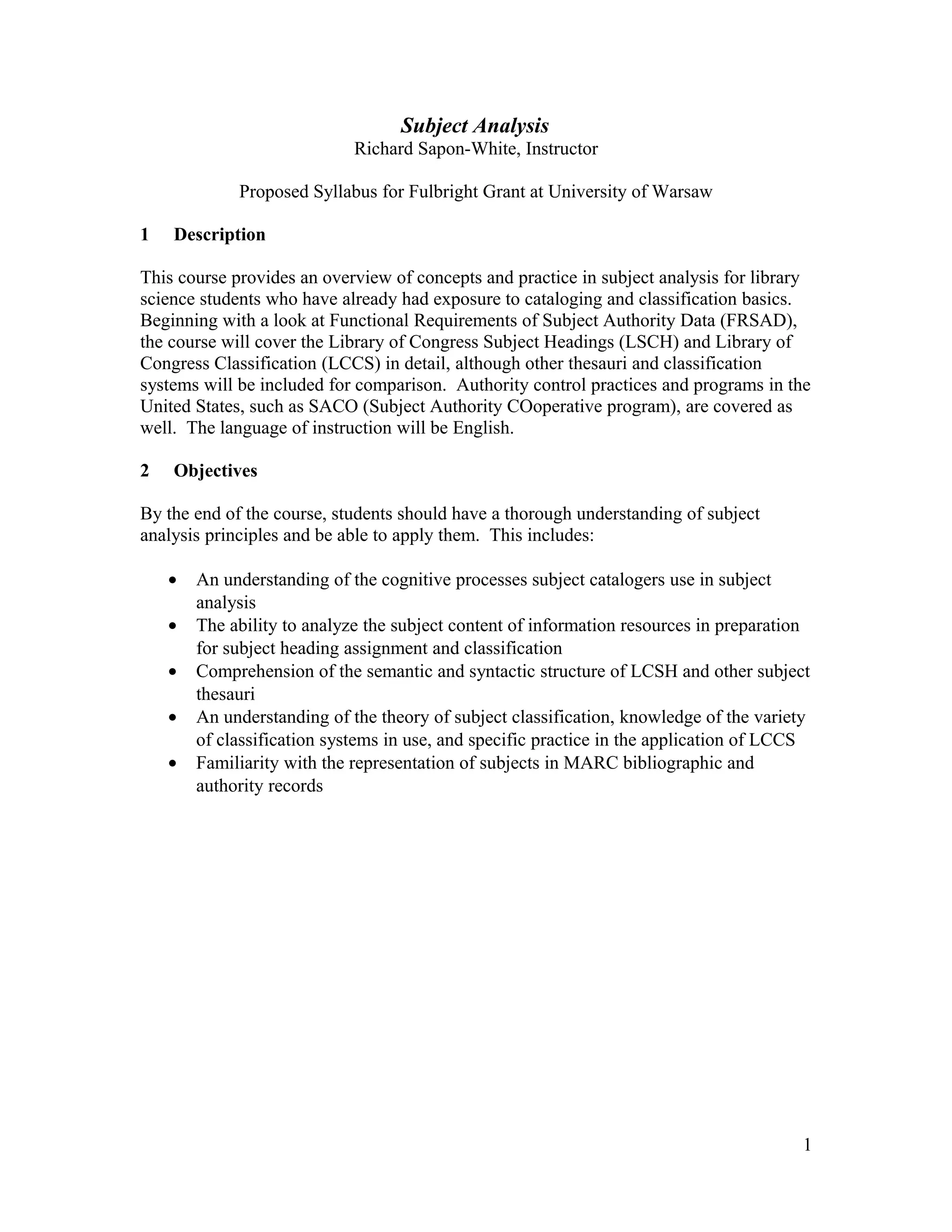
Subject Analysis
                             Richard Sapon-White, Instructor

             Proposed Syllabus for Fulbright Grant at University of Warsaw

1   Description

This course provides an overview of concepts and practice in subject analysis for library
science students who have already had exposure to cataloging and classification basics.
Beginning with a look at Functional Requirements of Subject Authority Data (FRSAD),
the course will cover the Library of Congress Subject Headings (LSCH) and Library of
Congress Classification (LCCS) in detail, although other thesauri and classification
systems will be included for comparison. Authority control practices and programs in the
United States, such as SACO (Subject Authority COoperative program), are covered as
well. The language of instruction will be English.

2   Objectives

By the end of the course, students should have a thorough understanding of subject
analysis principles and be able to apply them. This includes:

    •   An understanding of the cognitive processes subject catalogers use in subject
        analysis
    •   The ability to analyze the subject content of information resources in preparation
        for subject heading assignment and classification
    •   Comprehension of the semantic and syntactic structure of LCSH and other subject
        thesauri
    •   An understanding of the theory of subject classification, knowledge of the variety
        of classification systems in use, and specific practice in the application of LCCS
    •   Familiarity with the representation of subjects in MARC bibliographic and
        authority records


                                                                                         1
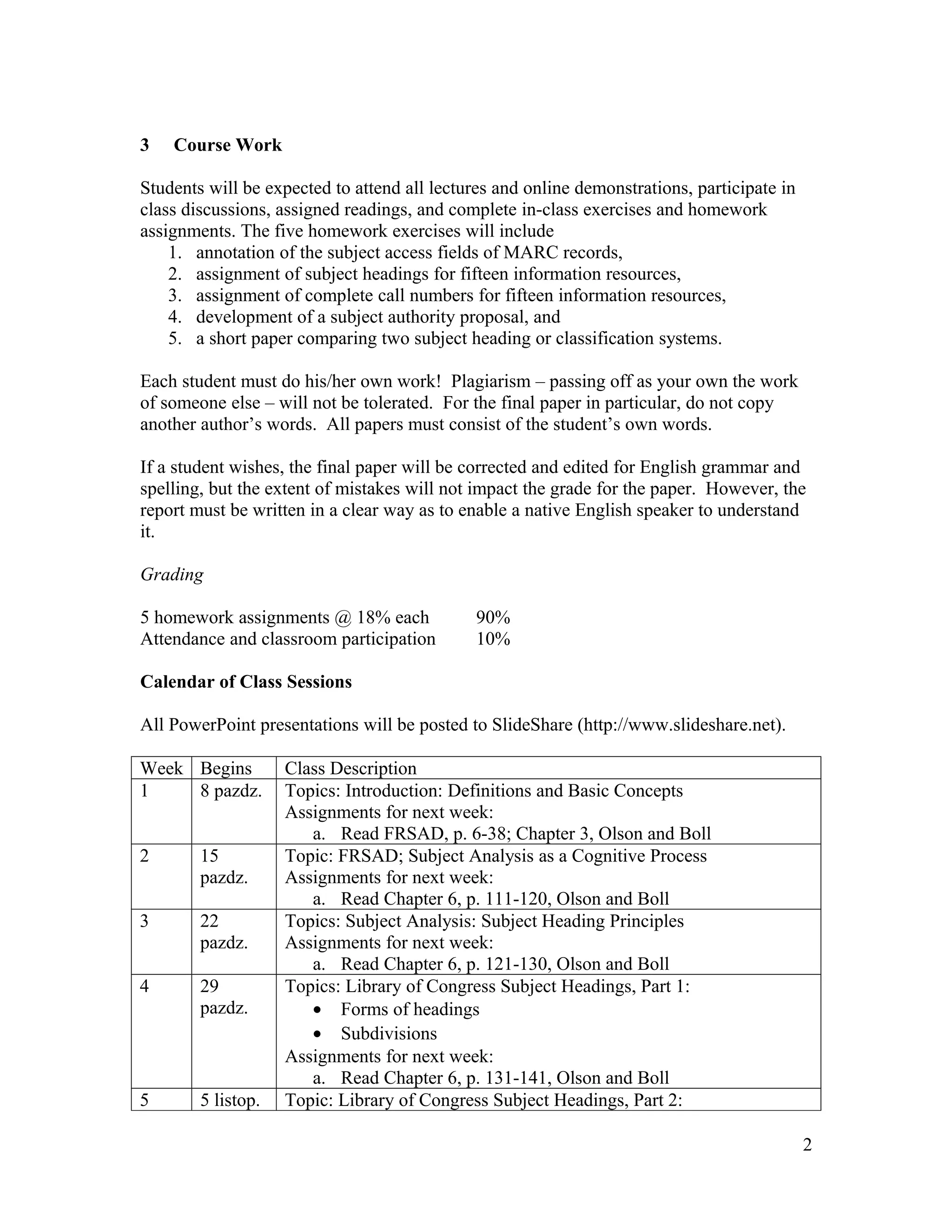
3   Course Work

Students will be expected to attend all lectures and online demonstrations, participate in
class discussions, assigned readings, and complete in-class exercises and homework
assignments. The five homework exercises will include
    1. annotation of the subject access fields of MARC records,
    2. assignment of subject headings for fifteen information resources,
    3. assignment of complete call numbers for fifteen information resources,
    4. development of a subject authority proposal, and
    5. a short paper comparing two subject heading or classification systems.

Each student must do his/her own work! Plagiarism – passing off as your own the work
of someone else – will not be tolerated. For the final paper in particular, do not copy
another author’s words. All papers must consist of the student’s own words.

If a student wishes, the final paper will be corrected and edited for English grammar and
spelling, but the extent of mistakes will not impact the grade for the paper. However, the
report must be written in a clear way as to enable a native English speaker to understand
it.

Grading

5 homework assignments @ 18% each             90%
Attendance and classroom participation        10%

Calendar of Class Sessions

All PowerPoint presentations will be posted to SlideShare (http://www.slideshare.net).

Week Begins         Class Description
1    8 pazdz.       Topics: Introduction: Definitions and Basic Concepts
                    Assignments for next week:
                       a. Read FRSAD, p. 6-38; Chapter 3, Olson and Boll
2       15          Topic: FRSAD; Subject Analysis as a Cognitive Process
        pazdz.      Assignments for next week:
                       a. Read Chapter 6, p. 111-120, Olson and Boll
3       22          Topics: Subject Analysis: Subject Heading Principles
        pazdz.      Assignments for next week:
                       a. Read Chapter 6, p. 121-130, Olson and Boll
4       29          Topics: Library of Congress Subject Headings, Part 1:
        pazdz.         • Forms of headings
                       • Subdivisions
                    Assignments for next week:
                       a. Read Chapter 6, p. 131-141, Olson and Boll
5       5 listop.   Topic: Library of Congress Subject Headings, Part 2:

                                                                                             2
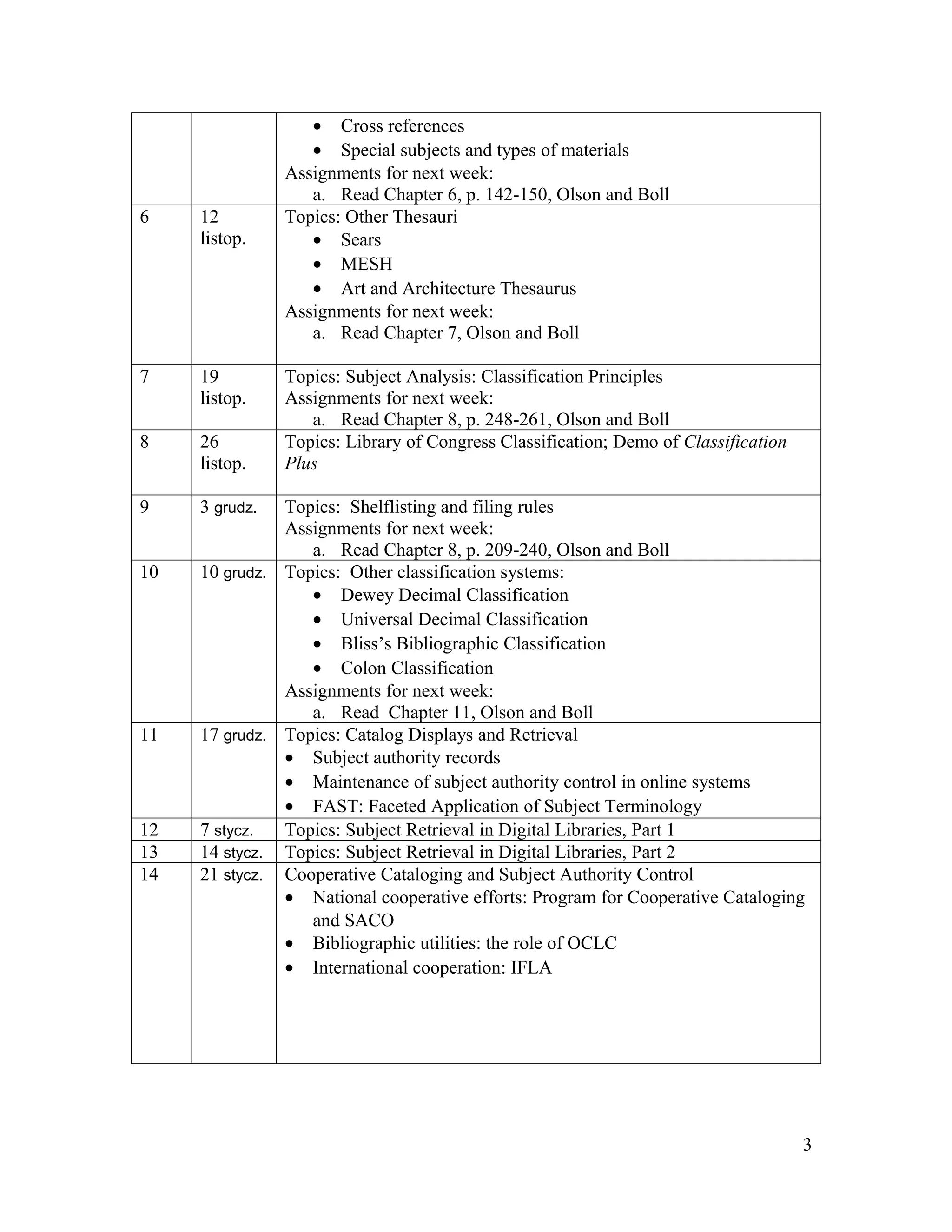
• Cross references
                   • Special subjects and types of materials
                Assignments for next week:
                   a. Read Chapter 6, p. 142-150, Olson and Boll
6    12         Topics: Other Thesauri
     listop.       • Sears
                   • MESH
                   • Art and Architecture Thesaurus
                Assignments for next week:
                   a. Read Chapter 7, Olson and Boll

7    19         Topics: Subject Analysis: Classification Principles
     listop.    Assignments for next week:
                   a. Read Chapter 8, p. 248-261, Olson and Boll
8    26         Topics: Library of Congress Classification; Demo of Classification
     listop.    Plus

9    3 grudz.  Topics: Shelflisting and filing rules
               Assignments for next week:
                  a. Read Chapter 8, p. 209-240, Olson and Boll
10   10 grudz. Topics: Other classification systems:
                  • Dewey Decimal Classification
                  • Universal Decimal Classification
                  • Bliss’s Bibliographic Classification
                  • Colon Classification
               Assignments for next week:
                  a. Read Chapter 11, Olson and Boll
11   17 grudz. Topics: Catalog Displays and Retrieval
               • Subject authority records
               • Maintenance of subject authority control in online systems
               • FAST: Faceted Application of Subject Terminology
12   7 stycz.  Topics: Subject Retrieval in Digital Libraries, Part 1
13   14 stycz. Topics: Subject Retrieval in Digital Libraries, Part 2
14   21 stycz. Cooperative Cataloging and Subject Authority Control
               • National cooperative efforts: Program for Cooperative Cataloging
                  and SACO
               • Bibliographic utilities: the role of OCLC
               • International cooperation: IFLA


                                                                                     3
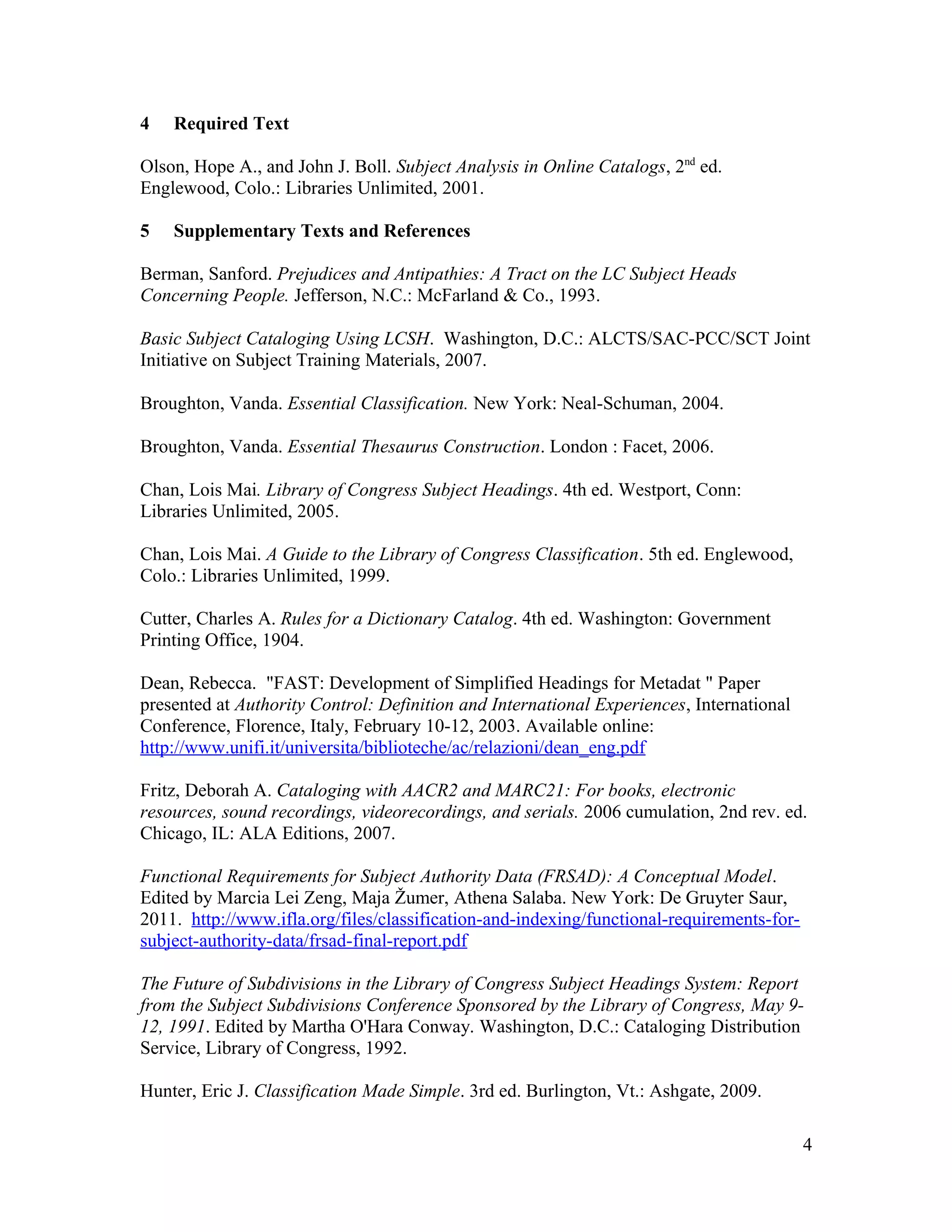
4   Required Text

Olson, Hope A., and John J. Boll. Subject Analysis in Online Catalogs, 2nd ed.
Englewood, Colo.: Libraries Unlimited, 2001.

5   Supplementary Texts and References

Berman, Sanford. Prejudices and Antipathies: A Tract on the LC Subject Heads
Concerning People. Jefferson, N.C.: McFarland & Co., 1993.

Basic Subject Cataloging Using LCSH. Washington, D.C.: ALCTS/SAC-PCC/SCT Joint
Initiative on Subject Training Materials, 2007.

Broughton, Vanda. Essential Classification. New York: Neal-Schuman, 2004.

Broughton, Vanda. Essential Thesaurus Construction. London : Facet, 2006.

Chan, Lois Mai. Library of Congress Subject Headings. 4th ed. Westport, Conn:
Libraries Unlimited, 2005.

Chan, Lois Mai. A Guide to the Library of Congress Classification. 5th ed. Englewood,
Colo.: Libraries Unlimited, 1999.

Cutter, Charles A. Rules for a Dictionary Catalog. 4th ed. Washington: Government
Printing Office, 1904.

Dean, Rebecca. "FAST: Development of Simplified Headings for Metadat " Paper
presented at Authority Control: Definition and International Experiences, International
Conference, Florence, Italy, February 10-12, 2003. Available online:
http://www.unifi.it/universita/biblioteche/ac/relazioni/dean_eng.pdf

Fritz, Deborah A. Cataloging with AACR2 and MARC21: For books, electronic
resources, sound recordings, videorecordings, and serials. 2006 cumulation, 2nd rev. ed.
Chicago, IL: ALA Editions, 2007.

Functional Requirements for Subject Authority Data (FRSAD): A Conceptual Model.
Edited by Marcia Lei Zeng, Maja Žumer, Athena Salaba. New York: De Gruyter Saur,
2011. http://www.ifla.org/files/classification-and-indexing/functional-requirements-for-
subject-authority-data/frsad-final-report.pdf

The Future of Subdivisions in the Library of Congress Subject Headings System: Report
from the Subject Subdivisions Conference Sponsored by the Library of Congress, May 9-
12, 1991. Edited by Martha O'Hara Conway. Washington, D.C.: Cataloging Distribution
Service, Library of Congress, 1992.

Hunter, Eric J. Classification Made Simple. 3rd ed. Burlington, Vt.: Ashgate, 2009.

                                                                                           4
Mann, Thomas. Library Research Models: A Guide to Classification, Cataloging, and
Computers. New York: Oxford University Press, 1993.

Mcilwaine, I.C. The Universal Decimal Classification: Guide to Its Use. The Hague:
UDC Consortium, 2000.

Program for Cooperative Cataloging Home Page. http://www.loc.gov/catdir/pcc/

Raju, Jaya and Reggie Raju. Descriptive and subject cataloguing: a workbook. Oxford:
Chandos, 2006.

Sauperl, Alenka. Subject Determination during the Cataloging Process. Lanham, Md.:
Scarecrow Press, 2002.

Subject access: preparing for the future. Edited by Patrice Landry, Leda Bultrini,
Edward T. O'Neill and Sandra K. Roe. Berlin: De Gruyter Saur, 2011.

Taylor, Arlene G. The Organization of Information. Englewood, Colo.: Libraries
Unlimited, 1999.

Taylor, Arlene G. Introduction to Cataloging and Classification. 10th ed. Westport,
Conn.: Libraries Unlimited, 2006.

Theory of Subject Analysis: A Sourcebook. Edited by Lois Mai Chan, Phyllis Richmond,
and Elaine Svenonius. Littleton, Colo.: Libraries Unlimited, 1985.

6   Subject Cataloging Tools

Bibliographic Formats and Standards. 3rd ed. Dublin, Ohio: OCLC Online Computer
Library Center, 2003. Available: http://www.oclc.org/bibformats/

LC Classification Outline. Washington, D.C., Library of Congress, Subject Cataloging
Division, 1998- [Continuously updated]. http://lcweb.loc.gov/catdir/cpso/lcco/lcco.html

Library of Congress Classification: Classes A-Z. [various editions] Washington, D.C.:
Cataloging Distribution Service, Library of Congress, 1933- .

Library of Congress Subject Headings. Washington. D.C.: Cataloging Distribution
Service, Library of Congress. Latest ed.

MARC 21 Format for Authority Data; Including Guidelines for Content Designation.
Washington, D.C.: Library of Congress, Cataloging Distribution Service, 1999. (1v.,
looseleaf); MARC 21 Concise Format for Authority Data, available:
http://lcweb.loc.gov/marc/authority/ecadhome.html


                                                                                          5
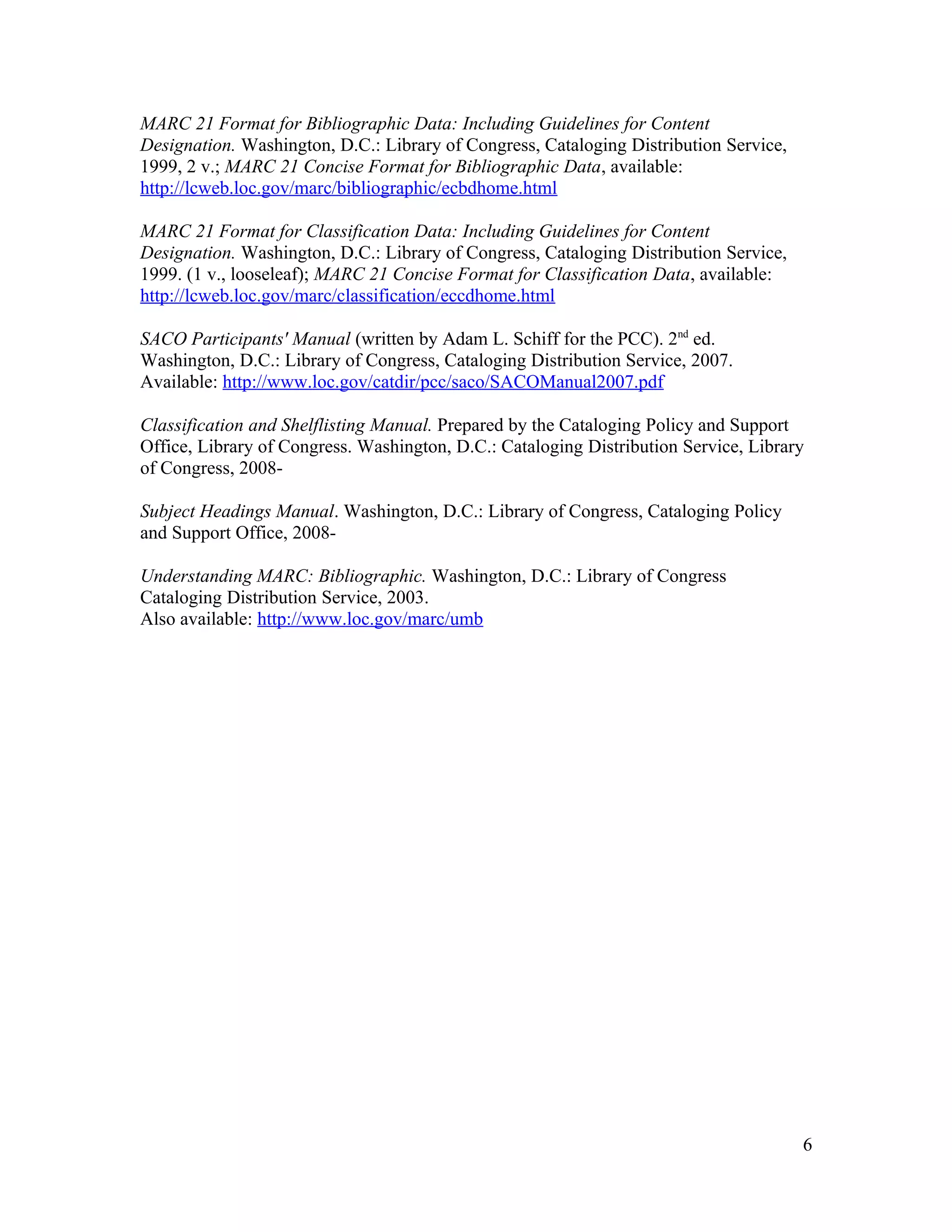
MARC 21 Format for Bibliographic Data: Including Guidelines for Content
Designation. Washington, D.C.: Library of Congress, Cataloging Distribution Service,
1999, 2 v.; MARC 21 Concise Format for Bibliographic Data, available:
http://lcweb.loc.gov/marc/bibliographic/ecbdhome.html

MARC 21 Format for Classification Data: Including Guidelines for Content
Designation. Washington, D.C.: Library of Congress, Cataloging Distribution Service,
1999. (1 v., looseleaf); MARC 21 Concise Format for Classification Data, available:
http://lcweb.loc.gov/marc/classification/eccdhome.html

SACO Participants' Manual (written by Adam L. Schiff for the PCC). 2nd ed.
Washington, D.C.: Library of Congress, Cataloging Distribution Service, 2007.
Available: http://www.loc.gov/catdir/pcc/saco/SACOManual2007.pdf

Classification and Shelflisting Manual. Prepared by the Cataloging Policy and Support
Office, Library of Congress. Washington, D.C.: Cataloging Distribution Service, Library
of Congress, 2008-

Subject Headings Manual. Washington, D.C.: Library of Congress, Cataloging Policy
and Support Office, 2008-

Understanding MARC: Bibliographic. Washington, D.C.: Library of Congress
Cataloging Distribution Service, 2003.
Also available: http://www.loc.gov/marc/umb


                                                                                       6

Subject analysis class syllabus for warsaw

  • 1.
    Subject Analysis Richard Sapon-White, Instructor Proposed Syllabus for Fulbright Grant at University of Warsaw 1 Description This course provides an overview of concepts and practice in subject analysis for library science students who have already had exposure to cataloging and classification basics. Beginning with a look at Functional Requirements of Subject Authority Data (FRSAD), the course will cover the Library of Congress Subject Headings (LSCH) and Library of Congress Classification (LCCS) in detail, although other thesauri and classification systems will be included for comparison. Authority control practices and programs in the United States, such as SACO (Subject Authority COoperative program), are covered as well. The language of instruction will be English. 2 Objectives By the end of the course, students should have a thorough understanding of subject analysis principles and be able to apply them. This includes: • An understanding of the cognitive processes subject catalogers use in subject analysis • The ability to analyze the subject content of information resources in preparation for subject heading assignment and classification • Comprehension of the semantic and syntactic structure of LCSH and other subject thesauri • An understanding of the theory of subject classification, knowledge of the variety of classification systems in use, and specific practice in the application of LCCS • Familiarity with the representation of subjects in MARC bibliographic and authority records 1
  • 2.
    3 Course Work Students will be expected to attend all lectures and online demonstrations, participate in class discussions, assigned readings, and complete in-class exercises and homework assignments. The five homework exercises will include 1. annotation of the subject access fields of MARC records, 2. assignment of subject headings for fifteen information resources, 3. assignment of complete call numbers for fifteen information resources, 4. development of a subject authority proposal, and 5. a short paper comparing two subject heading or classification systems. Each student must do his/her own work! Plagiarism – passing off as your own the work of someone else – will not be tolerated. For the final paper in particular, do not copy another author’s words. All papers must consist of the student’s own words. If a student wishes, the final paper will be corrected and edited for English grammar and spelling, but the extent of mistakes will not impact the grade for the paper. However, the report must be written in a clear way as to enable a native English speaker to understand it. Grading 5 homework assignments @ 18% each 90% Attendance and classroom participation 10% Calendar of Class Sessions All PowerPoint presentations will be posted to SlideShare (http://www.slideshare.net). Week Begins Class Description 1 8 pazdz. Topics: Introduction: Definitions and Basic Concepts Assignments for next week: a. Read FRSAD, p. 6-38; Chapter 3, Olson and Boll 2 15 Topic: FRSAD; Subject Analysis as a Cognitive Process pazdz. Assignments for next week: a. Read Chapter 6, p. 111-120, Olson and Boll 3 22 Topics: Subject Analysis: Subject Heading Principles pazdz. Assignments for next week: a. Read Chapter 6, p. 121-130, Olson and Boll 4 29 Topics: Library of Congress Subject Headings, Part 1: pazdz. • Forms of headings • Subdivisions Assignments for next week: a. Read Chapter 6, p. 131-141, Olson and Boll 5 5 listop. Topic: Library of Congress Subject Headings, Part 2: 2
  • 3.
    • Cross references • Special subjects and types of materials Assignments for next week: a. Read Chapter 6, p. 142-150, Olson and Boll 6 12 Topics: Other Thesauri listop. • Sears • MESH • Art and Architecture Thesaurus Assignments for next week: a. Read Chapter 7, Olson and Boll 7 19 Topics: Subject Analysis: Classification Principles listop. Assignments for next week: a. Read Chapter 8, p. 248-261, Olson and Boll 8 26 Topics: Library of Congress Classification; Demo of Classification listop. Plus 9 3 grudz. Topics: Shelflisting and filing rules Assignments for next week: a. Read Chapter 8, p. 209-240, Olson and Boll 10 10 grudz. Topics: Other classification systems: • Dewey Decimal Classification • Universal Decimal Classification • Bliss’s Bibliographic Classification • Colon Classification Assignments for next week: a. Read Chapter 11, Olson and Boll 11 17 grudz. Topics: Catalog Displays and Retrieval • Subject authority records • Maintenance of subject authority control in online systems • FAST: Faceted Application of Subject Terminology 12 7 stycz. Topics: Subject Retrieval in Digital Libraries, Part 1 13 14 stycz. Topics: Subject Retrieval in Digital Libraries, Part 2 14 21 stycz. Cooperative Cataloging and Subject Authority Control • National cooperative efforts: Program for Cooperative Cataloging and SACO • Bibliographic utilities: the role of OCLC • International cooperation: IFLA 3
  • 4.
    4 Required Text Olson, Hope A., and John J. Boll. Subject Analysis in Online Catalogs, 2nd ed. Englewood, Colo.: Libraries Unlimited, 2001. 5 Supplementary Texts and References Berman, Sanford. Prejudices and Antipathies: A Tract on the LC Subject Heads Concerning People. Jefferson, N.C.: McFarland & Co., 1993. Basic Subject Cataloging Using LCSH. Washington, D.C.: ALCTS/SAC-PCC/SCT Joint Initiative on Subject Training Materials, 2007. Broughton, Vanda. Essential Classification. New York: Neal-Schuman, 2004. Broughton, Vanda. Essential Thesaurus Construction. London : Facet, 2006. Chan, Lois Mai. Library of Congress Subject Headings. 4th ed. Westport, Conn: Libraries Unlimited, 2005. Chan, Lois Mai. A Guide to the Library of Congress Classification. 5th ed. Englewood, Colo.: Libraries Unlimited, 1999. Cutter, Charles A. Rules for a Dictionary Catalog. 4th ed. Washington: Government Printing Office, 1904. Dean, Rebecca. "FAST: Development of Simplified Headings for Metadat " Paper presented at Authority Control: Definition and International Experiences, International Conference, Florence, Italy, February 10-12, 2003. Available online: http://www.unifi.it/universita/biblioteche/ac/relazioni/dean_eng.pdf Fritz, Deborah A. Cataloging with AACR2 and MARC21: For books, electronic resources, sound recordings, videorecordings, and serials. 2006 cumulation, 2nd rev. ed. Chicago, IL: ALA Editions, 2007. Functional Requirements for Subject Authority Data (FRSAD): A Conceptual Model. Edited by Marcia Lei Zeng, Maja Žumer, Athena Salaba. New York: De Gruyter Saur, 2011. http://www.ifla.org/files/classification-and-indexing/functional-requirements-for- subject-authority-data/frsad-final-report.pdf The Future of Subdivisions in the Library of Congress Subject Headings System: Report from the Subject Subdivisions Conference Sponsored by the Library of Congress, May 9- 12, 1991. Edited by Martha O'Hara Conway. Washington, D.C.: Cataloging Distribution Service, Library of Congress, 1992. Hunter, Eric J. Classification Made Simple. 3rd ed. Burlington, Vt.: Ashgate, 2009. 4
  • 5.
    Mann, Thomas. LibraryResearch Models: A Guide to Classification, Cataloging, and Computers. New York: Oxford University Press, 1993. Mcilwaine, I.C. The Universal Decimal Classification: Guide to Its Use. The Hague: UDC Consortium, 2000. Program for Cooperative Cataloging Home Page. http://www.loc.gov/catdir/pcc/ Raju, Jaya and Reggie Raju. Descriptive and subject cataloguing: a workbook. Oxford: Chandos, 2006. Sauperl, Alenka. Subject Determination during the Cataloging Process. Lanham, Md.: Scarecrow Press, 2002. Subject access: preparing for the future. Edited by Patrice Landry, Leda Bultrini, Edward T. O'Neill and Sandra K. Roe. Berlin: De Gruyter Saur, 2011. Taylor, Arlene G. The Organization of Information. Englewood, Colo.: Libraries Unlimited, 1999. Taylor, Arlene G. Introduction to Cataloging and Classification. 10th ed. Westport, Conn.: Libraries Unlimited, 2006. Theory of Subject Analysis: A Sourcebook. Edited by Lois Mai Chan, Phyllis Richmond, and Elaine Svenonius. Littleton, Colo.: Libraries Unlimited, 1985. 6 Subject Cataloging Tools Bibliographic Formats and Standards. 3rd ed. Dublin, Ohio: OCLC Online Computer Library Center, 2003. Available: http://www.oclc.org/bibformats/ LC Classification Outline. Washington, D.C., Library of Congress, Subject Cataloging Division, 1998- [Continuously updated]. http://lcweb.loc.gov/catdir/cpso/lcco/lcco.html Library of Congress Classification: Classes A-Z. [various editions] Washington, D.C.: Cataloging Distribution Service, Library of Congress, 1933- . Library of Congress Subject Headings. Washington. D.C.: Cataloging Distribution Service, Library of Congress. Latest ed. MARC 21 Format for Authority Data; Including Guidelines for Content Designation. Washington, D.C.: Library of Congress, Cataloging Distribution Service, 1999. (1v., looseleaf); MARC 21 Concise Format for Authority Data, available: http://lcweb.loc.gov/marc/authority/ecadhome.html 5
  • 6.
    MARC 21 Formatfor Bibliographic Data: Including Guidelines for Content Designation. Washington, D.C.: Library of Congress, Cataloging Distribution Service, 1999, 2 v.; MARC 21 Concise Format for Bibliographic Data, available: http://lcweb.loc.gov/marc/bibliographic/ecbdhome.html MARC 21 Format for Classification Data: Including Guidelines for Content Designation. Washington, D.C.: Library of Congress, Cataloging Distribution Service, 1999. (1 v., looseleaf); MARC 21 Concise Format for Classification Data, available: http://lcweb.loc.gov/marc/classification/eccdhome.html SACO Participants' Manual (written by Adam L. Schiff for the PCC). 2nd ed. Washington, D.C.: Library of Congress, Cataloging Distribution Service, 2007. Available: http://www.loc.gov/catdir/pcc/saco/SACOManual2007.pdf Classification and Shelflisting Manual. Prepared by the Cataloging Policy and Support Office, Library of Congress. Washington, D.C.: Cataloging Distribution Service, Library of Congress, 2008- Subject Headings Manual. Washington, D.C.: Library of Congress, Cataloging Policy and Support Office, 2008- Understanding MARC: Bibliographic. Washington, D.C.: Library of Congress Cataloging Distribution Service, 2003. Also available: http://www.loc.gov/marc/umb 6