LIB 630 Classification and Cataloging
               Spring 2013


Subject
Analysis
     What’s it all about,
          Alfie?
2

 What is it?
 Subject analysis
 Examination of a bibliographic item by a trained
  subject specialist to determine the most specific
  subject heading(s) or descriptor(s) that fully
  describe its content, to serve in the bibliographic
  record as access points in a subject search of a
  library catalog, index, abstracting service, or
  bibliographic database. When no applicable
  subject heading can be found in the existing
  headings list or thesaurus of indexing terms, a
  new one must be created.
3

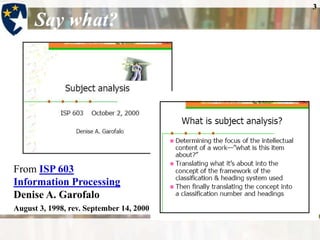
      Say what?


From ISP 603
Information Processing
Denise A. Garofalo
August 3, 1998, rev. September 14, 2000
4

 Why do all that?
 If we don’t we can’t find stuff!
 “Subject analysis is defined broadly as all
  methods and processes which can be
  described as representation for retrieval
  of information by its subjects, be they
  names, geographic locations, or topical
  subjects.”
    Quoted from Williamson, N. J. (1997). The Importance
     of Subject Analysis in Library and Information Science
     Education. Technical Services Quarterly 15(1/2):67-87
     by Pamela Hill in LS 500 Organization of Information
      Tuesday, February 24, 2004
5

 The rose by another name
Access to materials
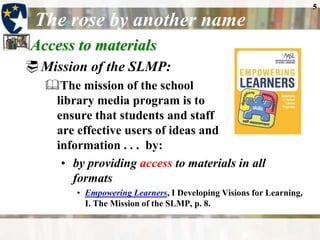
 Mission of the SLMP:
   The mission of the school
    library media program is to
    ensure that students and staff
    are effective users of ideas and
    information . . . by:
     • by providing access to materials in all
       formats
         • Empowering Learners, I Developing Visions for Learning,
           I. The Mission of the SLMP, p. 8.
6
 From the previous AASL guidelines:
 Intellectual access
 Mission and Goals of the
  School Library Media Program
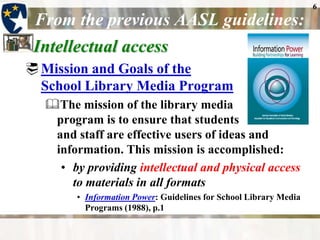
  The mission of the library media
   program is to ensure that students
   and staff are effective users of ideas and
   information. This mission is accomplished:
    • by providing intellectual and physical access
      to materials in all formats
        • Information Power: Guidelines for School Library Media
          Programs (1988), p.1
7

 What’s that all about?
  What’s the difference between
intellectual and physical access???
What is it all about?
It’s about what it’s about, compared
 to touching on the book
   Now, figure that one out!
         Librarians talk about
             ABOUTNESS
8

 Aboutness
 Aboutness
 The totality of subjects explicitly or
  implicitly addressed in the text of a
  document, including but not limited
  to the meaning(s) of the title, the
  stated and unstated intentions of the
  author, and the ways in which the
  information may be used by readers.
  Levels of specificity must be
  considered in ascertaining the
  subject(s) of a work.
9

 What do you mean?
Example from aboutness entry in ODLIS:
 In the case of the hypothetical title The
  Japanese Teamwork Approach to Improving
  High School Effectiveness, is the work
  about:
   1.   education?
   2.   educational effectiveness?
   3.   high school effectiveness?
   4.   teamwork?
   5.   a Japanese approach to teamwork?
   •     What do you say? See next slide!
10

 What’s the rule?
 Choose the most specific heading
 As a general rule, catalogers and indexers
  assign the most specific subject headings
  that describe the significant content of the
  item.
   [In] the Library of Congress Subject Headings list,
    the appropriate headings might be “High schools--
    Japan,” “Teacher effectiveness--Japan,” and
    “Teaching teams--Japan.”
      • Aboutness entry in ODLIS
11

How do you find out?
Walk like an Egyptian?


     • NO! Think like a librarian!!!!
12

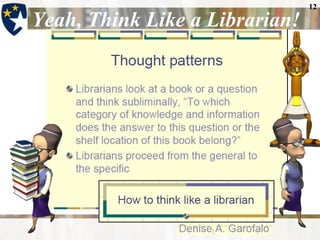
Yeah, Think Like a Librarian!
13

An Important Factor
 Cataloger’s judgment
 Individual perspective
   – Informed by the cataloger’s background
 knowledge of the subject
   – Informed by the cataloger’s cultural background
 Consistency in determining “What is it
  about?” leads to greater consistency in
  assignment of subject headings
      • Basic Subject Cataloging Using LCSH —Trainers’ Notes
14

 Another perspective
 It’s ―a precarious business‖
 The ability to determine what the item is
  “about” depends a great deal upon the
  cataloguer’s knowledge, biases, and
  judgment.
 Deciding the “aboutness” of a particular
  item also relies upon the patrons, which
  are served by a particular library or
  library system.
                         Library Sciences Site
                         Paula Laurita
                         Guest Author
15

In other words
     How you do it
     Depends on
      1. What you know
      2. What your users know (or, rather, what
         you think they know!)
      3. What you think might interest
         your users
16

       Steps
1.    Determine the main subject or subjects of the book
      This is done by examining the title, table of contents,
       description on the dust jacket, preface, text, and
       illustrations.
2.    The next step is to write down the subject and check
      to see if that choice is permitted in the standardized
      list.
        If the subject selected is not in the list,
         the related subjects must be consulted.
         It is possible, although not advisable, to
         add a local subject heading.
            • Chapter 6: Subject Headings
17
 Why use a standardized list?
Why Subject Headings?
 Subject headings often indicate the contents of books in
  terms that their titles do not use, which often may be
  nondescriptive or very general. Subject headings in
  online databases are often referred to as descriptors, but
  they serve the same purpose in locating valuable
  resources.
 Along with their subdivisions, subject headings provide a
  clear and systematic way of scanning the catalog for what
  is needed. Assigned headings are usually the dominant,
  and most important, subjects of a given item.
 Subject headings bring like materials together, requiring
  less use of the wide variation of synonymous terms that
  may appear to describe a single concept (teen, youth,
  adolescent, young adult, etc.).
       •   Using Subject Headings in PantherCat
18


 Robert Bratton, original cataloger, discusses the
question ―Where do subject headings come from?‖
 (a) The stork delivers them.
 (b) They grow on trees.
 (c) They magically appear on catalog records (which
     also magically appear).
 (d) Through the determined, diligent work of
     librarians.
  As a cataloger, I wish the answer was a, b, or c, but I
     know too well that it is d.
         No longer publicly available on the web
19

More on subject headings
 Bratton explains:
 First, catalogers at the University of Maryland Libraries
  utilize Library of Congress Subject Headings (LCSH) on
  bibliographic records.
 Second, LCSH is based upon the concept of “literary
  warrant,” which means that the topics in published
  literature drive the creation of subject headings. New
  subject headings are created when works about new
  topics are published and acquired by libraries. When a
  cataloger cannot find an appropriate subject heading for
  a work, he or she then considers proposing a new subject
  heading.
     Where do subject headings come from? From
20
  What about subject headings for schools?
 Manitoba provides an answer that is true for
USA as well:
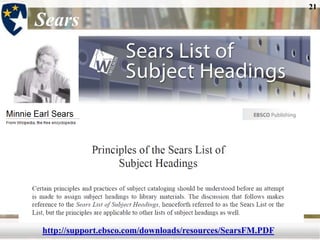
 The individual library may choose between Sears List of
  Subject Headings and Library of Congress Subject Headings
  (see Bibliography).
 The Sears List has long been the standard for school and
  smaller libraries. For most school libraries it will suffice.
  The Library of Congress subject headings should be
  considered only for larger libraries. All other situations
  cannot support the cost. Changes in technology may justify
  the use of Library of Congress subject headings in the
  future. Commercial vendors will provide the opportunity to
  select one or the other or both. When cataloguing is
  purchased, both Sears and Library of Congress subject
  headings should be requested. Then when the records are
  loaded, Sears would be used for the present time. The
  school library must update its edition of Sears regularly.
21

Sears


http://support.ebsco.com/downloads/resources/SearsFM.PDF
22

 Tips on using Sears
Use as specific a heading as possible:
 A book about bears should be given the subject heading BEARS
  rather than the general heading ANIMALS. For a book about
  several different animals, the more inclusive heading ANIMALS
  should be used rather than separate headings for each animal
  mentioned in the text. Determining whether to use a specific or a
  general subject entry can pose difficulties. The introduction to
  Sears describes how to designate them correctly.
 School libraries often find it valuable to include subject headings
  for Fiction and Easy materials. This makes it easier to identify
  storybooks about a particular subject or theme. In general, add
  the word FICTION as a subdivision of other subjects to indicate
  that the item is a work of fiction.
     From Cataloguing and Processing ch. 6
23

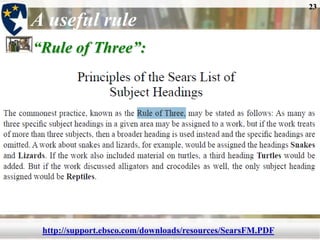
A useful rule
―Rule of Three‖:


 http://support.ebsco.com/downloads/resources/SearsFM.PDF
Subject analysis

Subject analysis

  • 1.
    LIB 630 Classificationand Cataloging Spring 2013 Subject Analysis What’s it all about, Alfie?
  • 2.
    2 What isit? Subject analysis  Examination of a bibliographic item by a trained subject specialist to determine the most specific subject heading(s) or descriptor(s) that fully describe its content, to serve in the bibliographic record as access points in a subject search of a library catalog, index, abstracting service, or bibliographic database. When no applicable subject heading can be found in the existing headings list or thesaurus of indexing terms, a new one must be created.
  • 3.
    3 Say what? From ISP 603 Information Processing Denise A. Garofalo August 3, 1998, rev. September 14, 2000
  • 4.
    4 Why doall that? If we don’t we can’t find stuff!  “Subject analysis is defined broadly as all methods and processes which can be described as representation for retrieval of information by its subjects, be they names, geographic locations, or topical subjects.”  Quoted from Williamson, N. J. (1997). The Importance of Subject Analysis in Library and Information Science Education. Technical Services Quarterly 15(1/2):67-87 by Pamela Hill in LS 500 Organization of Information Tuesday, February 24, 2004
  • 5.
    5 The roseby another name Access to materials  Mission of the SLMP: The mission of the school library media program is to ensure that students and staff are effective users of ideas and information . . . by: • by providing access to materials in all formats • Empowering Learners, I Developing Visions for Learning, I. The Mission of the SLMP, p. 8.
  • 6.
    6 From theprevious AASL guidelines: Intellectual access  Mission and Goals of the School Library Media Program The mission of the library media program is to ensure that students and staff are effective users of ideas and information. This mission is accomplished: • by providing intellectual and physical access to materials in all formats • Information Power: Guidelines for School Library Media Programs (1988), p.1
  • 7.
    7 What’s thatall about? What’s the difference between intellectual and physical access??? What is it all about? It’s about what it’s about, compared to touching on the book Now, figure that one out! Librarians talk about ABOUTNESS
  • 8.
    8 Aboutness Aboutness The totality of subjects explicitly or implicitly addressed in the text of a document, including but not limited to the meaning(s) of the title, the stated and unstated intentions of the author, and the ways in which the information may be used by readers. Levels of specificity must be considered in ascertaining the subject(s) of a work.
  • 9.
    9 What doyou mean? Example from aboutness entry in ODLIS:  In the case of the hypothetical title The Japanese Teamwork Approach to Improving High School Effectiveness, is the work about: 1. education? 2. educational effectiveness? 3. high school effectiveness? 4. teamwork? 5. a Japanese approach to teamwork? • What do you say? See next slide!
  • 10.
    10 What’s therule? Choose the most specific heading  As a general rule, catalogers and indexers assign the most specific subject headings that describe the significant content of the item. [In] the Library of Congress Subject Headings list, the appropriate headings might be “High schools-- Japan,” “Teacher effectiveness--Japan,” and “Teaching teams--Japan.” • Aboutness entry in ODLIS
  • 11.
    11 How do youfind out? Walk like an Egyptian? • NO! Think like a librarian!!!!
  • 12.
    12 Yeah, Think Likea Librarian!
  • 13.
    13 An Important Factor Cataloger’s judgment  Individual perspective – Informed by the cataloger’s background  knowledge of the subject – Informed by the cataloger’s cultural background  Consistency in determining “What is it about?” leads to greater consistency in assignment of subject headings • Basic Subject Cataloging Using LCSH —Trainers’ Notes
  • 14.
    14 Another perspective It’s ―a precarious business‖  The ability to determine what the item is “about” depends a great deal upon the cataloguer’s knowledge, biases, and judgment.  Deciding the “aboutness” of a particular item also relies upon the patrons, which are served by a particular library or library system. Library Sciences Site Paula Laurita Guest Author
  • 15.
    15 In other words How you do it  Depends on 1. What you know 2. What your users know (or, rather, what you think they know!) 3. What you think might interest your users
  • 16.
    16 Steps 1. Determine the main subject or subjects of the book  This is done by examining the title, table of contents, description on the dust jacket, preface, text, and illustrations. 2. The next step is to write down the subject and check to see if that choice is permitted in the standardized list.  If the subject selected is not in the list, the related subjects must be consulted. It is possible, although not advisable, to add a local subject heading. • Chapter 6: Subject Headings
  • 17.
    17 Why usea standardized list? Why Subject Headings?  Subject headings often indicate the contents of books in terms that their titles do not use, which often may be nondescriptive or very general. Subject headings in online databases are often referred to as descriptors, but they serve the same purpose in locating valuable resources.  Along with their subdivisions, subject headings provide a clear and systematic way of scanning the catalog for what is needed. Assigned headings are usually the dominant, and most important, subjects of a given item.  Subject headings bring like materials together, requiring less use of the wide variation of synonymous terms that may appear to describe a single concept (teen, youth, adolescent, young adult, etc.). • Using Subject Headings in PantherCat
  • 18.
    18 Robert Bratton,original cataloger, discusses the question ―Where do subject headings come from?‖ (a) The stork delivers them. (b) They grow on trees. (c) They magically appear on catalog records (which also magically appear). (d) Through the determined, diligent work of librarians.  As a cataloger, I wish the answer was a, b, or c, but I know too well that it is d. No longer publicly available on the web
  • 19.
    19 More on subjectheadings Bratton explains:  First, catalogers at the University of Maryland Libraries utilize Library of Congress Subject Headings (LCSH) on bibliographic records.  Second, LCSH is based upon the concept of “literary warrant,” which means that the topics in published literature drive the creation of subject headings. New subject headings are created when works about new topics are published and acquired by libraries. When a cataloger cannot find an appropriate subject heading for a work, he or she then considers proposing a new subject heading.  Where do subject headings come from? From
  • 20.
    20 Whatabout subject headings for schools? Manitoba provides an answer that is true for USA as well:  The individual library may choose between Sears List of Subject Headings and Library of Congress Subject Headings (see Bibliography).  The Sears List has long been the standard for school and smaller libraries. For most school libraries it will suffice. The Library of Congress subject headings should be considered only for larger libraries. All other situations cannot support the cost. Changes in technology may justify the use of Library of Congress subject headings in the future. Commercial vendors will provide the opportunity to select one or the other or both. When cataloguing is purchased, both Sears and Library of Congress subject headings should be requested. Then when the records are loaded, Sears would be used for the present time. The school library must update its edition of Sears regularly.
  • 21.
  • 22.
    22 Tips onusing Sears Use as specific a heading as possible:  A book about bears should be given the subject heading BEARS rather than the general heading ANIMALS. For a book about several different animals, the more inclusive heading ANIMALS should be used rather than separate headings for each animal mentioned in the text. Determining whether to use a specific or a general subject entry can pose difficulties. The introduction to Sears describes how to designate them correctly.  School libraries often find it valuable to include subject headings for Fiction and Easy materials. This makes it easier to identify storybooks about a particular subject or theme. In general, add the word FICTION as a subdivision of other subjects to indicate that the item is a work of fiction.  From Cataloguing and Processing ch. 6
  • 23.
    23 A useful rule ―Ruleof Three‖: http://support.ebsco.com/downloads/resources/SearsFM.PDF