

FINDING BOOKS

INF1100 – Week 8                   LRC
Books!
This lesson will cover:
Pros & Cons of Books!
Cataloging systems: Library of Congress and Dewey
                      Decimal
    Finding books using H-Cat and our Ebooks
                                         collection

There are two VERY IMPORTANT videos near the end
of this presentation.
 These will demonstrate HOW to search H-Cat and the
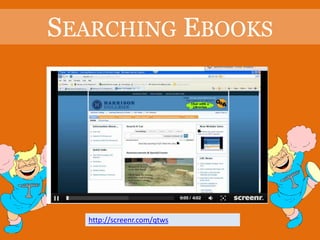
                                  Ebooks collection.
                 Just click the video image to view!
WHY USE BOOKS???
Books are published!
The facts in books have been verified
Very thorough information on a topic
Usually written by someone who is
qualified

         WHY USE BOOKS???
Take so long to get published, they can be
outdated by they time they are released!

Tooooooo Looooong (the INDEX at the
back can help you find the relevant parts)

You might find a book record, but not the
whole book!
       THE DOWNSIDE OF BOOKS?
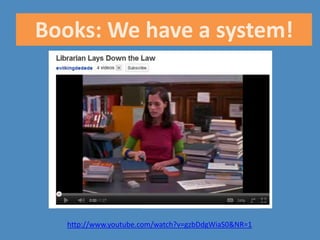
Books: We have a system!


  http://www.youtube.com/watch?v=gzbDdgWiaS0&NR=1
LIBRARY CALL NUMBERS:
  CLASSIFICATION SYSTEMS
     Dewey Decimal
           and
   Library of Congress
CLASSIFICATION SYSTEMS

Both Library of Congress and
  Dewey Decimal systems
   organize materials by
         SUBJECT.
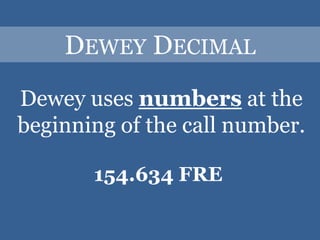
DEWEY DECIMAL
Dewey uses numbers at the
beginning of the call number.

       154.634 FRE
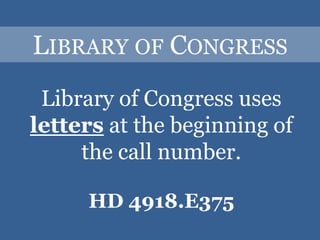
LIBRARY OF CONGRESS
 Library of Congress uses
letters at the beginning of
     the call number.

      HD 4918.E375
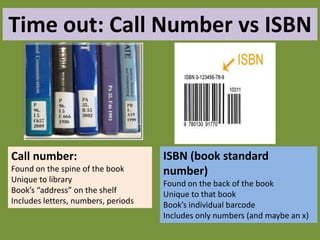
Time out: Call Number vs ISBN


Call number:                         ISBN (book standard
Found on the spine of the book       number)
Unique to library                    Found on the back of the book
Book’s “address” on the shelf        Unique to that book
Includes letters, numbers, periods   Book’s individual barcode
                                     Includes only numbers (and maybe an x)
The
  Stacks
(where the
books are)
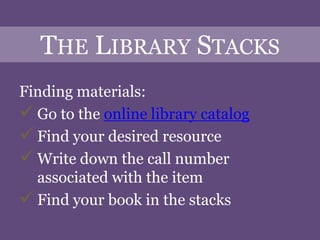
THE LIBRARY STACKS
Finding materials:
 Go to the online library catalog
 Find your desired resource
 Write down the call number
  associated with the item
 Find your book in the stacks
CALL NUMBER ORDER:
     LIBRARY OF CONGRESS
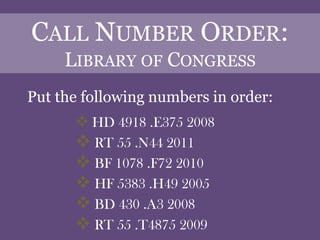
Put the following numbers in order:
       HD 4918 .E375 2008
       RT 55 .N44 2011
       BF 1078 .F72 2010
       HF 5383 .H49 2005
       BD 430 .A3 2008
       RT 55 .T4875 2009
CALL NUMBER ORDER:
    LIBRARY OF CONGRESS
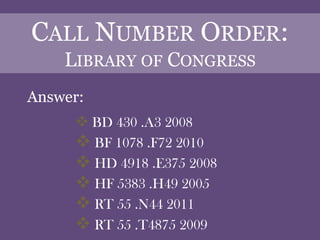
Answer:
      BD 430 .A3 2008
      BF 1078 .F72 2010
      HD 4918 .E375 2008
      HF 5383 .H49 2005
      RT 55 .N44 2011
      RT 55 .T4875 2009
WHAT YOU NEED TO
 REMEMBER ABOUT CALL
      NUMBERS:
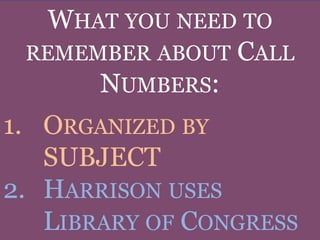
1. ORGANIZED BY
   SUBJECT
2. HARRISON USES
   LIBRARY OF CONGRESS
LRC ONLINE CATALOG:
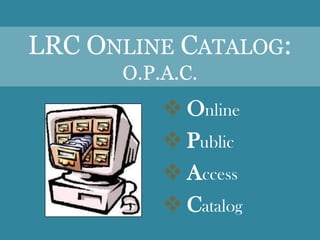
      O.P.A.C.
           Online
           Public
           Access
           Catalog
LRC ONLINE CATALOG:
      O.P.A.C.
   WAYS TO SEARCH:
         Title
        Author
       Subject
       Keyword
        Series
       ISBN #
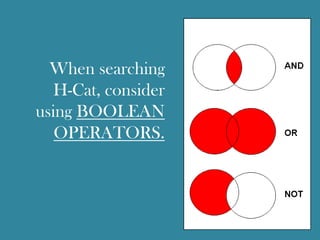
When searching
   H-Cat, consider
using BOOLEAN
   OPERATORS.
SEARCHING THE CATALOG

   LRC Online Catalog
        H-Cat
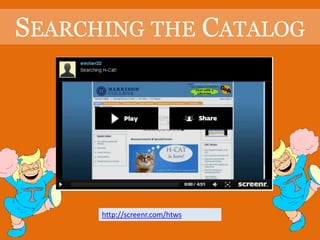
SEARCHING THE CATALOG


      http://screenr.com/htws
SEARCHING EBOOKS

   Ebsco Ebook
    Collection!
SEARCHING EBOOKS


  http://screenr.com/qtws
Homework:

Find two books on your topic and respond to the
reflection question
NO Learning activity

Please be sure to view the videos, understand the pros and cons of
using books in research, and how to search H-Cat and Ebooks.

Week 8 tuesday

  • 1.
  • 2.
    Books! This lesson willcover: Pros & Cons of Books! Cataloging systems: Library of Congress and Dewey Decimal Finding books using H-Cat and our Ebooks collection There are two VERY IMPORTANT videos near the end of this presentation. These will demonstrate HOW to search H-Cat and the Ebooks collection. Just click the video image to view!
  • 3.
  • 4.
    Books are published! Thefacts in books have been verified Very thorough information on a topic Usually written by someone who is qualified WHY USE BOOKS???
  • 5.
    Take so longto get published, they can be outdated by they time they are released! Tooooooo Looooong (the INDEX at the back can help you find the relevant parts) You might find a book record, but not the whole book! THE DOWNSIDE OF BOOKS?
  • 6.
    Books: We havea system! http://www.youtube.com/watch?v=gzbDdgWiaS0&NR=1
  • 7.
    LIBRARY CALL NUMBERS: CLASSIFICATION SYSTEMS Dewey Decimal and Library of Congress
  • 9.
    CLASSIFICATION SYSTEMS Both Libraryof Congress and Dewey Decimal systems organize materials by SUBJECT.
  • 10.
    DEWEY DECIMAL Dewey usesnumbers at the beginning of the call number. 154.634 FRE
  • 11.
    LIBRARY OF CONGRESS Library of Congress uses letters at the beginning of the call number. HD 4918.E375
  • 12.
    Time out: CallNumber vs ISBN Call number: ISBN (book standard Found on the spine of the book number) Unique to library Found on the back of the book Book’s “address” on the shelf Unique to that book Includes letters, numbers, periods Book’s individual barcode Includes only numbers (and maybe an x)
  • 13.
    The Stacks (wherethe books are)
  • 14.
    THE LIBRARY STACKS Findingmaterials:  Go to the online library catalog  Find your desired resource  Write down the call number associated with the item  Find your book in the stacks
  • 15.
    CALL NUMBER ORDER: LIBRARY OF CONGRESS Put the following numbers in order:  HD 4918 .E375 2008  RT 55 .N44 2011  BF 1078 .F72 2010  HF 5383 .H49 2005  BD 430 .A3 2008  RT 55 .T4875 2009
  • 16.
    CALL NUMBER ORDER: LIBRARY OF CONGRESS Answer:  BD 430 .A3 2008  BF 1078 .F72 2010  HD 4918 .E375 2008  HF 5383 .H49 2005  RT 55 .N44 2011  RT 55 .T4875 2009
  • 17.
    WHAT YOU NEEDTO REMEMBER ABOUT CALL NUMBERS: 1. ORGANIZED BY SUBJECT 2. HARRISON USES LIBRARY OF CONGRESS
  • 18.
    LRC ONLINE CATALOG: O.P.A.C.  Online  Public  Access  Catalog
  • 19.
    LRC ONLINE CATALOG: O.P.A.C. WAYS TO SEARCH: Title Author Subject Keyword Series ISBN #
  • 20.
    When searching H-Cat, consider using BOOLEAN OPERATORS.
  • 21.
    SEARCHING THE CATALOG LRC Online Catalog H-Cat
  • 22.
    SEARCHING THE CATALOG http://screenr.com/htws
  • 23.
    SEARCHING EBOOKS Ebsco Ebook Collection!
  • 24.
    SEARCHING EBOOKS http://screenr.com/qtws
  • 25.
    Homework: Find two bookson your topic and respond to the reflection question NO Learning activity Please be sure to view the videos, understand the pros and cons of using books in research, and how to search H-Cat and Ebooks.

Editor's Notes

  • #2 Ppt adapted from Rebecca Johnson, Harrison College – Ft Wayne. Used and adapted with permission.
  • #3 Click video or link to open video.
  • #4 Ppt adapted from Rebecca Johnson, Harrison College – Ft Wayne. Used and adapted with permission.
  • #5 Ppt adapted from Rebecca Johnson, Harrison College – Ft Wayne. Used and adapted with permission.
  • #6 Ppt adapted from Rebecca Johnson, Harrison College – Ft Wayne. Used and adapted with permission.
  • #7 Click video or link to open video.
  • #8 There are two types of classification systems that libraries use to organize materials on the shelf: Dewey Decimal Classification SystemUsed by most public libraries and some colleges Library of Congress Classification SystemUsed by most University and colleges (Harrison College uses this system)Call numbers are found on book spines. Look for a white label with a bunch of letters and numbers.
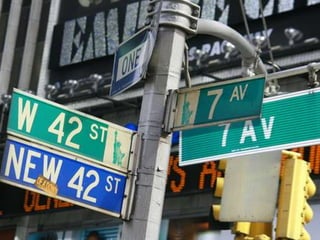
  • #9 Call numbers are like a street address for resources. It identifies where on the shelf an item can be located. Call numbers are assigned by librarians and may vary from library to library.
  • #10 For example, all books about dogs will be grouped together.
  • #11 Dewey uses numbers
  • #12 Library of Congress uses letters
  • #13 Call numbers and ISBN numbers are often confused.The call number is on the spine of the book, unique to that library, and is the book’s address.Call numbers include letters, numbers, and periods.The ISBN is the book standard number. Each edition of a book has a book assigned. This is handy if you want to make sure you are purchasing the correct textbook on Amazon! It is that edition of the book’s barcode, and includes only numbers. (occasionally there is an x at the end)Show examples.
  • #14 The Stacks is where the books are shelved
  • #15 Go to the website to show how to locate the online catalog.Do a search on a topic (Facebook is what I usually use). Point out how to click books on the left-hand side after the searchClick advanced search at the top of the screen (just under the main search box)Point out where to search by author, title, and keyword.Point out the limiters at the bottom (dates, format, a particular harrison college campus LRC)
  • #16 Begin with the 2 letters at the beginning then move down to the rest of the numbered call number.(have them do this in the same groups)BD 430.A3 2008; BF 1078.F72 2010; HD 4918.E375 2008; HF 5383.H49 2005; RT 55.N44 2011; RT 55.T4875 2009
  • #17 Begin with the 2 letters at the beginning then move down to the rest of the numbered call number.(have them do this in the same groups)BD 430.A3 2008; BF 1078.F72 2010; HD 4918.E375 2008; HF 5383.H49 2005; RT 55.N44 2011; RT 55.T4875 2009
  • #18 Begin with the 2 letters at the beginning then move down to the rest of the numbered call number.(have them do this in the same groups)BD 430.A3 2008; BF 1078.F72 2010; HD 4918.E375 2008; HF 5383.H49 2005; RT 55.N44 2011; RT 55.T4875 2009
  • #19 The OPAC can be searched for books, e-books, DVDs, CDRoms, and more.
  • #20 When searching the online catalog, you can search by the following “fields”
  • #21 They have learned these already. Just a refresher.AND – limitsOR – expandsNOT - limits
  • #22 In Class assignment. In groups, work through the in-class assignment. They will need to visit the LRC occasionally to pull books off the shelf.
  • #23 In Class assignment. In groups, work through the in-class assignment. They will need to visit the LRC occasionally to pull books off the shelf.
  • #24 In Class assignment. In groups, work through the in-class assignment. They will need to visit the LRC occasionally to pull books off the shelf.
  • #25 In Class assignment. In groups, work through the in-class assignment. They will need to visit the LRC occasionally to pull books off the shelf.