LC* Classification
*Library of Congress
The Library of Congress System
• “Libraries use classification systems to organize the books on the
shelves. A classification system uses letters and/or numbers (call
numbers) to arrange the books so that books on the same topic are
together. This arrangement results in "serendipitous browsing:" you
find one book in the catalog, go to the shelf, and an even better book
is sitting right next to it.”
- University of Georgia Libraries
What SU Libraries Use:
• We use the Library of Congress classification system
• Public libraries tend to use Dewey Decimal
• It’s just a different way of keeping books of similar/related subjects
together
• The books are shelved by call number which is a series of numbers
and letters that indicate where the book should go
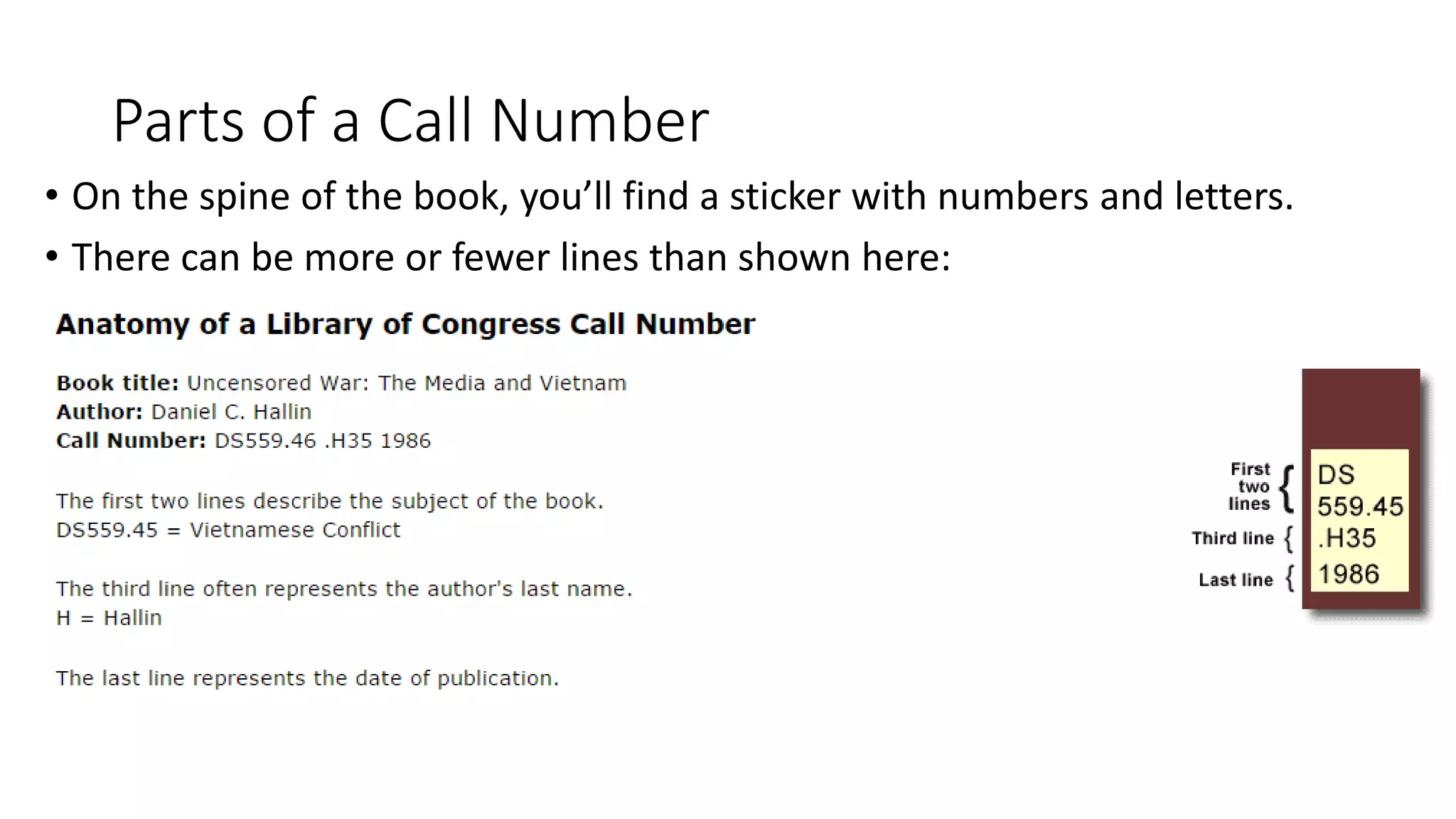
Parts of a Call Number
• On the spine of the book, you’ll find a sticker with numbers and letters.
• There can be more or fewer lines than shown here:
In Bird Library:
• Call numbers A – DX are on the 2nd floor
• Call numbers E – HJ are on the 3rd floor
• Call numbers HM – NA are on the 4th floor
• Call numbers NB – PZ are on the 5th floor
• Anything Q – Z is at Carnegie
• This doesn’t include what is stored offsite or in another location
• Many bound journals
• Special collections/rare books
• Architecture Reading Room
• Law Library
• MLK Library
How to
Read a
Call
Number:
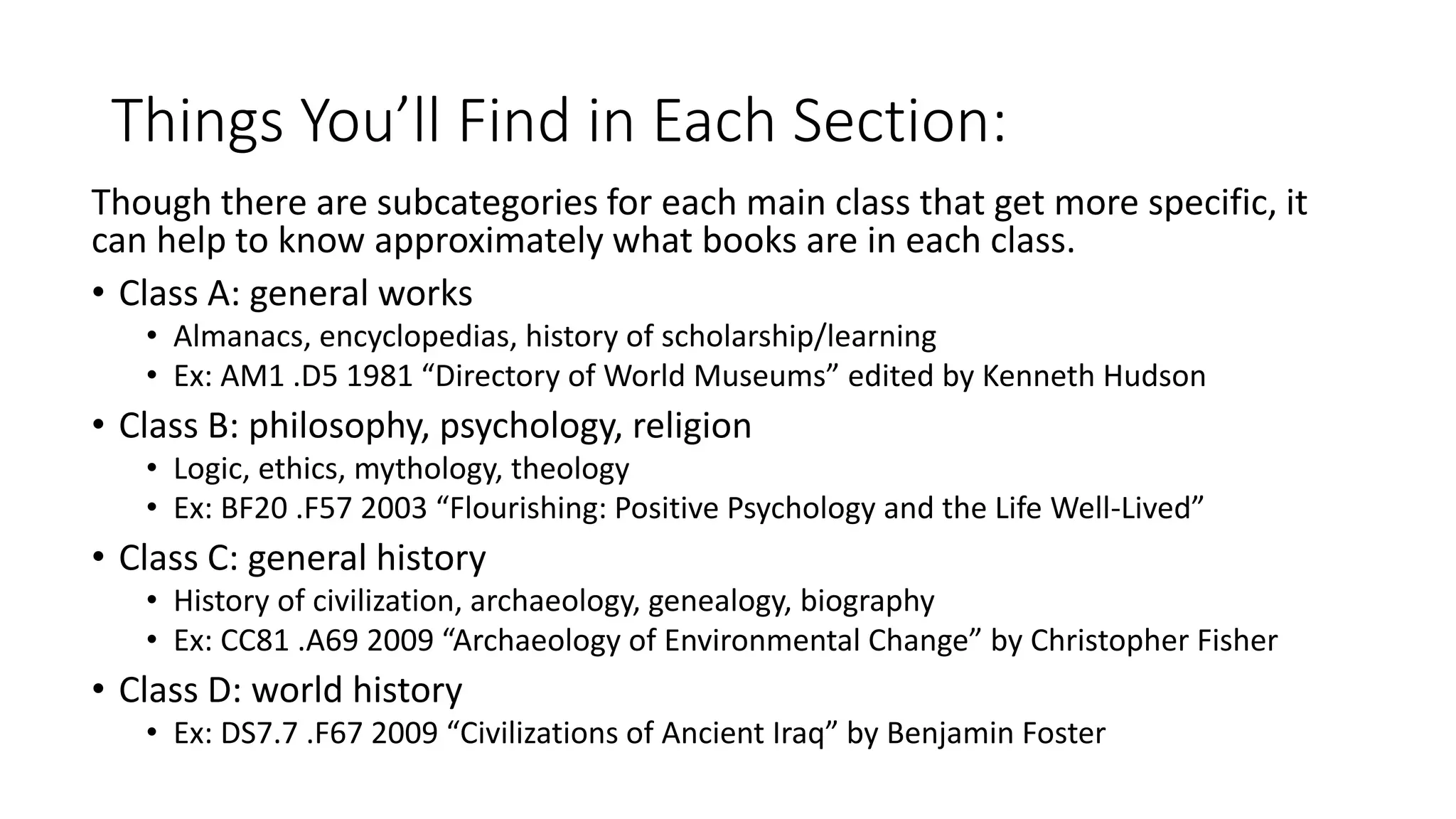
Things You’ll Find in Each Section:
Though there are subcategories for each main class that get more specific, it
can help to know approximately what books are in each class.
• Class A: general works
• Almanacs, encyclopedias, history of scholarship/learning
• Ex: AM1 .D5 1981 “Directory of World Museums” edited by Kenneth Hudson
• Class B: philosophy, psychology, religion
• Logic, ethics, mythology, theology
• Ex: BF20 .F57 2003 “Flourishing: Positive Psychology and the Life Well-Lived”
• Class C: general history
• History of civilization, archaeology, genealogy, biography
• Ex: CC81 .A69 2009 “Archaeology of Environmental Change” by Christopher Fisher
• Class D: world history
• Ex: DS7.7 .F67 2009 “Civilizations of Ancient Iraq” by Benjamin Foster
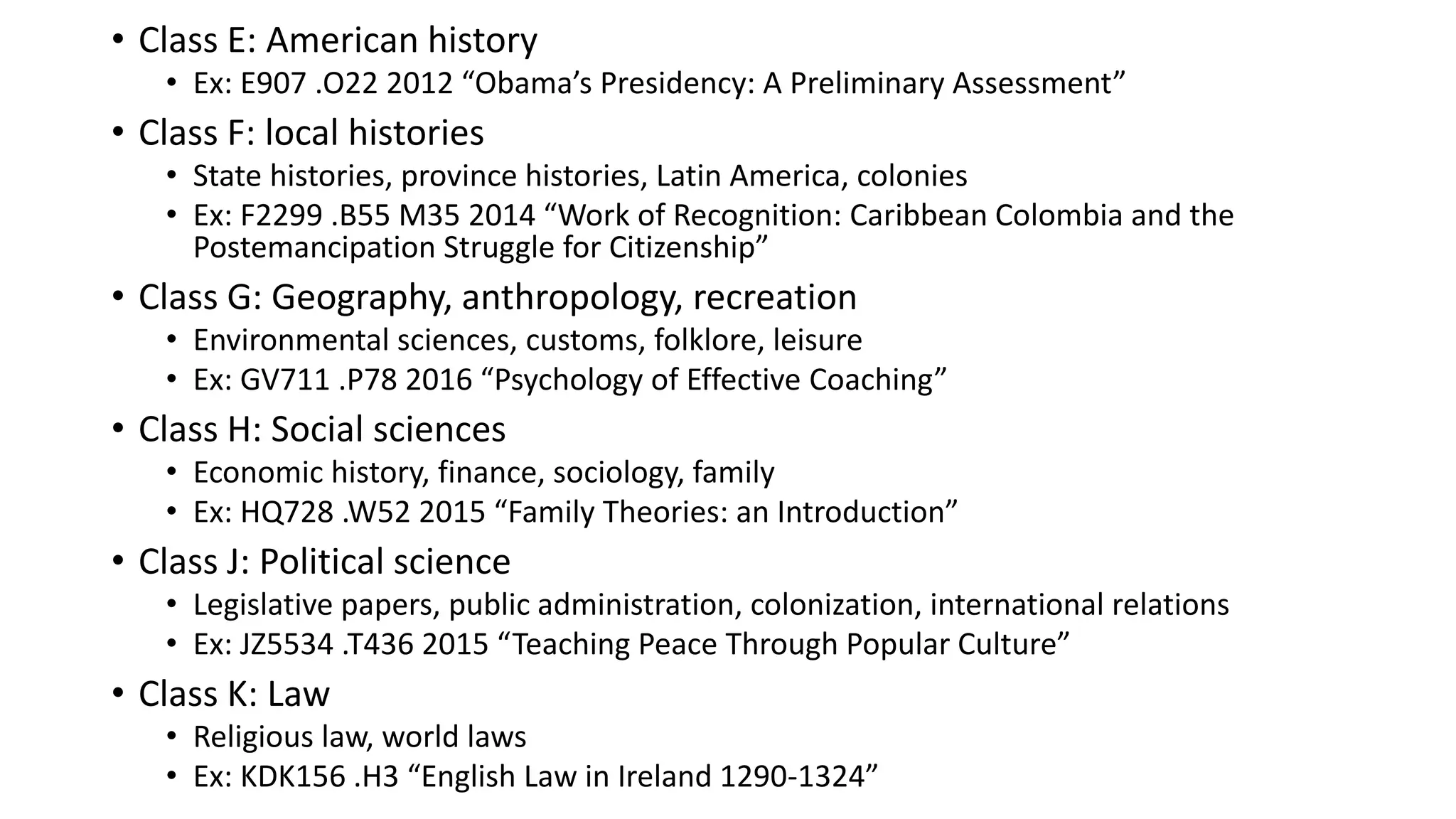
• Class E: American history
• Ex: E907 .O22 2012 “Obama’s Presidency: A Preliminary Assessment”
• Class F: local histories
• State histories, province histories, Latin America, colonies
• Ex: F2299 .B55 M35 2014 “Work of Recognition: Caribbean Colombia and the
Postemancipation Struggle for Citizenship”
• Class G: Geography, anthropology, recreation
• Environmental sciences, customs, folklore, leisure
• Ex: GV711 .P78 2016 “Psychology of Effective Coaching”
• Class H: Social sciences
• Economic history, finance, sociology, family
• Ex: HQ728 .W52 2015 “Family Theories: an Introduction”
• Class J: Political science
• Legislative papers, public administration, colonization, international relations
• Ex: JZ5534 .T436 2015 “Teaching Peace Through Popular Culture”
• Class K: Law
• Religious law, world laws
• Ex: KDK156 .H3 “English Law in Ireland 1290-1324”
• Class L: Education
• Theory, history, fraternities/sororities
• Ex: LC1035.4 G7 1994 “Tech Prep: a Strategy for School Reform”
• Class M : Music
• Literature on music, instruction, scores
• Ex: M23 .B85 1979 “Sonata for Piano”
• Class N: Fine arts
• Architecture, sculpture, painting, decorative arts
• Ex: NE2049 .L4 “History of French Etching from the 16th Century to the
Present Day
• Class P: Language and literature
• Linguistics, languages, literature, juvenile literature
• Ex: PM3962 .T48 1960 “Maya Hieroglyphic Writing: an Introduction”
Where Are the _____________ Books?
• Sometimes patrons will ask where the Russian history/French
impressionism/poetry books are
• While you can use the Library of Congress system to point them in the
general direction, try to see if they need more assistance
• Reference librarians and Learning Commons can help students find exactly
what they’re looking for or help them narrow their topic down

Library of Congress Classification

  • 1.
  • 2.
    The Library ofCongress System • “Libraries use classification systems to organize the books on the shelves. A classification system uses letters and/or numbers (call numbers) to arrange the books so that books on the same topic are together. This arrangement results in "serendipitous browsing:" you find one book in the catalog, go to the shelf, and an even better book is sitting right next to it.” - University of Georgia Libraries
  • 3.
    What SU LibrariesUse: • We use the Library of Congress classification system • Public libraries tend to use Dewey Decimal • It’s just a different way of keeping books of similar/related subjects together • The books are shelved by call number which is a series of numbers and letters that indicate where the book should go
  • 4.
    Parts of aCall Number • On the spine of the book, you’ll find a sticker with numbers and letters. • There can be more or fewer lines than shown here:
  • 5.
    In Bird Library: •Call numbers A – DX are on the 2nd floor • Call numbers E – HJ are on the 3rd floor • Call numbers HM – NA are on the 4th floor • Call numbers NB – PZ are on the 5th floor • Anything Q – Z is at Carnegie • This doesn’t include what is stored offsite or in another location • Many bound journals • Special collections/rare books • Architecture Reading Room • Law Library • MLK Library
  • 6.
  • 7.
    Things You’ll Findin Each Section: Though there are subcategories for each main class that get more specific, it can help to know approximately what books are in each class. • Class A: general works • Almanacs, encyclopedias, history of scholarship/learning • Ex: AM1 .D5 1981 “Directory of World Museums” edited by Kenneth Hudson • Class B: philosophy, psychology, religion • Logic, ethics, mythology, theology • Ex: BF20 .F57 2003 “Flourishing: Positive Psychology and the Life Well-Lived” • Class C: general history • History of civilization, archaeology, genealogy, biography • Ex: CC81 .A69 2009 “Archaeology of Environmental Change” by Christopher Fisher • Class D: world history • Ex: DS7.7 .F67 2009 “Civilizations of Ancient Iraq” by Benjamin Foster
  • 8.
    • Class E:American history • Ex: E907 .O22 2012 “Obama’s Presidency: A Preliminary Assessment” • Class F: local histories • State histories, province histories, Latin America, colonies • Ex: F2299 .B55 M35 2014 “Work of Recognition: Caribbean Colombia and the Postemancipation Struggle for Citizenship” • Class G: Geography, anthropology, recreation • Environmental sciences, customs, folklore, leisure • Ex: GV711 .P78 2016 “Psychology of Effective Coaching” • Class H: Social sciences • Economic history, finance, sociology, family • Ex: HQ728 .W52 2015 “Family Theories: an Introduction” • Class J: Political science • Legislative papers, public administration, colonization, international relations • Ex: JZ5534 .T436 2015 “Teaching Peace Through Popular Culture” • Class K: Law • Religious law, world laws • Ex: KDK156 .H3 “English Law in Ireland 1290-1324”
  • 9.
    • Class L:Education • Theory, history, fraternities/sororities • Ex: LC1035.4 G7 1994 “Tech Prep: a Strategy for School Reform” • Class M : Music • Literature on music, instruction, scores • Ex: M23 .B85 1979 “Sonata for Piano” • Class N: Fine arts • Architecture, sculpture, painting, decorative arts • Ex: NE2049 .L4 “History of French Etching from the 16th Century to the Present Day • Class P: Language and literature • Linguistics, languages, literature, juvenile literature • Ex: PM3962 .T48 1960 “Maya Hieroglyphic Writing: an Introduction”
  • 10.
    Where Are the_____________ Books? • Sometimes patrons will ask where the Russian history/French impressionism/poetry books are • While you can use the Library of Congress system to point them in the general direction, try to see if they need more assistance • Reference librarians and Learning Commons can help students find exactly what they’re looking for or help them narrow their topic down