FLOW OF PRESENTATION
• DIVERSITY MANAGEMENT
• BIOLOGICAL CHARACTERISTICS
• PHYSICAL ABILITY
• INTELLECTUAL ABILITY
• LEARNING & SHAPING
DIVERSITY
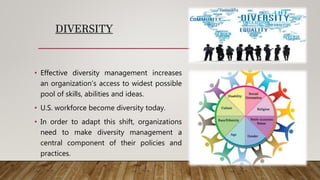
• Effective diversity management increases
an organization’s access to widest possible
pool of skills, abilities and ideas.
• U.S. workforce become diversity today.
• In order to adapt this shift, organizations
need to make diversity management a
central component of their policies and
practices.
LEVEL OF DIVERSITY
• Surface Level Diversity:
Differences in easily perceived characteristics, such as gender, race,
ethnicity, age, or disability, that do not necessarily reflect the ways
people think or feel but that may activate certain stereotypes.
• Deep Level Diversity:
Difference in values, personality, and work preferences that become
progressively more important for determining similarity as people
to know one another better.
DISCRIMINATION
• Noting of differences between things; often we refer to unfair
discrimination, which means making judgments about individuals
based on stereotypes regarding their demographic group.
• Discriminatory policies or practices
• Intimidation
• Mockery & insults
• Exclusion
• Incivility
• Harassments
BIOLOGICAL CHARACTERISTICS
• Age :
Older workers bring experience, judgment,
a strong work ethic, and commitment to quality.
• Gender :
Few differences between men and women that
affect job performance.
• Race :
Contentious issue: differences exist, but could
be more culture-based than race-based.
• Tenure :
People with job tenure (seniority at a job) are more
productive,
absent less frequently, have lower turnover, and are more
satisfied.
• Religion :
Islam is especially problematic in the workplace in this
9/11 world.
• Sexual Orientation :
Federal law does not protect against discrimination
(but state or local laws may).Domestic partner benefits are
important considerations.
• Gender Identity :
Relatively new issue – transgendered employees.
ABILITY
• Ability is an individual’s current capacity to perform various tasks in
a job.
• Two types of Ability
• Intellectual abilities
• Physical abilities
INTELLECTUAL ABILITIES
• Intellectual abilities is the capacity to do
mental activities thinking, reasoning, and
problem solving. It has seven dimensions.
• General mental ability is an overall factor of
intelligence as suggested by the positive
correlations among specific intellectual ability
dimensions.
• Number Aptitude :
Ability to do speedy and accurate arithmetic.
• Verbal Comprehension :
Ability to understand what is read or heard
and the relationship of words to each other.
• Perceptual Speed :
Ability to identify visual similarities &
differences,
quickly & accurately.
DIMENSIONS OF INTELLECTUAL ABILITIES
• Inductive Reasoning :
Ability to identify a logical sequence in a
problem & then solve a problem.
• Deductive Reasoning :
Ability to use logic & assess the
implications of an argument.
• Spatial Visualization :
Ability to imagine how an object would
look if its position in space would change.
• Memory :
Ability to retain and recall past
experiences.
PHYSICAL ABILITIES
• The capacity to do tasks demanding
stamina, dexterity, strength, and similar
characteristics.
• Nine basic abilities related to strength,
flexibility, and other factors are needed
to perform physical tasks.
• Strength Factors:
• Dynamic Strength:
Ability to exert muscular force repeatedly
or continuously over time.
• Trunk Strength:
Ability to exert muscular strength using
the trunk muscle.
• Static Strength:
Ability to exert force against external
objects.
• Explosive Strength:
Ability to expend a maximum amount of
energy in one or a series of explosive acts
• Flexibility Factors :
• Extent Flexibility:
Ability to move the trunk and
muscles as far as possible.
• Dynamic Flexibility:
Ability to make rapid, repeated
flexing movements.
• Other Factors :
• Body Coordination:
Ability to coordinate the
actions of different parts of the body
• Balance:
Ability to maintain equilibrium
forces pulling off balance.
• Stamina:
Ability to continue maximum effort
requiring prolonged effort over time.
LEARNING
• Any relatively permanent change in behavior as
a result of practice or experience.
• Learning can be understood clearly with the
help of some theories that will explain our
behavior.
• Learning can be defined as the permanent
change in behavior due to direct and indirect
experience. It means change in behavior,
attitude due to education and training, practice
and experience. It is completed by acquisition of
knowledge and skills, which are relatively
permanent.
THEORIES OF LEARNING
• Classical Conditioning :
A type of Conditioning in which an individual
responds to some stimulus that would not ordinarily
produce such a response
The classical conditioning occurs when a
conditioned stimulus is coupled with an unconditioned
stimulus. Usually, the conditioned stimulus (CS) is an
impartial stimulus like the sound of a tuning fork, the
unconditioned stimulus (US) is biologically effective like
the taste of food and the unconditioned response (UR) to
the unconditioned stimulus is an unlearned reflex response
like salivation or sweating.
• Operant Conditioning :
A type of conditioning in
which desired voluntary behavior leads to
reward or prevents a punishment
Let’s take an example of a
child. A child may learn to open a box to
get the candy inside, or learn to avoid
touching a hot stove. In comparison, the
classical conditioning develops a
relationship between a stimulus and a
behavior. The example can be further
elaborated as the child may learn to
at the sight of candy, or to tremble at the
sight of an angry parent.
• Social Learning Theory :
The view that people can learn through
observation and direct experience.
The social learning theory proposed by
Albert Bandura has become perhaps the most
influential theory of learning and development.
His theory added a social element,
arguing that people can learn new information
and behaviors by watching other people.
Known as observational learning (or
modeling), this type of learning can be used to
explain a wide variety of behaviors.
organization behavior

organization behavior

  • 2.
    FLOW OF PRESENTATION •DIVERSITY MANAGEMENT • BIOLOGICAL CHARACTERISTICS • PHYSICAL ABILITY • INTELLECTUAL ABILITY • LEARNING & SHAPING
  • 3.
    DIVERSITY • Effective diversitymanagement increases an organization’s access to widest possible pool of skills, abilities and ideas. • U.S. workforce become diversity today. • In order to adapt this shift, organizations need to make diversity management a central component of their policies and practices.
  • 4.
    LEVEL OF DIVERSITY •Surface Level Diversity: Differences in easily perceived characteristics, such as gender, race, ethnicity, age, or disability, that do not necessarily reflect the ways people think or feel but that may activate certain stereotypes. • Deep Level Diversity: Difference in values, personality, and work preferences that become progressively more important for determining similarity as people to know one another better.
  • 5.
    DISCRIMINATION • Noting ofdifferences between things; often we refer to unfair discrimination, which means making judgments about individuals based on stereotypes regarding their demographic group. • Discriminatory policies or practices • Intimidation • Mockery & insults • Exclusion • Incivility • Harassments
  • 6.
    BIOLOGICAL CHARACTERISTICS • Age: Older workers bring experience, judgment, a strong work ethic, and commitment to quality. • Gender : Few differences between men and women that affect job performance. • Race : Contentious issue: differences exist, but could be more culture-based than race-based.
  • 7.
    • Tenure : Peoplewith job tenure (seniority at a job) are more productive, absent less frequently, have lower turnover, and are more satisfied. • Religion : Islam is especially problematic in the workplace in this 9/11 world. • Sexual Orientation : Federal law does not protect against discrimination (but state or local laws may).Domestic partner benefits are important considerations. • Gender Identity : Relatively new issue – transgendered employees.
  • 8.
    ABILITY • Ability isan individual’s current capacity to perform various tasks in a job. • Two types of Ability • Intellectual abilities • Physical abilities
  • 9.
    INTELLECTUAL ABILITIES • Intellectualabilities is the capacity to do mental activities thinking, reasoning, and problem solving. It has seven dimensions. • General mental ability is an overall factor of intelligence as suggested by the positive correlations among specific intellectual ability dimensions.
  • 10.
    • Number Aptitude: Ability to do speedy and accurate arithmetic. • Verbal Comprehension : Ability to understand what is read or heard and the relationship of words to each other. • Perceptual Speed : Ability to identify visual similarities & differences, quickly & accurately. DIMENSIONS OF INTELLECTUAL ABILITIES
  • 11.
    • Inductive Reasoning: Ability to identify a logical sequence in a problem & then solve a problem. • Deductive Reasoning : Ability to use logic & assess the implications of an argument. • Spatial Visualization : Ability to imagine how an object would look if its position in space would change. • Memory : Ability to retain and recall past experiences.
  • 12.
    PHYSICAL ABILITIES • Thecapacity to do tasks demanding stamina, dexterity, strength, and similar characteristics. • Nine basic abilities related to strength, flexibility, and other factors are needed to perform physical tasks.
  • 13.
    • Strength Factors: •Dynamic Strength: Ability to exert muscular force repeatedly or continuously over time. • Trunk Strength: Ability to exert muscular strength using the trunk muscle. • Static Strength: Ability to exert force against external objects. • Explosive Strength: Ability to expend a maximum amount of energy in one or a series of explosive acts
  • 14.
    • Flexibility Factors: • Extent Flexibility: Ability to move the trunk and muscles as far as possible. • Dynamic Flexibility: Ability to make rapid, repeated flexing movements.
  • 15.
    • Other Factors: • Body Coordination: Ability to coordinate the actions of different parts of the body • Balance: Ability to maintain equilibrium forces pulling off balance. • Stamina: Ability to continue maximum effort requiring prolonged effort over time.
  • 16.
    LEARNING • Any relativelypermanent change in behavior as a result of practice or experience. • Learning can be understood clearly with the help of some theories that will explain our behavior. • Learning can be defined as the permanent change in behavior due to direct and indirect experience. It means change in behavior, attitude due to education and training, practice and experience. It is completed by acquisition of knowledge and skills, which are relatively permanent.
  • 17.
    THEORIES OF LEARNING •Classical Conditioning : A type of Conditioning in which an individual responds to some stimulus that would not ordinarily produce such a response The classical conditioning occurs when a conditioned stimulus is coupled with an unconditioned stimulus. Usually, the conditioned stimulus (CS) is an impartial stimulus like the sound of a tuning fork, the unconditioned stimulus (US) is biologically effective like the taste of food and the unconditioned response (UR) to the unconditioned stimulus is an unlearned reflex response like salivation or sweating.
  • 18.
    • Operant Conditioning: A type of conditioning in which desired voluntary behavior leads to reward or prevents a punishment Let’s take an example of a child. A child may learn to open a box to get the candy inside, or learn to avoid touching a hot stove. In comparison, the classical conditioning develops a relationship between a stimulus and a behavior. The example can be further elaborated as the child may learn to at the sight of candy, or to tremble at the sight of an angry parent.
  • 19.
    • Social LearningTheory : The view that people can learn through observation and direct experience. The social learning theory proposed by Albert Bandura has become perhaps the most influential theory of learning and development. His theory added a social element, arguing that people can learn new information and behaviors by watching other people. Known as observational learning (or modeling), this type of learning can be used to explain a wide variety of behaviors.