CBSE CLASS 12 BUSINESS STUDIES
CHAPTER – 5
ORGANISATION
REVISION NOTES
Meaning of Organizing
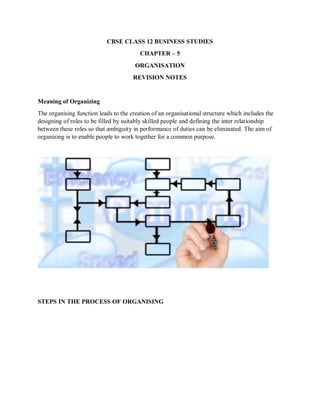
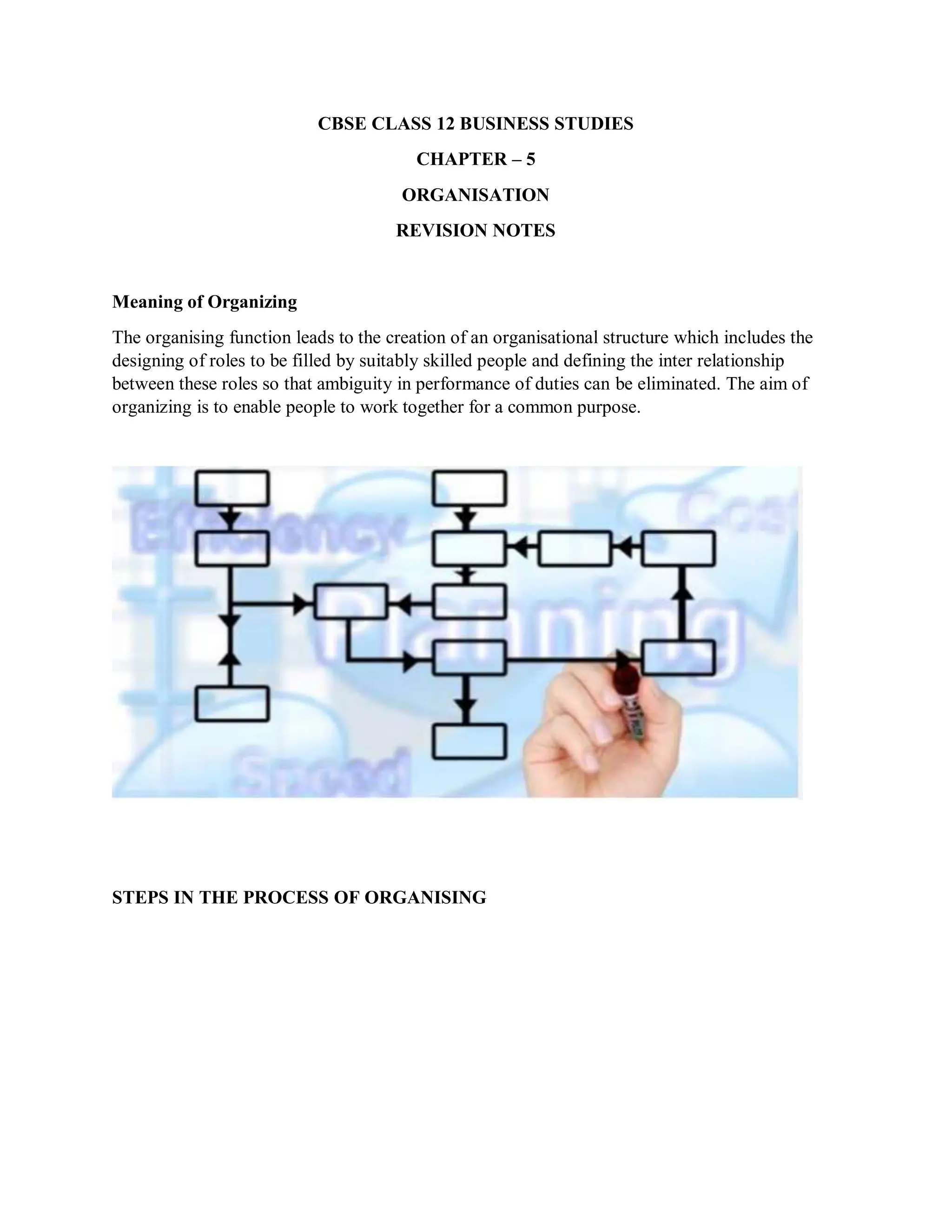
The organising function leads to the creation of an organisational structure which includes the
designing of roles to be filled by suitably skilled people and defining the inter relationship
between these roles so that ambiguity in performance of duties can be eliminated. The aim of
organizing is to enable people to work together for a common purpose.
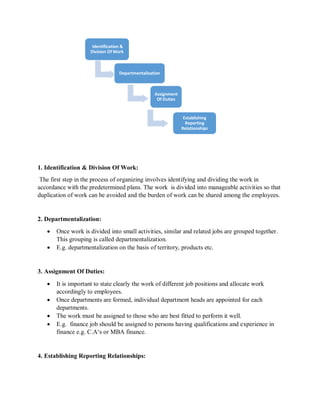
STEPS IN THE PROCESS OF ORGANISING
1. Identification & Division Of Work:
The first step in the process of organizing involves identifying and dividing the work in
accordance with the predetermined plans. The work is divided into manageable activities so that
duplication of work can be avoided and the burden of work can be shared among the employees.
2. Departmentalization:
• Once work is divided into small activities, similar and related jobs are grouped together.
This grouping is called departmentalization.
• E.g. departmentalization on the basis of territory, products etc.
3. Assignment Of Duties:
• It is important to state clearly the work of different job positions and allocate work
accordingly to employees.
• Once departments are formed, individual department heads are appointed for each
departments.
• The work must be assigned to those who are best fitted to perform it well.
• E.g. finance job should be assigned to persons having qualifications and experience in
finance e.g. C.A‘s or MBA finance.
4. Establishing Reporting Relationships:
Identification &
Division Of Work
Departmentalization
Assignment
Of Duties
Establishing
Reporting
Relationships
• Establishing authority and responsibility relationship helps to create a hierarchal structure
and also helps in coordination amongst various departments.
• Superior subordinate relations between different people and job positions is to be created,
so that everybody knows from whom he/she is to taking orders and to whom he/she can
issue orders.
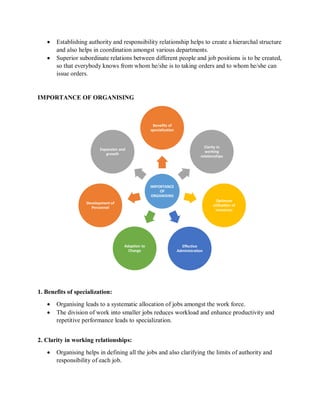
IMPORTANCE OF ORGANISING
1. Benefits of specialization:
• Organising leads to a systematic allocation of jobs amongst the work force.
• The division of work into smaller jobs reduces workload and enhance productivity and
repetitive performance leads to specialization.
2. Clarity in working relationships:
• Organising helps in defining all the jobs and also clarifying the limits of authority and
responsibility of each job.
IMPORTANCE
OF
ORGANISING
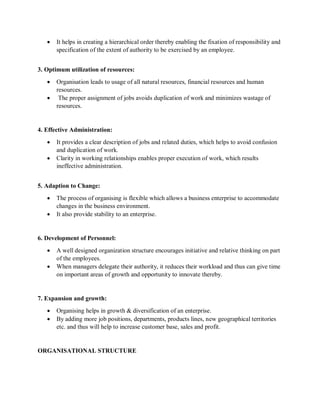
Benefits of
specialization
Clarity in
working
relationships
Optimum
utilization of
resources
Effective
Administration
Adaption to
Change
Development of
Personnel
Expansion and
growth
• It helps in creating a hierarchical order thereby enabling the fixation of responsibility and
specification of the extent of authority to be exercised by an employee.
3. Optimum utilization of resources:
• Organisation leads to usage of all natural resources, financial resources and human
resources.
• The proper assignment of jobs avoids duplication of work and minimizes wastage of
resources.
4. Effective Administration:
• It provides a clear description of jobs and related duties, which helps to avoid confusion
and duplication of work.
• Clarity in working relationships enables proper execution of work, which results
ineffective administration.
5. Adaption to Change:
• The process of organising is flexible which allows a business enterprise to accommodate
changes in the business environment.
• It also provide stability to an enterprise.
6. Development of Personnel:
• A well designed organization structure encourages initiative and relative thinking on part
of the employees.
• When managers delegate their authority, it reduces their workload and thus can give time
on important areas of growth and opportunity to innovate thereby.
7. Expansion and growth:
• Organising helps in growth & diversification of an enterprise.
• By adding more job positions, departments, products lines, new geographical territories
etc. and thus will help to increase customer base, sales and profit.
ORGANISATIONAL STRUCTURE
The organisation structure can be defined as the framework within which managerial and
operating tasks are performed. It specifies the relationships between people, work and resources
in an organisation.
Under the organizational structure, various posts are created to perform different activities for the
attainment of the predetermined objectives of the enterprise. The structure provides a basis or
framework for managers and other employees to perform their functions.
Span of management refers to the number of subordinates that can be effectively managed by a
superior. The Span of management largely gives shape to the organization structure. This
determines the levels of management in the structure.
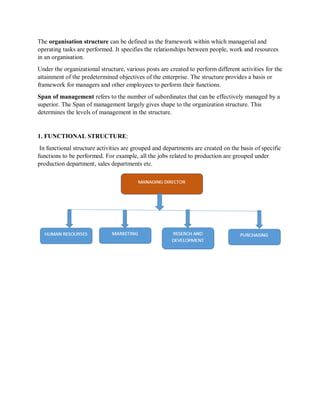
1. FUNCTIONAL STRUCTURE:
In functional structure activities are grouped and departments are created on the basis of specific
functions to be performed. For example, all the jobs related to production are grouped under
production department, sales departments etc.
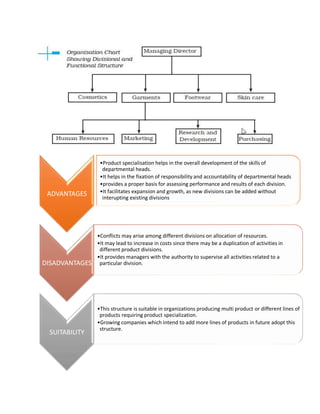
2. DIVISIONAL ORGANIZATION STRUCTURE
Dividing the whole enterprise according to the major products to be manufactured (like metal,
plastic, cosmetics etc.) is known as divisional organization structure.
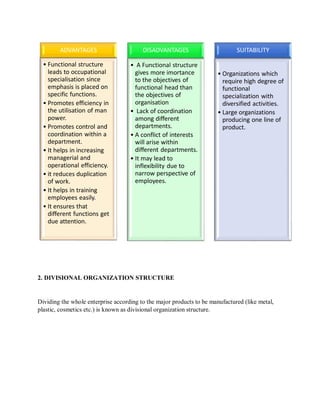
ADVANTAGES
• Functional structure
leads to occupational
specialisation since
emphasis is placed on
specific functions.
• Promotes efficiency in
the utilisation of man
power.
• Promotes control and
coordination within a
department.
• It helps in increasing
managerial and
operational efficiency.
• it reduces duplication
of work.
• It helps in training
employees easily.
• It ensures that
different functions get
due attention.
DISADVANTAGES
• A Functional structure
gives more imortance
to the objectives of
functional head than
the objectives of
organisation
• Lack of coordination
among different
departments.
• A conflict of interests
will arise within
different departments.
• It may lead to
inflexibility due to
narrow perspective of
employees.
SUITABILITY
• Organizations which
require high degree of
functional
specialization with
diversified activities.
• Large organizations
producing one line of
product.
ADVANTAGES
•Product specialisation helps in the overall development of the skills of
departmental heads.
•It helps in the fixation of responsibility and accountability of departmental heads
•provides a proper basis for assessing performance and results of each division.
•It facilitates expansion and growth, as new divisions can be added without
interupting existing divisions
DISADVANTAGES
•Conflicts may arise among different divisions on allocation of resources.
•It may lead to increase in costs since there may be a duplication of activities in
different product divisions.
•It provides managers with the authority to supervise all activities related to a
particular division.
SUITABILITY
•This structure is suitable in organizations producing multi product or different lines of
products requiring product specialization.
•Growing companies which intend to add more lines of products in future adopt this
structure.
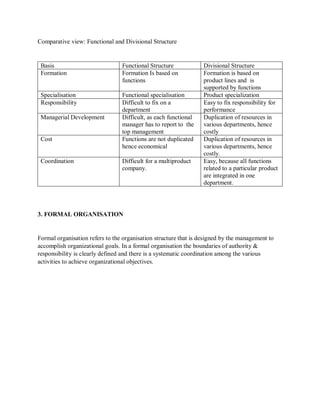
Comparative view: Functional and Divisional Structure
Basis Functional Structure Divisional Structure
Formation Formation Is based on
functions
Formation is based on
product lines and is
supported by functions
Specialisation Functional specialisation Product specialization
Responsibility Difficult to fix on a
department
Easy to fix responsibility for
performance
Managerial Development Difficult, as each functional
manager has to report to the
top management
Duplication of resources in
various departments, hence
costly
Cost Functions are not duplicated
hence economical
Duplication of resources in
various departments, hence
costly.
Coordination Difficult for a multiproduct
company.
Easy, because all functions
related to a particular product
are integrated in one
department.
3. FORMAL ORGANISATION
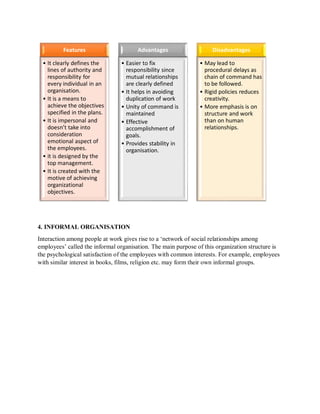
Formal organisation refers to the organisation structure that is designed by the management to
accomplish organizational goals. In a formal organisation the boundaries of authority &
responsibility is clearly defined and there is a systematic coordination among the various
activities to achieve organizational objectives.
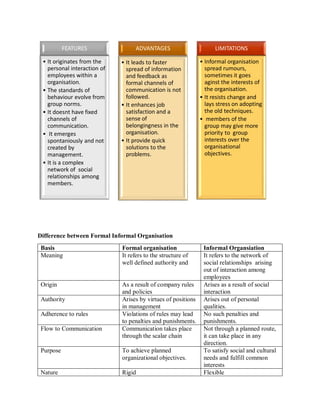
4. INFORMAL ORGANISATION
Interaction among people at work gives rise to a ‘network of social relationships among
employees’ called the informal organisation. The main purpose of this organization structure is
the psychological satisfaction of the employees with common interests. For example, employees
with similar interest in books, films, religion etc. may form their own informal groups.
Features
• It clearly defines the
lines of authority and
responsibility for
every individual in an
organisation.
• It is a means to
achieve the objectives
specified in the plans.
• It is impersonal and
doesn’t take into
consideration
emotional aspect of
the employees.
• it is designed by the
top management.
• It is created with the
motive of achieving
organizational
objectives.
Advantages
• Easier to fix
responsibility since
mutual relationships
are clearly defined
• It helps in avoiding
duplication of work
• Unity of command is
maintained
• Effective
accomplishment of
goals.
• Provides stability in
organisation.
Disadvantages
• May lead to
procedural delays as
chain of command has
to be followed.
• Rigid policies reduces
creativity.
• More emphasis is on
structure and work
than on human
relationships.
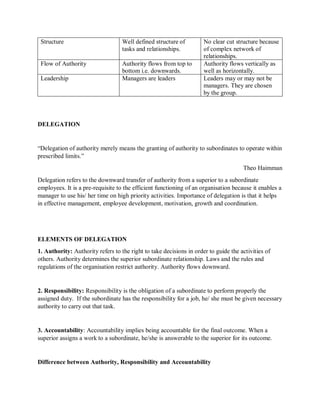
Difference between Formal Informal Organisation
Basis Formal organisation Informal Organsiation
Meaning It refers to the structure of
well defined authority and
It refers to the network of
social relationships arising
out of interaction among
employees
Origin As a result of company rules
and policies
Arises as a result of social
interaction
Authority Arises by virtues of positions
in management
Arises out of personal
qualities.
Adherence to rules Violations of rules may lead
to penalties and punishments.
No such penalties and
punishments.
Flow to Communication Communication takes place
through the scalar chain
Not through a planned route,
it can take place in any
direction.
Purpose To achieve planned
organizational objectives.
To satisfy social and cultural
needs and fulfill common
interests
Nature Rigid Flexible
FEATURES
• It originates from the
personal interaction of
employees within a
organisation.
• The standards of
behaviour evolve from
group norms.
• It doesnt have fixed
channels of
communication.
• It emerges
spontaniously and not
created by
management.
• It is a complex
network of social
relationships among
members.
ADVANTAGES
• It leads to faster
spread of information
and feedback as
formal channels of
communication is not
followed.
• It enhances job
satisfaction and a
sense of
belongingness in the
organisation.
• It provide quick
solutions to the
problems.
LIMITATIONS
• Informal organisation
spread rumours,
sometimes it goes
aginst the interests of
the organisation.
• It resists change and
lays stress on adopting
the old techniques.
• members of the
group may give more
priority to group
interests over the
organisational
objectives.
Structure Well defined structure of
tasks and relationships.
No clear cut structure because
of complex network of
relationships.
Flow of Authority Authority flows from top to
bottom i.e. downwards.
Authority flows vertically as
well as horizontally.
Leadership Managers are leaders Leaders may or may not be
managers. They are chosen
by the group.
DELEGATION
“Delegation of authority merely means the granting of authority to subordinates to operate within
prescribed limits.”
Theo Haimman
Delegation refers to the downward transfer of authority from a superior to a subordinate
employees. It is a pre-requisite to the efficient functioning of an organisation because it enables a
manager to use his/ her time on high priority activities. Importance of delegation is that it helps
in effective management, employee development, motivation, growth and coordination.
ELEMENTS OF DELEGATION
1. Authority: Authority refers to the right to take decisions in order to guide the activities of
others. Authority determines the superior subordinate relationship. Laws and the rules and
regulations of the organisation restrict authority. Authority flows downward.
2. Responsibility: Responsibility is the obligation of a subordinate to perform properly the
assigned duty. If the subordinate has the responsibility for a job, he/ she must be given necessary
authority to carry out that task.
3. Accountability: Accountability implies being accountable for the final outcome. When a
superior assigns a work to a subordinate, he/she is answerable to the superior for its outcome.
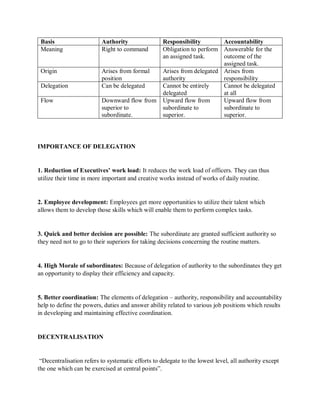
Difference between Authority, Responsibility and Accountability
Basis Authority Responsibility Accountability
Meaning Right to command Obligation to perform
an assigned task.
Answerable for the
outcome of the
assigned task.
Origin Arises from formal
position
Arises from delegated
authority
Arises from
responsibility
Delegation Can be delegated Cannot be entirely
delegated
Cannot be delegated
at all
Flow Downward flow from
superior to
subordinate.
Upward flow from
subordinate to
superior.
Upward flow from
subordinate to
superior.
IMPORTANCE OF DELEGATION
1. Reduction of Executives’ work load: It reduces the work load of officers. They can thus
utilize their time in more important and creative works instead of works of daily routine.
2. Employee development: Employees get more opportunities to utilize their talent which
allows them to develop those skills which will enable them to perform complex tasks.
3. Quick and better decision are possible: The subordinate are granted sufficient authority so
they need not to go to their superiors for taking decisions concerning the routine matters.
4. High Morale of subordinates: Because of delegation of authority to the subordinates they get
an opportunity to display their efficiency and capacity.
5. Better coordination: The elements of delegation – authority, responsibility and accountability
help to define the powers, duties and answer ability related to various job positions which results
in developing and maintaining effective coordination.
DECENTRALISATION
“Decentralisation refers to systematic efforts to delegate to the lowest level, all authority except
the one which can be exercised at central points”.
Louis Allen
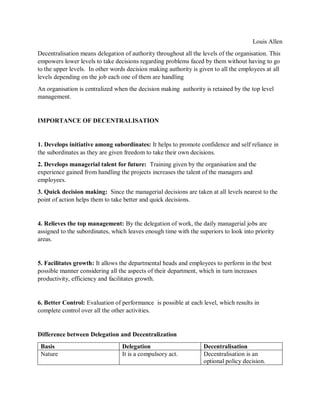
Decentralisation means delegation of authority throughout all the levels of the organisation. This
empowers lower levels to take decisions regarding problems faced by them without having to go
to the upper levels. In other words decision making authority is given to all the employees at all
levels depending on the job each one of them are handling
An organisation is centralized when the decision making authority is retained by the top level
management.
IMPORTANCE OF DECENTRALISATION
1. Develops initiative among subordinates: It helps to promote confidence and self reliance in
the subordinates as they are given freedom to take their own decisions.
2. Develops managerial talent for future: Training given by the organisation and the
experience gained from handling the projects increases the talent of the managers and
employees.
3. Quick decision making: Since the managerial decisions are taken at all levels nearest to the
point of action helps them to take better and quick decisions.
4. Relieves the top management: By the delegation of work, the daily managerial jobs are
assigned to the subordinates, which leaves enough time with the superiors to look into priority
areas.
5. Facilitates growth: It allows the departmental heads and employees to perform in the best
possible manner considering all the aspects of their department, which in turn increases
productivity, efficiency and facilitates growth.
6. Better Control: Evaluation of performance is possible at each level, which results in
complete control over all the other activities.
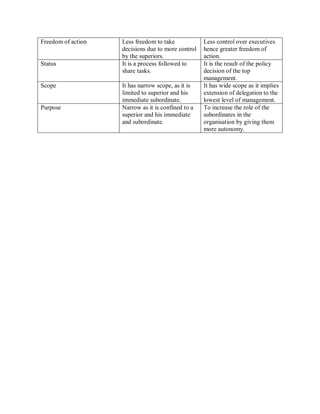
Difference between Delegation and Decentralization
Basis Delegation Decentralisation
Nature It is a compulsory act. Decentralisation is an
optional policy decision.
Freedom of action Less freedom to take
decisions due to more control
by the superiors.
Less control over executives
hence greater freedom of
action.
Status It is a process followed to
share tasks.
It is the result of the policy
decision of the top
management.
Scope It has narrow scope, as it is
limited to superior and his
immediate subordinate.
It has wide scope as it implies
extension of delegation to the
lowest level of management.
Purpose Narrow as it is confined to a
superior and his immediate
and subordinate.
To increase the role of the
subordinates in the
organisation by giving them
more autonomy.

Chapter 5 Organisiing Notes Grade 12.pdf

  • 1.
    CBSE CLASS 12BUSINESS STUDIES CHAPTER – 5 ORGANISATION REVISION NOTES Meaning of Organizing The organising function leads to the creation of an organisational structure which includes the designing of roles to be filled by suitably skilled people and defining the inter relationship between these roles so that ambiguity in performance of duties can be eliminated. The aim of organizing is to enable people to work together for a common purpose. STEPS IN THE PROCESS OF ORGANISING
  • 2.
    1. Identification &Division Of Work: The first step in the process of organizing involves identifying and dividing the work in accordance with the predetermined plans. The work is divided into manageable activities so that duplication of work can be avoided and the burden of work can be shared among the employees. 2. Departmentalization: • Once work is divided into small activities, similar and related jobs are grouped together. This grouping is called departmentalization. • E.g. departmentalization on the basis of territory, products etc. 3. Assignment Of Duties: • It is important to state clearly the work of different job positions and allocate work accordingly to employees. • Once departments are formed, individual department heads are appointed for each departments. • The work must be assigned to those who are best fitted to perform it well. • E.g. finance job should be assigned to persons having qualifications and experience in finance e.g. C.A‘s or MBA finance. 4. Establishing Reporting Relationships: Identification & Division Of Work Departmentalization Assignment Of Duties Establishing Reporting Relationships
  • 3.
    • Establishing authorityand responsibility relationship helps to create a hierarchal structure and also helps in coordination amongst various departments. • Superior subordinate relations between different people and job positions is to be created, so that everybody knows from whom he/she is to taking orders and to whom he/she can issue orders. IMPORTANCE OF ORGANISING 1. Benefits of specialization: • Organising leads to a systematic allocation of jobs amongst the work force. • The division of work into smaller jobs reduces workload and enhance productivity and repetitive performance leads to specialization. 2. Clarity in working relationships: • Organising helps in defining all the jobs and also clarifying the limits of authority and responsibility of each job. IMPORTANCE OF ORGANISING Benefits of specialization Clarity in working relationships Optimum utilization of resources Effective Administration Adaption to Change Development of Personnel Expansion and growth
  • 4.
    • It helpsin creating a hierarchical order thereby enabling the fixation of responsibility and specification of the extent of authority to be exercised by an employee. 3. Optimum utilization of resources: • Organisation leads to usage of all natural resources, financial resources and human resources. • The proper assignment of jobs avoids duplication of work and minimizes wastage of resources. 4. Effective Administration: • It provides a clear description of jobs and related duties, which helps to avoid confusion and duplication of work. • Clarity in working relationships enables proper execution of work, which results ineffective administration. 5. Adaption to Change: • The process of organising is flexible which allows a business enterprise to accommodate changes in the business environment. • It also provide stability to an enterprise. 6. Development of Personnel: • A well designed organization structure encourages initiative and relative thinking on part of the employees. • When managers delegate their authority, it reduces their workload and thus can give time on important areas of growth and opportunity to innovate thereby. 7. Expansion and growth: • Organising helps in growth & diversification of an enterprise. • By adding more job positions, departments, products lines, new geographical territories etc. and thus will help to increase customer base, sales and profit. ORGANISATIONAL STRUCTURE
  • 5.
    The organisation structurecan be defined as the framework within which managerial and operating tasks are performed. It specifies the relationships between people, work and resources in an organisation. Under the organizational structure, various posts are created to perform different activities for the attainment of the predetermined objectives of the enterprise. The structure provides a basis or framework for managers and other employees to perform their functions. Span of management refers to the number of subordinates that can be effectively managed by a superior. The Span of management largely gives shape to the organization structure. This determines the levels of management in the structure. 1. FUNCTIONAL STRUCTURE: In functional structure activities are grouped and departments are created on the basis of specific functions to be performed. For example, all the jobs related to production are grouped under production department, sales departments etc.
  • 6.
    2. DIVISIONAL ORGANIZATIONSTRUCTURE Dividing the whole enterprise according to the major products to be manufactured (like metal, plastic, cosmetics etc.) is known as divisional organization structure. ADVANTAGES • Functional structure leads to occupational specialisation since emphasis is placed on specific functions. • Promotes efficiency in the utilisation of man power. • Promotes control and coordination within a department. • It helps in increasing managerial and operational efficiency. • it reduces duplication of work. • It helps in training employees easily. • It ensures that different functions get due attention. DISADVANTAGES • A Functional structure gives more imortance to the objectives of functional head than the objectives of organisation • Lack of coordination among different departments. • A conflict of interests will arise within different departments. • It may lead to inflexibility due to narrow perspective of employees. SUITABILITY • Organizations which require high degree of functional specialization with diversified activities. • Large organizations producing one line of product.
  • 7.
    ADVANTAGES •Product specialisation helpsin the overall development of the skills of departmental heads. •It helps in the fixation of responsibility and accountability of departmental heads •provides a proper basis for assessing performance and results of each division. •It facilitates expansion and growth, as new divisions can be added without interupting existing divisions DISADVANTAGES •Conflicts may arise among different divisions on allocation of resources. •It may lead to increase in costs since there may be a duplication of activities in different product divisions. •It provides managers with the authority to supervise all activities related to a particular division. SUITABILITY •This structure is suitable in organizations producing multi product or different lines of products requiring product specialization. •Growing companies which intend to add more lines of products in future adopt this structure.
  • 8.
    Comparative view: Functionaland Divisional Structure Basis Functional Structure Divisional Structure Formation Formation Is based on functions Formation is based on product lines and is supported by functions Specialisation Functional specialisation Product specialization Responsibility Difficult to fix on a department Easy to fix responsibility for performance Managerial Development Difficult, as each functional manager has to report to the top management Duplication of resources in various departments, hence costly Cost Functions are not duplicated hence economical Duplication of resources in various departments, hence costly. Coordination Difficult for a multiproduct company. Easy, because all functions related to a particular product are integrated in one department. 3. FORMAL ORGANISATION Formal organisation refers to the organisation structure that is designed by the management to accomplish organizational goals. In a formal organisation the boundaries of authority & responsibility is clearly defined and there is a systematic coordination among the various activities to achieve organizational objectives.
  • 9.
    4. INFORMAL ORGANISATION Interactionamong people at work gives rise to a ‘network of social relationships among employees’ called the informal organisation. The main purpose of this organization structure is the psychological satisfaction of the employees with common interests. For example, employees with similar interest in books, films, religion etc. may form their own informal groups. Features • It clearly defines the lines of authority and responsibility for every individual in an organisation. • It is a means to achieve the objectives specified in the plans. • It is impersonal and doesn’t take into consideration emotional aspect of the employees. • it is designed by the top management. • It is created with the motive of achieving organizational objectives. Advantages • Easier to fix responsibility since mutual relationships are clearly defined • It helps in avoiding duplication of work • Unity of command is maintained • Effective accomplishment of goals. • Provides stability in organisation. Disadvantages • May lead to procedural delays as chain of command has to be followed. • Rigid policies reduces creativity. • More emphasis is on structure and work than on human relationships.
  • 10.
    Difference between FormalInformal Organisation Basis Formal organisation Informal Organsiation Meaning It refers to the structure of well defined authority and It refers to the network of social relationships arising out of interaction among employees Origin As a result of company rules and policies Arises as a result of social interaction Authority Arises by virtues of positions in management Arises out of personal qualities. Adherence to rules Violations of rules may lead to penalties and punishments. No such penalties and punishments. Flow to Communication Communication takes place through the scalar chain Not through a planned route, it can take place in any direction. Purpose To achieve planned organizational objectives. To satisfy social and cultural needs and fulfill common interests Nature Rigid Flexible FEATURES • It originates from the personal interaction of employees within a organisation. • The standards of behaviour evolve from group norms. • It doesnt have fixed channels of communication. • It emerges spontaniously and not created by management. • It is a complex network of social relationships among members. ADVANTAGES • It leads to faster spread of information and feedback as formal channels of communication is not followed. • It enhances job satisfaction and a sense of belongingness in the organisation. • It provide quick solutions to the problems. LIMITATIONS • Informal organisation spread rumours, sometimes it goes aginst the interests of the organisation. • It resists change and lays stress on adopting the old techniques. • members of the group may give more priority to group interests over the organisational objectives.
  • 11.
    Structure Well definedstructure of tasks and relationships. No clear cut structure because of complex network of relationships. Flow of Authority Authority flows from top to bottom i.e. downwards. Authority flows vertically as well as horizontally. Leadership Managers are leaders Leaders may or may not be managers. They are chosen by the group. DELEGATION “Delegation of authority merely means the granting of authority to subordinates to operate within prescribed limits.” Theo Haimman Delegation refers to the downward transfer of authority from a superior to a subordinate employees. It is a pre-requisite to the efficient functioning of an organisation because it enables a manager to use his/ her time on high priority activities. Importance of delegation is that it helps in effective management, employee development, motivation, growth and coordination. ELEMENTS OF DELEGATION 1. Authority: Authority refers to the right to take decisions in order to guide the activities of others. Authority determines the superior subordinate relationship. Laws and the rules and regulations of the organisation restrict authority. Authority flows downward. 2. Responsibility: Responsibility is the obligation of a subordinate to perform properly the assigned duty. If the subordinate has the responsibility for a job, he/ she must be given necessary authority to carry out that task. 3. Accountability: Accountability implies being accountable for the final outcome. When a superior assigns a work to a subordinate, he/she is answerable to the superior for its outcome. Difference between Authority, Responsibility and Accountability
  • 12.
    Basis Authority ResponsibilityAccountability Meaning Right to command Obligation to perform an assigned task. Answerable for the outcome of the assigned task. Origin Arises from formal position Arises from delegated authority Arises from responsibility Delegation Can be delegated Cannot be entirely delegated Cannot be delegated at all Flow Downward flow from superior to subordinate. Upward flow from subordinate to superior. Upward flow from subordinate to superior. IMPORTANCE OF DELEGATION 1. Reduction of Executives’ work load: It reduces the work load of officers. They can thus utilize their time in more important and creative works instead of works of daily routine. 2. Employee development: Employees get more opportunities to utilize their talent which allows them to develop those skills which will enable them to perform complex tasks. 3. Quick and better decision are possible: The subordinate are granted sufficient authority so they need not to go to their superiors for taking decisions concerning the routine matters. 4. High Morale of subordinates: Because of delegation of authority to the subordinates they get an opportunity to display their efficiency and capacity. 5. Better coordination: The elements of delegation – authority, responsibility and accountability help to define the powers, duties and answer ability related to various job positions which results in developing and maintaining effective coordination. DECENTRALISATION “Decentralisation refers to systematic efforts to delegate to the lowest level, all authority except the one which can be exercised at central points”.
  • 13.
    Louis Allen Decentralisation meansdelegation of authority throughout all the levels of the organisation. This empowers lower levels to take decisions regarding problems faced by them without having to go to the upper levels. In other words decision making authority is given to all the employees at all levels depending on the job each one of them are handling An organisation is centralized when the decision making authority is retained by the top level management. IMPORTANCE OF DECENTRALISATION 1. Develops initiative among subordinates: It helps to promote confidence and self reliance in the subordinates as they are given freedom to take their own decisions. 2. Develops managerial talent for future: Training given by the organisation and the experience gained from handling the projects increases the talent of the managers and employees. 3. Quick decision making: Since the managerial decisions are taken at all levels nearest to the point of action helps them to take better and quick decisions. 4. Relieves the top management: By the delegation of work, the daily managerial jobs are assigned to the subordinates, which leaves enough time with the superiors to look into priority areas. 5. Facilitates growth: It allows the departmental heads and employees to perform in the best possible manner considering all the aspects of their department, which in turn increases productivity, efficiency and facilitates growth. 6. Better Control: Evaluation of performance is possible at each level, which results in complete control over all the other activities. Difference between Delegation and Decentralization Basis Delegation Decentralisation Nature It is a compulsory act. Decentralisation is an optional policy decision.
  • 14.
    Freedom of actionLess freedom to take decisions due to more control by the superiors. Less control over executives hence greater freedom of action. Status It is a process followed to share tasks. It is the result of the policy decision of the top management. Scope It has narrow scope, as it is limited to superior and his immediate subordinate. It has wide scope as it implies extension of delegation to the lowest level of management. Purpose Narrow as it is confined to a superior and his immediate and subordinate. To increase the role of the subordinates in the organisation by giving them more autonomy.