ORGANISATIONAL SILOS
and how to fight it
“Silos devastate organizations.
They waste resources, kill productivity,
and jeopardize the achievement of goals.”
(Patrick Lencioni)
A specific mindset within an organization when particular departments, divisions or
business units do not wish to share information with others.
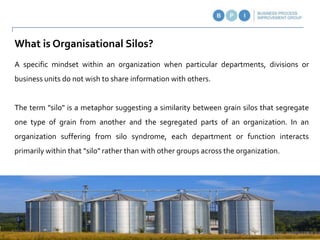
The term "silo" is a metaphor suggesting a similarity between grain silos that segregate
one type of grain from another and the segregated parts of an organization. In an
organization suffering from silo syndrome, each department or function interacts
primarily within that "silo" rather than with other groups across the organization.
What is Organisational Silos?
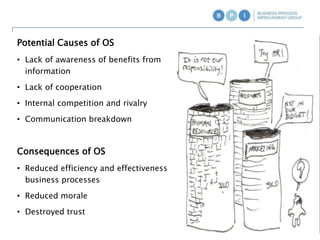
Potential Causes of OS
• Lack of awareness of benefits from
information
• Lack of cooperation
• Internal competition and rivalry
• Communication breakdown
Consequences of OS
• Reduced efficiency and effectiveness
business processes
• Reduced morale
• Destroyed trust
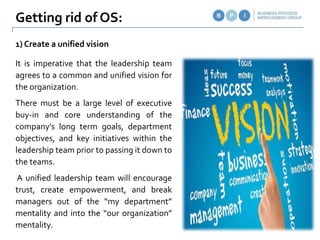
It is imperative that the leadership team
agrees to a common and unified vision for
the organization.
There must be a large level of executive
buy-in and core understanding of the
company’s long term goals, department
objectives, and key initiatives within the
leadership team prior to passing it down to
the teams.
A unified leadership team will encourage
trust, create empowerment, and break
managers out of the “my department”
mentality and into the “our organization”
mentality.
Getting rid of OS:
1) Create a unified vision
Getting rid of OS:
2) Direct the system towards achieving a common goal
Once the leadership team has agreed to the over-arching unified
vision of the organization or system, it is important that this team
determines underlying root problems that may be causing the
ripple effect of silos.
It is also important that all employees are aware of this objective
and understand how they can make an impact individually and what
is their role in the system.
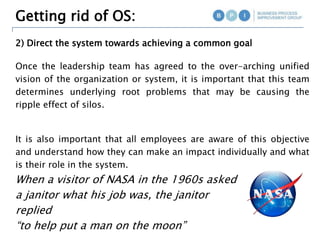
When a visitor of NASA in the 1960s asked
a janitor what his job was, the janitor
replied
“to help put a man on the moon”
Getting rid of OS:
2) Direct the system towards achieving a common goal
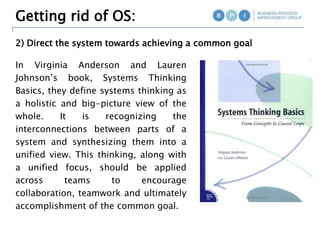
In Virginia Anderson and Lauren
Johnson’s book, Systems Thinking
Basics, they define systems thinking as
a holistic and big-picture view of the
whole. It is recognizing the
interconnections between parts of a
system and synthesizing them into a
unified view. This thinking, along with
a unified focus, should be applied
across teams to encourage
collaboration, teamwork and ultimately
accomplishment of the common goal.
3) Execute and measure
Once the goal common goal of the system is
defined, it also has to be measured
accurately.
The leadership team must establish a time
frame to complete the common goal,
benchmarks for success and delegate
specific tasks and objectives to other
members of the management team.
Regularly scheduled meetings with the
intention to hold each employee
accountable against their assigned task
should be held. It is not uncommon that a
large amount of inertia is needed to keep
the momentum going.
Getting rid of OS:
4) Collaborate and create
Getting rid of OS:
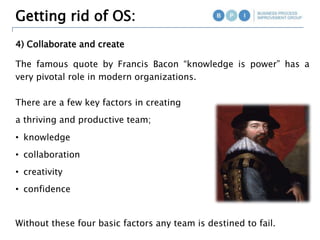
The famous quote by Francis Bacon “knowledge is power” has a
very pivotal role in modern organizations.
There are a few key factors in creating
a thriving and productive team;
• knowledge
• collaboration
• creativity
• confidence
Without these four basic factors any team is destined to fail.
4) Collaborate and create
Getting rid of OS:
To encourage your teams to exhibit all 4 of these traits it is
recommended that management allows and fosters cross-
departmental interaction.
The exchange of knowledge and the collaboration that will
inevitably take place between teams is absolutely priceless.
To maximize collaboration, knowledge, creativity and confidence it
is suggested that management works:
• to reduce unnecessary long and frequent meetings,
• builds out accessible and small meeting rooms,
• implements a cross-departmental training/education system,
• and encourages constructive feedback from outside departments.
Overcoming OS - Improved cycle time
A cross-functional team in one manufacturing company ran a
workshop aimed at reduction of their cycle time from receipt of
tender to delivery. Every function analysed its part of the process.
They were also asked what help they needed from the rest of the
organisation and what help they could give to others. Different
cross-functional project teams were formed to address issues.
After bringing the functions together at the workshop to share the
info, this resulted in them reducing their cycle time from 42 days to
33 days. It also reduced Non-Conformance and increased cash flow
Case Study
References:
Brent Gleeson, The Silos Mentality: How to Break Down the Barriers
Bruce Holland, The Curse of Silos, Slowness and Small-thinking in
Large Mature Organisations
Even Rosen, Collaboration: Smashing Silos
The Silo Mentality: How To Break Down The Barriers

Organisational silos

  • 1.
    ORGANISATIONAL SILOS and howto fight it “Silos devastate organizations. They waste resources, kill productivity, and jeopardize the achievement of goals.” (Patrick Lencioni)
  • 2.
    A specific mindsetwithin an organization when particular departments, divisions or business units do not wish to share information with others. The term "silo" is a metaphor suggesting a similarity between grain silos that segregate one type of grain from another and the segregated parts of an organization. In an organization suffering from silo syndrome, each department or function interacts primarily within that "silo" rather than with other groups across the organization. What is Organisational Silos?
  • 3.
    Potential Causes ofOS • Lack of awareness of benefits from information • Lack of cooperation • Internal competition and rivalry • Communication breakdown Consequences of OS • Reduced efficiency and effectiveness business processes • Reduced morale • Destroyed trust
  • 4.
    It is imperativethat the leadership team agrees to a common and unified vision for the organization. There must be a large level of executive buy-in and core understanding of the company’s long term goals, department objectives, and key initiatives within the leadership team prior to passing it down to the teams. A unified leadership team will encourage trust, create empowerment, and break managers out of the “my department” mentality and into the “our organization” mentality. Getting rid of OS: 1) Create a unified vision
  • 5.
    Getting rid ofOS: 2) Direct the system towards achieving a common goal Once the leadership team has agreed to the over-arching unified vision of the organization or system, it is important that this team determines underlying root problems that may be causing the ripple effect of silos. It is also important that all employees are aware of this objective and understand how they can make an impact individually and what is their role in the system. When a visitor of NASA in the 1960s asked a janitor what his job was, the janitor replied “to help put a man on the moon”
  • 6.
    Getting rid ofOS: 2) Direct the system towards achieving a common goal In Virginia Anderson and Lauren Johnson’s book, Systems Thinking Basics, they define systems thinking as a holistic and big-picture view of the whole. It is recognizing the interconnections between parts of a system and synthesizing them into a unified view. This thinking, along with a unified focus, should be applied across teams to encourage collaboration, teamwork and ultimately accomplishment of the common goal.
  • 7.
    3) Execute andmeasure Once the goal common goal of the system is defined, it also has to be measured accurately. The leadership team must establish a time frame to complete the common goal, benchmarks for success and delegate specific tasks and objectives to other members of the management team. Regularly scheduled meetings with the intention to hold each employee accountable against their assigned task should be held. It is not uncommon that a large amount of inertia is needed to keep the momentum going. Getting rid of OS:
  • 8.
    4) Collaborate andcreate Getting rid of OS: The famous quote by Francis Bacon “knowledge is power” has a very pivotal role in modern organizations. There are a few key factors in creating a thriving and productive team; • knowledge • collaboration • creativity • confidence Without these four basic factors any team is destined to fail.
  • 9.
    4) Collaborate andcreate Getting rid of OS: To encourage your teams to exhibit all 4 of these traits it is recommended that management allows and fosters cross- departmental interaction. The exchange of knowledge and the collaboration that will inevitably take place between teams is absolutely priceless. To maximize collaboration, knowledge, creativity and confidence it is suggested that management works: • to reduce unnecessary long and frequent meetings, • builds out accessible and small meeting rooms, • implements a cross-departmental training/education system, • and encourages constructive feedback from outside departments.
  • 10.
    Overcoming OS -Improved cycle time A cross-functional team in one manufacturing company ran a workshop aimed at reduction of their cycle time from receipt of tender to delivery. Every function analysed its part of the process. They were also asked what help they needed from the rest of the organisation and what help they could give to others. Different cross-functional project teams were formed to address issues. After bringing the functions together at the workshop to share the info, this resulted in them reducing their cycle time from 42 days to 33 days. It also reduced Non-Conformance and increased cash flow Case Study
  • 11.
    References: Brent Gleeson, TheSilos Mentality: How to Break Down the Barriers Bruce Holland, The Curse of Silos, Slowness and Small-thinking in Large Mature Organisations Even Rosen, Collaboration: Smashing Silos The Silo Mentality: How To Break Down The Barriers