



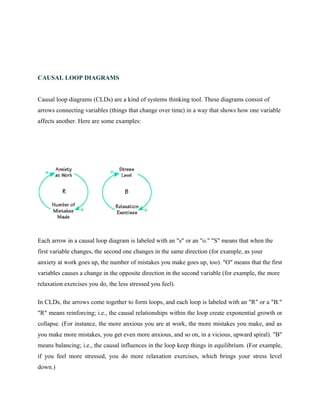




This seminar report provides an overview of systems thinking and key concepts. It defines systems thinking as viewing problems as parts of an overall system rather than in isolation. A system is a collection of parts integrated to accomplish an overall goal, with inputs, processes, outputs and outcomes, and feedback. Systems can be biological, mechanical, social, or other types and range from simple to complex. Systems theory studies principles that can be applied to all types of systems. Some basic principles of systems thinking discussed are that change is slow but lasting, cause and effect are not always closely linked, and easy answers often do not address complexity. The report also lists examples of systems principles like how a system's behavior depends on its structure and how systems seek


