T Shaped People
Agenda
 Concept.
 Origin.
 Benefits.
 Drawbacks and fixes.
 How to become one.
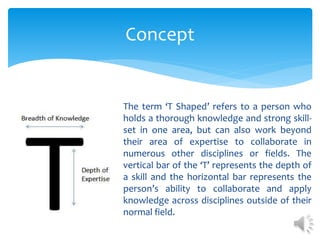
The term ‘T Shaped’ refers to a person who
holds a thorough knowledge and strong skill-
set in one area, but can also work beyond
their area of expertise to collaborate in
numerous other disciplines or fields. The
vertical bar of the ‘T’ represents the depth of
a skill and the horizontal bar represents the
person’s ability to collaborate and apply
knowledge across disciplines outside of their
normal field.
Concept
 The earliest reference is by David Guest in 1991.
 The credited for its popularity goes to Tim Brown CEO of IDEO an
international design and consulting firm founded in California.
“We look for people who are so inquisitive about the world that
they’re willing to try to do what you do. We call them “T-shaped
people.” They have a principal skill that describes the vertical leg of the
T — they’re mechanical engineers or industrial designers. But they are
so empathetic that they can branch out into other skills, such as
anthropology, and do them as well. They are able to explore insights
from many different perspectives and recognize patterns of behavior
that point to a universal human need.”
Origin
 Improved communication and collaboration.
 Improved flexibility.
 Less risk.
 Fewer bottlenecks.
Benefits
Improved communication and collaboration.
They have a good grasp of how everything fits together.
As a result they will typically have a greater
understanding and appreciation of what their
teammates are working on. They are willing to listen to
and work with their teammates because they know that
they'll likely learn something new.
Benefits
Improved flexibility.
More self organizing and cross functional the team is
more it can work flexibly to perform.
Benefits
Less risk.
A team comprising of such people will work together,
learning from each other as they do so. This lowers
overall risk because there is less information, greater
knowledge of the system amongst individual team
members, and growing skills amongst team members.
Benefits
Fewer bottlenecks.
If more people can work on all or more problem area in
a team less is the chance of waiting for a specialist to
do it all in any particular are.
Benefits
 Not all "T"s are Equal
 Identity Crisis
 Knowing Vs Doing
 Collaboration Vs Delegation
 Having Right Tools
Drawbacks and fixes
Not all "T"s are Equal
No one will be a perfect T-shape. This is a fact of life,
someone stronger in one area while moderate in other.
So each team will have a different experience
depending on which T-shape employee is assigned it.
Fix:
 ongoing training
 Process for filling in knowledge gaps
Drawbacks and fixes
Identity Crisis
Not all people will accurately know their skillsets. Some
will think they possess a much wider general knowledge
base while others a much deeper understanding of a
core topic than others
Fix:
 Set clear expectations
 Work with Team
Drawbacks and fixes
Knowing Vs Doing
They need not only be self-aware, but also need to have
the confidence and inclination to act.
Fix:
 Be consistently encouraging
 Clearly state expectations
Drawbacks and fixes
Collaboration Vs Delegation
T-shape people can often misunderstand
"collaboration" as "delegation“. Work together to get
things done.
Fix:
 Make sure people understand their T-shape
capabilities.
 Avoid a culture of "you must be masters of
everything"
Drawbacks and fixes
Having Right Tools
T-shape Employees Can Only Succeed if They Have the
Right Tools
Fix:
 Give them access to the expertise they need to do
their job.
 Encourage them to not only use them, but to speak
up if they need additional tools.
Drawbacks and fixes
 Work closely with others.
 Take general introductory training.
 Gain hands-on experience.
 Obtain mentoring.
 Work in a learning team.
 Read, read, and read.
 Challenge yourself.
 Communicate.
How to become one
Work closely with others.
One of the best ways to learn a new skill is to work side-
by-side with someone that already has that skill. One of
the side benefits of agile practices such as pair
programming and modeling with others is that you
quickly learn new, practical skills.
How to become one
Take general introductory training.
A good place to start learning is an introductory course.
Professional training companies, colleges, and even
conferences are very good sources of introductory
training. Let your manager know that you are interested
in taking training courses; that way when the budget
exists you may be given an opportunity to do so.
How to become one
Gain hands-on experience.
You can read all you want, and you should, and take lots
of training courses, but you do not really learn
something until you try it.
How to become one
Obtain mentoring.
A mentor is someone experienced with a given
technique or technology who guides novices through
the learning process. The best mentors have several
years of experience in the technologies and techniques,
mentoring experience, and good communication skills.
How to become one
Work in a learning team.
An effective way to learn new skills is to work in a
learning team, a small group of people given the task of
working together to learn a particular subject. Learning
teams are often asked to produce a small application
for the company.
How to become one
Read, read, and read.
For your learning efforts to be successful you must
read, read, read. You should read a wide range of
books. Read atleast one book a month just to keep up
with changes in the industry. Also read technical
magazines such as Software Development and business
magazines such as Fortune and The Economist. The Web
also a good source for a lot of great material available
free of charge.
How to become one
Challenge yourself.
Challenge yourself to constantly learn new things. Do
not be afraid of the unknown.
How to become one
Communicate.
Do not take for granted that people will know what you
are doing—or what you want to do. Make it known.
This means marketing yourself internally and letting
everyone around you know what you want out of the
current - and future - positions.
How to become one
A Sci-Fi author Robert Heinlein quoted:
"A human being should be able to change a diaper, plan
an invasion, butcher a hog, conn a ship, design a
building, write a sonnet, balance accounts, build a wall,
set a bone, comfort the dying, take orders, give orders,
cooperate, act alone, solve equations, analyze a new
problem, pitch manure, program a computer, cook a
tasty meal, fight efficiently, die gallantly.
Specialization is for insects."
Ending Note

T shaped people

  • 1.
    T Shaped People Agenda Concept.  Origin.  Benefits.  Drawbacks and fixes.  How to become one.
  • 2.
    The term ‘TShaped’ refers to a person who holds a thorough knowledge and strong skill- set in one area, but can also work beyond their area of expertise to collaborate in numerous other disciplines or fields. The vertical bar of the ‘T’ represents the depth of a skill and the horizontal bar represents the person’s ability to collaborate and apply knowledge across disciplines outside of their normal field. Concept
  • 3.
     The earliestreference is by David Guest in 1991.  The credited for its popularity goes to Tim Brown CEO of IDEO an international design and consulting firm founded in California. “We look for people who are so inquisitive about the world that they’re willing to try to do what you do. We call them “T-shaped people.” They have a principal skill that describes the vertical leg of the T — they’re mechanical engineers or industrial designers. But they are so empathetic that they can branch out into other skills, such as anthropology, and do them as well. They are able to explore insights from many different perspectives and recognize patterns of behavior that point to a universal human need.” Origin
  • 4.
     Improved communicationand collaboration.  Improved flexibility.  Less risk.  Fewer bottlenecks. Benefits
  • 5.
    Improved communication andcollaboration. They have a good grasp of how everything fits together. As a result they will typically have a greater understanding and appreciation of what their teammates are working on. They are willing to listen to and work with their teammates because they know that they'll likely learn something new. Benefits
  • 6.
    Improved flexibility. More selforganizing and cross functional the team is more it can work flexibly to perform. Benefits
  • 7.
    Less risk. A teamcomprising of such people will work together, learning from each other as they do so. This lowers overall risk because there is less information, greater knowledge of the system amongst individual team members, and growing skills amongst team members. Benefits
  • 8.
    Fewer bottlenecks. If morepeople can work on all or more problem area in a team less is the chance of waiting for a specialist to do it all in any particular are. Benefits
  • 9.
     Not all"T"s are Equal  Identity Crisis  Knowing Vs Doing  Collaboration Vs Delegation  Having Right Tools Drawbacks and fixes
  • 10.
    Not all "T"sare Equal No one will be a perfect T-shape. This is a fact of life, someone stronger in one area while moderate in other. So each team will have a different experience depending on which T-shape employee is assigned it. Fix:  ongoing training  Process for filling in knowledge gaps Drawbacks and fixes
  • 11.
    Identity Crisis Not allpeople will accurately know their skillsets. Some will think they possess a much wider general knowledge base while others a much deeper understanding of a core topic than others Fix:  Set clear expectations  Work with Team Drawbacks and fixes
  • 12.
    Knowing Vs Doing Theyneed not only be self-aware, but also need to have the confidence and inclination to act. Fix:  Be consistently encouraging  Clearly state expectations Drawbacks and fixes
  • 13.
    Collaboration Vs Delegation T-shapepeople can often misunderstand "collaboration" as "delegation“. Work together to get things done. Fix:  Make sure people understand their T-shape capabilities.  Avoid a culture of "you must be masters of everything" Drawbacks and fixes
  • 14.
    Having Right Tools T-shapeEmployees Can Only Succeed if They Have the Right Tools Fix:  Give them access to the expertise they need to do their job.  Encourage them to not only use them, but to speak up if they need additional tools. Drawbacks and fixes
  • 15.
     Work closelywith others.  Take general introductory training.  Gain hands-on experience.  Obtain mentoring.  Work in a learning team.  Read, read, and read.  Challenge yourself.  Communicate. How to become one
  • 16.
    Work closely withothers. One of the best ways to learn a new skill is to work side- by-side with someone that already has that skill. One of the side benefits of agile practices such as pair programming and modeling with others is that you quickly learn new, practical skills. How to become one
  • 17.
    Take general introductorytraining. A good place to start learning is an introductory course. Professional training companies, colleges, and even conferences are very good sources of introductory training. Let your manager know that you are interested in taking training courses; that way when the budget exists you may be given an opportunity to do so. How to become one
  • 18.
    Gain hands-on experience. Youcan read all you want, and you should, and take lots of training courses, but you do not really learn something until you try it. How to become one
  • 19.
    Obtain mentoring. A mentoris someone experienced with a given technique or technology who guides novices through the learning process. The best mentors have several years of experience in the technologies and techniques, mentoring experience, and good communication skills. How to become one
  • 20.
    Work in alearning team. An effective way to learn new skills is to work in a learning team, a small group of people given the task of working together to learn a particular subject. Learning teams are often asked to produce a small application for the company. How to become one
  • 21.
    Read, read, andread. For your learning efforts to be successful you must read, read, read. You should read a wide range of books. Read atleast one book a month just to keep up with changes in the industry. Also read technical magazines such as Software Development and business magazines such as Fortune and The Economist. The Web also a good source for a lot of great material available free of charge. How to become one
  • 22.
    Challenge yourself. Challenge yourselfto constantly learn new things. Do not be afraid of the unknown. How to become one
  • 23.
    Communicate. Do not takefor granted that people will know what you are doing—or what you want to do. Make it known. This means marketing yourself internally and letting everyone around you know what you want out of the current - and future - positions. How to become one
  • 24.
    A Sci-Fi authorRobert Heinlein quoted: "A human being should be able to change a diaper, plan an invasion, butcher a hog, conn a ship, design a building, write a sonnet, balance accounts, build a wall, set a bone, comfort the dying, take orders, give orders, cooperate, act alone, solve equations, analyze a new problem, pitch manure, program a computer, cook a tasty meal, fight efficiently, die gallantly. Specialization is for insects." Ending Note