Organisational theories
And principles
Aravind.T.S
KTU- Syllabus
www.aravindts.com
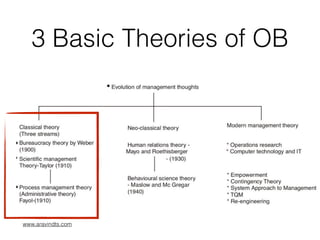
3 Basic Theories of OB
www.aravindts.com
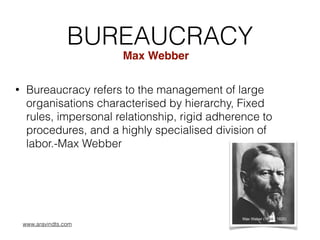
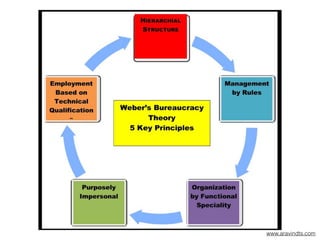
BUREAUCRACY
• Bureaucracy refers to the management of large
organisations characterised by hierarchy, Fixed
rules, impersonal relationship, rigid adherence to
procedures, and a highly specialised division of
labor.-Max Webber
Max Webber
www.aravindts.com
Characteristics of
Bureaucracy
• The rules and job responsibilities are written down
and clearly stated
• Clear hierarchy of power is concentrated among a
few high-ranking managers
• Appointments and promotions of officers are
formal, because these officers will be held
accountable.
www.aravindts.com
Characteristics of
Bureaucracy
• Employees are hired based on their skills and
knowledge, not because of favouritism or luck.
• Salaries are tied to a pay-grade system
• Bureaucracies are unable or unwilling to adapt to
changing conditions quickly (Micro- manageable)
www.aravindts.com
www.aravindts.com
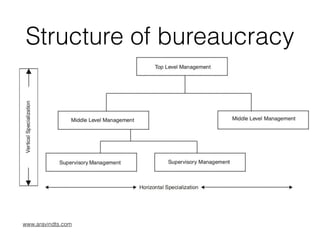
Structure of bureaucracy
www.aravindts.com
•Rigid rules and regulations
• Having no consideration for interpersonal
relationship based on emotions and human qualities
•Power has been considered as the dominant factor
to administer the organization
www.aravindts.com
Drawbacks of Bureaucratic model
•There are glaring drawbacks in the bureaucratic
model namely rigidity, impersonal and mechanistic
relationship.
•Lack of co-ordination and interpersonal
communication and lastly existence of blind faith in
rules and regulations.
www.aravindts.com
Application and Effect
•The system may work in large government
organizations or the organization where there is no
change anticipated.
•The theory does not promote fulfilment of human
needs and does not exploit full potential of
employees.
www.aravindts.com
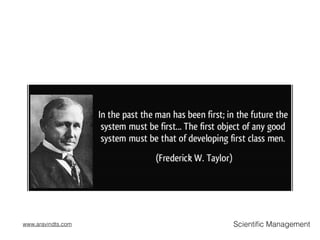
SCIENTIFIC MANAGEMENT -
Knowing exactly what you want men to do and
then see that they do it the best and cheapest way

Fredrick Winslow Taylor
www.aravindts.com
Scientific Managementwww.aravindts.com
Scientific Management www.aravindts.com
Features of Scientific
Management
•Separation of Planning and doing
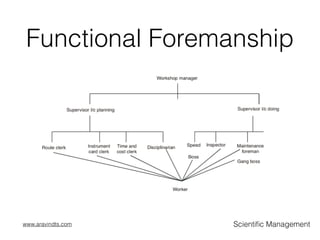
•Functional foremanship
•Job Analysis
•Standardisation
•Scientific selection and training of workers
•Financial incentives
•Economies
•Mentalrevolution 


•

Scientific Managementwww.aravindts.com
Separation of Planning and doing
Taylor divided the entire work into two parts namely
planning and doing. It was the responsibility of
supervisors to plan the work that an individual worker
is required to do and ensure that the tools required by
them are made available to them.
Scientific Managementwww.aravindts.com
Functional Foremanship
Scientific Managementwww.aravindts.com
Scientific selection and
training of workers
Workers selection should be carried out on
scientific basis. Taylor suggested that workers
should be given adequate training and work allotted
based on their physical and technical aptitude. 

Scientific Managementwww.aravindts.com
Financial incentives 

•He fixed targets for each work and they were paid
based on efficiency.
•Anybody who worked beyond the laid down target
were paid higher rate of wages and any employee
who could not meet allotted target was paid below
the laid down rate. 

www.aravindts.com
Economies
Taylor insisted that internal economy must been
sured by each worker ensuring that there was no
wastage in time and material while carrying out the
job. 

www.aravindts.com
Mental revolution 

Taylor was a firm believer that there must be sound
relations between the management and the workers. 

www.aravindts.com
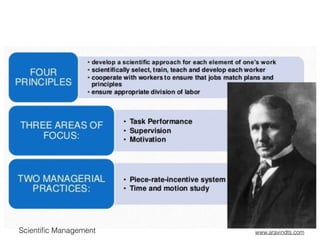
Principles of Scientific
Management
• Replacing Rule of Thumb with Science
• Harmony in Group Action
• Co-operation
• Maximum Output and development of workers 


www.aravindts.com
PROCESS MANAGEMENT
THEORY
He has used the term ‘administration’ instead of
management emphasising that there is unity of
science of administration.
www.aravindts.com
Industrial Activities
1.Technical – relating to production and maintenance
2. Commercial – buying, selling and exchange.
3. Financial – search for capital and its optimum utilization. 

4. Security – protection of property and human beings 

5. Accounting – accounting of stores and equipment. Statistics is also covered
under accounting. 

6. Managerial – activities include planning, organizing, commanding, coordinating
and control. 

www.aravindts.com
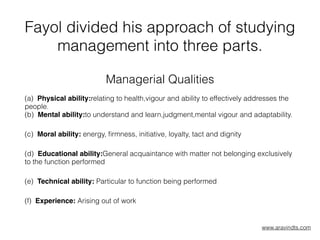
Fayol divided his approach of studying
management into three parts.
Managerial Qualities
(a)  Physical ability:relating to health,vigour and ability to effectively addresses the
people. 

(b)  Mental ability:to understand and learn,judgment,mental vigour and adaptability. 

(c)  Moral ability: energy, firmness, initiative, loyalty, tact and dignity 

(d)  Educational ability:General acquaintance with matter not belonging exclusively
to the function performed 

(e)  Technical ability: Particular to function being performed 

(f)  Experience: Arising out of work 

www.aravindts.com
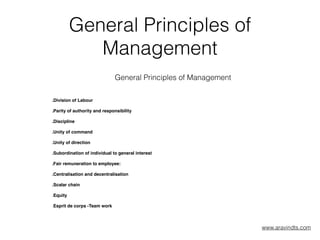
General Principles of
Management
General Principles of Management
.Division of Labour
.Parity of authority and responsibility
.Discipline
.Unity of command
.Unity of direction
.Subordination of individual to general interest
.Fair remuneration to employee:
.Centralisation and decentralisation
.Scalar chain
.Equity
.Esprit de corps -Team work


www.aravindts.com
www.aravindts.com
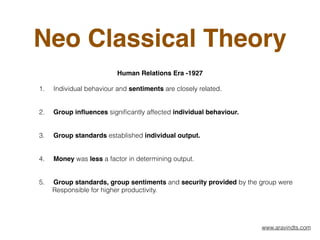
Neo Classical Theory
Human Relations Era -1927
1. Individual behaviour and sentiments are closely related. 

2. Group influences significantly affected individual behaviour. 

3. Group standards established individual output. 

4. Money was less a factor in determining output. 

5. Group standards, group sentiments and security provided by the group were 

Responsible for higher productivity. 

www.aravindts.com
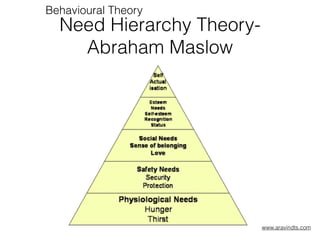
Need Hierarchy Theory-
Abraham Maslow
Behavioural Theory
www.aravindts.com
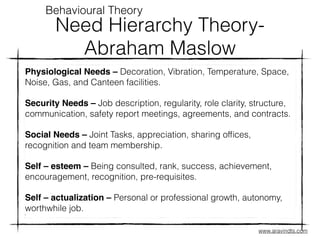
Need Hierarchy Theory-
Abraham Maslow
Physiological Needs – Decoration, Vibration, Temperature, Space,
Noise, Gas, and Canteen facilities.
Security Needs – Job description, regularity, role clarity, structure,
communication, safety report meetings, agreements, and contracts.
Social Needs – Joint Tasks, appreciation, sharing offices,
recognition and team membership.
Self – esteem – Being consulted, rank, success, achievement,
encouragement, recognition, pre-requisites.
Self – actualization – Personal or professional growth, autonomy,
worthwhile job.
•
Behavioural Theory
www.aravindts.com
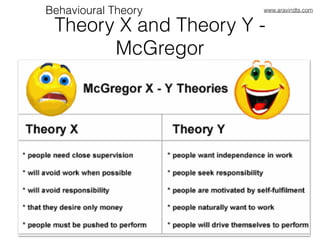
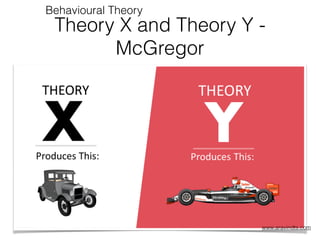
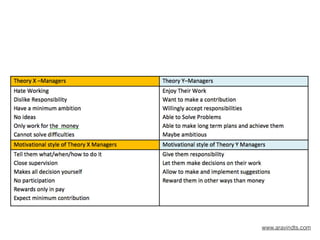
Theory X and Theory Y -
McGregor
Behavioural Theory www.aravindts.com
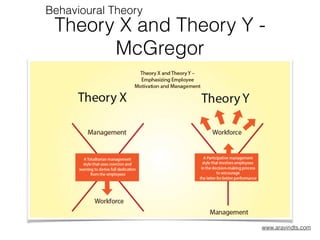
Theory X and Theory Y -
McGregor
Behavioural Theory
www.aravindts.com
Theory X and Theory Y -
McGregor
Behavioural Theory
www.aravindts.com
www.aravindts.com
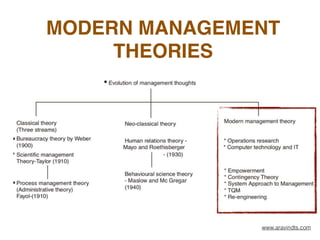
MODERN MANAGEMENT
THEORIES
www.aravindts.com
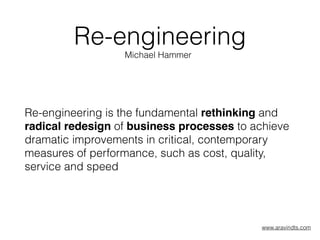
Re-engineering
Re-engineering is the fundamental rethinking and
radical redesign of business processes to achieve
dramatic improvements in critical, contemporary
measures of performance, such as cost, quality,
service and speed
Michael Hammer
www.aravindts.com
Re-engineering involves
total redesign of the job
www.aravindts.com
•The process of re- engineering begins with a clean
slate and a job is planned from beginning till end.
•The objective of re-engineering is to improve
efficiency, performance and overall productivity.
www.aravindts.com
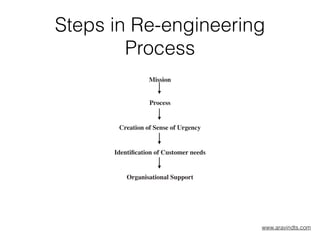
Steps in Re-engineering
Process
Mission
Process
Creation of Sense of Urgency
Identification of Customer needs
Organisational Support 

www.aravindts.com
Benchmarking
Benchmarking is the process of comparing work and
service methods against the best practices and
outcomes for the purpose of identifying changes that
will result in higher quality output.
www.aravindts.com
Empowerment
Empowerment is defined as “a process that enhances
intrinsic work motivation by positively influencing
impact, competence, meaningfulness and choice.
www.aravindts.com
Systems Approach to
Management
Defines system as an organized, unitary whole
composed of two or more interdependent parts,
components, or sub – systems and delineated by
identifiable boundaries from its environmental system.
www.aravindts.com
TQM
1.Build awareness of the need to improve
2. Set goals for improvement
3. Organize so as to reach the goals
4. Provide training
5. Conduct projects to solve problems
6. Report progress
7. Give recognition
8. Communicate results
9. Keep score of progress achieved
10. Maintain the momentum by making annual improvement part of the regular system
and processes of the company.
F. Juran
www.aravindts.com
Thank you
www.aravindts.com

Organisational Behaviour Theories and Principles

  • 1.
  • 2.
    3 Basic Theoriesof OB www.aravindts.com
  • 3.
    BUREAUCRACY • Bureaucracy refersto the management of large organisations characterised by hierarchy, Fixed rules, impersonal relationship, rigid adherence to procedures, and a highly specialised division of labor.-Max Webber Max Webber www.aravindts.com
  • 4.
    Characteristics of Bureaucracy • Therules and job responsibilities are written down and clearly stated • Clear hierarchy of power is concentrated among a few high-ranking managers • Appointments and promotions of officers are formal, because these officers will be held accountable. www.aravindts.com
  • 5.
    Characteristics of Bureaucracy • Employeesare hired based on their skills and knowledge, not because of favouritism or luck. • Salaries are tied to a pay-grade system • Bureaucracies are unable or unwilling to adapt to changing conditions quickly (Micro- manageable) www.aravindts.com
  • 6.
  • 7.
  • 8.
    •Rigid rules andregulations • Having no consideration for interpersonal relationship based on emotions and human qualities •Power has been considered as the dominant factor to administer the organization www.aravindts.com
  • 9.
    Drawbacks of Bureaucraticmodel •There are glaring drawbacks in the bureaucratic model namely rigidity, impersonal and mechanistic relationship. •Lack of co-ordination and interpersonal communication and lastly existence of blind faith in rules and regulations. www.aravindts.com
  • 10.
    Application and Effect •Thesystem may work in large government organizations or the organization where there is no change anticipated. •The theory does not promote fulfilment of human needs and does not exploit full potential of employees. www.aravindts.com
  • 11.
    SCIENTIFIC MANAGEMENT - Knowingexactly what you want men to do and then see that they do it the best and cheapest way
 Fredrick Winslow Taylor www.aravindts.com
  • 12.
  • 13.
  • 14.
    Features of Scientific Management •Separationof Planning and doing •Functional foremanship •Job Analysis •Standardisation •Scientific selection and training of workers •Financial incentives •Economies •Mentalrevolution 
 
 •
 Scientific Managementwww.aravindts.com
  • 15.
    Separation of Planningand doing Taylor divided the entire work into two parts namely planning and doing. It was the responsibility of supervisors to plan the work that an individual worker is required to do and ensure that the tools required by them are made available to them. Scientific Managementwww.aravindts.com
  • 16.
  • 17.
    Scientific selection and trainingof workers Workers selection should be carried out on scientific basis. Taylor suggested that workers should be given adequate training and work allotted based on their physical and technical aptitude. 
 Scientific Managementwww.aravindts.com
  • 18.
    Financial incentives 
 •Hefixed targets for each work and they were paid based on efficiency. •Anybody who worked beyond the laid down target were paid higher rate of wages and any employee who could not meet allotted target was paid below the laid down rate. 
 www.aravindts.com
  • 19.
    Economies Taylor insisted thatinternal economy must been sured by each worker ensuring that there was no wastage in time and material while carrying out the job. 
 www.aravindts.com
  • 20.
    Mental revolution 
 Taylorwas a firm believer that there must be sound relations between the management and the workers. 
 www.aravindts.com
  • 21.
    Principles of Scientific Management •Replacing Rule of Thumb with Science • Harmony in Group Action • Co-operation • Maximum Output and development of workers 


 www.aravindts.com
  • 22.
    PROCESS MANAGEMENT THEORY He hasused the term ‘administration’ instead of management emphasising that there is unity of science of administration. www.aravindts.com
  • 23.
    Industrial Activities 1.Technical –relating to production and maintenance 2. Commercial – buying, selling and exchange. 3. Financial – search for capital and its optimum utilization. 
 4. Security – protection of property and human beings 
 5. Accounting – accounting of stores and equipment. Statistics is also covered under accounting. 
 6. Managerial – activities include planning, organizing, commanding, coordinating and control. 
 www.aravindts.com
  • 24.
    Fayol divided hisapproach of studying management into three parts. Managerial Qualities (a)  Physical ability:relating to health,vigour and ability to effectively addresses the people. 
 (b)  Mental ability:to understand and learn,judgment,mental vigour and adaptability. 
 (c)  Moral ability: energy, firmness, initiative, loyalty, tact and dignity 
 (d)  Educational ability:General acquaintance with matter not belonging exclusively to the function performed 
 (e)  Technical ability: Particular to function being performed 
 (f)  Experience: Arising out of work 
 www.aravindts.com
  • 25.
    General Principles of Management GeneralPrinciples of Management .Division of Labour .Parity of authority and responsibility .Discipline .Unity of command .Unity of direction .Subordination of individual to general interest .Fair remuneration to employee: .Centralisation and decentralisation .Scalar chain .Equity .Esprit de corps -Team work
 
 
 www.aravindts.com
  • 26.
  • 27.
    Neo Classical Theory HumanRelations Era -1927 1. Individual behaviour and sentiments are closely related. 
 2. Group influences significantly affected individual behaviour. 
 3. Group standards established individual output. 
 4. Money was less a factor in determining output. 
 5. Group standards, group sentiments and security provided by the group were 
 Responsible for higher productivity. 
 www.aravindts.com
  • 28.
    Need Hierarchy Theory- AbrahamMaslow Behavioural Theory www.aravindts.com
  • 29.
    Need Hierarchy Theory- AbrahamMaslow Physiological Needs – Decoration, Vibration, Temperature, Space, Noise, Gas, and Canteen facilities. Security Needs – Job description, regularity, role clarity, structure, communication, safety report meetings, agreements, and contracts. Social Needs – Joint Tasks, appreciation, sharing offices, recognition and team membership. Self – esteem – Being consulted, rank, success, achievement, encouragement, recognition, pre-requisites. Self – actualization – Personal or professional growth, autonomy, worthwhile job. • Behavioural Theory www.aravindts.com
  • 30.
    Theory X andTheory Y - McGregor Behavioural Theory www.aravindts.com
  • 31.
    Theory X andTheory Y - McGregor Behavioural Theory www.aravindts.com
  • 32.
    Theory X andTheory Y - McGregor Behavioural Theory www.aravindts.com
  • 33.
  • 34.
  • 35.
    Re-engineering Re-engineering is thefundamental rethinking and radical redesign of business processes to achieve dramatic improvements in critical, contemporary measures of performance, such as cost, quality, service and speed Michael Hammer www.aravindts.com
  • 36.
    Re-engineering involves total redesignof the job www.aravindts.com
  • 37.
    •The process ofre- engineering begins with a clean slate and a job is planned from beginning till end. •The objective of re-engineering is to improve efficiency, performance and overall productivity. www.aravindts.com
  • 38.
    Steps in Re-engineering Process Mission Process Creationof Sense of Urgency Identification of Customer needs Organisational Support 
 www.aravindts.com
  • 39.
    Benchmarking Benchmarking is theprocess of comparing work and service methods against the best practices and outcomes for the purpose of identifying changes that will result in higher quality output. www.aravindts.com
  • 40.
    Empowerment Empowerment is definedas “a process that enhances intrinsic work motivation by positively influencing impact, competence, meaningfulness and choice. www.aravindts.com
  • 41.
    Systems Approach to Management Definessystem as an organized, unitary whole composed of two or more interdependent parts, components, or sub – systems and delineated by identifiable boundaries from its environmental system. www.aravindts.com
  • 42.
    TQM 1.Build awareness ofthe need to improve 2. Set goals for improvement 3. Organize so as to reach the goals 4. Provide training 5. Conduct projects to solve problems 6. Report progress 7. Give recognition 8. Communicate results 9. Keep score of progress achieved 10. Maintain the momentum by making annual improvement part of the regular system and processes of the company. F. Juran www.aravindts.com
  • 43.