The Evolution of
Management Theory
Why learn Management Theories?
2–2
• Knowledge of management history can help
us better understand current management
practices while avoiding some mistakes of the
past. The practice of management has always
reflected historical times and societal
conditions. For instance, innovation, global
competition, and general competitive
pressures reflect a reality of today’s business
world: “Innovate or lose.”
3
Evolution of Management
“The Industrial Revolution is possibly the most important
pre-twentieth-century influence on management. The
introduction of machine powers combined with the division
of labor made large, efficient factories possible. Planning,
organizing, leading, and controlling became necessary
activities.”
• Managers of organizations began seeking ways to
better satisfy customer needs.
• Social problems developed in the large groups of
workers employed under the factory system.
2–4
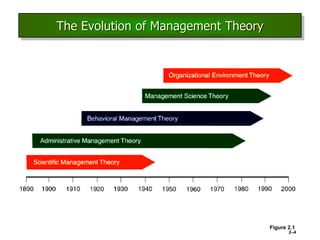
The Evolution of Management Theory
Figure 2.1
What we call modern management
today came into existence with the
boom of the industrial revolution
and several key theories such as
Fayol, Taylor, Werber and Follett.
Modern management
encompasses the scientific school
of thought, Behaviorist ,The
human relations school of thought,
and others which are then grouped
together based on the time period
in which they arose.
2–5
Modern Management
Historical Background
• Modern management theory can be
conceptualized as a direct reaction to the
technological and economic breakthroughs of the
industrial revolution.
• As industrialization brought about the need to
increase production ,so too did it create a need for
an ample work force, one which would be trained
and managed at each step through the chain of
command.
• As the enterprise increased ,theories, on the best
way to manage such a robust workforce
abounded. These theories focused on the end
goals of an organization, the task and the projects
which must be completed for the company
success.
Modern Management Facets:
• Modern management is best understood as
the collection of ideas relating to all aspects of
work organizations.
• Main area of investigation includes:
• Structure authority and Control
• Science technology and skills
• Administration communication and human
interaction.
Scientific Management theory
• Scientific management is defined as the use of
the scientific method to determine the “one best
way” for a job to be done.
Scientific Management Theory
2–9
Job Specialization and
the Division of Labor
• Adam Smith (18th century economist)
Observed that firms manufactured pins in one of
two different ways:
• Craft-style—each worker did all steps.
• Production—each worker specialized in one step.
Realized that job specialization resulted in much
higher efficiency and productivity
• Breaking down the total job allowed for the division of
labor in which workers became very skilled at their
specific tasks.
2–10
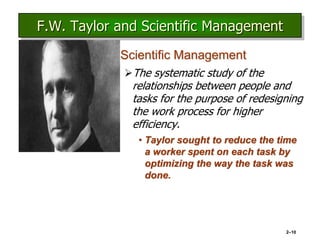
F.W. Taylor and Scientific Management
• Scientific Management
The systematic study of the
relationships between people and
tasks for the purpose of redesigning
the work process for higher
efficiency.
• Taylor sought to reduce the time
a worker spent on each task by
optimizing the way the task was
done.
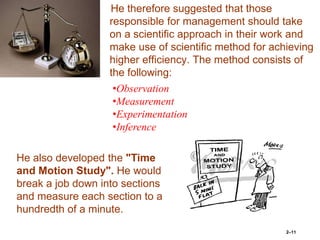
He therefore suggested that those
responsible for management should take
on a scientific approach in their work and
make use of scientific method for achieving
higher efficiency. The method consists of
the following:
2–11
•Observation
•Measurement
•Experimentation
•Inference
He also developed the "Time
and Motion Study". He would
break a job down into sections
and measure each section to a
hundredth of a minute.
2–12
Four Principles of Scientific Management
Principles to increase efficiency:
1. Study the ways jobs are performed now and
determine new ways to do them.
• Gather detailed time and motion information.
• Try different methods to see which is best.
2. Codify the new methods into rules.
• Teach to all workers the new method.
3. Select workers whose skills match the rules.
4. Establish fair levels of performance and pay
a premium for higher performance.
• Workers should benefit from higher output
Advantages
• The advantage of this Theory is that
organizations became much more successful
and flexible. Also, each individual member of
staff were scientifically trained and developed
rather than leaving them to train themselves,
giving them a much more successful working
environment and the stability of a long term
working relationship.
2–13
• The Theory also has its disadvantages, as some
workers resented the idea of being watched and
timed and this led to many strikes
• Managers often implemented only the
increased output side of Taylor’s plan.
 They did not allow workers to share in increased
output.
 Specialized jobs became very boring, dull.
 Workers ended up distrusting Scientific Management.
• Workers could purposely “under-perform”
• Management responded with increased use
of machines.
Problems
• Frank and Lillian Gilbreth refined Taylor’s
methods.
 Made many improvements to time and motion studies.
• Time and motion studies:
 1. Break down each action into components.
 2. Find better ways to perform it.
 3. Reorganize each action to be more efficient.
• Gilbreths also studied fatigue problems, lighting,
heating and other worker issues.
Frank and Lillian Gilbreth
How Do Today’s Managers Use
Scientific Management?
Guidelines devised by Taylor and others to improve
production efficiency are still used in today’s
organizations. However, current management practice
is not restricted to scientific management practices
alone. Elements of scientific management still used
include:
1. Using time and motion studies
2. Hiring best qualified workers
3. Designing incentive systems based on output
2–16
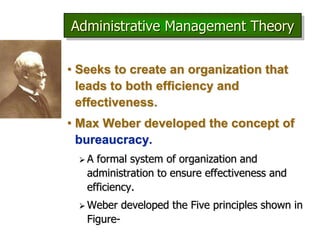
• Seeks to create an organization that
leads to both efficiency and
effectiveness.
• Max Weber developed the concept of
bureaucracy.
 A formal system of organization and
administration to ensure effectiveness and
efficiency.
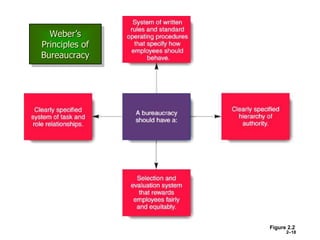
 Weber developed the Five principles shown in
Figure-
Administrative Management Theory
2–18
Weber’s
Principles of
Bureaucracy
Figure 2.2
2–19
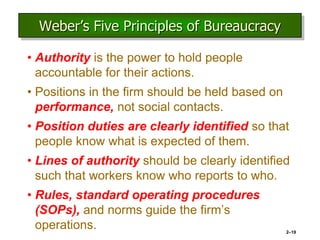
Weber’s Five Principles of Bureaucracy
• Authority is the power to hold people
accountable for their actions.
• Positions in the firm should be held based on
performance, not social contacts.
• Position duties are clearly identified so that
people know what is expected of them.
• Lines of authority should be clearly identified
such that workers know who reports to who.
• Rules, standard operating procedures
(SOPs), and norms guide the firm’s
operations.
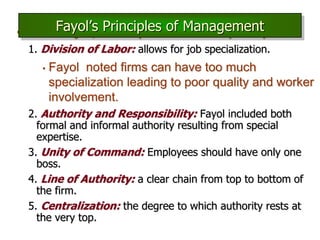
• Henri Fayol, developed a set of 14 principles:
1. Division of Labor: allows for job specialization.
• Fayol noted firms can have too much
specialization leading to poor quality and worker
involvement.
2. Authority and Responsibility: Fayol included both
formal and informal authority resulting from special
expertise.
3. Unity of Command: Employees should have only one
boss.
4. Line of Authority: a clear chain from top to bottom of
the firm.
5. Centralization: the degree to which authority rests at
the very top.
Fayol’s Principles of Management
6. Unity of Direction: One plan of action to
guide the organization.
7. Equity: Treat all employees fairly in
justice and respect.
8. Order: Each employee is put where they
have the most value.
9. Initiative: Encourage innovation.
10. Discipline: obedient, applied, respectful
employees needed.
Fayol’s Principles of Management
11. Remuneration of Personnel: The
payment system contributes to success.
12. Stability of Tenure: Long-term
employment is important.
13. General interest over individual
interest: The organization takes
precedence over the individual.
14. Esprit de corps: Share enthusiasm or
devotion to the organization.
Fayol’s Principles of Management
Some current management concepts and theories can
be traced to the work of the general administrative
theorists.
1.The functional view of a manager’s job relates to
Henri Fayol’s concept of management.
2.Weber’s bureaucratic characteristics are evident in
many of today’s large organizations—even in highly
flexible organizations that employ talented
professionals. Some bureaucratic mechanisms are
necessary in highly innovative organizations to ensure
that resources are used efficiently and effectively.
2–23
How Do Today’s Managers Use
General Administrative Theories?
2–24
Management Science Theory
• The quantitative approach to management, sometimes
known as operations research or management science,
uses quantitative techniques to improve decision making.
This approach includes applications of statistics,
optimization models, information models, and computer
simulations.
Quantitative management—utilizes linear
programming, modeling, simulation systems.
Operations management—techniques to analyze all
aspects of the production system.
Total Quality Management (TQM)—focuses on
improving quality throughout an organization.
Management Information Systems (MIS)—provides
information about the organization.
• 1. The quantitative approach has contributed
most directly to managerial decision making,
particularly in planning and controlling.
• 2. The availability of sophisticated computer
software programs has made the use of
quantitative techniques more feasible for
managers.
2–25
How Do Today’s Managers Use
The Quantitative Approach?
2–26
Behavioral Management Theory
• Focuses on the way a manager should
personally manage to motivate employees.
• Mary Parker Follett: an influential leader in
early managerial theory.
 Suggested workers help in analyzing their jobs for
improvements.
 The worker knows the best way to improve the job.
 If workers have the knowledge of the task, then they
should control the task.
Cont..
• The field of study concerned with the actions
(behaviors) of people at work is
organizational behavior. Organizational
behavior (OB) research has contributed much
of what we know about human resources
management and contemporary views of
motivation, leadership, trust, teamwork, and
conflict management.
2–27
• Study of worker efficiency at the Hawthorne
Works of the Western Electric Co. during
1924-1932.
 Worker productivity was measured at various
levels of light illumination.
 Researchers found that regardless of whether the
light levels were raised or lowered, productivity rose.
• Actually, it appears that the workers enjoyed
the attention they received as part of the
study and were more productive.
Hawthorne Study
2–29
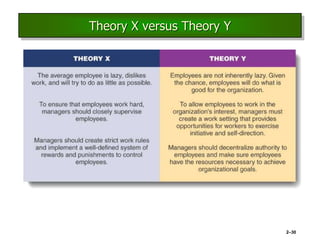
Theory X and Theory Y
• Douglas McGregor proposed the two different
sets of assumptions about workers.
Theory X assumes the average worker is lazy,
dislikes work and will do as little as possible.
• Managers must closely supervise and control through
reward and punishment.
Theory Y assumes workers are not lazy, want to do
a good job and the job itself will determine if the
worker likes the work.
• Managers should allow workers greater latitude, and
create an organization to stimulate the workers.
2–30
Theory X versus Theory Y
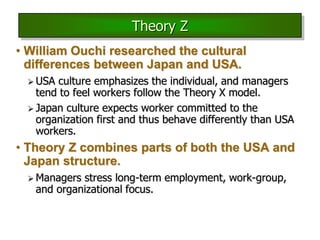
• William Ouchi researched the cultural
differences between Japan and USA.
 USA culture emphasizes the individual, and managers
tend to feel workers follow the Theory X model.
 Japan culture expects worker committed to the
organization first and thus behave differently than USA
workers.
• Theory Z combines parts of both the USA and
Japan structure.
 Managers stress long-term employment, work-group,
and organizational focus.
Theory Z
• 1. The behavioral approach assists managers
in designing jobs that motivate workers, in
working with employee teams, and in facilitating
the flow of communication within organizations.
• 2. The behavioral approach provides the
foundation for current theories of motivation,
leadership, and group behavior and
development.
2–32
How Do Today’s Managers Use
The Behavioral Approach?
THE SYSTEMS APPROACH
• During the 1960s researchers began to
analyze organizations from a systems
perspective based on the physical sciences. A
system is a set of interrelated and
interdependent parts arranged in a manner
that produces a unified whole. The two basic
types of systems are open and closed. A
closed system is not influenced by and does
not interact with its environment. An open
system interacts with its environment
2–33
Cont..
• Using the systems approach, managers envision an
organization as a body with many interdependent
parts, each of which is important to the well-being of
the organization as a whole.
• Managers coordinate the work activities of the various
parts of the organization, realizing that decisions and
actions taken in one organizational area will affect
other areas.
• The systems approach recognizes that organizations
are not self-contained; they rely on and are affected
by factors in their external environment.
2–34
2–35
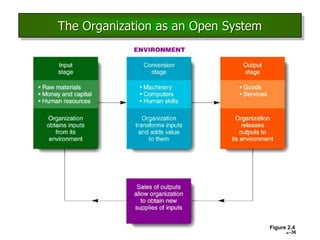
The Open-Systems View
• Open System
A system that takes resources for its external
environment and converts them into goods and
services that are then sent back to that
environment for purchase by customers.
Inputs: the acquisition of external resources.
Conversion: the processing of inputs into goods and
services.
Output: the release of finished goods into the
environment.
2–36
The Organization as an Open System
Figure 2.4
2–37
Other System Considerations
• Closed system
A system that is self-contained and thus not
affected by changes occurring in its external
environment.
Often undergoes entropy and loses its ability to
control itself, and fails.
2–38
Contingency Theory
• Contingency Theory
• The contingency approach recognizes that
different organizations require different ways
of managing.
• The contingency approach to management is a
view that the organization recognizes and
responds to situational variables as they arise.
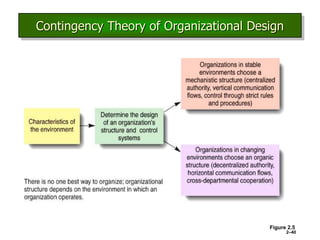
The idea that the organizational structures and
control systems manager choose depend on—are
contingent on—characteristics of the external
environment in which the organization operates.
Assumes there is no one best way to manage.
• The environment impacts the firm and managers
must be flexible to react to environmental changes.
In rapidly changing organizational environments,
managers must find ways to coordinate different
departments to respond quickly and effectively
2–39
2–40
Contingency Theory of Organizational Design
Figure 2.5
CURRENT TRENDS AND ISSUES
• After the study of the history and development
of management theories, students can better
understand how current concepts and
practices are changing the way managers do
their jobs today.
Globalization. Organizational operations are
no longer limited by national borders.
Managers throughout the world must deal with
new opportunities and challenges inherent in
the globalization of business.
2–41
Ethics. Cases of corporate lying, misrepresentations,
and financial manipulations have been widespread in
recent years.
• While most managers continue to behave in a highly
ethical manner, abuses suggest a need to “upgrade”
ethical standards.
• Ethics education is increasingly emphasized in college
curricula today.
• Organizations are taking a more active role in creating
and using codes of ethics, ethics training programs,
and ethical hiring procedures.
2–42
Workforce diversity refers to a workforce that is
heterogeneous in terms of gender, race, ethnicity,
age, and other characteristics that reflect differences.
• Workforce diversity is a global issue.
• The assimilation (“melting pot”) model used before
the early 1980s has been replaced by the recognition
and celebration of differences.
• Accommodating diverse groups of people by
addressing different lifestyles, family needs, and work
styles is a major challenge for today’s managers
• Wise managers value diversity as an asset in bringing
a broad range of viewpoints and problem-solving skills
to an organization.
2–43
Entrepreneurship is the process whereby an
individual or group of individuals use organized efforts
to pursue opportunities to create value and grow by
fulfilling wants and needs through innovation and
uniqueness, no matter what resources the
entrepreneur currently has.
1. Three important themes stand out in this
definition:
a. The pursuit of opportunities
b. Innovation
c. Growth
2. Entrepreneurship will continue to be important to
societies around the world. 2–44
Managing in an E-Business World
• 1. E-business (electronic business) is a
comprehensive term describing the way an
organization does its work by using electronic
(Internet-based) linkages with its key constituencies in
order to efficiently and effectively achieve its goals.
• 2. While critics questioned the viability of Internet-
based companies (dot-coms) after the high-tech
implosion in 2000 and 2001, e-business is here to
stay.
• 3. E-commerce (electronic commerce) is the sales
and marketing component of e-business.
2–45
Knowledge Management and Learning
Organizations.
• Change is occurring at an unprecedented rate.
• To be successful, today’s organization must
become a learning organization—one that
has developed the capacity to continuously
learn, adapt, and change.
2–46
Quality Management.
• Quality management is a philosophy of
management that is driven by continual
improvement and response to customer
needs and expectations
• TQM represents a counterpoint to earlier
management theorists who believed that low
costs were the only road to increased
productivity.The objective of quality
management is to create an organization
committed to continuous improvement in work
processes. 2–47

MASSE-1(Module1).ppt

  • 1.
  • 2.
    Why learn ManagementTheories? 2–2 • Knowledge of management history can help us better understand current management practices while avoiding some mistakes of the past. The practice of management has always reflected historical times and societal conditions. For instance, innovation, global competition, and general competitive pressures reflect a reality of today’s business world: “Innovate or lose.”
  • 3.
    3 Evolution of Management “TheIndustrial Revolution is possibly the most important pre-twentieth-century influence on management. The introduction of machine powers combined with the division of labor made large, efficient factories possible. Planning, organizing, leading, and controlling became necessary activities.” • Managers of organizations began seeking ways to better satisfy customer needs. • Social problems developed in the large groups of workers employed under the factory system.
  • 4.
    2–4 The Evolution ofManagement Theory Figure 2.1
  • 5.
    What we callmodern management today came into existence with the boom of the industrial revolution and several key theories such as Fayol, Taylor, Werber and Follett. Modern management encompasses the scientific school of thought, Behaviorist ,The human relations school of thought, and others which are then grouped together based on the time period in which they arose. 2–5 Modern Management
  • 6.
    Historical Background • Modernmanagement theory can be conceptualized as a direct reaction to the technological and economic breakthroughs of the industrial revolution. • As industrialization brought about the need to increase production ,so too did it create a need for an ample work force, one which would be trained and managed at each step through the chain of command. • As the enterprise increased ,theories, on the best way to manage such a robust workforce abounded. These theories focused on the end goals of an organization, the task and the projects which must be completed for the company success.
  • 7.
    Modern Management Facets: •Modern management is best understood as the collection of ideas relating to all aspects of work organizations. • Main area of investigation includes: • Structure authority and Control • Science technology and skills • Administration communication and human interaction.
  • 8.
    Scientific Management theory •Scientific management is defined as the use of the scientific method to determine the “one best way” for a job to be done. Scientific Management Theory
  • 9.
    2–9 Job Specialization and theDivision of Labor • Adam Smith (18th century economist) Observed that firms manufactured pins in one of two different ways: • Craft-style—each worker did all steps. • Production—each worker specialized in one step. Realized that job specialization resulted in much higher efficiency and productivity • Breaking down the total job allowed for the division of labor in which workers became very skilled at their specific tasks.
  • 10.
    2–10 F.W. Taylor andScientific Management • Scientific Management The systematic study of the relationships between people and tasks for the purpose of redesigning the work process for higher efficiency. • Taylor sought to reduce the time a worker spent on each task by optimizing the way the task was done.
  • 11.
    He therefore suggestedthat those responsible for management should take on a scientific approach in their work and make use of scientific method for achieving higher efficiency. The method consists of the following: 2–11 •Observation •Measurement •Experimentation •Inference He also developed the "Time and Motion Study". He would break a job down into sections and measure each section to a hundredth of a minute.
  • 12.
    2–12 Four Principles ofScientific Management Principles to increase efficiency: 1. Study the ways jobs are performed now and determine new ways to do them. • Gather detailed time and motion information. • Try different methods to see which is best. 2. Codify the new methods into rules. • Teach to all workers the new method. 3. Select workers whose skills match the rules. 4. Establish fair levels of performance and pay a premium for higher performance. • Workers should benefit from higher output
  • 13.
    Advantages • The advantageof this Theory is that organizations became much more successful and flexible. Also, each individual member of staff were scientifically trained and developed rather than leaving them to train themselves, giving them a much more successful working environment and the stability of a long term working relationship. 2–13
  • 14.
    • The Theoryalso has its disadvantages, as some workers resented the idea of being watched and timed and this led to many strikes • Managers often implemented only the increased output side of Taylor’s plan.  They did not allow workers to share in increased output.  Specialized jobs became very boring, dull.  Workers ended up distrusting Scientific Management. • Workers could purposely “under-perform” • Management responded with increased use of machines. Problems
  • 15.
    • Frank andLillian Gilbreth refined Taylor’s methods.  Made many improvements to time and motion studies. • Time and motion studies:  1. Break down each action into components.  2. Find better ways to perform it.  3. Reorganize each action to be more efficient. • Gilbreths also studied fatigue problems, lighting, heating and other worker issues. Frank and Lillian Gilbreth
  • 16.
    How Do Today’sManagers Use Scientific Management? Guidelines devised by Taylor and others to improve production efficiency are still used in today’s organizations. However, current management practice is not restricted to scientific management practices alone. Elements of scientific management still used include: 1. Using time and motion studies 2. Hiring best qualified workers 3. Designing incentive systems based on output 2–16
  • 17.
    • Seeks tocreate an organization that leads to both efficiency and effectiveness. • Max Weber developed the concept of bureaucracy.  A formal system of organization and administration to ensure effectiveness and efficiency.  Weber developed the Five principles shown in Figure- Administrative Management Theory
  • 18.
  • 19.
    2–19 Weber’s Five Principlesof Bureaucracy • Authority is the power to hold people accountable for their actions. • Positions in the firm should be held based on performance, not social contacts. • Position duties are clearly identified so that people know what is expected of them. • Lines of authority should be clearly identified such that workers know who reports to who. • Rules, standard operating procedures (SOPs), and norms guide the firm’s operations.
  • 20.
    • Henri Fayol,developed a set of 14 principles: 1. Division of Labor: allows for job specialization. • Fayol noted firms can have too much specialization leading to poor quality and worker involvement. 2. Authority and Responsibility: Fayol included both formal and informal authority resulting from special expertise. 3. Unity of Command: Employees should have only one boss. 4. Line of Authority: a clear chain from top to bottom of the firm. 5. Centralization: the degree to which authority rests at the very top. Fayol’s Principles of Management
  • 21.
    6. Unity ofDirection: One plan of action to guide the organization. 7. Equity: Treat all employees fairly in justice and respect. 8. Order: Each employee is put where they have the most value. 9. Initiative: Encourage innovation. 10. Discipline: obedient, applied, respectful employees needed. Fayol’s Principles of Management
  • 22.
    11. Remuneration ofPersonnel: The payment system contributes to success. 12. Stability of Tenure: Long-term employment is important. 13. General interest over individual interest: The organization takes precedence over the individual. 14. Esprit de corps: Share enthusiasm or devotion to the organization. Fayol’s Principles of Management
  • 23.
    Some current managementconcepts and theories can be traced to the work of the general administrative theorists. 1.The functional view of a manager’s job relates to Henri Fayol’s concept of management. 2.Weber’s bureaucratic characteristics are evident in many of today’s large organizations—even in highly flexible organizations that employ talented professionals. Some bureaucratic mechanisms are necessary in highly innovative organizations to ensure that resources are used efficiently and effectively. 2–23 How Do Today’s Managers Use General Administrative Theories?
  • 24.
    2–24 Management Science Theory •The quantitative approach to management, sometimes known as operations research or management science, uses quantitative techniques to improve decision making. This approach includes applications of statistics, optimization models, information models, and computer simulations. Quantitative management—utilizes linear programming, modeling, simulation systems. Operations management—techniques to analyze all aspects of the production system. Total Quality Management (TQM)—focuses on improving quality throughout an organization. Management Information Systems (MIS)—provides information about the organization.
  • 25.
    • 1. Thequantitative approach has contributed most directly to managerial decision making, particularly in planning and controlling. • 2. The availability of sophisticated computer software programs has made the use of quantitative techniques more feasible for managers. 2–25 How Do Today’s Managers Use The Quantitative Approach?
  • 26.
    2–26 Behavioral Management Theory •Focuses on the way a manager should personally manage to motivate employees. • Mary Parker Follett: an influential leader in early managerial theory.  Suggested workers help in analyzing their jobs for improvements.  The worker knows the best way to improve the job.  If workers have the knowledge of the task, then they should control the task.
  • 27.
    Cont.. • The fieldof study concerned with the actions (behaviors) of people at work is organizational behavior. Organizational behavior (OB) research has contributed much of what we know about human resources management and contemporary views of motivation, leadership, trust, teamwork, and conflict management. 2–27
  • 28.
    • Study ofworker efficiency at the Hawthorne Works of the Western Electric Co. during 1924-1932.  Worker productivity was measured at various levels of light illumination.  Researchers found that regardless of whether the light levels were raised or lowered, productivity rose. • Actually, it appears that the workers enjoyed the attention they received as part of the study and were more productive. Hawthorne Study
  • 29.
    2–29 Theory X andTheory Y • Douglas McGregor proposed the two different sets of assumptions about workers. Theory X assumes the average worker is lazy, dislikes work and will do as little as possible. • Managers must closely supervise and control through reward and punishment. Theory Y assumes workers are not lazy, want to do a good job and the job itself will determine if the worker likes the work. • Managers should allow workers greater latitude, and create an organization to stimulate the workers.
  • 30.
  • 31.
    • William Ouchiresearched the cultural differences between Japan and USA.  USA culture emphasizes the individual, and managers tend to feel workers follow the Theory X model.  Japan culture expects worker committed to the organization first and thus behave differently than USA workers. • Theory Z combines parts of both the USA and Japan structure.  Managers stress long-term employment, work-group, and organizational focus. Theory Z
  • 32.
    • 1. Thebehavioral approach assists managers in designing jobs that motivate workers, in working with employee teams, and in facilitating the flow of communication within organizations. • 2. The behavioral approach provides the foundation for current theories of motivation, leadership, and group behavior and development. 2–32 How Do Today’s Managers Use The Behavioral Approach?
  • 33.
    THE SYSTEMS APPROACH •During the 1960s researchers began to analyze organizations from a systems perspective based on the physical sciences. A system is a set of interrelated and interdependent parts arranged in a manner that produces a unified whole. The two basic types of systems are open and closed. A closed system is not influenced by and does not interact with its environment. An open system interacts with its environment 2–33
  • 34.
    Cont.. • Using thesystems approach, managers envision an organization as a body with many interdependent parts, each of which is important to the well-being of the organization as a whole. • Managers coordinate the work activities of the various parts of the organization, realizing that decisions and actions taken in one organizational area will affect other areas. • The systems approach recognizes that organizations are not self-contained; they rely on and are affected by factors in their external environment. 2–34
  • 35.
    2–35 The Open-Systems View •Open System A system that takes resources for its external environment and converts them into goods and services that are then sent back to that environment for purchase by customers. Inputs: the acquisition of external resources. Conversion: the processing of inputs into goods and services. Output: the release of finished goods into the environment.
  • 36.
    2–36 The Organization asan Open System Figure 2.4
  • 37.
    2–37 Other System Considerations •Closed system A system that is self-contained and thus not affected by changes occurring in its external environment. Often undergoes entropy and loses its ability to control itself, and fails.
  • 38.
    2–38 Contingency Theory • ContingencyTheory • The contingency approach recognizes that different organizations require different ways of managing. • The contingency approach to management is a view that the organization recognizes and responds to situational variables as they arise.
  • 39.
    The idea thatthe organizational structures and control systems manager choose depend on—are contingent on—characteristics of the external environment in which the organization operates. Assumes there is no one best way to manage. • The environment impacts the firm and managers must be flexible to react to environmental changes. In rapidly changing organizational environments, managers must find ways to coordinate different departments to respond quickly and effectively 2–39
  • 40.
    2–40 Contingency Theory ofOrganizational Design Figure 2.5
  • 41.
    CURRENT TRENDS ANDISSUES • After the study of the history and development of management theories, students can better understand how current concepts and practices are changing the way managers do their jobs today. Globalization. Organizational operations are no longer limited by national borders. Managers throughout the world must deal with new opportunities and challenges inherent in the globalization of business. 2–41
  • 42.
    Ethics. Cases ofcorporate lying, misrepresentations, and financial manipulations have been widespread in recent years. • While most managers continue to behave in a highly ethical manner, abuses suggest a need to “upgrade” ethical standards. • Ethics education is increasingly emphasized in college curricula today. • Organizations are taking a more active role in creating and using codes of ethics, ethics training programs, and ethical hiring procedures. 2–42
  • 43.
    Workforce diversity refersto a workforce that is heterogeneous in terms of gender, race, ethnicity, age, and other characteristics that reflect differences. • Workforce diversity is a global issue. • The assimilation (“melting pot”) model used before the early 1980s has been replaced by the recognition and celebration of differences. • Accommodating diverse groups of people by addressing different lifestyles, family needs, and work styles is a major challenge for today’s managers • Wise managers value diversity as an asset in bringing a broad range of viewpoints and problem-solving skills to an organization. 2–43
  • 44.
    Entrepreneurship is theprocess whereby an individual or group of individuals use organized efforts to pursue opportunities to create value and grow by fulfilling wants and needs through innovation and uniqueness, no matter what resources the entrepreneur currently has. 1. Three important themes stand out in this definition: a. The pursuit of opportunities b. Innovation c. Growth 2. Entrepreneurship will continue to be important to societies around the world. 2–44
  • 45.
    Managing in anE-Business World • 1. E-business (electronic business) is a comprehensive term describing the way an organization does its work by using electronic (Internet-based) linkages with its key constituencies in order to efficiently and effectively achieve its goals. • 2. While critics questioned the viability of Internet- based companies (dot-coms) after the high-tech implosion in 2000 and 2001, e-business is here to stay. • 3. E-commerce (electronic commerce) is the sales and marketing component of e-business. 2–45
  • 46.
    Knowledge Management andLearning Organizations. • Change is occurring at an unprecedented rate. • To be successful, today’s organization must become a learning organization—one that has developed the capacity to continuously learn, adapt, and change. 2–46
  • 47.
    Quality Management. • Qualitymanagement is a philosophy of management that is driven by continual improvement and response to customer needs and expectations • TQM represents a counterpoint to earlier management theorists who believed that low costs were the only road to increased productivity.The objective of quality management is to create an organization committed to continuous improvement in work processes. 2–47