
ORGANISATION EFFECTIVENESSORGANISATION EFFECTIVENESS
Outlines-:Outlines-:
►DefinationDefination
►Differences between O.E & EffeciencyDifferences between O.E & Effeciency
►Importance of measuring effectivenessImportance of measuring effectiveness
►Theory of effectivenessTheory of effectiveness
DefinationDefination
►Effectiveness may be defined as the degreeEffectiveness may be defined as the degree
to which an organisation achieves its goals.to which an organisation achieves its goals.
oror
 Organisation remains effective as long asOrganisation remains effective as long as
the org.uses its resources in an efficientthe org.uses its resources in an efficient
manner to achieve its goalsmanner to achieve its goals
Differences between O.E &Differences between O.E &
EffeciencyEffeciency
►The two term are used quite closely &The two term are used quite closely &
sometimes interchangeably,but they aresometimes interchangeably,but they are
differentdifferent
►Barnard states that-:Barnard states that-:
O.E is the degree to which operativeO.E is the degree to which operative
goals have been achievedgoals have been achieved..
Efficiency means theEfficiency means the cost incurredcost incurred toto
achieve the goals.achieve the goals.
Cont…Cont…
►Three situation comes out-:Three situation comes out-:
1)Org.may be efficient but may not be1)Org.may be efficient but may not be
effective.effective.
2)Org.may not be efficient but may be2)Org.may not be efficient but may be
effectiveeffective
3)Both3)Both
Cont..Cont..
►11stst
casecase-Efficiency refers to internal-Efficiency refers to internal
conversion process where effectivenessconversion process where effectiveness
reflects external phenomenon.reflects external phenomenon.
►Example-Org. may be low costExample-Org. may be low cost
producing(efficient)but it may fail to realiseproducing(efficient)but it may fail to realise
matching price for its product.Thus it incurrsmatching price for its product.Thus it incurrs
loss(ineffective)loss(ineffective)
Cont..Cont..
►22ndnd
case-case-It may not be effective but due toIt may not be effective but due to
external environment it may earn profit &external environment it may earn profit &
show effectiveness.show effectiveness.
►33rdrd
casecase-In this situation people tend to use-In this situation people tend to use
both the term interchangeably.both the term interchangeably.
Importance of measuring effectivenessImportance of measuring effectiveness
►Whether the org. is doing things rightly orWhether the org. is doing things rightly or
not.not.
►Whether the customers are satisfied or not.Whether the customers are satisfied or not.
►Changes are to be made in theChanges are to be made in the
policies,strategies etc or not.policies,strategies etc or not.
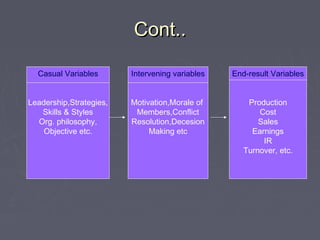
►It helps to find out the link between casualIt helps to find out the link between casual
variables,intervening variables & end resultvariables,intervening variables & end result
variables.variables.
Cont..Cont..
Casual Variables
Leadership,Strategies,
Skills & Styles
Org. philosophy,
Objective etc.
Intervening variables
Motivation,Morale of
Members,Conflict
Resolution,Decesion
Making etc
End-result Variables
Production
Cost
Sales
Earnings
IR
Turnover, etc.
Cont..Cont..
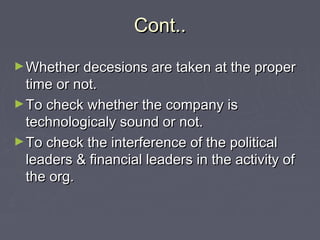
►Whether decesions are taken at the properWhether decesions are taken at the proper
time or not.time or not.
►To check whether the company isTo check whether the company is
technologicaly sound or not.technologicaly sound or not.
►To check the interference of the politicalTo check the interference of the political
leaders & financial leaders in the activity ofleaders & financial leaders in the activity of
the org.the org.
Theory/Approaches of effectivenessTheory/Approaches of effectiveness
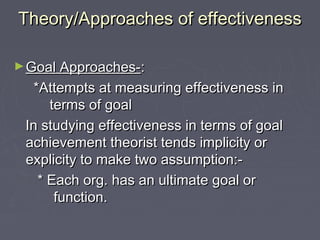
►Goal Approaches-Goal Approaches-::
*Attempts at measuring effectiveness in*Attempts at measuring effectiveness in
terms of goalterms of goal
In studying effectiveness in terms of goalIn studying effectiveness in terms of goal
achievement theorist tends implicity orachievement theorist tends implicity or
explicity to make two assumption:-explicity to make two assumption:-
* Each org. has an ultimate goal or* Each org. has an ultimate goal or
function.function.
Cont..Cont..
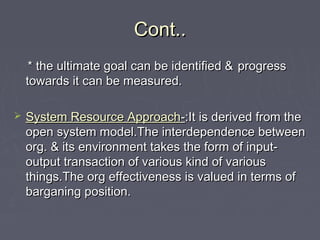
* the ultimate goal can be identified &* the ultimate goal can be identified & progressprogress
towards it can be measured.towards it can be measured.
 System Resource ApproachSystem Resource Approach--:It is derived from the:It is derived from the
open system model.The interdependence betweenopen system model.The interdependence between
org. & its environment takes the form of input-org. & its environment takes the form of input-
output transaction of various kind of variousoutput transaction of various kind of various
things.The org effectiveness is valued in terms ofthings.The org effectiveness is valued in terms of
barganing position.barganing position.
Cont..Cont..
►Strategic Constituencies Approach-Strategic Constituencies Approach-::
It has been derived from systemIt has been derived from system
resource approach with two majorresource approach with two major
differences-differences-
*This approach considers only relevant*This approach considers only relevant
environment of the org.environment of the org.
*This approach does not only consider*This approach does not only consider
taking inputs from the environment buttaking inputs from the environment but
exporting its output to its environmentexporting its output to its environment
Cont..Cont..
►Behavioural approach-:Behavioural approach-:
It takes into account the behaviour of theIt takes into account the behaviour of the
people of the org.which ultimatelypeople of the org.which ultimately
determines the degree of goal achievementdetermines the degree of goal achievement
by an org.This approach is based on twoby an org.This approach is based on two
assumptions-:assumptions-:
1)Organisations as collectivity of people1)Organisations as collectivity of people
have one set of goals & people as individualhave one set of goals & people as individual
has another set of goal.has another set of goal.
Cont..Cont..
2)Degree of organisation effectiveness2)Degree of organisation effectiveness
depends on the degree of integration ofdepends on the degree of integration of
organisational & individual goals.organisational & individual goals.
In between this two extreme points(org goalIn between this two extreme points(org goal
& individual goal)there may be three& individual goal)there may be three
alternative level of integration:-alternative level of integration:-
Cont..Cont..
► Low degree of goal integrationLow degree of goal integration
► Moderate degree of goalModerate degree of goal
integrationintegration
► High degree of goal integrationHigh degree of goal integration
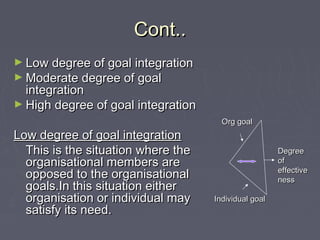
Low degree of goal integrationLow degree of goal integration
This is the situation where theThis is the situation where the
organisational members areorganisational members are
opposed to the organisationalopposed to the organisational
goals.In this situation eithergoals.In this situation either
organisation or individual mayorganisation or individual may
satisfy its need.satisfy its need.
DegreeDegree
ofof
effectiveeffective
nessness
Org goalOrg goal
Individual goalIndividual goal
Cont..Cont..
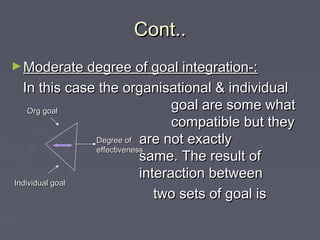
►Moderate degree of goal integration-:Moderate degree of goal integration-:
In this case the organisational & individualIn this case the organisational & individual
goal are some whatgoal are some what
compatible but theycompatible but they
are not exactlyare not exactly
same. The result ofsame. The result of
interaction betweeninteraction between
two sets of goal istwo sets of goal is
Org goalOrg goal
Individual goalIndividual goal
Degree ofDegree of
effectivenesseffectiveness
Cont..Cont..
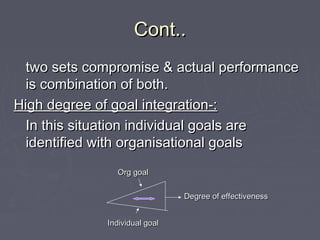
two sets compromise & actual performancetwo sets compromise & actual performance
is combination of both.is combination of both.
High degree of goal integration-:High degree of goal integration-:
In this situation individual goals areIn this situation individual goals are
identified with organisational goalsidentified with organisational goals
Degree of effectivenessDegree of effectiveness
Individual goalIndividual goal
Org goalOrg goal
Organisation effectiveness

Organisation effectiveness

  • 1.
  • 2.
    Outlines-:Outlines-: ►DefinationDefination ►Differences between O.E& EffeciencyDifferences between O.E & Effeciency ►Importance of measuring effectivenessImportance of measuring effectiveness ►Theory of effectivenessTheory of effectiveness
  • 3.
    DefinationDefination ►Effectiveness may bedefined as the degreeEffectiveness may be defined as the degree to which an organisation achieves its goals.to which an organisation achieves its goals. oror  Organisation remains effective as long asOrganisation remains effective as long as the org.uses its resources in an efficientthe org.uses its resources in an efficient manner to achieve its goalsmanner to achieve its goals
  • 4.
    Differences between O.E&Differences between O.E & EffeciencyEffeciency ►The two term are used quite closely &The two term are used quite closely & sometimes interchangeably,but they aresometimes interchangeably,but they are differentdifferent ►Barnard states that-:Barnard states that-: O.E is the degree to which operativeO.E is the degree to which operative goals have been achievedgoals have been achieved.. Efficiency means theEfficiency means the cost incurredcost incurred toto achieve the goals.achieve the goals.
  • 5.
    Cont…Cont… ►Three situation comesout-:Three situation comes out-: 1)Org.may be efficient but may not be1)Org.may be efficient but may not be effective.effective. 2)Org.may not be efficient but may be2)Org.may not be efficient but may be effectiveeffective 3)Both3)Both
  • 6.
    Cont..Cont.. ►11stst casecase-Efficiency refers tointernal-Efficiency refers to internal conversion process where effectivenessconversion process where effectiveness reflects external phenomenon.reflects external phenomenon. ►Example-Org. may be low costExample-Org. may be low cost producing(efficient)but it may fail to realiseproducing(efficient)but it may fail to realise matching price for its product.Thus it incurrsmatching price for its product.Thus it incurrs loss(ineffective)loss(ineffective)
  • 7.
    Cont..Cont.. ►22ndnd case-case-It may notbe effective but due toIt may not be effective but due to external environment it may earn profit &external environment it may earn profit & show effectiveness.show effectiveness. ►33rdrd casecase-In this situation people tend to use-In this situation people tend to use both the term interchangeably.both the term interchangeably.
  • 8.
    Importance of measuringeffectivenessImportance of measuring effectiveness ►Whether the org. is doing things rightly orWhether the org. is doing things rightly or not.not. ►Whether the customers are satisfied or not.Whether the customers are satisfied or not. ►Changes are to be made in theChanges are to be made in the policies,strategies etc or not.policies,strategies etc or not. ►It helps to find out the link between casualIt helps to find out the link between casual variables,intervening variables & end resultvariables,intervening variables & end result variables.variables.
  • 9.
    Cont..Cont.. Casual Variables Leadership,Strategies, Skills &Styles Org. philosophy, Objective etc. Intervening variables Motivation,Morale of Members,Conflict Resolution,Decesion Making etc End-result Variables Production Cost Sales Earnings IR Turnover, etc.
  • 10.
    Cont..Cont.. ►Whether decesions aretaken at the properWhether decesions are taken at the proper time or not.time or not. ►To check whether the company isTo check whether the company is technologicaly sound or not.technologicaly sound or not. ►To check the interference of the politicalTo check the interference of the political leaders & financial leaders in the activity ofleaders & financial leaders in the activity of the org.the org.
  • 11.
    Theory/Approaches of effectivenessTheory/Approachesof effectiveness ►Goal Approaches-Goal Approaches-:: *Attempts at measuring effectiveness in*Attempts at measuring effectiveness in terms of goalterms of goal In studying effectiveness in terms of goalIn studying effectiveness in terms of goal achievement theorist tends implicity orachievement theorist tends implicity or explicity to make two assumption:-explicity to make two assumption:- * Each org. has an ultimate goal or* Each org. has an ultimate goal or function.function.
  • 12.
    Cont..Cont.. * the ultimategoal can be identified &* the ultimate goal can be identified & progressprogress towards it can be measured.towards it can be measured.  System Resource ApproachSystem Resource Approach--:It is derived from the:It is derived from the open system model.The interdependence betweenopen system model.The interdependence between org. & its environment takes the form of input-org. & its environment takes the form of input- output transaction of various kind of variousoutput transaction of various kind of various things.The org effectiveness is valued in terms ofthings.The org effectiveness is valued in terms of barganing position.barganing position.
  • 13.
    Cont..Cont.. ►Strategic Constituencies Approach-StrategicConstituencies Approach-:: It has been derived from systemIt has been derived from system resource approach with two majorresource approach with two major differences-differences- *This approach considers only relevant*This approach considers only relevant environment of the org.environment of the org. *This approach does not only consider*This approach does not only consider taking inputs from the environment buttaking inputs from the environment but exporting its output to its environmentexporting its output to its environment
  • 14.
    Cont..Cont.. ►Behavioural approach-:Behavioural approach-: Ittakes into account the behaviour of theIt takes into account the behaviour of the people of the org.which ultimatelypeople of the org.which ultimately determines the degree of goal achievementdetermines the degree of goal achievement by an org.This approach is based on twoby an org.This approach is based on two assumptions-:assumptions-: 1)Organisations as collectivity of people1)Organisations as collectivity of people have one set of goals & people as individualhave one set of goals & people as individual has another set of goal.has another set of goal.
  • 15.
    Cont..Cont.. 2)Degree of organisationeffectiveness2)Degree of organisation effectiveness depends on the degree of integration ofdepends on the degree of integration of organisational & individual goals.organisational & individual goals. In between this two extreme points(org goalIn between this two extreme points(org goal & individual goal)there may be three& individual goal)there may be three alternative level of integration:-alternative level of integration:-
  • 16.
    Cont..Cont.. ► Low degreeof goal integrationLow degree of goal integration ► Moderate degree of goalModerate degree of goal integrationintegration ► High degree of goal integrationHigh degree of goal integration Low degree of goal integrationLow degree of goal integration This is the situation where theThis is the situation where the organisational members areorganisational members are opposed to the organisationalopposed to the organisational goals.In this situation eithergoals.In this situation either organisation or individual mayorganisation or individual may satisfy its need.satisfy its need. DegreeDegree ofof effectiveeffective nessness Org goalOrg goal Individual goalIndividual goal
  • 17.
    Cont..Cont.. ►Moderate degree ofgoal integration-:Moderate degree of goal integration-: In this case the organisational & individualIn this case the organisational & individual goal are some whatgoal are some what compatible but theycompatible but they are not exactlyare not exactly same. The result ofsame. The result of interaction betweeninteraction between two sets of goal istwo sets of goal is Org goalOrg goal Individual goalIndividual goal Degree ofDegree of effectivenesseffectiveness
  • 18.
    Cont..Cont.. two sets compromise& actual performancetwo sets compromise & actual performance is combination of both.is combination of both. High degree of goal integration-:High degree of goal integration-: In this situation individual goals areIn this situation individual goals are identified with organisational goalsidentified with organisational goals Degree of effectivenessDegree of effectiveness Individual goalIndividual goal Org goalOrg goal