Copyright © 2009 by The McGraw-Hill Companies, Inc. All rights reserved.McGraw-Hill/Irwin
Introduction to
the Field of
Organizational
Behavior
Chapter One
1-2
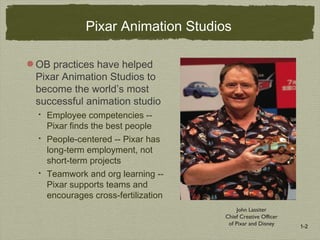
John Lassiter
Chief Creative Officer
of Pixar and Disney
Pixar Animation Studios
OB practices have helped
Pixar Animation Studios to
become the world’s most
successful animation studio
 Employee competencies --
Pixar finds the best people
 People-centered -- Pixar has
long-term employment, not
short-term projects
 Teamwork and org learning --
Pixar supports teams and
encourages cross-fertilization
1-3
John Lassiter
Chief Creative Officer
of Pixar and Disney
Organizational Behavior and Organizations
Organizational behavior
 The study of what people think,
feel, and do in and around
organizations
Organizations
 Groups of people who work
interdependently toward some
purpose
— Structured patterns of interaction:
employees expect each other to
complete certain tasks in a
coordinated way
— Have common objectives (even if
not fully agreed)
1-4
Why Study Organizational Behavior?
OB theories help you to make sense of the
workplace
 Important -- much of our time is in organizations
OB provides knowledge/tools to work with others
 Helps you to get things done—influencing people,
building high performance work teams, motivating
workers, handling workplace conflicts, and so on
OB improves an organization’s financial health
 Firms that apply performance-based rewards, employee
communication, work-life balance, and other OB
practices outperform firms in which these practices are
absent
Copyright © 2009 by The McGraw-Hill Companies, Inc. All rights reserved.McGraw-Hill/Irwin
Lockheed Martin
Perspectives of
Organizational
Effectiveness
Introduction to the Field of
Organizational Behavior
1-6
Old Perspective: Achieving Goals
The objective of most organizational theories is to
make organizations more effective
Effective organizations achieve their stated goals
Goal attainment view is no longer accepted as a
perspective of organizational effectiveness,
because:
 Companies could set easy goals to be considered effective
 Some goals are too abstract to know if achieved
 Company might achieve goals but go out of business by
achieving wrong goals
 Today, organizational effectiveness is defined according to
four perspectives (see next slide)
1-7
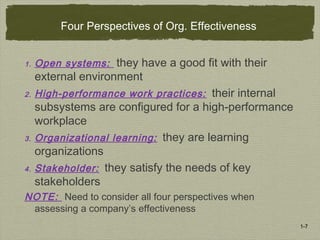
Four Perspectives of Org. Effectiveness
1. Open systems: they have a good fit with their
external environment
2. High-performance work practices: their internal
subsystems are configured for a high-performance
workplace
3. Organizational learning: they are learning
organizations
4. Stakeholder: they satisfy the needs of key
stakeholders
NOTE: Need to consider all four perspectives when
assessing a company’s effectiveness
1-8
Open Systems Perspective
Organizations are complex systems that “live”
within (and depend upon) the external
environment
Effective organizations
 Maintain a close “fit” with those changing conditions
 Transform inputs to outputs efficiently and flexibly
Open systems perspective is the foundation on
which the other three effectiveness perspectives
are built
1-9
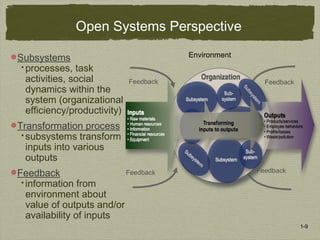
Open Systems Perspective
Subsystems
 processes, task
activities, social
dynamics within the
system (organizational
efficiency/productivity)
Transformation process
 subsystems transform
inputs into various
outputs
Feedback
 information from
environment about
value of outputs and/or
availability of inputs
FeedbackFeedback
FeedbackFeedback
Environment
1-10
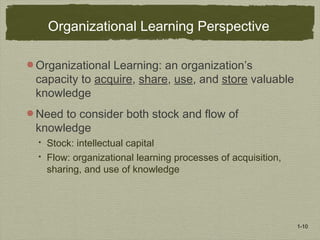
Organizational Learning Perspective
Organizational Learning: an organization’s
capacity to acquire, share, use, and store valuable
knowledge
Need to consider both stock and flow of
knowledge
 Stock: intellectual capital
 Flow: organizational learning processes of acquisition,
sharing, and use of knowledge
1-11
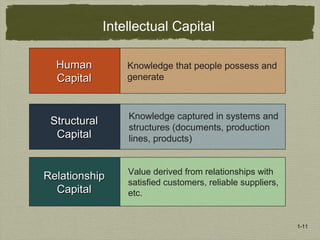
Intellectual Capital
RelationshipRelationship
CapitalCapital
Value derived from relationships with
satisfied customers, reliable suppliers,
etc.
StructuralStructural
CapitalCapital
Knowledge captured in systems and
structures (documents, production
lines, products)
HumanHuman
CapitalCapital
Knowledge that people possess and
generate
1-12
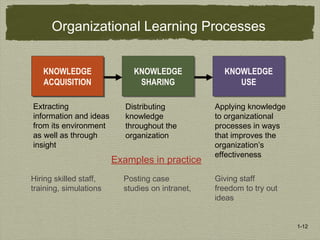
Organizational Learning Processes
Applying knowledge
to organizational
processes in ways
that improves the
organization’s
effectiveness
Distributing
knowledge
throughout the
organization
Extracting
information and ideas
from its environment
as well as through
insight
KNOWLEDGE
ACQUISITION
KNOWLEDGE
ACQUISITION
KNOWLEDGE
SHARING
KNOWLEDGE
SHARING
KNOWLEDGE
USE
KNOWLEDGE
USE
Examples in practice
Hiring skilled staff,
training, simulations
Posting case
studies on intranet,
Giving staff
freedom to try out
ideas
1-13
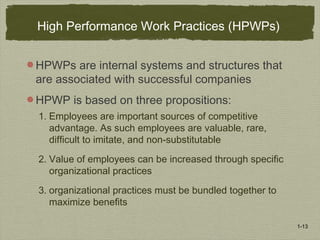
High Performance Work Practices (HPWPs)
HPWPs are internal systems and structures that
are associated with successful companies
HPWP is based on three propositions:
1. Employees are important sources of competitive
advantage. As such employees are valuable, rare,
difficult to imitate, and non-substitutable
2. Value of employees can be increased through specific
organizational practices
3. organizational practices must be bundled together to
maximize benefits
1-14
High Performance Work Practices
No consensus, but HPWPs include:
 Employee involvement and work autonomy (and their
combination as self-directed teams).
 Employee competence (training, selection, etc.).
 Performance-based rewards
1-15
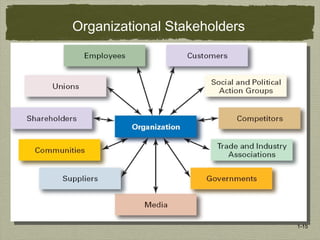
Organizational Stakeholders
1-16
Stakeholder Perspective
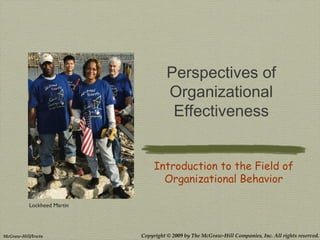
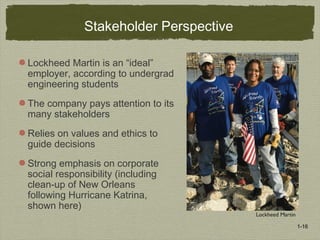
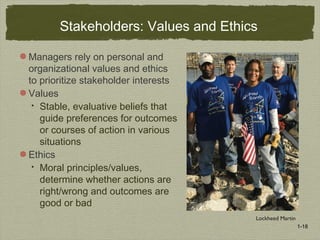
Lockheed Martin is an “ideal”
employer, according to undergrad
engineering students
The company pays attention to its
many stakeholders
Relies on values and ethics to
guide decisions
Strong emphasis on corporate
social responsibility (including
clean-up of New Orleans
following Hurricane Katrina,
shown here)
Lockheed Martin
1-17
Lockheed Martin
Stakeholder Perspective
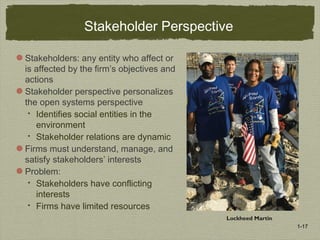
Stakeholders: any entity who affect or
is affected by the firm’s objectives and
actions
Stakeholder perspective personalizes
the open systems perspective
 Identifies social entities in the
environment
 Stakeholder relations are dynamic
Firms must understand, manage, and
satisfy stakeholders’ interests
Problem:
 Stakeholders have conflicting
interests
 Firms have limited resources
1-18
Stakeholders: Values and Ethics
Managers rely on personal and
organizational values and ethics
to prioritize stakeholder interests
Values
 Stable, evaluative beliefs that
guide preferences for outcomes
or courses of action in various
situations
Ethics
 Moral principles/values,
determine whether actions are
right/wrong and outcomes are
good or bad
Lockheed Martin
1-19
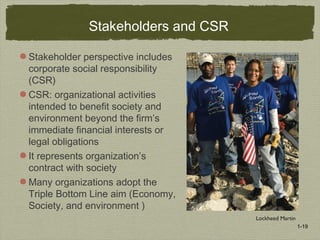
Stakeholders and CSR
Stakeholder perspective includes
corporate social responsibility
(CSR)
CSR: organizational activities
intended to benefit society and
environment beyond the firm’s
immediate financial interests or
legal obligations
It represents organization’s
contract with society
Many organizations adopt the
Triple Bottom Line aim (Economy,
Society, and environment )
Lockheed Martin
Copyright © 2009 by The McGraw-Hill Companies, Inc. All rights reserved.McGraw-Hill/Irwin
Types of
Individual Behavior
Introduction to the Field of
Organizational Behavior
1-21
Types of Individual Behavior
OrganizationalOrganizational
CitizenshipCitizenship
Performance beyond the required job
duties. Involves various forms of
cooperation and helpfulness to others that
support organization’s effectiveness
Task PerformanceTask Performance
Goal-directed behaviors under person’s
control that support organization’s
effectiveness. They transform inputs into
outputs
more
The implementation of the four perspectives of organizational effectiveness
requires performing five types of employees behavior. These behaviors are:
1-22
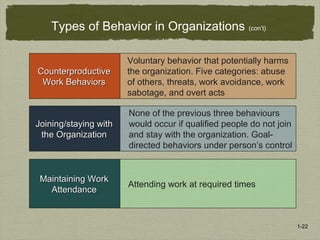
Types of Behavior in Organizations (con’t)
Maintaining WorkMaintaining Work
AttendanceAttendance
Attending work at required times
Joining/staying withJoining/staying with
the Organizationthe Organization
None of the previous three behaviours
would occur if qualified people do not join
and stay with the organization. Goal-
directed behaviors under person’s control
CounterproductiveCounterproductive
Work BehaviorsWork Behaviors
Voluntary behavior that potentially harms
the organization. Five categories: abuse
of others, threats, work avoidance, work
sabotage, and overt acts
Copyright © 2009 by The McGraw-Hill Companies, Inc. All rights reserved.McGraw-Hill/Irwin
Contemporary
Challenges
for Organizations
Introduction to the Field of
Organizational Behavior
1-24
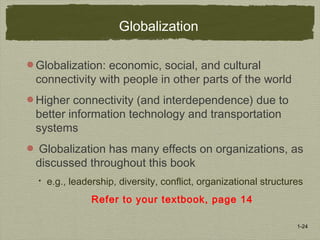
Globalization
Globalization: economic, social, and cultural
connectivity with people in other parts of the world
Higher connectivity (and interdependence) due to
better information technology and transportation
systems
Globalization has many effects on organizations, as
discussed throughout this book
 e.g., leadership, diversity, conflict, organizational structures
Refer to your textbook, page 14
1-25
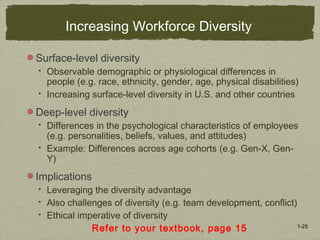
Increasing Workforce Diversity
Surface-level diversity
 Observable demographic or physiological differences in
people (e.g. race, ethnicity, gender, age, physical disabilities)
 Increasing surface-level diversity in U.S. and other countries
Deep-level diversity
 Differences in the psychological characteristics of employees
(e.g. personalities, beliefs, values, and attitudes)
 Example: Differences across age cohorts (e.g. Gen-X, Gen-
Y)
Implications
 Leveraging the diversity advantage
 Also challenges of diversity (e.g. team development, conflict)
 Ethical imperative of diversity
Refer to your textbook, page 15
1-26
Employment Relationships
Work hours
 Less separation from work
 24/7 work schedule (longer but more flexible)
 Due mainly to IT (Internet and BB) and globalization
 Push for more work-life balance
— minimizing conflict between work and non-work demands
Virtual work
 Perform jobs away from traditional workplace (e.g.
telecommuting)
 Some benefits, but also suited more to some types of
people
Copyright © 2009 by The McGraw-Hill Companies, Inc. All rights reserved.McGraw-Hill/Irwin
Introduction to the
Field of
Organizational
Behavior
Chapter One

dragon 1

  • 1.
    Copyright © 2009by The McGraw-Hill Companies, Inc. All rights reserved.McGraw-Hill/Irwin Introduction to the Field of Organizational Behavior Chapter One
  • 2.
    1-2 John Lassiter Chief CreativeOfficer of Pixar and Disney Pixar Animation Studios OB practices have helped Pixar Animation Studios to become the world’s most successful animation studio  Employee competencies -- Pixar finds the best people  People-centered -- Pixar has long-term employment, not short-term projects  Teamwork and org learning -- Pixar supports teams and encourages cross-fertilization
  • 3.
    1-3 John Lassiter Chief CreativeOfficer of Pixar and Disney Organizational Behavior and Organizations Organizational behavior  The study of what people think, feel, and do in and around organizations Organizations  Groups of people who work interdependently toward some purpose — Structured patterns of interaction: employees expect each other to complete certain tasks in a coordinated way — Have common objectives (even if not fully agreed)
  • 4.
    1-4 Why Study OrganizationalBehavior? OB theories help you to make sense of the workplace  Important -- much of our time is in organizations OB provides knowledge/tools to work with others  Helps you to get things done—influencing people, building high performance work teams, motivating workers, handling workplace conflicts, and so on OB improves an organization’s financial health  Firms that apply performance-based rewards, employee communication, work-life balance, and other OB practices outperform firms in which these practices are absent
  • 5.
    Copyright © 2009by The McGraw-Hill Companies, Inc. All rights reserved.McGraw-Hill/Irwin Lockheed Martin Perspectives of Organizational Effectiveness Introduction to the Field of Organizational Behavior
  • 6.
    1-6 Old Perspective: AchievingGoals The objective of most organizational theories is to make organizations more effective Effective organizations achieve their stated goals Goal attainment view is no longer accepted as a perspective of organizational effectiveness, because:  Companies could set easy goals to be considered effective  Some goals are too abstract to know if achieved  Company might achieve goals but go out of business by achieving wrong goals  Today, organizational effectiveness is defined according to four perspectives (see next slide)
  • 7.
    1-7 Four Perspectives ofOrg. Effectiveness 1. Open systems: they have a good fit with their external environment 2. High-performance work practices: their internal subsystems are configured for a high-performance workplace 3. Organizational learning: they are learning organizations 4. Stakeholder: they satisfy the needs of key stakeholders NOTE: Need to consider all four perspectives when assessing a company’s effectiveness
  • 8.
    1-8 Open Systems Perspective Organizationsare complex systems that “live” within (and depend upon) the external environment Effective organizations  Maintain a close “fit” with those changing conditions  Transform inputs to outputs efficiently and flexibly Open systems perspective is the foundation on which the other three effectiveness perspectives are built
  • 9.
    1-9 Open Systems Perspective Subsystems processes, task activities, social dynamics within the system (organizational efficiency/productivity) Transformation process  subsystems transform inputs into various outputs Feedback  information from environment about value of outputs and/or availability of inputs FeedbackFeedback FeedbackFeedback Environment
  • 10.
    1-10 Organizational Learning Perspective OrganizationalLearning: an organization’s capacity to acquire, share, use, and store valuable knowledge Need to consider both stock and flow of knowledge  Stock: intellectual capital  Flow: organizational learning processes of acquisition, sharing, and use of knowledge
  • 11.
    1-11 Intellectual Capital RelationshipRelationship CapitalCapital Value derivedfrom relationships with satisfied customers, reliable suppliers, etc. StructuralStructural CapitalCapital Knowledge captured in systems and structures (documents, production lines, products) HumanHuman CapitalCapital Knowledge that people possess and generate
  • 12.
    1-12 Organizational Learning Processes Applyingknowledge to organizational processes in ways that improves the organization’s effectiveness Distributing knowledge throughout the organization Extracting information and ideas from its environment as well as through insight KNOWLEDGE ACQUISITION KNOWLEDGE ACQUISITION KNOWLEDGE SHARING KNOWLEDGE SHARING KNOWLEDGE USE KNOWLEDGE USE Examples in practice Hiring skilled staff, training, simulations Posting case studies on intranet, Giving staff freedom to try out ideas
  • 13.
    1-13 High Performance WorkPractices (HPWPs) HPWPs are internal systems and structures that are associated with successful companies HPWP is based on three propositions: 1. Employees are important sources of competitive advantage. As such employees are valuable, rare, difficult to imitate, and non-substitutable 2. Value of employees can be increased through specific organizational practices 3. organizational practices must be bundled together to maximize benefits
  • 14.
    1-14 High Performance WorkPractices No consensus, but HPWPs include:  Employee involvement and work autonomy (and their combination as self-directed teams).  Employee competence (training, selection, etc.).  Performance-based rewards
  • 15.
  • 16.
    1-16 Stakeholder Perspective Lockheed Martinis an “ideal” employer, according to undergrad engineering students The company pays attention to its many stakeholders Relies on values and ethics to guide decisions Strong emphasis on corporate social responsibility (including clean-up of New Orleans following Hurricane Katrina, shown here) Lockheed Martin
  • 17.
    1-17 Lockheed Martin Stakeholder Perspective Stakeholders:any entity who affect or is affected by the firm’s objectives and actions Stakeholder perspective personalizes the open systems perspective  Identifies social entities in the environment  Stakeholder relations are dynamic Firms must understand, manage, and satisfy stakeholders’ interests Problem:  Stakeholders have conflicting interests  Firms have limited resources
  • 18.
    1-18 Stakeholders: Values andEthics Managers rely on personal and organizational values and ethics to prioritize stakeholder interests Values  Stable, evaluative beliefs that guide preferences for outcomes or courses of action in various situations Ethics  Moral principles/values, determine whether actions are right/wrong and outcomes are good or bad Lockheed Martin
  • 19.
    1-19 Stakeholders and CSR Stakeholderperspective includes corporate social responsibility (CSR) CSR: organizational activities intended to benefit society and environment beyond the firm’s immediate financial interests or legal obligations It represents organization’s contract with society Many organizations adopt the Triple Bottom Line aim (Economy, Society, and environment ) Lockheed Martin
  • 20.
    Copyright © 2009by The McGraw-Hill Companies, Inc. All rights reserved.McGraw-Hill/Irwin Types of Individual Behavior Introduction to the Field of Organizational Behavior
  • 21.
    1-21 Types of IndividualBehavior OrganizationalOrganizational CitizenshipCitizenship Performance beyond the required job duties. Involves various forms of cooperation and helpfulness to others that support organization’s effectiveness Task PerformanceTask Performance Goal-directed behaviors under person’s control that support organization’s effectiveness. They transform inputs into outputs more The implementation of the four perspectives of organizational effectiveness requires performing five types of employees behavior. These behaviors are:
  • 22.
    1-22 Types of Behaviorin Organizations (con’t) Maintaining WorkMaintaining Work AttendanceAttendance Attending work at required times Joining/staying withJoining/staying with the Organizationthe Organization None of the previous three behaviours would occur if qualified people do not join and stay with the organization. Goal- directed behaviors under person’s control CounterproductiveCounterproductive Work BehaviorsWork Behaviors Voluntary behavior that potentially harms the organization. Five categories: abuse of others, threats, work avoidance, work sabotage, and overt acts
  • 23.
    Copyright © 2009by The McGraw-Hill Companies, Inc. All rights reserved.McGraw-Hill/Irwin Contemporary Challenges for Organizations Introduction to the Field of Organizational Behavior
  • 24.
    1-24 Globalization Globalization: economic, social,and cultural connectivity with people in other parts of the world Higher connectivity (and interdependence) due to better information technology and transportation systems Globalization has many effects on organizations, as discussed throughout this book  e.g., leadership, diversity, conflict, organizational structures Refer to your textbook, page 14
  • 25.
    1-25 Increasing Workforce Diversity Surface-leveldiversity  Observable demographic or physiological differences in people (e.g. race, ethnicity, gender, age, physical disabilities)  Increasing surface-level diversity in U.S. and other countries Deep-level diversity  Differences in the psychological characteristics of employees (e.g. personalities, beliefs, values, and attitudes)  Example: Differences across age cohorts (e.g. Gen-X, Gen- Y) Implications  Leveraging the diversity advantage  Also challenges of diversity (e.g. team development, conflict)  Ethical imperative of diversity Refer to your textbook, page 15
  • 26.
    1-26 Employment Relationships Work hours Less separation from work  24/7 work schedule (longer but more flexible)  Due mainly to IT (Internet and BB) and globalization  Push for more work-life balance — minimizing conflict between work and non-work demands Virtual work  Perform jobs away from traditional workplace (e.g. telecommuting)  Some benefits, but also suited more to some types of people
  • 27.
    Copyright © 2009by The McGraw-Hill Companies, Inc. All rights reserved.McGraw-Hill/Irwin Introduction to the Field of Organizational Behavior Chapter One