Organizational effectiveness and
organizational climate
Presented by S.Ramani
INTRODUCTION
• it is the center of excellence in organization.
• Effectiveness is the degree to which organization
realize its goals.
• its is ability of an organizational to mobilize its center
of power for action –producing and adaptation or it
can be seen in terms of survival of the organization
Concept of organizational effectiveness
• It is extent to which an organization achieves its goal
within the given resource .
• it reflects how well an organization accomplishes the
purposes for which it exits.
• It also refers to degree to which predetermined
operational and operative goals and achieved.
Definitions of organizational effectiveness
Historical background
• Frederick taylor- production
maximization ,cost
• henry fayol - is a function of clear
authority and discipline within an
organization
• Elton mayo - is a function of
productivity resulting from employee
satisfaction,technological excellence,ect
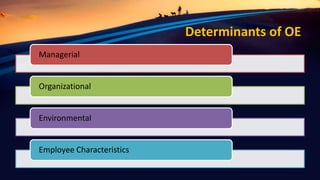
Determinants of OE
Managerial
Organizational
Environmental
Employee Characteristics
Managerial characteristics
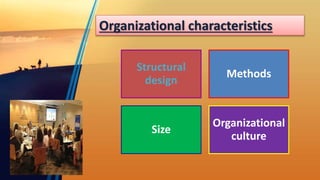
Organizational characteristics
Structural
design
Methods
Size
Organizational
culture
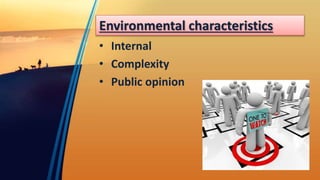
Environmental characteristics
• Internal
• Complexity
• Public opinion
Employees characteristics
Individual goals
Skills
Motives
Attitudes
Values
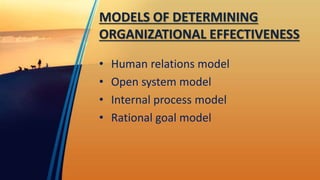
MODELS OF DETERMINING
ORGANIZATIONAL EFFECTIVENESS
• Human relations model
• Open system model
• Internal process model
• Rational goal model
Human relation model
• management concern is on the
development of human resources.
Employees are given opportunities for
autonomy and development.
• Management works toward Sub-goals of
cohesion, morale, and training
opportunities Organizations using this
are more concerned with employees
than the environment.
Open system model
The external focus is concerned with management
goals, its sub goals and dimension.
Management’s goals are primarily focused on
growth and resource acquisition for
organization.
Sub-goals are based on its flexibility, readiness,
and positive evaluation by the external
environment.
Dominant value is establishing a good relationship
with the external environment to grow and
acquire resources.
Internal process model
• It reflects the values of internal focus and structural
control.
• It seeks a stable organizational setting that maintains
itself in an orderly way.
• Well established In environment and just wish to keep
their current position.
• Sub-goals include mechanisms for efficient
communication, information management, and decision-
making
Rational Goal Model
• This model reflects management values of structural
control and external focus.
• The primary goals are productivity, efficiency, and
profit; organization wants to achieve output goals in
a controlled way.
• Its sub-goals include internal planning and goal-
setting, which are rational management tools. This
model is similar to the goal approach model.
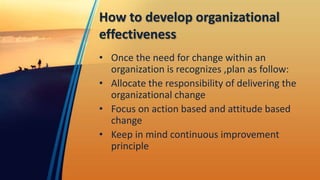
How to develop organizational
effectiveness
• Once the need for change within an
organization is recognizes ,plan as follow:
• Allocate the responsibility of delivering the
organizational change
• Focus on action based and attitude based
change
• Keep in mind continuous improvement
principle
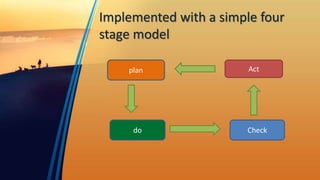
Implemented with a simple four
stage model
plan Act
do Check
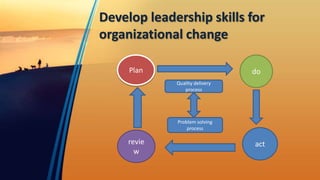
Develop leadership skills for
organizational change
Plan do
revie
w
act
Quality delivery
process
Problem solving
process
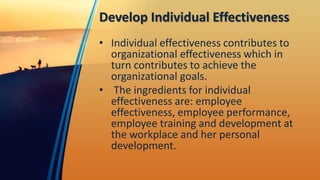
Develop Individual Effectiveness
• Individual effectiveness contributes to
organizational effectiveness which in
turn contributes to achieve the
organizational goals.
• The ingredients for individual
effectiveness are: employee
effectiveness, employee performance,
employee training and development at
the workplace and her personal
development.
organizational
Organizational
climate
INTRODUCTION
• The progress and prosperity of any organization
depends upon the mental balance of its
employees.
• Balanced minds will create balanced climate.

The unbalanced minds in the organization may
disrupt or dilute the activities of the
organization.
• Developing an effective climate is therefore a
key component for any organization seeking to
increase its efficiency thus achieves the
organizational goals.
MEANING OF ORGANIZATIONAL
CLIMATE
• Organizational climate refers to the
perception of employees towards the
organization with regard to the prevailing
feelings and values of the organization.
• It also refers the culture of the
organization.
• It is also a set of properties of the work
environment, perceived directly or
indirectly by the employees.
Definition of organizational
climate
• Organizational climate is a relatively ending quality
of the internal environment that is experienced by
the members, influences their behavior and can
described in terms of values of a particular set of
characteristics of the organization.
-Renato Tagiun’, 1968
WHY TO MEASURE
ORGANIZATIONAL CLIMATE
• Organizational climate has impact on
workforce performance and
organizational outcomes.
• Workplace climate helps in boosting
employees to perform their level best
which in turn results in increasing
revenues, reducing production costs,
and improving consumer satisfaction.
AREAS OF MEASURING
ORGANIZATIONAL CLIMATE
• The areas of measuring climate are to
identify the components both in absolute
and perceptual terms.
• the areas are: external environment
,organizational leadership ,mission
,organizational structure ,system
,management practice ,working teams,
supervisors, self at work ,employees
motivation, commitment, development,
and stress.
DIMENSION OF ORGANIZATIONAL
CLIMATE
likert has proposed six dimensions
• leadership ,
• motivation,
• communication,
• decisions,
• goals and control
pareek has identified twelve
processes of OC
• Orientation
• Interpersonal Relationships
• Supervision
• Problems
• Management of Mistakes
• Conflict Management
CONT…..
• Communication
• Decision –making
• Trust
• Management of rewards
• Risk taking
• Innovation and change
Sociological dimensions of
organizational climate
• Smooth flow of information and management
support of employees.
• Commitment to goal achievement through
employee involvement.
• Standards of performance that challenge promote
pride and improve individual performance.
• Responsibility for one’s own work fostered and
supported by managers.
• Team work a sense of belonging, mutual trust and
respect.
Environmental dimensions of
climate
• It includes -room attractiveness
,Illumine,Shape of the furniture
PRACTICING NURSES WANTS A
CLIMATE THAT WILL GIVE THEM
• Job satisfaction
• Good working conditions
• High salaries
• Opportunities for professional growth
• Career development
• Administrative support that includes adequate
staffing and shift options
• To develop their self esteem through self
actualization
Helln'egel and Slocum (2006)
Communication
Value
Expectation
Norms
Policies
Rules
Programs
leadership
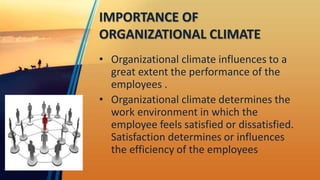
IMPORTANCE OF
ORGANIZATIONAL CLIMATE
• Organizational climate influences to a
great extent the performance of the
employees .
• Organizational climate determines the
work environment in which the
employee feels satisfied or dissatisfied.
Satisfaction determines or influences
the efficiency of the employees
FACTORS INFLUENCING
ORGANIZATION CLIMATE
• organizational context,
• organizational structure,
• organization customs and values
• physical environment,
• communication
• reward system and employee encouragement,
• performance evaluation system,
• training and development programes,
supervision
Role of Nurse Managers In
Organizational Climate
• Nurse Managers should emphasize
management tasks or activities that
stimulate motivation in nursing employees.
• Nurse Managers should establish a
management strategy to support new
nurses and involve them in decision
making.
• Nurse Managers should establish a climate
in which discipline is applied fairly and
uniformly.
Cont….
• Nurse manager will work to establish an organizational
climate that provides
• -incentives for clinical nurses,
• -Places them on committees,
• - creative and equitable in all staffing matters;
• -Emphasizes pride,
• -Promotes participation,
• -Rewards seniority and achievements,
• -Reduces boredom and frustrations.
• -Nurse Managers need management education and
training.
Journal references
• Impact of organizational climate on organizational
commitment and perceived organizational
performance: empirical evidence from public
hospitals
Conclusions
• There was a positive and linear relationship
between organizational climate with organizational
commitment and perceived organizational
performance.
Summary and conclusion
Any questions
Organizational effectiveness

Organizational effectiveness

  • 2.
  • 3.
    INTRODUCTION • it isthe center of excellence in organization. • Effectiveness is the degree to which organization realize its goals. • its is ability of an organizational to mobilize its center of power for action –producing and adaptation or it can be seen in terms of survival of the organization
  • 4.
    Concept of organizationaleffectiveness • It is extent to which an organization achieves its goal within the given resource . • it reflects how well an organization accomplishes the purposes for which it exits. • It also refers to degree to which predetermined operational and operative goals and achieved.
  • 5.
  • 6.
    Historical background • Fredericktaylor- production maximization ,cost • henry fayol - is a function of clear authority and discipline within an organization • Elton mayo - is a function of productivity resulting from employee satisfaction,technological excellence,ect
  • 7.
  • 8.
  • 9.
  • 10.
  • 11.
  • 12.
    MODELS OF DETERMINING ORGANIZATIONALEFFECTIVENESS • Human relations model • Open system model • Internal process model • Rational goal model
  • 13.
    Human relation model •management concern is on the development of human resources. Employees are given opportunities for autonomy and development. • Management works toward Sub-goals of cohesion, morale, and training opportunities Organizations using this are more concerned with employees than the environment.
  • 14.
    Open system model Theexternal focus is concerned with management goals, its sub goals and dimension. Management’s goals are primarily focused on growth and resource acquisition for organization. Sub-goals are based on its flexibility, readiness, and positive evaluation by the external environment. Dominant value is establishing a good relationship with the external environment to grow and acquire resources.
  • 15.
    Internal process model •It reflects the values of internal focus and structural control. • It seeks a stable organizational setting that maintains itself in an orderly way. • Well established In environment and just wish to keep their current position. • Sub-goals include mechanisms for efficient communication, information management, and decision- making
  • 16.
    Rational Goal Model •This model reflects management values of structural control and external focus. • The primary goals are productivity, efficiency, and profit; organization wants to achieve output goals in a controlled way. • Its sub-goals include internal planning and goal- setting, which are rational management tools. This model is similar to the goal approach model.
  • 17.
    How to developorganizational effectiveness • Once the need for change within an organization is recognizes ,plan as follow: • Allocate the responsibility of delivering the organizational change • Focus on action based and attitude based change • Keep in mind continuous improvement principle
  • 18.
    Implemented with asimple four stage model plan Act do Check
  • 19.
    Develop leadership skillsfor organizational change Plan do revie w act Quality delivery process Problem solving process
  • 20.
    Develop Individual Effectiveness •Individual effectiveness contributes to organizational effectiveness which in turn contributes to achieve the organizational goals. • The ingredients for individual effectiveness are: employee effectiveness, employee performance, employee training and development at the workplace and her personal development.
  • 21.
  • 22.
    INTRODUCTION • The progressand prosperity of any organization depends upon the mental balance of its employees. • Balanced minds will create balanced climate. The unbalanced minds in the organization may disrupt or dilute the activities of the organization. • Developing an effective climate is therefore a key component for any organization seeking to increase its efficiency thus achieves the organizational goals.

  • 23.
    MEANING OF ORGANIZATIONAL CLIMATE •Organizational climate refers to the perception of employees towards the organization with regard to the prevailing feelings and values of the organization. • It also refers the culture of the organization. • It is also a set of properties of the work environment, perceived directly or indirectly by the employees.
  • 24.
    Definition of organizational climate •Organizational climate is a relatively ending quality of the internal environment that is experienced by the members, influences their behavior and can described in terms of values of a particular set of characteristics of the organization. -Renato Tagiun’, 1968
  • 25.
    WHY TO MEASURE ORGANIZATIONALCLIMATE • Organizational climate has impact on workforce performance and organizational outcomes. • Workplace climate helps in boosting employees to perform their level best which in turn results in increasing revenues, reducing production costs, and improving consumer satisfaction.
  • 26.
    AREAS OF MEASURING ORGANIZATIONALCLIMATE • The areas of measuring climate are to identify the components both in absolute and perceptual terms. • the areas are: external environment ,organizational leadership ,mission ,organizational structure ,system ,management practice ,working teams, supervisors, self at work ,employees motivation, commitment, development, and stress.
  • 27.
    DIMENSION OF ORGANIZATIONAL CLIMATE likerthas proposed six dimensions • leadership , • motivation, • communication, • decisions, • goals and control
  • 28.
    pareek has identifiedtwelve processes of OC • Orientation • Interpersonal Relationships • Supervision • Problems • Management of Mistakes • Conflict Management
  • 29.
    CONT….. • Communication • Decision–making • Trust • Management of rewards • Risk taking • Innovation and change
  • 30.
    Sociological dimensions of organizationalclimate • Smooth flow of information and management support of employees. • Commitment to goal achievement through employee involvement. • Standards of performance that challenge promote pride and improve individual performance. • Responsibility for one’s own work fostered and supported by managers. • Team work a sense of belonging, mutual trust and respect.

  • 31.
    Environmental dimensions of climate •It includes -room attractiveness ,Illumine,Shape of the furniture
  • 32.
    PRACTICING NURSES WANTSA CLIMATE THAT WILL GIVE THEM • Job satisfaction • Good working conditions • High salaries • Opportunities for professional growth • Career development • Administrative support that includes adequate staffing and shift options • To develop their self esteem through self actualization
  • 33.
    Helln'egel and Slocum(2006) Communication Value Expectation Norms Policies Rules Programs leadership
  • 34.
    IMPORTANCE OF ORGANIZATIONAL CLIMATE •Organizational climate influences to a great extent the performance of the employees . • Organizational climate determines the work environment in which the employee feels satisfied or dissatisfied. Satisfaction determines or influences the efficiency of the employees
  • 35.
    FACTORS INFLUENCING ORGANIZATION CLIMATE •organizational context, • organizational structure, • organization customs and values • physical environment, • communication • reward system and employee encouragement, • performance evaluation system, • training and development programes, supervision
  • 36.
    Role of NurseManagers In Organizational Climate • Nurse Managers should emphasize management tasks or activities that stimulate motivation in nursing employees. • Nurse Managers should establish a management strategy to support new nurses and involve them in decision making. • Nurse Managers should establish a climate in which discipline is applied fairly and uniformly.
  • 37.
    Cont…. • Nurse managerwill work to establish an organizational climate that provides • -incentives for clinical nurses, • -Places them on committees, • - creative and equitable in all staffing matters; • -Emphasizes pride, • -Promotes participation, • -Rewards seniority and achievements, • -Reduces boredom and frustrations. • -Nurse Managers need management education and training.
  • 38.
    Journal references • Impactof organizational climate on organizational commitment and perceived organizational performance: empirical evidence from public hospitals Conclusions • There was a positive and linear relationship between organizational climate with organizational commitment and perceived organizational performance.
  • 39.
  • 40.