
ORGANIZATION CONCEPT,
ITS EFFECTIVNESS ;
STAKEHOLDERS, MANAGERS
& ETHICS
Presented by -Tulsi Gyawali
Organization Meaning &
Concept
Part-A
ORGANIZATION : MEANING & CONCEPT
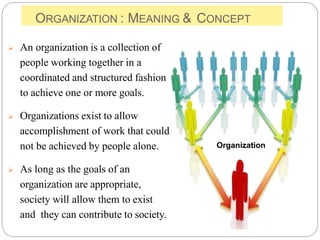
 An organization is a collection of
people working together in a
coordinated and structured fashion
to achieve one or more goals.
 Organizations exist to allow
accomplishment of work that could
not be achieved by people alone.
 As long as the goals of an
organization are appropriate,
society will allow them to exist
and they can contribute to society.
Organization
ORGANIZATION : MEANING & CONCEPT
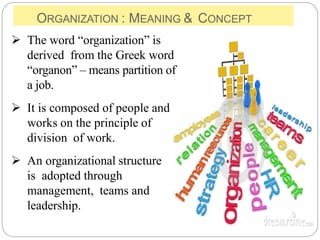
 The word “organization” is
derived from the Greek word
“organon” – means partition of
a job.
 It is composed of people and
works on the principle of
division of work.
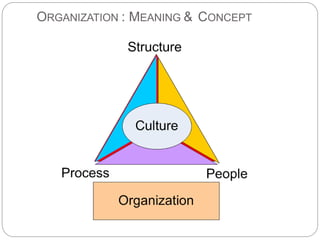
 An organizational structure
is adopted through
management, teams and
leadership.
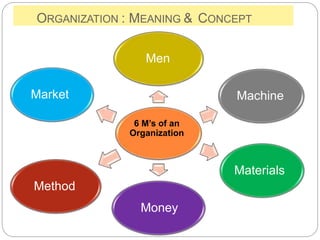
ORGANIZATION : MEANING & CONCEPT
6 M’s of an
Organization
Men
Machine
Materials
Method
Money
Market
ORGANIZATION : MEANING & CONCEPT
7 “S” Model
for
Organization
Superordinate
Goals
Staff
Structure
StrategySystem
Skill
Style
ORGANIZATION : MEANING & CONCEPT
Types of organization
 There are a variety of legal types of organizations, including corporations,
governments, non-governmental organizations, international organiza- tions,
armed forces, charities, not-for-profit corporations, partnerships, cooperatives,
universities, and various types of political organizations.
 A hybrid organization is a body that operates in both the public sector and the
private sector simultaneously, fulfilling public duties and developing
commercial market activities.
 A voluntary association is an organization consisting of volunteers. Such
organizations may be able to operate without legal formalities, depending on
jurisdiction, including informal clubs.
 Organizations may also operate in secret and/or illegally in the case of
secret societies, criminal organizations and resistance movements.
Organization Effectiveness
Part-B
ORGANIZATIONAL EFFECTIVENESS
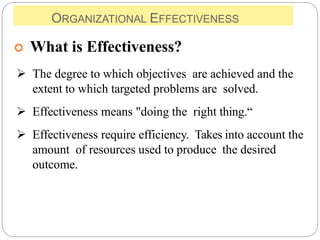
 What is Effectiveness?
 The degree to which objectives are achieved and the
extent to which targeted problems are solved.
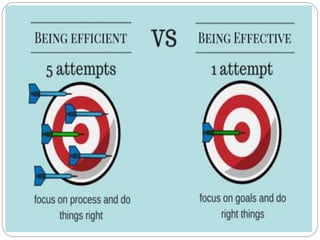
 Effectiveness means "doing the right thing.“
 Effectiveness require efficiency. Takes into account the
amount of resources used to produce the desired
outcome.
ORGANIZATIONAL EFFECTIVENESS
“Organizational effectiveness is the
concept of how effective an organization is
in achieving the outcomes the organization
intends to produce.”
ORGANIZATIONAL EFFECTIVENESS
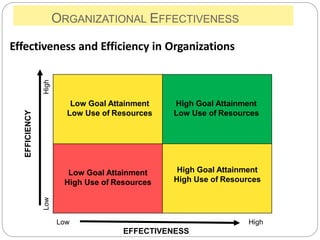
Effectiveness and Efficiency in Organizations
Low Goal Attainment
Low Use of Resources
High Goal Attainment
Low Use of Resources
Low Goal Attainment
High Use of Resources
High Goal Attainment
High Use of Resources
Low High
LowHigh
EFFICIENCY
EFFECTIVENESS
ORGANIZATIONAL EFFECTIVENESS
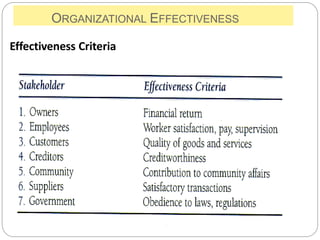
Effectiveness Criteria
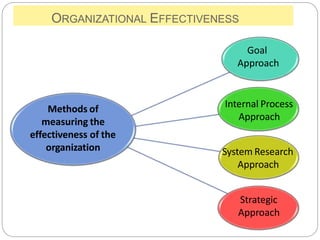
ORGANIZATIONAL EFFECTIVENESS
Methods of
measuring the
effectiveness of the
organization
Goal
Approach
Internal Process
Approach
System Research
Approach
Strategic
Approach
ORGANIZATIONAL EFFECTIVENESS
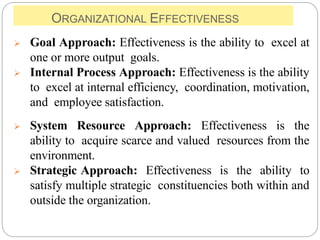
 Goal Approach: Effectiveness is the ability to excel at
one or more output goals.
 Internal Process Approach: Effectiveness is the ability
to excel at internal efficiency, coordination, motivation,
and employee satisfaction.
 System Resource Approach: Effectiveness is the
ability to acquire scarce and valued resources from the
environment.
 Strategic Approach: Effectiveness is the ability to
satisfy multiple strategic constituencies both within and
outside the organization.
ORGANIZATIONAL EFFECTIVENESS
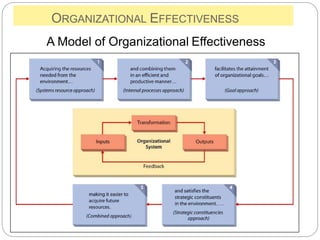
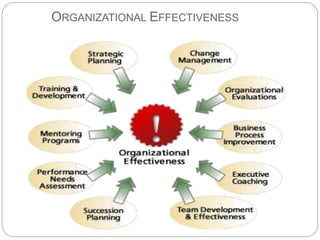
A Model of Organizational Effectiveness
ORGANIZATIONAL EFFECTIVENESS
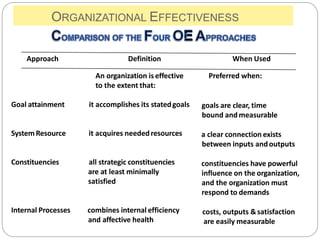
DefinitionApproach
An organization is effective
to the extent that:
Goal attainment it accomplishes its statedgoals
SystemResource it acquires neededresources
Constituencies all strategic constituencies
are at least minimally
satisfied
Internal Processes combines internal efficiency
and affective health
When Used
Preferred when:
goals are clear, time
bound andmeasurable
a clear connection exists
between inputs andoutputs
constituencies have powerful
influence on the organization,
and the organization must
respond to demands
costs, outputs &satisfaction
are easily measurable
ORGANIZATIONAL EFFECTIVENESS
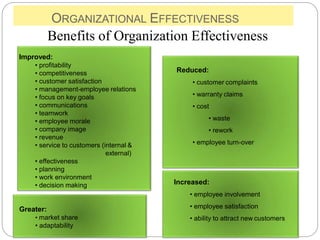
Reduced:
• customer complaints
• warranty claims
• cost
• waste
• rework
• employee turn-over
Improved:
• profitability
• competitiveness
• customer satisfaction
• management-employee relations
• focus on key goals
• communications
• teamwork
• employee morale
• company image
• revenue
• service to customers (internal &
external)
• effectiveness
• planning
• work environment
• decision making
Greater:
• market share
• adaptability
Increased:
• employee involvement
• employee satisfaction
• ability to attract new customers
Benefits of Organization Effectiveness
Stakeholders, Managers &
Ethics
Part-C
STAKEHOLDERS, MANAGERS, AND ETHICS
STAKEHOLDER RELATIONSHIPS
 Stakeholders
 Stakeholders are people who have an interest in a
company's or organization's affairs.
 A stakeholder is a party that has an interest in a
company and can either affect or be affected by the
business. The primary stakeholders in a typical
corporation are its investors, employees, customers
and suppliers
STAKEHOLDERS, MANAGERS, AND ETHICS
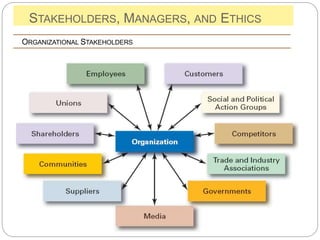
ORGANIZATIONAL STAKEHOLDERS
STAKEHOLDERS, MANAGERS, AND ETHICS
 INSIDE STAKEHOLDERS
 People who are closest to an organization and have
the strongest and most direct claim on
organizational resources
 Shareholders: the owners of the
organization (Mutual Funds)
 Managers: the employees who are responsible for
coordinating organizational resources and ensuring
that an organization’s goals are successfully met
 The workforce: all non-managerial employees
STAKEHOLDERS, MANAGERS, AND ETHICS
OUTSIDE STAKEHOLDERS
 People who do not own the organization, are not
employed by it, but do have some interest in it.
 Customers: an organization’s largest outside
stakeholder group (Airlines & travelers—Employees
and Customers).
 Suppliers: provide reliable raw materials and
component parts to organizations (Stationary supplies
for an educational institution).
 The government
 Wants companies to obey the rules rule & regulations.
 corporate governance issues.
STAKEHOLDERS, MANAGERS, AND ETHICS
OUTSIDE STAKEHOLDERS
 Trade unions: relationships with companies can be one
of conflict or cooperation.
 Local communities: their general economic well-being
is strongly affected by the success or failure of local
businesses.
 The general public
 Wants local businesses to do well against overseas
competition.
 Wants corporations to act in socially responsible
way.
STAKEHOLDERS, MANAGERS, AND ETHICS
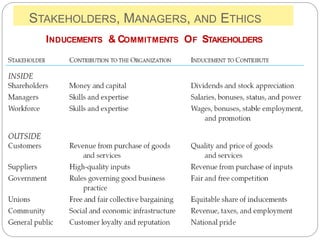
INDUCEMENTS & COMMITMENTS OF STAKEHOLDERS
STAKEHOLDERS, MANAGERS, AND ETHICS
ORGANIZATIONAL EFFECTIVENESS :SATISFYING GOALS &
INTERESTS OF STAKEHOLDERS
 An organization is used simultaneously by various
stakehol- ders to achieve their goals -
 Shareholders: return on their investment
 Customers: product reliability and product value
 Employees: compensation, working conditions, career prospects
 The Suppliers : Quality raw materials, effective supply chain
 Each stakeholder group is motivated to contribute to the org-
anization.
 Each group evaluates the effectiveness of the organization by
judging how well it meets the group’s goals.
STAKEHOLDERS, MANAGERS, AND ETHICS
Top Managers & Organization Authority
Top managers are responsible for setting goals and allocating
rewards.
 Authority: the power to hold people accountable for
their actions and to make decisions concerning the use of
organizational resources.
 Shareholders: the ultimate authority over the use of a
corporation’s resources.
 They own the company
 They exercise control over it through their
representatives
STAKEHOLDERS, MANAGERS, AND ETHICS
Top Managers & Organization Authority
 The board of directors: monitors corporate managers’
activities and rewards corporate managers who pursue
activities that satisfy stakeholder goals
 Inside directors: hold offices in a company’s formal
hierarchy
 Outside directors: not full-time employees
 Corporate-level management: the inside stakeholder
group that has ultimate responsibility for setting company
goals and allocating organizational resources.
STAKEHOLDERS, MANAGERS, AND ETHICS
TOPMANAGEMENT TEAM
 Top-management team: a group of managers
who report to the CEO and COO and help the
CEO set the company’s strategy and its long-term
goals and objectives.
 Corporate managers: the members of top-
management team whose responsibility is to set
strategy for the corporation as a whole.
STAKEHOLDERS, MANAGERS, AND ETHICS
OTHER MANAGERS
 Divisional managers: managers who set policy only
for the division they head.
 Functional managers: managers who are responsible
for developing the functional skills and capabilities that
collectively provide the core competences that give the
organization its competitive advantage.
STAKEHOLDERS, MANAGERS, AND ETHICS
WHAT IS BUSINESS ETHICS
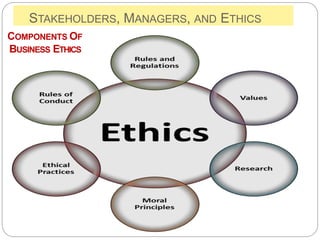
 Ethics: moral principles and beliefs
about what is right or wrong (utilitarian,
rights & justice)
 Laws specify what people and organizations
can and cannot do
 Ethics and laws are relative
 No absolute or unvarying standards exist
to determine how people should behave
STAKEHOLDERS, MANAGERS, AND ETHICS
COMPONENTS OF
BUSINESS ETHICS
STAKEHOLDERS, MANAGERS, AND ETHICS
CREATINGAN ETHICALORGANIZATION
 An organization is said to be
ethical if members behave
ethically.
 Put in place incentives to
encourage ethical behavior
 and punishments to discourage unethical
 behaviors.
 Managers can lead by setting ethical examples & should
communicate the ethical values to all inside and outside
stakeholders.
STAKEHOLDERS, MANAGERS, AND ETHICS
MAJOR SOURCESOFORGANIZATIONALETHICS
 Societal ethics: codified in a society’s legal system, in
its customs and practices, and in the unwritten norms
and values that people use to interact with each other.
 Professional ethics: the moral rules and values that a
group of people uses to control the way they perform a
task or use resources.
 Individual ethics: the personal and moral standards
used by individuals to structure their interactions with
other people.
STAKEHOLDERS, MANAGERS, AND ETHICS
WHY DOESUNETHICALBEHAVIOROCCUR
 Personal ethics: ethics developed as part of the
upbringing and education.
 Self-interest: weighing our own personal
interests against the effects of our actions on
others.
 Outside pressure: pressures from the reward
systems, industry and other forces.
STAKEHOLDERS, MANAGERS, AND ETHICS
DESIGNING AN ETHICALSTRUCTURE&CONTROL
SYSTEM
 Design an organizational structure that reduces
incentives to act unethically.
 Take steps to encourage whistle-blowing
 – encourage employees to inform about
 an organization’s unethical actions.
 Establish position of ethics officer and create ethics
committee.
STAKEHOLDERS, MANAGERS, AND ETHICS
SUPPORTING THEINTERESTOFSTAKEHOLDERGROUPS
 Find ways to satisfy the needs of various
stakeholder groups.
 Pressure from outside stakeholders can also
promote ethical behavior.
 The government and its agencies, industry
councils, regulatory bodies, and consumer
watchdogs all play critical roles in establishing
ethical rules.
Organization Effectiveness, Stakeholders & Business Ethics

Organization Effectiveness, Stakeholders & Business Ethics

  • 1.
    ORGANIZATION CONCEPT, ITS EFFECTIVNESS; STAKEHOLDERS, MANAGERS & ETHICS Presented by -Tulsi Gyawali
  • 2.
  • 3.
    ORGANIZATION : MEANING& CONCEPT  An organization is a collection of people working together in a coordinated and structured fashion to achieve one or more goals.  Organizations exist to allow accomplishment of work that could not be achieved by people alone.  As long as the goals of an organization are appropriate, society will allow them to exist and they can contribute to society. Organization
  • 4.
    ORGANIZATION : MEANING& CONCEPT  The word “organization” is derived from the Greek word “organon” – means partition of a job.  It is composed of people and works on the principle of division of work.  An organizational structure is adopted through management, teams and leadership.
  • 5.
    ORGANIZATION : MEANING& CONCEPT 6 M’s of an Organization Men Machine Materials Method Money Market
  • 6.
    ORGANIZATION : MEANING& CONCEPT 7 “S” Model for Organization Superordinate Goals Staff Structure StrategySystem Skill Style
  • 7.
  • 8.
    ORGANIZATION : MEANING& CONCEPT Types of organization  There are a variety of legal types of organizations, including corporations, governments, non-governmental organizations, international organiza- tions, armed forces, charities, not-for-profit corporations, partnerships, cooperatives, universities, and various types of political organizations.  A hybrid organization is a body that operates in both the public sector and the private sector simultaneously, fulfilling public duties and developing commercial market activities.  A voluntary association is an organization consisting of volunteers. Such organizations may be able to operate without legal formalities, depending on jurisdiction, including informal clubs.  Organizations may also operate in secret and/or illegally in the case of secret societies, criminal organizations and resistance movements.
  • 9.
  • 10.
    ORGANIZATIONAL EFFECTIVENESS  Whatis Effectiveness?  The degree to which objectives are achieved and the extent to which targeted problems are solved.  Effectiveness means "doing the right thing.“  Effectiveness require efficiency. Takes into account the amount of resources used to produce the desired outcome.
  • 12.
    ORGANIZATIONAL EFFECTIVENESS “Organizational effectivenessis the concept of how effective an organization is in achieving the outcomes the organization intends to produce.”
  • 13.
    ORGANIZATIONAL EFFECTIVENESS Effectiveness andEfficiency in Organizations Low Goal Attainment Low Use of Resources High Goal Attainment Low Use of Resources Low Goal Attainment High Use of Resources High Goal Attainment High Use of Resources Low High LowHigh EFFICIENCY EFFECTIVENESS
  • 14.
  • 15.
    ORGANIZATIONAL EFFECTIVENESS Methods of measuringthe effectiveness of the organization Goal Approach Internal Process Approach System Research Approach Strategic Approach
  • 16.
    ORGANIZATIONAL EFFECTIVENESS  GoalApproach: Effectiveness is the ability to excel at one or more output goals.  Internal Process Approach: Effectiveness is the ability to excel at internal efficiency, coordination, motivation, and employee satisfaction.  System Resource Approach: Effectiveness is the ability to acquire scarce and valued resources from the environment.  Strategic Approach: Effectiveness is the ability to satisfy multiple strategic constituencies both within and outside the organization.
  • 17.
    ORGANIZATIONAL EFFECTIVENESS A Modelof Organizational Effectiveness
  • 18.
    ORGANIZATIONAL EFFECTIVENESS DefinitionApproach An organizationis effective to the extent that: Goal attainment it accomplishes its statedgoals SystemResource it acquires neededresources Constituencies all strategic constituencies are at least minimally satisfied Internal Processes combines internal efficiency and affective health When Used Preferred when: goals are clear, time bound andmeasurable a clear connection exists between inputs andoutputs constituencies have powerful influence on the organization, and the organization must respond to demands costs, outputs &satisfaction are easily measurable
  • 19.
  • 20.
    ORGANIZATIONAL EFFECTIVENESS Reduced: • customercomplaints • warranty claims • cost • waste • rework • employee turn-over Improved: • profitability • competitiveness • customer satisfaction • management-employee relations • focus on key goals • communications • teamwork • employee morale • company image • revenue • service to customers (internal & external) • effectiveness • planning • work environment • decision making Greater: • market share • adaptability Increased: • employee involvement • employee satisfaction • ability to attract new customers Benefits of Organization Effectiveness
  • 21.
  • 22.
    STAKEHOLDERS, MANAGERS, ANDETHICS STAKEHOLDER RELATIONSHIPS  Stakeholders  Stakeholders are people who have an interest in a company's or organization's affairs.  A stakeholder is a party that has an interest in a company and can either affect or be affected by the business. The primary stakeholders in a typical corporation are its investors, employees, customers and suppliers
  • 23.
    STAKEHOLDERS, MANAGERS, ANDETHICS ORGANIZATIONAL STAKEHOLDERS
  • 24.
    STAKEHOLDERS, MANAGERS, ANDETHICS  INSIDE STAKEHOLDERS  People who are closest to an organization and have the strongest and most direct claim on organizational resources  Shareholders: the owners of the organization (Mutual Funds)  Managers: the employees who are responsible for coordinating organizational resources and ensuring that an organization’s goals are successfully met  The workforce: all non-managerial employees
  • 25.
    STAKEHOLDERS, MANAGERS, ANDETHICS OUTSIDE STAKEHOLDERS  People who do not own the organization, are not employed by it, but do have some interest in it.  Customers: an organization’s largest outside stakeholder group (Airlines & travelers—Employees and Customers).  Suppliers: provide reliable raw materials and component parts to organizations (Stationary supplies for an educational institution).  The government  Wants companies to obey the rules rule & regulations.  corporate governance issues.
  • 26.
    STAKEHOLDERS, MANAGERS, ANDETHICS OUTSIDE STAKEHOLDERS  Trade unions: relationships with companies can be one of conflict or cooperation.  Local communities: their general economic well-being is strongly affected by the success or failure of local businesses.  The general public  Wants local businesses to do well against overseas competition.  Wants corporations to act in socially responsible way.
  • 27.
    STAKEHOLDERS, MANAGERS, ANDETHICS INDUCEMENTS & COMMITMENTS OF STAKEHOLDERS
  • 28.
    STAKEHOLDERS, MANAGERS, ANDETHICS ORGANIZATIONAL EFFECTIVENESS :SATISFYING GOALS & INTERESTS OF STAKEHOLDERS  An organization is used simultaneously by various stakehol- ders to achieve their goals -  Shareholders: return on their investment  Customers: product reliability and product value  Employees: compensation, working conditions, career prospects  The Suppliers : Quality raw materials, effective supply chain  Each stakeholder group is motivated to contribute to the org- anization.  Each group evaluates the effectiveness of the organization by judging how well it meets the group’s goals.
  • 29.
    STAKEHOLDERS, MANAGERS, ANDETHICS Top Managers & Organization Authority Top managers are responsible for setting goals and allocating rewards.  Authority: the power to hold people accountable for their actions and to make decisions concerning the use of organizational resources.  Shareholders: the ultimate authority over the use of a corporation’s resources.  They own the company  They exercise control over it through their representatives
  • 30.
    STAKEHOLDERS, MANAGERS, ANDETHICS Top Managers & Organization Authority  The board of directors: monitors corporate managers’ activities and rewards corporate managers who pursue activities that satisfy stakeholder goals  Inside directors: hold offices in a company’s formal hierarchy  Outside directors: not full-time employees  Corporate-level management: the inside stakeholder group that has ultimate responsibility for setting company goals and allocating organizational resources.
  • 31.
    STAKEHOLDERS, MANAGERS, ANDETHICS TOPMANAGEMENT TEAM  Top-management team: a group of managers who report to the CEO and COO and help the CEO set the company’s strategy and its long-term goals and objectives.  Corporate managers: the members of top- management team whose responsibility is to set strategy for the corporation as a whole.
  • 32.
    STAKEHOLDERS, MANAGERS, ANDETHICS OTHER MANAGERS  Divisional managers: managers who set policy only for the division they head.  Functional managers: managers who are responsible for developing the functional skills and capabilities that collectively provide the core competences that give the organization its competitive advantage.
  • 33.
    STAKEHOLDERS, MANAGERS, ANDETHICS WHAT IS BUSINESS ETHICS  Ethics: moral principles and beliefs about what is right or wrong (utilitarian, rights & justice)  Laws specify what people and organizations can and cannot do  Ethics and laws are relative  No absolute or unvarying standards exist to determine how people should behave
  • 34.
    STAKEHOLDERS, MANAGERS, ANDETHICS COMPONENTS OF BUSINESS ETHICS
  • 35.
    STAKEHOLDERS, MANAGERS, ANDETHICS CREATINGAN ETHICALORGANIZATION  An organization is said to be ethical if members behave ethically.  Put in place incentives to encourage ethical behavior  and punishments to discourage unethical  behaviors.  Managers can lead by setting ethical examples & should communicate the ethical values to all inside and outside stakeholders.
  • 36.
    STAKEHOLDERS, MANAGERS, ANDETHICS MAJOR SOURCESOFORGANIZATIONALETHICS  Societal ethics: codified in a society’s legal system, in its customs and practices, and in the unwritten norms and values that people use to interact with each other.  Professional ethics: the moral rules and values that a group of people uses to control the way they perform a task or use resources.  Individual ethics: the personal and moral standards used by individuals to structure their interactions with other people.
  • 37.
    STAKEHOLDERS, MANAGERS, ANDETHICS WHY DOESUNETHICALBEHAVIOROCCUR  Personal ethics: ethics developed as part of the upbringing and education.  Self-interest: weighing our own personal interests against the effects of our actions on others.  Outside pressure: pressures from the reward systems, industry and other forces.
  • 38.
    STAKEHOLDERS, MANAGERS, ANDETHICS DESIGNING AN ETHICALSTRUCTURE&CONTROL SYSTEM  Design an organizational structure that reduces incentives to act unethically.  Take steps to encourage whistle-blowing  – encourage employees to inform about  an organization’s unethical actions.  Establish position of ethics officer and create ethics committee.
  • 39.
    STAKEHOLDERS, MANAGERS, ANDETHICS SUPPORTING THEINTERESTOFSTAKEHOLDERGROUPS  Find ways to satisfy the needs of various stakeholder groups.  Pressure from outside stakeholders can also promote ethical behavior.  The government and its agencies, industry councils, regulatory bodies, and consumer watchdogs all play critical roles in establishing ethical rules.