Submitted To: Prof. Alpha Lokhande
 NISHA SALIAN 014122
 PRIYANKA SHAH 014128
 NAZNEEN SHEIKH 014137
 ANIES VARGHESE 014164
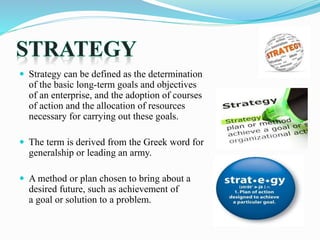
 Strategy can be defined as the determination
of the basic long-term goals and objectives
of an enterprise, and the adoption of courses
of action and the allocation of resources
necessary for carrying out these goals.
 The term is derived from the Greek word for
generalship or leading an army.
 A method or plan chosen to bring about a
desired future, such as achievement of
a goal or solution to a problem.
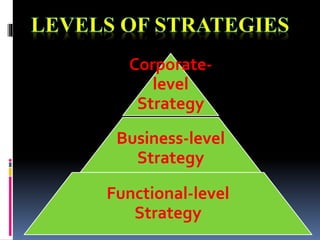
Corporate-
level
Strategy
Business-level
Strategy
Functional-level
Strategy
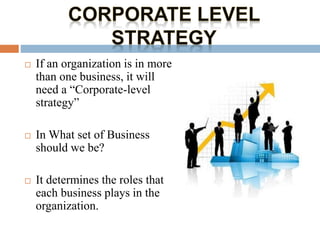
 If an organization is in more
than one business, it will
need a “Corporate-level
strategy”
 In What set of Business
should we be?
 It determines the roles that
each business plays in the
organization.
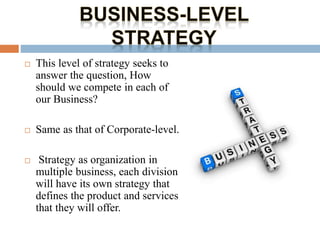
 This level of strategy seeks to
answer the question, How
should we compete in each of
our Business?
 Same as that of Corporate-level.
 Strategy as organization in
multiple business, each division
will have its own strategy that
defines the product and services
that they will offer.
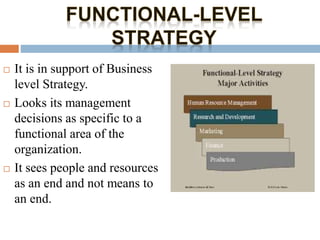
 It is in support of Business
level Strategy.
 Looks its management
decisions as specific to a
functional area of the
organization.
 It sees people and resources
as an end and not means to
an end.
INNOVATION STRATEGY
Marketing Differentiation
Strategy
BREADTH STRATEGY COST CONTROL STRATEGY
Miles and Snow’s Four Strategic
Types
 Raymond Miles & Charles Snow classified the
organization into four strategic types: Prospectors,
Defenders, Analyzers and Reactors
 Managers seek to formulate strategies that are congruent
with the external environment
1) Prospector: innovate, take risks, seek out new
opportunities and grow
 Finding and exploiting new product
and market opportunities.
 Creativity over efficiency
Examples: FedEx, Microsoft, Google
2) Defender: stability or even retrenchment
(opposite to prospector)
 Offer products to a narrow domain
 Strategy is concerned with stability and seeks hold
onto customers.
 They strive aggressively to prevent the competitors
to enter into their “turf”
Example: Manufacturer of Soft-soap
3) Analyzer: try to maintain a stable business while
innovating on the periphery
In between the prospector and the defender
Examples: Microsoft (e.g., Win 8), IBM
4) Reactor: not really a strategy… ad-hoc response
to threats and opportunities in the market
No long-term plan
Examples: Xerox and Kodak, which struggled to keep
up recently
 Organizational design is the way an organization is
to be structured and operated by its members.
 It is both a plan and process.
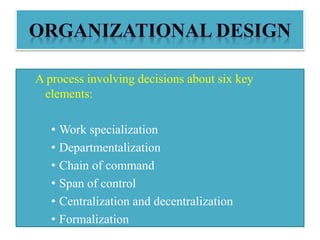
A process involving decisions about six key
elements:
• Work specialization
• Departmentalization
• Chain of command
• Span of control
• Centralization and decentralization
• Formalization
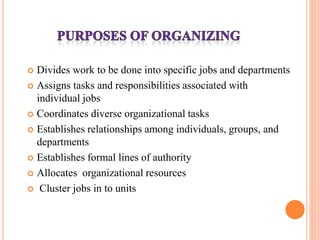
 Divides work to be done into specific jobs and departments
 Assigns tasks and responsibilities associated with
individual jobs
 Coordinates diverse organizational tasks
 Establishes relationships among individuals, groups, and
departments
 Establishes formal lines of authority
 Allocates organizational resources
 Cluster jobs in to units
 Work Specialization
◦ The degree to which tasks in the organization are
divided into separate jobs with each step
completed by a different person
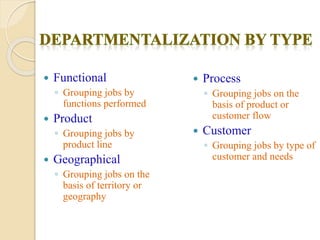
 Functional
◦ Grouping jobs by
functions performed
 Product
◦ Grouping jobs by
product line
 Geographical
◦ Grouping jobs on the
basis of territory or
geography
 Process
◦ Grouping jobs on the
basis of product or
customer flow
 Customer
◦ Grouping jobs by type of
customer and needs
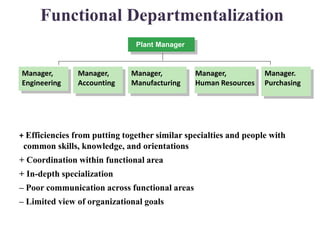
Functional Departmentalization
+ Efficiencies from putting together similar specialties and people with
common skills, knowledge, and orientations
+ Coordination within functional area
+ In-depth specialization
– Poor communication across functional areas
– Limited view of organizational goals
Plant Manager
Manager,
Engineering
Manager,
Accounting
Manager,
Manufacturing
Manager,
Human Resources
Manager.
Purchasing
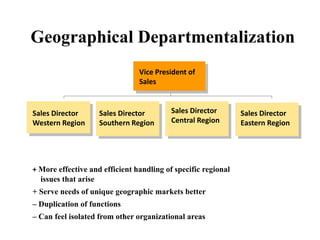
Geographical Departmentalization
+ More effective and efficient handling of specific regional
issues that arise
+ Serve needs of unique geographic markets better
– Duplication of functions
– Can feel isolated from other organizational areas
Vice President of
Sales
Sales Director
Western Region
Sales Director
Southern Region
Sales Director
Central Region
Sales Director
Eastern Region
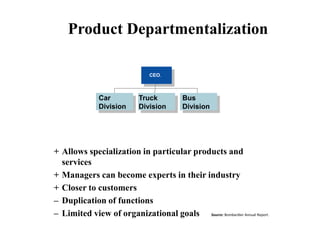
Product Departmentalization
+ Allows specialization in particular products and
services
+ Managers can become experts in their industry
+ Closer to customers
– Duplication of functions
– Limited view of organizational goals Source: Bombardier Annual Report.
CEO.
Truck
Division
Bus
Division
Car
Division
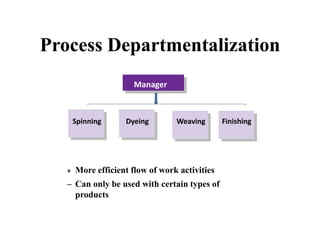
Process Departmentalization
+ More efficient flow of work activities
– Can only be used with certain types of
products
Plant
Manager
FinishingWeavingDyeingSpinning
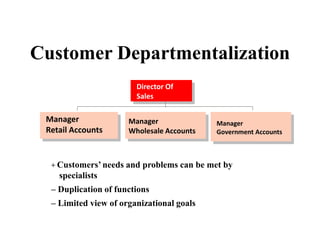
Customer Departmentalization
+ Customers’ needs and problems can be met by
specialists
– Duplication of functions
– Limited view of organizational goals
Manager
Retail Accounts
Manager
Wholesale Accounts
Manager
Government Accounts
Director Of
Sales
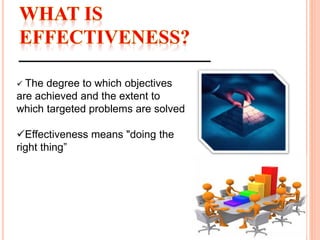
 The degree to which objectives
are achieved and the extent to
which targeted problems are solved
Effectiveness means "doing the
right thing”
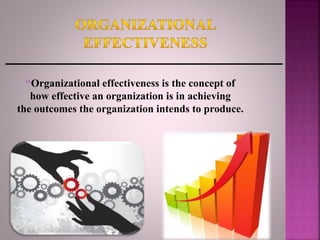
“Organizational effectiveness is the concept of
how effective an organization is in achieving
the outcomes the organization intends to produce.
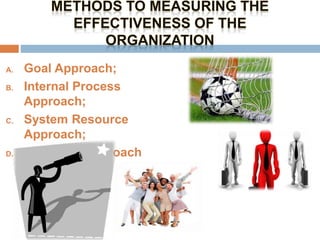
A. Goal Approach;
B. Internal Process
Approach;
C. System Resource
Approach;
D. Strategic Approach
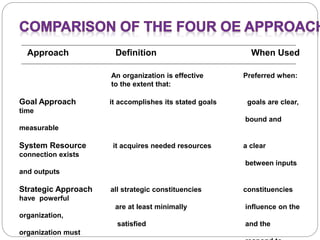
Approach Definition When Used
An organization is effective Preferred when:
to the extent that:
Goal Approach it accomplishes its stated goals goals are clear,
time
bound and
measurable
System Resource it acquires needed resources a clear
connection exists
between inputs
and outputs
Strategic Approach all strategic constituencies constituencies
have powerful
are at least minimally influence on the
organization,
satisfied and the
organization must
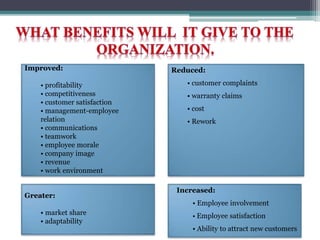
Improved:
• profitability
• competitiveness
• customer satisfaction
• management-employee
relation
• communications
• teamwork
• employee morale
• company image
• revenue
• work environment
Reduced:
• customer complaints
• warranty claims
• cost
• Rework
Greater:
• market share
• adaptability
Increased:
• Employee involvement
• Employee satisfaction
• Ability to attract new customers
 Organizational effectiveness
is the degree of achievements
of an organizational
objectives.
Strategy, organization design and Effectiveness

Strategy, organization design and Effectiveness

  • 1.
    Submitted To: Prof.Alpha Lokhande
  • 3.
     NISHA SALIAN014122  PRIYANKA SHAH 014128  NAZNEEN SHEIKH 014137  ANIES VARGHESE 014164
  • 4.
     Strategy canbe defined as the determination of the basic long-term goals and objectives of an enterprise, and the adoption of courses of action and the allocation of resources necessary for carrying out these goals.  The term is derived from the Greek word for generalship or leading an army.  A method or plan chosen to bring about a desired future, such as achievement of a goal or solution to a problem.
  • 5.
  • 6.
     If anorganization is in more than one business, it will need a “Corporate-level strategy”  In What set of Business should we be?  It determines the roles that each business plays in the organization.
  • 7.
     This levelof strategy seeks to answer the question, How should we compete in each of our Business?  Same as that of Corporate-level.  Strategy as organization in multiple business, each division will have its own strategy that defines the product and services that they will offer.
  • 8.
     It isin support of Business level Strategy.  Looks its management decisions as specific to a functional area of the organization.  It sees people and resources as an end and not means to an end.
  • 9.
  • 10.
    BREADTH STRATEGY COSTCONTROL STRATEGY
  • 12.
    Miles and Snow’sFour Strategic Types  Raymond Miles & Charles Snow classified the organization into four strategic types: Prospectors, Defenders, Analyzers and Reactors  Managers seek to formulate strategies that are congruent with the external environment 1) Prospector: innovate, take risks, seek out new opportunities and grow  Finding and exploiting new product and market opportunities.  Creativity over efficiency Examples: FedEx, Microsoft, Google
  • 13.
    2) Defender: stabilityor even retrenchment (opposite to prospector)  Offer products to a narrow domain  Strategy is concerned with stability and seeks hold onto customers.  They strive aggressively to prevent the competitors to enter into their “turf” Example: Manufacturer of Soft-soap
  • 14.
    3) Analyzer: tryto maintain a stable business while innovating on the periphery In between the prospector and the defender Examples: Microsoft (e.g., Win 8), IBM 4) Reactor: not really a strategy… ad-hoc response to threats and opportunities in the market No long-term plan Examples: Xerox and Kodak, which struggled to keep up recently
  • 15.
     Organizational designis the way an organization is to be structured and operated by its members.  It is both a plan and process.
  • 16.
    A process involvingdecisions about six key elements: • Work specialization • Departmentalization • Chain of command • Span of control • Centralization and decentralization • Formalization
  • 17.
     Divides workto be done into specific jobs and departments  Assigns tasks and responsibilities associated with individual jobs  Coordinates diverse organizational tasks  Establishes relationships among individuals, groups, and departments  Establishes formal lines of authority  Allocates organizational resources  Cluster jobs in to units
  • 18.
     Work Specialization ◦The degree to which tasks in the organization are divided into separate jobs with each step completed by a different person
  • 19.
     Functional ◦ Groupingjobs by functions performed  Product ◦ Grouping jobs by product line  Geographical ◦ Grouping jobs on the basis of territory or geography  Process ◦ Grouping jobs on the basis of product or customer flow  Customer ◦ Grouping jobs by type of customer and needs
  • 20.
    Functional Departmentalization + Efficienciesfrom putting together similar specialties and people with common skills, knowledge, and orientations + Coordination within functional area + In-depth specialization – Poor communication across functional areas – Limited view of organizational goals Plant Manager Manager, Engineering Manager, Accounting Manager, Manufacturing Manager, Human Resources Manager. Purchasing
  • 21.
    Geographical Departmentalization + Moreeffective and efficient handling of specific regional issues that arise + Serve needs of unique geographic markets better – Duplication of functions – Can feel isolated from other organizational areas Vice President of Sales Sales Director Western Region Sales Director Southern Region Sales Director Central Region Sales Director Eastern Region
  • 22.
    Product Departmentalization + Allowsspecialization in particular products and services + Managers can become experts in their industry + Closer to customers – Duplication of functions – Limited view of organizational goals Source: Bombardier Annual Report. CEO. Truck Division Bus Division Car Division
  • 23.
    Process Departmentalization + Moreefficient flow of work activities – Can only be used with certain types of products Plant Manager FinishingWeavingDyeingSpinning
  • 24.
    Customer Departmentalization + Customers’needs and problems can be met by specialists – Duplication of functions – Limited view of organizational goals Manager Retail Accounts Manager Wholesale Accounts Manager Government Accounts Director Of Sales
  • 26.
     The degreeto which objectives are achieved and the extent to which targeted problems are solved Effectiveness means "doing the right thing”
  • 27.
    “Organizational effectiveness isthe concept of how effective an organization is in achieving the outcomes the organization intends to produce.
  • 28.
    A. Goal Approach; B.Internal Process Approach; C. System Resource Approach; D. Strategic Approach
  • 29.
    Approach Definition WhenUsed An organization is effective Preferred when: to the extent that: Goal Approach it accomplishes its stated goals goals are clear, time bound and measurable System Resource it acquires needed resources a clear connection exists between inputs and outputs Strategic Approach all strategic constituencies constituencies have powerful are at least minimally influence on the organization, satisfied and the organization must
  • 30.
    Improved: • profitability • competitiveness •customer satisfaction • management-employee relation • communications • teamwork • employee morale • company image • revenue • work environment Reduced: • customer complaints • warranty claims • cost • Rework Greater: • market share • adaptability Increased: • Employee involvement • Employee satisfaction • Ability to attract new customers
  • 31.
     Organizational effectiveness isthe degree of achievements of an organizational objectives.