ORGANIZATIONAL
EFFECTIVENESS
HISTORICAL OPINIONS
ABOUT ORGANIZATIONAL
EFFECTIVENESS
1. FREDERICK TAYLOR
2. HENRI FAYOL
3. ELTON MAYO
FREDERICK TAYLOR
EFFECTIVENESS WAS DETERMINED BY
FACTORS SUCH AS PRODUCTION
MAXIMIZATION, COST
MINIMALIZATION, TECHNOLOGICAL
EXCELLENCE, Etc.
HENRI FAYOL
EFFECTIVENESS IS A FUNCTION OF CLEAR
AUTHORITY AND DISCIPLINE WITHIN AN
ORGANIZATION
ELTON MAYO
EFFECTIVENESS IS A FUNCTION OF
PRODUCTIVITY RESULTING FROM
EMPLOYEE SATISFACTION
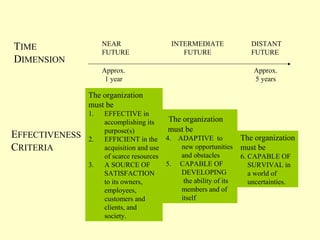
NEAR
FUTURE
INTERMEDIATE
FUTURE
DISTANT
FUTURE
TIME
DIMENSION
Approx.
1 year
Approx.
5 years
EFFECTIVENESS
CRITERIA
The organization
must be
1. EFFECTIVE in
accomplishing its
purpose(s)
2. EFFICIENT in the
acquisition and use
of scarce resources
3. A SOURCE OF
SATISFACTION
to its owners,
employees,
customers and
clients, and
society.
The organization
must be
4. ADAPTIVE to
new opportunities
and obstacles
5. CAPABLE OF
DEVELOPING
the ability of its
members and of
itself
The organization
must be
6. CAPABLE OF
SURVIVAL in
a world of
uncertainties.
ORGANIZATIONAL
EFFECTIVENESS
MEETING ORGANIZATIONAL OBJECTIVES AND
PRVAILING SOCIETAL EXPECTATIONS IN THE
NEAR FUTURE, ADAPTING AND DEVELOPING IN
THE INTERMEDIATE FUTURE, AND SURVIVING
IN THE DISTANT FUTURE.
APPROACHES TO MEASURING
ORGANIZATIONAL EFFECTIVENESS
• Goal Approach: Effectiveness is the ability to
excel at one or more output goals.
• Internal Process Approach: Effectiveness is the
ability to excel at internal efficiency, coordination,
motivation, and employee satisfaction.
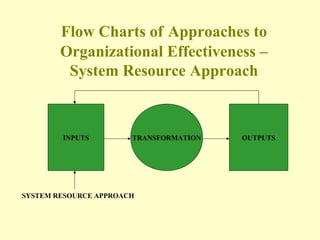
• System Resource Approach: Effectiveness is the
ability to acquire scarce and valued resources from
the environment.
Approaches to Measuring Org.
Effectiveness, continued
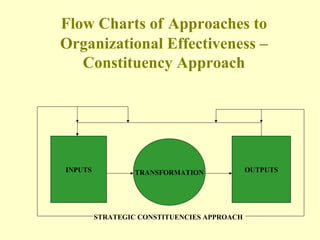
• Constituency Approach: Effectiveness is
the ability to satisfy multiple strategic
constituencies both within and outside the
organization.
• Domain Approach: Effectiveness is the
ability to excel in one or more among
several domains as selected by senior
managers.
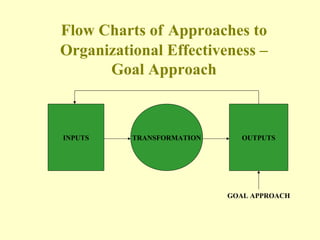
Flow Charts of Approaches to
Organizational Effectiveness –
Goal Approach
TRANSFORMATIONINPUTS OUTPUTS
GOAL APPROACH
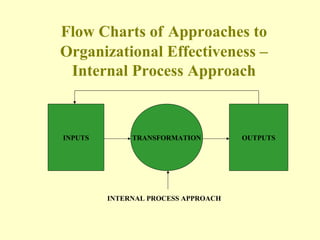
Flow Charts of Approaches to
Organizational Effectiveness –
Internal Process Approach
TRANSFORMATIONINPUTS OUTPUTS
INTERNAL PROCESS APPROACH
Flow Charts of Approaches to
Organizational Effectiveness –
System Resource Approach
TRANSFORMATIONINPUTS OUTPUTS
SYSTEM RESOURCE APPROACH
Flow Charts of Approaches to
Organizational Effectiveness –
Constituency Approach
TRANSFORMATIONINPUTS OUTPUTS
STRATEGIC CONSTITUENCIES APPROACH
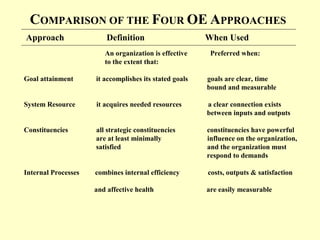
COMPARISON OF THE FOUR OE APPROACHES
Approach Definition When Used
An organization is effective Preferred when:
to the extent that:
Goal attainment it accomplishes its stated goals goals are clear, time
bound and measurable
System Resource it acquires needed resources a clear connection exists
between inputs and outputs
Constituencies all strategic constituencies constituencies have powerful
are at least minimally influence on the organization,
satisfied and the organization must
respond to demands
Internal Processes combines internal efficiency costs, outputs & satisfaction
and affective health are easily measurable
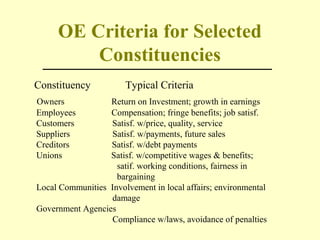
OE Criteria for Selected
Constituencies
Constituency Typical Criteria
Owners Return on Investment; growth in earnings
Employees Compensation; fringe benefits; job satisf.
Customers Satisf. w/price, quality, service
Suppliers Satisf. w/payments, future sales
Creditors Satisf. w/debt payments
Unions Satisf. w/competitive wages & benefits;
satif. working conditions, fairness in
bargaining
Local Communities Involvement in local affairs; environmental
damage
Government Agencies
Compliance w/laws, avoidance of penalties
The Contradictions Model of
Organizational Effectiveness
The idea of trying to characterize a whole organization as
totally effective or ineffective is problematic. In any complex
organization there may be parts of the organization that function
well and suggest effectiveness while other aspects of that same
organization perform poorly.
Four Central Assumptions of
the Contradictions Model
1. Organizations face complex environments that place multiple and
conflicting demands and constraints on them. It may not be possible
to succeed in meeting all the environmental conditions an organization
faces.
2. Organizations have multiple, conflicting goals. It is impossible to
maximize achievement of all goals.
3. Organizations face multiple internal and external stakeholders or
constituent groups that make competing or conflicting demands. It
may be impossible to satisfy all groups of people who express interest
in a company.
4. Organizations must manage multiple and conflicting time demands.
Satisfying short- or long-term demands at the expense of the other may
result in sub-optimal performance.
Competing Values Model
Organizational goals and performance are
defined by top and middle management. By
comparing the diverse effectiveness indicators
used by managers and researchers, Quinn &
Rohrbaugh looked for underlying similarities
and found underlying dimensions of effectiveness
criteria that reflected competing management
values in organizations.
Competing Values Dimensions I
Focus: whether dominant values concern issues that are
internal to the organization or external to it.
Internal focus reflects management concern for well-being
and efficiency of employees. External focus reflects an
emphasis on the well-being of the organization itself and its
“fit” with its environment.
Competing Values Dimensions II
Structure: whether stability versus flexibility is the
dominant structural consideration.
Stability reflects a management value for efficiency
and top-down control, while flexibility represents
a management value for learning and change.
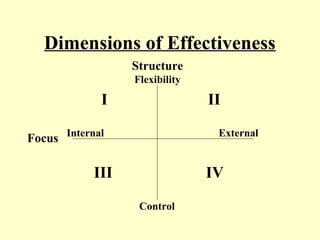
Dimensions of Effectiveness
Structure
Flexibility
Control
Focus Internal External
I II
III IV
Four Models of Effectiveness
Quadrant I : Human Relations Model – internal
Focus and flexible structure. Management
concern is on the development of human
resources. Employees are given opportunities
for autonomy and development. Management
works toward sub-goals of cohesion, morale, and
training opportunities. Organizations using this
are more concerned with employees than the
environment.
Four Models of Effectiveness II
Quadrant II: Open Systems Model – Combination
of external focus and flexible structure.
Management’s goals are primarily growth and
resource acquisition. Sub-goals are flexibility,
readiness, and positive evaluation by the external
environment. Dominant value is establishing
a good relationship with the external environment
to grow and acquire resources. Similar to the
Systems Resource Model.
Four Models of Effectiveness III
Quadrant III: Internal Process Model – Reflects
the values of internal focus and structural
control. Seeks a stable organizational setting that
maintains itself in an orderly way. Well
established in environment and just wish to keep
their current position. Sub-goals include
mechanisms for efficient communication,
information management, and decision-making.
Four Models of Effectiveness IV
Quadrant IV: Rational Goal Model – Reflects
Management values of structural control and
external focus. Primary goals are productivity,
efficiency, and profit. Organization wants to
achieve output goals in a controlled way.
Sub-goals include internal planning and
goal-setting, which are rational management
tools. Similar to the Goal Approach.
Competing Values
Four different opposing value sets within the
organization. Exist simultaneously, and the
“right” balance for the organization is subject
to managerial discretion.
Emphasis may change over time, especially as the
organization evolves through its life cycle.
Examples: hospitals, airlines

Orgeff

  • 1.
  • 2.
    HISTORICAL OPINIONS ABOUT ORGANIZATIONAL EFFECTIVENESS 1.FREDERICK TAYLOR 2. HENRI FAYOL 3. ELTON MAYO
  • 3.
    FREDERICK TAYLOR EFFECTIVENESS WASDETERMINED BY FACTORS SUCH AS PRODUCTION MAXIMIZATION, COST MINIMALIZATION, TECHNOLOGICAL EXCELLENCE, Etc.
  • 4.
    HENRI FAYOL EFFECTIVENESS ISA FUNCTION OF CLEAR AUTHORITY AND DISCIPLINE WITHIN AN ORGANIZATION
  • 5.
    ELTON MAYO EFFECTIVENESS ISA FUNCTION OF PRODUCTIVITY RESULTING FROM EMPLOYEE SATISFACTION
  • 6.
    NEAR FUTURE INTERMEDIATE FUTURE DISTANT FUTURE TIME DIMENSION Approx. 1 year Approx. 5 years EFFECTIVENESS CRITERIA Theorganization must be 1. EFFECTIVE in accomplishing its purpose(s) 2. EFFICIENT in the acquisition and use of scarce resources 3. A SOURCE OF SATISFACTION to its owners, employees, customers and clients, and society. The organization must be 4. ADAPTIVE to new opportunities and obstacles 5. CAPABLE OF DEVELOPING the ability of its members and of itself The organization must be 6. CAPABLE OF SURVIVAL in a world of uncertainties.
  • 7.
    ORGANIZATIONAL EFFECTIVENESS MEETING ORGANIZATIONAL OBJECTIVESAND PRVAILING SOCIETAL EXPECTATIONS IN THE NEAR FUTURE, ADAPTING AND DEVELOPING IN THE INTERMEDIATE FUTURE, AND SURVIVING IN THE DISTANT FUTURE.
  • 8.
    APPROACHES TO MEASURING ORGANIZATIONALEFFECTIVENESS • Goal Approach: Effectiveness is the ability to excel at one or more output goals. • Internal Process Approach: Effectiveness is the ability to excel at internal efficiency, coordination, motivation, and employee satisfaction. • System Resource Approach: Effectiveness is the ability to acquire scarce and valued resources from the environment.
  • 9.
    Approaches to MeasuringOrg. Effectiveness, continued • Constituency Approach: Effectiveness is the ability to satisfy multiple strategic constituencies both within and outside the organization. • Domain Approach: Effectiveness is the ability to excel in one or more among several domains as selected by senior managers.
  • 10.
    Flow Charts ofApproaches to Organizational Effectiveness – Goal Approach TRANSFORMATIONINPUTS OUTPUTS GOAL APPROACH
  • 11.
    Flow Charts ofApproaches to Organizational Effectiveness – Internal Process Approach TRANSFORMATIONINPUTS OUTPUTS INTERNAL PROCESS APPROACH
  • 12.
    Flow Charts ofApproaches to Organizational Effectiveness – System Resource Approach TRANSFORMATIONINPUTS OUTPUTS SYSTEM RESOURCE APPROACH
  • 13.
    Flow Charts ofApproaches to Organizational Effectiveness – Constituency Approach TRANSFORMATIONINPUTS OUTPUTS STRATEGIC CONSTITUENCIES APPROACH
  • 14.
    COMPARISON OF THEFOUR OE APPROACHES Approach Definition When Used An organization is effective Preferred when: to the extent that: Goal attainment it accomplishes its stated goals goals are clear, time bound and measurable System Resource it acquires needed resources a clear connection exists between inputs and outputs Constituencies all strategic constituencies constituencies have powerful are at least minimally influence on the organization, satisfied and the organization must respond to demands Internal Processes combines internal efficiency costs, outputs & satisfaction and affective health are easily measurable
  • 15.
    OE Criteria forSelected Constituencies Constituency Typical Criteria Owners Return on Investment; growth in earnings Employees Compensation; fringe benefits; job satisf. Customers Satisf. w/price, quality, service Suppliers Satisf. w/payments, future sales Creditors Satisf. w/debt payments Unions Satisf. w/competitive wages & benefits; satif. working conditions, fairness in bargaining Local Communities Involvement in local affairs; environmental damage Government Agencies Compliance w/laws, avoidance of penalties
  • 16.
    The Contradictions Modelof Organizational Effectiveness The idea of trying to characterize a whole organization as totally effective or ineffective is problematic. In any complex organization there may be parts of the organization that function well and suggest effectiveness while other aspects of that same organization perform poorly.
  • 17.
    Four Central Assumptionsof the Contradictions Model 1. Organizations face complex environments that place multiple and conflicting demands and constraints on them. It may not be possible to succeed in meeting all the environmental conditions an organization faces. 2. Organizations have multiple, conflicting goals. It is impossible to maximize achievement of all goals. 3. Organizations face multiple internal and external stakeholders or constituent groups that make competing or conflicting demands. It may be impossible to satisfy all groups of people who express interest in a company. 4. Organizations must manage multiple and conflicting time demands. Satisfying short- or long-term demands at the expense of the other may result in sub-optimal performance.
  • 18.
    Competing Values Model Organizationalgoals and performance are defined by top and middle management. By comparing the diverse effectiveness indicators used by managers and researchers, Quinn & Rohrbaugh looked for underlying similarities and found underlying dimensions of effectiveness criteria that reflected competing management values in organizations.
  • 19.
    Competing Values DimensionsI Focus: whether dominant values concern issues that are internal to the organization or external to it. Internal focus reflects management concern for well-being and efficiency of employees. External focus reflects an emphasis on the well-being of the organization itself and its “fit” with its environment.
  • 20.
    Competing Values DimensionsII Structure: whether stability versus flexibility is the dominant structural consideration. Stability reflects a management value for efficiency and top-down control, while flexibility represents a management value for learning and change.
  • 21.
  • 22.
    Four Models ofEffectiveness Quadrant I : Human Relations Model – internal Focus and flexible structure. Management concern is on the development of human resources. Employees are given opportunities for autonomy and development. Management works toward sub-goals of cohesion, morale, and training opportunities. Organizations using this are more concerned with employees than the environment.
  • 23.
    Four Models ofEffectiveness II Quadrant II: Open Systems Model – Combination of external focus and flexible structure. Management’s goals are primarily growth and resource acquisition. Sub-goals are flexibility, readiness, and positive evaluation by the external environment. Dominant value is establishing a good relationship with the external environment to grow and acquire resources. Similar to the Systems Resource Model.
  • 24.
    Four Models ofEffectiveness III Quadrant III: Internal Process Model – Reflects the values of internal focus and structural control. Seeks a stable organizational setting that maintains itself in an orderly way. Well established in environment and just wish to keep their current position. Sub-goals include mechanisms for efficient communication, information management, and decision-making.
  • 25.
    Four Models ofEffectiveness IV Quadrant IV: Rational Goal Model – Reflects Management values of structural control and external focus. Primary goals are productivity, efficiency, and profit. Organization wants to achieve output goals in a controlled way. Sub-goals include internal planning and goal-setting, which are rational management tools. Similar to the Goal Approach.
  • 26.
    Competing Values Four differentopposing value sets within the organization. Exist simultaneously, and the “right” balance for the organization is subject to managerial discretion. Emphasis may change over time, especially as the organization evolves through its life cycle. Examples: hospitals, airlines