WHAT ?
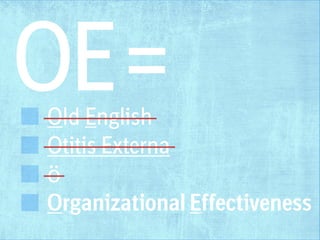
OE =

Old English
Otitis Externa
ö
Organizational Effectiveness
= what?
What happens

when you start
asking questions?
People have

important conversations.
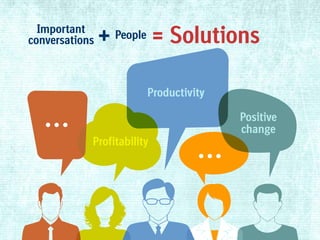
Important
conversations

+ People =  olutions
S
Productivity

Profitability

Positive
change
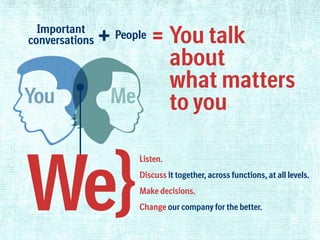
Important
conversations

You

+ People =  ou talk
Y
about
what matters
Me
to you

We

Listen.
Discuss it together, across functions, at all levels.
Make decisions.
Change our company for the better.
SO...

WHAT?
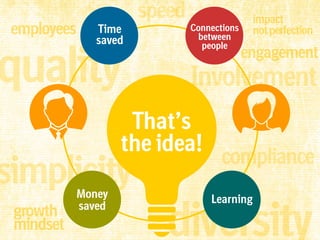
employees

Time
saved

quality

speed

Connections
between
people

growth
mindset

Money
saved

engagement

Involvement

That’s
the idea!

simplicity

impact
not perfection

compliance

diversity
Learning
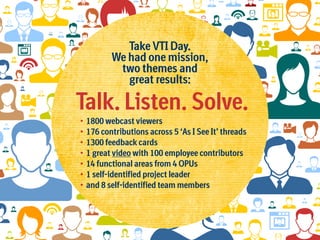
Take VTI Day.
We had one mission,
two themes and
great results:

Talk. Listen. Solve.
•	 1800 webcast viewers
•	176 contributions across 5 ‘As I See It’ threads
•	 1300 feedback cards
•	 1 great video with 100 employee contributors
•	 14 functional areas from 4 OPUs
•	 1 self-identified project leader
•	 and 8 self-identified team members
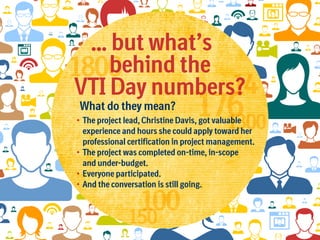
… but what’s
behind the
1800
14
VTI Day numbers?
What do they mean?

176
1300

•	 The project lead, Christine Davis, got valuable
experience and hours she could apply toward her
professional certification in project management.
•	The project was completed on-time, in-scope
and under-budget.
•	 Everyone participated.
•	 And the conversation is still going.

100
150
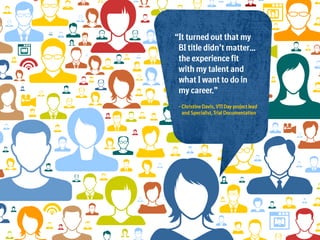
“It turned out that my
BI title didn’t matter…
the experience fit
with my talent and
what I want to do in
my career.”
– Christine Davis, VTI Day project lead
and Specialist, Trial Documentation
Another example is an
Alignment  Efficiency project
that took on ways to improve

cross-functional
collaboration
in large-scale initiatives within
the Enabling Functions.
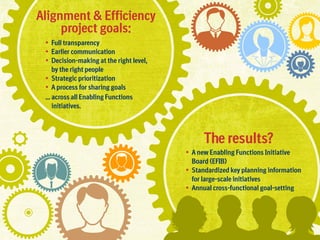
Alignment  Efficiency
project goals:
•	 Full transparency
•	 Earlier communication
D
•	 ecision-making at the right level,

by the right people
•	 Strategic prioritization
•	 A process for sharing goals
… across all Enabling Functions

initiatives.

The results?
•	 A new Enabling Functions Initiative

Board (EFIB)
S
•	 tandardized key planning information
for large-scale initiatives
•	 Annual cross-functional goal-setting
“Sometimes people
feel that they can only
improve what they can
do, but things can’t
change at the top… this
is an example where
senior leaders… are
very open to change.”
– Hillary Wilson, Enabling Functions
project lead and Brand Business
Operations
And yet another example of
Alignment  Efficiency in OE:

Onboarding
The volunteer team took a look at the
Onboarding process to identify pain points
and recommend improvements.
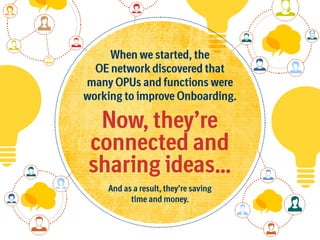
When we started, the
OE network discovered that
many OPUs and functions were
working to improve Onboarding.

Now, they’re
connected and
sharing ideas…
And as a result, they’re saving
time and money.
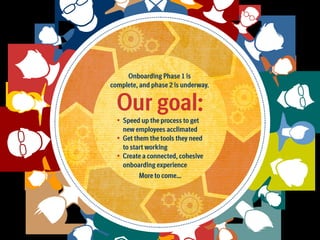
Onboarding Phase 1 is
complete, and phase 2 is underway.

Our goal:
•	 Speed up the process to get

new employees acclimated
G
•	 et them the tools they need
to start working
C
•	 reate a connected, cohesive
onboarding experience
More to come…
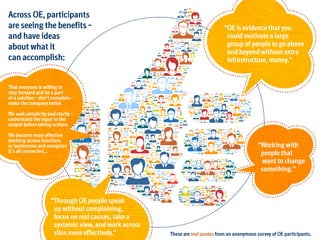
Across OE, participants
are seeing the benefits –
and have ideas
about what it
can accomplish:

“OE is evidence that you
could motivate a large
group of people to go above
and beyond without extra
infrastructure, money.”

That everyone is willing to
step forward and be a part
of a solution – don’t complain –
make the company better.
We seek simplicity and clarity –
understand the input to the
output before taking actions.
We become more effective
working across functions
or businesses and recognize
it’s all connected…

“Through OE people speak
up without complaining,
focus on real causes, take a
systemic view, and work across
silos more effectively.”

“Working with
people that
want to change
something.”

These are real quotes from an anonymous survey of OE participants.
NOW

WHAT?
This is

your workplace.
You
have control.
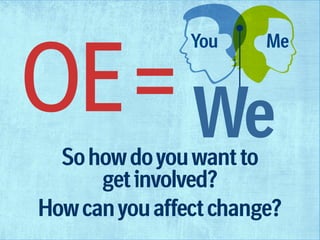
OE = We
You

Me

So how do you want to
get involved?
How can you affect change?
Join

the conversation today!
Visit http://bi-oe to find out how...

Organizational Effectiveness 2013 Impact Assessment

  • 1.
  • 3.
    OE = Old English OtitisExterna ö Organizational Effectiveness
  • 4.
  • 5.
    What happens when youstart asking questions?
  • 6.
  • 7.
    Important conversations + People = olutions S Productivity Profitability Positive change
  • 8.
    Important conversations You + People = ou talk Y about what matters Me to you We Listen. Discuss it together, across functions, at all levels. Make decisions. Change our company for the better.
  • 9.
  • 10.
  • 11.
    Take VTI Day. Wehad one mission, two themes and great results: Talk. Listen. Solve. • 1800 webcast viewers • 176 contributions across 5 ‘As I See It’ threads • 1300 feedback cards • 1 great video with 100 employee contributors • 14 functional areas from 4 OPUs • 1 self-identified project leader • and 8 self-identified team members
  • 12.
    … but what’s behindthe 1800 14 VTI Day numbers? What do they mean? 176 1300 • The project lead, Christine Davis, got valuable experience and hours she could apply toward her professional certification in project management. • The project was completed on-time, in-scope and under-budget. • Everyone participated. • And the conversation is still going. 100 150
  • 13.
    “It turned outthat my BI title didn’t matter… the experience fit with my talent and what I want to do in my career.” – Christine Davis, VTI Day project lead and Specialist, Trial Documentation
  • 14.
    Another example isan Alignment Efficiency project that took on ways to improve cross-functional collaboration in large-scale initiatives within the Enabling Functions.
  • 15.
    Alignment Efficiency projectgoals: • Full transparency • Earlier communication D • ecision-making at the right level, by the right people • Strategic prioritization • A process for sharing goals … across all Enabling Functions initiatives. The results? • A new Enabling Functions Initiative Board (EFIB) S • tandardized key planning information for large-scale initiatives • Annual cross-functional goal-setting
  • 16.
    “Sometimes people feel thatthey can only improve what they can do, but things can’t change at the top… this is an example where senior leaders… are very open to change.” – Hillary Wilson, Enabling Functions project lead and Brand Business Operations
  • 17.
    And yet anotherexample of Alignment Efficiency in OE: Onboarding The volunteer team took a look at the Onboarding process to identify pain points and recommend improvements.
  • 18.
    When we started,the OE network discovered that many OPUs and functions were working to improve Onboarding. Now, they’re connected and sharing ideas… And as a result, they’re saving time and money.
  • 19.
    Onboarding Phase 1is complete, and phase 2 is underway. Our goal: • Speed up the process to get new employees acclimated G • et them the tools they need to start working C • reate a connected, cohesive onboarding experience More to come…
  • 20.
    Across OE, participants areseeing the benefits – and have ideas about what it can accomplish: “OE is evidence that you could motivate a large group of people to go above and beyond without extra infrastructure, money.” That everyone is willing to step forward and be a part of a solution – don’t complain – make the company better. We seek simplicity and clarity – understand the input to the output before taking actions. We become more effective working across functions or businesses and recognize it’s all connected… “Through OE people speak up without complaining, focus on real causes, take a systemic view, and work across silos more effectively.” “Working with people that want to change something.” These are real quotes from an anonymous survey of OE participants.
  • 21.
  • 22.
  • 23.
  • 24.
    OE = We You Me Sohow do you want to get involved? How can you affect change?
  • 25.
    Join the conversation today! Visithttp://bi-oe to find out how...