FARMSCAPING
for ORGANIC CROP PRODUCTION
FARMSCAPING
for ORGANIC CROP PRODUCTION
Rufina Ward
Alabama A&M University
Farmscape
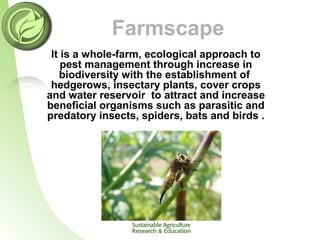
It is a whole-farm, ecological approach to
pest management through increase in
biodiversity with the establishment of
hedgerows, insectary plants, cover crops
and water reservoir to attract and increase
beneficial organisms such as parasitic and
predatory insects, spiders, bats and birds .
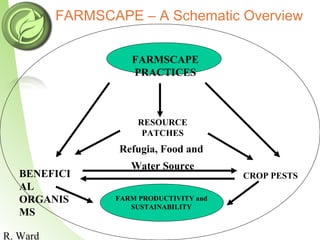
FARMSCAPE – A Schematic Overview
RESOURCE
PATCHES
Refugia, Food and
Water Source
BENEFICI
AL
ORGANIS
MS
CROP PESTS
FARMSCAPE
PRACTICES
FARM PRODUCTIVITY and
SUSTAINABILITY
R. Ward
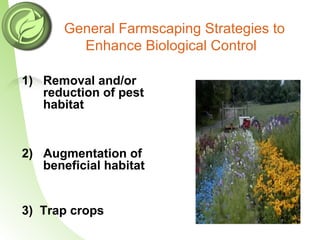
General Farmscaping Strategies to
Enhance Biological Control
1) Removal and/or
reduction of pest
habitat
2) Augmentation of
beneficial habitat
3) Trap crops
Farmscape Plans are:
 1) Easy to implement
 2) Effective
 3) Easy to modify and adopt
Benefits from Farmscape Practices
 1) Reduce pesticide use
 2) Save money
 3) Reduce chemical residues in
farm products
 4) Render farm environment safe
and healthy for humans and wildlife
 5) Add value to the overall health and
beauty of the farm
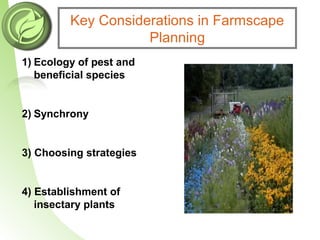
Key Considerations in Farmscape
Planning
1) Ecology of pest and
beneficial species
2) Synchrony
3) Choosing strategies
4) Establishment of
insectary plants
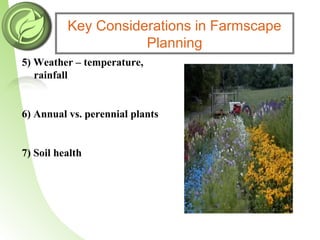
Key Considerations in Farmscape
Planning
5) Weather – temperature,
rainfall
6) Annual vs. perennial plants
7) Soil health
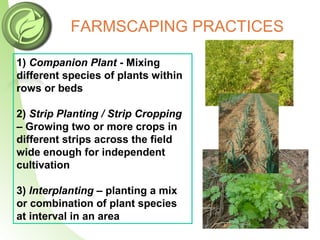
FARMSCAPING PRACTICES
1) Companion Plant - Mixing
different species of plants within
rows or beds
2) Strip Planting / Strip Cropping
– Growing two or more crops in
different strips across the field
wide enough for independent
cultivation
3) Interplanting – planting a mix
or combination of plant species
at interval in an area
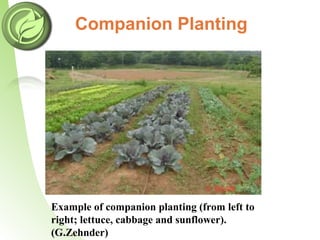
Companion Planting
Example of companion planting (from left to
right; lettuce, cabbage and sunflower).
(G.Zehnder)
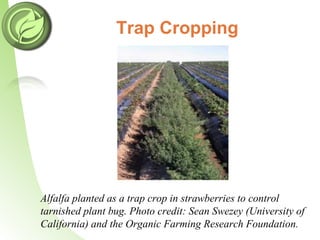
Trap Cropping
Alfalfa planted as a trap crop in strawberries to control
tarnished plant bug. Photo credit: Sean Swezey (University of
California) and the Organic Farming Research Foundation.
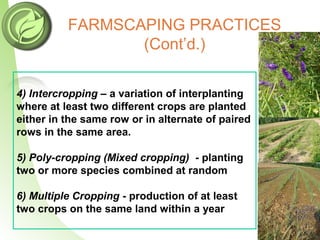
FARMSCAPING PRACTICES
(Cont’d.)
4) Intercropping – a variation of interplanting
where at least two different crops are planted
either in the same row or in alternate of paired
rows in the same area.
5) Poly-cropping (Mixed cropping) - planting
two or more species combined at random
6) Multiple Cropping - production of at least
two crops on the same land within a year
FARMSCAPING PRACTICES
(Cont’d.)
7) Trap Cropping – crop planted to lure
insect pests away from cash crops
8) Cover Crop – cultivation of a second
type of crop mainly to improve the
production system for a primary crop
9) Green Manure – a growing crop
incorporated into the soil to improve soil
quality and fertility
FARMSCAPING PRACTICES
(Cont’d.)
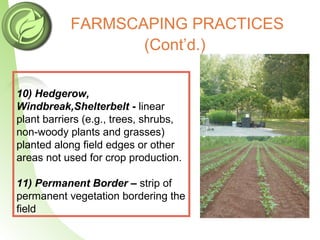
10) Hedgerow,
Windbreak,Shelterbelt - linear
plant barriers (e.g., trees, shrubs,
non-woody plants and grasses)
planted along field edges or other
areas not used for crop production.
11) Permanent Border – strip of
permanent vegetation bordering the
field
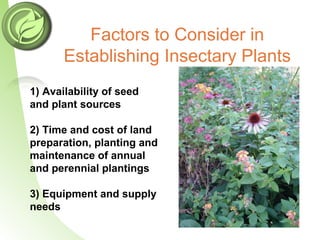
Factors to Consider in
Establishing Insectary Plants
1) Availability of seed
and plant sources
2) Time and cost of land
preparation, planting and
maintenance of annual
and perennial plantings
3) Equipment and supply
needs
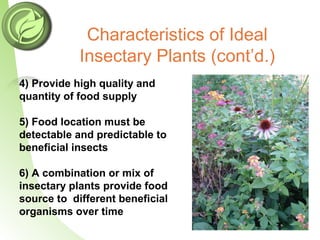
Characteristics of Ideal
Insectary Plants (cont’d.)
4) Provide high quality and
quantity of food supply
5) Food location must be
detectable and predictable to
beneficial insects
6) A combination or mix of
insectary plants provide food
source to different beneficial
organisms over time
Examples of Good Insectary Plants
Buckwheat
(Fagopyrum esculentum) Polygonaceae
Sweet clover (Melilotus
officinalis) Fabaceae
White clover
(Trifolium repens)
Fabaceae
Red clover (Trifolium
pratense) Fabaceae
Mustard plants
(Brassica spp.)
Brassicaceae
Hairy vetch
(Vicia villosa)
Fabaceae
Queen Anne’s lace
Daucus carrota Apiaceae
Sunflower
(Helianthus spp.)
Asteraceae
Skullcap
(Scutellaria sp.)
Lamiaceae
Mexican sunflower
(Tithonia grandiflora)
Asteraceae
ESSENTIAL STEPS TO
FARMSCAPING
1) Keep good farm records
2) Obtain information on pests and
beneficials
3) Make a list of tools that will create
favorable environment to beneficials but
hostile to pest species.
4) From above list, select tools that best fit
into farm’s cropping system, rotation,
equipment, available labor, etc.
STEPS TO FARMSCAPING
(Cont’d.)
5) Fine tune the system by experimenting
and re-experimenting. Try something
new or modify what has already been
tried to improve farming system.
6) Start simple and small, then develop the
farmscaping as experience and
observations dictate.
REFERENCES
Altieri, M.A., and M. Leibman. 1994. Insect, weed, and plant disease
management in multiple cropping systems. In Francis, C.A. (ed.).
Multiple Cropping Systems. Macmillan Company, New York. 383 p.
Amador, M.F. 1980. Behavior of three species (corn, beans, squash)
in polyculture in Chontalpa, Tabasco, Mexico. CSAT, Cardenas,
Tabasco, Mexico.
Anon. 1990. Strip intercropping offers low-input way to boost
yields. Sensible Agriculture. May. p. 7–8.
Anon. 1987. Intercropping bolsters silage yields. Hay and Forage
Grower. August. p. 29.
Bowen, John F., and Bernard A. Kratky. 1986. Successful
multiple cropping requires superior management skills.
Agribusiness Worldwide. November/December. p. 22–30.
Bugg, R.L. and C. Waddington. 1994. Managing cover crops to
manage arthropod pests of orchards. Agricultural Ecosystems &
Environment. Vol. 50. p. 11–28.
REFERENCES
Ehler, L. E. 2002. Farmscape ecology of stink bugs in nothern
California. Fremontia 30(3-4): 59-61.
Francis, R., and D.R. Decoteau. 1993. Developing an effective
southernpea and sweet corn intercrop system. Hort Technology.
Vol. 3, No. 2. p. 178–184.
Grossman, Joel, and William Quarles. 1993. Strip intercropping for
biological control. IPM Practitioner. April. p. 1–11.
Long, R.F., A. Corbett, C. Lamb, C. Reberg-Horton, J. Chandler, M.
Stimmann. 1998. Beneficial insects move from flowering plants to
nearby crops. California Agriculture, September-October. p. 23–26.
Martin, Ralph, Don Smith, and Harvey Voldeng. 1987. Intercropping
corn and soybeans. Sustainable Farming. REAP Canada. McGill
University, Macdonald Campus. www.eap.mcgill.ca
Pickett, C.H. and R.L. Bugg (eds). 1998. Enhancing Biological
Control: Habitat Management to Promote Natural Enemies of
Agricultural Pests. University of California Press, Berkeley, CA.
REFERENCES
• Richardson, P. 1997. Polyculture makes the most of
biodiversity. HRM of Texas Newsletter. Summer. p. 5, 7.
Stapel, J.O. and A.M. Cortesero. 1997. Importance of nectar
sources for adult parasitoids in biological control programs.
Midwest Biological Control News. May. p. 1, 7.
Sullivan, P. 2003. Intercropping principles and production
practices. ATTRA publication #IP135.
http://attra.ncat.org/attra-pub/intercrop.html
Tonneson, Lon, and Jim Houtsma. 1991. Adding new
wrinkles to alternate strips. The Farmer. September 7. p. 8–9.
Willy, R.W., et al. 1983. Intercropping studies with annual
crops. In: Better Crops for Food, CIBA Foundation
Symposium 97. Pitman, London, UK.
http://www.eap.mcgill.ca/CSI_2.htm
http://www.ipm.ucdavis.edu/PMG/glossary.html
REFERENCES
Anon. 1990. Strip intercropping offers low-input way to
boost yields. Sensible Agriculture. May. p. 7–8.
Altieri, M.A., and M. Leibman. 1994. Insect, weed, and plant
disease management in multiple cropping systems. In
Francis, C.A. (ed.). Multiple Cropping Systems. Macmillan
Company, New York. 383 p.
Ecological Agriculture Projects. Mixing Crop Species. McGill
University, Macdonald Campus.
www.eap.mcgill.ca/CSI_2.htm
Richardson, Pat. 1997. Polyculture makes the most of
biodiversity. HRM of Texas Newsletter. Summer. p. 5, 7.
Acknowledgements
This presentation address general organic production practices. It is to be
to use in planning and conducting organic horticulture trainings. The
presentation is part of project funded by a Southern SARE PDP titled
“Building Organic Agriculture Extension Training Capacity in the
Southeast”
Project Collaborators
•Elena Garcia, University of Arkansas CES
Heather Friedrich, University of Arkansas
Obadiah Njue, University of Arkansas at Pine Bluff
Jeanine Davis, North Carolina State University
Geoff Zehnder, Clemson University
Charles Mitchell, Auburn University
Rufina Ward, Alabama A&M University
Ken Ward, Alabama A&M University
Karen Wynne, Alabama Sustainable Agriculture Network

Organic Farm Scaping

  • 1.
    FARMSCAPING for ORGANIC CROPPRODUCTION FARMSCAPING for ORGANIC CROP PRODUCTION Rufina Ward Alabama A&M University
  • 2.
    Farmscape It is awhole-farm, ecological approach to pest management through increase in biodiversity with the establishment of hedgerows, insectary plants, cover crops and water reservoir to attract and increase beneficial organisms such as parasitic and predatory insects, spiders, bats and birds .
  • 3.
    FARMSCAPE – ASchematic Overview RESOURCE PATCHES Refugia, Food and Water Source BENEFICI AL ORGANIS MS CROP PESTS FARMSCAPE PRACTICES FARM PRODUCTIVITY and SUSTAINABILITY R. Ward
  • 4.
    General Farmscaping Strategiesto Enhance Biological Control 1) Removal and/or reduction of pest habitat 2) Augmentation of beneficial habitat 3) Trap crops
  • 5.
    Farmscape Plans are: 1) Easy to implement  2) Effective  3) Easy to modify and adopt
  • 6.
    Benefits from FarmscapePractices  1) Reduce pesticide use  2) Save money  3) Reduce chemical residues in farm products  4) Render farm environment safe and healthy for humans and wildlife  5) Add value to the overall health and beauty of the farm
  • 7.
    Key Considerations inFarmscape Planning 1) Ecology of pest and beneficial species 2) Synchrony 3) Choosing strategies 4) Establishment of insectary plants
  • 8.
    Key Considerations inFarmscape Planning 5) Weather – temperature, rainfall 6) Annual vs. perennial plants 7) Soil health
  • 9.
    FARMSCAPING PRACTICES 1) CompanionPlant - Mixing different species of plants within rows or beds 2) Strip Planting / Strip Cropping – Growing two or more crops in different strips across the field wide enough for independent cultivation 3) Interplanting – planting a mix or combination of plant species at interval in an area
  • 10.
    Companion Planting Example ofcompanion planting (from left to right; lettuce, cabbage and sunflower). (G.Zehnder)
  • 11.
    Trap Cropping Alfalfa plantedas a trap crop in strawberries to control tarnished plant bug. Photo credit: Sean Swezey (University of California) and the Organic Farming Research Foundation.
  • 12.
    FARMSCAPING PRACTICES (Cont’d.) 4) Intercropping– a variation of interplanting where at least two different crops are planted either in the same row or in alternate of paired rows in the same area. 5) Poly-cropping (Mixed cropping) - planting two or more species combined at random 6) Multiple Cropping - production of at least two crops on the same land within a year
  • 13.
    FARMSCAPING PRACTICES (Cont’d.) 7) TrapCropping – crop planted to lure insect pests away from cash crops 8) Cover Crop – cultivation of a second type of crop mainly to improve the production system for a primary crop 9) Green Manure – a growing crop incorporated into the soil to improve soil quality and fertility
  • 14.
    FARMSCAPING PRACTICES (Cont’d.) 10) Hedgerow, Windbreak,Shelterbelt- linear plant barriers (e.g., trees, shrubs, non-woody plants and grasses) planted along field edges or other areas not used for crop production. 11) Permanent Border – strip of permanent vegetation bordering the field
  • 15.
    Factors to Considerin Establishing Insectary Plants 1) Availability of seed and plant sources 2) Time and cost of land preparation, planting and maintenance of annual and perennial plantings 3) Equipment and supply needs
  • 16.
    Characteristics of Ideal InsectaryPlants (cont’d.) 4) Provide high quality and quantity of food supply 5) Food location must be detectable and predictable to beneficial insects 6) A combination or mix of insectary plants provide food source to different beneficial organisms over time
  • 17.
    Examples of GoodInsectary Plants Buckwheat (Fagopyrum esculentum) Polygonaceae Sweet clover (Melilotus officinalis) Fabaceae White clover (Trifolium repens) Fabaceae Red clover (Trifolium pratense) Fabaceae Mustard plants (Brassica spp.) Brassicaceae Hairy vetch (Vicia villosa) Fabaceae Queen Anne’s lace Daucus carrota Apiaceae Sunflower (Helianthus spp.) Asteraceae Skullcap (Scutellaria sp.) Lamiaceae Mexican sunflower (Tithonia grandiflora) Asteraceae
  • 18.
    ESSENTIAL STEPS TO FARMSCAPING 1)Keep good farm records 2) Obtain information on pests and beneficials 3) Make a list of tools that will create favorable environment to beneficials but hostile to pest species. 4) From above list, select tools that best fit into farm’s cropping system, rotation, equipment, available labor, etc.
  • 19.
    STEPS TO FARMSCAPING (Cont’d.) 5)Fine tune the system by experimenting and re-experimenting. Try something new or modify what has already been tried to improve farming system. 6) Start simple and small, then develop the farmscaping as experience and observations dictate.
  • 20.
    REFERENCES Altieri, M.A., andM. Leibman. 1994. Insect, weed, and plant disease management in multiple cropping systems. In Francis, C.A. (ed.). Multiple Cropping Systems. Macmillan Company, New York. 383 p. Amador, M.F. 1980. Behavior of three species (corn, beans, squash) in polyculture in Chontalpa, Tabasco, Mexico. CSAT, Cardenas, Tabasco, Mexico. Anon. 1990. Strip intercropping offers low-input way to boost yields. Sensible Agriculture. May. p. 7–8. Anon. 1987. Intercropping bolsters silage yields. Hay and Forage Grower. August. p. 29. Bowen, John F., and Bernard A. Kratky. 1986. Successful multiple cropping requires superior management skills. Agribusiness Worldwide. November/December. p. 22–30. Bugg, R.L. and C. Waddington. 1994. Managing cover crops to manage arthropod pests of orchards. Agricultural Ecosystems & Environment. Vol. 50. p. 11–28.
  • 21.
    REFERENCES Ehler, L. E.2002. Farmscape ecology of stink bugs in nothern California. Fremontia 30(3-4): 59-61. Francis, R., and D.R. Decoteau. 1993. Developing an effective southernpea and sweet corn intercrop system. Hort Technology. Vol. 3, No. 2. p. 178–184. Grossman, Joel, and William Quarles. 1993. Strip intercropping for biological control. IPM Practitioner. April. p. 1–11. Long, R.F., A. Corbett, C. Lamb, C. Reberg-Horton, J. Chandler, M. Stimmann. 1998. Beneficial insects move from flowering plants to nearby crops. California Agriculture, September-October. p. 23–26. Martin, Ralph, Don Smith, and Harvey Voldeng. 1987. Intercropping corn and soybeans. Sustainable Farming. REAP Canada. McGill University, Macdonald Campus. www.eap.mcgill.ca Pickett, C.H. and R.L. Bugg (eds). 1998. Enhancing Biological Control: Habitat Management to Promote Natural Enemies of Agricultural Pests. University of California Press, Berkeley, CA.
  • 22.
    REFERENCES • Richardson, P.1997. Polyculture makes the most of biodiversity. HRM of Texas Newsletter. Summer. p. 5, 7. Stapel, J.O. and A.M. Cortesero. 1997. Importance of nectar sources for adult parasitoids in biological control programs. Midwest Biological Control News. May. p. 1, 7. Sullivan, P. 2003. Intercropping principles and production practices. ATTRA publication #IP135. http://attra.ncat.org/attra-pub/intercrop.html Tonneson, Lon, and Jim Houtsma. 1991. Adding new wrinkles to alternate strips. The Farmer. September 7. p. 8–9. Willy, R.W., et al. 1983. Intercropping studies with annual crops. In: Better Crops for Food, CIBA Foundation Symposium 97. Pitman, London, UK. http://www.eap.mcgill.ca/CSI_2.htm http://www.ipm.ucdavis.edu/PMG/glossary.html
  • 23.
    REFERENCES Anon. 1990. Stripintercropping offers low-input way to boost yields. Sensible Agriculture. May. p. 7–8. Altieri, M.A., and M. Leibman. 1994. Insect, weed, and plant disease management in multiple cropping systems. In Francis, C.A. (ed.). Multiple Cropping Systems. Macmillan Company, New York. 383 p. Ecological Agriculture Projects. Mixing Crop Species. McGill University, Macdonald Campus. www.eap.mcgill.ca/CSI_2.htm Richardson, Pat. 1997. Polyculture makes the most of biodiversity. HRM of Texas Newsletter. Summer. p. 5, 7.
  • 24.
    Acknowledgements This presentation addressgeneral organic production practices. It is to be to use in planning and conducting organic horticulture trainings. The presentation is part of project funded by a Southern SARE PDP titled “Building Organic Agriculture Extension Training Capacity in the Southeast” Project Collaborators •Elena Garcia, University of Arkansas CES Heather Friedrich, University of Arkansas Obadiah Njue, University of Arkansas at Pine Bluff Jeanine Davis, North Carolina State University Geoff Zehnder, Clemson University Charles Mitchell, Auburn University Rufina Ward, Alabama A&M University Ken Ward, Alabama A&M University Karen Wynne, Alabama Sustainable Agriculture Network

Editor's Notes

  • #3 Farmscaping does not provide complete solutions to pest problems but, with farmscape practices in place, farms stand to gain important and long lasting benefits. Farmers must choose a combination of strategies and associated techniques that are best suited to the climate (temperature, rainfall, seasonality) and soil ecology (pH, soil type, fertility, etc) of an area. Plants and plantings (e.g., insectary plants, hedgerows, borders, companion plants, strip-/inter-/multiple cropping, cover crop, trap crop, etc.) must be chosen according to their suitability and adaptations to such conditions, as well as resistance or susceptibility to pest attacks. A combination of plant species best adapted to the area that would be able to provide continuous food sources and refugia for beneficials must be selected. Ideally, at the same time such plantings should provide or encourage environmental conditions unfavorable to the health and proliferation of pest insects, disease organisms and weeds. These strategies are central to the fundamental principles of Integrated Pest Management (IPM). Improved biodiversity can be effected by enhancing habitat and food availability for beneficial insects via increase in number and kinds of crops throughout the year. Also, provision of water sources (reservoir, ponds) is an important consideration.
  • #4 The concept of “farmscape” takes into account not only the individual components within the farming system but also focuses on their relationship and dynamic interaction (See Farmscape – Schematic Overview); the outside circle represents environmental factors (e.g., soil, temperature, rainfall, photoperiod) that affect plants, pests and natural enemies and how they interact and how these interrelationships influence farm decisions and impact farm productivity and sustainability. Farmscape involves in-farm configuration of cultivated as well as uncultivated resource patches to create an agroecosystem environment that encourages, supports and utilizes naturally occurring beneficial organisms as part of the integrated pest management (IPM) arsenal to combat crop pests. Farmscape includes all tools and strategies of crop and habitat manipulations used to improve biodiversity, thereby creating an environment favorable to increase of beneficial organisms, including parasitoids, predators and pollinators. Farmscaping practices that increase beneficial insects are collectively regarded as only one of several components of a designed IPM strategy incorporated into the overall farm operation plan. How the components interact and contribute toward sustainability and optimization of farm productivity must be understood in order to maximize farm production.
  • #5 When formulating farmscaping strategies, it would be helpful to consider beneficial insects as “livestock”, thus, farm techniques and practices that will help maintain their health and reproduction are paramount considerations. To ensure the survival of biological control agents, host insects (those that serve as food for parasitoids and prey for predators) must be available. Therefore, a certain level of pest infestation is necessary to sustain and enhance natural enemy populations. The fundamental goals of farmscape are to provide an environment favorable to the proliferation of natural enemies while creating hostile environments for pests if and whenever possible. GENERAL FARMSCAPING STRATEGIES: 1) Removal and/or Reduction of pest habitat – includes reduction of overwintering sites, removal of crop residues or alteration of locations invaded by pests. Examples include turning over soil to expose and dessicate immature stages, discarding or burning refuse that may protect hibernating or diapausing insects, burning infested plant residues, eliminating or controlling weeds or early spring hosts, etc. These practices will directly kill or eliminate pests or break their life cycles, thus preventing or slowing down population build up. 2) Augmentation of beneficial habitat by increasing plant diversity - This can be done by augmenting resources for food and shelter by providing insectary plants year round. Annuals, to provide seasonal supplies of nectar and pollen sources, and perennials, such as hedgerows and borders, have been used as insectary plants. When designing plant insectaries, choose a combination of plants that will provide pollen and nectar during months when beneficials are active. Also include plants that produce flowers sequentially during the growing season or during the year to provide a continuous supply of food and available refugia. 3) Trap Crops: Trap crops are more attractive to the pest than the market crop. This may be due to the timing of the appearance of the trap crop relative to the market crop and/or because the trap is more attractive to the pest insect. Trap crops are either treated with pesticides or removed with the “trapped” pests, thus eliminating a source of reinfestation or preventing subsequent movement to nearby crops.
  • #6 Ease of implementation – Most farmers already practice on-farm crop or plant diversification without realizing so. Most farm fields contain one or more of the following: border plants, two or more crops in the area at any one time, cover crops, border crops, hedgerows, multicropping, strip/intercropping, etc. Effective – Once established, natural enemies are effective, particularly against pests at low population levels; biological control agents are self-perpetuating as long as there are pests to feed on. Ease of modification and adoption – Farmers need to know and understand how each farmscaping practice impacts pests and farm productivity in order to more effectively increase efficiency in controlling pests.
  • #7 Farmscape practices improve plant diversity that support and encourage proliferation of beneficials thus increasing pest management benefits. Intercrops “confuse” pests in locating host plants; they also interfere with pest movement. An example is the use of lupine as cover crops in cotton production in Georgia. With legume cover crop, the number of insecticide applications and amount of fertilizer required are reduced and the margin of profit increased for farmers. In this system, lupine is planted in the spring ahead of cotton. Strips of lupine are killed using herbicides for cotton planting while the middles rows remain to provide refuge to beneficials and prevent weed from coming up. Later in the season, lupine is incorporated into the soil as nitrogen source. Another benefit from crop diversification is risk reduction for farmers. If one crop fails, harvests from other crops can compensate for the loss. Reduction in pesticide use protects the environment (reduced chemical residues in farm products, ground and surface waters), conserves the natural enemies and pollinators that provide free services and saves input costs. Farmscaping increases biodiversity and structural diversity and improves the general appearance and aesthetic beauty of the farm. Natural enemies and pollinators have access to a wide selection of plant foods. Reduction in pesticide use protects the environment (reduced chemical residues in farm products, ground and surface waters), conserves the natural enemies and pollinators that provide free services and saves input costs Farmscaping increases biodiversity and structural diversity and improves the general appearance and aesthetic beauty of the farm. Natural enemies and pollinators have access to a wide selection of plant foods.
  • #8 1) Ecology of pest and beneficials – Farmer must know which economic pests must be targeted and their most important natural enemies. Knowledge of habits and host plant range of both pests and natural enemies is important in selecting plants to use as intercrops, companion plants, strip crops or insectary plants. Although seasoned farmers may already be familiar with a crop’s pests, they may know as much about the parasitoids and predators that can reduce specific pest species. Farmers must also know the primary food source and other needs of pests and beneficials and plants that attract either or both insect groups. 2) Timing or ecological synchrony of population peaks and occurrence of pest and natural enemies- Farmers shoulde be able to answer the following questions: When do pest populations generally first appear and when do these populations become economically damaging? When do the most important predators and parasites of the pest appear? When do food sources (nectar, pollen, alternate hosts, and prey) for beneficials first appear? How long do they last? What native annuals and perennials can provide habitat? 3) Choice of strategies – Farmers must decide a suitable strategy that may involve one or more of the following: reduction of pest habitat, augmentation of beneficial habitat, trap crops. 4) Insectary plants- In addition to selecting plant species to use as insectary plants, farmers must know: (a) where to procure seed and plant materials; (b) cost of establishment (ground preparation, planting and maintenance); (c) the number of plantings of annuals needed per season of beneficial habitat; (d) equipment needs; (e) cost of installation and maintenance of perennials.
  • #9 5) Weather - Yearly variations in weather may present decision dilemmas to farmers. Certain management practices may not be necessary or work very well one year but may be important the next year due to prevailing weather conditions. Good examples are thrips on tomato plants which could become particularly severe during dry conditions but may not be a problem during wet seasons and therefore may not need any farmscape application. Farmers must design a farmscape plan that can be easily modified as the situation dictates. 6) Annual or perennial plants -The type of cropping system (perennial vs. annual) is an important factor in farmscaping. Perennial systems (e.g., orchards) are ecologically more stable. Unlike annuals, perennial plants are not harvested or destroyed on a yearly basis. Maintaining a cover crop in perennial systems will increase biodiversity of the cropping system. 7) Soil health – Soil is a dynamic living environment that supports plant life, animals and diversity, maintaining and enhancing water and air quality and supporting human life and habitation (Wikipedia). It is therefore fundamental to the existence of every life form. Farm productivity is gauged by plant health and crop yield. Farmers must adopt cultural practices that support regenerative capacity of soil by maintaining and enhancing its physical, chemical and biological properties. Such cultural practices include mulching and composting which increase soil humus, organic fertilizer, etc.
  • #10 All farmscaping practices improve biodiversity through increasing the number of plant species as well as the biological organisms such as insects (pest and beneficial above or below ground levels) that these plants support. Mixing crop species, an excellent technique for vegetable production, has the advantage increasing diversity that may "disguise" crops from pests, and improve efficiency in the use of soil and water resources. Companion Plant - This is a broad topic that refers to the addition of specific plants to enhance the growth and quality of nearby crops. In a pest management context companion plants are usually added to deter or repel pests. The African marigold, for example, releases thiopene—a nematode repellent—making it a good companion for a number of garden crops. A recent study on the effects of non-host companion plants on host finding by the cabbage root fly and onion fly demonstrated that companion plant odor had little or no effect, but that plant size, leaf area and color were the most important factors in disrupting host location. Many plants contain substances in their roots, leaves or flowers that may repel and/or attract certain insects. Plants that contain antifeedants that can help ward off pests from plants/crops nearby without impacting the beneficials are best. Companion plants have been employed as an IPM tool. Examples of companion plants are: Basil for tomato, pepper, oregano, asparagus, petunia; Amaranth with sweet corn; Anise for cole crops; asparagus with tomatoes, asters, dill, coriander, parsley, basil, marigolds; Cabbage with onion, celery, dill, potato. 2) Strip Planting/ Strip Cropping – Growing two or more crops in different strips across the field wide enough for independent cultivation. Strip cropping has been used to prevent soil erosion and increase plant diversity and enhance beneficial organisms. However, in vegetable cropping systems, strip cropping may not affect insect behavior and crop yield. An example of wildlife conservation using strip cropping is planting strips of clover in cotton fields to provide protective habitats for threatened songbirds. 3) Interplanting - Growing different species, for example beans and corn, at intervals.
  • #13 Farmscaping Practices (cont’d.): 4) Intercropping – Use of alternate rows of different plant/crop species. 5) Poly-cropping (mixed cropping) – Planting two or more species combined at random, e.g., mixing cereal grains with legumes, undersowing brassica with clover, and brassicas with beans. Although some insect control successes have been reported from implementing this technique experimentally, application on commercial scales may not be practical. This technique appears to work well for limited vegetable production. 6) Multiple Cropping – Planting two or more crops on the same piece of land within a year. This practice is useful in weed and disease control, especially when a cover crop and non-host or resistant crops are planted prior to the cash crop. For example, planting rye grass ahead of soybean will help in weed control; also planting non-cole crops as summer crops behind canola will reduce build up of disease inoculum of black leg, a serious disease on canola and others in the cabbage family.
  • #14 Farmscaping Practices (cont’d.): 7) Trap Cropping -A trap crop is a crop that is planted to lure insect pests away from the cash crop. The trap crop can be a different plant species, a different variety, or just a different growth stage of the same species, as long as it is more attractive to the pests when they are present. Successful use of trap crops is challenging. The trap crop must be more attractive to the pest than the cash crop, and steps must be taken to ensure that the pests in the trap crop don’t later migrate to the cash crop. Trap crops are not effective against pests that are weak fliers and/or are wind-dispersed (e.g., aphids, spider mites). Trap crops were originally designed to be used in conventional systems where insecticides could be used to kill the pests in the trap crop. In organic systems approved insecticides can be used, but pests can also be eliminated by crop destruction. The timing is critical – destruction too early or too late can negate the trap crop effects or even result in mass pest migration to the cash crop. 8) Cover crop – Prevents soil erosion, builds soil productivity and control pests (weeds), and increase diversity and enhance beneficials. Good cover crops do not harbor economic pests of primary crops but instead divert them away from main crop. They interfere with host finding and host recognition behavior of economic pests preventing them from locating the main crop. Effective cover crops reduce pest success by altering host plant nutrition without negative effects on the crop. They should alter microclimate in favor of beneficials but to the detriment of pests. They may also increase natural enemy abundance and/or efficiency. 9) Green manure – This is practice is done by growing a crop that while still green is cut and plowed under the soil, and as a soil amendment, green manure enhances soil fertility and quality for improved growth of the crop subsequently planted in the same area.
  • #15 10) Hedgerows, windbreaks, shelterbelts –Benefits include reduction in windspeed, creation of microclimates favorable to biological organisms, reduction of soil erosion and dessiccation of crops from wind, provision of wildlife habitat and enhancement of snow distribution in temperate regions. 11) Permanent border – Border plants provide habitat to beneficial insects (natural enemies and pollinators) and their hosts throughout the growing season.
  • #16 Availability of seeds and plant sources – It is important that farmers have access to quality, organically grown seeds, seedlings and planting stocks and in adequate supply to meet farmers’ needs. Inorganically produced seeds or plant materials can also be used under certain conditions, for example, inorganic (untreated) seeds and planting stock can be used to produce organic seeds and planting materials but not for the production of edible sprouts. 2) Time and cost – How much time and money does establishing and maintaining insectary plants entail? 3) Equipment and supply needs
  • #17 4) Good insectary plants produce high quality and high amount of nectar and pollen. Those with extrafloral nectaries provide greater supply of nectar and larger plant area on which insects can forage. 5) They must be readily detected by and predictable to beneficial insects. 6) It is important to note that the occurrence of natural enemies must be in synchrony with the appearance of their host pests, and the availability of nectar and pollen supplies must coincide with those beneficials who need them as essential resources (pollinators, free-living adult parasitoids).
  • #19 Maintain an activity log of when, where and what occurred on the farm. Include information on seeding, planting and harvest [date of seeding or transplanting, lot location, seeding rate, crop variety, cover crop, cultivation and irrigation regimes, mulches, pest management treatments (type and rates), soil amendments, fertilizers, harvest date, yield], environmental conditions (rainfall, temperature) and other soil and plant inputs. Good records will assist farmers to (a) meet compliance requirements for organic certification; (b) improve farm and business management; and (c) develop a farming (whole-farm) system approach. The USDA National Organic Program requires farmers to submit specific information on farm operations and other activities; consistently keeping good farm records will make it easier for farmers to comply with such requirements. Also, tracking production and finances will help farmers to make necessary adjustments to improve farm returns. Likewise, it will be easier for farmers to recognize patterns across farm that will help them develop better plans, organize information, understand problems and find solutions to these problems. Be informed about the ecology of pest (species, date of occurrence or peak season), host preferences (age or stage of host plant, part of host plant, etc.) and beneficials (species, host and stage of host they attack, date/season of occurrence, sugar/nectar source). To be effective as control agents, the appearance of beneficials should be timed to effect biological control of pests on main crop. Likewise, shelter and food source should be available upon appearance of natural enemies and host insects that use them. Strategies to prolong availability of blooms include staggered planting of cover crops, planting mixed annuals and perennials, and strip harvesting of cover crop will slow down removal of food source thereby allowing movement of beneficials to alternate hosts. Creating environment hostile to pests is corollary to creating conditions favorable to beneficials. It has been shown in the literature that mixture of plants (increased plant diversity) supports less pests than do pure crop stands. Companion planting or intercropping interferes with plant host location by pests. Tools include list of insectary plants, crop rotation schemes, hedgerows, ecological information on pests and beneficials, etc. 4) Prepare a farm plan that incorporate and use tools listed above that is best suited to specific farms considering pervasive weather and soil conditions.