TOTAL LANDCARE
SCALING-UP CA SYSTEMS – FROM PLOT TO
DISTRICT AND REGIONAL LEVELS
IFAD LEARNING EVENT / SEMINAR
ROME, JANUARY 13-14, 2015
FOCUS OF PRESENTATION
 Part 1: Development of the CA System
Promoted by TLC
 Part 2: Identification of Challenges to
Adoption & Strategies for Scaling up CA
CONSERVATION AGRICULTURE:
TLC Experiences with CIMMYT
Keep the message simple:
 Make small planting holes with a dibble stick
 Retain crop residues produced in situ
 Diversify crops with rotations or intercrops.
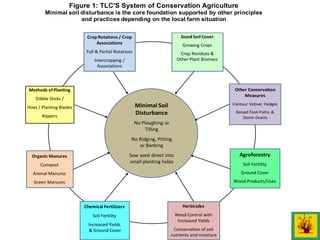
Minimal Soil
Disturbance
No Ploughing or
Tilling
No Ridging, Pitting
or Banking
Sow seed direct into
small planting holes
Organic Manures
Compost
Animal Manures
Green Manures
Crop Rotations / Crop
Associations
Full & Partial Rotations
Intercropping /
Associations
Methods of Planting
Dibble Sticks /
Hoes / Planting Blades
Rippers
Other Conservation
Measures
Contour Vetiver Hedges
Raised Foot-Paths &
Storm Drains
Agroforestry
Soil Fertility
Ground Cover
Wood Products/Uses
Herbicides
Weed Control with
Increased Yields
Conservation of soil
nutrients and moisture
Chemical Fertilizers
Soil Fertility
Increased Yields
& Ground Cover
Figure 1: TLC'S System of Conservation Agriculture
Minimal soil disturbance is the core foundation supported by other principles
and practices depending on the local farm situation
Good Soil Cover
Growing Crops
Crop Residues &
Other Plant Biomass
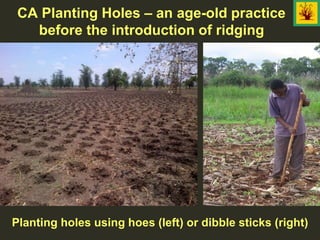
CA Planting Holes – an age-old practice
before the introduction of ridging
Planting holes using hoes (left) or dibble sticks (right)
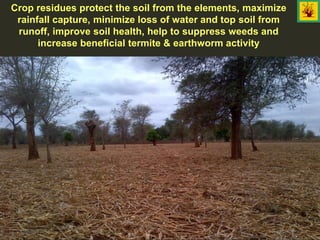
Crop residues protect the soil from the elements, maximize
rainfall capture, minimize loss of water and top soil from
runoff, improve soil health, help to suppress weeds and
increase beneficial termite & earthworm activity
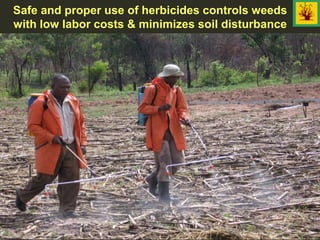
Safe and proper use of herbicides controls weeds
with low labor costs & minimizes soil disturbance
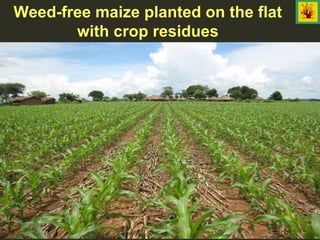
Weed-free maize planted on the flat
with crop residues
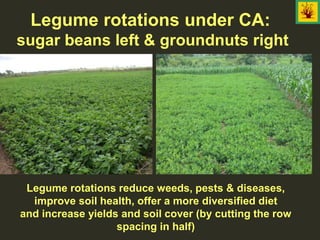
Legume rotations under CA:
sugar beans left & groundnuts right
Legume rotations reduce weeds, pests & diseases,
improve soil health, offer a more diversified diet
and increase yields and soil cover (by cutting the row
spacing in half)
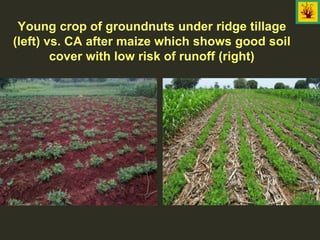
Young crop of groundnuts under ridge tillage
(left) vs. CA after maize which shows good soil
cover with low risk of runoff (right)
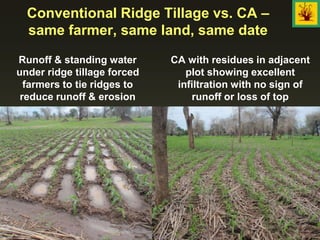
Conventional Ridge Tillage vs. CA –
same farmer, same land, same date
Runoff & standing water
under ridge tillage forced
farmers to tie ridges to
reduce runoff & erosion
CA with residues in adjacent
plot showing excellent
infiltration with no sign of
runoff or loss of top
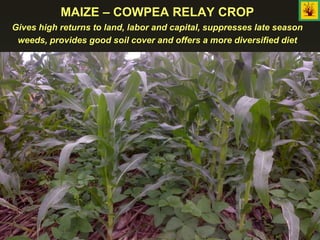
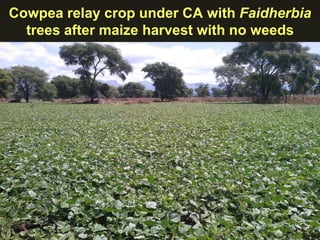
MAIZE – COWPEA RELAY CROP
Gives high returns to land, labor and capital, suppresses late season
weeds, provides good soil cover and offers a more diversified diet
Cowpea relay crop under CA with Faidherbia
trees after maize harvest with no weeds
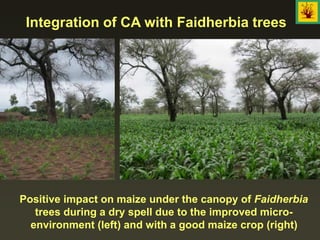
Positive impact on maize under the canopy of Faidherbia
trees during a dry spell due to the improved micro-
environment (left) and with a good maize crop (right)
Integration of CA with Faidherbia trees
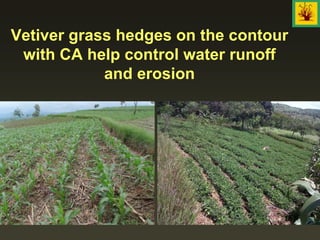
Vetiver grass hedges on the contour
with CA help control water runoff
and erosion
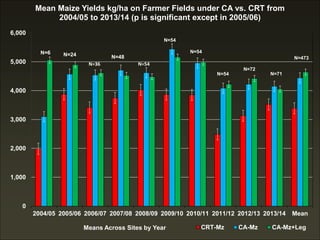
 Increased yields of 20-30% on average, with 60-100% in
years of poor rainfall
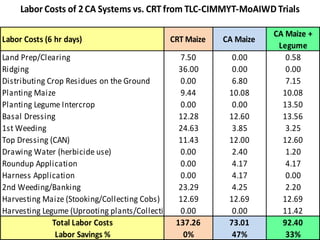
 Labor savings of 30-50% with major impacts on women
and child labor
 Increased income from increased yields and lower costs,
especially with legumes as sole or intercrops.
 Synergies from integrating CA with Faidherbia albida in
the extensive belt where the tree is common
 Use of Stellar Star vs Roundup as a more effective
herbicide that can be applied up to 4 weeks after planting
maize
Key Drivers for Adopting CA:
0
1,000
2,000
3,000
4,000
5,000
6,000
2004/05 2005/06 2006/07 2007/08 2008/09 2009/10 2010/11 2011/12 2012/13 2013/14 Mean
Means Across Sites by Year
Mean Maize Yields kg/ha on Farmer Fields under CA vs. CRT from
2004/05 to 2013/14 (p is significant except in 2005/06)
CRT-Mz CA-Mz CA-Mz+Leg
N=24
N=36 N=54
N=48
N=54
N=6 N=54
N=54
N=72
N=71
N=473
0
500
1000
1500
2000
2500
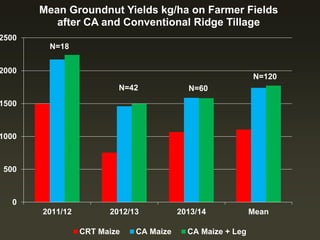
2011/12 2012/13 2013/14 Mean
Mean Groundnut Yields kg/ha on Farmer Fields
after CA and Conventional Ridge Tillage
CRT Maize CA Maize CA Maize + Leg
N=18
N=42 N=60
N=120
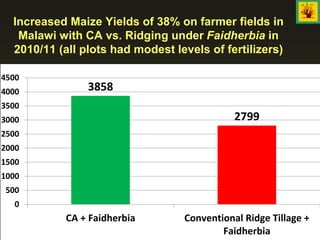
Increased Maize Yields of 38% on farmer fields in
Malawi with CA vs. Ridging under Faidherbia in
2010/11 (all plots had modest levels of fertilizers)
3858
2799
0
500
1000
1500
2000
2500
3000
3500
4000
4500
CA + Faidherbia Conventional Ridge Tillage +
Faidherbia
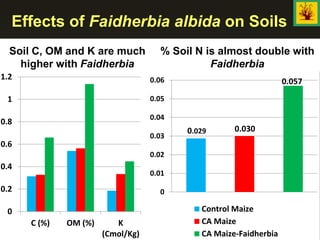
Effects of Faidherbia albida on Soils
Soil C, OM and K are much
higher with Faidherbia
0
0.2
0.4
0.6
0.8
1
1.2
C (%) OM (%) K
(Cmol/Kg)
% Soil N is almost double with
Faidherbia
0.029 0.030
0.057
0
0.01
0.02
0.03
0.04
0.05
0.06
Control Maize
CA Maize
CA Maize-Faidherbia
Labor Costs (6 hr days) CRT Maize CA Maize
CA Maize +
Legume
Land Prep/Clearing 7.50 0.00 0.58
Ridging 36.00 0.00 0.00
Distributing Crop Residues on the Ground 0.00 6.80 7.15
Planting Maize 9.44 10.08 10.08
Planting Legume Intercrop 0.00 0.00 13.50
Basal Dressing 12.28 12.60 13.56
1st Weeding 24.63 3.85 3.25
Top Dressing (CAN) 11.43 12.00 12.60
Drawing Water (herbicide use) 0.00 2.40 1.20
Roundup Application 0.00 4.17 4.17
Harness Application 0.00 4.17 0.00
2nd Weeding/Banking 23.29 4.25 2.20
Harvesting Maize (Stooking/Collecting Cobs) 12.69 12.69 12.69
Harvesting Legume (Uprooting plants/Collecting Pods)0.00 0.00 11.42
Total Labor Costs 137.26 73.01 92.40
Labor Savings % 0% 47% 33%
Labor Costs of 2CA Systems vs. CRT from TLC-CIMMYT-MoAIWD Trials
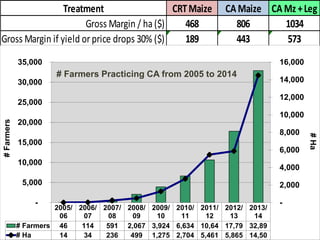
CRTMaize CA Maize CA Mz +Leg
468 806 1034
189 443 573
1701 1493 1686
Treatment
Break-even yield @current price (kg/ha)
Gross Margin / ha($)
Gross Margin if yield orprice drops 30% ($)
2005/
06
2006/
07
2007/
08
2008/
09
2009/
10
2010/
11
2011/
12
2012/
13
2013/
14
# Farmers 46 114 591 2,067 3,924 6,634 10,64 17,79 32,89
# Ha 14 34 236 499 1,275 2,704 5,461 5,865 14,50
-
2,000
4,000
6,000
8,000
10,000
12,000
14,000
16,000
-
5,000
10,000
15,000
20,000
25,000
30,000
35,000
#Ha
#Farmers
# Farmers Practicing CA from 2005 to 2014
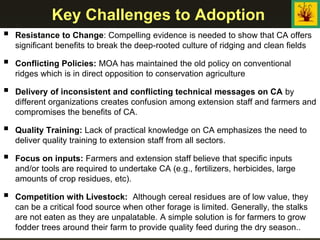
Key Challenges to Adoption
 Resistance to Change: Compelling evidence is needed to show that CA offers
significant benefits to break the deep-rooted culture of ridging and clean fields
 Conflicting Policies: MOA has maintained the old policy on conventional
ridges which is in direct opposition to conservation agriculture
 Delivery of inconsistent and conflicting technical messages on CA by
different organizations creates confusion among extension staff and farmers and
compromises the benefits of CA.
 Quality Training: Lack of practical knowledge on CA emphasizes the need to
deliver quality training to extension staff from all sectors.
 Focus on inputs: Farmers and extension staff believe that specific inputs
and/or tools are required to undertake CA (e.g., fertilizers, herbicides, large
amounts of crop residues, etc).
 Competition with Livestock: Although cereal residues are of low value, they
can be a critical food source when other forage is limited. Generally, the stalks
are not eaten as they are unpalatable. A simple solution is for farmers to grow
fodder trees around their farm to provide quality feed during the dry season..
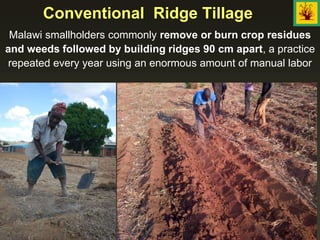
Conventional Ridge Tillage
Malawi smallholders commonly remove or burn crop residues
and weeds followed by building ridges 90 cm apart, a practice
repeated every year using an enormous amount of manual labor
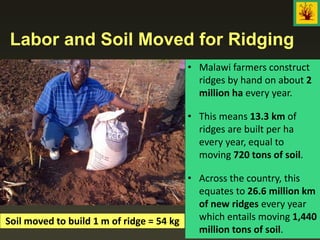
Labor and Soil Moved for Ridging
Soil moved to build 1 m of ridge = 54 kg
• Malawi farmers construct
ridges by hand on about 2
million ha every year.
• This means 13.3 km of
ridges are built per ha
every year, equal to
moving 720 tons of soil.
• Across the country, this
equates to 26.6 million km
of new ridges every year
which entails moving 1,440
million tons of soil.
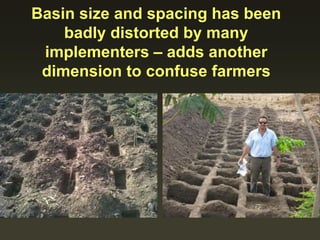
Basin size and spacing has been
badly distorted by many
implementers – adds another
dimension to confuse farmers
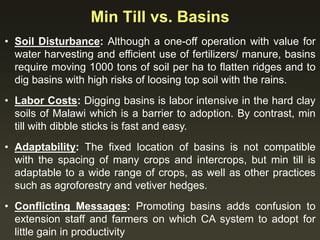
Min Till vs. Basins
• Soil Disturbance: Although a one-off operation with value for
water harvesting and efficient use of fertilizers/ manure, basins
require moving 1000 tons of soil per ha to flatten ridges and to
dig basins with high risks of loosing top soil with the rains.
• Labor Costs: Digging basins is labor intensive in the hard clay
soils of Malawi which is a barrier to adoption. By contrast, min
till with dibble sticks is fast and easy.
• Adaptability: The fixed location of basins is not compatible
with the spacing of many crops and intercrops, but min till is
adaptable to a wide range of crops, as well as other practices
such as agroforestry and vetiver hedges.
• Conflicting Messages: Promoting basins adds confusion to
extension staff and farmers on which CA system to adopt for
little gain in productivity
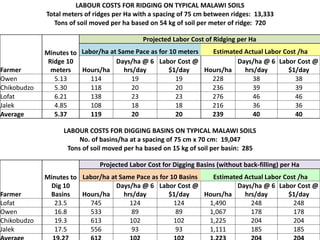
LABOUR COSTS FOR RIDGING ON TYPICAL MALAWI SOILS
Total meters of ridges per Ha with a spacing of 75 cm between ridges: 13,333
Tons of soil moved per ha based on 54 kg of soil per meter of ridge: 720
Farmer
Minutes to
Ridge 10
meters
Projected Labor Cost of Ridging per Ha
Labor/ha at Same Pace as for 10 meters Estimated Actual Labor Cost /ha
Hours/ha
Days/ha @ 6
hrs/day
Labor Cost @
$1/day Hours/ha
Days/ha @ 6
hrs/day
Labor Cost @
$1/day
Owen 5.13 114 19 19 228 38 38
Chikobudzo 5.30 118 20 20 236 39 39
Lofat 6.21 138 23 23 276 46 46
Jalek 4.85 108 18 18 216 36 36
Average 5.37 119 20 20 239 40 40
LABOUR COSTS FOR DIGGING BASINS ON TYPICAL MALAWI SOILS
No. of basins/ha at a spacing of 75 cm x 70 cm: 19,047
Tons of soil moved per ha based on 15 kg of soil per basin: 285
Farmer
Minutes to
Dig 10
Basins
Projected Labor Cost for Digging Basins (without back-filling) per Ha
Labor/ha at Same Pace as for 10 Basins Estimated Actual Labor Cost /ha
Hours/ha
Days/ha @ 6
hrs/day
Labor Cost @
$1/day Hours/ha
Days/ha @ 6
hrs/day
Labor Cost @
$1/day
Lofat 23.5 745 124 124 1,490 248 248
Owen 16.8 533 89 89 1,067 178 178
Chikobudzo 19.3 613 102 102 1,225 204 204
Jalek 17.5 556 93 93 1,111 185 185
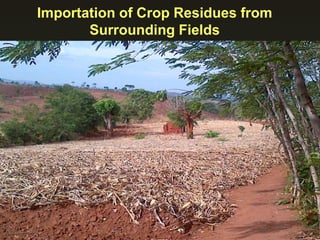
Importation of Crop Residues from
Surrounding Fields
Key Objectives of SAPP – Increasing
Productivity and Profitability with Enhanced
Resilience to Climate Change
1. Increase adoption of CA among 150,000 smallholder
farmers over 5 years.
2. Integrate crop diversification, agroforestry and small
livestock with CA to increase benefits and impacts
3. Increase farmer access to input and output markets.
4. Harmonize best CA practices for delivering sound and
consistent extension messages to farmers.
5. Increase support for CA by strengthening the
knowledge base and understanding of CA among key
stakeholders. partners
Foundation for Scaling Up CA under IFAD’s
Sustainable Ag Productivity Program
• Evidence-based Results: Collaboration with CIMMYT
over the past 10 years has provided the scientific
foundation and credibility for TLC to take a lead role in
promoting CA in Malawi.
• Experience with Farmers: There is no substitute for
practical hands-on experience in identifying key
challenges and drivers to the adoption of CA. TLC has a
sound understanding of the factors impacting adoption and
how to overcome them.
• Extension Network: TLC’s extensive network of field
staff is closely aligned with that of Government to provide
the infrastructure necessary to promote CA on a large
Foundation for Scaling up…..
• Lead Farmer Approach: TLC delivers effective extension
services by training and supporting lead farmers elected by
communities to train fellow farmers through demonstrations on
their own farms. No incentives are offered except for the
training and inputs received for demonstrations and field days.
• Harmonization of technical messages and training: As the
nominated lead institution on CA in Malawi (through the NCATF
and its members), TLC is developing guidelines and certified
training courses to help harmonize the delivery of sound and
consistent messages on CA principles and practices.
• Improve farmer access to inputs and markets by facilitating
linkages with agro-dealers and buyers of produce to enhance
productivity and profitability while lowering labor costs.
SAPP – Strategy for Scaling up CA
TLC has mapped out a strategy to scale up CA based on the
experiences and knowledge gained over the past 10 years:
1. Address the major challenges to adoption
2. Promote key drivers of increased yields and incomes at
lower costs:
 increased yields of legume crops from halving the row
spacing and doubling the ground cover
 Promote CA in the belt where Faidherbia is common.
 integrate cowpeas and pigeon peas as relay and
intercrops to increase returns to land, labor and capital
(high yields of high value crops resistant to drought
with suppression of late season weeds)
ACKNOWLEDGEMENTS
Information in this presentation was produced by Total
LandCare and CIMMYT with support from the
Government of Malawi, IFAD, the Royal Norwegian
Embassy, USAID and DFID
TOTAL LANDCARE
P.O. Box 2440
Area 14, Plot 100
Lilongwe, Malawi
Tel: +265 1 770 904 / 905; Fax: +265 1 770 919
Email: total.landcare.mw@gmail.com
Website: www.totallandcare.org

SCALING-UP CA SYSTEMS – FROM PLOT TO DISTRICT AND REGIONAL LEVELS

  • 1.
    TOTAL LANDCARE SCALING-UP CASYSTEMS – FROM PLOT TO DISTRICT AND REGIONAL LEVELS IFAD LEARNING EVENT / SEMINAR ROME, JANUARY 13-14, 2015
  • 2.
    FOCUS OF PRESENTATION Part 1: Development of the CA System Promoted by TLC  Part 2: Identification of Challenges to Adoption & Strategies for Scaling up CA
  • 3.
    CONSERVATION AGRICULTURE: TLC Experienceswith CIMMYT Keep the message simple:  Make small planting holes with a dibble stick  Retain crop residues produced in situ  Diversify crops with rotations or intercrops.
  • 4.
    Minimal Soil Disturbance No Ploughingor Tilling No Ridging, Pitting or Banking Sow seed direct into small planting holes Organic Manures Compost Animal Manures Green Manures Crop Rotations / Crop Associations Full & Partial Rotations Intercropping / Associations Methods of Planting Dibble Sticks / Hoes / Planting Blades Rippers Other Conservation Measures Contour Vetiver Hedges Raised Foot-Paths & Storm Drains Agroforestry Soil Fertility Ground Cover Wood Products/Uses Herbicides Weed Control with Increased Yields Conservation of soil nutrients and moisture Chemical Fertilizers Soil Fertility Increased Yields & Ground Cover Figure 1: TLC'S System of Conservation Agriculture Minimal soil disturbance is the core foundation supported by other principles and practices depending on the local farm situation Good Soil Cover Growing Crops Crop Residues & Other Plant Biomass
  • 5.
    CA Planting Holes– an age-old practice before the introduction of ridging Planting holes using hoes (left) or dibble sticks (right)
  • 6.
    Crop residues protectthe soil from the elements, maximize rainfall capture, minimize loss of water and top soil from runoff, improve soil health, help to suppress weeds and increase beneficial termite & earthworm activity
  • 7.
    Safe and properuse of herbicides controls weeds with low labor costs & minimizes soil disturbance
  • 8.
    Weed-free maize plantedon the flat with crop residues
  • 9.
    Legume rotations underCA: sugar beans left & groundnuts right Legume rotations reduce weeds, pests & diseases, improve soil health, offer a more diversified diet and increase yields and soil cover (by cutting the row spacing in half)
  • 10.
    Young crop ofgroundnuts under ridge tillage (left) vs. CA after maize which shows good soil cover with low risk of runoff (right)
  • 11.
    Conventional Ridge Tillagevs. CA – same farmer, same land, same date Runoff & standing water under ridge tillage forced farmers to tie ridges to reduce runoff & erosion CA with residues in adjacent plot showing excellent infiltration with no sign of runoff or loss of top
  • 12.
    MAIZE – COWPEARELAY CROP Gives high returns to land, labor and capital, suppresses late season weeds, provides good soil cover and offers a more diversified diet
  • 13.
    Cowpea relay cropunder CA with Faidherbia trees after maize harvest with no weeds
  • 14.
    Positive impact onmaize under the canopy of Faidherbia trees during a dry spell due to the improved micro- environment (left) and with a good maize crop (right) Integration of CA with Faidherbia trees
  • 15.
    Vetiver grass hedgeson the contour with CA help control water runoff and erosion
  • 16.
     Increased yieldsof 20-30% on average, with 60-100% in years of poor rainfall  Labor savings of 30-50% with major impacts on women and child labor  Increased income from increased yields and lower costs, especially with legumes as sole or intercrops.  Synergies from integrating CA with Faidherbia albida in the extensive belt where the tree is common  Use of Stellar Star vs Roundup as a more effective herbicide that can be applied up to 4 weeks after planting maize Key Drivers for Adopting CA:
  • 17.
    0 1,000 2,000 3,000 4,000 5,000 6,000 2004/05 2005/06 2006/072007/08 2008/09 2009/10 2010/11 2011/12 2012/13 2013/14 Mean Means Across Sites by Year Mean Maize Yields kg/ha on Farmer Fields under CA vs. CRT from 2004/05 to 2013/14 (p is significant except in 2005/06) CRT-Mz CA-Mz CA-Mz+Leg N=24 N=36 N=54 N=48 N=54 N=6 N=54 N=54 N=72 N=71 N=473
  • 18.
    0 500 1000 1500 2000 2500 2011/12 2012/13 2013/14Mean Mean Groundnut Yields kg/ha on Farmer Fields after CA and Conventional Ridge Tillage CRT Maize CA Maize CA Maize + Leg N=18 N=42 N=60 N=120
  • 19.
    Increased Maize Yieldsof 38% on farmer fields in Malawi with CA vs. Ridging under Faidherbia in 2010/11 (all plots had modest levels of fertilizers) 3858 2799 0 500 1000 1500 2000 2500 3000 3500 4000 4500 CA + Faidherbia Conventional Ridge Tillage + Faidherbia
  • 20.
    Effects of Faidherbiaalbida on Soils Soil C, OM and K are much higher with Faidherbia 0 0.2 0.4 0.6 0.8 1 1.2 C (%) OM (%) K (Cmol/Kg) % Soil N is almost double with Faidherbia 0.029 0.030 0.057 0 0.01 0.02 0.03 0.04 0.05 0.06 Control Maize CA Maize CA Maize-Faidherbia
  • 21.
    Labor Costs (6hr days) CRT Maize CA Maize CA Maize + Legume Land Prep/Clearing 7.50 0.00 0.58 Ridging 36.00 0.00 0.00 Distributing Crop Residues on the Ground 0.00 6.80 7.15 Planting Maize 9.44 10.08 10.08 Planting Legume Intercrop 0.00 0.00 13.50 Basal Dressing 12.28 12.60 13.56 1st Weeding 24.63 3.85 3.25 Top Dressing (CAN) 11.43 12.00 12.60 Drawing Water (herbicide use) 0.00 2.40 1.20 Roundup Application 0.00 4.17 4.17 Harness Application 0.00 4.17 0.00 2nd Weeding/Banking 23.29 4.25 2.20 Harvesting Maize (Stooking/Collecting Cobs) 12.69 12.69 12.69 Harvesting Legume (Uprooting plants/Collecting Pods)0.00 0.00 11.42 Total Labor Costs 137.26 73.01 92.40 Labor Savings % 0% 47% 33% Labor Costs of 2CA Systems vs. CRT from TLC-CIMMYT-MoAIWD Trials
  • 22.
    CRTMaize CA MaizeCA Mz +Leg 468 806 1034 189 443 573 1701 1493 1686 Treatment Break-even yield @current price (kg/ha) Gross Margin / ha($) Gross Margin if yield orprice drops 30% ($) 2005/ 06 2006/ 07 2007/ 08 2008/ 09 2009/ 10 2010/ 11 2011/ 12 2012/ 13 2013/ 14 # Farmers 46 114 591 2,067 3,924 6,634 10,64 17,79 32,89 # Ha 14 34 236 499 1,275 2,704 5,461 5,865 14,50 - 2,000 4,000 6,000 8,000 10,000 12,000 14,000 16,000 - 5,000 10,000 15,000 20,000 25,000 30,000 35,000 #Ha #Farmers # Farmers Practicing CA from 2005 to 2014
  • 23.
    Key Challenges toAdoption  Resistance to Change: Compelling evidence is needed to show that CA offers significant benefits to break the deep-rooted culture of ridging and clean fields  Conflicting Policies: MOA has maintained the old policy on conventional ridges which is in direct opposition to conservation agriculture  Delivery of inconsistent and conflicting technical messages on CA by different organizations creates confusion among extension staff and farmers and compromises the benefits of CA.  Quality Training: Lack of practical knowledge on CA emphasizes the need to deliver quality training to extension staff from all sectors.  Focus on inputs: Farmers and extension staff believe that specific inputs and/or tools are required to undertake CA (e.g., fertilizers, herbicides, large amounts of crop residues, etc).  Competition with Livestock: Although cereal residues are of low value, they can be a critical food source when other forage is limited. Generally, the stalks are not eaten as they are unpalatable. A simple solution is for farmers to grow fodder trees around their farm to provide quality feed during the dry season..
  • 24.
    Conventional Ridge Tillage Malawismallholders commonly remove or burn crop residues and weeds followed by building ridges 90 cm apart, a practice repeated every year using an enormous amount of manual labor
  • 25.
    Labor and SoilMoved for Ridging Soil moved to build 1 m of ridge = 54 kg • Malawi farmers construct ridges by hand on about 2 million ha every year. • This means 13.3 km of ridges are built per ha every year, equal to moving 720 tons of soil. • Across the country, this equates to 26.6 million km of new ridges every year which entails moving 1,440 million tons of soil.
  • 26.
    Basin size andspacing has been badly distorted by many implementers – adds another dimension to confuse farmers
  • 27.
    Min Till vs.Basins • Soil Disturbance: Although a one-off operation with value for water harvesting and efficient use of fertilizers/ manure, basins require moving 1000 tons of soil per ha to flatten ridges and to dig basins with high risks of loosing top soil with the rains. • Labor Costs: Digging basins is labor intensive in the hard clay soils of Malawi which is a barrier to adoption. By contrast, min till with dibble sticks is fast and easy. • Adaptability: The fixed location of basins is not compatible with the spacing of many crops and intercrops, but min till is adaptable to a wide range of crops, as well as other practices such as agroforestry and vetiver hedges. • Conflicting Messages: Promoting basins adds confusion to extension staff and farmers on which CA system to adopt for little gain in productivity
  • 28.
    LABOUR COSTS FORRIDGING ON TYPICAL MALAWI SOILS Total meters of ridges per Ha with a spacing of 75 cm between ridges: 13,333 Tons of soil moved per ha based on 54 kg of soil per meter of ridge: 720 Farmer Minutes to Ridge 10 meters Projected Labor Cost of Ridging per Ha Labor/ha at Same Pace as for 10 meters Estimated Actual Labor Cost /ha Hours/ha Days/ha @ 6 hrs/day Labor Cost @ $1/day Hours/ha Days/ha @ 6 hrs/day Labor Cost @ $1/day Owen 5.13 114 19 19 228 38 38 Chikobudzo 5.30 118 20 20 236 39 39 Lofat 6.21 138 23 23 276 46 46 Jalek 4.85 108 18 18 216 36 36 Average 5.37 119 20 20 239 40 40 LABOUR COSTS FOR DIGGING BASINS ON TYPICAL MALAWI SOILS No. of basins/ha at a spacing of 75 cm x 70 cm: 19,047 Tons of soil moved per ha based on 15 kg of soil per basin: 285 Farmer Minutes to Dig 10 Basins Projected Labor Cost for Digging Basins (without back-filling) per Ha Labor/ha at Same Pace as for 10 Basins Estimated Actual Labor Cost /ha Hours/ha Days/ha @ 6 hrs/day Labor Cost @ $1/day Hours/ha Days/ha @ 6 hrs/day Labor Cost @ $1/day Lofat 23.5 745 124 124 1,490 248 248 Owen 16.8 533 89 89 1,067 178 178 Chikobudzo 19.3 613 102 102 1,225 204 204 Jalek 17.5 556 93 93 1,111 185 185
  • 29.
    Importation of CropResidues from Surrounding Fields
  • 30.
    Key Objectives ofSAPP – Increasing Productivity and Profitability with Enhanced Resilience to Climate Change 1. Increase adoption of CA among 150,000 smallholder farmers over 5 years. 2. Integrate crop diversification, agroforestry and small livestock with CA to increase benefits and impacts 3. Increase farmer access to input and output markets. 4. Harmonize best CA practices for delivering sound and consistent extension messages to farmers. 5. Increase support for CA by strengthening the knowledge base and understanding of CA among key stakeholders. partners
  • 31.
    Foundation for ScalingUp CA under IFAD’s Sustainable Ag Productivity Program • Evidence-based Results: Collaboration with CIMMYT over the past 10 years has provided the scientific foundation and credibility for TLC to take a lead role in promoting CA in Malawi. • Experience with Farmers: There is no substitute for practical hands-on experience in identifying key challenges and drivers to the adoption of CA. TLC has a sound understanding of the factors impacting adoption and how to overcome them. • Extension Network: TLC’s extensive network of field staff is closely aligned with that of Government to provide the infrastructure necessary to promote CA on a large
  • 32.
    Foundation for Scalingup….. • Lead Farmer Approach: TLC delivers effective extension services by training and supporting lead farmers elected by communities to train fellow farmers through demonstrations on their own farms. No incentives are offered except for the training and inputs received for demonstrations and field days. • Harmonization of technical messages and training: As the nominated lead institution on CA in Malawi (through the NCATF and its members), TLC is developing guidelines and certified training courses to help harmonize the delivery of sound and consistent messages on CA principles and practices. • Improve farmer access to inputs and markets by facilitating linkages with agro-dealers and buyers of produce to enhance productivity and profitability while lowering labor costs.
  • 33.
    SAPP – Strategyfor Scaling up CA TLC has mapped out a strategy to scale up CA based on the experiences and knowledge gained over the past 10 years: 1. Address the major challenges to adoption 2. Promote key drivers of increased yields and incomes at lower costs:  increased yields of legume crops from halving the row spacing and doubling the ground cover  Promote CA in the belt where Faidherbia is common.  integrate cowpeas and pigeon peas as relay and intercrops to increase returns to land, labor and capital (high yields of high value crops resistant to drought with suppression of late season weeds)
  • 34.
    ACKNOWLEDGEMENTS Information in thispresentation was produced by Total LandCare and CIMMYT with support from the Government of Malawi, IFAD, the Royal Norwegian Embassy, USAID and DFID TOTAL LANDCARE P.O. Box 2440 Area 14, Plot 100 Lilongwe, Malawi Tel: +265 1 770 904 / 905; Fax: +265 1 770 919 Email: total.landcare.mw@gmail.com Website: www.totallandcare.org