

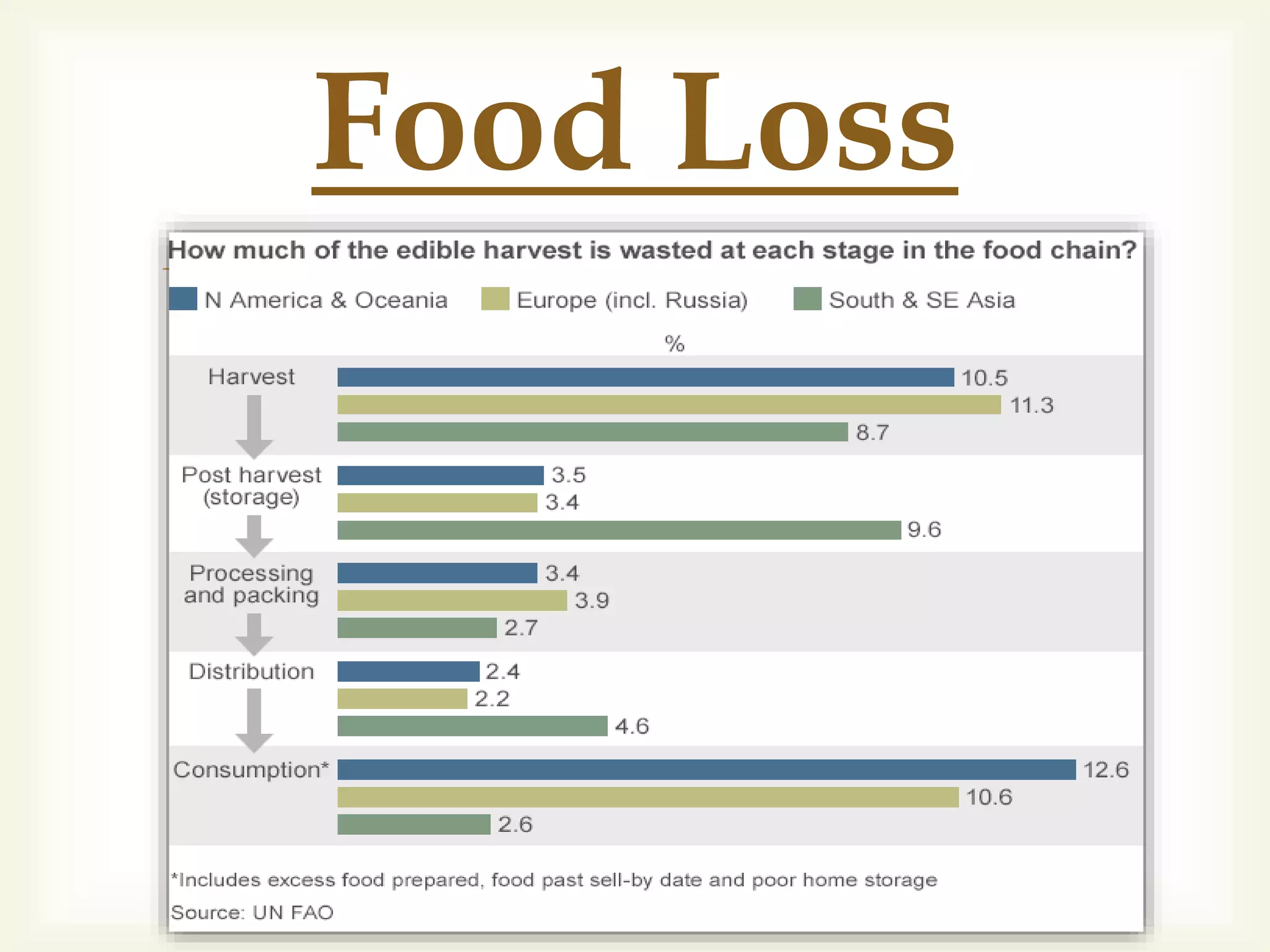
Food Loss

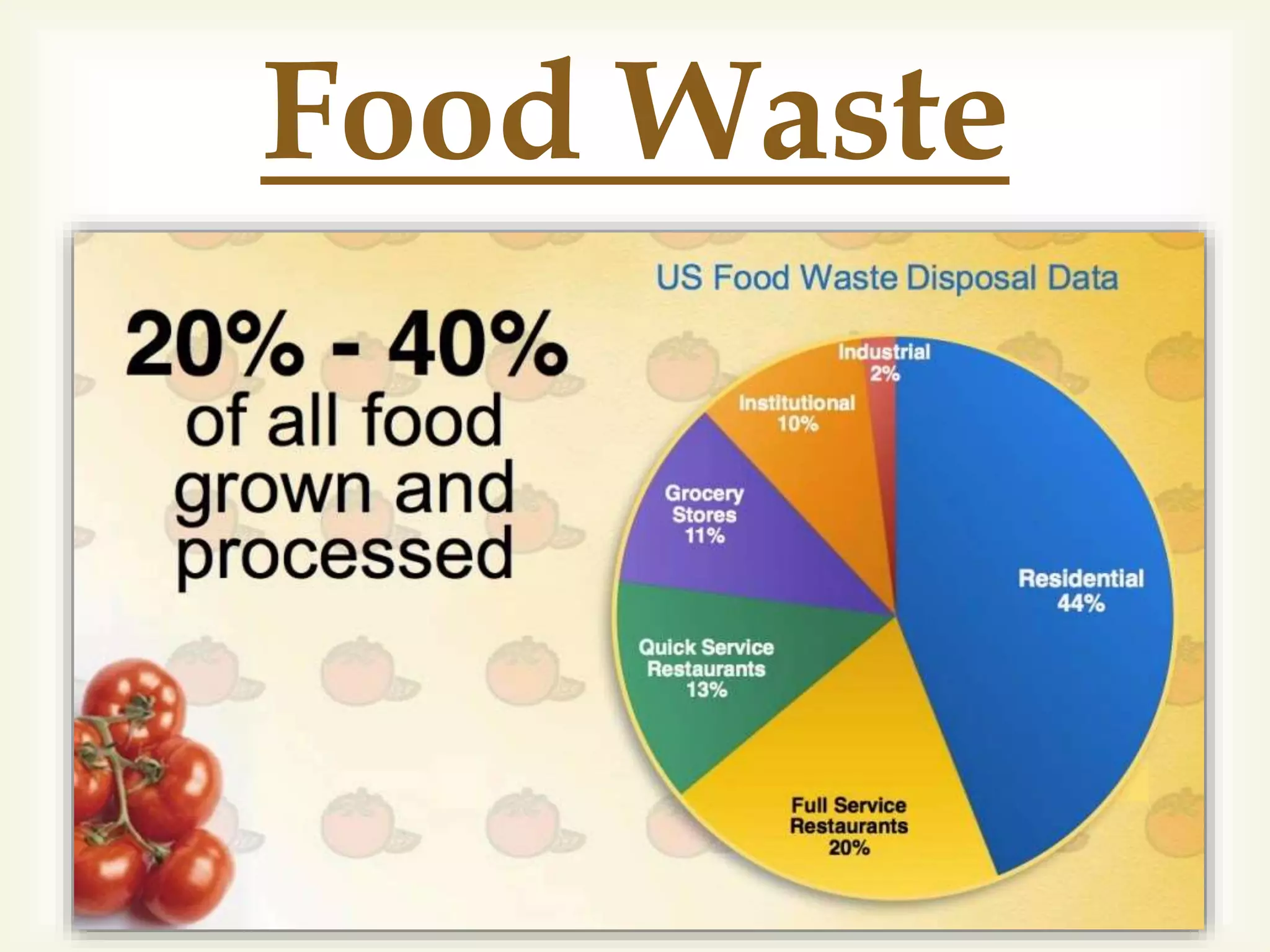
Food Waste

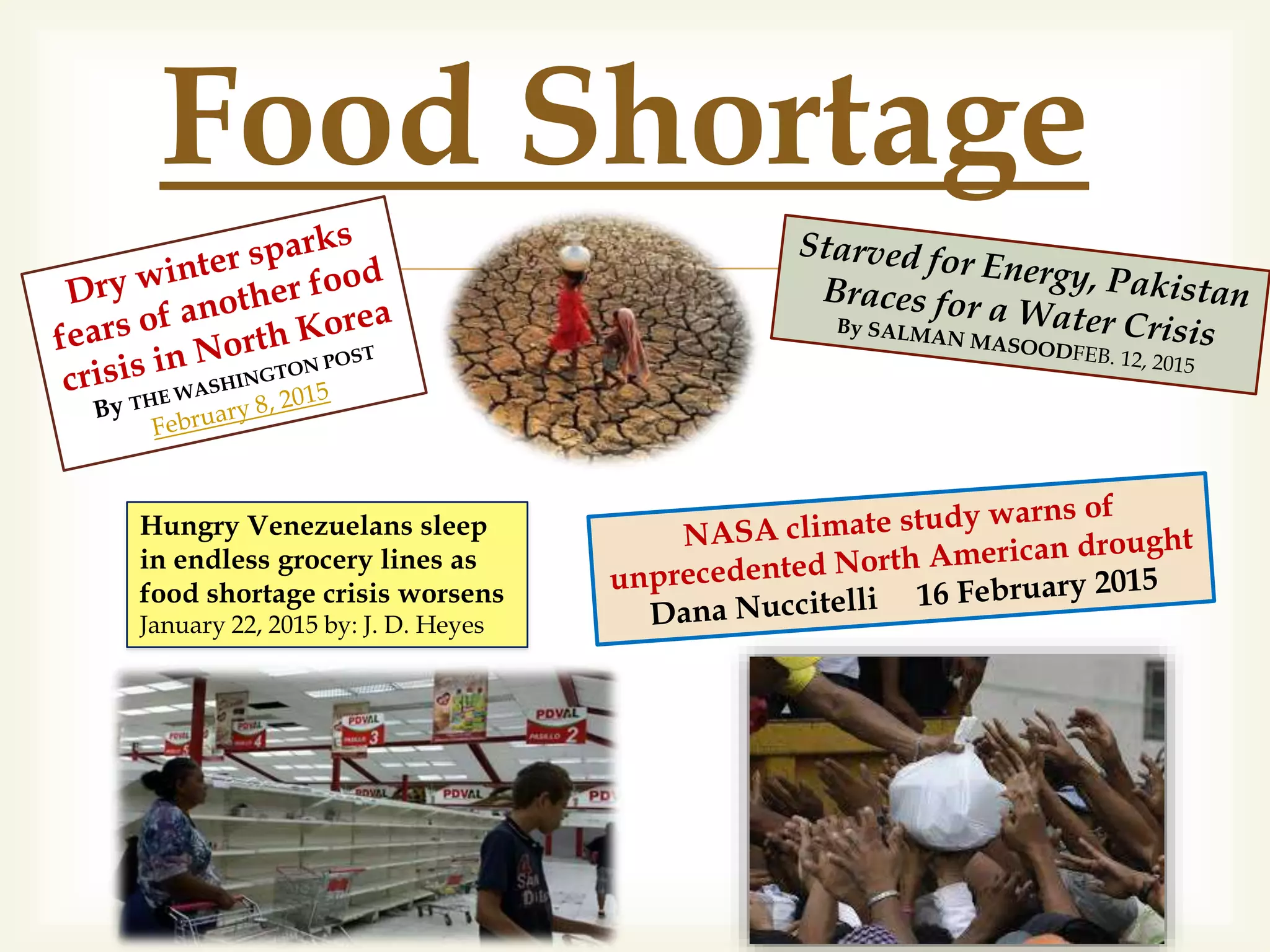
Food Shortage
Hungry Venezuelans sleep
in endless grocery lines as
food shortage crisis worsens
January 22, 2015 by: J. D. Heyes

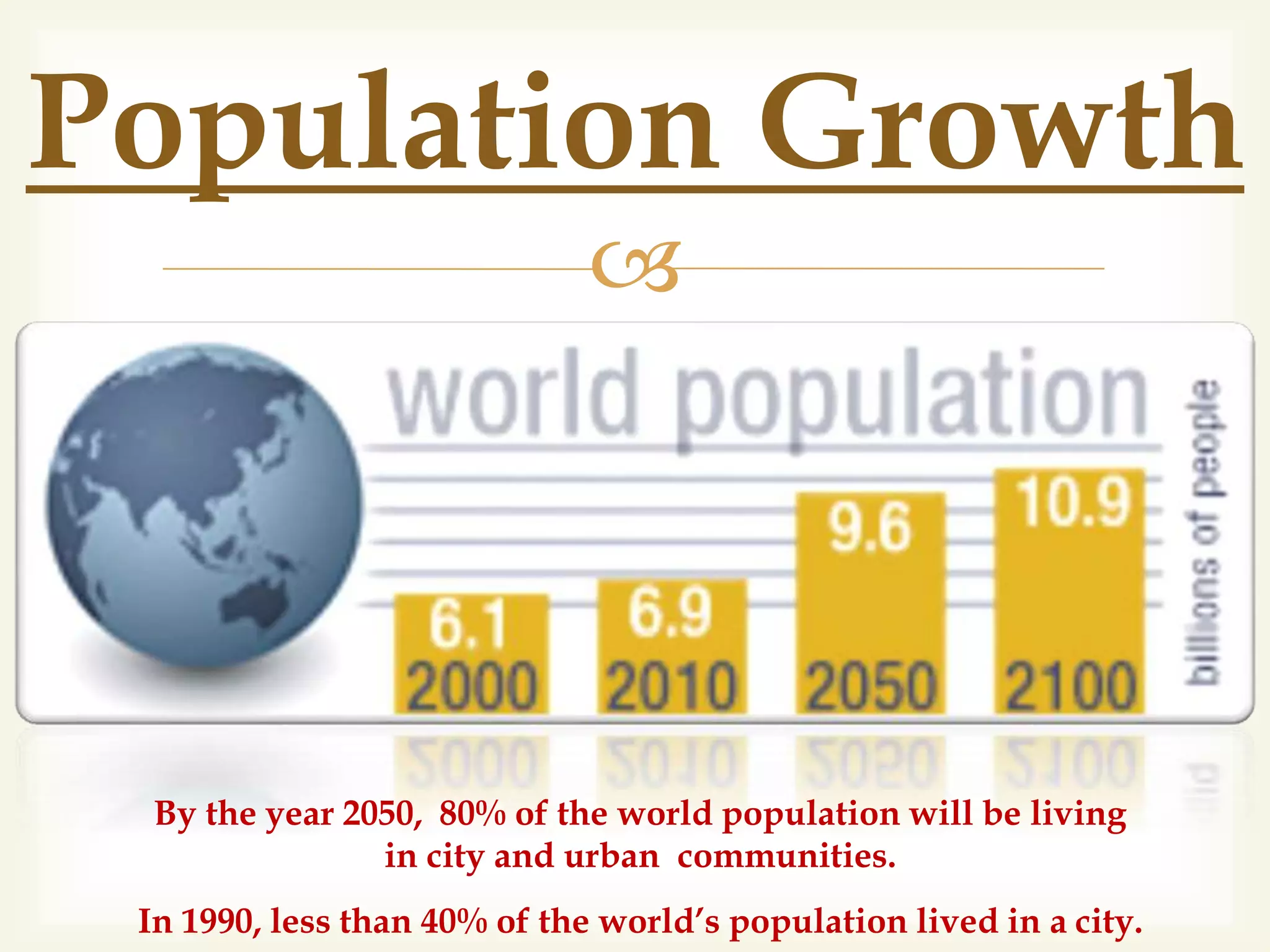
Population Growth
By the year 2050, 80% of the world population will be living
in city and urban communities.
In 1990, less than 40% of the world’s population lived in a city.

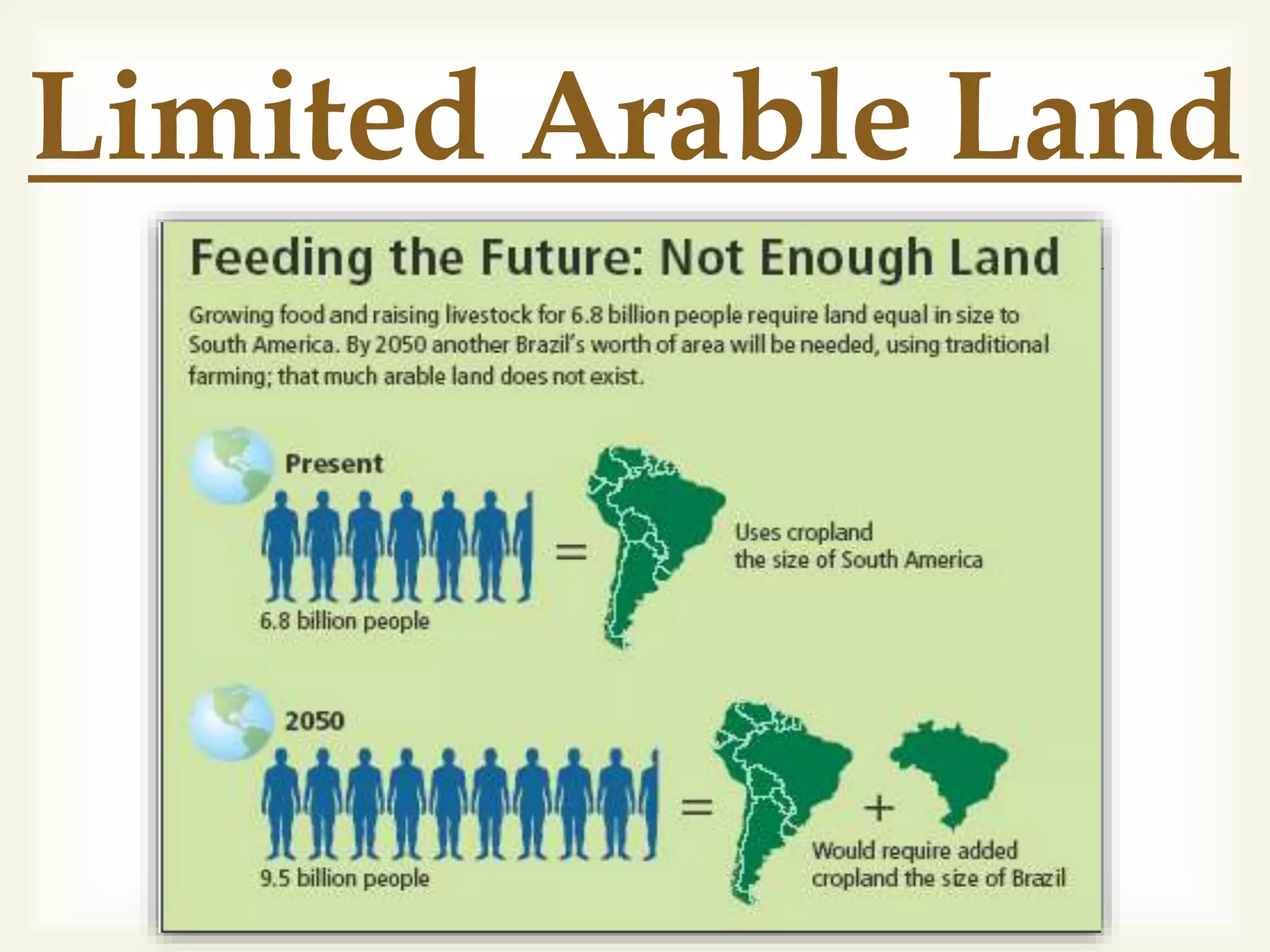
Limited Arable Land

Solutions?
• Hydroponics
• Vertical Farming
• Aquaponics

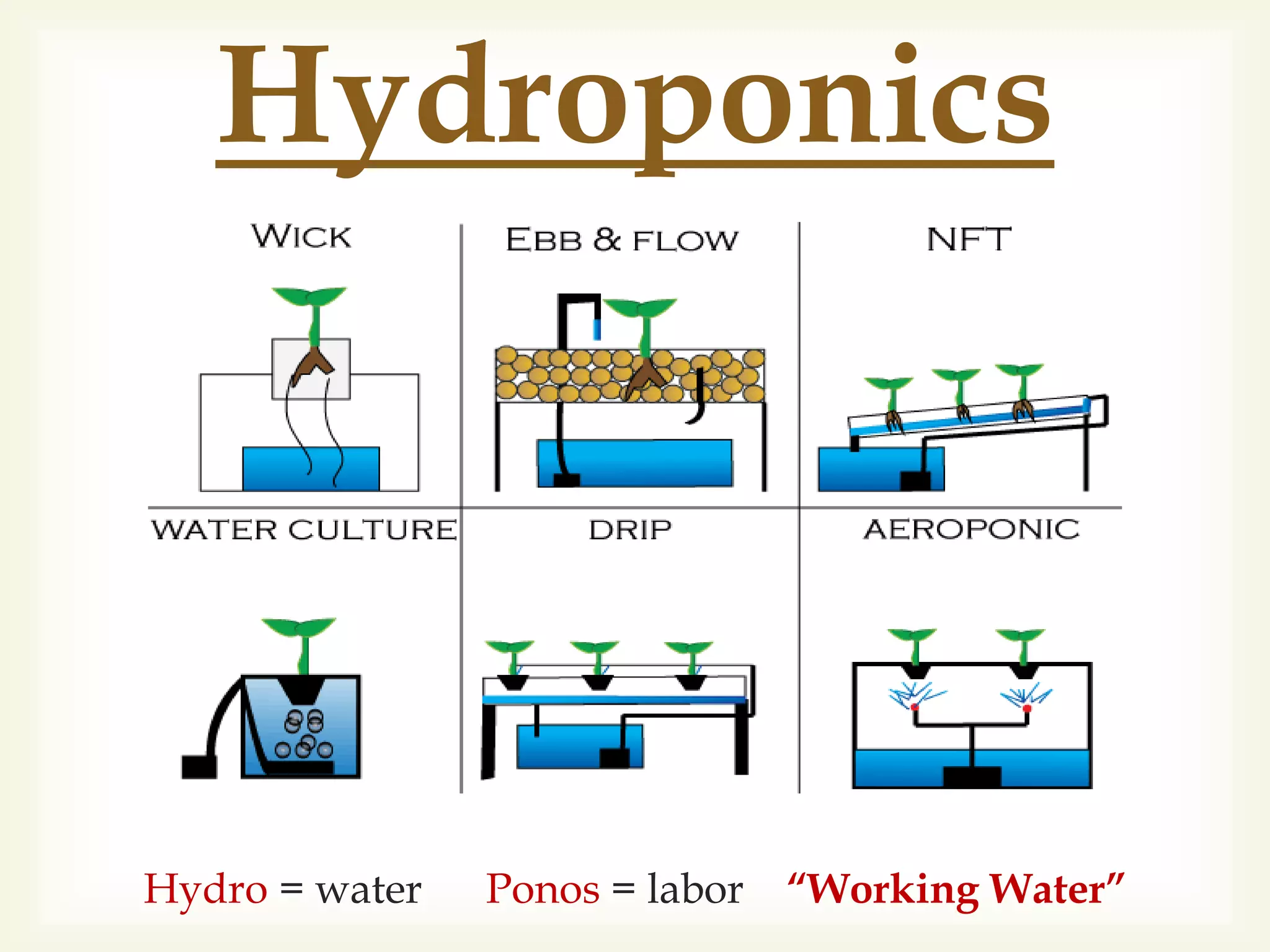
Hydroponics
Hydro = water Ponos = labor “Working Water”
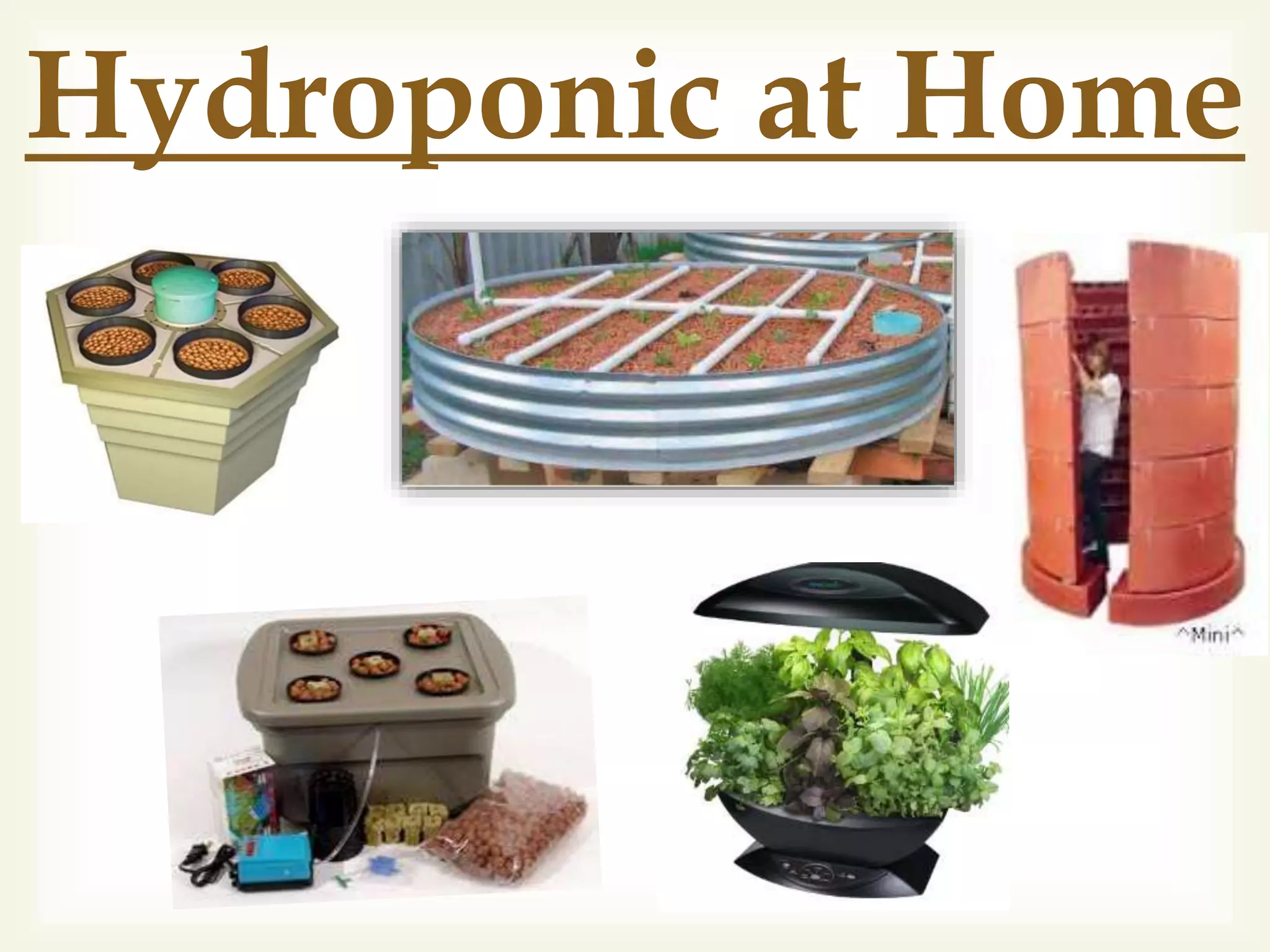
Hydroponics at Home
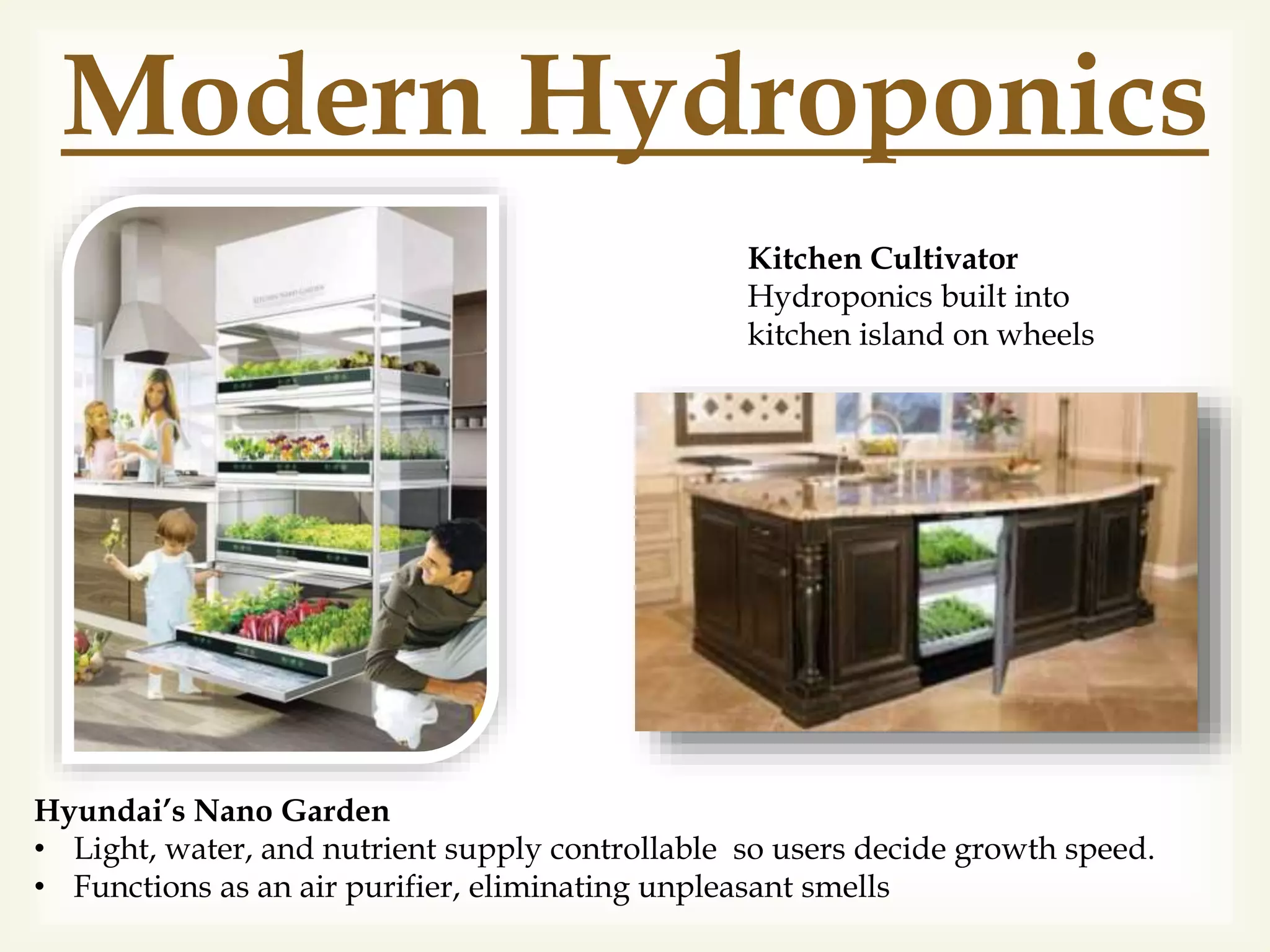
Modern Hydroponics
Hyundai’s Nano Garden
• Light, water, and nutrient supply controllable so users decide growth speed.
• Functions as an air purifier, eliminating unpleasant smells
Kitchen Cultivator
Hydroponics built into
kitchen island on wheels
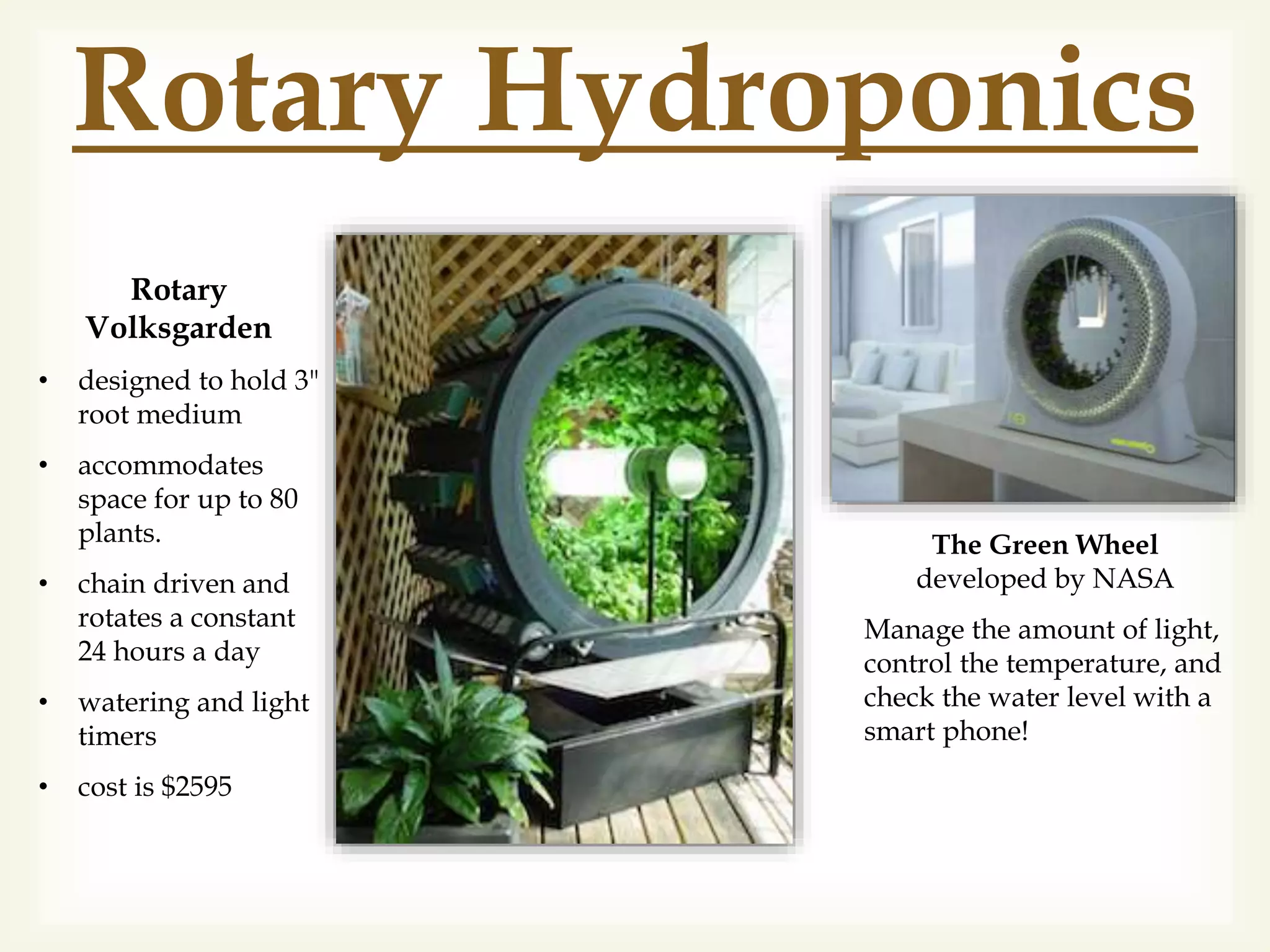
Rotary Hydroponics
The Green Wheel
developed by NASA
Manage the amount of light,
control the temperature, and
check the water level with a
smart phone!
Rotary
Volksgarden
• designed to hold 3"
root medium
• accommodates
space for up to 80
plants.
• chain driven and
rotates a constant
24 hours a day
• watering and light
timers
• cost is $2595
Hydroponics Technology
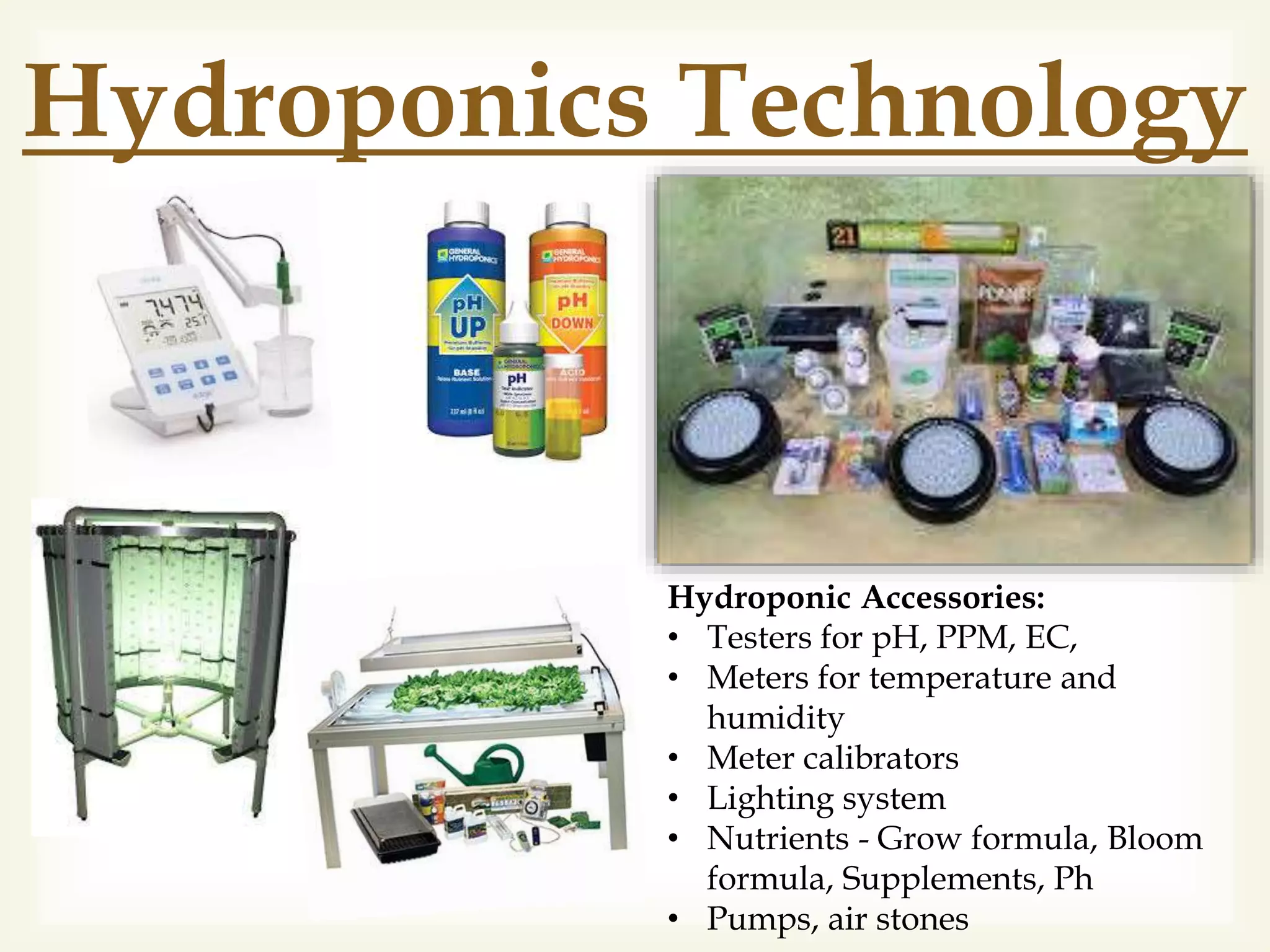
Hydroponic Accessories:
• Testers for pH, PPM, EC,
• Meters for temperature and
humidity
• Meter calibrators
• Lighting system
• Nutrients - Grow formula, Bloom
formula, Supplements, Ph
• Pumps, air stones
Rooftop Hydroponics
Gotham Greens
Rooftop Farm located in
Brooklyn, New York
• 15k square feet
• 100 tons of produce in the first year
• $2 million dollar start-up
• Yields 20% more than traditional farming
Rooftop Hydroponics

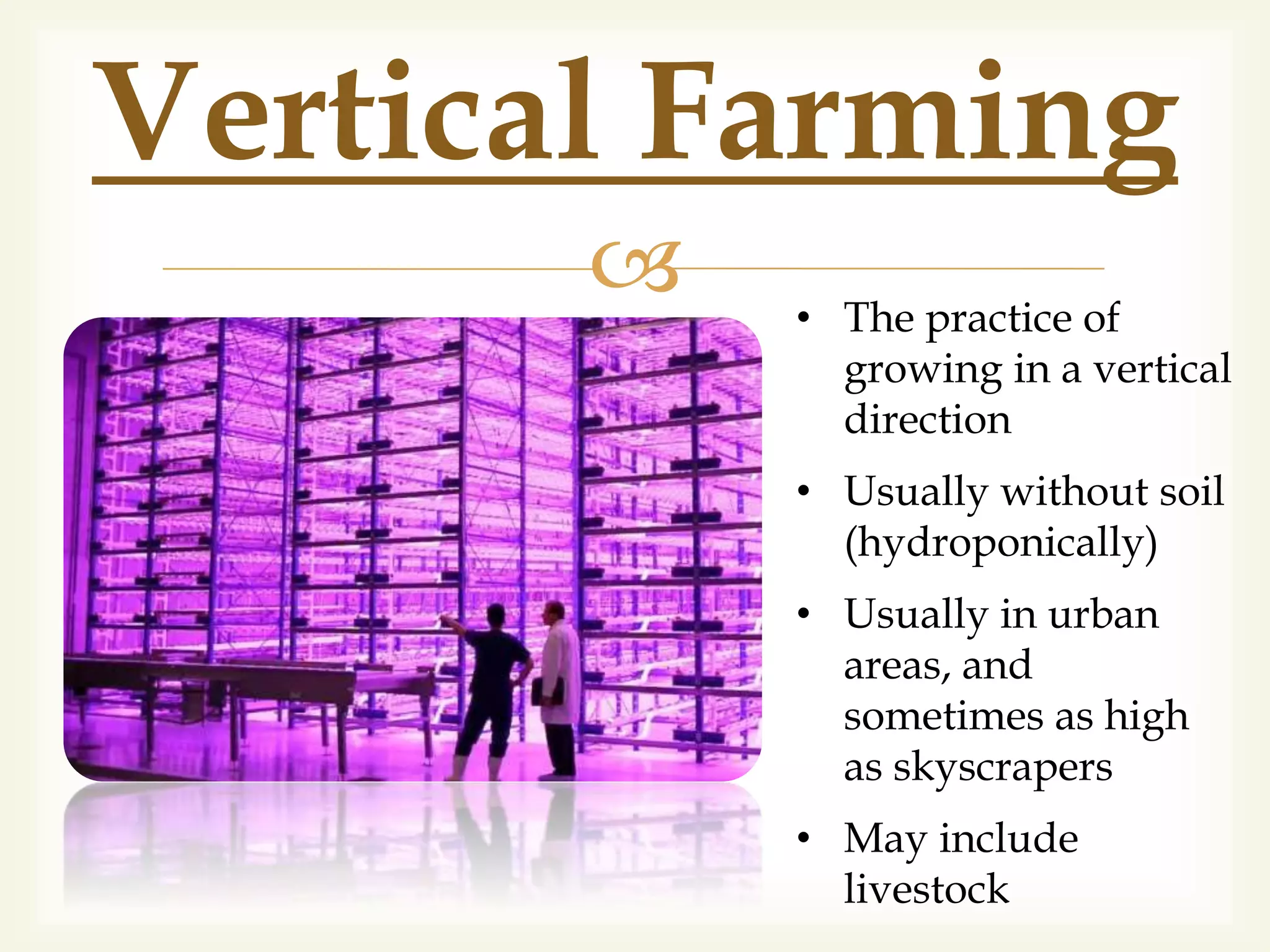
Vertical Farming
• The practice of
growing in a vertical
direction
• Usually without soil
(hydroponically)
• Usually in urban
areas, and
sometimes as high
as skyscrapers
• May include
livestock
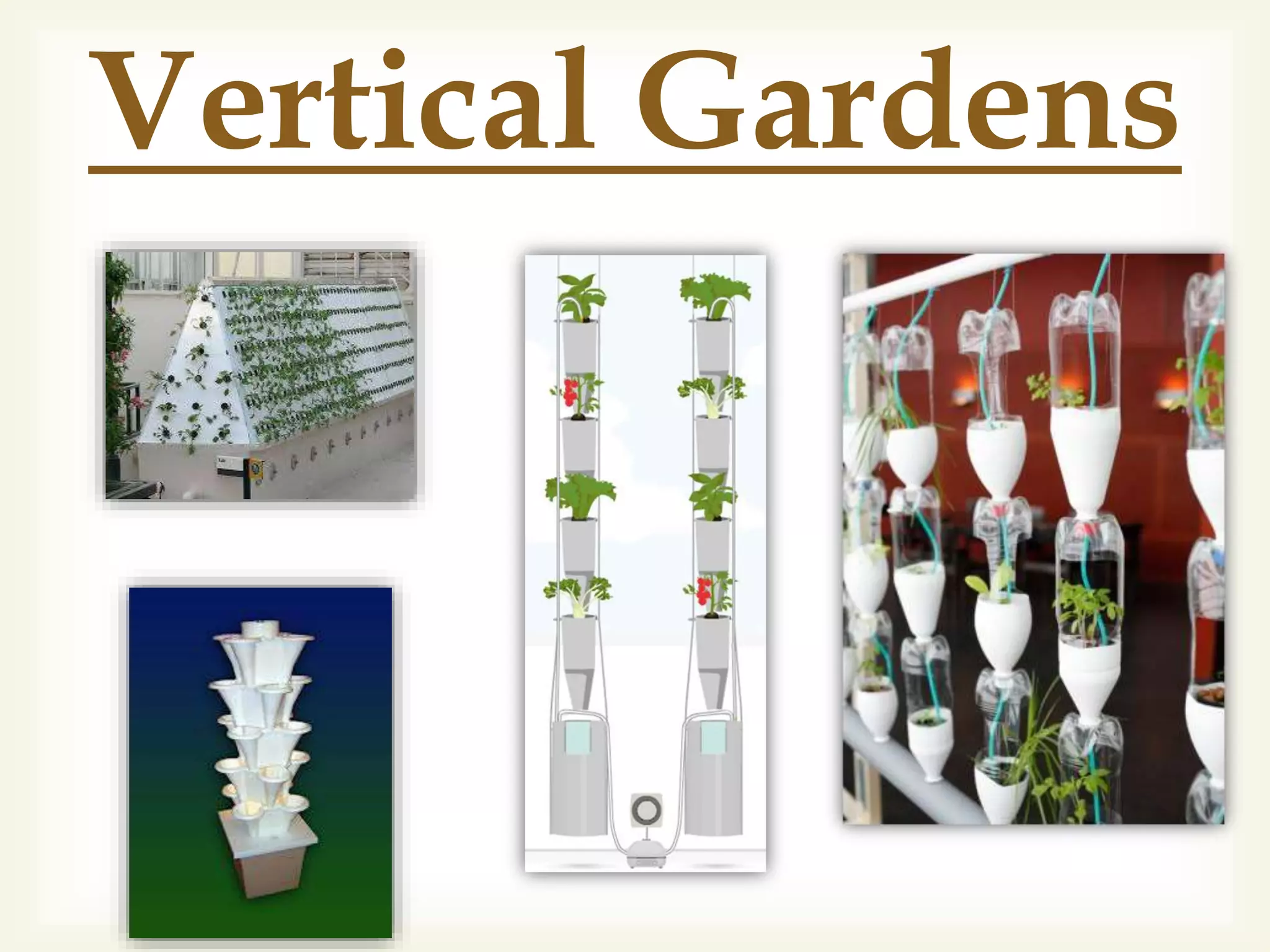
Vertical Gardens
Vertical Farms
Vertical Harvest
Jackson Hole, Wyoming
Opening early 2016
• Three-story, 13,500 square-foot
hydroponic green house (150’ x 30’)
• Should produce over 37,000 pounds of
greens, 4,400 pounds of herbs, and 44,000
pounds of tomatoes
• 95% of future crops already sold to local
restaurants, grocery stores, and a hospital
• Employs citizens with disabilities
Vertical Farms
Vertical Harvest
Jackson Hole, Wyoming
Opening early 2016
• Three-story, 13,500 square-foot
hydroponic green house (150’ x 30’)
• Should produce over 37,000 pounds of
greens, 4,400 pounds of herbs, and 44,000
pounds of tomatoes
• 95% of future crops already sold to local
restaurants, grocery stores, and a hospital
• Employs citizens with disabilities,
Vertical Farms
Sky Greens Vertical Farm
Singapore
• World’s first low carbon,
hydraulic driven vertical farm
• Uses minimal land, water and
energy resources
• 10x more productive than
conventional farming
• Only $360/month ($3/tower)
on electricity
• 3 stories tall, 120 aluminum
towers
• Able to produce 1 ton of fresh
veggies every other day
The Future of Vertical Farms
Floating Farms F.R.A.
(Floating Response Architecture)
Proposal for Singapore
By JAPA Design Firm
• Loop shape enables the vertical
structure to receive more sunlight
without having significant shadows
• System will aim for zero food waste by
using a data management system to
track of how much food people are
buying, so the farm can automatically
adjust production
The Future of Vertical Farms
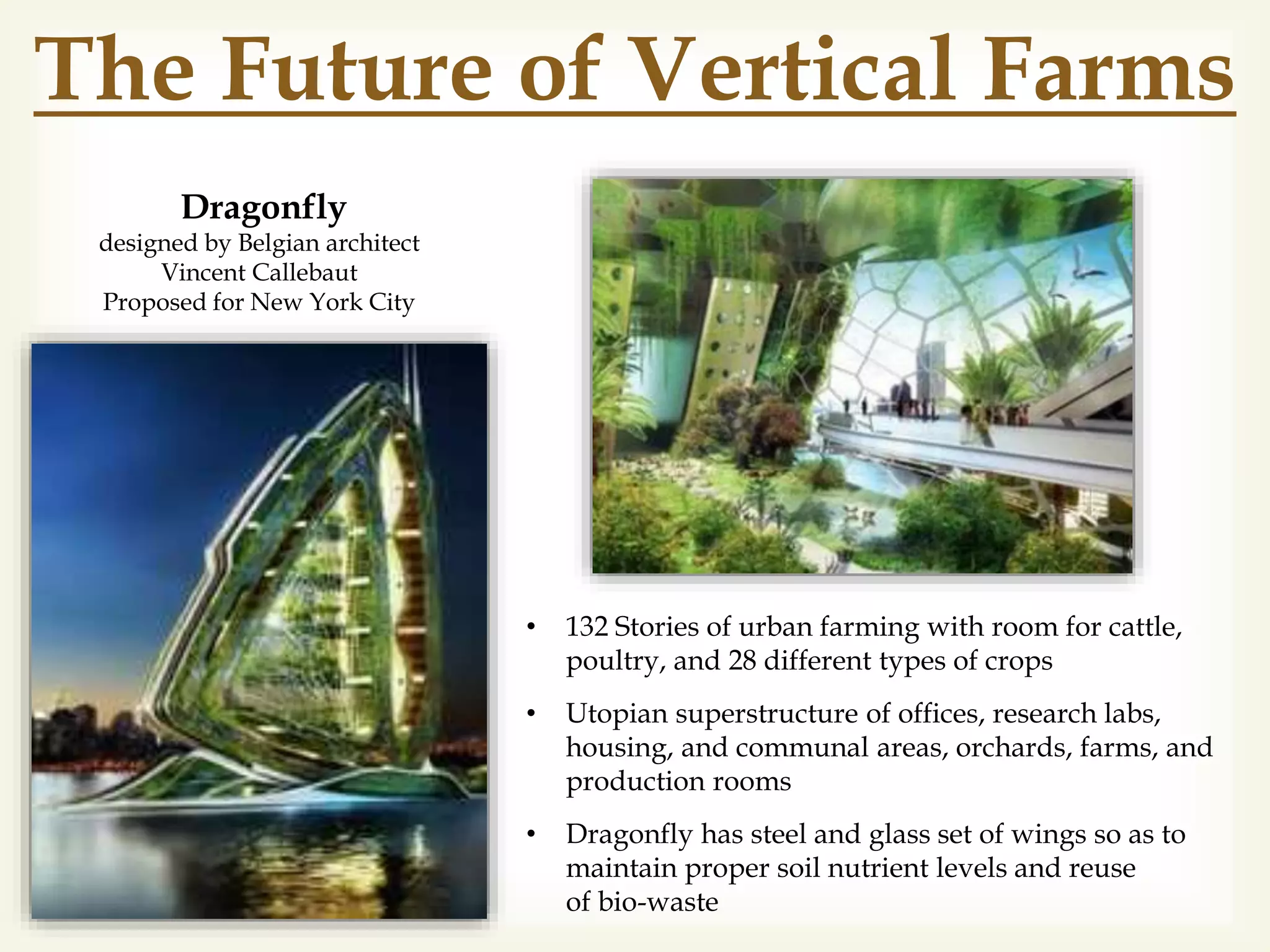
• 132 Stories of urban farming with room for cattle,
poultry, and 28 different types of crops
• Utopian superstructure of offices, research labs,
housing, and communal areas, orchards, farms, and
production rooms
• Dragonfly has steel and glass set of wings so as to
maintain proper soil nutrient levels and reuse
of bio-waste
Dragonfly
designed by Belgian architect
Vincent Callebaut
Proposed for New York City
The Future of Vertical Farms
• 132 Stories of urban farming with room for cattle,
poultry, and 28 different types of crops
• utopian superstructure of offices, research labs,
housing, and communal areas, orchards, farms, and
production rooms
• Dragonfly has steel and glass set of wings so as to
maintain proper soil nutrient levels and reuse
of bio-waste
Dragonfly– designed
by Belgian architect
Vincent Callebaut
Proposed for New York City
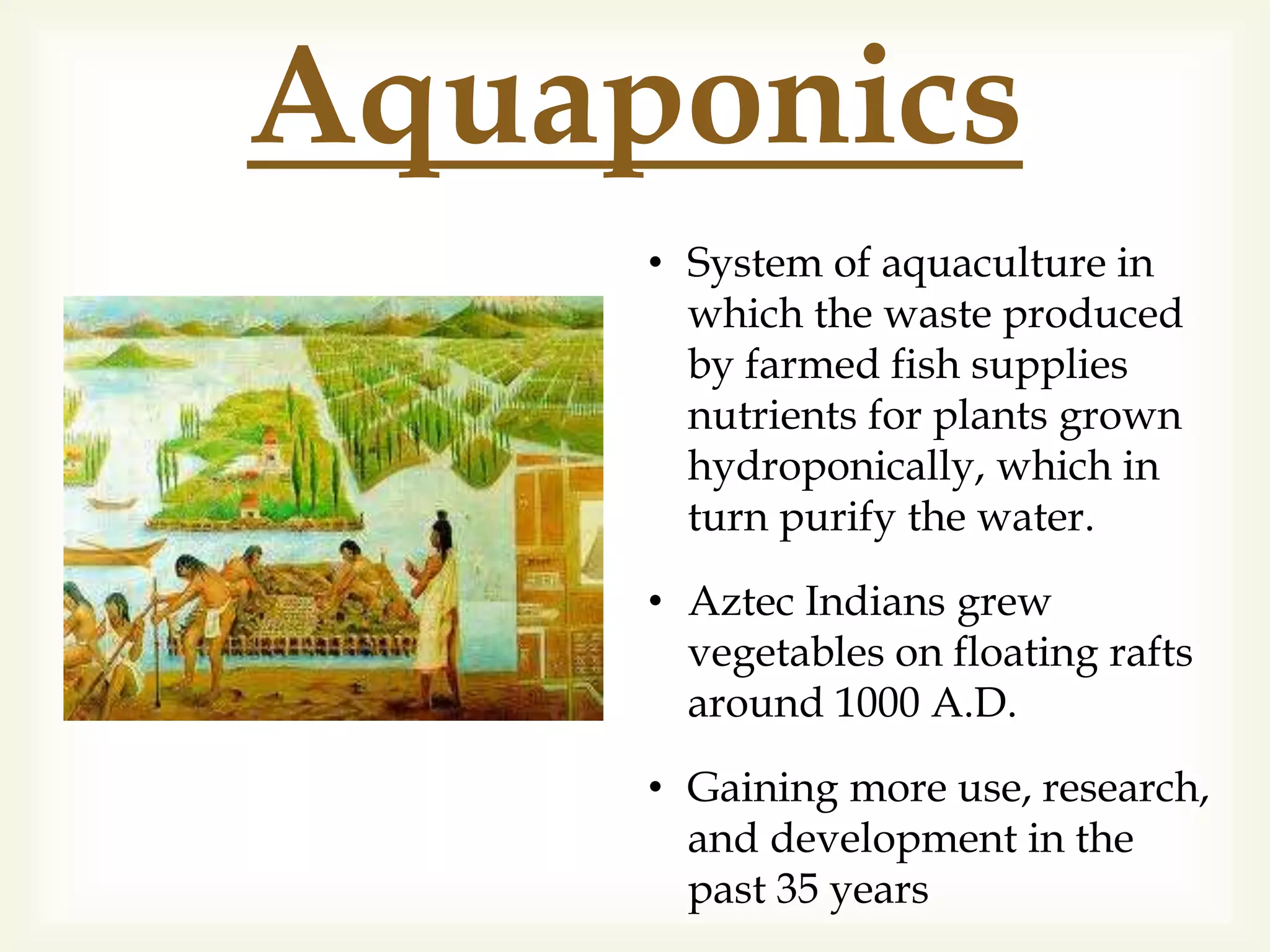
Aquaponics
• System of aquaculture in
which the waste produced
by farmed fish supplies
nutrients for plants grown
hydroponically, which in
turn purify the water.
• Aztec Indians grew
vegetables on floating rafts
around 1000 A.D.
• Gaining more use, research,
and development in the
past 35 years

Aquaponics
Generally, a well-managed system with a 300 gallon fish
tank will produce:
• 10 pounds of vegetables per every square foot of grow
space
• 50 to 80 pounds of fish per year
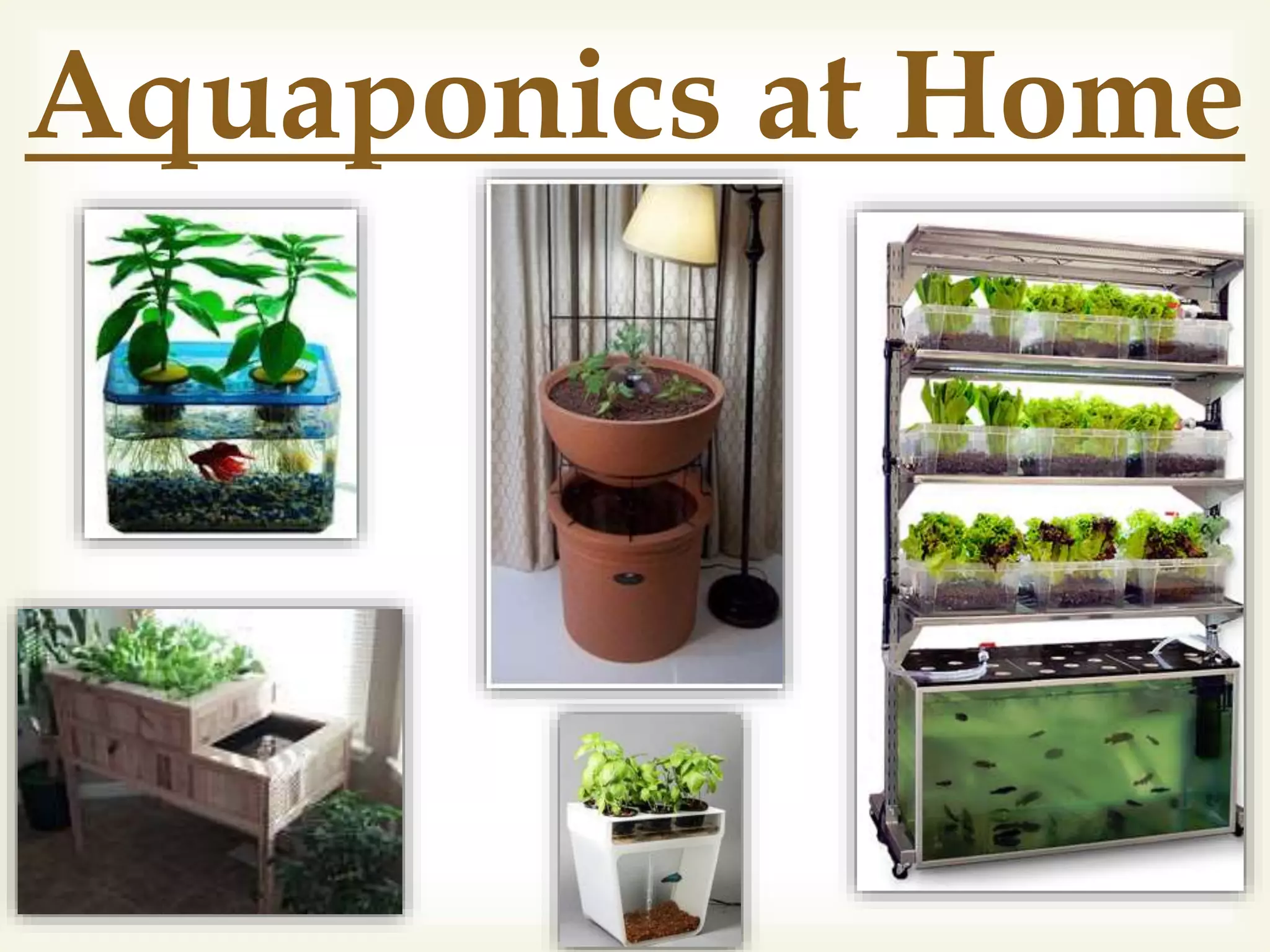
Aquaponics at Home
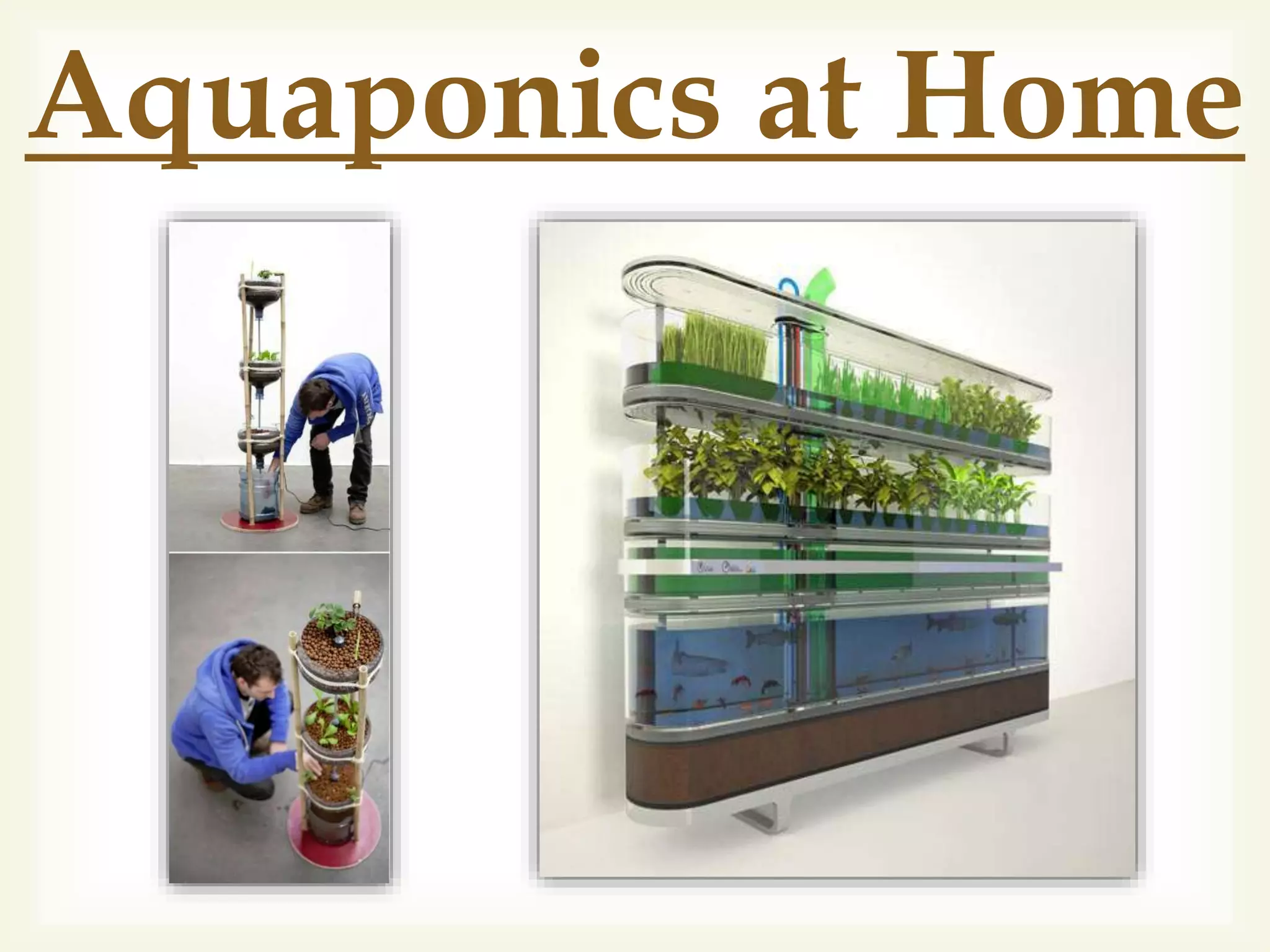
Aquaponics at Home
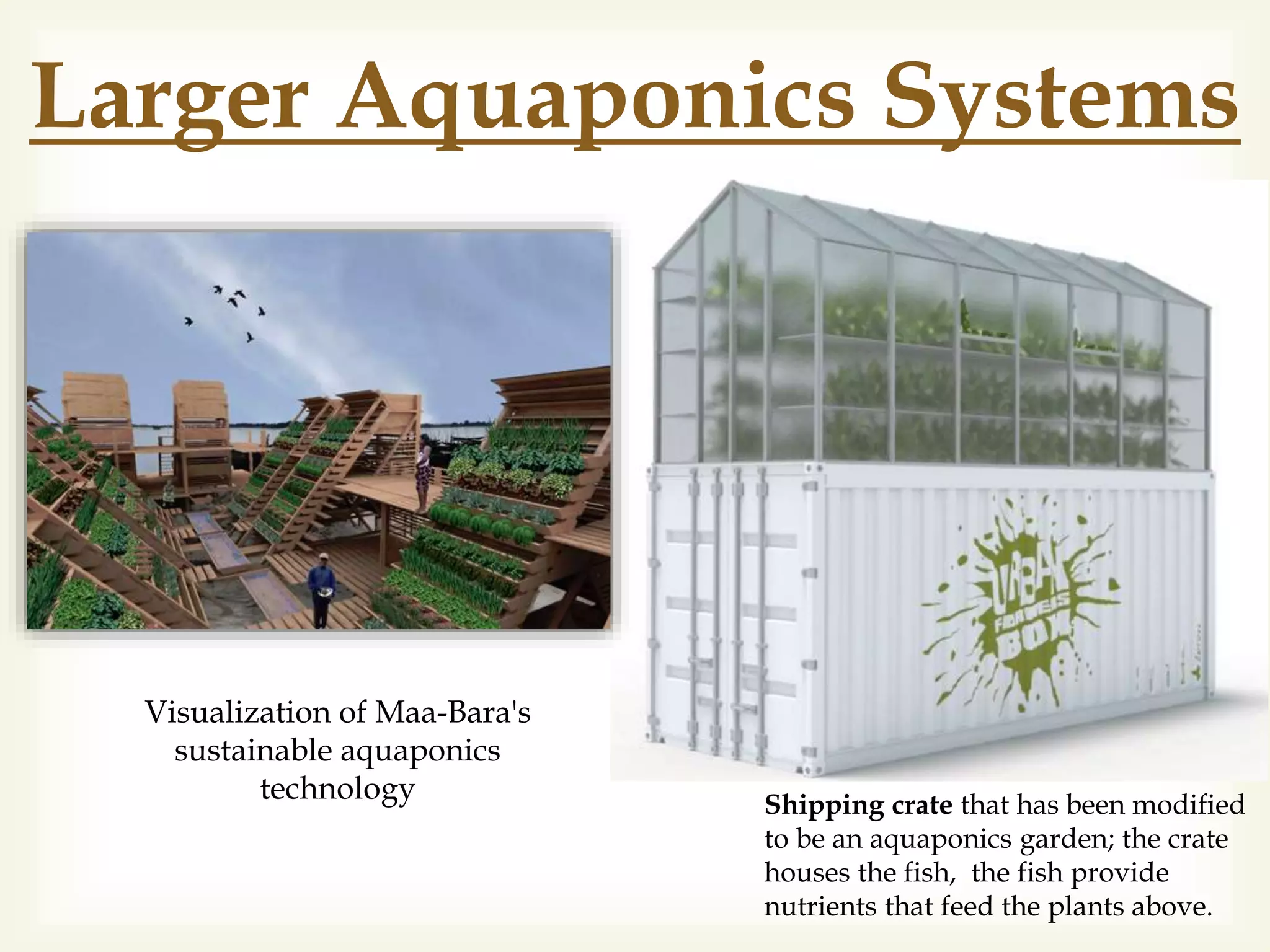
Larger Aquaponics Systems
Shipping crate that has been modified
to be an aquaponics garden; the crate
houses the fish, the fish provide
nutrients that feed the plants above.
Visualization of Maa-Bara's
sustainable aquaponics
technology
Commercial Aquaponics
FarmedHere – Chicago, Illinois
• 90,000 square feet of a formerly abandoned suburban Chicago warehouse,
actually equals 140,000 square feet of growing space.
• Energy-efficient compact-fluorescent lights; even though the lights run
continuously, they only account for 18% of the facility's overall costs.
• Aquaponic growing technologies save up to 97% of fresh water.
• Produces organic food an average of two- to three-times faster than traditional
farming methods.

Commercial Aquaponics
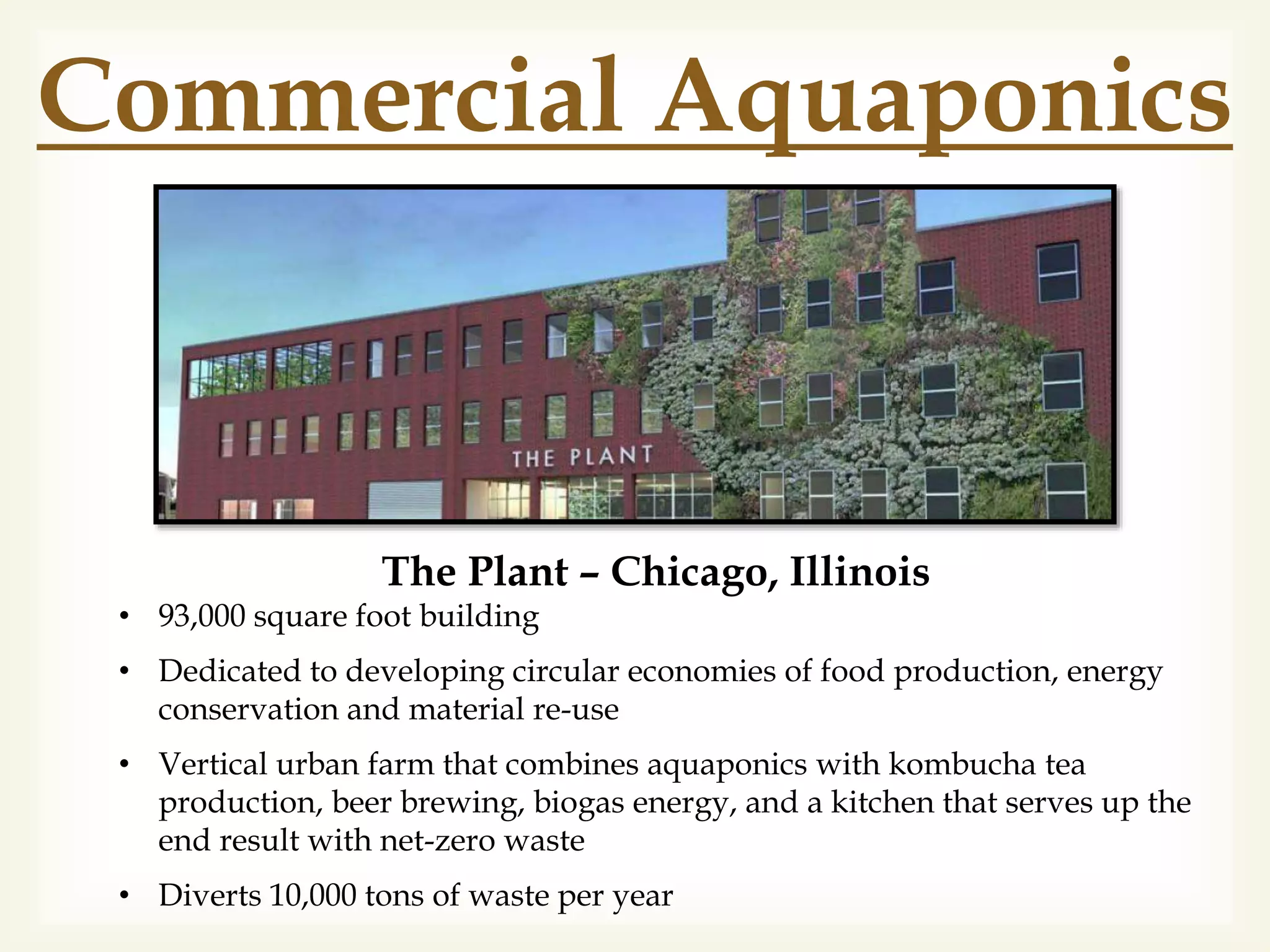
The Plant – Chicago, Illinois
• 93,000 square foot building
• Dedicated to developing circular economies of food production, energy
conservation and material re-use
• Vertical urban farm that combines aquaponics with kombucha tea
production, beer brewing, biogas energy, and a kitchen that serves up the
end result with net-zero waste
• Diverts 10,000 tons of waste per year
Vertical
Farming
Hydro-
ponics
Aqua-
ponics
• Preserve the
Environment
• Reduce the
Carbon
Footprint
• Year-round
Higher Yield
Crops
• No Weeding
and Waist-
High
Harvesting
• No GMOs,
pesticides, or
herbicides
• Reduce Food
Waste
• Use 95% Less
Water
• Grow in any
Environment
• No
Agricultural
Runoff/Toxic
Fertilizers
“The questions arises, can we supply enough food for
everybody on the planet, including a growing urban
population? and I think we can. And I think we can do it by
empowering people in the cities to grow food right there,”
– Dickson Despommier, Columbia University.
“Modern agriculture is the largest consumer of land on the
planet, it’s the largest consumer of fresh water on the planet,
about 60% of the world’s fresh water withdrawal goes toward
conventional agriculture; it’s the source of the world’s most
water pollution, it is responsible for about 15%of the global
greenhouse emissions.”
Viraj Puri
CEO and Co-founder of Gotham Greens

Urban Farming Technology

  • 2.
  • 3.
  • 4.
  • 5.
     Food Shortage Hungry Venezuelanssleep in endless grocery lines as food shortage crisis worsens January 22, 2015 by: J. D. Heyes
  • 6.
     Population Growth By theyear 2050, 80% of the world population will be living in city and urban communities. In 1990, less than 40% of the world’s population lived in a city.
  • 7.
  • 8.
  • 9.
     Hydroponics Hydro = waterPonos = labor “Working Water”
  • 10.
  • 11.
    Modern Hydroponics Hyundai’s NanoGarden • Light, water, and nutrient supply controllable so users decide growth speed. • Functions as an air purifier, eliminating unpleasant smells Kitchen Cultivator Hydroponics built into kitchen island on wheels
  • 12.
    Rotary Hydroponics The GreenWheel developed by NASA Manage the amount of light, control the temperature, and check the water level with a smart phone! Rotary Volksgarden • designed to hold 3" root medium • accommodates space for up to 80 plants. • chain driven and rotates a constant 24 hours a day • watering and light timers • cost is $2595
  • 13.
    Hydroponics Technology Hydroponic Accessories: •Testers for pH, PPM, EC, • Meters for temperature and humidity • Meter calibrators • Lighting system • Nutrients - Grow formula, Bloom formula, Supplements, Ph • Pumps, air stones
  • 14.
    Rooftop Hydroponics Gotham Greens RooftopFarm located in Brooklyn, New York • 15k square feet • 100 tons of produce in the first year • $2 million dollar start-up • Yields 20% more than traditional farming
  • 15.
  • 16.
     Vertical Farming • Thepractice of growing in a vertical direction • Usually without soil (hydroponically) • Usually in urban areas, and sometimes as high as skyscrapers • May include livestock
  • 17.
  • 18.
    Vertical Farms Vertical Harvest JacksonHole, Wyoming Opening early 2016 • Three-story, 13,500 square-foot hydroponic green house (150’ x 30’) • Should produce over 37,000 pounds of greens, 4,400 pounds of herbs, and 44,000 pounds of tomatoes • 95% of future crops already sold to local restaurants, grocery stores, and a hospital • Employs citizens with disabilities
  • 19.
    Vertical Farms Vertical Harvest JacksonHole, Wyoming Opening early 2016 • Three-story, 13,500 square-foot hydroponic green house (150’ x 30’) • Should produce over 37,000 pounds of greens, 4,400 pounds of herbs, and 44,000 pounds of tomatoes • 95% of future crops already sold to local restaurants, grocery stores, and a hospital • Employs citizens with disabilities,
  • 20.
    Vertical Farms Sky GreensVertical Farm Singapore • World’s first low carbon, hydraulic driven vertical farm • Uses minimal land, water and energy resources • 10x more productive than conventional farming • Only $360/month ($3/tower) on electricity • 3 stories tall, 120 aluminum towers • Able to produce 1 ton of fresh veggies every other day
  • 21.
    The Future ofVertical Farms Floating Farms F.R.A. (Floating Response Architecture) Proposal for Singapore By JAPA Design Firm • Loop shape enables the vertical structure to receive more sunlight without having significant shadows • System will aim for zero food waste by using a data management system to track of how much food people are buying, so the farm can automatically adjust production
  • 22.
    The Future ofVertical Farms • 132 Stories of urban farming with room for cattle, poultry, and 28 different types of crops • Utopian superstructure of offices, research labs, housing, and communal areas, orchards, farms, and production rooms • Dragonfly has steel and glass set of wings so as to maintain proper soil nutrient levels and reuse of bio-waste Dragonfly designed by Belgian architect Vincent Callebaut Proposed for New York City
  • 23.
    The Future ofVertical Farms • 132 Stories of urban farming with room for cattle, poultry, and 28 different types of crops • utopian superstructure of offices, research labs, housing, and communal areas, orchards, farms, and production rooms • Dragonfly has steel and glass set of wings so as to maintain proper soil nutrient levels and reuse of bio-waste Dragonfly– designed by Belgian architect Vincent Callebaut Proposed for New York City
  • 24.
    Aquaponics • System ofaquaculture in which the waste produced by farmed fish supplies nutrients for plants grown hydroponically, which in turn purify the water. • Aztec Indians grew vegetables on floating rafts around 1000 A.D. • Gaining more use, research, and development in the past 35 years
  • 25.
     Aquaponics Generally, a well-managedsystem with a 300 gallon fish tank will produce: • 10 pounds of vegetables per every square foot of grow space • 50 to 80 pounds of fish per year
  • 26.
  • 27.
  • 28.
    Larger Aquaponics Systems Shippingcrate that has been modified to be an aquaponics garden; the crate houses the fish, the fish provide nutrients that feed the plants above. Visualization of Maa-Bara's sustainable aquaponics technology
  • 29.
    Commercial Aquaponics FarmedHere –Chicago, Illinois • 90,000 square feet of a formerly abandoned suburban Chicago warehouse, actually equals 140,000 square feet of growing space. • Energy-efficient compact-fluorescent lights; even though the lights run continuously, they only account for 18% of the facility's overall costs. • Aquaponic growing technologies save up to 97% of fresh water. • Produces organic food an average of two- to three-times faster than traditional farming methods.
  • 30.
     Commercial Aquaponics The Plant– Chicago, Illinois • 93,000 square foot building • Dedicated to developing circular economies of food production, energy conservation and material re-use • Vertical urban farm that combines aquaponics with kombucha tea production, beer brewing, biogas energy, and a kitchen that serves up the end result with net-zero waste • Diverts 10,000 tons of waste per year
  • 33.
    Vertical Farming Hydro- ponics Aqua- ponics • Preserve the Environment •Reduce the Carbon Footprint • Year-round Higher Yield Crops • No Weeding and Waist- High Harvesting • No GMOs, pesticides, or herbicides • Reduce Food Waste • Use 95% Less Water • Grow in any Environment • No Agricultural Runoff/Toxic Fertilizers
  • 34.
    “The questions arises,can we supply enough food for everybody on the planet, including a growing urban population? and I think we can. And I think we can do it by empowering people in the cities to grow food right there,” – Dickson Despommier, Columbia University. “Modern agriculture is the largest consumer of land on the planet, it’s the largest consumer of fresh water on the planet, about 60% of the world’s fresh water withdrawal goes toward conventional agriculture; it’s the source of the world’s most water pollution, it is responsible for about 15%of the global greenhouse emissions.” Viraj Puri CEO and Co-founder of Gotham Greens

Editor's Notes

  • #3 Growing concern of a 2-faced food crisis
  • #4 Our world is experiences considerable food loss at every stage of the food chain Harvest Post harvest (storage) Processing and packing Distribution Consumption – excess prepared, food past sale date
  • #5 Bring the statistics closer to home - food waste in the US 11% - grocery stores 44% - residential – portion of that due to it going bad before we use it Some of this could be solved if our food had a longer shelf life – if we were able to buy it closer to the time it was harvested
  • #6 Other parts of the world are dealing with food shortages These are some recent headlines
  • #7 World population is growing By the year 2050, 80% of the world population will be living in city and urban communities. In 1990, less than 40% of the world’s population lived in a city.
  • #8 Arable means “to PLOW” in Latin Land that can grow things and be cultivated 2050 – would require cropland the size of South America and Brazil That much cropland does not exist!
  • #9 We will need to develop alternatives of supplemental solutions BEFORE 2050
  • #10 Hydroponics is the technology of growing plants with a supplemented nutrient solution instead of using soil. There are several different designs of hydroponic systems. Some methods use a growing medium for the plants, such as clay pellets, wood chips, or foam. Others allow the roots to dangle in the nutrient solution or they are simply sprayed by a fine mist of the solution.
  • #11 Several homemade systems as well as ready-to-go kits; Uses 70-90% less water than traditional farming & gardening
  • #12 Technological innovations allowing people with limited space and no yards to have the conveniences and benefits of hydroponics in their home. Light, water, and nutrient supply controllable so users decide growth speed. Functions as an air purifier, eliminating unpleasant smells
  • #14 Uses 70-90% less water than traditional farming & gardneing; diseases and pests are more manageable since there is no soil; growing can be maintained year-round without the need for crop rotation and weeding, and higher yields can be produced in less space.
  • #15 There are currently large scale urban hydroponic farms all over the globe – including the South Pole!
  • #16 Growing so close to the grocery store has increased the shelf life of produce at the grocery stores and in the customers’ homes.
  • #17 Further assisting the issue of working in limited space or maximizing the amount of space available – is the use of vertical farming.
  • #19 It is now possible to control the temperature, humidity, lighting, airflow and nutrient conditions to get the best productivity out of plants year round, anywhere in the world.
  • #21 Singapore is an extremely large, dense country with little to no arable land Import 90% of their produce
  • #22 These vertical farms can be the solution to feeding an increasing urban population while diminishing the adverse effects climate has on the farming industry such as droughts and floods.
  • #23 132 Stories of urban farming with room for cattle, poultry, and 28 different types of crops Utopian superstructure of offices, research labs, housing, and communal areas, orchards, farms, and production rooms Dragonfly has steel and glass set of wings so as to maintain proper soil nutrient levels and reuse of bio-waste
  • #25 Ancient Chinese were using forms of aquaponics (duck cages over the fish ponds, nutrients from fish pond water to sustain rice fields) in 5th century B.C.
  • #26 A properly set up system can be very efficient, with very little maintenance. Fish should be fed high quality fish food to avoid problems with the taste of the vegetables.
  • #27 Multiple sizes – desk top herb gardens and larger
  • #28 Creative designs
  • #29 Larger designs for family or community sized urban gardens
  • #30 Aquaponic growing technologies save up to 97% of fresh water. Produces organic food an average of two- to three-times faster than traditional farming methods
  • #31 https://www.youtube.com/watch?v=zMBxJTQqnRI#t=93 93,000 square foot building Dedicated to developing circular economies of food production, energy conservation and material re-use Vertical urban farm that combines aquaponics with kombucha tea production, beer brewing, biogas energy, and a kitchen that serves up the end result with net-zero waste Diverts 10,000 tons of waste per year
  • #34 No Agricultural Runoff/Toxic Fertilizers Year-round Higher Yield Crops Reduce Food Waste – longer shelf life by bringing food closer to the people