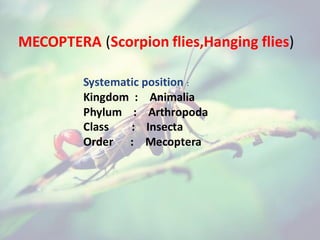
MECOPTERA (Scorpion flies,Hanging flies)
Systematic position :
Kingdom : Animalia
Phylum : Arthropoda
Class : Insecta
Order : Mecoptera
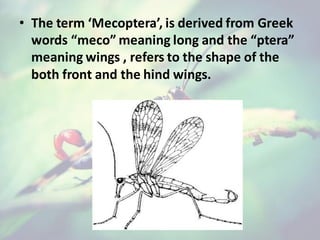
• The term ‘Mecoptera’, is derived from Greek
words “meco” meaning long and the “ptera”
meaning wings , refers to the shape of the
both front and the hind wings.
Mecoptera
➢ Mecoptera is a small holometabolous insect order
with approximately 600 extant described species
placed in 9 families and 32 genera.(Penny & Byers
1979;Penny 1997).
➢ Two families –Panorpidae and Bittacidae contain
90% of mecopteran species.
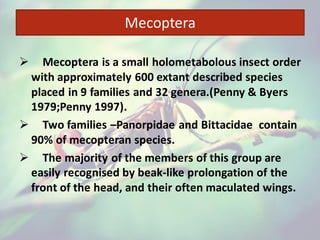
➢ The majority of the members of this group are
easily recognised by beak-like prolongation of the
front of the head, and their often maculated wings.
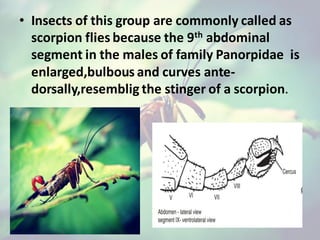
• Insects of this group are commonly called as
scorpion flies because the 9th abdominal
segment in the males of family Panorpidae is
enlarged,bulbous and curves ante-
dorsally,resemblig the stinger of a scorpion.
• Bittacidae sometimes commonly known as
hanging flies because species hang from the
plants by the fore or middle legs.
EXTERNAL CHARACTERS
• HEAD:
• The anterior region of the head is usually
prolonged into a rostrum which is formed by the
elongation of the head capsule together with
clupeus ,labrum and maxillae.
LABRUM
FRONTAL VIEW OF HEAD
• The compound eyes are well developed and there are
usually three ocelli.
• The antennae are more or less filiform and many jointed,
there being about 40-50 joints in Panorpa and 16-20 in
Bittacus.
• The mandibles are slender and elongate ;they are only
dentate at their apices,each bearing 1-3 sharp teeth.
• The maxillae are complete,their palpi are five jointed,and
galeae and laciniae are hairy lobes of somewhat complex
structure.
• The labium consists of an elongated submentum,not
always differentiated from the short mentum,the
prementum exhibits a traces of bilobed structure,ligula is
disappeared.Labial palpi are 1-3 segmented.
HEAD (FRONTAL VIEW)
GALEA
LACINIA
THORAX
• The thorax is elongate in some groups(i.e.
Panorpidae,Bittacidae,Choristidae) with pronotum
generally saddle like ,wider than long and often with
transverse ridges.Both meso and metathorax are well
developed.
• The legs are generally adapted for walking ,the claws
are usually paired, and in Panorpa they are strongly
pectinated.
• In Bittacus ,the claws are single ,and the 4th and 5th
tarsal joints are provided with fine teeth along their
inner margins,the 5th joint is capable of closing on to
the 4th in the manner of the blade of a pocket knife.
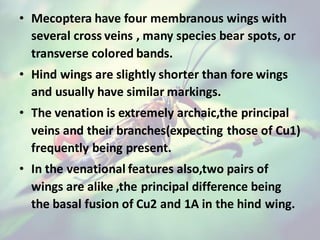
• Mecoptera have four membranous wings with
several cross veins , many species bear spots, or
transverse colored bands.
• Hind wings are slightly shorter than fore wings
and usually have similar markings.
• The venation is extremely archaic,the principal
veins and their branches(expecting those of Cu1)
frequently being present.
• In the venational features also,two pairs of
wings are alike ,the principal difference being
the basal fusion of Cu2 and 1A in the hind wing.
ABDOMEN
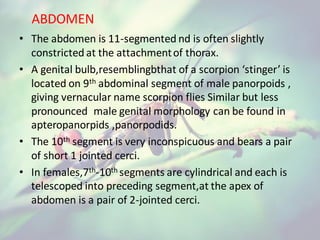
• The abdomen is 11-segmented nd is often slightly
constricted at the attachmentof thorax.
• A genital bulb,resemblingbthat of a scorpion ‘stinger’ is
located on 9th abdominal segment of male panorpoids ,
giving vernacular name scorpion flies Similar but less
pronounced male genital morphology can be found in
apteropanorpids ,panorpodids.
• The 10th segment is very inconspicuous and bears a pair
of short 1 jointed cerci.
• In females,7th-10th segments are cylindrical and each is
telescoped into preceding segment,at the apex of
abdomen is a pair of 2-jointed cerci.
Abdomen of Panorpa bashanicola
male
female
Yuan Hua et al.(2018)
• Most mecopterans inhabit moist environment,
although a few species inhabit semi desert
environments.
• Adults are requently associated with broad
leaved plants and can be occassionally observed
in open sunny areas.
• Scorpion flies (Panorpidae) are likely to be
encounter in wooden habitats where deciduous
trees growing in rich shaded soils.
• Boreid adults (Boreidae:snow scorpion flies)
occur occur in winter months , and in mountain
habitats.
• Bittacids are known to inhabit grasslands,forests
and caves where high moisture occurs.
HABITAT
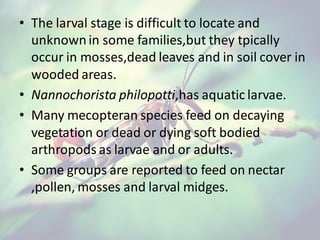
• The larval stage is difficult to locate and
unknownin some families,but they tpically
occur in mosses,dead leaves and in soil cover in
wooded areas.
• Nannochorista philopotti,has aquatic larvae.
• Many mecopteran species feed on decaying
vegetation or dead or dying soft bodied
arthropods as larvae and or adults.
• Some groups are reported to feed on nectar
,pollen, mosses and larval midges.
• Bittacidae bear modified legs for grasping and
holding prey such as Diptera,Hymenoptera
and Lepidoptera.
• Kleptoparasitic Panorpa scorpion flies are
known to feed on dead or dying insects
captured in spider webs.
MATING/COPULATION
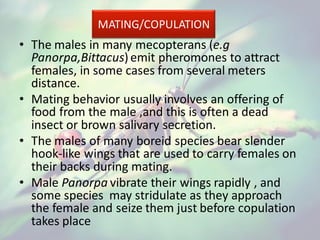
• The males in many mecopterans (e.g
Panorpa,Bittacus)emit pheromones to attract
females, in some cases from several meters
distance.
• Mating behavior usually involves an offering of
food from the male ,and this is often a dead
insect or brown salivary secretion.
• The males of many boreid species bear slender
hook-like wings that are used to carry females on
their backs during mating.
• Male Panorpa vibrate their wings rapidly , and
some species may stridulate as they approach
the female and seize them just before copulation
takes place
BITTACIDAE
BOREIDAE
LIFE CYCLE
• Eruciform(Panorpidae,
Bittacidae)
• Grub(Boreidae,Panorp
odidae)
• Exarate
pupa,capableof
abdominal
movement,with
decticous mandibles
• Loose cavities in
soil(Panorpa sp)
• Dropped
randomlyon to
the
ground(Bittacus
sp)
• Boreus(In mosses
• (winter-spring)
• Adult longevitydepends
to a large extent on
reproductivebiology.
• Males-risky acts-mating
• Eg;Meropeids(claspers)
• Panorpa nuptialis
• One month…
Adult
2-3 months
in lab
conditions
EGGS(5-10
days)
Larva
Pupa(10-21
days)
▪ EGG : Eggs are either singly laid or in masses,they are ovoidal
in Panorpa sp & cuboidal in Bittacus sp.
▪ LARVA : It is eruciform bears a close resemblance to
caterpillar.
▪ The head is rather large with prominent 4 jointed antennae
and it bears a group of about 20-28 simple eyes on either side
▪ The mandibles are sharply toothed,the maxillae are divided
into lobes corresponding with galeae and laciniae.The
maxillary palpi are 4 jointe and labium is small with labial
palpi 3 jointed.
▪ The thorax bears 3 pairs of legs,each composedof 4 joints.The
abdomen is 10 segmented and the first eight somites eacg
carry a pair of abdominal feet.
▪ A median dorsal chitinised shield is present on all the body
segments.Thefirst 9 abdominal shields each carry a pair of
annulated process,the last two pairs being considerably
larger.
• The 10th segment bears a single median process of
similar character together with a curious retractile
lobed vesicle on its ventral side.
• 9 pairs of spiracles are present (one on prothorax,8
on 1st eight abdominal segments)
Classification
S.NO FAMILY COMMON NAMES
1 Nannochoristidae
2 Bittacidae Hanging flies
3 Boreidae Snow scorpions
4 Meropeidae Earwig flies
5 Eomeropidae
6 Apteropanorpidae Wingless scorpion flies
7 Choristidae
8 Panorpodiadae Short faced scorpion flies
9 Panorpidae Scorpion flies
Classification.-Theorder has been recently
monographed by Esben Petersen,whose family
divisions are as below :
Tarsi single clawed and modified for raptorial use-
BITTACIDAE
Wings vestigeal-BOREIDAE
Wings well developed- PANORPIDAE
• A sister group relation between Boreidae and
Siphanoptera is supported by morphological
evidence.
• The process of resilin secretion in the flea(pleural
arch) and Boreus(wing base) is similar, and
different from that of the locust and dragonfly.
• The unusual proventricular spines in fleas and
boreids are morphologically similar.
• Both groups have multiple sex chromosomes.
• Most convincing morphological evdence comes
from recent research on ovarioles,which
demonstrates that boreid ovarioles are
fundamentally different from those in other
mecoptera , but similar to those found in fleas.
• Mecoptera possess polytrohic-meroistic
ovarioles ,whereas the ovarioles in Boreus
are devoid of nurse cells and therefore
panoistic.
• Molecular data also provides a compelling
argument for a sister group relationship
between Boreidae and Siphanoptera.
Whiting, M. F. (2002). Mecoptera is paraphyletic:
multiple genes and phylogeny of Mecoptera and
Siphonaptera. Zoologica scripta, 31(1), 93-104.
REFERENCE
Submitted to:
Dr.T.Uma Maheswari
Professor
Dept. of Entomology
Submitted by :
G.Satish
RAM/18-48
Thank you

Mecoptera - Scorpion files

  • 1.
    MECOPTERA (Scorpion flies,Hangingflies) Systematic position : Kingdom : Animalia Phylum : Arthropoda Class : Insecta Order : Mecoptera
  • 2.
    • The term‘Mecoptera’, is derived from Greek words “meco” meaning long and the “ptera” meaning wings , refers to the shape of the both front and the hind wings.
  • 3.
    Mecoptera ➢ Mecoptera isa small holometabolous insect order with approximately 600 extant described species placed in 9 families and 32 genera.(Penny & Byers 1979;Penny 1997). ➢ Two families –Panorpidae and Bittacidae contain 90% of mecopteran species. ➢ The majority of the members of this group are easily recognised by beak-like prolongation of the front of the head, and their often maculated wings.
  • 4.
    • Insects ofthis group are commonly called as scorpion flies because the 9th abdominal segment in the males of family Panorpidae is enlarged,bulbous and curves ante- dorsally,resemblig the stinger of a scorpion.
  • 5.
    • Bittacidae sometimescommonly known as hanging flies because species hang from the plants by the fore or middle legs.
  • 6.
    EXTERNAL CHARACTERS • HEAD: •The anterior region of the head is usually prolonged into a rostrum which is formed by the elongation of the head capsule together with clupeus ,labrum and maxillae. LABRUM FRONTAL VIEW OF HEAD
  • 7.
    • The compoundeyes are well developed and there are usually three ocelli. • The antennae are more or less filiform and many jointed, there being about 40-50 joints in Panorpa and 16-20 in Bittacus. • The mandibles are slender and elongate ;they are only dentate at their apices,each bearing 1-3 sharp teeth. • The maxillae are complete,their palpi are five jointed,and galeae and laciniae are hairy lobes of somewhat complex structure. • The labium consists of an elongated submentum,not always differentiated from the short mentum,the prementum exhibits a traces of bilobed structure,ligula is disappeared.Labial palpi are 1-3 segmented.
  • 8.
  • 9.
    THORAX • The thoraxis elongate in some groups(i.e. Panorpidae,Bittacidae,Choristidae) with pronotum generally saddle like ,wider than long and often with transverse ridges.Both meso and metathorax are well developed. • The legs are generally adapted for walking ,the claws are usually paired, and in Panorpa they are strongly pectinated. • In Bittacus ,the claws are single ,and the 4th and 5th tarsal joints are provided with fine teeth along their inner margins,the 5th joint is capable of closing on to the 4th in the manner of the blade of a pocket knife.
  • 10.
    • Mecoptera havefour membranous wings with several cross veins , many species bear spots, or transverse colored bands. • Hind wings are slightly shorter than fore wings and usually have similar markings. • The venation is extremely archaic,the principal veins and their branches(expecting those of Cu1) frequently being present. • In the venational features also,two pairs of wings are alike ,the principal difference being the basal fusion of Cu2 and 1A in the hind wing.
  • 12.
    ABDOMEN • The abdomenis 11-segmented nd is often slightly constricted at the attachmentof thorax. • A genital bulb,resemblingbthat of a scorpion ‘stinger’ is located on 9th abdominal segment of male panorpoids , giving vernacular name scorpion flies Similar but less pronounced male genital morphology can be found in apteropanorpids ,panorpodids. • The 10th segment is very inconspicuous and bears a pair of short 1 jointed cerci. • In females,7th-10th segments are cylindrical and each is telescoped into preceding segment,at the apex of abdomen is a pair of 2-jointed cerci.
  • 13.
    Abdomen of Panorpabashanicola male female Yuan Hua et al.(2018)
  • 14.
    • Most mecopteransinhabit moist environment, although a few species inhabit semi desert environments. • Adults are requently associated with broad leaved plants and can be occassionally observed in open sunny areas. • Scorpion flies (Panorpidae) are likely to be encounter in wooden habitats where deciduous trees growing in rich shaded soils. • Boreid adults (Boreidae:snow scorpion flies) occur occur in winter months , and in mountain habitats. • Bittacids are known to inhabit grasslands,forests and caves where high moisture occurs. HABITAT
  • 15.
    • The larvalstage is difficult to locate and unknownin some families,but they tpically occur in mosses,dead leaves and in soil cover in wooded areas. • Nannochorista philopotti,has aquatic larvae. • Many mecopteran species feed on decaying vegetation or dead or dying soft bodied arthropods as larvae and or adults. • Some groups are reported to feed on nectar ,pollen, mosses and larval midges.
  • 16.
    • Bittacidae bearmodified legs for grasping and holding prey such as Diptera,Hymenoptera and Lepidoptera. • Kleptoparasitic Panorpa scorpion flies are known to feed on dead or dying insects captured in spider webs.
  • 17.
    MATING/COPULATION • The malesin many mecopterans (e.g Panorpa,Bittacus)emit pheromones to attract females, in some cases from several meters distance. • Mating behavior usually involves an offering of food from the male ,and this is often a dead insect or brown salivary secretion. • The males of many boreid species bear slender hook-like wings that are used to carry females on their backs during mating. • Male Panorpa vibrate their wings rapidly , and some species may stridulate as they approach the female and seize them just before copulation takes place
  • 18.
  • 19.
    LIFE CYCLE • Eruciform(Panorpidae, Bittacidae) •Grub(Boreidae,Panorp odidae) • Exarate pupa,capableof abdominal movement,with decticous mandibles • Loose cavities in soil(Panorpa sp) • Dropped randomlyon to the ground(Bittacus sp) • Boreus(In mosses • (winter-spring) • Adult longevitydepends to a large extent on reproductivebiology. • Males-risky acts-mating • Eg;Meropeids(claspers) • Panorpa nuptialis • One month… Adult 2-3 months in lab conditions EGGS(5-10 days) Larva Pupa(10-21 days)
  • 20.
    ▪ EGG :Eggs are either singly laid or in masses,they are ovoidal in Panorpa sp & cuboidal in Bittacus sp. ▪ LARVA : It is eruciform bears a close resemblance to caterpillar. ▪ The head is rather large with prominent 4 jointed antennae and it bears a group of about 20-28 simple eyes on either side ▪ The mandibles are sharply toothed,the maxillae are divided into lobes corresponding with galeae and laciniae.The maxillary palpi are 4 jointe and labium is small with labial palpi 3 jointed. ▪ The thorax bears 3 pairs of legs,each composedof 4 joints.The abdomen is 10 segmented and the first eight somites eacg carry a pair of abdominal feet. ▪ A median dorsal chitinised shield is present on all the body segments.Thefirst 9 abdominal shields each carry a pair of annulated process,the last two pairs being considerably larger.
  • 21.
    • The 10thsegment bears a single median process of similar character together with a curious retractile lobed vesicle on its ventral side. • 9 pairs of spiracles are present (one on prothorax,8 on 1st eight abdominal segments)
  • 22.
    Classification S.NO FAMILY COMMONNAMES 1 Nannochoristidae 2 Bittacidae Hanging flies 3 Boreidae Snow scorpions 4 Meropeidae Earwig flies 5 Eomeropidae 6 Apteropanorpidae Wingless scorpion flies 7 Choristidae 8 Panorpodiadae Short faced scorpion flies 9 Panorpidae Scorpion flies
  • 23.
    Classification.-Theorder has beenrecently monographed by Esben Petersen,whose family divisions are as below : Tarsi single clawed and modified for raptorial use- BITTACIDAE Wings vestigeal-BOREIDAE Wings well developed- PANORPIDAE
  • 24.
    • A sistergroup relation between Boreidae and Siphanoptera is supported by morphological evidence. • The process of resilin secretion in the flea(pleural arch) and Boreus(wing base) is similar, and different from that of the locust and dragonfly. • The unusual proventricular spines in fleas and boreids are morphologically similar. • Both groups have multiple sex chromosomes. • Most convincing morphological evdence comes from recent research on ovarioles,which demonstrates that boreid ovarioles are fundamentally different from those in other mecoptera , but similar to those found in fleas.
  • 25.
    • Mecoptera possesspolytrohic-meroistic ovarioles ,whereas the ovarioles in Boreus are devoid of nurse cells and therefore panoistic. • Molecular data also provides a compelling argument for a sister group relationship between Boreidae and Siphanoptera. Whiting, M. F. (2002). Mecoptera is paraphyletic: multiple genes and phylogeny of Mecoptera and Siphonaptera. Zoologica scripta, 31(1), 93-104. REFERENCE
  • 26.
    Submitted to: Dr.T.Uma Maheswari Professor Dept.of Entomology Submitted by : G.Satish RAM/18-48
  • 27.