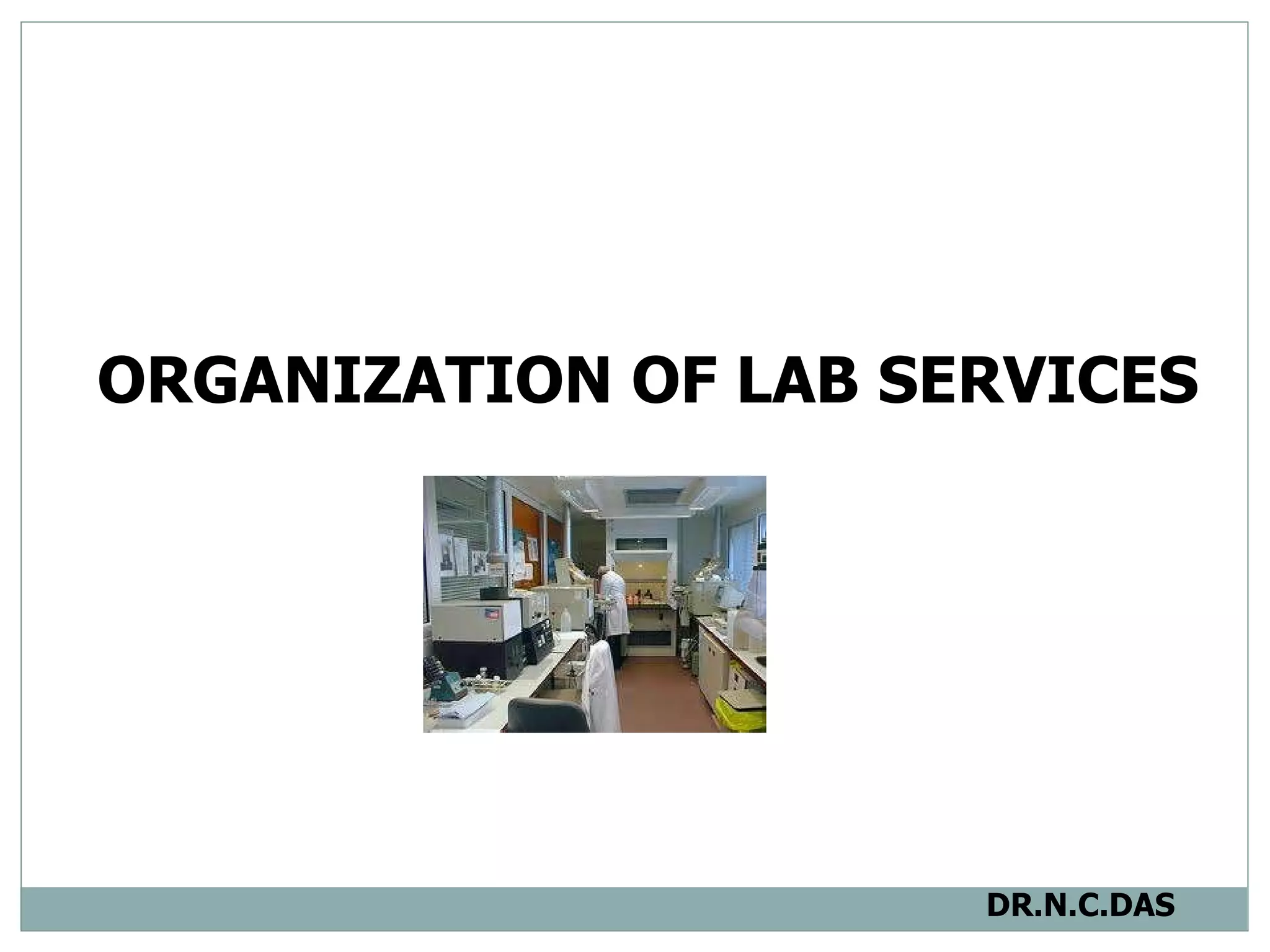

ORGANIZATION OF LAB SERVICES   DR.N.C.DAS
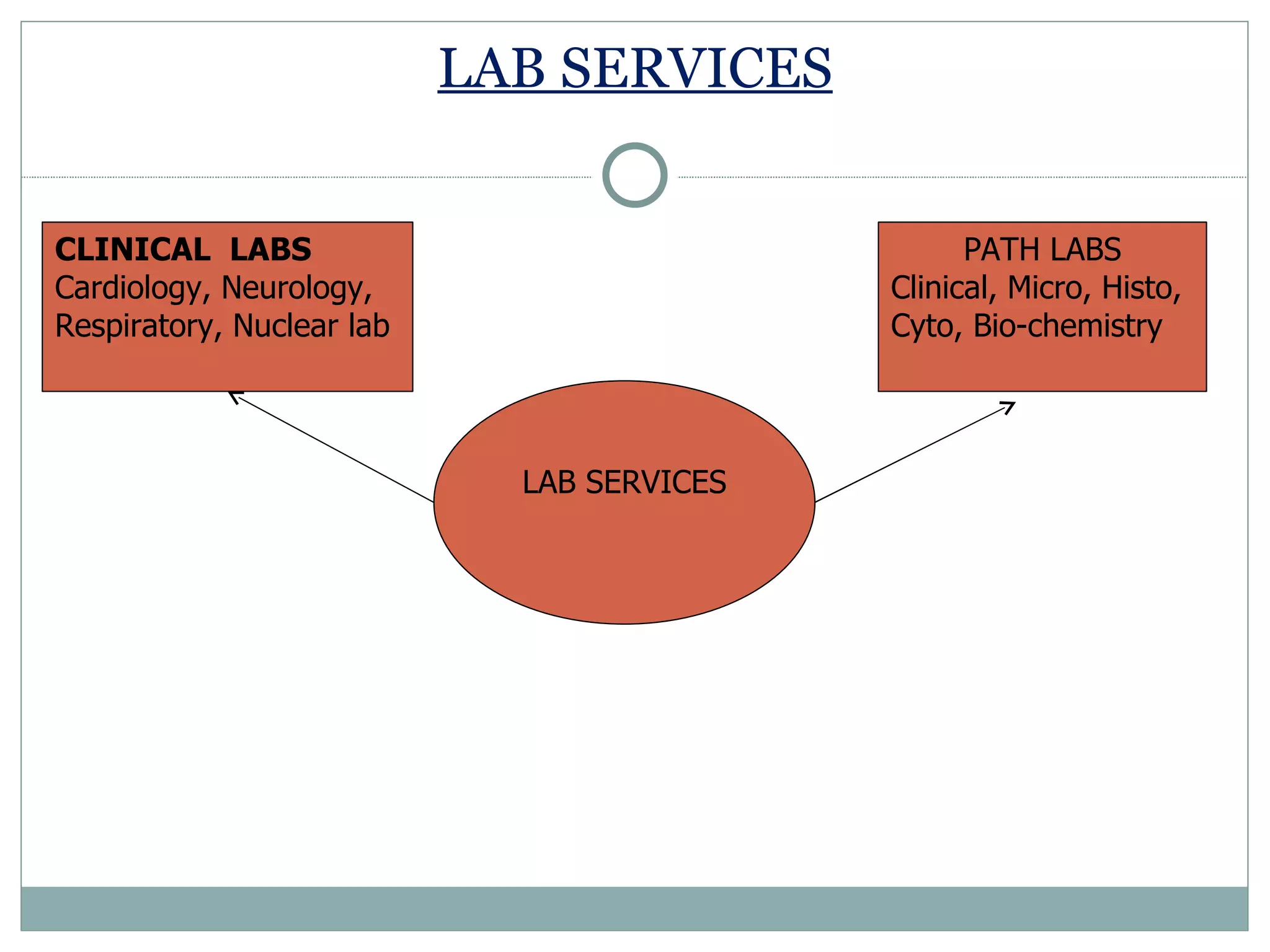
LAB SERVICES LAB SERVICES CLINICAL  LABS Cardiology, Neurology, Respiratory, Nuclear lab PATH LABS Clinical, Micro, Histo, Cyto, Bio-chemistry
CHANGING ROLE OF LAB SERVICES Once upon a time the hospital laboratory, was a small, dark, cul-de-sac reeking of chemicals, and located in the bowels of the hospital next to the morgue.  The scenario is changing fast its image and emerging as a high-tech, respected member of the hospital team. Medical technologists and technicians no longer huddle over racks of test tubes; instead, they work in brightly-lit, air-conditioned labs. Monitoring and maintaining sophisticated laboratory analyzers capable of running hundreds of patient samples each day.
IMPORTANCE OF LAB Laboratory services are essential to health care delivery.  The hospital lab offers the convenience of local service, and familiarity with both the outpatient and his physician.  Hospital labs depend on their outpatient testing to make up money lost during times of low in-house census They address both preventive and curative activities, i.e. patient diagnosis, and the selection of drugs for treatment.  They are also an indispensable tool in the surveillance  and control of diseases.  Improved disease recognition will improve the  accuracy of statistical reporting, and thus effective national health planning.
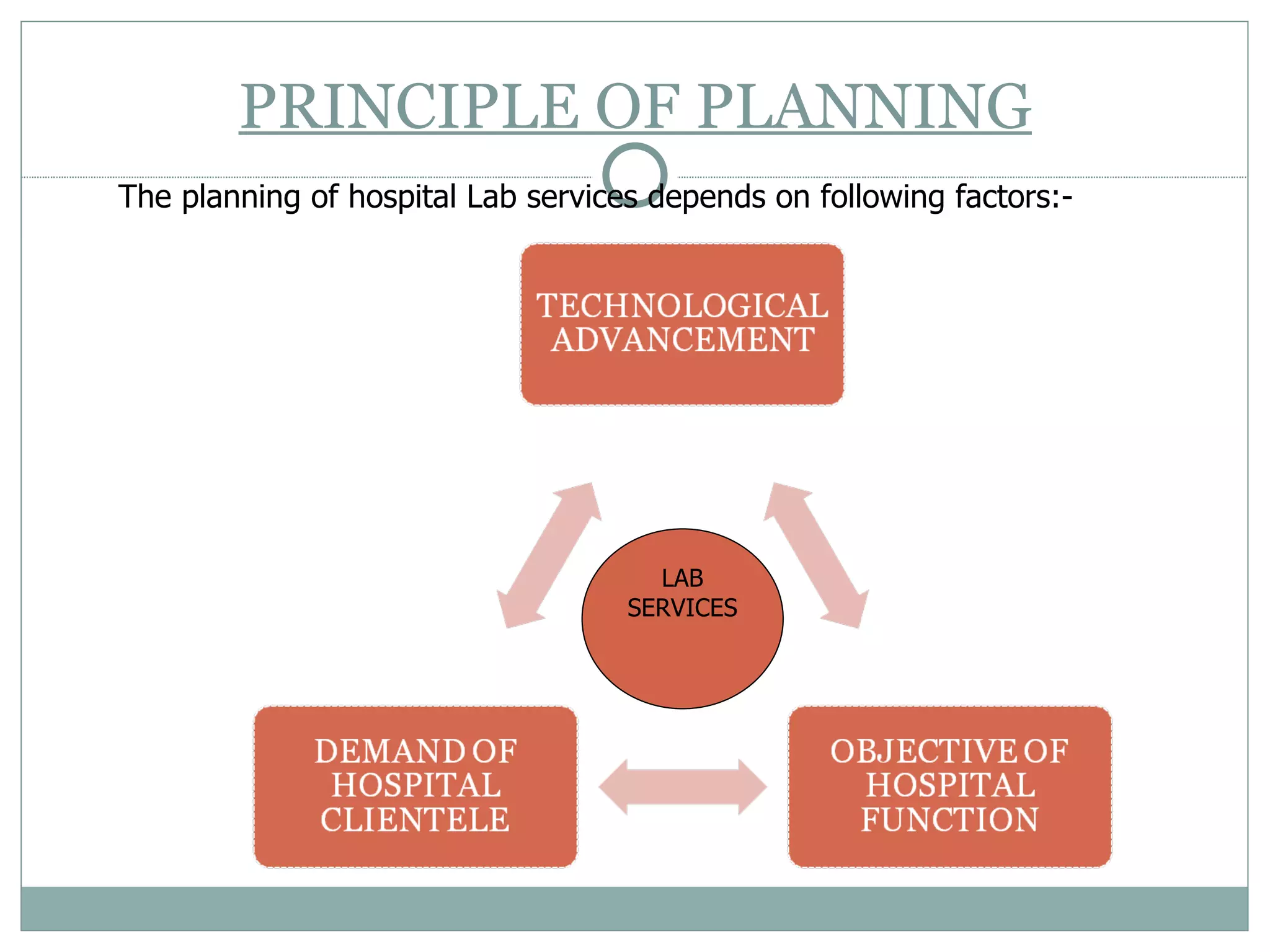
PRINCIPLE OF PLANNING The planning of hospital Lab services depends on following factors:- LAB SERVICES
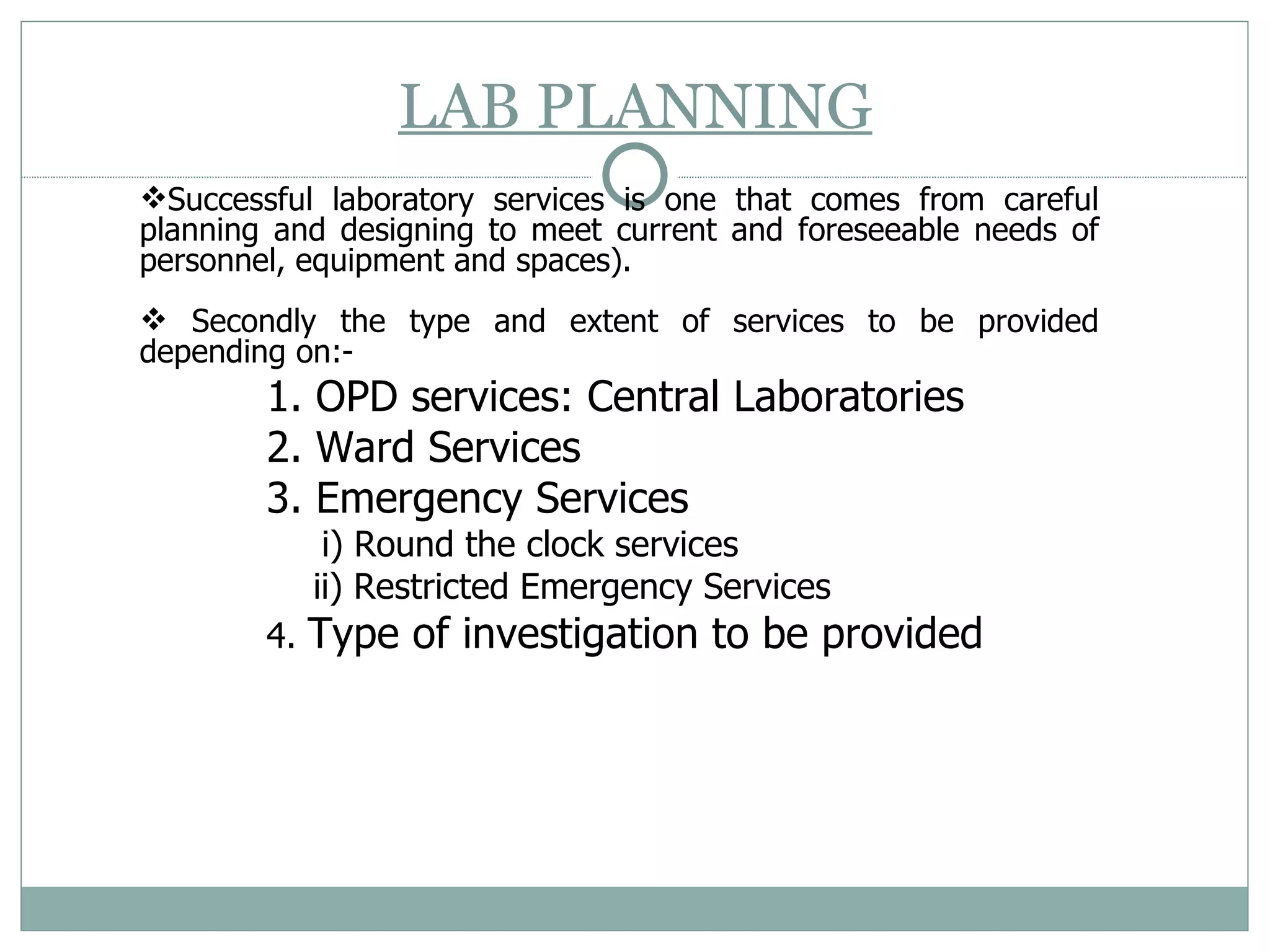
LAB PLANNING Successful laboratory services is one that comes from careful planning and designing to meet current and foreseeable needs of personnel, equipment and spaces). Secondly the type and extent of services to be provided depending on:- 1. OPD services: Central Laboratories  2. Ward Services  3. Emergency Services   i) Round the clock services  ii) Restricted Emergency Services 4.  Type of investigation to be provided
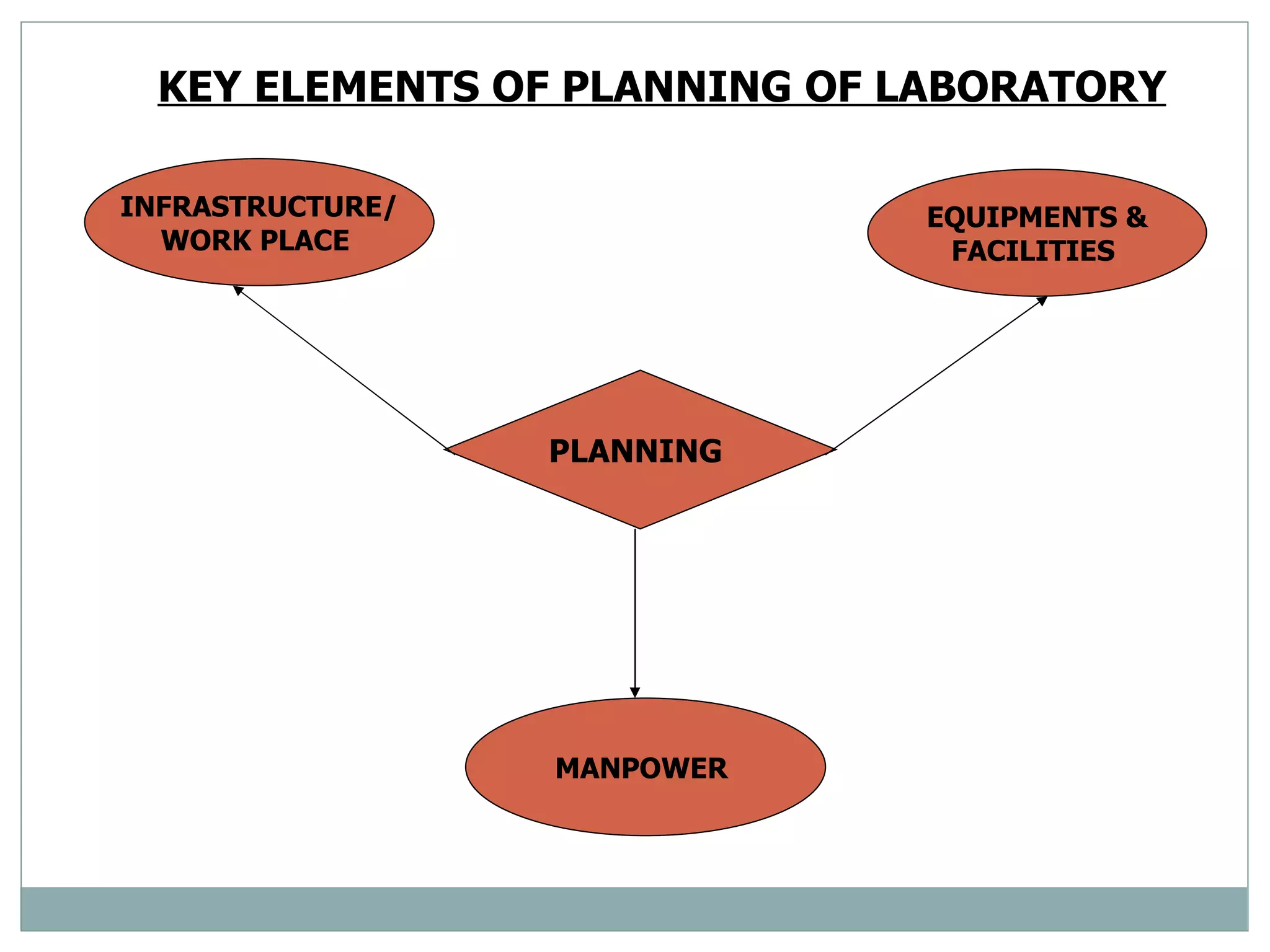
KEY ELEMENTS OF PLANNING OF LABORATORY   PLANNING  INFRASTRUCTURE/ WORK PLACE  EQUIPMENTS & FACILITIES  MANPOWER
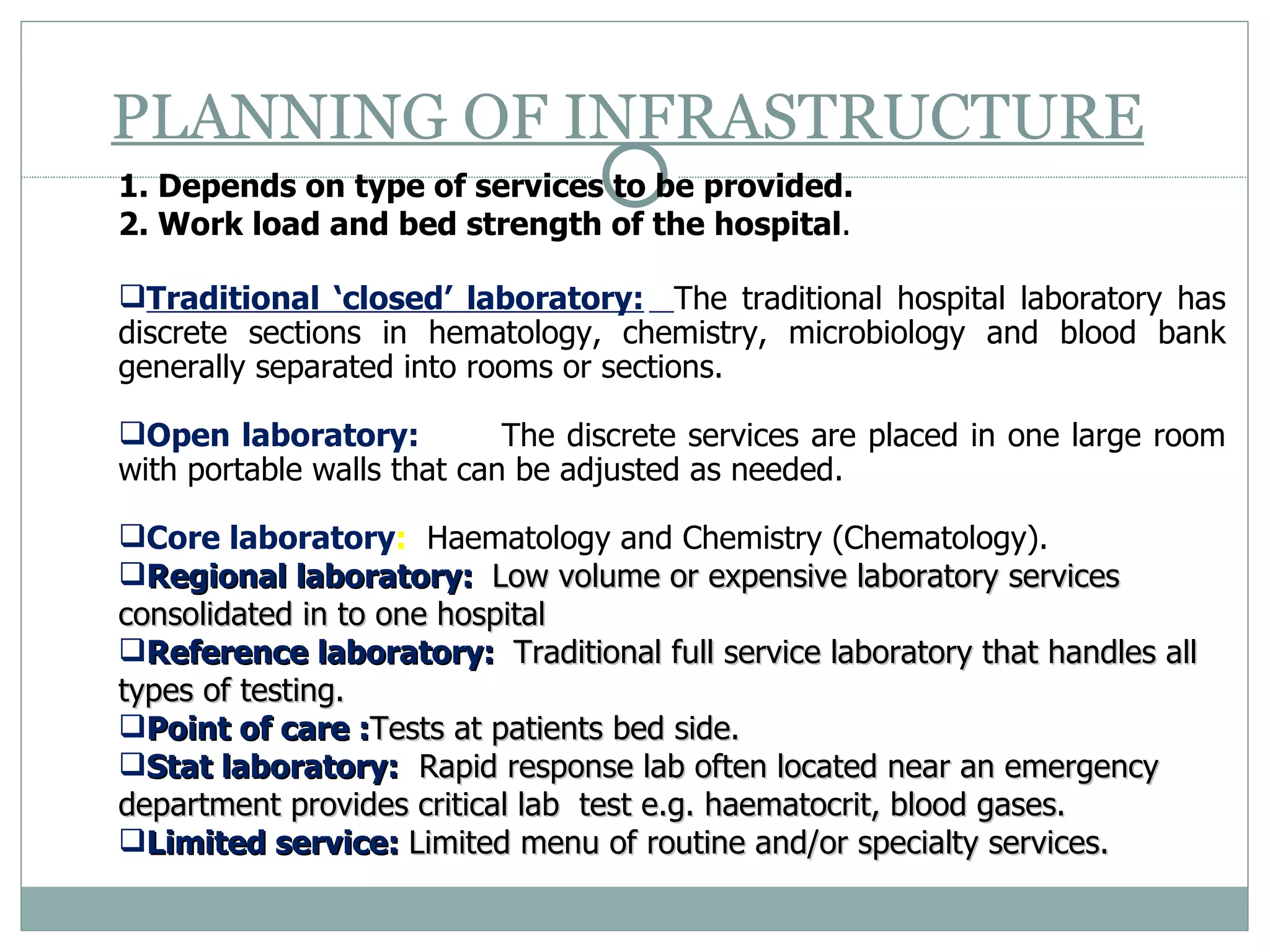
PLANNING OF INFRASTRUCTURE   1. Depends on type of services to be provided. 2. Work load and bed strength of the hospital .  Traditional ‘closed’ laboratory:   The traditional hospital laboratory has discrete sections in hematology, chemistry, microbiology and blood bank generally separated into rooms or sections.  Open laboratory: The discrete services are placed in one large room with portable walls that can be adjusted as needed.  Core laboratory :   Haematology and Chemistry (Chematology). Regional laboratory:  Low volume or expensive laboratory services consolidated in to one hospital Reference laboratory:   Traditional full service laboratory that handles all types of testing. Point of care : Tests at patients bed side. Stat laboratory:   Rapid response lab often located near an emergency department provides critical lab  test e.g. haematocrit, blood gases.  Limited service:  Limited menu of routine and/or specialty services.
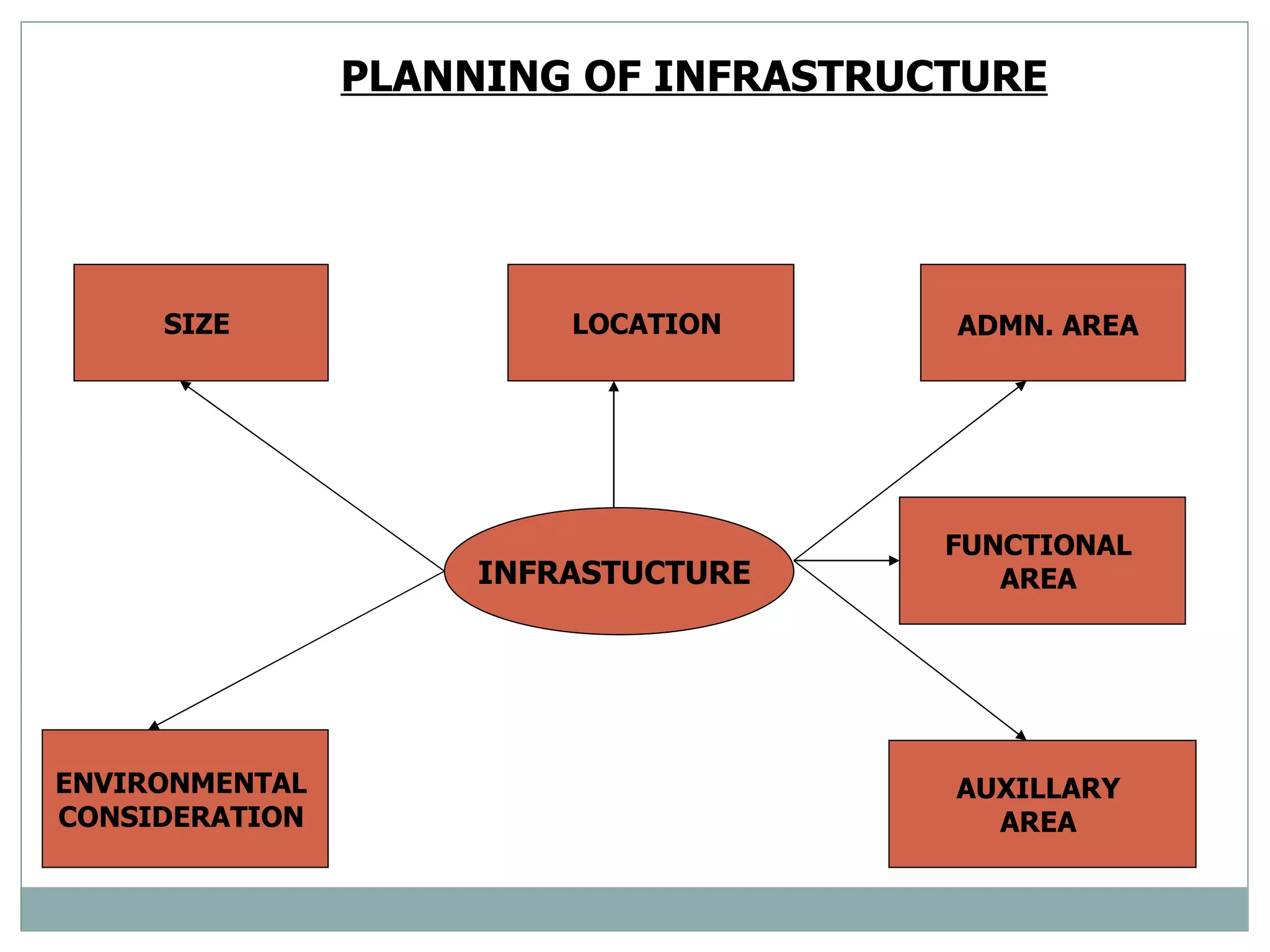
PLANNING OF INFRASTRUCTURE   INFRASTUCTURE  SIZE  LOCATION  ADMN. AREA   ENVIRONMENTAL  CONSIDERATION  AUXILLARY  AREA  FUNCTIONAL  AREA
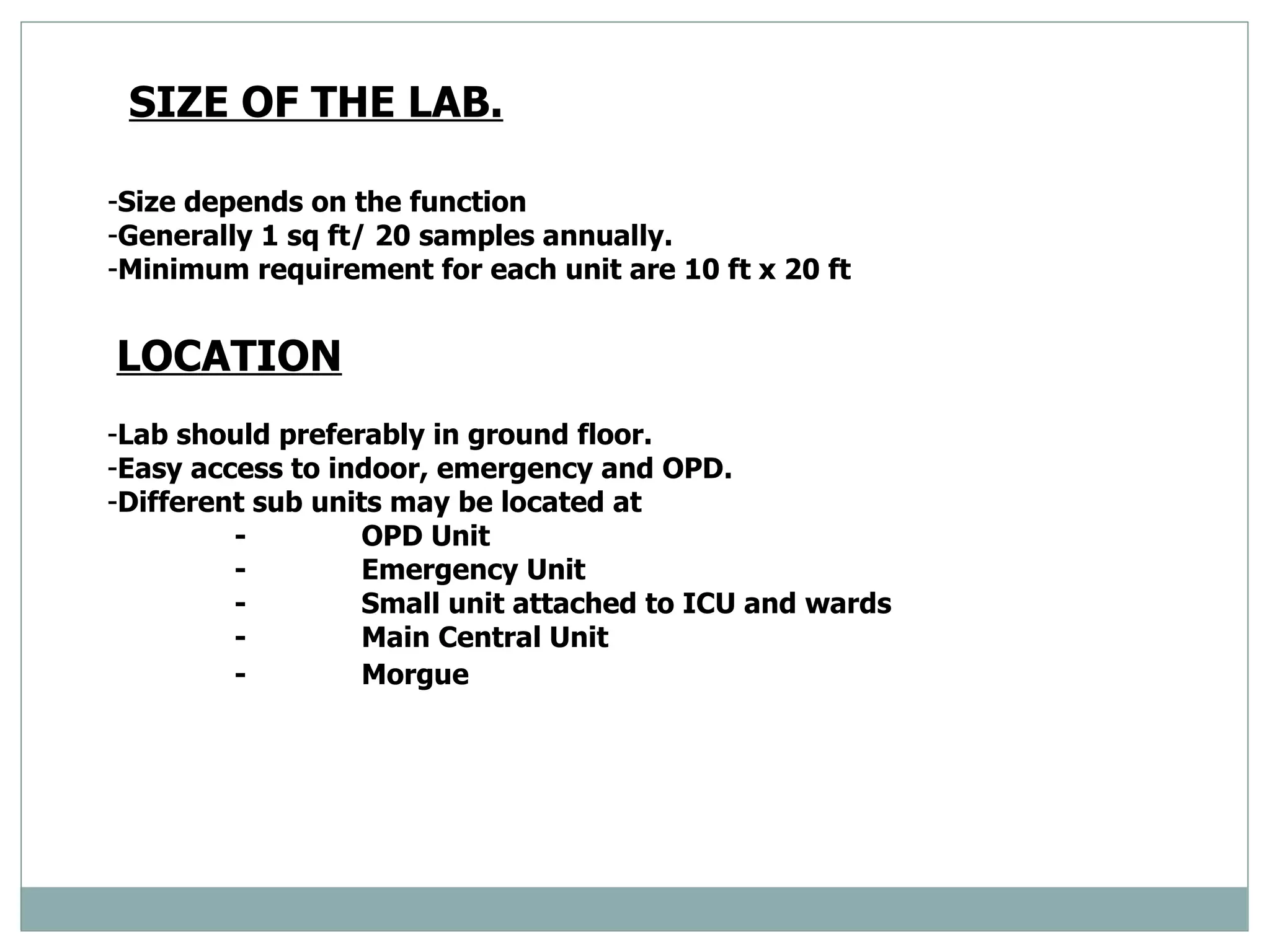
SIZE OF THE LAB. Size depends on the function  Generally 1 sq ft/ 20 samples annually.  Minimum requirement for each unit are 10 ft x 20 ft  LOCATION   Lab should preferably in ground floor.  Easy access to indoor, emergency and OPD. Different sub units may be located at  - OPD Unit  - Emergency Unit  - Small unit attached to ICU and wards  - Main Central Unit  - Morgue
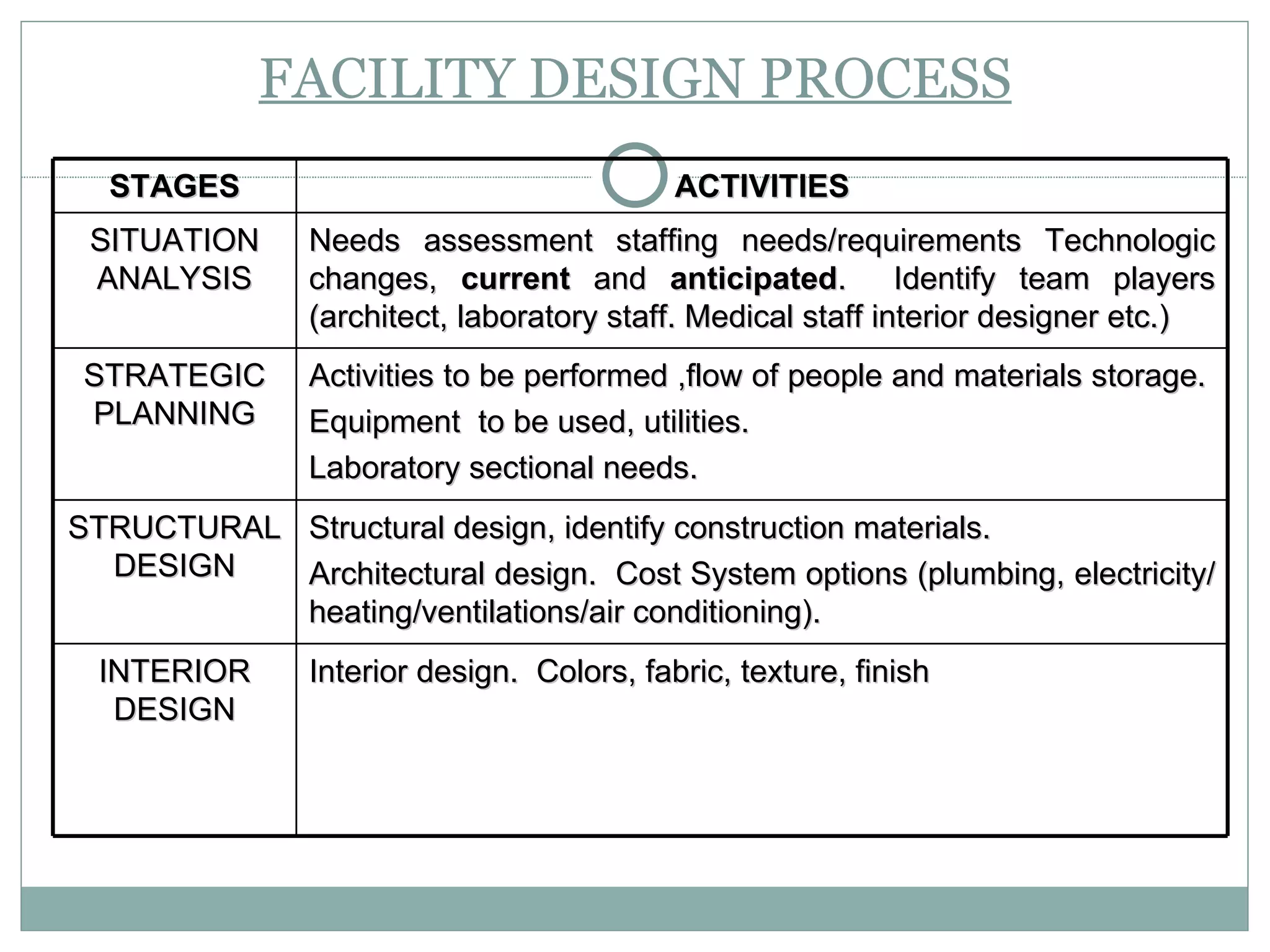
FACILITY DESIGN PROCESS STAGES ACTIVITIES SITUATION ANALYSIS Needs assessment staffing needs/requirements Technologic changes,  current  and  anticipated .  Identify team players (architect, laboratory staff. Medical staff interior designer etc.)  STRATEGIC PLANNING Activities to be performed ,flow of people and materials storage.  Equipment  to be used, utilities.  Laboratory sectional needs.  STRUCTURAL DESIGN Structural design, identify construction materials.  Architectural design.  Cost System options (plumbing, electricity/heating/ventilations/air conditioning). INTERIOR DESIGN Interior design.  Colors, fabric, texture, finish
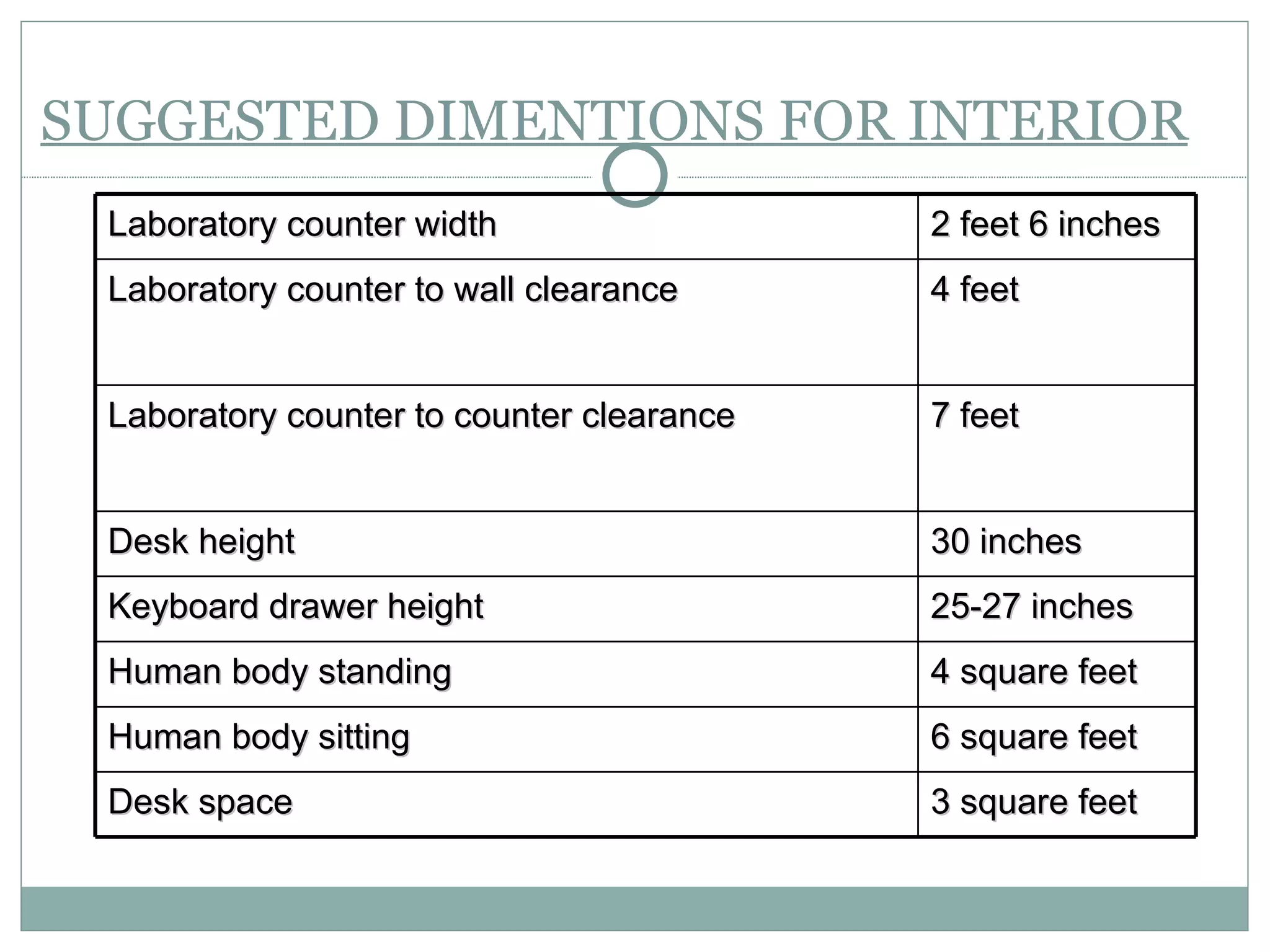
SUGGESTED DIMENTIONS FOR INTERIOR Laboratory counter width 2 feet 6 inches Laboratory counter to wall clearance 4 feet Laboratory counter to counter clearance  7 feet Desk height  30 inches  Keyboard drawer height  25-27 inches  Human body standing  4 square feet  Human body sitting 6 square feet Desk space  3 square feet
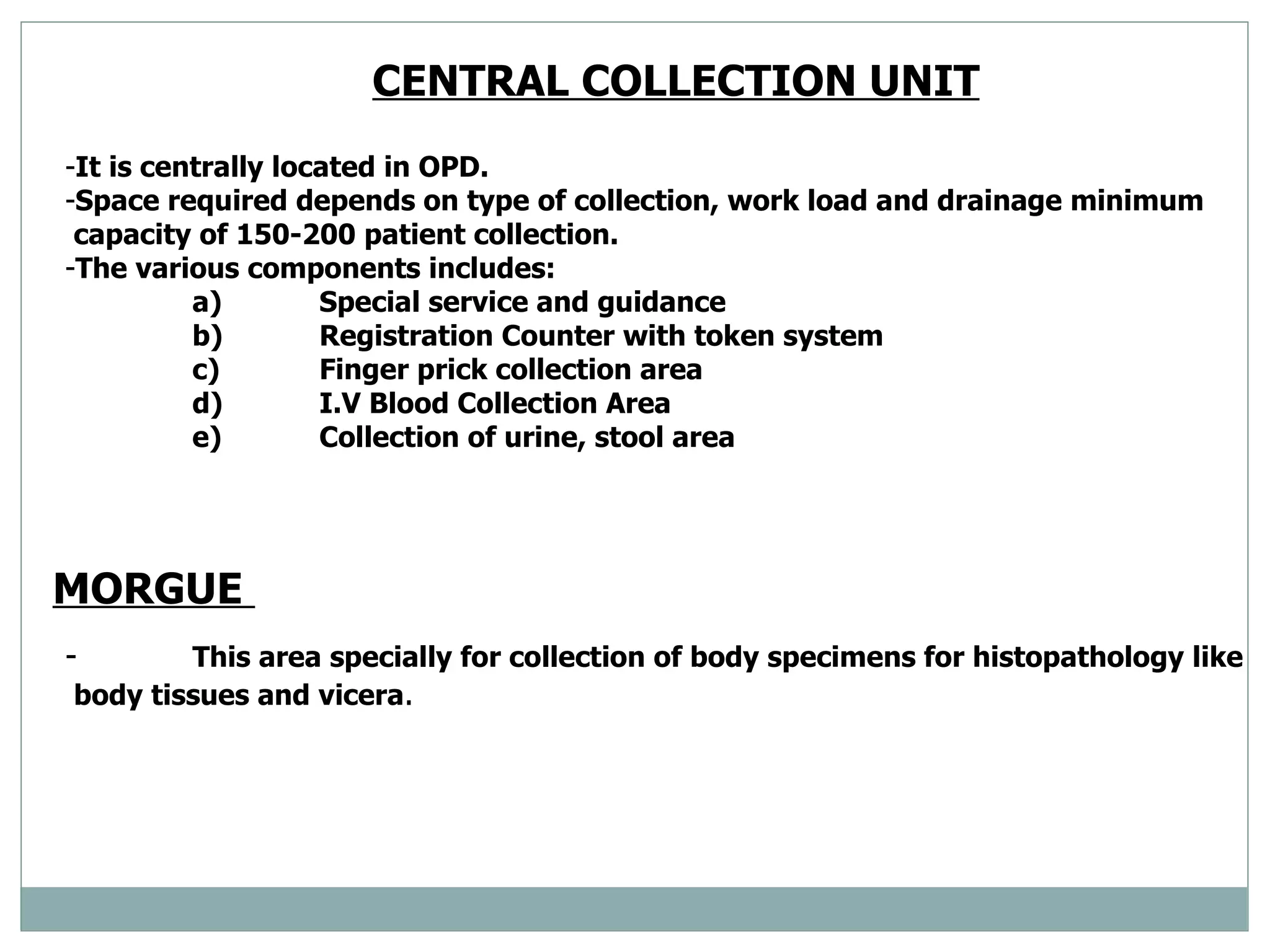
CENTRAL COLLECTION UNIT   It is centrally located in OPD. Space required depends on type of collection, work load and drainage minimum capacity of 150-200 patient collection.  The various components includes: a) Special service and guidance  b) Registration Counter with token system  c) Finger prick collection area  d) I.V Blood Collection Area  e) Collection of urine, stool area  MORGUE  - This area specially for collection of body specimens for histopathology like  body tissues and vicera .
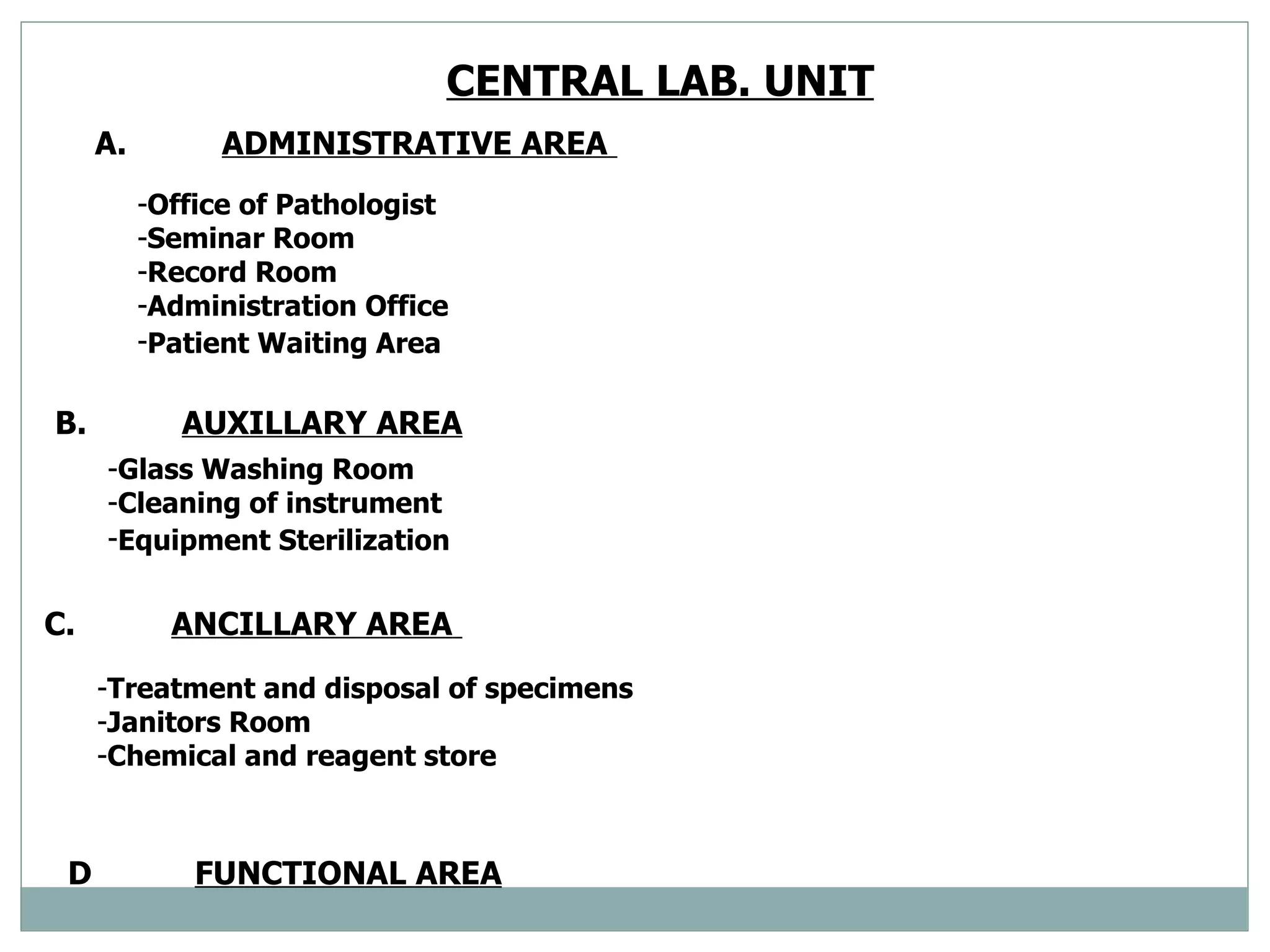
CENTRAL LAB. UNIT   A. ADMINISTRATIVE AREA   Office of Pathologist  Seminar Room  Record Room  Administration Office  Patient Waiting Area   B. AUXILLARY AREA   Glass Washing Room  Cleaning of instrument  Equipment Sterilization   C. ANCILLARY AREA   Treatment and disposal of specimens  Janitors Room  Chemical and reagent store  D FUNCTIONAL AREA
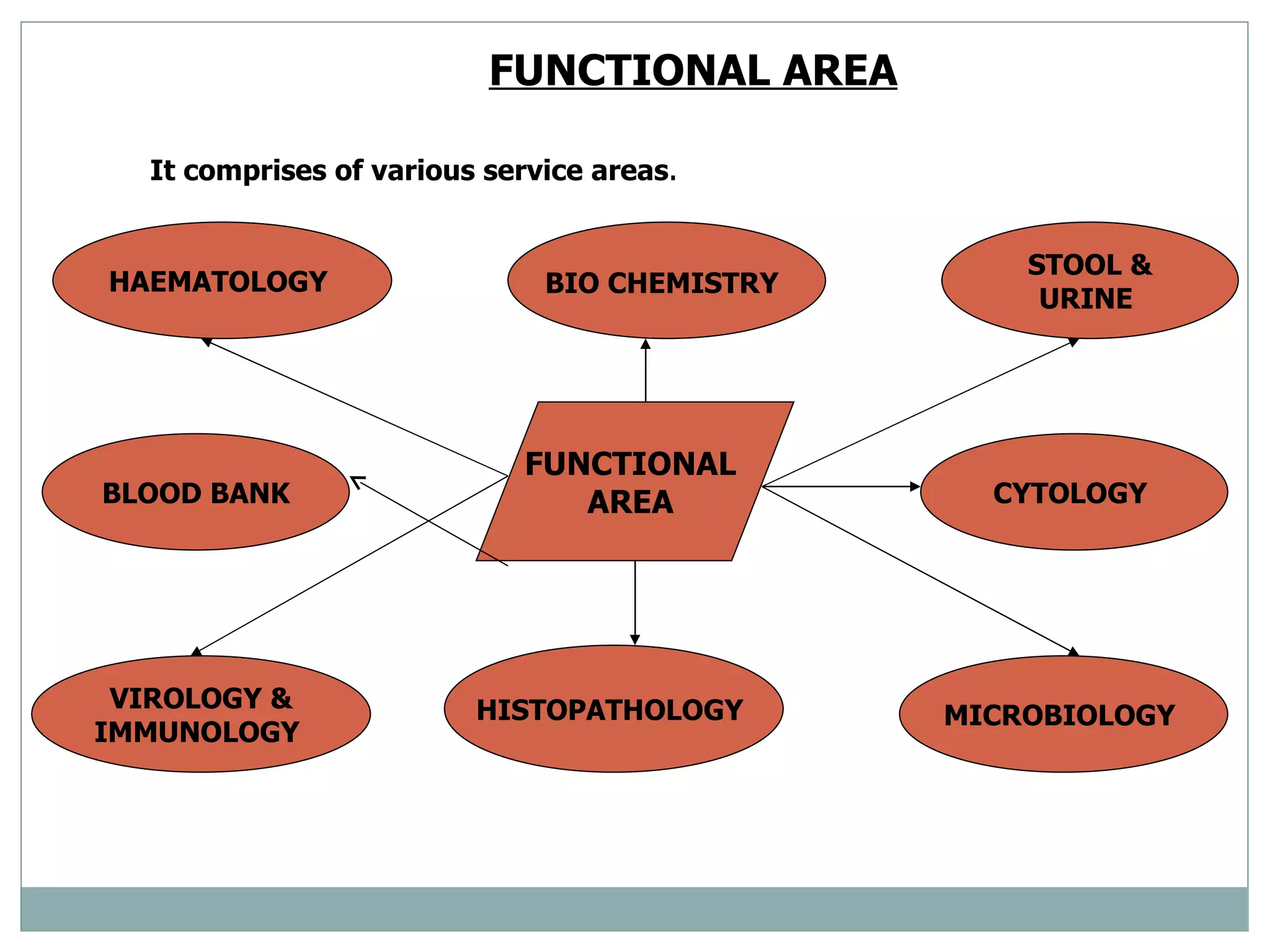
FUNCTIONAL AREA   It comprises of various service areas . FUNCTIONAL  AREA  HAEMATOLOGY  VIROLOGY & IMMUNOLOGY  BIO CHEMISTRY   HISTOPATHOLOGY  STOOL & URINE  CYTOLOGY  MICROBIOLOGY  BLOOD BANK
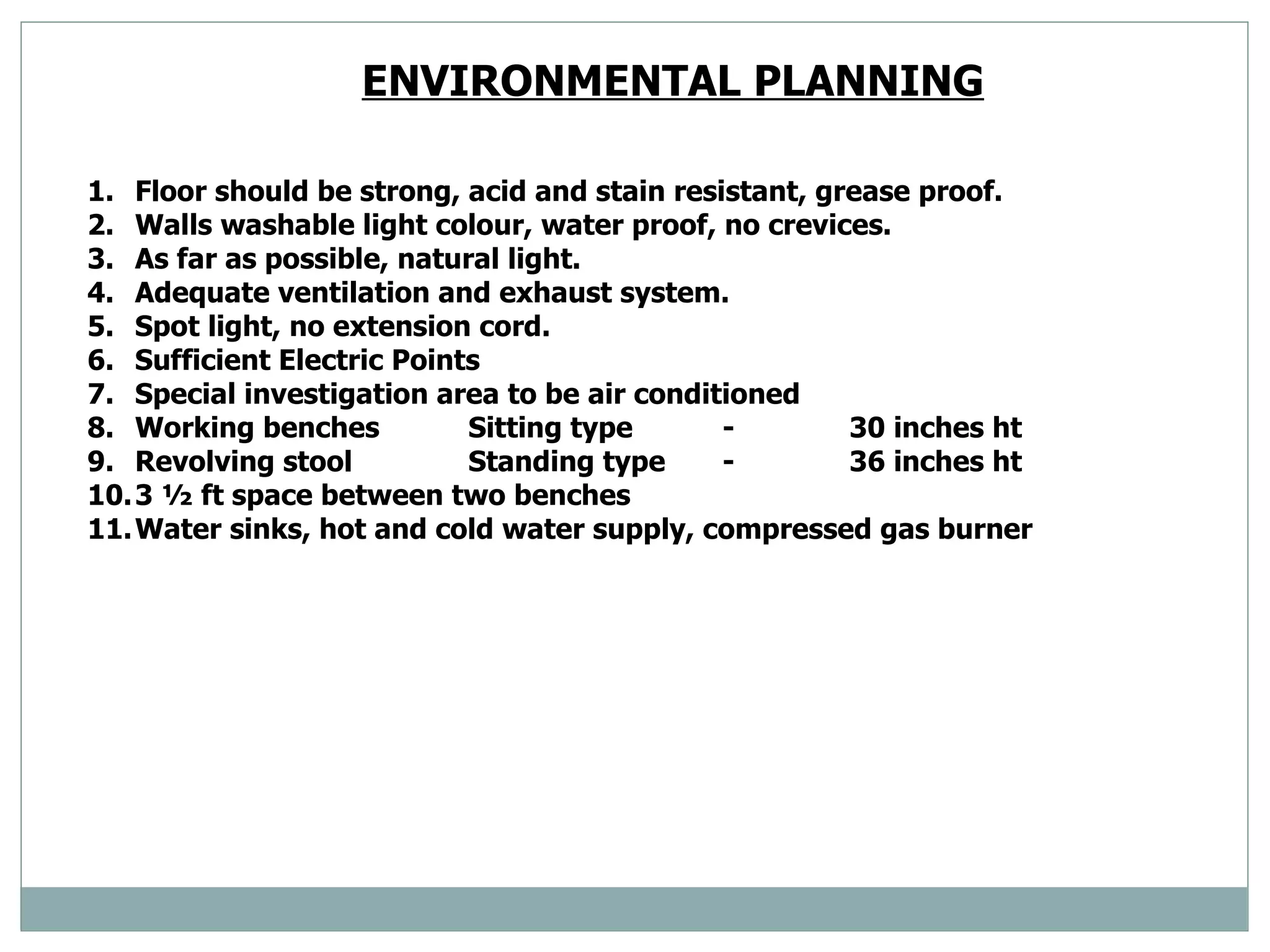
ENVIRONMENTAL PLANNING   Floor should be strong, acid and stain resistant, grease proof.  Walls washable light colour, water proof, no crevices. As far as possible, natural light.  Adequate ventilation and exhaust system.  Spot light, no extension cord.  Sufficient Electric Points  Special investigation area to be air conditioned  Working benches  Sitting type - 30 inches ht Revolving stool Standing type - 36 inches ht  3 ½ ft space between two benches  Water sinks, hot and cold water supply, compressed gas burner
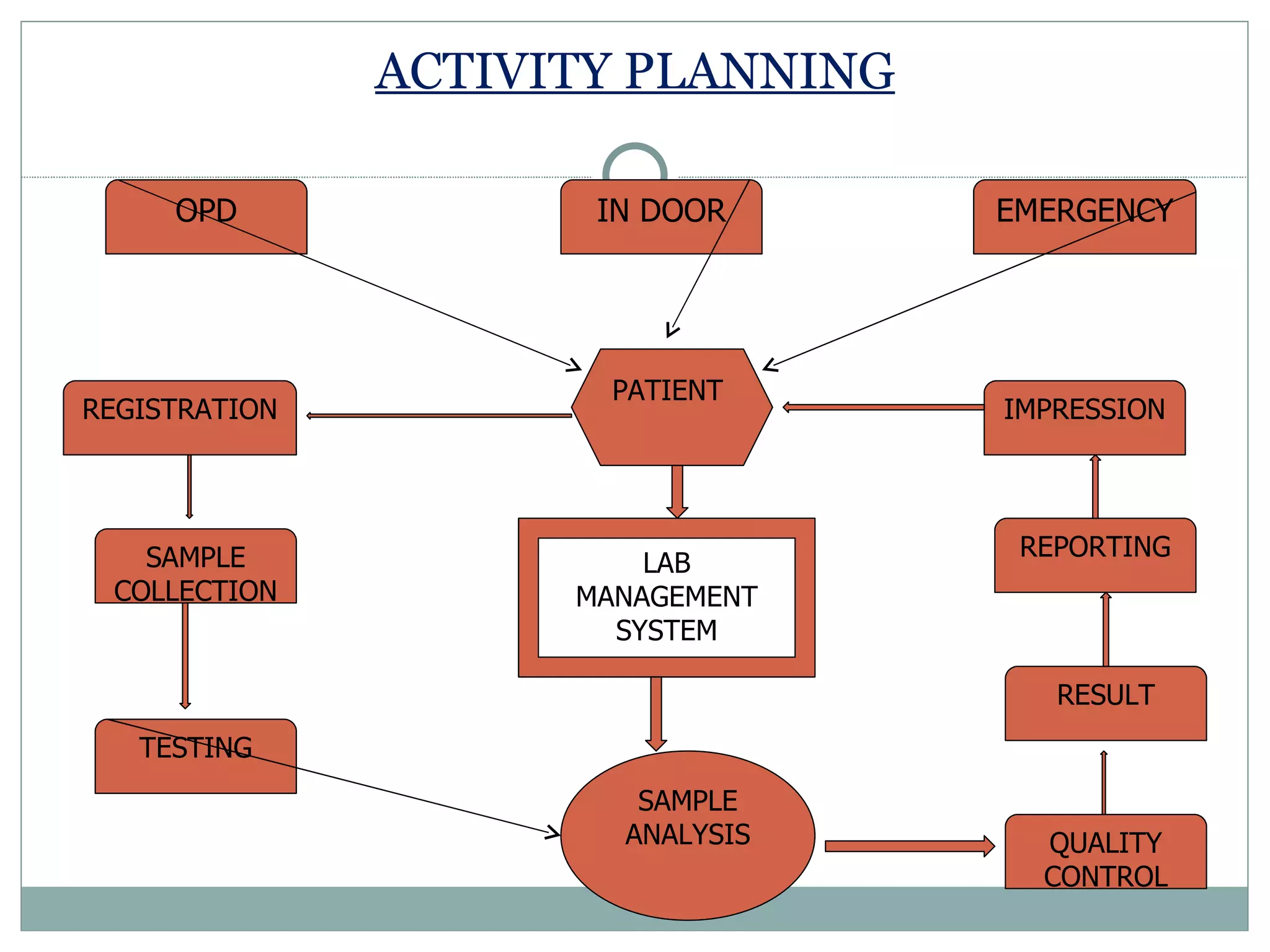
ACTIVITY PLANNING LAB MANAGEMENT SYSTEM PATIENT OPD SAMPLE COLLECTION REGISTRATION IN DOOR EMERGENCY RESULT REPORTING IMPRESSION TESTING QUALITY CONTROL SAMPLE ANALYSIS
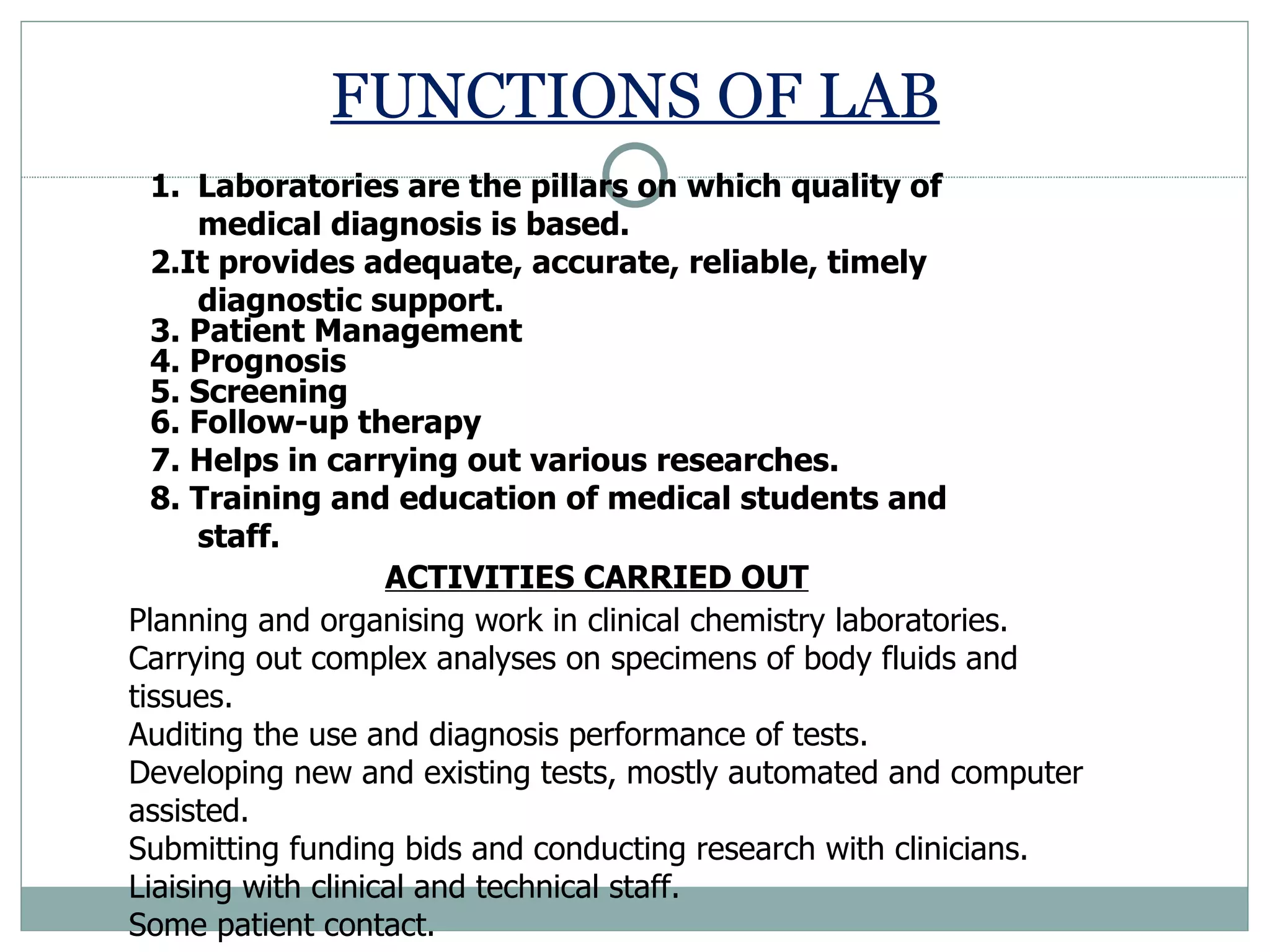
FUNCTIONS OF LAB Laboratories are the pillars on which quality of medical diagnosis is based. 2.It provides adequate, accurate, reliable, timely diagnostic support.  3. Patient Management  4. Prognosis  5. Screening  6. Follow-up therapy 7. Helps in carrying out various researches.  8. Training and education of medical students and staff.  Planning and organising work in clinical chemistry laboratories. Carrying out complex analyses on specimens of body fluids and tissues. Auditing the use and diagnosis performance of tests. Developing new and existing tests, mostly automated and computer assisted. Submitting funding bids and conducting research with clinicians. Liaising with clinical and technical staff. Some patient contact. ACTIVITIES CARRIED OUT
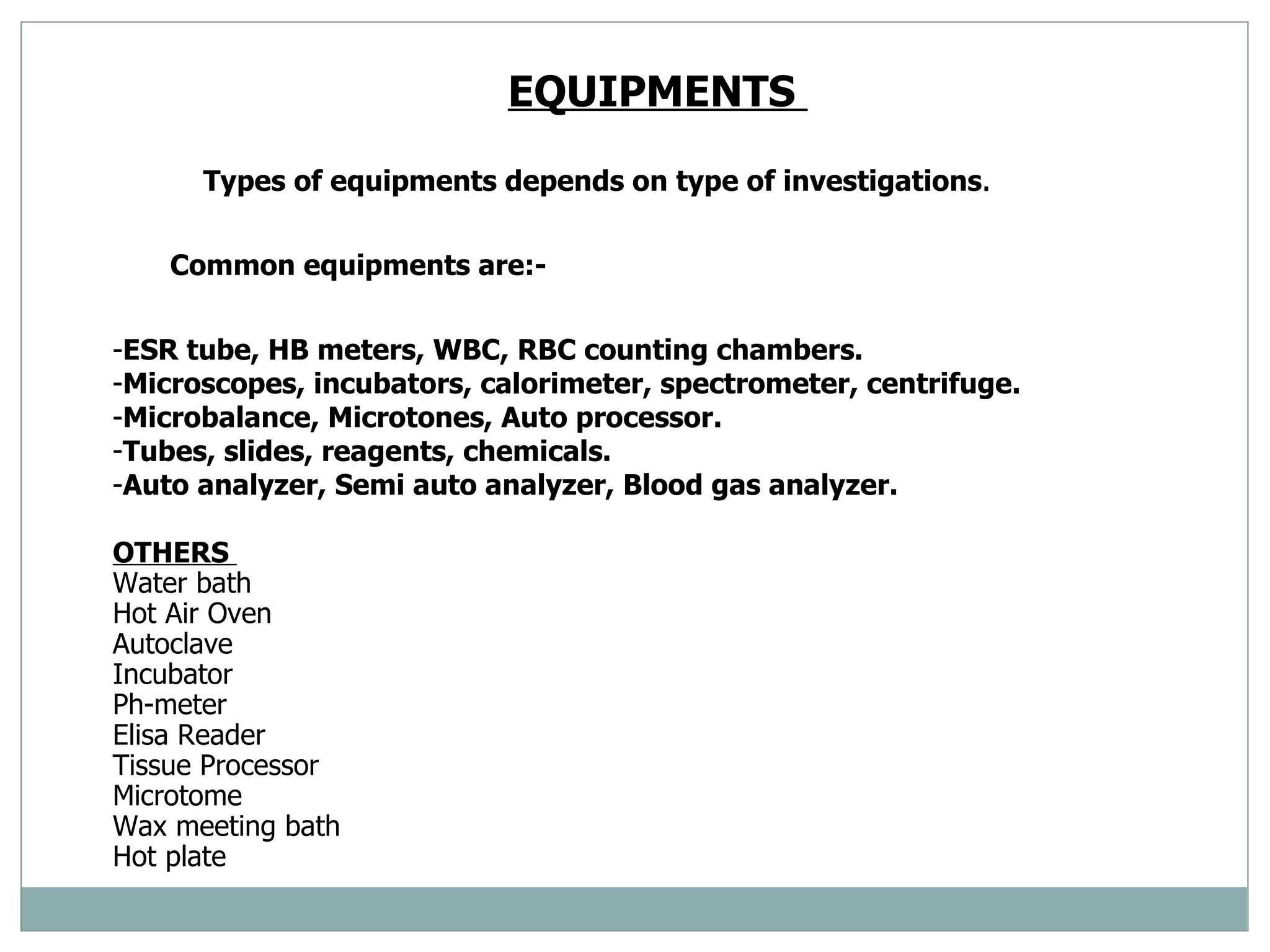
EQUIPMENTS  Types of equipments depends on type of investigations . Common equipments are:- ESR tube, HB meters, WBC, RBC counting chambers.  Microscopes, incubators, calorimeter, spectrometer, centrifuge.  Microbalance, Microtones, Auto processor.  Tubes, slides, reagents, chemicals.  Auto analyzer, Semi auto analyzer, Blood gas analyzer.  OTHERS  Water bath  Hot Air Oven  Autoclave  Incubator  Ph-meter  Elisa Reader Tissue Processor  Microtome Wax meeting bath  Hot plate
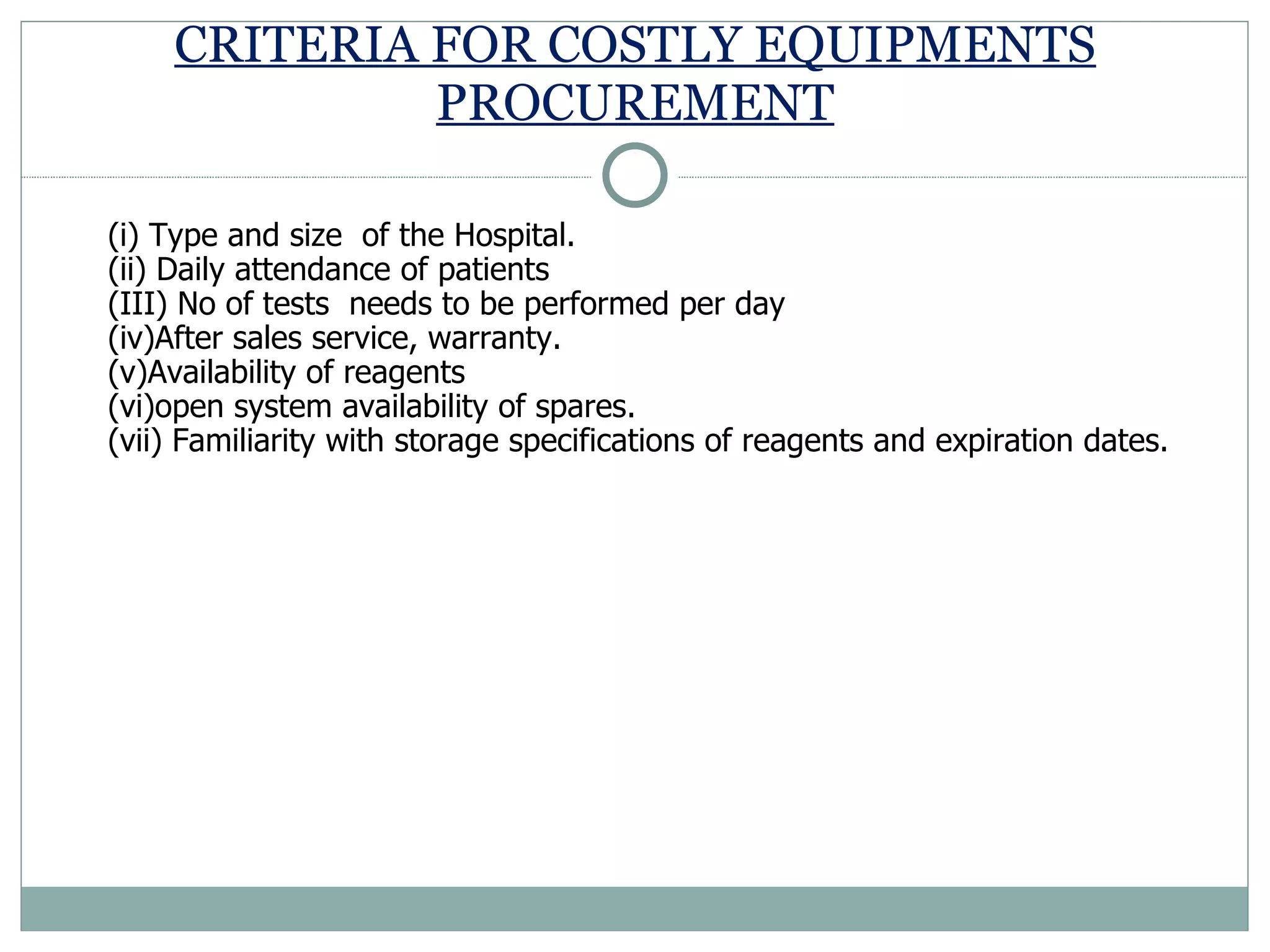
CRITERIA FOR COSTLY EQUIPMENTS PROCUREMENT (i) Type and size  of the Hospital.  (ii) Daily attendance of patients (III) No of tests  needs to be performed per day (iv)After sales service, warranty. (v)Availability of reagents  (vi)open system availability of spares.  (vii) Familiarity with storage specifications of reagents and expiration dates.
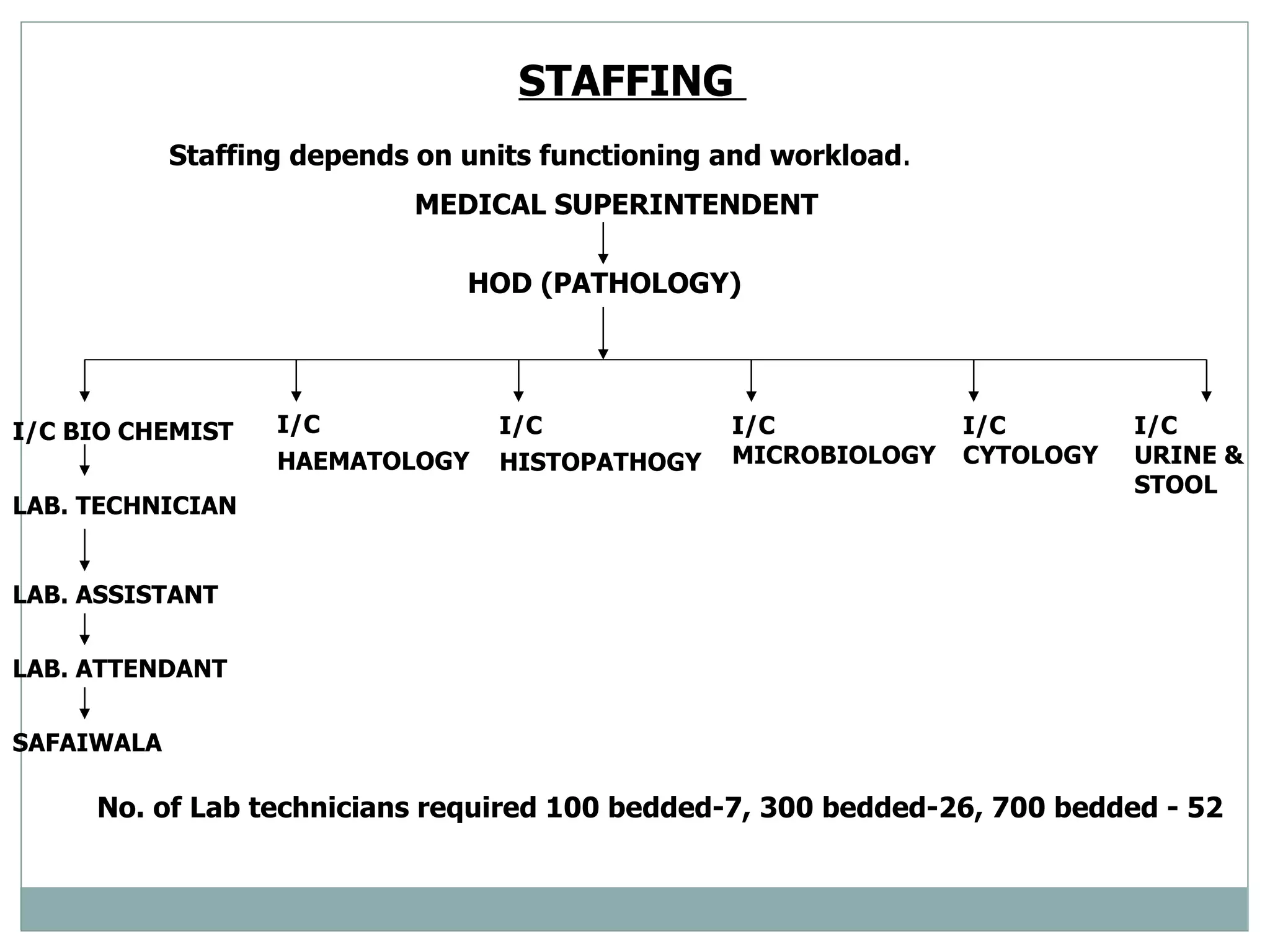
STAFFING  Staffing depends on units functioning and workload . MEDICAL SUPERINTENDENT  HOD (PATHOLOGY) I/C BIO CHEMIST   LAB. TECHNICIAN   LAB. ASSISTANT   LAB. ATTENDANT   SAFAIWALA  I/C  HAEMATOLOGY   I/C  HISTOPATHOGY   I/C MICROBIOLOGY I/C  CYTOLOGY I/C URINE & STOOL No. of Lab technicians required 100 bedded-7, 300 bedded-26, 700 bedded - 52
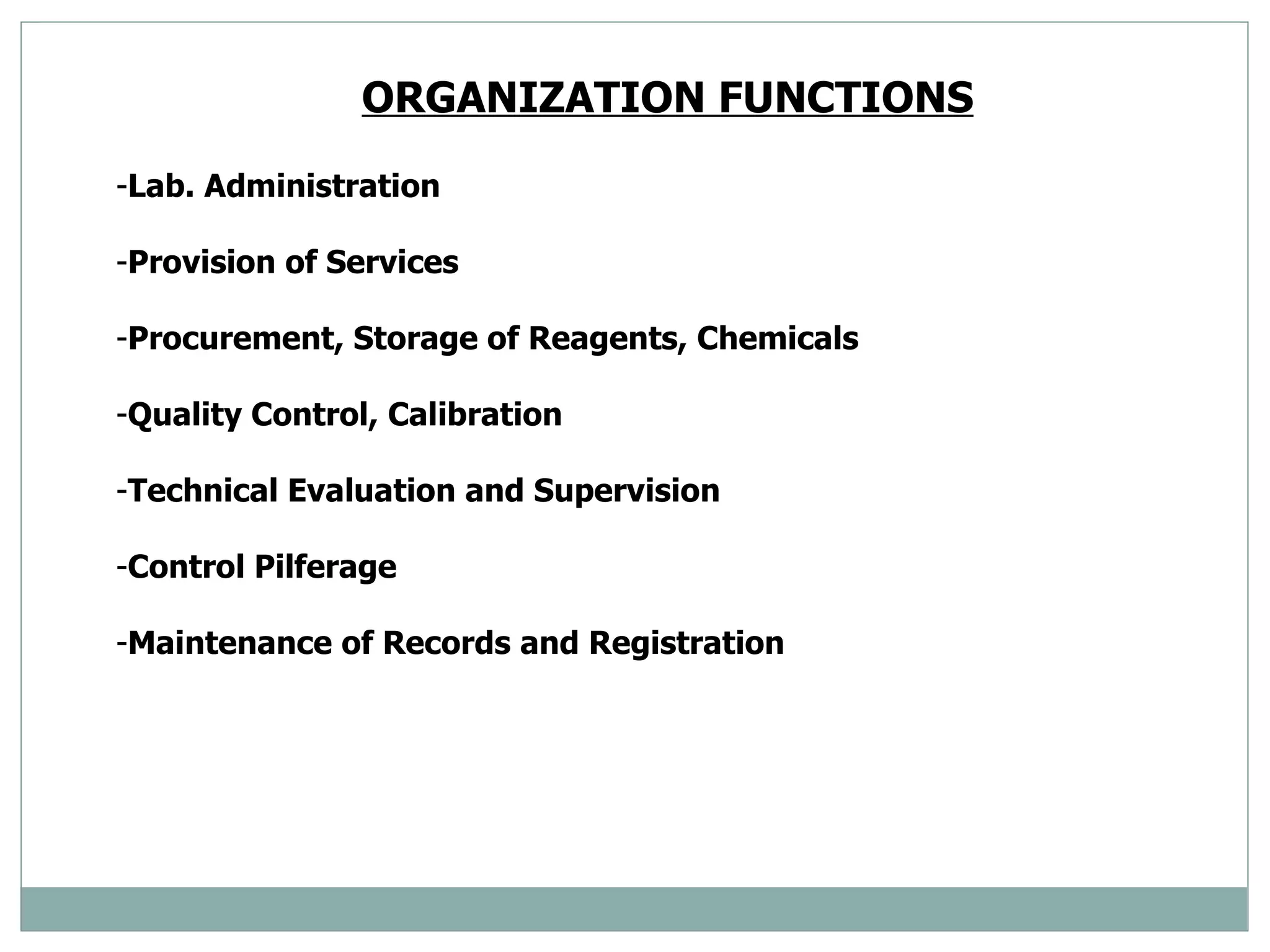
ORGANIZATION FUNCTIONS   Lab. Administration  Provision of Services  Procurement, Storage of Reagents, Chemicals Quality Control, Calibration  Technical Evaluation and Supervision  Control Pilferage  Maintenance of Records and Registration
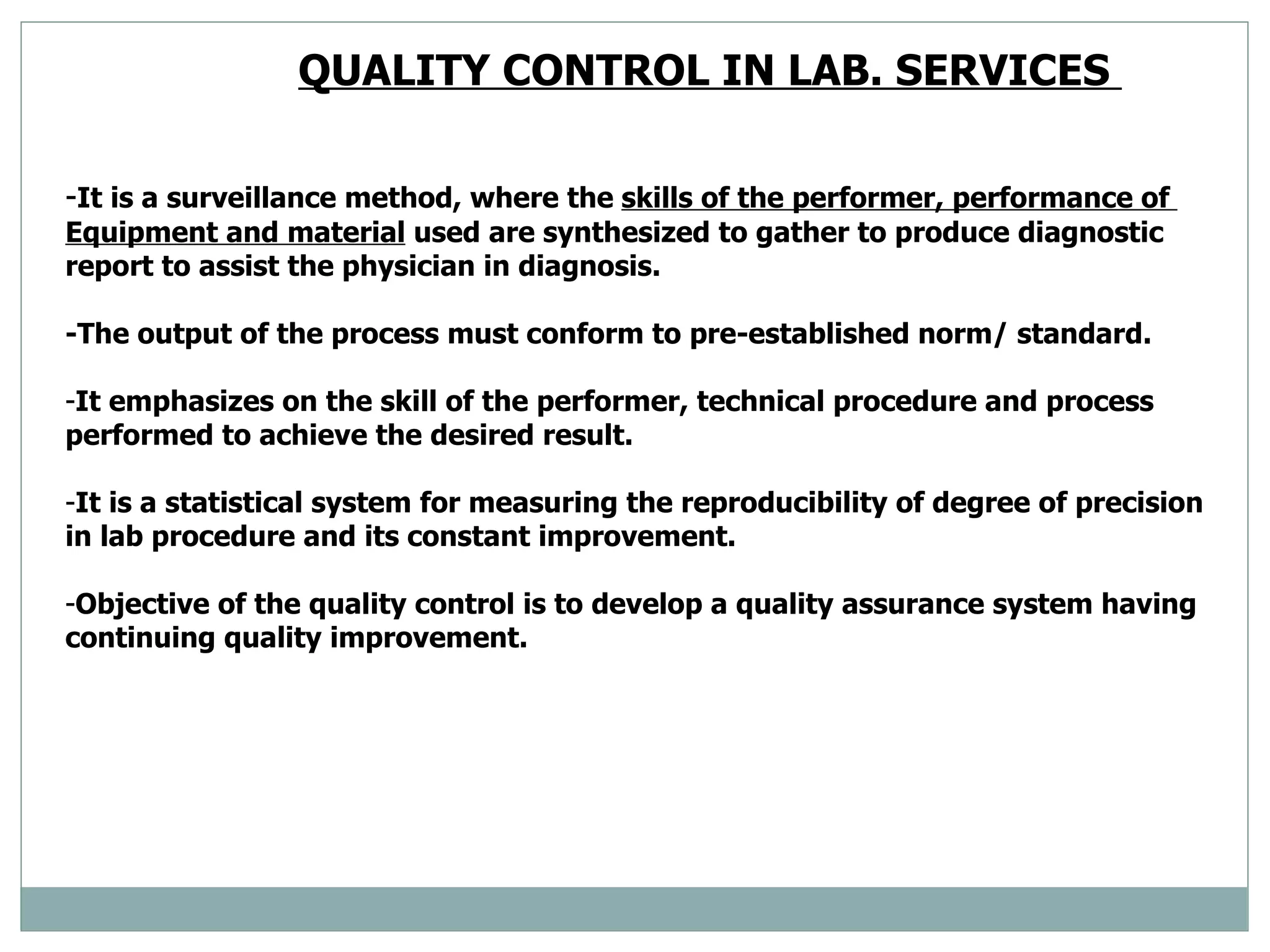
QUALITY CONTROL IN LAB. SERVICES  - It is a surveillance method, where the  skills of the performer, performance of  Equipment and material  used are synthesized to gather to produce diagnostic report to assist the physician in diagnosis. -The output of the process must conform to pre-established norm/ standard. It emphasizes on the skill of the performer, technical procedure and process performed to achieve the desired result.  It is a statistical system for measuring the reproducibility of degree of precision in lab procedure and its constant improvement.  Objective of the quality control is to develop a quality assurance system having continuing quality improvement.
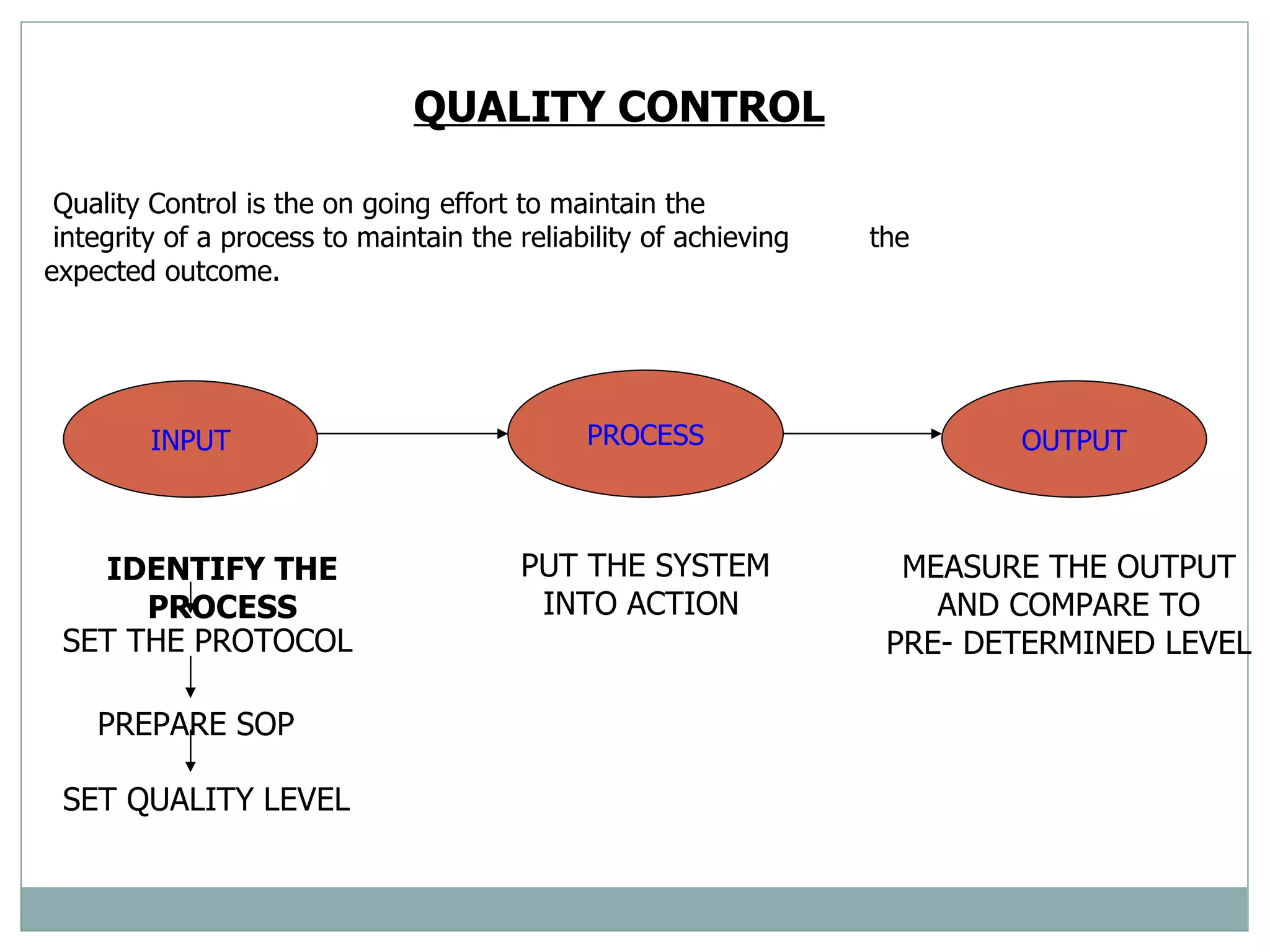
QUALITY CONTROL Quality Control is the on going effort to maintain the integrity of a process to maintain the reliability of achieving  the expected outcome.  PROCESS INPUT OUTPUT IDENTIFY THE PROCESS SET THE PROTOCOL   PREPARE SOP SET QUALITY LEVEL PUT THE SYSTEM INTO ACTION   MEASURE THE OUTPUT AND COMPARE TO PRE- DETERMINED LEVEL
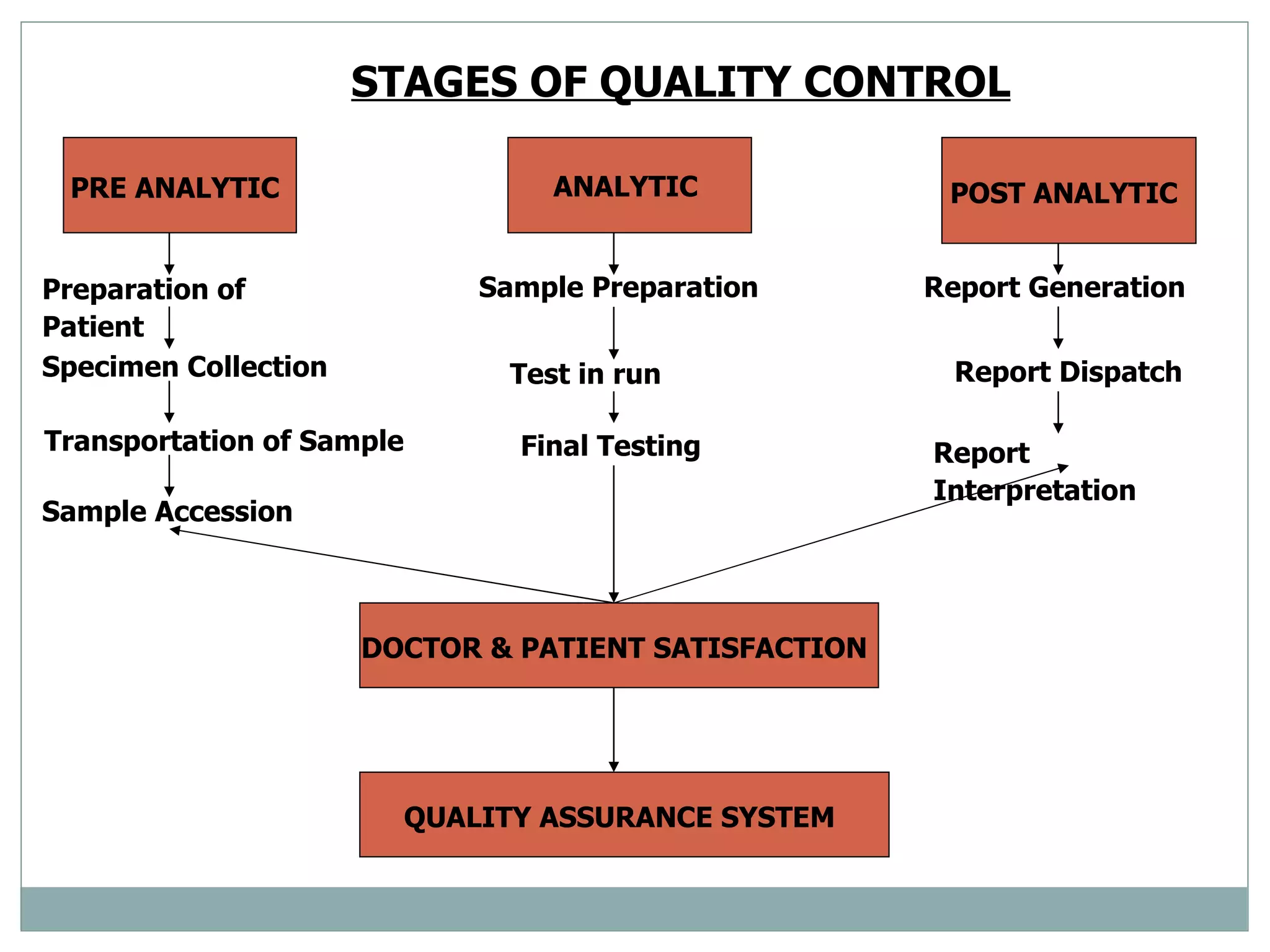
STAGES OF QUALITY CONTROL   PRE ANALYTIC   ANALYTIC  POST ANALYTIC   Preparation of Patient   Specimen Collection   Transportation of Sample   Sample Accession  Sample Preparation   Test in run Final Testing   Report Generation   Report Dispatch   Report Interpretation   DOCTOR & PATIENT SATISFACTION   QUALITY ASSURANCE SYSTEM
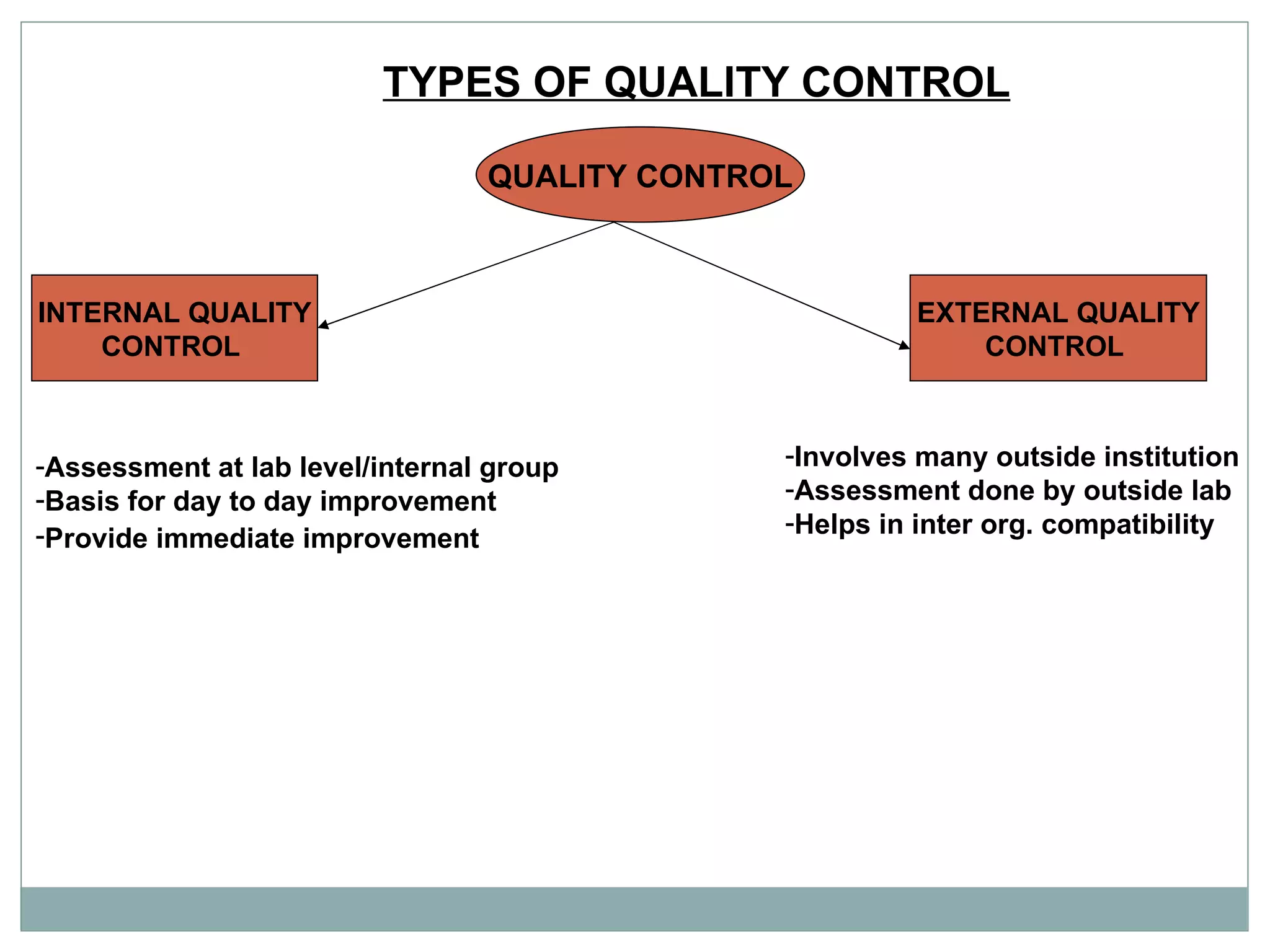
TYPES OF QUALITY CONTROL   QUALITY CONTROL INTERNAL QUALITY CONTROL  EXTERNAL QUALITY CONTROL  Assessment at lab level/internal group  Basis for day to day improvement  Provide immediate improvement   Involves many outside institution  Assessment done by outside lab Helps in inter org. compatibility
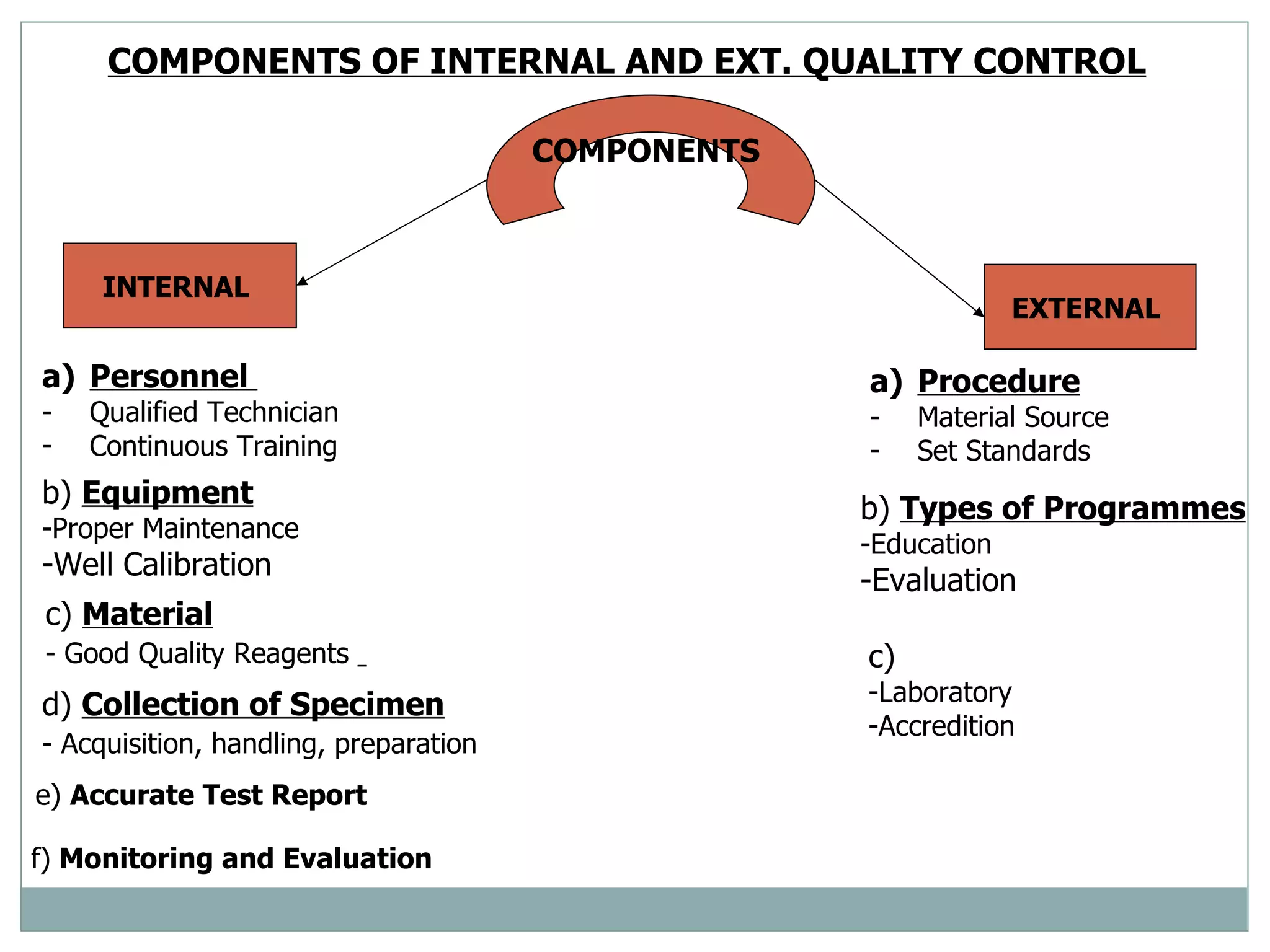
COMPONENTS OF INTERNAL AND EXT. QUALITY CONTROL   COMPONENTS   INTERNAL  EXTERNAL  Personnel  Qualified Technician  Continuous Training  b)  Equipment Proper Maintenance  Well Calibration  c)  Material - Good Quality Reagents  d)  Collection of Specimen - Acquisition, handling, preparation  e)  Accurate Test Report   f)  Monitoring and Evaluation   Procedure Material Source  Set Standards  b)  Types of Programmes Education  Evaluation  c)  Laboratory  Accredition
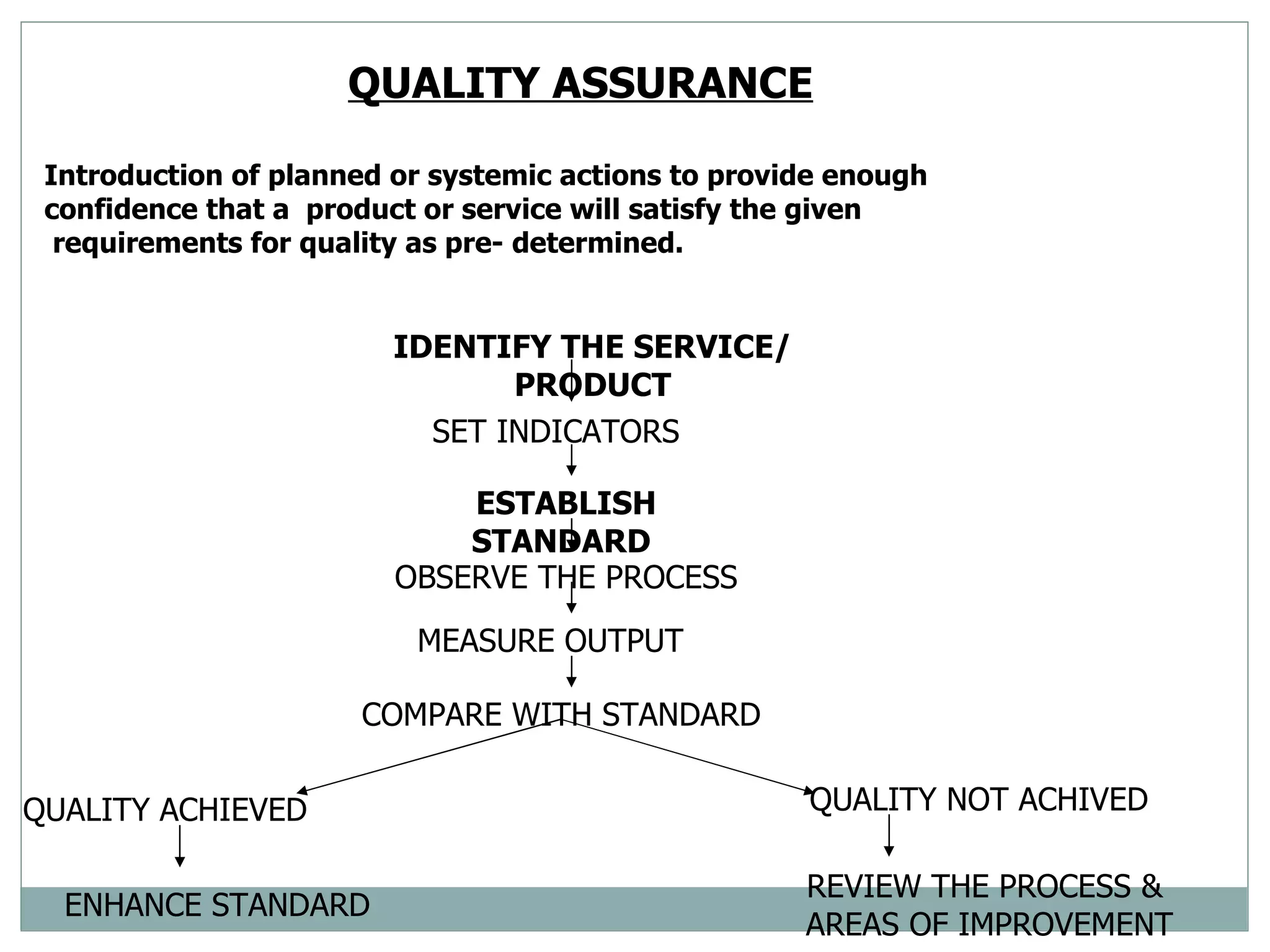
QUALITY ASSURANCE   Introduction of planned or systemic actions to provide enough  confidence that a  product or service will satisfy the given requirements for quality as pre- determined.  IDENTIFY THE SERVICE/ PRODUCT SET INDICATORS  ESTABLISH STANDARD   OBSERVE THE PROCESS MEASURE OUTPUT COMPARE WITH STANDARD  QUALITY ACHIEVED QUALITY NOT ACHIVED ENHANCE STANDARD  REVIEW THE PROCESS &  AREAS OF IMPROVEMENT
 
THANK YOU   DR.N.C.DAS

Orag. of lab services

  • 1.
    ORGANIZATION OF LABSERVICES DR.N.C.DAS
  • 2.
    LAB SERVICES LABSERVICES CLINICAL LABS Cardiology, Neurology, Respiratory, Nuclear lab PATH LABS Clinical, Micro, Histo, Cyto, Bio-chemistry
  • 3.
    CHANGING ROLE OFLAB SERVICES Once upon a time the hospital laboratory, was a small, dark, cul-de-sac reeking of chemicals, and located in the bowels of the hospital next to the morgue. The scenario is changing fast its image and emerging as a high-tech, respected member of the hospital team. Medical technologists and technicians no longer huddle over racks of test tubes; instead, they work in brightly-lit, air-conditioned labs. Monitoring and maintaining sophisticated laboratory analyzers capable of running hundreds of patient samples each day.
  • 4.
    IMPORTANCE OF LABLaboratory services are essential to health care delivery. The hospital lab offers the convenience of local service, and familiarity with both the outpatient and his physician. Hospital labs depend on their outpatient testing to make up money lost during times of low in-house census They address both preventive and curative activities, i.e. patient diagnosis, and the selection of drugs for treatment. They are also an indispensable tool in the surveillance and control of diseases. Improved disease recognition will improve the accuracy of statistical reporting, and thus effective national health planning.
  • 5.
    PRINCIPLE OF PLANNINGThe planning of hospital Lab services depends on following factors:- LAB SERVICES
  • 6.
    LAB PLANNING Successfullaboratory services is one that comes from careful planning and designing to meet current and foreseeable needs of personnel, equipment and spaces). Secondly the type and extent of services to be provided depending on:- 1. OPD services: Central Laboratories 2. Ward Services 3. Emergency Services i) Round the clock services ii) Restricted Emergency Services 4. Type of investigation to be provided
  • 7.
    KEY ELEMENTS OFPLANNING OF LABORATORY PLANNING INFRASTRUCTURE/ WORK PLACE EQUIPMENTS & FACILITIES MANPOWER
  • 8.
    PLANNING OF INFRASTRUCTURE 1. Depends on type of services to be provided. 2. Work load and bed strength of the hospital . Traditional ‘closed’ laboratory: The traditional hospital laboratory has discrete sections in hematology, chemistry, microbiology and blood bank generally separated into rooms or sections. Open laboratory: The discrete services are placed in one large room with portable walls that can be adjusted as needed. Core laboratory : Haematology and Chemistry (Chematology). Regional laboratory: Low volume or expensive laboratory services consolidated in to one hospital Reference laboratory: Traditional full service laboratory that handles all types of testing. Point of care : Tests at patients bed side. Stat laboratory: Rapid response lab often located near an emergency department provides critical lab test e.g. haematocrit, blood gases. Limited service: Limited menu of routine and/or specialty services.
  • 9.
    PLANNING OF INFRASTRUCTURE INFRASTUCTURE SIZE LOCATION ADMN. AREA ENVIRONMENTAL CONSIDERATION AUXILLARY AREA FUNCTIONAL AREA
  • 10.
    SIZE OF THELAB. Size depends on the function Generally 1 sq ft/ 20 samples annually. Minimum requirement for each unit are 10 ft x 20 ft LOCATION Lab should preferably in ground floor. Easy access to indoor, emergency and OPD. Different sub units may be located at - OPD Unit - Emergency Unit - Small unit attached to ICU and wards - Main Central Unit - Morgue
  • 11.
    FACILITY DESIGN PROCESSSTAGES ACTIVITIES SITUATION ANALYSIS Needs assessment staffing needs/requirements Technologic changes, current and anticipated . Identify team players (architect, laboratory staff. Medical staff interior designer etc.) STRATEGIC PLANNING Activities to be performed ,flow of people and materials storage. Equipment to be used, utilities. Laboratory sectional needs. STRUCTURAL DESIGN Structural design, identify construction materials. Architectural design. Cost System options (plumbing, electricity/heating/ventilations/air conditioning). INTERIOR DESIGN Interior design. Colors, fabric, texture, finish
  • 12.
    SUGGESTED DIMENTIONS FORINTERIOR Laboratory counter width 2 feet 6 inches Laboratory counter to wall clearance 4 feet Laboratory counter to counter clearance 7 feet Desk height 30 inches Keyboard drawer height 25-27 inches Human body standing 4 square feet Human body sitting 6 square feet Desk space 3 square feet
  • 13.
    CENTRAL COLLECTION UNIT It is centrally located in OPD. Space required depends on type of collection, work load and drainage minimum capacity of 150-200 patient collection. The various components includes: a) Special service and guidance b) Registration Counter with token system c) Finger prick collection area d) I.V Blood Collection Area e) Collection of urine, stool area MORGUE - This area specially for collection of body specimens for histopathology like body tissues and vicera .
  • 14.
    CENTRAL LAB. UNIT A. ADMINISTRATIVE AREA Office of Pathologist Seminar Room Record Room Administration Office Patient Waiting Area B. AUXILLARY AREA Glass Washing Room Cleaning of instrument Equipment Sterilization C. ANCILLARY AREA Treatment and disposal of specimens Janitors Room Chemical and reagent store D FUNCTIONAL AREA
  • 15.
    FUNCTIONAL AREA It comprises of various service areas . FUNCTIONAL AREA HAEMATOLOGY VIROLOGY & IMMUNOLOGY BIO CHEMISTRY HISTOPATHOLOGY STOOL & URINE CYTOLOGY MICROBIOLOGY BLOOD BANK
  • 16.
    ENVIRONMENTAL PLANNING Floor should be strong, acid and stain resistant, grease proof. Walls washable light colour, water proof, no crevices. As far as possible, natural light. Adequate ventilation and exhaust system. Spot light, no extension cord. Sufficient Electric Points Special investigation area to be air conditioned Working benches Sitting type - 30 inches ht Revolving stool Standing type - 36 inches ht 3 ½ ft space between two benches Water sinks, hot and cold water supply, compressed gas burner
  • 17.
    ACTIVITY PLANNING LABMANAGEMENT SYSTEM PATIENT OPD SAMPLE COLLECTION REGISTRATION IN DOOR EMERGENCY RESULT REPORTING IMPRESSION TESTING QUALITY CONTROL SAMPLE ANALYSIS
  • 18.
    FUNCTIONS OF LABLaboratories are the pillars on which quality of medical diagnosis is based. 2.It provides adequate, accurate, reliable, timely diagnostic support. 3. Patient Management 4. Prognosis 5. Screening 6. Follow-up therapy 7. Helps in carrying out various researches. 8. Training and education of medical students and staff. Planning and organising work in clinical chemistry laboratories. Carrying out complex analyses on specimens of body fluids and tissues. Auditing the use and diagnosis performance of tests. Developing new and existing tests, mostly automated and computer assisted. Submitting funding bids and conducting research with clinicians. Liaising with clinical and technical staff. Some patient contact. ACTIVITIES CARRIED OUT
  • 19.
    EQUIPMENTS Typesof equipments depends on type of investigations . Common equipments are:- ESR tube, HB meters, WBC, RBC counting chambers. Microscopes, incubators, calorimeter, spectrometer, centrifuge. Microbalance, Microtones, Auto processor. Tubes, slides, reagents, chemicals. Auto analyzer, Semi auto analyzer, Blood gas analyzer. OTHERS Water bath Hot Air Oven Autoclave Incubator Ph-meter Elisa Reader Tissue Processor Microtome Wax meeting bath Hot plate
  • 20.
    CRITERIA FOR COSTLYEQUIPMENTS PROCUREMENT (i) Type and size of the Hospital. (ii) Daily attendance of patients (III) No of tests needs to be performed per day (iv)After sales service, warranty. (v)Availability of reagents (vi)open system availability of spares. (vii) Familiarity with storage specifications of reagents and expiration dates.
  • 21.
    STAFFING Staffingdepends on units functioning and workload . MEDICAL SUPERINTENDENT HOD (PATHOLOGY) I/C BIO CHEMIST LAB. TECHNICIAN LAB. ASSISTANT LAB. ATTENDANT SAFAIWALA I/C HAEMATOLOGY I/C HISTOPATHOGY I/C MICROBIOLOGY I/C CYTOLOGY I/C URINE & STOOL No. of Lab technicians required 100 bedded-7, 300 bedded-26, 700 bedded - 52
  • 22.
    ORGANIZATION FUNCTIONS Lab. Administration Provision of Services Procurement, Storage of Reagents, Chemicals Quality Control, Calibration Technical Evaluation and Supervision Control Pilferage Maintenance of Records and Registration
  • 23.
    QUALITY CONTROL INLAB. SERVICES - It is a surveillance method, where the skills of the performer, performance of Equipment and material used are synthesized to gather to produce diagnostic report to assist the physician in diagnosis. -The output of the process must conform to pre-established norm/ standard. It emphasizes on the skill of the performer, technical procedure and process performed to achieve the desired result. It is a statistical system for measuring the reproducibility of degree of precision in lab procedure and its constant improvement. Objective of the quality control is to develop a quality assurance system having continuing quality improvement.
  • 24.
    QUALITY CONTROL QualityControl is the on going effort to maintain the integrity of a process to maintain the reliability of achieving the expected outcome. PROCESS INPUT OUTPUT IDENTIFY THE PROCESS SET THE PROTOCOL PREPARE SOP SET QUALITY LEVEL PUT THE SYSTEM INTO ACTION MEASURE THE OUTPUT AND COMPARE TO PRE- DETERMINED LEVEL
  • 25.
    STAGES OF QUALITYCONTROL PRE ANALYTIC ANALYTIC POST ANALYTIC Preparation of Patient Specimen Collection Transportation of Sample Sample Accession Sample Preparation Test in run Final Testing Report Generation Report Dispatch Report Interpretation DOCTOR & PATIENT SATISFACTION QUALITY ASSURANCE SYSTEM
  • 26.
    TYPES OF QUALITYCONTROL QUALITY CONTROL INTERNAL QUALITY CONTROL EXTERNAL QUALITY CONTROL Assessment at lab level/internal group Basis for day to day improvement Provide immediate improvement Involves many outside institution Assessment done by outside lab Helps in inter org. compatibility
  • 27.
    COMPONENTS OF INTERNALAND EXT. QUALITY CONTROL COMPONENTS INTERNAL EXTERNAL Personnel Qualified Technician Continuous Training b) Equipment Proper Maintenance Well Calibration c) Material - Good Quality Reagents d) Collection of Specimen - Acquisition, handling, preparation e) Accurate Test Report f) Monitoring and Evaluation Procedure Material Source Set Standards b) Types of Programmes Education Evaluation c) Laboratory Accredition
  • 28.
    QUALITY ASSURANCE Introduction of planned or systemic actions to provide enough confidence that a product or service will satisfy the given requirements for quality as pre- determined. IDENTIFY THE SERVICE/ PRODUCT SET INDICATORS ESTABLISH STANDARD OBSERVE THE PROCESS MEASURE OUTPUT COMPARE WITH STANDARD QUALITY ACHIEVED QUALITY NOT ACHIVED ENHANCE STANDARD REVIEW THE PROCESS & AREAS OF IMPROVEMENT
  • 29.
  • 30.
    THANK YOU DR.N.C.DAS