The National Health Laboratory
Network—Uganda:
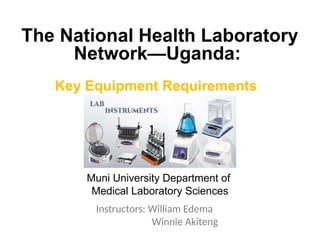
Key Equipment Requirements
Muni University Department of
Medical Laboratory Sciences
Instructors: William Edema
Winnie Akiteng
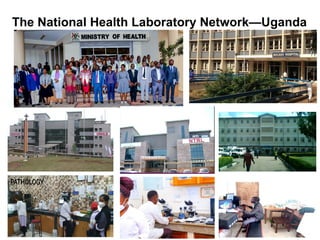
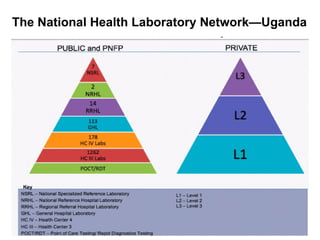
The National Health Laboratory Network—Uganda
Level specific considerations
 Health Centre III Laboratory
 The Health Center III is the lowest health facility level where a
formal laboratory services is offered, the laboratory facility at
this level has the basic facilities for laboratory diagnosis, a basic
biosafety requirements as detailed below:
 Basic Services: Routine tests:
Hb estimation, WBC count, Sickle cell screening, ESR,
ABO/Rh grouping;
Sputum for AFB, Gram staining, Wet prep;
Blood slides for haemoparasites, Urine chemistry and
microscopy, basic serology (HIV, Hepatitis B and C, Urine
HCG, Syphilis, TB LAM, Cryptococcal antigen), RBS, EID POC,
CD4, CD8 count and ratios, stool analysis.
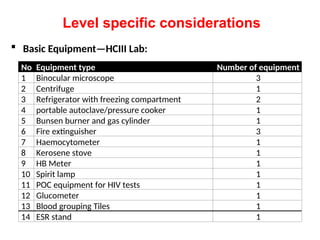
 Basic Equipment—HCIII Lab:
No Equipment type Number of equipment
1 Binocular microscope 3
2 Centrifuge 1
3 Refrigerator with freezing compartment 2
4 portable autoclave/pressure cooker 1
5 Bunsen burner and gas cylinder 1
6 Fire extinguisher 3
7 Haemocytometer 1
8 Kerosene stove 1
9 HB Meter 1
10 Spirit lamp 1
11 POC equipment for HIV tests 1
12 Glucometer 1
13 Blood grouping Tiles 1
14 ESR stand 1
Level specific considerations
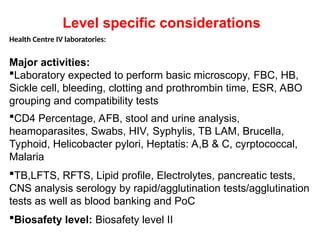
Health Centre IV laboratories:
Major activities:
Laboratory expected to perform basic microscopy, FBC, HB,
Sickle cell, bleeding, clotting and prothrombin time, ESR, ABO
grouping and compatibility tests
CD4 Percentage, AFB, stool and urine analysis,
heamoparasites, Swabs, HIV, Syphylis, TB LAM, Brucella,
Typhoid, Helicobacter pylori, Heptatis: A,B & C, cyrptococcal,
Malaria
TB,LFTS, RFTS, Lipid profile, Electrolytes, pancreatic tests,
CNS analysis serology by rapid/agglutination tests/agglutination
tests as well as blood banking and PoC
Biosafety level: Biosafety level II
Level specific considerations
Sketch of Proposed Laboratory Design for Health Centre IV
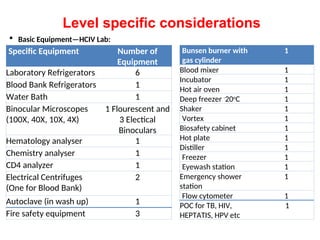
 Basic Equipment—HCIV Lab:
Specific Equipment Number of
Equipment
Laboratory Refrigerators 6
Blood Bank Refrigerators 1
Water Bath 1
Binocular Microscopes
(100X, 40X, 10X, 4X)
1 Flourescent and
3 Electical
Binoculars
Hematology analyser 1
Chemistry analyser 1
CD4 analyzer 1
Electrical Centrifuges
(One for Blood Bank)
2
Autoclave (in wash up) 1
Fire safety equipment 3
Bunsen burner with
gas cylinder
1
Blood mixer 1
Incubator 1
Hot air oven 1
Deep freezer -
20o
C 1
Shaker 1
Vortex 1
Biosafety cabinet 1
Hot plate 1
Distiller 1
Freezer 1
Eyewash station 1
Emergency shower
station
1
Flow cytometer 1
POC for TB, HIV,
HEPTATIS, HPV etc
1
Level specific considerations
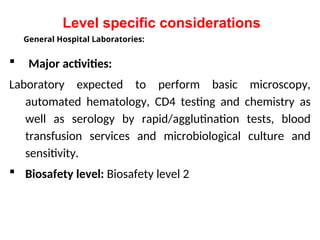
General Hospital Laboratories:
 Major activities:
Laboratory expected to perform basic microscopy,
automated hematology, CD4 testing and chemistry as
well as serology by rapid/agglutination tests, blood
transfusion services and microbiological culture and
sensitivity.
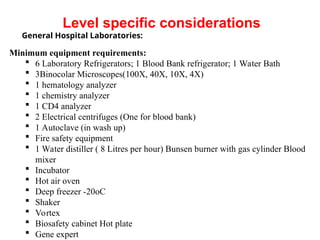
 Biosafety level: Biosafety level 2
Level specific considerations
General Hospital Laboratories:
Minimum equipment requirements:
 6 Laboratory Refrigerators; 1 Blood Bank refrigerator; 1 Water Bath
 3Binocolar Microscopes(100X, 40X, 10X, 4X)
 1 hematology analyzer
 1 chemistry analyzer
 1 CD4 analyzer
 2 Electrical centrifuges (One for blood bank)
 1 Autoclave (in wash up)
 Fire safety equipment
 1 Water distiller ( 8 Litres per hour) Bunsen burner with gas cylinder Blood
mixer
 Incubator
 Hot air oven
 Deep freezer -20oC
 Shaker
 Vortex
 Biosafety cabinet Hot plate
 Gene expert
Level specific considerations
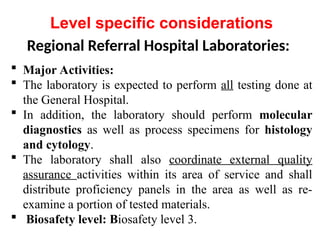
Regional Referral Hospital Laboratories:
 Major Activities:
 The laboratory is expected to perform all testing done at
the General Hospital.
 In addition, the laboratory should perform molecular
diagnostics as well as process specimens for histology
and cytology.
 The laboratory shall also coordinate external quality
assurance activities within its area of service and shall
distribute proficiency panels in the area as well as re-
examine a portion of tested materials.
 Biosafety level: Biosafety level 3.
Level specific considerations
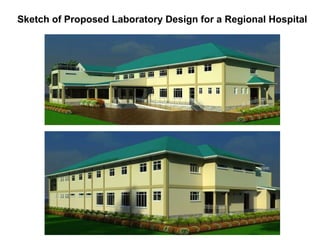
Sketch of Proposed Laboratory Design for a Regional Hospital
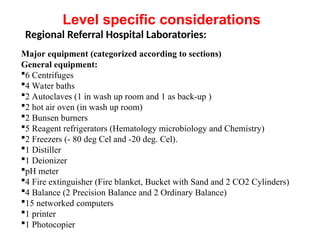
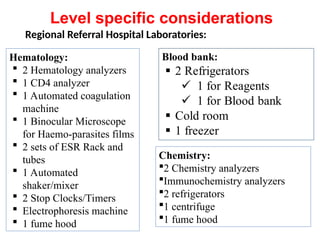
Regional Referral Hospital Laboratories:
Major equipment (categorized according to sections)
General equipment:
6 Centrifuges
4 Water baths
2 Autoclaves (1 in wash up room and 1 as back-up )
2 hot air oven (in wash up room)
2 Bunsen burners
5 Reagent refrigerators (Hematology microbiology and Chemistry)
2 Freezers (- 80 deg Cel and -20 deg. Cel).
1 Distiller
1 Deionizer
pH meter
4 Fire extinguisher (Fire blanket, Bucket with Sand and 2 CO2 Cylinders)
4 Balance (2 Precision Balance and 2 Ordinary Balance)
15 networked computers
1 printer
1 Photocopier
Level specific considerations
Regional Referral Hospital Laboratories:
Hematology:
 2 Hematology analyzers
 1 CD4 analyzer
 1 Automated coagulation
machine
 1 Binocular Microscope
for Haemo-parasites films
 2 sets of ESR Rack and
tubes
 1 Automated
shaker/mixer
 2 Stop Clocks/Timers
 Electrophoresis machine
 1 fume hood
Chemistry:
2 Chemistry analyzers
Immunochemistry analyzers
2 refrigerators
1 centrifuge
1 fume hood
Level specific considerations
Regional Referral Hospital Laboratories:
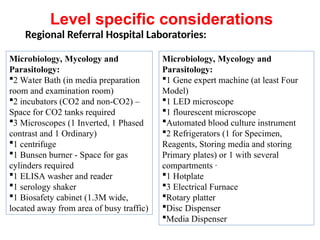
Microbiology, Mycology and
Parasitology:
2 Water Bath (in media preparation
room and examination room)
2 incubators (CO2 and non-CO2) –
Space for CO2 tanks required
3 Microscopes (1 Inverted, 1 Phased
contrast and 1 Ordinary)
1 centrifuge
1 Bunsen burner - Space for gas
cylinders required
1 ELISA washer and reader
1 serology shaker
1 Biosafety cabinet (1.3M wide,
located away from area of busy traffic)
Microbiology, Mycology and
Parasitology:
1 Gene expert machine (at least Four
Model)
1 LED microscope
1 flourescent microscope
Automated blood culture instrument
2 Refrigerators (1 for Specimen,
Reagents, Storing media and storing
Primary plates) or 1 with several
compartments ·
1 Hotplate
3 Electrical Furnace
Rotary platter
Disc Dispenser
Media Dispenser
Level specific considerations
Regional Referral Hospital Laboratories:
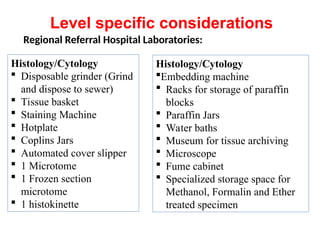
Histology/Cytology
 Disposable grinder (Grind
and dispose to sewer)
 Tissue basket
 Staining Machine
 Hotplate
 Coplins Jars
 Automated cover slipper
 1 Microtome
 1 Frozen section
microtome
 1 histokinette
Histology/Cytology
Embedding machine
 Racks for storage of paraffin
blocks
 Paraffin Jars
 Water baths
 Museum for tissue archiving
 Microscope
 Fume cabinet
 Specialized storage space for
Methanol, Formalin and Ether
treated specimen
Level specific considerations
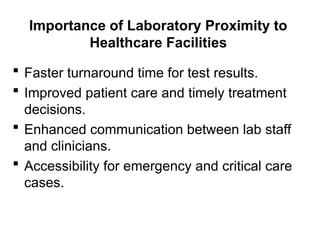
Importance of Laboratory Proximity to
Healthcare Facilities
 Faster turnaround time for test results.
 Improved patient care and timely treatment
decisions.
 Enhanced communication between lab staff
and clinicians.
 Accessibility for emergency and critical care
cases.
Test Specialization in Medical Laboratories
 Clinical chemistry
 Clinical microbiology
 Hematology
 Blood banking and serology
 Histopathology and cytopathology
 Molecular biology
 Public health testing (water analysis, environmental
toxins)
 Endocrinology
 Fertility, nutrition, fitness, and wellness testing
Laboratory Equipment
Management
Introduction
 Many factors need to be considered when
selecting, and subsequently utilising,
laboratory equipment;
 Initial Selection Assessment
 Budgeting
 Installation & Training
 Laboratory Evaluation
 Documentation
 Maintenance & Servicing
 Trouble-shooting
Biomedical Instruments
 Instruments and equipment are essential for the
functioning of any medical laboratory.
There should be no confusion with these two terms-
equipment and instruments.
All instruments are equipment but all equipment is not
instruments.
 Laboratory equipment refers to various tools used by a
laboratory worker in a laboratory.
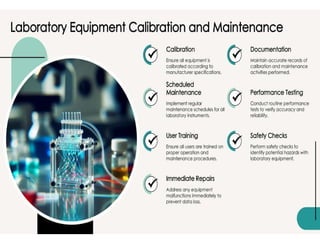
 Laboratory equipment is generally used either to perform
an experiment or to take measurement and gather data.
Biomedical Instruments
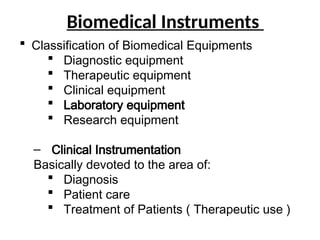
 Classification of Biomedical Equipments
 Diagnostic equipment
 Therapeutic equipment
 Clinical equipment
 Laboratory equipment
 Research equipment
– Clinical Instrumentation
Basically devoted to the area of:
 Diagnosis
 Patient care
 Treatment of Patients ( Therapeutic use )
Biomedical Instruments
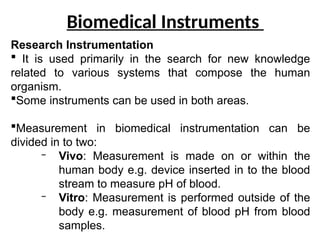
Research Instrumentation
 It is used primarily in the search for new knowledge
related to various systems that compose the human
organism.
Some instruments can be used in both areas.
Measurement in biomedical instrumentation can be
divided in to two:
– Vivo: Measurement is made on or within the
human body e.g. device inserted in to the blood
stream to measure pH of blood.
– Vitro: Measurement is performed outside of the
body e.g. measurement of blood pH from blood
samples.
Biomedical Instruments
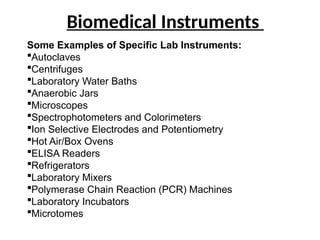
Some Examples of Specific Lab Instruments:
Autoclaves
Centrifuges
Laboratory Water Baths
Anaerobic Jars
Microscopes
Spectrophotometers and Colorimeters
Ion Selective Electrodes and Potentiometry
Hot Air/Box Ovens
ELISA Readers
Refrigerators
Laboratory Mixers
Polymerase Chain Reaction (PCR) Machines
Laboratory Incubators
Microtomes
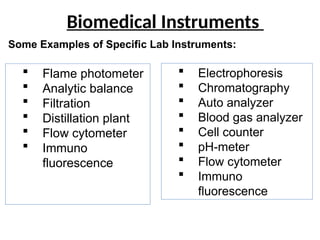
Biomedical Instruments
 Flame photometer
 Analytic balance
 Filtration
 Distillation plant
 Flow cytometer
 Immuno
fluorescence
 Electrophoresis
 Chromatography
 Auto analyzer
 Blood gas analyzer
 Cell counter
 pH-meter
 Flow cytometer
 Immuno
fluorescence
Some Examples of Specific Lab Instruments:
Instrument Selection
• Laboratory instruments have become
increasingly complex.
• Selecting the correct system for your
needs requires a detailed programme of
assessment and evaluation.
Initial Selection Assessment
 Laboratory instruments have become
increasingly complex.
 Selecting the correct system for your needs
requires a detailed assessment and
evaluation.
Range in cost, complexity & function.
Extremely important to select the
CORRECT instrument for your needs
Initial Selection Assessment
Selection considerations;
 Throughput (sample capacity)
 Range of applications
 Versatility; able to use different sources
of reagents or spares
 Sample volume
 Sample preparation
 QC and calibration requirements
 Level of technical skill required
Initial Selection Assessment
Selection considerations….;
 Power and other service requirements
 Environmental requirements: Temp &
humidity
 Adequate space available, remember
ventilation
 Running costs; reagents, spares,
maintenance & service, power
consumption.
 Reliability & reputation
Initial Selection Assessment
Selection considerations...;
 What level & quality of support/ backup
is available for;
o Training
o Technical advice
o Service & Preventative Maintenance
o Rapid call out
o Reliable supply of reagents & spares
Budgeting
• Very important to consider TOTAL costs
when budgeting for a new instrument;
• Instrument:
• Outright purchase vs Rental
• Delivery & installation
• Running costs;
• Service contract & emergency call-out
• Reagents, consumables & spares
• Controls & calibrators
• Services – electricity, water, gases
• Staffing requirements
• Backup system – purchase & running costs?
Installation
 Wherever possible a new instrument
should be installed and commissioned
by the supplier.
 If the customer is to install, detailed
information must be supplied by the
manufacturer, including;
Installation
 Installation considerations;
 Procedures for unpacking the instrument
 Detailed component list
 Instructions on what to do if the
instrument is damaged - insurance?
 Specifications of service requirements;
Voltage and power backup (UPS?)
Water pressure & purity
Gas supply
Drainage
H&S requirements - PPE
Installation
 Installation considerations (cont’d);
• Specifications for physical environment;
Temperature tolerances
Humidity
Dust
Vibration
load bearing
Light, direct sun
Space & ventilation
Training
 Detailed training and instruction should be
provided by a competent manufacturer’s
representative, particularly in the case of major
equipment.
 It is crucial that all operators are fully trained in
all stages of the instruments operation including;
Start-up & shut-down procedures
Cleaning & maintenance
Sample preparation & handling
QC & calibration procedures
Trouble shooting
Data acquisition and storage
Laboratory Evaluation
 Before an instrument is placed into routine
operation, a period of observation and
staff familiarisation must be provided.
 This will help identify any inherent defects
in the machine and allow staff to fully
understand its capabilities and restrictions.
Laboratory Evaluation
 For analytical instruments, a full performance
evaluation must be undertaken before
patient/study samples can be analysed and
the data utilised. This should include;
 Detailed instrument & assay validation
 Establish IQC procedures and determine
control limits for all methods.
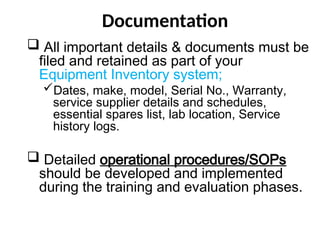
Documentation
 All important details & documents must be
filed and retained as part of your
Equipment Inventory system;
Dates, make, model, Serial No., Warranty,
service supplier details and schedules,
essential spares list, lab location, Service
history logs.
 Detailed operational procedures/SOPs
should be developed and implemented
during the training and evaluation phases.
Develop a Maintenance Plan
 Routine Maintenance: Develop and document a
detailed schedule of routine maintenance
according to manufacturers instruction.
 Scheduled Maintenance: includes service repair
by manufacturer, calibration,
 Function check plus any other problems
 Trouble Shooting:
Occurrence Logs; details of all problems
encountered and steps taken to rectify the
incident – Corrective Actions –
DOCUMENT.!
Preventive Maintenance
 Routine cleaning
 Adjustments
 Replacement of equipment parts
Instrument / Assay Backup
 Must ensure comparability of results with an
equal level of IQC in place.
11/02/25 41
Equipment Inventory
Record:
 Instrument type, model number,
serial number.
 Location in laboratory.
 Date purchased.
 Manufacturer and
 Vendor contact information.
 Warranty,
 Note expiration date
 Spare parts
11/02/25 42
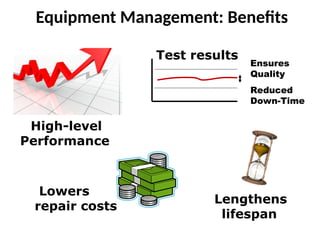
Equipment Management: Benefits
High-level
Performance
Test results
Ensures
Quality
Reduced
Down-Time
Lowers
repair costs
Lengthens
lifespan

The Uganda Lab Network & Lab Management.ppt

  • 1.
    The National HealthLaboratory Network—Uganda: Key Equipment Requirements Muni University Department of Medical Laboratory Sciences Instructors: William Edema Winnie Akiteng
  • 2.
    The National HealthLaboratory Network—Uganda
  • 3.
    The National HealthLaboratory Network—Uganda
  • 4.
    Level specific considerations Health Centre III Laboratory  The Health Center III is the lowest health facility level where a formal laboratory services is offered, the laboratory facility at this level has the basic facilities for laboratory diagnosis, a basic biosafety requirements as detailed below:  Basic Services: Routine tests: Hb estimation, WBC count, Sickle cell screening, ESR, ABO/Rh grouping; Sputum for AFB, Gram staining, Wet prep; Blood slides for haemoparasites, Urine chemistry and microscopy, basic serology (HIV, Hepatitis B and C, Urine HCG, Syphilis, TB LAM, Cryptococcal antigen), RBS, EID POC, CD4, CD8 count and ratios, stool analysis.
  • 5.
     Basic Equipment—HCIIILab: No Equipment type Number of equipment 1 Binocular microscope 3 2 Centrifuge 1 3 Refrigerator with freezing compartment 2 4 portable autoclave/pressure cooker 1 5 Bunsen burner and gas cylinder 1 6 Fire extinguisher 3 7 Haemocytometer 1 8 Kerosene stove 1 9 HB Meter 1 10 Spirit lamp 1 11 POC equipment for HIV tests 1 12 Glucometer 1 13 Blood grouping Tiles 1 14 ESR stand 1 Level specific considerations
  • 6.
    Health Centre IVlaboratories: Major activities: Laboratory expected to perform basic microscopy, FBC, HB, Sickle cell, bleeding, clotting and prothrombin time, ESR, ABO grouping and compatibility tests CD4 Percentage, AFB, stool and urine analysis, heamoparasites, Swabs, HIV, Syphylis, TB LAM, Brucella, Typhoid, Helicobacter pylori, Heptatis: A,B & C, cyrptococcal, Malaria TB,LFTS, RFTS, Lipid profile, Electrolytes, pancreatic tests, CNS analysis serology by rapid/agglutination tests/agglutination tests as well as blood banking and PoC Biosafety level: Biosafety level II Level specific considerations
  • 7.
    Sketch of ProposedLaboratory Design for Health Centre IV
  • 8.
     Basic Equipment—HCIVLab: Specific Equipment Number of Equipment Laboratory Refrigerators 6 Blood Bank Refrigerators 1 Water Bath 1 Binocular Microscopes (100X, 40X, 10X, 4X) 1 Flourescent and 3 Electical Binoculars Hematology analyser 1 Chemistry analyser 1 CD4 analyzer 1 Electrical Centrifuges (One for Blood Bank) 2 Autoclave (in wash up) 1 Fire safety equipment 3 Bunsen burner with gas cylinder 1 Blood mixer 1 Incubator 1 Hot air oven 1 Deep freezer - 20o C 1 Shaker 1 Vortex 1 Biosafety cabinet 1 Hot plate 1 Distiller 1 Freezer 1 Eyewash station 1 Emergency shower station 1 Flow cytometer 1 POC for TB, HIV, HEPTATIS, HPV etc 1 Level specific considerations
  • 9.
    General Hospital Laboratories: Major activities: Laboratory expected to perform basic microscopy, automated hematology, CD4 testing and chemistry as well as serology by rapid/agglutination tests, blood transfusion services and microbiological culture and sensitivity.  Biosafety level: Biosafety level 2 Level specific considerations
  • 10.
    General Hospital Laboratories: Minimumequipment requirements:  6 Laboratory Refrigerators; 1 Blood Bank refrigerator; 1 Water Bath  3Binocolar Microscopes(100X, 40X, 10X, 4X)  1 hematology analyzer  1 chemistry analyzer  1 CD4 analyzer  2 Electrical centrifuges (One for blood bank)  1 Autoclave (in wash up)  Fire safety equipment  1 Water distiller ( 8 Litres per hour) Bunsen burner with gas cylinder Blood mixer  Incubator  Hot air oven  Deep freezer -20oC  Shaker  Vortex  Biosafety cabinet Hot plate  Gene expert Level specific considerations
  • 11.
    Regional Referral HospitalLaboratories:  Major Activities:  The laboratory is expected to perform all testing done at the General Hospital.  In addition, the laboratory should perform molecular diagnostics as well as process specimens for histology and cytology.  The laboratory shall also coordinate external quality assurance activities within its area of service and shall distribute proficiency panels in the area as well as re- examine a portion of tested materials.  Biosafety level: Biosafety level 3. Level specific considerations
  • 12.
    Sketch of ProposedLaboratory Design for a Regional Hospital
  • 13.
    Regional Referral HospitalLaboratories: Major equipment (categorized according to sections) General equipment: 6 Centrifuges 4 Water baths 2 Autoclaves (1 in wash up room and 1 as back-up ) 2 hot air oven (in wash up room) 2 Bunsen burners 5 Reagent refrigerators (Hematology microbiology and Chemistry) 2 Freezers (- 80 deg Cel and -20 deg. Cel). 1 Distiller 1 Deionizer pH meter 4 Fire extinguisher (Fire blanket, Bucket with Sand and 2 CO2 Cylinders) 4 Balance (2 Precision Balance and 2 Ordinary Balance) 15 networked computers 1 printer 1 Photocopier Level specific considerations
  • 14.
    Regional Referral HospitalLaboratories: Hematology:  2 Hematology analyzers  1 CD4 analyzer  1 Automated coagulation machine  1 Binocular Microscope for Haemo-parasites films  2 sets of ESR Rack and tubes  1 Automated shaker/mixer  2 Stop Clocks/Timers  Electrophoresis machine  1 fume hood Chemistry: 2 Chemistry analyzers Immunochemistry analyzers 2 refrigerators 1 centrifuge 1 fume hood Level specific considerations
  • 15.
    Regional Referral HospitalLaboratories: Microbiology, Mycology and Parasitology: 2 Water Bath (in media preparation room and examination room) 2 incubators (CO2 and non-CO2) – Space for CO2 tanks required 3 Microscopes (1 Inverted, 1 Phased contrast and 1 Ordinary) 1 centrifuge 1 Bunsen burner - Space for gas cylinders required 1 ELISA washer and reader 1 serology shaker 1 Biosafety cabinet (1.3M wide, located away from area of busy traffic) Microbiology, Mycology and Parasitology: 1 Gene expert machine (at least Four Model) 1 LED microscope 1 flourescent microscope Automated blood culture instrument 2 Refrigerators (1 for Specimen, Reagents, Storing media and storing Primary plates) or 1 with several compartments · 1 Hotplate 3 Electrical Furnace Rotary platter Disc Dispenser Media Dispenser Level specific considerations
  • 16.
    Regional Referral HospitalLaboratories: Histology/Cytology  Disposable grinder (Grind and dispose to sewer)  Tissue basket  Staining Machine  Hotplate  Coplins Jars  Automated cover slipper  1 Microtome  1 Frozen section microtome  1 histokinette Histology/Cytology Embedding machine  Racks for storage of paraffin blocks  Paraffin Jars  Water baths  Museum for tissue archiving  Microscope  Fume cabinet  Specialized storage space for Methanol, Formalin and Ether treated specimen Level specific considerations
  • 17.
    Importance of LaboratoryProximity to Healthcare Facilities  Faster turnaround time for test results.  Improved patient care and timely treatment decisions.  Enhanced communication between lab staff and clinicians.  Accessibility for emergency and critical care cases.
  • 18.
    Test Specialization inMedical Laboratories  Clinical chemistry  Clinical microbiology  Hematology  Blood banking and serology  Histopathology and cytopathology  Molecular biology  Public health testing (water analysis, environmental toxins)  Endocrinology  Fertility, nutrition, fitness, and wellness testing
  • 19.
  • 20.
    Introduction  Many factorsneed to be considered when selecting, and subsequently utilising, laboratory equipment;  Initial Selection Assessment  Budgeting  Installation & Training  Laboratory Evaluation  Documentation  Maintenance & Servicing  Trouble-shooting
  • 21.
    Biomedical Instruments  Instrumentsand equipment are essential for the functioning of any medical laboratory. There should be no confusion with these two terms- equipment and instruments. All instruments are equipment but all equipment is not instruments.  Laboratory equipment refers to various tools used by a laboratory worker in a laboratory.  Laboratory equipment is generally used either to perform an experiment or to take measurement and gather data.
  • 22.
    Biomedical Instruments  Classificationof Biomedical Equipments  Diagnostic equipment  Therapeutic equipment  Clinical equipment  Laboratory equipment  Research equipment – Clinical Instrumentation Basically devoted to the area of:  Diagnosis  Patient care  Treatment of Patients ( Therapeutic use )
  • 23.
    Biomedical Instruments Research Instrumentation It is used primarily in the search for new knowledge related to various systems that compose the human organism. Some instruments can be used in both areas. Measurement in biomedical instrumentation can be divided in to two: – Vivo: Measurement is made on or within the human body e.g. device inserted in to the blood stream to measure pH of blood. – Vitro: Measurement is performed outside of the body e.g. measurement of blood pH from blood samples.
  • 24.
    Biomedical Instruments Some Examplesof Specific Lab Instruments: Autoclaves Centrifuges Laboratory Water Baths Anaerobic Jars Microscopes Spectrophotometers and Colorimeters Ion Selective Electrodes and Potentiometry Hot Air/Box Ovens ELISA Readers Refrigerators Laboratory Mixers Polymerase Chain Reaction (PCR) Machines Laboratory Incubators Microtomes
  • 25.
    Biomedical Instruments  Flamephotometer  Analytic balance  Filtration  Distillation plant  Flow cytometer  Immuno fluorescence  Electrophoresis  Chromatography  Auto analyzer  Blood gas analyzer  Cell counter  pH-meter  Flow cytometer  Immuno fluorescence Some Examples of Specific Lab Instruments:
  • 26.
    Instrument Selection • Laboratoryinstruments have become increasingly complex. • Selecting the correct system for your needs requires a detailed programme of assessment and evaluation.
  • 27.
    Initial Selection Assessment Laboratory instruments have become increasingly complex.  Selecting the correct system for your needs requires a detailed assessment and evaluation. Range in cost, complexity & function. Extremely important to select the CORRECT instrument for your needs
  • 28.
    Initial Selection Assessment Selectionconsiderations;  Throughput (sample capacity)  Range of applications  Versatility; able to use different sources of reagents or spares  Sample volume  Sample preparation  QC and calibration requirements  Level of technical skill required
  • 29.
    Initial Selection Assessment Selectionconsiderations….;  Power and other service requirements  Environmental requirements: Temp & humidity  Adequate space available, remember ventilation  Running costs; reagents, spares, maintenance & service, power consumption.  Reliability & reputation
  • 30.
    Initial Selection Assessment Selectionconsiderations...;  What level & quality of support/ backup is available for; o Training o Technical advice o Service & Preventative Maintenance o Rapid call out o Reliable supply of reagents & spares
  • 31.
    Budgeting • Very importantto consider TOTAL costs when budgeting for a new instrument; • Instrument: • Outright purchase vs Rental • Delivery & installation • Running costs; • Service contract & emergency call-out • Reagents, consumables & spares • Controls & calibrators • Services – electricity, water, gases • Staffing requirements • Backup system – purchase & running costs?
  • 32.
    Installation  Wherever possiblea new instrument should be installed and commissioned by the supplier.  If the customer is to install, detailed information must be supplied by the manufacturer, including;
  • 33.
    Installation  Installation considerations; Procedures for unpacking the instrument  Detailed component list  Instructions on what to do if the instrument is damaged - insurance?  Specifications of service requirements; Voltage and power backup (UPS?) Water pressure & purity Gas supply Drainage H&S requirements - PPE
  • 34.
    Installation  Installation considerations(cont’d); • Specifications for physical environment; Temperature tolerances Humidity Dust Vibration load bearing Light, direct sun Space & ventilation
  • 35.
    Training  Detailed trainingand instruction should be provided by a competent manufacturer’s representative, particularly in the case of major equipment.  It is crucial that all operators are fully trained in all stages of the instruments operation including; Start-up & shut-down procedures Cleaning & maintenance Sample preparation & handling QC & calibration procedures Trouble shooting Data acquisition and storage
  • 36.
    Laboratory Evaluation  Beforean instrument is placed into routine operation, a period of observation and staff familiarisation must be provided.  This will help identify any inherent defects in the machine and allow staff to fully understand its capabilities and restrictions.
  • 37.
    Laboratory Evaluation  Foranalytical instruments, a full performance evaluation must be undertaken before patient/study samples can be analysed and the data utilised. This should include;  Detailed instrument & assay validation  Establish IQC procedures and determine control limits for all methods.
  • 39.
    Documentation  All importantdetails & documents must be filed and retained as part of your Equipment Inventory system; Dates, make, model, Serial No., Warranty, service supplier details and schedules, essential spares list, lab location, Service history logs.  Detailed operational procedures/SOPs should be developed and implemented during the training and evaluation phases.
  • 40.
    Develop a MaintenancePlan  Routine Maintenance: Develop and document a detailed schedule of routine maintenance according to manufacturers instruction.  Scheduled Maintenance: includes service repair by manufacturer, calibration,  Function check plus any other problems  Trouble Shooting: Occurrence Logs; details of all problems encountered and steps taken to rectify the incident – Corrective Actions – DOCUMENT.!
  • 41.
    Preventive Maintenance  Routinecleaning  Adjustments  Replacement of equipment parts Instrument / Assay Backup  Must ensure comparability of results with an equal level of IQC in place. 11/02/25 41
  • 42.
    Equipment Inventory Record:  Instrumenttype, model number, serial number.  Location in laboratory.  Date purchased.  Manufacturer and  Vendor contact information.  Warranty,  Note expiration date  Spare parts 11/02/25 42
  • 43.
    Equipment Management: Benefits High-level Performance Testresults Ensures Quality Reduced Down-Time Lowers repair costs Lengthens lifespan

Editor's Notes

  • #19  Proper management of the equipment in the laboratory is necessary to ensure accurate, reliable, and timely testing. It is the responsibility of the laboratory management to: oversee all the equipment management systems in the laboratory; ensure that all persons who will be using the instruments have been appropriately trained and understand how to both properly operate the instrument and perform all necessary routine maintenance procedures. Oversight of an equipment management program includes: assigning responsibilities for all activities; assuring that all personnel are trained on operation and maintenance; monitoring the equipment management activities: review all equipment records routinely; update maintenance procedures as necessary; ensure that all procedures are followed.
  • #20  Proper management of the equipment in the laboratory is necessary to ensure accurate, reliable, and timely testing. It is the responsibility of the laboratory management to: oversee all the equipment management systems in the laboratory; ensure that all persons who will be using the instruments have been appropriately trained and understand how to both properly operate the instrument and perform all necessary routine maintenance procedures. Oversight of an equipment management program includes: assigning responsibilities for all activities; assuring that all personnel are trained on operation and maintenance; monitoring the equipment management activities: review all equipment records routinely; update maintenance procedures as necessary; ensure that all procedures are followed.
  • #21  Proper management of the equipment in the laboratory is necessary to ensure accurate, reliable, and timely testing. It is the responsibility of the laboratory management to: oversee all the equipment management systems in the laboratory; ensure that all persons who will be using the instruments have been appropriately trained and understand how to both properly operate the instrument and perform all necessary routine maintenance procedures. Oversight of an equipment management program includes: assigning responsibilities for all activities; assuring that all personnel are trained on operation and maintenance; monitoring the equipment management activities: review all equipment records routinely; update maintenance procedures as necessary; ensure that all procedures are followed.
  • #22  Proper management of the equipment in the laboratory is necessary to ensure accurate, reliable, and timely testing. It is the responsibility of the laboratory management to: oversee all the equipment management systems in the laboratory; ensure that all persons who will be using the instruments have been appropriately trained and understand how to both properly operate the instrument and perform all necessary routine maintenance procedures. Oversight of an equipment management program includes: assigning responsibilities for all activities; assuring that all personnel are trained on operation and maintenance; monitoring the equipment management activities: review all equipment records routinely; update maintenance procedures as necessary; ensure that all procedures are followed.
  • #23  Proper management of the equipment in the laboratory is necessary to ensure accurate, reliable, and timely testing. It is the responsibility of the laboratory management to: oversee all the equipment management systems in the laboratory; ensure that all persons who will be using the instruments have been appropriately trained and understand how to both properly operate the instrument and perform all necessary routine maintenance procedures. Oversight of an equipment management program includes: assigning responsibilities for all activities; assuring that all personnel are trained on operation and maintenance; monitoring the equipment management activities: review all equipment records routinely; update maintenance procedures as necessary; ensure that all procedures are followed.
  • #24  Proper management of the equipment in the laboratory is necessary to ensure accurate, reliable, and timely testing. It is the responsibility of the laboratory management to: oversee all the equipment management systems in the laboratory; ensure that all persons who will be using the instruments have been appropriately trained and understand how to both properly operate the instrument and perform all necessary routine maintenance procedures. Oversight of an equipment management program includes: assigning responsibilities for all activities; assuring that all personnel are trained on operation and maintenance; monitoring the equipment management activities: review all equipment records routinely; update maintenance procedures as necessary; ensure that all procedures are followed.
  • #25  Proper management of the equipment in the laboratory is necessary to ensure accurate, reliable, and timely testing. It is the responsibility of the laboratory management to: oversee all the equipment management systems in the laboratory; ensure that all persons who will be using the instruments have been appropriately trained and understand how to both properly operate the instrument and perform all necessary routine maintenance procedures. Oversight of an equipment management program includes: assigning responsibilities for all activities; assuring that all personnel are trained on operation and maintenance; monitoring the equipment management activities: review all equipment records routinely; update maintenance procedures as necessary; ensure that all procedures are followed.
  • #26  As the laboratory puts an equipment management program in place the following elements should be considered: Selection and purchasing — When obtaining new equipment what criteria should be used to select equipment? Should equipment be purchased, or would it be better to lease? Installation — For new equipment, what are the installation requirements, and who will install the new instrument? Calibration and performance evaluation — What is needed to calibrate and validate that the equipment is operating correctly? How will these important procedures be conducted for both old and new instruments? Maintenance — What maintenance schedule is recommended by the manufacturer? Will the laboratory need additional preventive maintenance procedures? Are current maintenance procedures being conducted properly? Troubleshooting — Is there a clear procedure for troubleshooting for each instrument? Service and repair — What is the cost? Can the laboratory obtain the necessary service and repair in its geographical area? Retiring and disposing of equipment — What must be done to dispose of old equipment when it needs to be replaced?
  • #27 Before purchasing ask if: wiring diagrams, computer software information, a list of parts needed, and an operator’s manual are provided; the manufacturer will install the equipment and train staff (covering travel expenses as necessary) as part of the purchase price; the warranty includes a trial period to verify that the instrument performs as expected; the manufacturer’s maintenance can be included in the contract and if so, whether maintenance is provided on a regular basis.
  • #28 Determine if the laboratory can provide all the necessary physical requirements, such as electricity, water, and space. There must be adequate room to move the equipment into the laboratory; consider door openings and elevator access.
  • #29 Determine if the laboratory can provide all the necessary physical requirements, such as electricity, water, and space. There must be adequate room to move the equipment into the laboratory; consider door openings and elevator access.
  • #30 Determine if the laboratory can provide all the necessary physical requirements, such as electricity, water, and space. There must be adequate room to move the equipment into the laboratory; consider door openings and elevator access.
  • #32  Before equipment is installed, verify that all physical requirements (electrical, space, doors, ventilation, and water supply) have been met. Other things to consider are: The vendor’s responsibilities for installation should be confirmed in writing prior to beginning the installation process. A checklist of the expected performance specifications should be developed, so that performance can be quickly verified as soon as the equipment is installed. Whenever possible, it is best to have the manufacturer install laboratory equipment; this will likely improve the conditions of the warranty, and also may ensure that the installation is done properly and quickly.
  • #33 If equipment is installed by the laboratory: check that the package contents contain all of the parts; make a copy of any software that is part of the system; do not allow the equipment to be used before it is completely installed, performance is verified, and testing personnel are trained.
  • #35 Post – Installation: After equipment has been installed, the following details need to be addressed before putting the equipment into service: assign responsibility for performing the maintenance and operation programs; develop a system for recording the use of parts and supplies; implement a written plan for calibration, performance verification, and proper operation of the equipment; establish a scheduled maintenance program that includes daily, weekly, and monthly maintenance tasks; provide training for all operators; only personnel who have been trained specifically to properly use the equipment should be authorized as operators.
  • #36 Equipment Performance evaluation: Prior to testing patient specimens, it is important to evaluate the performance of new equipment to ensure it is working correctly with respect to accuracy and precision. In addition, test methods using kits or laboratory instruments need to be evaluated for the ability to detect disease (sensitivity, specificity, positive and negative predictive value), and to determine normal and reportable ranges.
  • #37 Verification of manufacturers’ performance claims: Manufacturers provide performance evaluations for testing methods using their kits or instruments, and include the information in the package inserts or operators’ manuals. However, laboratories need to verify the manufacturers’ performance claims, and demonstrate they can get the same results using the kits or equipment in their laboratory, with their personnel.   Some of the steps that should be followed to verify performance include: testing samples with known values and comparing the results to the expected or certified value; if equipment is temperature-controlled, establishing the stability and uniformity of the temperature.
  • #39 As a follow-up step, the laboratory director or designee must consistently review, sign, and date all documentation at least monthly to establish an audit trail. The laboratory should establish tolerance limits for equipment temperatures and other monitored conditions (e.g., %CO2, liquid nitrogen levels) that are consistent with manufacturers’ guidelines and procedural activities because certain reagents and equipment perform optimally under specific conditions. The laboratory must document all scheduled preventive maintenance, unscheduled maintenance, service records, and calibrations for all equipment utilized. This documentation should be readily accessible to operators. The lab should also maintain daily (or “dates of use”) record of temperatures and other monitored conditions (e.g. humidity). For observations that fall outside of designated tolerance ranges, the laboratory must maintain appropriate documentation of corrective action for these out-of-range temperatures and other conditions.
  • #40 Equipment Maintenance Plan: A maintenance plan will include preventive maintenance procedures as well as provision for inventory, troubleshooting, and repair of equipment. When implementing an equipment maintenance program, some of the initial steps will include what follows. Assign responsibility for providing oversight. Develop written policies and procedures for maintaining equipment, including routine maintenance plans for each piece of equipment. The plan should specify the frequency with which all maintenance tasks should be performed. Develop the format for records, create logs and forms, and establish the processes to maintain records. Train staff on the use and maintenance of the equipment, and assure that all staff understand their specific responsibilities.  
  • #41 Laboratory staff must conduct preventive maintenance and service per manufacturer specifications by following documented daily, weekly, and/or monthly routine maintenance plans for all equipment utilized to ensure that all equipment performs consistently and reproducibly during the conduct of the trial. Preventive maintenance includes measures such as systematic and routine cleaning, adjustment, and replacement of equipment parts at scheduled intervals. Manufacturers generally recommend a set of equipment maintenance tasks that should be performed at regular intervals: daily, weekly, monthly, or yearly
  • #42 The laboratory should keep an inventory log of all equipment in the laboratory. The log should be updated with information on new equipment, as it is added, and include documentation of when old equipment is retired. For each piece of equipment, the equipment inventory log should have a record of: instrument type, make and model number, and serial number of the instrument, so that any problems can be discussed with the manufacturer; date the equipment was purchased, and whether it was purchased new, used, or reconditioned; manufacturer/vendor contact information; presence or absence of documentation, spare parts, and maintenance contract; warranty’s expiration date;