PRESENTATION ON
OR, AND, NOT GATES
Created by
MD. NAZMUS SAQIB KHAN
ID 12075768
Contents
 FIRST SEGMENT
 INTRODUCTION TO LOGIC GATES
 BASIC GATES
 SECOND SEGMENT
 SOME OTHER GATES
 THIRD SEGMENT
 COMBINATIONS OF GATES
 EXAMPLES OF GATES
 REAL WORLD PROBLEM
INTRODUCTION TO LOGIC
GATES
Boolean algebra is used to model the circuitry of
electronic devices. Each input and each output of
such a device can be thought as a member of the set
{0,1}. A computer, or other electronic device, is
made up of a number of circuits. Each circuit can be
designed using the rules of Boolean algebra. The
basic elements of circuits are called gates. Each
type of gate implements a Boolean operation.
BASIC GATES
 OR GATE
 AND GATE
 NOT GATE
OR GATE
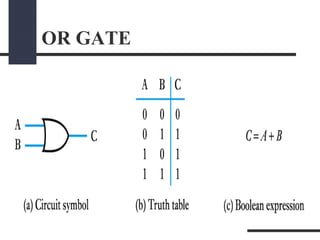
OR GATE: An OR gate is a circuit that has two
inputs and one output. The output voltage of an OR
gate is high(or 1) if either one or both of the input
voltages is high(1), and the output voltage is low(or
0) if both of the input voltages are low(0). Clearly,
the output signal of an OR gate corresponds to a
proposition which is the disjunction of the
propositions corresponding to the input signals. In
other words, the output of this gate is the Boolean
sum of the inputted variables. This is shown in the
following figure.
OR GATE
AND GATE
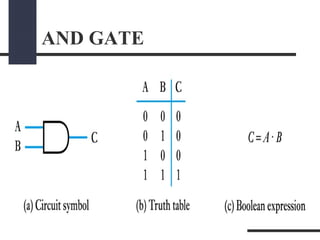
AND GATE: An AND gate is a circuit that has two
inputs and one output. The output voltage of an AND
gate is high(1) if both of the input voltages are high(1),
and the output voltage is low(0) if either one or both of
the input voltages is low(0). Clearly, the output signal
of an AND gate corresponds to a proposition which is
the conjunction of the propositions corresponding to
the input signals. In other words, the output of this gate
is the Boolean product of the inputted variables. This is
shown in the following figure.
AND GATE
NOT GATE
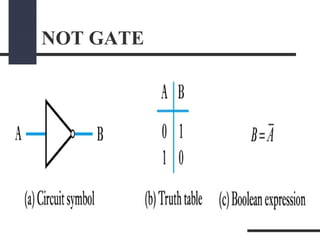
NOT GATE: A NOT gate, or an inverter, is a circuit
that has one input and one output. Its output voltage is
high(1) if the input voltage is low(0), and the output
voltage is low(0) if the input voltage is high(1). The
output signal of a NOT gate corresponds to a
proposition which is the negation of the proposition
corresponding to the input signal. In other words, the
output of this gate is the Boolean complement of the
inputted variable. This is shown in the following
figure.
NOT GATE
ANY QUESTIONS
IN THIS
SECTION??
SOME OTHER GATES
NAND Gate
NOR Gate
XOR Gate
XNOR Gate
NAND Gate
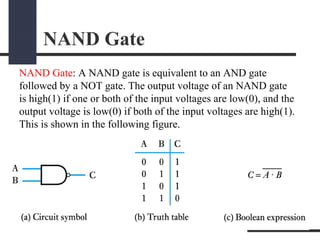
NAND Gate: A NAND gate is equivalent to an AND gate
followed by a NOT gate. The output voltage of an NAND gate
is high(1) if one or both of the input voltages are low(0), and the
output voltage is low(0) if both of the input voltages are high(1).
This is shown in the following figure.
NOR Gate
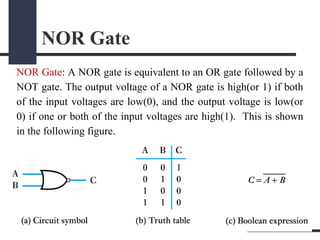
NOR Gate: A NOR gate is equivalent to an OR gate followed by a
NOT gate. The output voltage of a NOR gate is high(or 1) if both
of the input voltages are low(0), and the output voltage is low(or
0) if one or both of the input voltages are high(1). This is shown
in the following figure.
XOR Gate
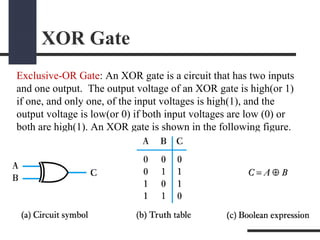
Exclusive-OR Gate: An XOR gate is a circuit that has two inputs
and one output. The output voltage of an XOR gate is high(or 1)
if one, and only one, of the input voltages is high(1), and the
output voltage is low(or 0) if both input voltages are low (0) or
both are high(1). An XOR gate is shown in the following figure.
XNOR Gate
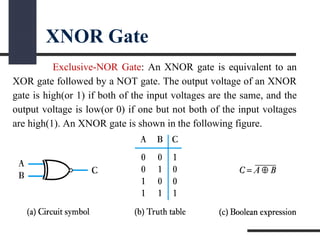
Exclusive-NOR Gate: An XNOR gate is equivalent to an
XOR gate followed by a NOT gate. The output voltage of an XNOR
gate is high(or 1) if both of the input voltages are the same, and the
output voltage is low(or 0) if one but not both of the input voltages
are high(1). An XNOR gate is shown in the following figure.
ANY QUESTIONS
IN THIS
SECTION??
COMBINATIONS OF GATES
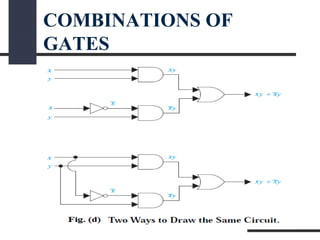
Combinations of Gates:
Combinational circuits can be constructed using a combination
of inverters, OR gates, and AND gates. When combinations of
circuits are formed, some gates may share inputs. This is shown
in one of two ways in depiction of circuits. One method is to use
branchings that indicate all the gates that use a given input. The
other method is to indicate this input separately to each gate. Fig.
(d) illustrates the two ways of showing gates with the same input
values. Note also that output from a gate may be used as input by
one or more other elements, as shown in Fig.(d). Both drawings
in Fig.(d) depict the circuit that produces the output
COMBINATIONS OF
GATES
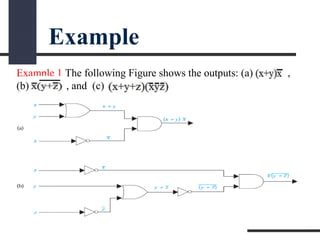
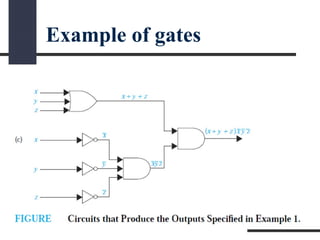
Example
Example 1 The following Figure shows the outputs: (a) ,
(b) , and (c)
Example of gates
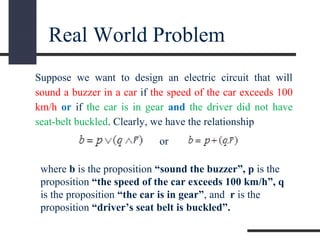
Real World Problem
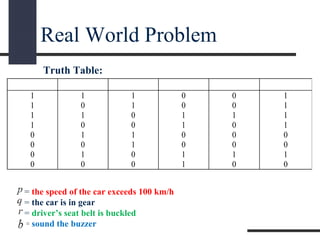
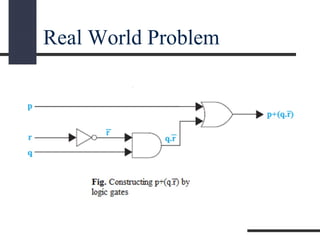
Suppose we want to design an electric circuit that will
sound a buzzer in a car if the speed of the car exceeds 100
km/h or if the car is in gear and the driver did not have
seat-belt buckled. Clearly, we have the relationship
or
where b is the proposition “sound the buzzer”, p is the
proposition “the speed of the car exceeds 100 km/h”, q
is the proposition “the car is in gear”, and r is the
proposition “driver’s seat belt is buckled”.
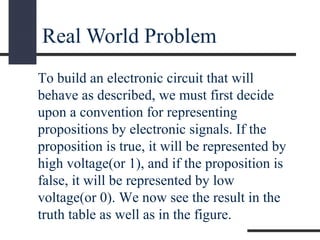
To build an electronic circuit that will
behave as described, we must first decide
upon a convention for representing
propositions by electronic signals. If the
proposition is true, it will be represented by
high voltage(or 1), and if the proposition is
false, it will be represented by low
voltage(or 0). We now see the result in the
truth table as well as in the figure.
Real World Problem
Truth Table:
1
1
1
1
0
0
0
0
1
0
1
0
1
0
1
0
1
1
0
0
1
1
0
0
0
0
1
1
0
0
1
1
0
0
1
0
0
0
1
0
1
1
1
1
0
0
1
0
= the speed of the car exceeds 100 km/h
= the car is in gear
= driver’s seat belt is buckled
= sound the buzzer
Real World Problem
REFERENCES
“Discrete Mathematics and its
Applications” – Kenneth H. Rosen
“Elements of Discrete Mathematics” –
C. L. Liu
 Wikipedia
Some Web Links
THANK YOU
ALL!
END OF THE
PRESENTATION

OR, AND, NOT Gates

  • 1.
    PRESENTATION ON OR, AND,NOT GATES Created by MD. NAZMUS SAQIB KHAN ID 12075768
  • 2.
    Contents  FIRST SEGMENT INTRODUCTION TO LOGIC GATES  BASIC GATES  SECOND SEGMENT  SOME OTHER GATES  THIRD SEGMENT  COMBINATIONS OF GATES  EXAMPLES OF GATES  REAL WORLD PROBLEM
  • 3.
    INTRODUCTION TO LOGIC GATES Booleanalgebra is used to model the circuitry of electronic devices. Each input and each output of such a device can be thought as a member of the set {0,1}. A computer, or other electronic device, is made up of a number of circuits. Each circuit can be designed using the rules of Boolean algebra. The basic elements of circuits are called gates. Each type of gate implements a Boolean operation.
  • 4.
    BASIC GATES  ORGATE  AND GATE  NOT GATE
  • 5.
    OR GATE OR GATE:An OR gate is a circuit that has two inputs and one output. The output voltage of an OR gate is high(or 1) if either one or both of the input voltages is high(1), and the output voltage is low(or 0) if both of the input voltages are low(0). Clearly, the output signal of an OR gate corresponds to a proposition which is the disjunction of the propositions corresponding to the input signals. In other words, the output of this gate is the Boolean sum of the inputted variables. This is shown in the following figure.
  • 6.
  • 7.
    AND GATE AND GATE:An AND gate is a circuit that has two inputs and one output. The output voltage of an AND gate is high(1) if both of the input voltages are high(1), and the output voltage is low(0) if either one or both of the input voltages is low(0). Clearly, the output signal of an AND gate corresponds to a proposition which is the conjunction of the propositions corresponding to the input signals. In other words, the output of this gate is the Boolean product of the inputted variables. This is shown in the following figure.
  • 8.
  • 9.
    NOT GATE NOT GATE:A NOT gate, or an inverter, is a circuit that has one input and one output. Its output voltage is high(1) if the input voltage is low(0), and the output voltage is low(0) if the input voltage is high(1). The output signal of a NOT gate corresponds to a proposition which is the negation of the proposition corresponding to the input signal. In other words, the output of this gate is the Boolean complement of the inputted variable. This is shown in the following figure.
  • 10.
  • 11.
  • 12.
    SOME OTHER GATES NANDGate NOR Gate XOR Gate XNOR Gate
  • 13.
    NAND Gate NAND Gate:A NAND gate is equivalent to an AND gate followed by a NOT gate. The output voltage of an NAND gate is high(1) if one or both of the input voltages are low(0), and the output voltage is low(0) if both of the input voltages are high(1). This is shown in the following figure.
  • 14.
    NOR Gate NOR Gate:A NOR gate is equivalent to an OR gate followed by a NOT gate. The output voltage of a NOR gate is high(or 1) if both of the input voltages are low(0), and the output voltage is low(or 0) if one or both of the input voltages are high(1). This is shown in the following figure.
  • 15.
    XOR Gate Exclusive-OR Gate:An XOR gate is a circuit that has two inputs and one output. The output voltage of an XOR gate is high(or 1) if one, and only one, of the input voltages is high(1), and the output voltage is low(or 0) if both input voltages are low (0) or both are high(1). An XOR gate is shown in the following figure.
  • 16.
    XNOR Gate Exclusive-NOR Gate:An XNOR gate is equivalent to an XOR gate followed by a NOT gate. The output voltage of an XNOR gate is high(or 1) if both of the input voltages are the same, and the output voltage is low(or 0) if one but not both of the input voltages are high(1). An XNOR gate is shown in the following figure.
  • 17.
  • 18.
    COMBINATIONS OF GATES Combinationsof Gates: Combinational circuits can be constructed using a combination of inverters, OR gates, and AND gates. When combinations of circuits are formed, some gates may share inputs. This is shown in one of two ways in depiction of circuits. One method is to use branchings that indicate all the gates that use a given input. The other method is to indicate this input separately to each gate. Fig. (d) illustrates the two ways of showing gates with the same input values. Note also that output from a gate may be used as input by one or more other elements, as shown in Fig.(d). Both drawings in Fig.(d) depict the circuit that produces the output
  • 19.
  • 20.
    Example Example 1 Thefollowing Figure shows the outputs: (a) , (b) , and (c)
  • 21.
  • 22.
    Real World Problem Supposewe want to design an electric circuit that will sound a buzzer in a car if the speed of the car exceeds 100 km/h or if the car is in gear and the driver did not have seat-belt buckled. Clearly, we have the relationship or where b is the proposition “sound the buzzer”, p is the proposition “the speed of the car exceeds 100 km/h”, q is the proposition “the car is in gear”, and r is the proposition “driver’s seat belt is buckled”.
  • 23.
    To build anelectronic circuit that will behave as described, we must first decide upon a convention for representing propositions by electronic signals. If the proposition is true, it will be represented by high voltage(or 1), and if the proposition is false, it will be represented by low voltage(or 0). We now see the result in the truth table as well as in the figure.
  • 24.
    Real World Problem TruthTable: 1 1 1 1 0 0 0 0 1 0 1 0 1 0 1 0 1 1 0 0 1 1 0 0 0 0 1 1 0 0 1 1 0 0 1 0 0 0 1 0 1 1 1 1 0 0 1 0 = the speed of the car exceeds 100 km/h = the car is in gear = driver’s seat belt is buckled = sound the buzzer
  • 25.
  • 26.
    REFERENCES “Discrete Mathematics andits Applications” – Kenneth H. Rosen “Elements of Discrete Mathematics” – C. L. Liu  Wikipedia Some Web Links
  • 27.
    THANK YOU ALL! END OFTHE PRESENTATION