Binomial Option Pricing
• By – Mr. Debasis Mohanty
• We begin with a single period.
• Then, we stitch single periods together to form the Multi-Period Binomial
Option Pricing Model.
• The Multi-Period Binomial Option Pricing Model is extremely flexible,
hence valuable; it can value American options (which can be exercised
early), and most, if not all, exotic options.
The Binomial Option Pricing Model
(BOPM)
Assumptions of the BOPM
• There are two (and only two) possible prices for the underlying asset on
the next date. The underlying price will either:
– Increase by a factor of u% (an uptick)
– Decrease by a factor of d% (a downtick)
• The uncertainty is that we do not know which of the two prices will be
realized.
• No dividends.
• The one-period interest rate, r, is constant over the life of the option (r%
per period).
• Markets are perfect (no commissions, bid-ask spreads, taxes, price
pressure, etc.)
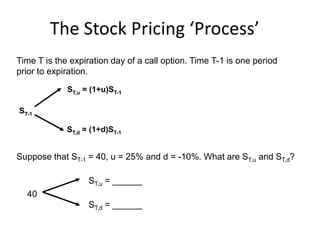
The Stock Pricing ‘Process’
ST,d = (1+d)ST-1
ST,u = (1+u)ST-1
ST-1
Suppose that ST-1 = 40, u = 25% and d = -10%. What are ST,u and ST,d?
40
ST,u = ______
ST,d = ______
Time T is the expiration day of a call option. Time T-1 is one period
prior to expiration.
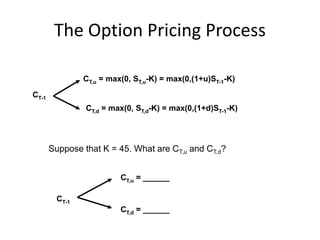
The Option Pricing Process
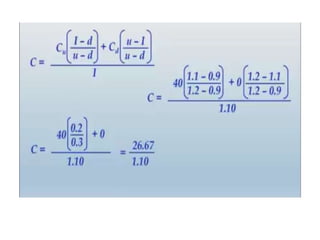
CT,d = max(0, ST,d-K) = max(0,(1+d)ST-1-K)
CT,u = max(0, ST,u-K) = max(0,(1+u)ST-1-K)
CT-1
Suppose that K = 45. What are CT,u and CT,d?
CT-1
CT,u = ______
CT,d = ______
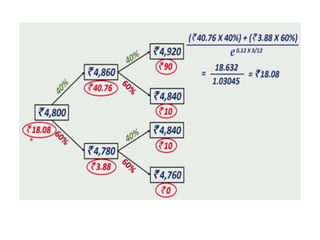
Binomial Option pricing

Binomial Option pricing

  • 1.
    Binomial Option Pricing •By – Mr. Debasis Mohanty
  • 2.
    • We beginwith a single period. • Then, we stitch single periods together to form the Multi-Period Binomial Option Pricing Model. • The Multi-Period Binomial Option Pricing Model is extremely flexible, hence valuable; it can value American options (which can be exercised early), and most, if not all, exotic options. The Binomial Option Pricing Model (BOPM)
  • 3.
    Assumptions of theBOPM • There are two (and only two) possible prices for the underlying asset on the next date. The underlying price will either: – Increase by a factor of u% (an uptick) – Decrease by a factor of d% (a downtick) • The uncertainty is that we do not know which of the two prices will be realized. • No dividends. • The one-period interest rate, r, is constant over the life of the option (r% per period). • Markets are perfect (no commissions, bid-ask spreads, taxes, price pressure, etc.)
  • 4.
    The Stock Pricing‘Process’ ST,d = (1+d)ST-1 ST,u = (1+u)ST-1 ST-1 Suppose that ST-1 = 40, u = 25% and d = -10%. What are ST,u and ST,d? 40 ST,u = ______ ST,d = ______ Time T is the expiration day of a call option. Time T-1 is one period prior to expiration.
  • 5.
    The Option PricingProcess CT,d = max(0, ST,d-K) = max(0,(1+d)ST-1-K) CT,u = max(0, ST,u-K) = max(0,(1+u)ST-1-K) CT-1 Suppose that K = 45. What are CT,u and CT,d? CT-1 CT,u = ______ CT,d = ______