Option Pricing Models
What are option pricing
models?
 Option pricing models are mathematical models that use certain
variables to calculate the theoretical value of an option. The
theoretical value of an option is an estimate of what an option should
be worth using all known inputs.
 In other words, option pricing models provide us a fair value of an
option.
 There are several option pricing models such as the Black-Scholes
Model (BSM), binomial option pricing, and Monte-Carlo simulation.
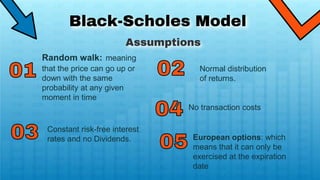
Assumptions
Constant risk-free interest
rates and no Dividends.
No transaction costs
Random walk: meaning
that the price can go up or
down with the same
probability at any given
moment in time
Normal distribution
of returns.
Black-Scholes Model
European options: which
means that it can only be
exercised at the expiration
date
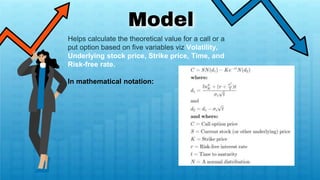
Model
Helps calculate the theoretical value for a call or a
put option based on five variables viz Volatility,
Underlying stock price, Strike price, Time, and
Risk-free rate.
In mathematical notation:
• Black-Scholes assumes stock prices follow
a lognormal distribution because asset
prices cannot be negative (they are
bounded by zero).
• Often, asset prices are observed to have
significant right skewness and some
degree of kurtosis (fat tails). This means
high-risk downward moves often happen
more often in the market than a normal
distribution predicts.
Binomial Option Pricing Model
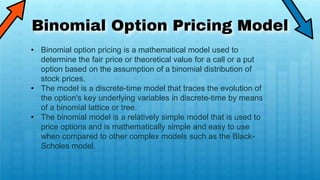
• Binomial option pricing is a mathematical model used to
determine the fair price or theoretical value for a call or a put
option based on the assumption of a binomial distribution of
stock prices.
• The model is a discrete-time model that traces the evolution of
the option's key underlying variables in discrete-time by means
of a binomial lattice or tree.
• The binomial model is a relatively simple model that is used to
price options and is mathematically simple and easy to use
when compared to other complex models such as the Black-
Scholes model.
Assumptions
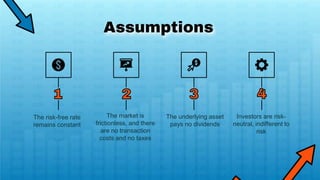
The risk-free rate
remains constant
The market is
frictionless, and there
are no transaction
costs and no taxes
The underlying asset
pays no dividends
Investors are risk-
neutral, indifferent to
risk
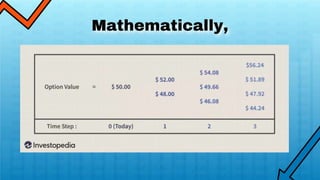
Mathematically,
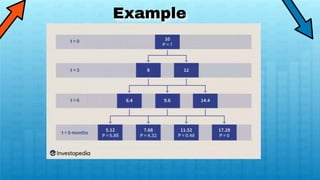
Example
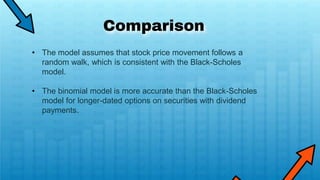
Comparison
• The model assumes that stock price movement follows a
random walk, which is consistent with the Black-Scholes
model.
• The binomial model is more accurate than the Black-Scholes
model for longer-dated options on securities with dividend
payments.
Conclusion
Plays crucial role in
quantifying and
effectively managing
the risk linked
to options.
Determines whether a
particular contract is
overpriced or
underpriced relative to
its intrinsic value. This
information can be
used to make
informed trading
decisions.
Enables investors to
assess the fair value
of options and make
informed investment
decisions.
Gives insights into the
responsiveness of option
prices to alterations in factors
like the price of the
underlying asset, volatility,
and expiration period. Aids
investors in evaluating and
mitigating their vulnerability
to market fluctuations and
potential financial setbacks.
Thank you!

options cmfd.pptx

  • 1.
  • 2.
    What are optionpricing models?  Option pricing models are mathematical models that use certain variables to calculate the theoretical value of an option. The theoretical value of an option is an estimate of what an option should be worth using all known inputs.  In other words, option pricing models provide us a fair value of an option.  There are several option pricing models such as the Black-Scholes Model (BSM), binomial option pricing, and Monte-Carlo simulation.
  • 3.
    Assumptions Constant risk-free interest ratesand no Dividends. No transaction costs Random walk: meaning that the price can go up or down with the same probability at any given moment in time Normal distribution of returns. Black-Scholes Model European options: which means that it can only be exercised at the expiration date
  • 4.
    Model Helps calculate thetheoretical value for a call or a put option based on five variables viz Volatility, Underlying stock price, Strike price, Time, and Risk-free rate. In mathematical notation:
  • 5.
    • Black-Scholes assumesstock prices follow a lognormal distribution because asset prices cannot be negative (they are bounded by zero). • Often, asset prices are observed to have significant right skewness and some degree of kurtosis (fat tails). This means high-risk downward moves often happen more often in the market than a normal distribution predicts.
  • 7.
    Binomial Option PricingModel • Binomial option pricing is a mathematical model used to determine the fair price or theoretical value for a call or a put option based on the assumption of a binomial distribution of stock prices. • The model is a discrete-time model that traces the evolution of the option's key underlying variables in discrete-time by means of a binomial lattice or tree. • The binomial model is a relatively simple model that is used to price options and is mathematically simple and easy to use when compared to other complex models such as the Black- Scholes model.
  • 8.
    Assumptions The risk-free rate remainsconstant The market is frictionless, and there are no transaction costs and no taxes The underlying asset pays no dividends Investors are risk- neutral, indifferent to risk
  • 9.
  • 10.
  • 11.
    Comparison • The modelassumes that stock price movement follows a random walk, which is consistent with the Black-Scholes model. • The binomial model is more accurate than the Black-Scholes model for longer-dated options on securities with dividend payments.
  • 12.
    Conclusion Plays crucial rolein quantifying and effectively managing the risk linked to options. Determines whether a particular contract is overpriced or underpriced relative to its intrinsic value. This information can be used to make informed trading decisions. Enables investors to assess the fair value of options and make informed investment decisions. Gives insights into the responsiveness of option prices to alterations in factors like the price of the underlying asset, volatility, and expiration period. Aids investors in evaluating and mitigating their vulnerability to market fluctuations and potential financial setbacks.
  • 13.