1
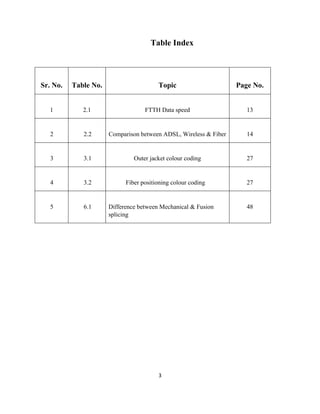
TABLE OF CONTENTS
Content Page No.
Table of Contents………………………………………………………………...................................v
Table Index…………………………………………………………………........................................vii
Figure Index………………………………………………………………….....................................viii
Abstract……………………………………………………………………………………………….......ix
Content Page No.
CHAPTER 1: INTRODCUTION .....................................................................1-3
1.1 Overview 1
1.2 Vision & Mission 2
1.3 Products & Services 2
1.4 Projects, Revenue, Growth Plan 3
CHAPTER 2: INTRODUCTION TO OFC.....................................................4-15
2.1 History of OFC 4-5
2.2 Elements of Optical Fibre 5-6
2.3 Fiber Optic Link Components 7-11
2.4 How Optical Fibre works 12
2.5 Advantage of OFC 12-14
2.6 Application of OFC 15
CHAPTER 3: DESIGNING OF OPTICAL FIBRE.....................................16-27
3.1 Structure of Optical Fibre 16-18
3.2 Types of Optical Fibre 18-23
3.2.1 Single Mode Fibre 18-19
3.2.2 Multi-Mode Fibre 19-20
3.2.3 Single Mode v/s Multi-Mode 21-23
3.3 Types of Optical Fibre & Colour Coding 25-27
CHAPTER 4: OPTICAL NETWORKS........................................................28-34
2
4.1 Passive Optical Network (PON) 28-31
4.1.1 FTTH 29-30
4.1.2 FTTC 30
4.1.3 FTTP 30
4.2 Synchronous Optical Network (SONET) 31-34
4.2.1 SONET/SDH Protocol Overview 31-32
4.2.2 SONET Multiplexing 32-33
4.2.3 Benefits of SONET 33-34
Chapter 5: OPTICAL FIBRE INSTALLATION.........................................35-39
5.1 Introduction 35
5.2 Surveying & Preparing area root map. 35-36
5.3 Trenching & laying of Duct 37-38
5.4 Cable Jetting 38-39
Chapter 6: SPLICING OF OPTICAL FIBRE…………………………...40-47
6.1 Introduction 40
6.2 Fusion Splicing 40-43
6.3 Mechanical Splicing 44-47
6.4 Fusion v/s Mechanical Splicing 47
Chapter 7: POWER MEASUREMENT........................................................48-54
7.1 Introduction 48
7.2 Types of Power losses 49-52
7.2.1 Extrinsic Power Losses 49-51
7.2.2 Intrinsic Power Losses 51-52
7.3 Power Loss Measurement 52-55
7.3.1 Power Meter 53-54
7.3.2 OTDR 54
Chapter 8:CONCLUSION..................................................................................55
Chapter 9: REFERENCES.............................................................................56-57
3
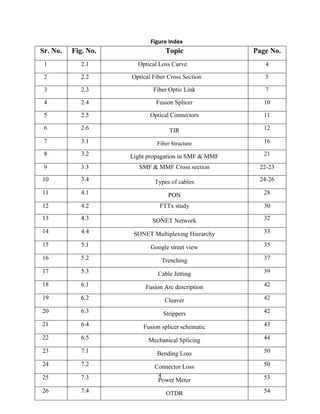
Table Index
Sr. No. Table No. Topic Page No.
1 2.1 FTTH Data speed 13
2 2.2 Comparison between ADSL, Wireless & Fiber 14
3 3.1 Outer jacket colour coding 27
4 3.2 Fiber positioning colour coding 27
5 6.1 Difference between Mechanical & Fusion
splicing
48
4
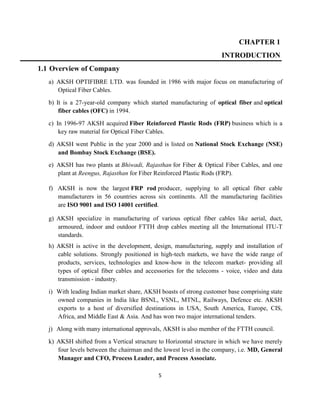
Figure Index
Sr. No. Fig. No. Topic Page No.
1 2.1 Optical Loss Curve 4
2 2.2 Optical Fiber Cross Section 5
3 2.3 Fiber Optic Link 7
4 2.4 Fusion Splicer 10
5 2.5 Optical Connectors 11
6 2.6 TIR 12
7 3.1 Fiber Structure 16
8 3.2 Light propagation in SMF & MMF 21
9 3.3 SMF & MMF Cross section 22-23
10 3.4 Types of cables 24-26
11 4.1 PON 28
12 4.2 FTTx study 30
13 4.3 SONET Network 32
14 4.4 SONET Multiplexing Hierarchy 33
15 5.1 Google street view 35
16 5.2 Trenching 37
17 5.3 Cable Jetting 39
18 6.1 Fusion Arc description 42
19 6.2 Cleaver 42
20 6.3 Strippers 42
21 6.4 Fusion splicer schematic 43
22 6.5 Mechanical Splicing 44
23 7.1 Bending Loss 50
24 7.2 Connector Loss 50
25 7.3 Power Meter 53
26 7.4 OTDR 54
5
CHAPTER 1
INTRODUCTION
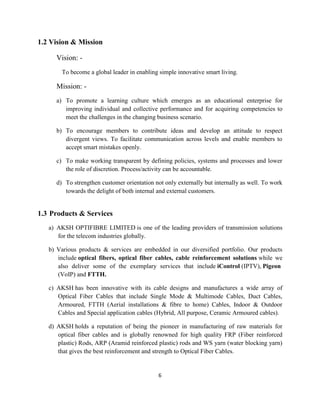
1.1 Overview of Company
a) AKSH OPTIFIBRE LTD. was founded in 1986 with major focus on manufacturing of
Optical Fiber Cables.
b) It is a 27-year-old company which started manufacturing of optical fiber and optical
fiber cables (OFC) in 1994.
c) In 1996-97 AKSH acquired Fiber Reinforced Plastic Rods (FRP) business which is a
key raw material for Optical Fiber Cables.
d) AKSH went Public in the year 2000 and is listed on National Stock Exchange (NSE)
and Bombay Stock Exchange (BSE).
e) AKSH has two plants at Bhiwadi, Rajasthan for Fiber & Optical Fiber Cables, and one
plant at Reengus, Rajasthan for Fiber Reinforced Plastic Rods (FRP).
f) AKSH is now the largest FRP rod producer, supplying to all optical fiber cable
manufacturers in 56 countries across six continents. All the manufacturing facilities
are ISO 9001 and ISO 14001 certified.
g) AKSH specialize in manufacturing of various optical fiber cables like aerial, duct,
armoured, indoor and outdoor FTTH drop cables meeting all the International ITU-T
standards.
h) AKSH is active in the development, design, manufacturing, supply and installation of
cable solutions. Strongly positioned in high-tech markets, we have the wide range of
products, services, technologies and know-how in the telecom market- providing all
types of optical fiber cables and accessories for the telecoms - voice, video and data
transmission - industry.
i) With leading Indian market share, AKSH boasts of strong customer base comprising state
owned companies in India like BSNL, VSNL, MTNL, Railways, Defence etc. AKSH
exports to a host of diversified destinations in USA, South America, Europe, CIS,
Africa, and Middle East & Asia. And has won two major international tenders.
j) Along with many international approvals, AKSH is also member of the FTTH council.
k) AKSH shifted from a Vertical structure to Horizontal structure in which we have merely
four levels between the chairman and the lowest level in the company, i.e. MD, General
Manager and CFO, Process Leader, and Process Associate.
6
1.2 Vision & Mission
Vision: -
To become a global leader in enabling simple innovative smart living.
Mission: -
a) To promote a learning culture which emerges as an educational enterprise for
improving individual and collective performance and for acquiring competencies to
meet the challenges in the changing business scenario.
b) To encourage members to contribute ideas and develop an attitude to respect
divergent views. To facilitate communication across levels and enable members to
accept smart mistakes openly.
c) To make working transparent by defining policies, systems and processes and lower
the role of discretion. Process/activity can be accountable.
d) To strengthen customer orientation not only externally but internally as well. To work
towards the delight of both internal and external customers.
1.3 Products & Services
a) AKSH OPTIFIBRE LIMITED is one of the leading providers of transmission solutions
for the telecom industries globally.
b) Various products & services are embedded in our diversified portfolio. Our products
include optical fibers, optical fiber cables, cable reinforcement solutions while we
also deliver some of the exemplary services that include iControl (IPTV), Pigeon
(VoIP) and FTTH.
c) AKSH has been innovative with its cable designs and manufactures a wide array of
Optical Fiber Cables that include Single Mode & Multimode Cables, Duct Cables,
Armoured, FTTH (Aerial installations & fibre to home) Cables, Indoor & Outdoor
Cables and Special application cables (Hybrid, All purpose, Ceramic Armoured cables).
d) AKSH holds a reputation of being the pioneer in manufacturing of raw materials for
optical fiber cables and is globally renowned for high quality FRP (Fiber reinforced
plastic) Rods, ARP (Aramid reinforced plastic) rods and WS yarn (water blocking yarn)
that gives the best reinforcement and strength to Optical Fiber Cables.
7
e) In 2002, AKSH started its 1st
Fiber to the Home (FTTH) in Jaipur and later collaborated
with MTNL & BSNL in Jan. 2010 to launch its 1st FTTH project in Jaipur. Similar
projects are started in Delhi and Mumbai in collaboration with MTNL and in Ajmer,
Faridabad and Gurgaon in collaboration with BSNL.
1.4Projects, Revenue & Growth Plan
Projects: -
a) AKSH has been successfully completed the assignment installing of 2600 Km of All
Dielectric Self Supporting (ADSS) optical fibre cable in Bhutan under Bhutan Power
Corporation Limited.
b) In Mauritius, AKSH has received contract from BTL Mauritius to supply and install
FTTH triple play equipment.
c) In 2002, AKSH started its 1st Fibre to the Home (FTTH) in Jaipur and later collaborated
with MTNL & BSNL in Jan 2010 to launch its 1st FTTH project in Jaipur.
d) In 2011, the first ever IPTV service in Rajasthan was launched by AKSH in collaboration
with BSNL.
Revenue: -
AKSH Optifibre Limited reports strong financial results for Q4 FY16 & FY 2015-16.
Revenue increased by 23% to Rs. 462 crores, New Delhi, May 30, 2016.
Growth Plan: -
a) By 2020 AKSH aiming towards to complete takeover of the IPTV business all over
India.
b) Also, contributing towards the Make in India initiative of our government, AKSH is
aiming eye on the largest manufacturer and exporter of FRP Rods and Armoured
cable in India.
8
CHAPTER 2
INTRODUCTION TO OFC
2.1 History of OFC
a) In the late 19th and early 20th centuries, light was guided through bent glass rods to
illuminate body cavities. Alexander Graham Bell invented a 'Photo-phone' to transmit
voice signals over an optical beam.
b) By 1964, a critical and theoretical specification was identified by Dr. Charles K. Kao for
long-range communication devices, the 10 or 20 dB of light loss per kilometre standard.
c) The first challenge undertaken by scientists was to develop a glass so pure that one
percent of the light would be retained at the end of one kilometre (km), the existing
unrepeated transmission distance for copper-based telephone systems. In terms of
attenuation, this one-percent of light retention translated to 20 decibels per kilometre
(dB/km) of glass material.
d) Glass researchers all over the world worked on the challenge in the 1960s, but the
breakthrough came in 1970, when Corning Incorporated scientists Dr. Robert Maurer,
Donald Keck, and Peter Schultz created a fiber with a measured attenuation of less than
20 dB per km. It was the purest glass ever made.
e) In April 1977, General Telephone and Electronics tested and deployed the world's first
live telephone traffic through a fiber-optic system running at 6 Mbps, in Long Beach,
California. They were soon followed by Bell in May 1977, with an optical telephone
communication system installed in the downtown Chicago area, covering a distance of
1.5 miles.
f) Figure 2.1 shows three curves. The top, dashed, curve corresponds to early 1980’s fiber,
the middle, dotted, curve corresponds to late 1980’s fiber, and the bottom, solid, curve
corresponds to modern optical fiber.
Fig. 2.1: Optical Loss Curve [1]
9
The earliest fiber optic systems were developed at an operating wavelength of about 850
nm. This wavelength corresponds to the so-called “first window” in a silica-based optical
fiber. This window refers to a wavelength region that offers low optical loss. It sits
between several large absorption peaks caused primarily by moisture in the fiber
and Rayleigh scattering.
g) Most companies jumped to the “second window” at 1310 nm with lower attenuation of
about 0.5 dB/km. In late 1977, Nippon Telegraph and Telephone (NTT) developed the
“third window” at 1550 nm. It offered the theoretical minimum optical loss for silica-
based fibers, about 0.2 dB/km.
h) Today, 850 nm, 1310 nm, and 1550 nm systems are all manufactured and deployed along
with very low-end, short distance, systems using visible wavelengths near 660 nm.
i) The shortest link lengths can be handled with wavelengths of 660 nm or 850 nm. The
longest link lengths require 1550 nm wavelength systems. A “fourth window,” near 1625
nm, is being developed. While it is not lower loss than the 1550 nm window, the loss is
comparable.
2.2 Elements of Optical Fiber
An optical fiber is a thin, flexible, transparent fiber that acts as a waveguide, or "light pipe",
to transmit light between the two ends of the fiber. Optical fibers are widely used in fiber-
optic communications, which permits transmission over longer distances and at higher
bandwidths (data rates) than other forms of communication. Fibers are used instead of metal
wires because signals travel along them with less loss and are also immune to
electromagnetic interference.
Fig. 2.2: Fiber cross-section [2]
10
a) Core -
The core of a conventional optical fiber is a cylinder of glass or plastic that runs along the
fiber's length. The core is surrounded by a medium with a lower index of refraction,
typically a cladding of a different glass, or plastic. The three most common core sizes are:
(i) 9 µm diameter (single-mode)
(ii) 50 µm diameter (multi-mode)
(ii) 62.5 µm diameter (multi-mode)
b) Cladding –
The fibers are coated with a glass of slightly lower refractive index. This is known
as cladding. The cladding increases the critical angle within the core fiber and also
prevents adjacent fibers from touching each other. At every point of contact light would
escape into another fiber.
c) Coating –
The coating is the first non-optical layer around the cladding. The coating typically
consists of one or more layers of polymer that protect the silica structure against physical
or environmental damage. The coating is stripped off when the fiber is connectorized or
fusion spliced.
d) Strengthening fibers –
These components help protect the core against crushing forces and excessive tension
during installation. The materials can range from Kevlat4 to wire strands to gel-filled
sleeves.
e) Jacket –
The jacket is an important feature of the fiber. It is 900 microns and helps protect the
fiber from breaking during installation and termination and is located outside of the
coating.
2.3 Fiber Optic Link Components
In order to comprehend how fiber optic applications work, it is important to understand the
components of a fiber optic link. Simplistically, there are four main components in a fiber
optic link.
a) Optical Transmitter
b) Optical Fiber/Cable
c) Connectors
d) Optical Reciever
11
Fig. 2.3: Optical link path [3]
a) Optical Transmitter-
The transmitter converts the electrical signals to optical. A transmitter contains a light
source such as a Light Emitting Diode (LED) or a Laser (Light Amplification by
Stimulated Emission of Radiation) diode, or a Vertical Cavity Surface Emitting Laser
(VCSEL).
(i) LED: Is used in multimode applications and has the largest spectral width that
carries the least amount of bandwidth.
Fig. 2.4: LED Beam [2]
(ii) VCSEL: Is also used in multimode applications with a narrower spectral width
that can carry more bandwidth than the LED.
Fig. 2.5: VCSEL Beam [3]
12
(iii) LASER: Has the smallest spectral width, carries the most bandwidth, and is used
in single mode applications.
Fig. 2.6: Laser Beam [2]
These sources produce light at certain wavelengths depending upon the materials
from which they are made. Most fiber optic sources use wavelengths in the infrared
band, specifically 850nm (1nm=10-9m), 1300nm and 1550nm. For reference, visible
light operates in the 400-700nm range (see Fig.2.7).
Fig. 2.7: Spectrum[2]
b) Optical Fiber/Cable-
In this section, we discuss the structure and properties of an optical fiber, how it guides
light, and how it is cabled for protection.
An optical fiber is made of 3 concentric layers (see Figure 2.8)
13
(i) Core: This central section, made of silica or doped silica, is the light transmitting
region of the fiber.
(ii) Cladding: This is the first layer around the core. It is also made of silica, but not
the same composition as the core. This creates an optical waveguide which
confines the light in the core by total internal reflection at the core-cladding
interface.
(iii) Coating: The coating is the first non-optical layer around the cladding. The
coating typically consists of one or more layers of polymer that protect the
silica structure against physical or environmental damage. The coating is
stripped off when the fiber is connectorized or fusion spliced.
Fig. 2.8: Fiber geometry [3]
(iv) Buffer (not pictured): The buffer is an important feature of the fiber. It is 900
microns and helps protect the fiber from breaking during installation and
termination and is located outside of the coating.
c) Connectors-
Fiber optic links require a method to connect the transmitter to the fiber optic cable and
the fiber optic cable to the receiver. In general, there are two methods to link optical
fibers together.
Fusion Splice: The first method is called a fusion splice. This operation consists of
directly linking two fibers by welding with an electric arc or a fusion splicer (see
Figure 2.9). The advantages of this approach are that the linking method is fast and
simple and there is very little insertion loss (the loss of light generated by a
connection is called Insertion Loss [IL]). The disadvantages are that the link is
relatively fragile, is permanent, and the initial cost (of the fusion splicer) is high.
14
Fig. 2.9: Splicer tool [3]
Connectors- The second method involves the uses of fiber optic connectors. A
connector terminates the optical fiber inside a ceramic ferrule, using epoxy to
hold the fiber in place. The connectors can be mated and unmated at any time.
The advantages of this approach are that the connection is robust, the connector
can be chosen according to the application, and the connector can be connected
and disconnected hundreds or even thousands of time without damaging the
connectors. The disadvantages of this approach are that the connectorization takes
longer than fusion splicing, requires special tools, and the insertion loss can be
higher when compared with fusion splicing.
There are two types of fiber optic connectors: physical contact and expanded
beam.
(i) Physical Contact Connectors- Physical contact connectors utilize fiber in
a tightly tolerance ceramic ferrule. This allows easy handling of the fiber
and protects it from damage. The principle of physical contact connectors
involves the direct contact of polished fibers within two ceramic ferrules.
The ferrules are aligned using a ceramic alignment sleeve (see Figure
2.10). Insertion loss is a function of the alignment accuracy and the polish
quality. There are springs behind the ferrule to ensure that the two ferrules
are in constant contact even in high vibration and shock environments.
15
Fig. 2.10: Contact connector [5]
(ii) Expanded Beam Technology- The other connector technology is
expanded beam, which consists of placing a lens at the exit of each fiber to
widen and collimate the light. In this configuration, there is an air gap
between the optical fibers/lens assemblies (see Figure 2.11). The loss
generated by an expanded beam connection is more than that of a physical
contact connector due to the lenses, mechanical alignment and sometimes
protective windows (approximately 0.8 to 2.5dB typical). This type of
connector performs well against particle contamination on the lens
because the beam is expanded to a much larger size than the beam that
comes directly from a fiber.
Fig. 2.11: Expanded beam [5]
d) Optical Receiver-
The last component of the fiber optic link is the optical receiver, which uses a photodiode
to convert the optical signals into electrical. The two types of photodiodes used are:
Positive Intrinsic Negative (PIN) and the Avalanche Photo Diode (APD).
16
2.4 How Optical Fiber Works
The operation of an optical fiber is based on the principle of total internal reflection (See fig.
2.12) Light reflects (bounces back) or refracts (alters its direction while penetrating a
different medium), depending on the angle at which it strikes a surface.
The angle of refraction at the interface between two media is governed by Snell’s law:
2211 sinsin  nn 
Fig. 2.12: Snell’s Law [3]
The light is "guided" down (see Figure 2.13) the core of the fiber by the optical "cladding"
which has a lower refractive index (the ratio of the velocity of light in a vacuum to its velocity
in a specified medium) that traps light in the core through "total internal reflection."
Fig. 2.13: TIR in Fiber [3]
17
2.5 Advantage of OFC
OFC has obvious advantages for the consumer, both today and in the foreseeable future,
offering improved performance for broadband services in comparison with those currently
delivered primarily over copper networks.
a) Speed: The speed comparison factor might be the most convincing one for you as
customers. OFC provides the highest possible speeds of Internet access downstream
(from the network to the end user) as well as upstream (from the user to the network).
Mobile connections are much slower than OFC, especially when several users are in the
same area and share the available network. Satellite connections are also much slower
than FTTH: they entail a delay, which hampers phone conversations and other
interactive activities. Other fixed technologies, like ADSL, use metal wires - which are
about 100 times slower than fibre to the home – to connect your home to the fiber city
network.
Keeping in mind that FTTH allows at least 1 Gbps download and 1 Gbps upload, the
following table drawn by the FTTH Council Europe shows typical download and upload
speeds for photo and video transfer for different bandwidth combination:
Table 2.1: FTTH Data speed [4]
Time taken for: 1 GB photo album 4.7 GB standard video 25 GB HD Video
1 Gbps download
1 Gbps upload
9 sec. 39 sec. 3 min 28 sec.
100 Mbps download
100 Mbps upload
1 min 23 sec. 6 min 31 sec. 34 in 40 sec.
50 Mbps download
10 Mbps upload
2 min 46 sec.
13 min 52 sec.
13 min 2 sec.
1 hr 5 min.
1 hr 9 min.
5 hr 47 min.
8 Mbps download
1 Mbps upload
19 min.
2 hr 32 min.
1 hr 29 min.
11 hr 54 min.
7 hr 55 min.
-
b) Reliability: Even though OFC speed is remarkable, we should consider other factors that
also impact on the end user service. Reliability is definitely one of these factors. An
FTTH broadband connection offers an improved network reliability.
18
c) Security: The reliability factor is linked with security. Magnetic fields don't just generate
noise in signal carrying conductors; they also make it possible to leak out the
information that is on the conductor. There are no radiated magnetic fields around
optical fibers; the electromagnetic fields are confined within the fiber. That makes it
impossible to tap the signal being transmitted through a fiber without cutting into the
fiber. Secure fiber networks can therefore help protect content from piracy when other
broadband solutions are more likely subject to these kinds of virtual threats or even
viruses.
Fiber offers many advantages when looking at the active network, as shown in the
following table (Table 2.2)
Table 2.2: Comparison between ADSL, Wireless & Fiber [4]
ADSL Wireless Fiber
Pros- Copper cables are
already there.
Pros- Ideal for non-reachable
places.
No cable needs to be
developed.
Pros- More Bandwidth
Reliability
Flexibility
High Security
Longer economic life
More types of services
possible with fiber
Cons- Loss in signal strength
Less secure
Low bandwidth
Cons- Less secure
Low bandwidth
Cons- Fibre optic cable are not
there yet, they need to be deployed.
19
2.6 Application of OFC
Fiber optic cables find many uses in a wide variety of industries and applications. Some uses
of OFC include:
Medical: Used as light guides, imaging tools and also as lasers for surgeries.
Defence/Government: Used as hydrophones for seismic and SONAR uses, as wiring in
aircraft, submarines and other vehicles and also for field networking.
Data Storage: Used for data transmission.
Telecommunications: Fiber is laid and used for transmitting and receiving purposes.
Networking: Used to connect users and servers in a variety of network settings and help
increase the speed and accuracy of data transmission.
Industrial/Commercial: Used for imaging in hard to reach areas, as wiring where EMI is an
issue, as sensory devices to make temperature, pressure and other measurements, and as
wiring in automobiles and in industrial settings.
Broadcast/CATV: Broadcast/cable companies are using fiber optic cables for wiring
CATV, HDTV, internet, video on-demand and other applications.
Fiber optic cables are used for lighting and imaging and as sensors to measure and monitor a
vast array of variables. Fiber optic cables are also used in research and development and
testing across all the above mentioned industries.
20
CHAPTER 3
DESIGNING OF OPTICAL FIBER
3.1 Structure of Optical Fiber
The composition of the cladding glass relative to the core glass determines the fiber's
ability to reflect light. That reflection is usually caused by creating a higher refractive index
in the core of the glass than in the surrounding cladding glass. The refractive index of the
core is increased by slightly modifying the composition of the core glass, generally by
adding small amounts of a dopant. Figure. (3.1) is the graphical description of inside of
optical fiber. It shows that how light behave inside the fiber.
Fig. 3.1: Fiber structure [6]
The first step in manufacturing glass optical fibers is to make a solid glass rod, known as a
preform. Ultra-pure chemicals -- primarily silicon tetrachloride (SiCl4) and germanium
tetrachloride (GeCl4) -- are converted into glass during preform manufacturing.
These chemicals are used in varying proportions to fabricate the core regions for the
different types of preforms.
The basic chemical reaction of manufacturing optical glass is:
21
SiCl4 (gas) + O2 > SiO2 (solid) + 2Cl2 (in the presence of heat)
GeCl4 (gas) + O2 > GeO2 (solid) + 2Cl2 (in the presence of heat)
The core composition of all standard communication fibers consists primarily of silica, with
varying amounts of germania added to increase the fiber's refractive index to the desired
level. Single-mode fibers typically have only small amounts of germania and have a uniform
composition within the core. Multimode fibers typically have a much higher refractive
index, and therefore much higher germania content. Also, the core composition and the
refractive index of graded-index multimode fibers changes across the core of the fiber to
give the refractive index a parabolic shape.
3.1.1 Two basic cable designs are:
Loose-tube cable, used in the majority of outside-plant installations in North America, and
tight-buffered cable, primarily used inside buildings.
The modular design of loose-tube cables typically holds up to 12 fibers per buffer tube with
a maximum per cable fiber count of more than 200 fibers. Loose-tube cables can be all-
dielectric or optionally armoured. The modular buffer-tube design permits easy drop-off of
groups of fibers at intermediate points, without interfering with other protected buffer tubes
being routed to other locations. The loose-tube design also helps in the identification and
administration of fibers in the system.
Single-fiber tight-buffered cables are used as pigtails, patch cords and jumpers to terminate
loose-tube cables directly into opto-electronic transmitters, receivers and other active and
passive components.
Multi-fiber tight-buffered cables also are available and are used primarily for alternative
routing and handling flexibility and ease within buildings.
a) Loose-Tube Cable
In a loose-tube cable design, color-coded plastic buffer tubes house and protect optical fibers.
A gel filling compound impedes water penetration. Excess fiber length (relative to buffer
tube length) insulates fibers from stresses of installation and environmental loading. Buffer
tubes are stranded around a dielectric or steel central member, which serves as an anti-
buckling element.
The cable core, typically uses aramid yarn, as the primary tensile strength member. The outer
polyethylene jacket is extruded over the core. If armouring is required, a corrugated steel tape
is formed around a single jacketed cable with an additional jacket extruded over the armour.
Loose-tube cables typically are used for outside-plant installation in aerial, duct and direct-
buried applications.
22
b) Tight-Buffered Cable
With tight-buffered cable designs, the buffering material is in direct contact with the fiber.
This design is suited for "jumper cables" which connect outside plant cables to terminal
equipment, and also for linking various devices in a premises network.
Multi-fiber, tight-buffered cables often are used for intra-building, risers, general building
and plenum applications.
The tight-buffered design provides a rugged cable structure to protect individual fibers during
handling, routing and connectorization. Yarn strength members keep the tensile load away
from the fiber.
As with loose-tube cables, optical specifications for tight-buffered cables also should include
the maximum performance of all fibers over the operating temperature range and life of the
cable. Averages should not be acceptable
3.2 Types of Optical Fiber
There are two main types of fiber optic cables:-
a) Single Mode Fiber (SMF)
b) Multi-Mode Fiber (MMF)
3.2.1 Single Mode Fiber (SMF):
A single-mode optical fiber (SMF) is an optical fiber designed to carry light only directly
down the fiber - the transverse mode. Modes are the possible solutions of the Helmholtz
equation for waves, which is obtained by combining Maxwell's equations and the boundary
conditions.
These modes define the way the wave travels through space, i.e. how the wave is distributed
in space. Waves can have the same mode but have different frequencies. This is the case in
single-mode fibers, where we can have waves with different frequencies, but of the same
mode, which means that they are distributed in space in the same way, and that gives us a
single ray of light. Although the ray travels parallel to the length of the fiber, it is often
called transverse mode since its electromagnetic vibrations occur perpendicular (transverse)
to the length of the fiber.
The 2009 Nobel Prize in Physics was awarded to Charles K. Kao for his theoretical work on
the single-mode optical fiber.
23
SMF has a very narrow core (typically around 9µm), which allows only single mode of light
to propagate.
Can support distances of up to several thousand kilometres, with appropriate amplification
and dispersion compensation.
Propagation of light rays can be easily understanding by the (Fig. 3.2).
Fig. 3.2: SMF [12]
It carries light pulses along single path. Only the lowest order mode (fundamental mode)
can propagate in the fiber and all higher modes are under cut-off condition.
It uses LASER as a light source. Single mode fibers are constructed by
a) Letting dimensions of core diameter be a few wavelengths
b) By having small index difference between core and cladding
In practice core-cladding index difference varies between 0.1 and 1.0 percent.
Typical single mode fibre may have a core radius of 3 microns an NA=0.1 at
wavelength= 0.8 micron.
3.2.2 Multi-Mode Fiber:
Multi-mode optical fiber is a type of optical fiber mostly used for communication over
short distances, such as within a building or on a campus. Typical multimode links have
data rates of 10 Mbit/s to 10 Gbit/s over link lengths of up to 600 meters (2000 feet).The
main difference between multi-mode and single-mode optical fiber is that the former has
much larger core diameter, typically 50–100 micrometres; much larger than the
wavelength of the light carried in it. Because of the large core and also the possibility of
large numerical aperture, multi-mode fiber has higher "light-gathering" capacity than
single-mode fiber. In practical terms, the larger core size simplifies connections and also
allows the use of lower-cost electronics such as light-emitting diodes (LEDs)
and vertical-cavity surface-emitting lasers (VCSELs) which operate at the 850 nm and
1300 nm wavelength (single-mode fibers used in telecommunications typically operate at
24
1310 or 1550 nm). However, compared to single-mode fibers, the multi-mode
fiber bandwidth–distance product limit is lower. Because multi-mode fiber has a larger
core-size than single-mode fiber, it supports more than one propagation mode; hence it is
limited by modal dispersion, while single mode is not.
The LED light sources sometimes used with multi-mode fiber produce a range of
wavelengths and these each propagate at different speeds. This chromatic dispersion is
another limit to the useful length for multi-mode fiber optic cable. In contrast, the lasers
used to drive single-mode fibers produce coherent light of a single wavelength. Due to
the modal dispersion, multi-mode fiber has higher pulse spreading rates than single mode
fiber, limiting multi-mode fiber’s information transmission capacity.
Single-mode fibers are often used in high-precision scientific research because restricting
the light to only one propagation mode allows it to be focused to an intense, diffraction-
limited spot.
Jacket colour is sometimes used to distinguish multi-mode cables from single-mode ones.
The standard TIA-598C recommends, for non-military applications, the use of a yellow
jacket for single-mode fiber, and orange or aqua for multi-mode fiber, depending on
type. Some vendors use violet to distinguish higher performance OM4 communications
fiber from other types.
Fig. 3.3: MMF [10]
3.2.3 Single Mode v/s Multi-Mode:
Now, we are studying the combine behaviour of single mode and multi-mode fiber with
respect to their efficiency and ways of propagation.
25
Fig. 3.4: Light ray in SMF & MMF [9]
Typical multimode fibers have a core diameter/cladding diameter ratio of 50 microns/125
microns (10-6 meters) and 62.5/125 (although 100/140 and other sizes are sometimes used
depending on the application). Single mode fibers have a core/cladding ratio of 9/125 at
wavelengths of 1300nm and 1550nm.It is shown in (fig. 3.5)
Fig. 3.5: Core Dimension [8]
Single Mode fiber optic cable has a small diametric core that allows only one mode of light
to propagate. Because of this, the number of light reflections created as the light passes
through the core decreases, lowering attenuation and creating the ability for the signal to
26
travel further. This application is typically used in long distance, higher bandwidth runs by
Telcos, CATV companies, and Colleges and Universities.
Single Mode fiber is usually 9/125 in construction. This means that the core to cladding
diameter ratio is 9 microns to 125 microns.
Fig. 3.6: Single mode [14]
Multimode fiber optic cable has a large diametric core that allows multiple modes of light to
propagate. Because of this, the number of light reflections created as the light passes through the
core increases, creating the ability for more data to pass through at a given time. Because of the
high dispersion and attenuation rate with this type of fiber, the quality of the signal is reduced
over long distances. This application is typically used for short distance, data and audio/video
applications in LANs. RF broadband signals, such as what cable companies commonly use,
cannot be transmitted over multimode fiber.
Multimode fiber is usually 50/125 and 62.5/125 in construction. This means that the core to
cladding diameter ratio is 50 microns to 125 microns and 62.5 microns to 125 microns.
Fig. 3.7: Multimode cross section [4]
27
3.2.4 What’s Happening Inside the Multimode Fiber-
Step-Index Multimode Fiber
Due to its large core, some of the light rays that make up the digital pulse may travel a direct
route, whereas others zigzag as they bounce off the cladding. These alternate paths cause the
different groups of light rays, referred to as modes, to arrive separately at the receiving point.
The pulse, an aggregate of different modes, begins to spread out, losing its well-defined shape.
The need to leave spacing between pulses to prevent overlapping limits the amount of
information that can be sent. This type of fiber is best suited for transmission over short
distances.
Graded-Index Multimode Fiber
Contains a core in which the refractive index diminishes gradually from the centre axis out
toward the cladding. The higher refractive index at the centre makes the light rays moving down
the axis advance more slowly than those near the cladding. Due to the graded index, light in the
core curves helically rather than zigzag off the cladding, reducing its travel distance. The
shortened path and the higher speed allow light at the periphery to arrive at a receiver at about
the same time as the slow but straight rays in the core axis. The result: digital pulse suffers less
dispersion. This type of fiber is best suited for local-area networks.
3.3 Types of Optical Fiber & Colour Coding
(a) Distribution Cable:
Fig. 3.8: Distributed [16]
Distribution Cable (compact building cable) packages individual 900µm buffered fiber
reducing size and cost when compared to breakout cable. The connectors may be installed
directly on the 900µm buffered fiber at the breakout box location. The space saving
28
(OFNR) rated cable may be installed where ever breakout cable is used. FIS will
connectorize directly onto 900µm fiber or will build up ends to a 3mm jacketed fiber
before the connectors are installed.
(b) Indoor/Outdoor Tight Buffer:
Fig. 3.9: Tight buffer [16]
FIS now offers indoor/outdoor rated tight buffer cables in Riser and Plenum rated
versions. These cables are flexible, easy to handle and simple to install. Since they do not
use gel, the connectors can be terminated directly onto the fiber without difficult to use
breakout kits. This provides an easy and overall less expensive installation. (Temperature
rating -40ºC to +85ºC).
(c) Indoor/Outdoor Breakout Cable:
Fig. 3.10: Indoor breakout cable [16]
FIS indoor/outdoor rated breakout style cables are easy to install and simple to terminate
without the need for fan-out kits. These rugged and durable cables are OFNR rated so
they can be used indoors, while also having a -40c to +85c operating temperature range
and the benefits of fungus, water and UV protection making them perfect for outdoor
applications. They come standard with 2.5mm sub units and they are available in plenum
rated versions.
29
(d) Loose Tube Cable:
Fig. 3.11: Losse Tube [16]
Loose tube cable is designed to endure outside temperatures and high moisture
conditions. The fibers are loosely packaged in gel filled buffer tubes to repel water.
Recommended for use between buildings that are unprotected from outside elements.
Loose tube cable is restricted from inside building use, typically allowing entry not to
exceed 50 feet
(e) Aerial Cable/Self-Supporting:
Fig. 3.12: Aerial Cable [16]
Aerial cable provides ease of installation and reduces time and cost. Figure 8 cable can
easily be separated between the fiber and the messenger. Temperature range ( -55ºC to
+85ºC).
(f) Hybrid & Composite Cable:
Fig. 3.13: Composite [16]
30
Hybrid cables offer the same great benefits as our standard indoor/outdoor cables, with
the convenience of installing multimode and single mode fibers all in one pull. Our
composite cables offer optical fiber along with solid 14 gauge wires suitable for a variety
of uses including power, grounding and other electronic controls.
(g) Armoured Cable:
Fig. 3.14: Armoured cable [16]
Armoured cable can be used for rodent protection in direct burial if required. This cable
is non-gel filled and can also be used in aerial applications. The armour can be removed
leaving the inner cable suitable for any indoor/outdoor use. (Temperature rating -40ºC to
+85ºC).
Colour Coding:
The type of fiber can be identified by use the of standardized colours on the outer jacket. As
shown in the given Table 3.1.
Table 3.: Outer jacket colour coding [18]
Colour Fiber Type
Orange 62.5µm (OM1) or 50µm (OM2) Multi-Mode Fiber
Yellow 8-10 µm Single-Mode Fiber
Aqua 10 Gbps + 50µm (OM3) Multi-Mode Fiber
Blue Polarization maintaining Single Mode Fiber
31
Now to define the position of further fiber hair, there is an another colour code for the
positioning of fiber. As shown in the table 3.2.
Table 3.2: Fiber positioning colour coding [18]
Position Number Colour Mode
1 Blue
2 Orange
3 Green
4 Brown
5 Slate
6 White
7 Red
8 Black
9 Yellow
10 Violet
11 Rose
12 Aqua
13 through 24 Repeat colours 1 through 12
with black tracer
32
CHAPTER 4
OPTICAL NETWORKS
4.1 Passive Optical Networks
Passive Optical Network (PON) is a telecommunications technology that implements a point-
to-multipoint architecture, in which unpowered fiber Optic Splitters are used to enable a
single optical fiber to serve multiple end-points such as customers, without having to provision
individual fibers between the hub and customer.
Fig. 4.1: PON Network [14]
A PON consists of an optical line terminal (OLT) at the service provider's central office (hub)
and a number of optical network units (ONUs) or Optical Network Terminals (ONTs), near end
users. A PON reduces the amount of fiber and central office equipment required compared
with point-to-point architectures. A passive optical network is a form of fiber-optic access
network. In most cases, downstream signals are broadcast to all premises sharing multiple
fibers. Encryption can prevent eavesdropping. Upstream signals are combined using a multiple
access protocol, usually time division multiple access (TDMA). PON can be divided into
following types –
33
4.1.1 FTTH:
FTTH (fiber-to-the-home): It is a form of fiber-optic communication delivery that reaches one
living or working space. The fiber extends from the central office to the subscriber's living or
working space. Once at the subscriber's living or working space, the signal may be conveyed
throughout the space using any means, including twisted pair, coaxial cable, wireless, power line
communication or optical fiber. Fiber reaches the boundary of the living space, such as a box on
the outside wall of a home. Passive optical networks and point-to-point Ethernet are architectures
that deliver triple-play services over FTTH networks directly from an operator's central office.
Each subscriber is connected by a dedicated fibre to a port on the equipment in the POP, or to the
passive optical splitter, using shared feeder fibre to the POP and 100BASE-BX10 or 1000BASE-
BX10 transmission for Ethernet technology or GPON (EPON) technology in case of point-to-
multipoint topology.
Connectivity via FTTH:
BSNL will extend fiber from its nearest Central Office (CO) location directly or through
franchisee and install HONT and battery backup at the customers identified locations. The
services such as Voice, Broadband, and IPTV etc. will be enabled as per the customer’s request
plans for the same.
The services over FTTH:
Basic internet Access Service controlled and uncontrolled from 256Kbps to 1000Mbps.
c) TV over IP Service (MPEG2).
d) Video on Demand (VoD)(MPEG4) play like VCR
e) Audio on Demand Service
f) Bandwidth on Demand (User and or service configurable)
g) Remote Education
h) Point to Point and Point to Multi Point Video Conferencing, virtual
classroom
i) Voice and Video Telephony over IP: Connection under control of centrally
located soft switches
j) Interactive Gaming
k) VPN on broadband
l) Dial up VPN Service
m) Virtual Private LAN Service (VPLS)
4.1.2 FTTC:
FTTC (fiber to the curb): where fiber is generally too far from the users for standard ethernet
configurations over existing copper cabling. They generally use very-high-bit-rate digital
subscriber line (VDSL) at downstream rates of 80 Mbit/s, but this falls extremely quickly over
34
a distance of 100 meters. Fiber is often said to be "future-proof" because the data rate of the
connection is usually limited by the terminal equipment rather than the fiber, permitting
substantial speed improvements by equipment upgrades before the fiber itself must be upgraded.
Still, the type and length of employed fibers chosen, e.g. multimode vs. single-mode, are critical
for applicability for future connections of over 1 Gbit/s.
4.1.3 FTTP:
FTTP (fiber-to-the-premises): This term is used either as a blanket term for both FTTH and
FTTB, or where the fiber network includes both homes and small businesses. Fiber to the
premises (FTTP) is a form of fiber-optic communication delivery, in which an optical fiber is run
in an optical distribution network from the central office all the way to the premises occupied by
the subscriber. The term "FTTP" has become ambiguous and may also refer to FTTC where the
fiber terminates at a utility pole without reaching the premises.
4.1.4 FTTDp:
Fiber to the Distribution Point (FTTDp)–this solution has been proposed in the last two years.
Connecting the POP to the Distribution Point via the optical cable and then from the Distribution
Point to the end-user premises via existing copper infrastructure. The Distribution Points could
be a hand-hole, a drop box on the pole or located in the basement of a building. This architecture
could support VDSL or G. Fast technology for a short last mile, normally less than 250m.
Fig. 4.2: FTTx Comparison [12]
35
Optical Fiber in India:
Fiber to the Home (FTTH) is a unique technology being used by BSNL for the first time in
India. The fiber connectivity having unlimited bandwidth and state of the art technology
provides fix access platform to deliver the high speed broadband from 256 Kbps to 100 Mbps,
IPTV having different type of contents like HDTV and future coming 3D TV and range of voice
telephony services. It provides a comprehensive solution for the IP leased line, internet, Closed
User Group (CUG), MPLS-VPN, VoIP, video conferencing, video calls, etc. Whatever the
services available on the internet platform, bandwidth on demand can be delivered by this
connectivity to the without changing the access fiber and home device. Customer will get a CPE
called Home Optical Network Termination (HONT) consist of 4X100 Mbps Ethernet ports and 2
normal telephone ports. Each 100 Mbps ports will provide broadband, IPTVs, IP Video call and
leased line etc. as required by the customers. Customer will get power back unit having full load
backup of four hours and normal backup of three days. This power backup will be AC input and
connecting to the HONT on 12V DC.
4.2 Synchronous Optical Network (SONET)
4.2.1 SONET/SDH Protocol Overview:
Synchronous Optical Networking (SONET) and Synchronous Digital Hierarchy (SDH) are
standardized multiplexing protocols that transfer multiple digital bit streams over optical fiber
using lasers or light-emitting diodes (LEDs). Lower data rates can also be transferred via an
electrical interface. The method was developed to replace the Plesiochronous Digital Hierarchy
(PDH) system for transporting larger amounts of telephone calls and data traffic over the same
fiber without synchronization problems. SONET generic criteria are detailed in Telcordia
Technologies Generic Requirements document GR-253-CORE.Generic criteria applicable to
SONET and other transmission systems (e.g., asynchronous fiber optic systems or digital radio
systems) are found in Telcordia GR-499-CORE.
SONET and SDH often use different terms to describe identical features or functions. This can
cause confusion and exaggerate their differences. With a few exceptions, SDH can be thought of
as a superset of SONET. The protocol is an extremely heavily-multiplexed structure, with the
header interleaved between the data in a complex way. This permits the encapsulated data to
have its own frame rate and be able to "float around" relative to the SDH/SONET frame structure
and rate. This interleaving permits a very low latency for the encapsulated data. Data passing
through equipment can be delayed by at most 32 microseconds (µs), compared to a frame rate of
125 µs; many competing protocols buffer the data during such transits for at least one frame or
packet before sending it on. Extra padding is allowed for the multiplexed data to move within the
overall framing, as the data is clocked at a different rate than the frame rate. The protocol is
36
made more complex by the decision to permit this padding at most levels of the multiplexing
structure, but it improves all-around performance.
Fig. 4.3: Sonet Ring [15]
4.2.2 SONET Multiplexing:
The multiplexing principles of SONET are as follows-
Mapping: It is used when tributaries are adapted into VTs by adding justification bits and POH
information.
Aligning: It takes place when a pointer is included in STS path or VT POH, to allow the first
byte of VT to be located.
Multiplexing: Used when multiple order lower path-layer signals are adapted into a higher
order- path signal or vice-versa.
Stuffing: SONET has ability to handle various input tributary rates from asynchronous signals;
as the tributary signals are multiplexed and aligned, some spare capacity has been designed into
the SONET frame to provide enough space for all these various tributary rates; therefore, at
certain point in multiplexing hierarchy, this space capacity is filled with fixed stuffing bits that
carry no information but are required to fill up the particular frame.
One of the benefits of SONET is that it can carry large payloads (50 Mbps). However, the
existing digital hierarchy signals can be accommodated as well, thus protecting investment in
current equipment.
Figure 4.4 illustrates the basic multiplexing structure of SONET. Any type of services, ranging
from voice to high-speed data and video, can be accepted by various types of service adapters.
37
Fig. 4.4: Sonet Multiplexing Hierarchy [7]
4.2.3 Benefits of SONET:
Today's carrier backbone networks are supported by synchronous optical network (SONET)
and synchronous digital hierarchy (SDH) transmission technologies. SONET is the standard
used in the United States and SDH is the standard used outside the United States.
SONET/SDH specification outlines the frame format, multiplexing method, and
synchronization method between the equipment, as well as the specifying optical interface.
SONET/SDH will continue to play a key role in the next generation of networks for many
carriers. In the core network, the carriers offer services such as telephone, dedicated leased
lines, and Internet protocol (IP) data, which are continuously transmitted. The individual data
is not transmitted on separate lines; instead it is multiplexed into higher speeds and
transmitted on SONET/SDH networks at up to 10 gigabits per second (Gbps). The following
sections describe the need for SONET/SDH.
Synchronous Digital Transmission
Until the introduction of SONET in the mid-1980s, plesiochronous digital hierarchy (PDH)
systems commonly used data multiplexing technology. The primary problem with PDH was
that to extract low-speed traffic, all traffic that was multiplexed to higher speeds had to be de-
multiplexed into lower speeds. With PDH, the equipment had to support multiplexing and de-
multiplexing the signal, adding cost and complexity to the network. SONET was introduced
as a synchronous transmission system that could directly extract low-speed signals from
multiplexed high-speed traffic. Based on the ANSI standard, the CCITT approved the
international standard known as SDH based on the SONET technology.
38
Mid-Span Meet
The adoption and acceptance of SONET allowed carriers to be able to choose equipment from
different vendors instead of using only a single vendor with a proprietary optical format. The
ability to mix equipment from different vendors in one system is called the "Mid-Span Meet".
Speed
SONET and SDH give carriers much more bandwidth to carry voice and data traffic than
PDH technology. The base rate for SONET is 51 Mbps. Synchronous transport signal (STS-n)
refers to the SONET signal in the electrical domain, and optical carrier (OC-n) refers to the
SONET signal in the optical domain. The base rate for SDH is 155 Mbps. Synchronous
transport module (STM-n) refers to the SDH signal level in both the electrical and optical
domains.
Reliability
Carriers require an extremely reliable network and cannot afford downtime. Therefore, most
SONET/SDH networks have a ring structure, which adds high reliability to the overall
transmission network. Even if the optical fiber is cut, the transmission path is backed-up and
restored within 50 ms. Figure 4.5 shows an example SONET ring.
Fig. 4.5: Sonet Ring [10]
A SONET/SDH transmission network is composed of several pieces of equipment, including:
(a) Terminal multiplexer (TM)
(b) Add-drop multiplexer (ADM)
(c) Repeater
(d) Digital cross-connect system (DCS)
39
Chapter 5
OPTICAL FIBER INSTALLATION
5.1 Introduction:
Fiber optic network installation refers to the specialized processes leading to a successful
installation and operation of a fiber optic network. It includes determining the type of
communication system(s) which will be carried over the network, the geographic layout
(premises, campus, outside plant (OSP, etc.), the transmission equipment required and the fiber
network over which it will operate. Next we have to consider requirements for permits,
easements, permissions and inspections. Once we get to that stage, we can consider actual
component selection, placement, installation practices, testing, troubleshooting and network
equipment installation and start-up. Finally, we have to consider documentation, maintenance
and planning for restoration in event of an outage.
5.2 Surveying & Preparing area root map:
It is the first and most significant step of optical fiber installation. Here, first a survey team is
sent to the targeted area, where they do a survey on number of customers interested and how the
fibre will be laid. The task of the optical engineer is to draw a root map according to the
requirement, in such way that minimum of resources used. Then the engineer makes a rough
sketch of fibre laying root, and then sent it to service division for other formalities.
Fig. 5.1: Google street view [18]
40
Whether a network is planned for an area with a high or a low population density the approach
will be a completely different exercise as the optimal architecture and design rules for these
networks will differ greatly:
• In a dense area, one provider will choose to group more subscribers on a single aggregation
point and achieve a relatively good filling of all aggregation points; however in rural areas
distance between buildings and aggregation points may become a more important constraint in
the design than capacity of each aggregation point, resulting in a broader variation in filling of
aggregation points.
• In dense areas there are, in general, more equivalent options for grouping buildings around
aggregation points, as well as for routing the cables between aggregation points and buildings. In
rural areas there are less equivalent alternatives.
• Rural areas will have more options for placing cabinets, while urban areas spaces are limited
and thus more constraints apply for cabinet placement.
• Unit costs for deploying cables can differ significantly between urban and rural areas: in rural
areas, one meter of trenching will be less expensive than similar trenching in urban areas, as, for
example, the type of pavement in the two areas differs as does the associated cost of restoring the
individual pavements. Additionally, more aerial deployments are used in rural areas. This will
impact on the relationship between labour and material costs of both types of deployment, thus
requiring a different set of design rules to be used for achieving minimal costs
• Equipment vendors have developed special deployment methods and cable types for urban
versus rural deployments.
Regarding route information, a minimal input is the street topology information. This data is
available for most areas. Typical data providers for street topologies are the providers of large
geographical information systems (GIS) databases that are also used for car navigation systems.
This data is often displayed on mapping and route planning websites such as
http://maps.google.com. Alternative local data providers may exist. For some regions, the open
source data from OpenStreetMap, www.openstreetmap.org may be a good starting point.
Fig. 5.2: Satellite view [18]
41
5.3 Trenching:
A trench is a type of excavation or depression in the ground that is generally deeper than it is
wide (as opposed to a wider gully, or ditch), and narrow compared to its length.
The advantages of this technique over conventional cable laying technologies lie essentially
in its speed of execution, lower cost, significantly lower environmental impact and limited
disruption to road traffic and, as a consequence of the previous items, easiness in obtaining
permits for the taking over of public area.
Trenching can be carried out by two methods either by labour workers as per the route plan
requirements and site terrain or by a machine known as trencher. A trencher is a piece
of construction equipment used to dig trenches, especially for laying pipes or cables, for
installing drainage, or in preparation for trench warfare. Trenchers may range in size from
walk-behind models, to attachments for a skid loader or tractor, to very heavy tracked heavy
equipment.
Fig. 5.3: Fiber Laying [19]
After trenching, the next step is laying of duct in trench. Duct is that pipe in which fibre cables
are going to blow. They are made up of hard plastic. The another method of laying duct is
through HDD.
HDD: HDD stands for Horizontal Directional Drilling; it is used to lay duct without trenching
the ground. It has a flexible drilling bid which drills underground up to 1-3 Km. It is a steerable
trenchless method of installing underground pipe, conduit, or cable in a shallow arc along a
prescribed bore path by using a surface-launched drilling rig, with minimal impact on the
surrounding area.
42
Fig. 5.4: HDD working [17]
5.4 Cable Jetting:
Cable Pulling is the traditional method of pulling cables through previously installed cable ducts
or conduit using a pull line. Successful pulling requires cables to be pulled at the straightest
angles possible. The fewer bends that the cable needs to be pulled through — the better. A
generous amount of Cable Pulling Lubricant should also be used during the entire process to
decrease friction and avoid damaging the cable. Clear communication between installation team
members is also essential when pulling cable. The technique of installing flexible and
lightweight fibre optic units using compressed air was developed during the 1980s by British
Telecom. This early version of jetting did not use additional pushing. True cable jetting was
invented by Willem Griffioen of KPN Research in the late 1980s. Cable jetting is the process of
blowing a cable through a duct while simultaneously pushing the cable into the duct.
Compressed air is injected at the duct inlet and flows through the duct and along the cable at high
speed.
Cable jetting is the process of blowing a cable through a duct while simultaneously pushing the
cable into the duct. Compressed air is injected at the duct inlet and flows through the duct and
along the cable at high speed. (Preferably, no suction pig is used at the cable head.) The high
speed air propels the cable due to drag forces and pressure drop. The friction of the cable against
the duct is reduced by the distributed airflow, and large forces that would generate high friction
are avoided. Because of the expanding airflow, the air propelling forces are relatively small at
the cable inlet and large at the air exhaust end of the duct. To compensate for this, an additional
pushing force is applied to the cable by the jetting equipment. The pushing force, acting mainly
near the cable inlet, combined with the airflow propelling forces, increases the maximum jetting
distance considerably. Special lubricants have been developed for cable jetting to further reduce
friction.
43
Fig. 5.5: Cable jetting techniques [17]
The advantages of cable jetting over cable pulling include:
(a) Longer installation distances possible
(b) Bends in duct don’t hinder jetting process
(c) Less force is exerted on the cable
(d) No need to install a winch rope
(e) Equipment only needed at one end of route
44
Chapter 6
SPLICING OF OPTICAL FIBER
6.1 Introduction
The essential requirements for establishing a low-loss and high-speed telecommunication line
using optical fibers are high performance and quality splicing technology. The simple connection
of optical fibers using optical connectors and mechanical splices is increasing. Fiber optic
splicing involves joining two fiber optic cables together. The other, more common, method of
joining fibers is called termination or connectorization. Fiber splicing typically results in lower
light loss and back reflection than termination making it the preferred method when the cable
runs are too long for a single length of fiber or when joining two different types of cable
together, such as a 48-fiber cable to four 12-fiber cables. Splicing is also used to restore fiber
optic cables when a buried cable is accidentally severed.
There are two methods of fiber optic splicing,
(a) Fusion splicing
(b) Mechanical splicing
6.2 Fusion Splicing
Fusion splice is needed for long-haul and high-capacity trunk communications such as submarine
optical fiber cable. This requires not only ultra-low loss and low back reflection, but also long
term reliability and strength of the fusion splice. The fusion splice is also used when splicing
specialty optical fibers for light amplification and high power laser transmission for use in
various medical procedures or machining applications. In addition to the splicing technology,
fiber cleaving and splice protection technologies are also important steps in the splicing process.
Fusion splicing is the process of fusing or welding two fibers together usually by an electric arc.
Fusion splicing is the most widely used method of splicing as it provides for the lowest loss and
least reflectance, as well as providing the strongest and most reliable joint between two fibers.
Fusion splicing may be done one fiber at a time or a complete fiber ribbon from ribbon cable at
one time. First we'll look at single fiber splicing and then ribbon splicing. Fusion splicing
machines are mostly automated tools that require you pre-set the splicing parameters or choose
factory recommended settings that will control the splicing process itself. There are many
occasions when fibre optic splices are needed. One of the most common occurs when a fibre
optic cable that is available is not sufficiently long for the required run. In this case it is possible
to splice together two cables to make a permanent connection. As fibre optic cables are generally
only manufactured in lengths up to about 5 km, when lengths of 10 km are required, for example,
then it is necessary to splice two lengths together.
45
The major steps involved in optical fiber fusion splicing can be summarized as the following.
a) Optical fiber stripping: The fiber cable jacket is removed and then the fiber polymer coating
is stripped with fiber optic strippers.
b) Fiber cleaving: The fiber is cleaved with specialized tool called fiber cleaver. Two types of
fiber cleaver exist: high precision fiber cleaver for single mode applications and field cleaver for
multimode applications. A mirror like almost perfect end face is achieved by this cleaving
process.
c) Fiber alignment: The fibers are laterally aligned to each other by step motor in a fusion
splicer. This may involve rotating the fibers in polarization maintaining fiber splicing.
d) Fiber welding: The fibers are then heated with electric arc or other methods to the fiber
glass's softening point and then both fibers are pressed together to form a solid joint.
e) Insertion loss estimation: The insertion loss is estimated based on the fusion quality and
dimensions.
f) Pull tension strength testing: The fusion is pull proof tested when opening the fusion splicer
cover.
g) Splice protection with fusion splice sleeve: The fusion splice joint is then protected with a
heat shrink tube with a steel strength member inside to form a solid and reliable fiber joint.
Fig. 6.1: Fusion electric arc [9]
46
Fig. 6.2: Optical cleaver [9] Fig. 6.3: Strippers [6]
Optical fiber applications have expanded to many fields other than telecommunications. We
developed a specialty fiber fusion splicer that has an adjustable fiber clamping position
mechanism, electrode oscillating mechanism, and optical fiber end-view image observation
system in order to splice various types, such as polarization maintaining fibers and large
diameter fibers for high power laser transmission. Fig.6.4 shows the appearance of this splicer.
Fig. 6.4: Fusion splice [20]
47
The Advantages of Optical Fiber Fusion Splicing
There are other approaches for interconnecting fibers such as fiber optic connectors and
mechanical splicing. Compared to these two, fusion splicing has many advantages as explained
below.
(a) Fusion splicing is very compact
(b) Fusion splicing has the lowest insertion loss
(c) Fusion splicing has the lowest back reflection (optical return loss ORL)
(d) Fusion splicing has the highest mechanical strength
(e) Fusion splicing is permanent
(f) Fusion splicing can withstand extreme high temperature changes
(g) Fusion splicing prevents dust and other contaminants from entering the
optical path
6.3 Mechanical Splicing
Mechanical splices are used to create permanent joints between two fibers by holding the fibers
in an alignment fixture and reducing loss and reflectance with a transparent gel or optical
adhesive between the fibers that matches the optical properties of the glass. Mechanical splices
generally have higher loss and greater reflectance than fusion splices, and because the fibers are
crimped to hold them in place, do not have as good fiber retention or pull-out strength. The
splice component itself, which includes a precision alignment mechanism, is more expensive
than the simple protection sleeve needed by a fusion splice.
Mechanical splices are most popular for fast, temporary restoration or for splicing multimode
fibers in a premises installation. They are also used - without crimping the fibers - as temporary
splices for testing bare fibers with OTDRs or OLTSs. Of course most pre-polished splice
connectors use an internal mechanical splice (several actually have fusion splices) so the
mechanisms and techniques described here apply to those also.
The advantage of mechanical splices is they do not need an expensive machine to make the
splices. A relatively simple cleaver and some cable preparation tools are all that's needed,
although a visual fault locator (VFL) is useful to optimize some types of splices.
48
Fig. 6.5: Mechanical splice equipment [23]
What Is Mechanical Fiber Splice?
Fiber optic mechanical splice performs a similar function to the fusion splice except that the
fibers are held together by mechanical means rather than by a welding technique. Mechanical
splices somewhat look like fusion splice protection sleeves. In a mechanical splice, two cleaved
fiber tips are mechanically aligned to each other by a special housing. Usually, index matching
gel is positioned between the fiber tips to maximize coupling and minimize back reflection.
Advantages of Mechanical Splice
There are some significant advantages of using mechanical fiber splice than fusion splices. Here
are a few of them:
(a) Mechanical splices require no power supplies
(b) Many mechanical fiber splice designs require no extra tools beyond a fiber stripper and
fiber cleaver
(c) They can be used in situations where fusion splicing is not practical or impossible
(d) Mechanical splices can be made within a couple of minutes, this makes it ideal for
temporary connections
Disadvantages of Mechanical Fiber Splices
Fiber optic mechanical splices have their cons too.
(a) Higher insertion loss. The typical insertion loss for a mechanical splice is about 0.2dB
which is significantly higher than the 0.02dB loss for a typical fusion splice.
49
(b) Mechanical splices are typically for multimode fibers. The tough alignment tolerance for
single mode fibers makes it hard for mechanical splices to meet
(c) Mechanical splice is more expensive than fusion splices. But if you take into account the
expensive fusion splicing machines that fusion splices need, the average cost is actually
much lower for mechanical splice if you just do a few splices.
(d) Since the refractive index of most index matching compounds varies with temperature, so
the optical performance of a mechanical splice can be sensitive to ambient temperature
(e) Mechanical splices are not thought to be as reliable as fusion splices over long periods of
time
(f) Mechanical splices are used only in relatively benign environments such as inside an
office building.
Alignment Mechanisms of Mechanical Fiber Optic Splices
The principle of mechanical splice is simple and straightforward. Two fibers are stripped,
cleaned and cleaved. They are then aligned and held in position either by epoxy resin or by
mechanical clips.
1. V-Groove Type
V-groove has been used widely in aligning optical fibers. The most obvious example is
its success in fusion splicing machines. Look at the following illustration (Fig. 6.6).
Fig. 6.6: V-Groove picture [14]
50
V-groove is the most commonly used alignment mechanism for mechanical fiber splices.
V-groove consists of a base plate in which a precise V-groove is etched.
(a) Cleaved fibers are placed into the groove and their ends are butt-coupled into
contact.
(b) Index matching gel is used to bridge the gap between the two ends to prevent gap
loss and to reduce Fresnel reflection
(c) A locking mechanism then holds the fibers in position and provides mechanical
protection for the fibers
(d) Index matching epoxy can be used in place of index matching gel. The epoxy is
usually cured with ultraviolet light. The epoxy can hold the fibers in place
2. Bent Tube Type
Bent tube design actually uses the same principle as V-groove. A length of fiber is pushed into
a tube which is curved, the springiness of the fiber forces itself to follow the outside of the
curve. If the tube is of square cross-section, the fiber will follow the far corner. The fiber is
now positioned by a V-shaped wall of the tube. In some designs, the cross-section of the bent
tube is circular instead of square. Index matching gel is added before the fibers are inserted.
Fig. 6.6: Bent tube [20]
51
3. Precision Tube Type
The precision tube type is very simple and straightforward. A precise hole with a slightly
larger diameter than the fiber OD is formed through a piece of ceramic or other material.
When a piece of bare fiber is inserted from each end, the two fibers are aligned when they
contact.
The disadvantage of this type is that insertion loss is higher than other types. This is caused by
the hard to control tolerance of the hole diameter.
6.4 Fusion v/s Mechanical Splicing:
Mechanical and fusion splicing both accomplish the same thing; they bring two optical
fibres together and hold them that way so that an optical signal can pass through the join.
However, this is where the similarities end--and, for contractors, where weighing trade-offs
begins. Overall, the advantages of fusion splicing are primarily lower loss and better
reflectance performance; it is in these areas that it surpasses mechanical splicing.
In the early days of fiber optics, fusion splicing was an exacting, demanding task. Today -
although care is needed - the splicing procedure is straightforward, with key steps fully
automated. Mechanical and fusion splicing are two broad categories that describe the
techniques used for fiber splicing. A Mechanical Splice is a fiber splice where mechanical
fixtures and materials perform fiber alignment and connection. A fusion splice is a process
of using localized heat to melt or fuse the ends of two optical fibers together. Each splicing
technique seeks to optimize splice performance and reduce splice loss. Low-loss fiber
splicing results from proper fiber end preparation and alignment. Mechanical splices have
higher insertion losses, lower reliability and higher return losses than fusion splicing.
Table 6.1: Comparison between fusion & mechanical splicing [16]
Sr. No. Fusion Splicing Mechanical Splicing
1. Two fibre end are aligned and then
fused together.
Just a mechanical alignment device.
2. Fused with the help of electric arc. Splice with the help of index
matching gel.
3. Still, two separated fibres are not
continuous.
The joint is continuous.
5. Due to electric arc, the strength of
glass core is weaken at the point of
splicing, which cause losses.
No such problem is encountered in
mechanical splicing.
52
Chapter 7
POWER MEASUREMENT
7.1 Introduction
Ideally, optical signals coupled between fiber optic components are transmitted with no loss of
light. However, there is always some type of imperfection present at fiber optic connections that
causes some loss of light. It is the amount of optical power lost at fiber optic connections that is a
concern of system designers. The design of fiber optic systems depends on how much light is
launched into an optical fiber from an optical source and how much light is coupled between
fiber optic components, such as from one fiber to another. The amount of power launched from a
source into a fiber depends on the optical properties of both the source and the fiber. The amount
of optical power launched into an optical fiber depends on the radiance of the optical source. An
optical source's radiance, or brightness, is a measure of its optical power launching capability.
Radiance is the amount of optical power emitted in a specific direction per unit time by a unit
area of emitting surface. For most types of optical sources, only a fraction of the power emitted
by the source is launched into the optical fiber. The loss in optical power through a connection is
defined similarly to that of signal attenuation through a fiber. Various types of loss are occur in
optical fiber communication, which are as follows-
7.2 Types of Power losses
7.2.1 Extrinsic Loss:
These losses are specific to geometry and handling of the fibers and are not functions of the
fiber material itself. There are three basic types:
(a)bending losses
(b)launching losses
(c)connector losses
(a) Bending Losses: Bending losses are the result of distortion of the fiber from the ideal
straight-line configuration. While the light is traveling inside the fiber, part of the wave
front on the outside of the bend must travel faster than the part of the smaller inner radius
of the bend. Since this is not possible, a portion of the wave must be radiated away.
Losses are greater for bends with smaller radii, particularly for kinks or micro-bends in a
fiber. An important cause of attenuation is due to micro-bending of the fiber. Micro-
bending is due to irregularly distributed undulations in the fiber with radii of curvature of
a few millimetres and deviations from the mean line of a few micrometres, as
exemplified in Figure 7.1
53
Fig. 7.1: Bending loss [5]
(b) Launching Losses: The term launching loss refers to an optical fiber not being able to
propagate all the incoming light rays from an optical source. These occur during the
process of coupling light into the fiber (e.g., losses at the interface stages). Rays launched
outside the angle of acceptance excite only dissipative radiation modes in the fiber. In
general, elaborate techniques have been developed to realize efficient coupling between
the light source and the fiber, mainly achieved by means of condensers and focusing
lenses. The focused input beam of light needs to be carefully matched by fiber parameters
for good coupling. Equally, once the light is transmitted through the fiber, output fiber
characteristics must also match the output target characteristics to be able to couple the
largest proportion of the transmitted light. This can be done by a suitable focusing lens
arrangements in the output end.
(c) Connector Losses: Connector losses are associated with the coupling of the output of
one fiber with the input of another fiber, or couplings with detectors or other components.
The significant losses may arise in fiber connectors and splices of the cores of the joined
fibers having unequal diameters or misaligned centres, or if their axes are tilted.
Fig. 7.2: Connector Loss [24]
54
In general, the positions and shapes of the fiber cores are controlled to tight manufacturing
tolerances. Fibers having attenuations greater than 1 dB/km are rarely used in communication
networks. Nevertheless, the attenuation of badly matched fibers may exceed 1 dB/km per
connector or splice if they are badly handled during installation stages. A good coupling
efficiency requires precise positioning of the fibers to centre the cores. The simplest way to avoid
connector losses is by splicing the two ends of the fibers permanently, either by gluing of by
fusing at high temperatures. Losses in gaps can be viewed as a type of Fresnel loss because
existing air space introduces two media interfaces and their associated Fresnel reflection losses.
In this case, there are two major losses to be considered. The first loss takes place in the inner
surface of the transmitting fiber, and the second loss occurs due to reflections from the surface of
the second fiber. One way of eliminating these losses is by introducing a coupler that matches
the optical impedances of the two materials. This arrangement results in matched reflection
coefficients, which is analogous to matching of impedances.
7.2.2 Intrinsic Fiber Losses
Intrinsic fiber losses are those associated with the fiber optic material itself, and the total loss is
proportional to length L. Once inside the fiber, light is attenuated primarily because of absorption
and scattering; therefore, these are the primary causes of the losses.
(a) Absorption Losses: As in the case of most transitive systems, light loss through
absorption in an optical fiber tends to be an exponential function of length. Absorption
loss is caused by the presence of impurities such as traces of metal ions (e.g., Cu2+,
Fe3+) and hydroxyl (OH–) ions. Optical power is absorbed in the excitation of molecular
vibrations of such impurities in the glass, as illustrated in Figure 59.3. One characteristic
of absorption is that it occurs only in the vicinity of definite wavelengths corresponding
to the natural oscillation frequencies or their harmonics of the particular material. In
modern fibers, absorption losses are almost entirely due to OH–1 ion. The fundamental
vibration mode of these ions corresponds to l = 2.73 µm and the harmonics at 1.37 and
0.95 µm. It is possible to employ dehydration techniques during manufacturing to reduce
presence of OH1 ions. Unlike scattering losses, which are relatively wideband effects,
absorption losses due to each type of impurity act like a band-suppression filter, showing
peak absorption at well-defined wavelengths.
(b) Scattering Losses: Despite the careful manufacturing techniques, most fibers are
inhomogeneous that have disordered, amorphous structures. Power losses due to
scattering are caused by such imperfections in the core material and irregularities
between the junction and cladding in structural in homogeneities, the basic molecular
structure has random components, whereas, in compositional inhomogeneity, the
chemical composition of the material varies. The net effect from either inhomogeneity is
a fluctuation in the refractive index. As a rule of thumb, if the scale of these fluctuations
is on the order of l/10 or less, each irregularity acts as a scattering centre. This is a form
of Rayleigh scattering and is characterized by an effective absorption coefficient that is
proportional to. Rayleigh scattering can be caused by the existence of tiny dielectric
55
inconsistencies in the glass. Because these perturbations are small with respect to the
waves being propagated, light striking a Rayleigh imperfection scatters in all directions.
Scattering losses are less at longer wavelengths, where the majority of the transmission
losses are due to absorption from impurities such as ions. Rayleigh scattering losses are
not localized, and they follow a distribution law throughout the fiber. However, they can
be minimized by having low thermodynamic density fluctuations. A small part of the
scattered light may scatter backward, propagating in the opposite direction. This
backscattering has important characteristics and may be used for measuring fiber
properties. Usually, the in homogeneities in the glass are smaller than the wavelength l of
the light. The scattering losses in glass fibers approximately follow the Raleigh scattering
law; that is, they are very high for small wavelengths and decrease with increasing
wavelength.
(c) Linear scattering losses: Through this mechanism a portion/total optical power within
one propagating mode is transferred to another. Now when the transfer takes place to a
leaky or radiation mode then the result is attenuation. It can be divided into two major
categories namely- Mie scattering and Rayleigh scattering.
(i) Mie Scattering: Non perfect cylindrical structure of the fiber and imperfections like
irregularities in the core-cladding interface, diameter fluctuations, strains and bubbles
may create linear scattering which is termed as Mie scattering.
(ii) Rayleigh Scattering: The dominant reason behind Rayleigh scattering is refractive
index fluctuations due to density and compositional variation in the core. It is the
major intrinsic loss mechanism in the low impedance window. Rayleigh scattering
can be reduced to a large extent by using longest possible wavelength.
(d) Nonlinear scattering losses: Specially at high optical power levels scattering causes
disproportionate attenuation, due to nonlinear behaviour. Because of this nonlinear
scattering the optical power from one mode is transferred in either the forward or
backward direction to the same, or other modes, at different frequencies. The two
dominant types of nonlinear scattering are:
(i) Stimulated Brillouin Scattering and
(ii) Stimulated Raman Scattering
7.3 Power Loss Measurement
The most basic fiber optic measurement is optical power from the end of a fiber. This
measurement is the basis for loss measurements as well as the power from a source or presented
at a receiver. Typically, both transmitters and receivers have receptacles for fiber optic
connectors, so measuring the power of a transmitter is done by attaching a test cable to the
source and measuring the power at the other end. For receivers, one disconnects the cable
attached to the receiver receptacle and measures the output with the meter.
56
Fig. 7.3: Power Measurement [22]
While optical power meters are the primary power measurement instrument, optical time
domain reflectometers (OTDRs) also measure power in testing loss.
Optical power is based on the heating power of the light, and some optical lab instruments
actually measure the heat when light is absorbed in a detector. While this may work for high
power lasers, these detectors are not sensitive enough for the low power levels typical for
fiber optic communication systems.
7.3.1 Power Meter:
An optical power meter (OPM) is a device used to measure the power in an optical signal.
The term usually refers to a device for testing average power in fiber optic systems. Other
general purpose light power measuring devices are usually
called radiometers, photometers, laser power meters (can be photodiode sensors
or thermopile laser sensors), light meters or lux meters. A typical optical power meter
consists of a calibrated sensor, measuring amplifier and display. The sensor primarily
consists of a photodiode selected for the appropriate range of wavelengths and power levels.
On the display unit, the measured optical power and set wavelength is displayed. Power
meters are calibrated using a traceable calibration standard such as a NIST standard. A
traditional optical power meter responds to a broad spectrum of light, however the calibration
is wavelength dependent. This is not normally an issue, since the test wavelength is usually
known, however it has a couple of drawbacks. The most basic fiber optic measurement is
optical power from the end of a fiber. This measurement is the basis for loss measurements
as well as the power from a source or presented at a receiver.
57
Measurement of the power of a transmitter is done by attaching a test cable to the source and
measuring the power at the other end. For receivers, one disconnects the cable attached to the
receiver receptacle and measures the output with the meter. Optical power meters typically
use semiconductor detectors since they are sensitive to light in the wavelengths and power
levels common to fiber optics. Most fiber optic power meters are available with a choice of 3
different detectors, silicon (Si), Germanium (Ge), or Indium-Gallium-Arsenide (In GaAs).
Fig. 7.4: Power Meter [16]
7.3.2 OTDR:
The OTDR is the most important investigation tool for optical fibres, which is applicable for
the measurement of fibre loss, connector loss and for the determination of the exact place and
the value of cable discontinuities. By means of very short pulses it is also possible to
measure the modal dispersion of multimodal fibres. The structure of a typical OTDR
equipment is shown below:
58
Fig. 7.5: OTDR [16]
The principal of the OTDR analyser is the following: a short light pulse is transmitted into
the fibre under test and the time of the incidence and the amplitude of the reflected pulses are
measured. The commonly used pulse width ranges from nanosecs to microsecs, the power of
the pulse can exceed 10 mW. The repetition frequency depends on the fibre length, typically
is between 1 and 20 kHz, naturally it is smaller for longer fibres. The division by 2 at the
inputs of oscilloscope is needed since both the vertical (loss) and the horizontal (length)
scales correspond to the one-way length.
Some of the terms often used in specifying the quality of an OTDR are as follows:
Accuracy: Defined as the correctness of the measurement i.e., the difference between the
measured value and the true value of the event being measured.
Measurement range: Defined as the maximum attenuation that can be placed between
the instrument and the event being measured, for which the instrument will still be able to
measure the event within acceptable accuracy limits.
Instrument resolution: Is a measure of how close two events can be spaced and still be
recognized as two separate events. The duration of the measurement pulse and the data
sampling interval create a resolution limitation for OTDRs. The shorter the pulse duration
and the shorter the data sampling interval, the better the instrument resolution, but the
shorter the measurement range. Resolution is also often limited when powerful
reflections return to the OTDR and temporarily overload the detector. When this occurs,
sometime is required before the instrument can resolve a second fiber event. Some OTDR
manufacturers use a “masking” procedure to improve resolution. The procedure shields
or “masks” the detector from high-power fiber reflections, preventing detector overload
and eliminating the need for detector recovery.
59
CHAPTER 8
CONCLUSION
In present era, the communication sector is at its peak. But, it is yet farther to go. Today
communication is not only limited to voice and data, rather we have broken the data barrier.
I had an excellent experience during my training at AKSH OPTIFIBRE LTD. I learned about
Optical fiber installation. AKSH is the only IPTV service provider in Rajasthan. AKSH holds a
reputation of being the pioneer in manufacturing of raw materials for optical fibre cables and is
globally renowned for high quality FRP (Fibre reinforced plastic) Rods, ARP (Aramid reinforced
plastic) rods and WS yarn (water blocking yarn) that gives the best reinforcement and strength to
Optical Fibre Cables.
I was working as Optical Fiber Technician Trainee during my training. First 7 days we have
taught some basics terminologies realted to optical fiber communication and some basic
operations which we have to perform on site with the team. The class were conducted at service
division of AKSH at Sitapura, Jaipur. Then after a week we have allotted to different teams for
an onsite experience of Optical fiber installation and splicing of various types of optical fibers.
Overall the learning environment was very good and I have learned various terminologies related
to optical fiber communication and also gain some tremendous practical field experience.
60
CHAPTER 9
REFERENCES
[1] Ming-Jun Li, Xin Chen, Daniel A. Nolan, Ji Wang, James A. West, and Karl W. Koch,
“Specialty fibers for optical communication systems” Optical Fiber Telecommunications V A:
Components and Subsystems, 2008, Elsevier.
[2] C. E. Shannon, “A mathematical theory of communication,” Bell Syst. Tech. J., vol. 27, pp.
379–423, 623–656, 1948.
[3] Jian Chao Li & Dennis R. Alexander, “Propagation of ultra-short laser pulses through
Water,” Optics Express, Vol. 15(4), pp.1939- 1946, February 2007.
[4] M. Noshada, A. Rostami, “FWM minimization in WDM optical communication systems
using the asymmetrical dispersion managed fibers” Optik 123 (2012) 758– 760
[5] X. Wang and K. Kitayama, "Analysis of beat noise in coherent and incoherent time-preading
OCDMA," J. Lightwave Technol 22, 2226-2235, (2004).
[6] T. H. Shake, "Confident performance of -encoded optical CDMA", J. Lightwave Technol.23,
1652- 1663, (2005).
[7] Antonio Mendez Senior Member, IEEE, Robert M. Gagliardi, Fellow, IEEE, Vincent
J.Hernandez J."Design and performance analysis of Wavelength/Time (WIT) matrix codes for
optical CDMA". Journal of light wave technology Vol.2lNovember 2003.
[8] M. Noshada, A. Rostami, “FWM minimization in WDM optical communication systems
using the asymmetrical dispersion managed fibers”, International Journal for Light and Electron
Optics, vol. 123, no. 9, pp. 758– 760, 2012.
[9] X. Wang and K. Kitayama, "Analysis of beat noise in coherent and incoherent time-spreading
OCDMA," IEEE/OSA Journal of Lightwave Technology, vol. 22, no. 10, pp. 2226-2235, 2004.
[10] T. H. Shake, "Confident performance of encoded optical CDMA", IEEE/OSA Journal of
Lightwave Technology, vol. 23, pp. 1652- 1663, 2005.
[11] Prachi Sharma et al, “A Review of the Development in the Field of Fiber Optic
Communication Systems”, International Journal of Emerging Technology and Advanced
Engineering, Vol. 3, no. 5, pp. 113-119, 2013.
[12] G. Keiser, op cit, p 51
[13] Franz Fidler, Markus Knapek, Joachim Horwath, and Walter R.Leeb, “Optical
Communications for High-Altitude Platforms”, IEEE Journal of Selected Topics in Quantum
Electronics, Vol. 16, no. 5, September/October 2010.
61
[14] T. Otani, K. Goto, H. Abe, M. Tanaka, H. Yamamoto, and H. Wakabayashi, Electron.
Lett.31, 380, 1995.
[15] Mizushima et al., “Improving Performance and Tolerance in Harsh Environmental
Conditions of New Fusion Splicer”, Fujikura Technical Review, Vol114, pp.17-20, 2008
[16] Iwashita et al., “Small Fusion Splicer Splice MateTM”, Fujikura Technical Review, Voll08,
pp.10-13, 2005.
[17] Tobita et al., “Specialty Fiber Fusion Splicer”, Fujikura Technical Review, Vol119, pp.17-
21, 2010
[18] Konuma et al., “Fusion Splicer for Specialty Optical Fiber with Advanced Functions”,
Fujikura Technical Review, Vol120, pp.12-15, 2011
[19] Iwashita et al., “Small Fusion Splicer and Fiber Cleaver”, Fujikura Technical Review,
Vol.35, pp.10-14, 2006
[20] http://www.thefoa.org/tech/ref/termination/mechsplice.html
[21] http://www.timbercon.com/medical-fiber-optics/
[22] http://www.fibersystems.com/products/navy/
[23] http://www.ratioplast.com/pdf/rpo/909/E09PM00000111_RevA01.pdf
[24] http://www.akshoptifibre.com/infrastructure.php

Optical fiber Communication training report

  • 1.
    1 TABLE OF CONTENTS ContentPage No. Table of Contents………………………………………………………………...................................v Table Index…………………………………………………………………........................................vii Figure Index………………………………………………………………….....................................viii Abstract……………………………………………………………………………………………….......ix Content Page No. CHAPTER 1: INTRODCUTION .....................................................................1-3 1.1 Overview 1 1.2 Vision & Mission 2 1.3 Products & Services 2 1.4 Projects, Revenue, Growth Plan 3 CHAPTER 2: INTRODUCTION TO OFC.....................................................4-15 2.1 History of OFC 4-5 2.2 Elements of Optical Fibre 5-6 2.3 Fiber Optic Link Components 7-11 2.4 How Optical Fibre works 12 2.5 Advantage of OFC 12-14 2.6 Application of OFC 15 CHAPTER 3: DESIGNING OF OPTICAL FIBRE.....................................16-27 3.1 Structure of Optical Fibre 16-18 3.2 Types of Optical Fibre 18-23 3.2.1 Single Mode Fibre 18-19 3.2.2 Multi-Mode Fibre 19-20 3.2.3 Single Mode v/s Multi-Mode 21-23 3.3 Types of Optical Fibre & Colour Coding 25-27 CHAPTER 4: OPTICAL NETWORKS........................................................28-34
  • 2.
    2 4.1 Passive OpticalNetwork (PON) 28-31 4.1.1 FTTH 29-30 4.1.2 FTTC 30 4.1.3 FTTP 30 4.2 Synchronous Optical Network (SONET) 31-34 4.2.1 SONET/SDH Protocol Overview 31-32 4.2.2 SONET Multiplexing 32-33 4.2.3 Benefits of SONET 33-34 Chapter 5: OPTICAL FIBRE INSTALLATION.........................................35-39 5.1 Introduction 35 5.2 Surveying & Preparing area root map. 35-36 5.3 Trenching & laying of Duct 37-38 5.4 Cable Jetting 38-39 Chapter 6: SPLICING OF OPTICAL FIBRE…………………………...40-47 6.1 Introduction 40 6.2 Fusion Splicing 40-43 6.3 Mechanical Splicing 44-47 6.4 Fusion v/s Mechanical Splicing 47 Chapter 7: POWER MEASUREMENT........................................................48-54 7.1 Introduction 48 7.2 Types of Power losses 49-52 7.2.1 Extrinsic Power Losses 49-51 7.2.2 Intrinsic Power Losses 51-52 7.3 Power Loss Measurement 52-55 7.3.1 Power Meter 53-54 7.3.2 OTDR 54 Chapter 8:CONCLUSION..................................................................................55 Chapter 9: REFERENCES.............................................................................56-57
  • 3.
    3 Table Index Sr. No.Table No. Topic Page No. 1 2.1 FTTH Data speed 13 2 2.2 Comparison between ADSL, Wireless & Fiber 14 3 3.1 Outer jacket colour coding 27 4 3.2 Fiber positioning colour coding 27 5 6.1 Difference between Mechanical & Fusion splicing 48
  • 4.
    4 Figure Index Sr. No.Fig. No. Topic Page No. 1 2.1 Optical Loss Curve 4 2 2.2 Optical Fiber Cross Section 5 3 2.3 Fiber Optic Link 7 4 2.4 Fusion Splicer 10 5 2.5 Optical Connectors 11 6 2.6 TIR 12 7 3.1 Fiber Structure 16 8 3.2 Light propagation in SMF & MMF 21 9 3.3 SMF & MMF Cross section 22-23 10 3.4 Types of cables 24-26 11 4.1 PON 28 12 4.2 FTTx study 30 13 4.3 SONET Network 32 14 4.4 SONET Multiplexing Hierarchy 33 15 5.1 Google street view 35 16 5.2 Trenching 37 17 5.3 Cable Jetting 39 18 6.1 Fusion Arc description 42 19 6.2 Cleaver 42 20 6.3 Strippers 42 21 6.4 Fusion splicer schematic 43 22 6.5 Mechanical Splicing 44 23 7.1 Bending Loss 50 24 7.2 Connector Loss 50 25 7.3 Power Meter 53 26 7.4 OTDR 54
  • 5.
    5 CHAPTER 1 INTRODUCTION 1.1 Overviewof Company a) AKSH OPTIFIBRE LTD. was founded in 1986 with major focus on manufacturing of Optical Fiber Cables. b) It is a 27-year-old company which started manufacturing of optical fiber and optical fiber cables (OFC) in 1994. c) In 1996-97 AKSH acquired Fiber Reinforced Plastic Rods (FRP) business which is a key raw material for Optical Fiber Cables. d) AKSH went Public in the year 2000 and is listed on National Stock Exchange (NSE) and Bombay Stock Exchange (BSE). e) AKSH has two plants at Bhiwadi, Rajasthan for Fiber & Optical Fiber Cables, and one plant at Reengus, Rajasthan for Fiber Reinforced Plastic Rods (FRP). f) AKSH is now the largest FRP rod producer, supplying to all optical fiber cable manufacturers in 56 countries across six continents. All the manufacturing facilities are ISO 9001 and ISO 14001 certified. g) AKSH specialize in manufacturing of various optical fiber cables like aerial, duct, armoured, indoor and outdoor FTTH drop cables meeting all the International ITU-T standards. h) AKSH is active in the development, design, manufacturing, supply and installation of cable solutions. Strongly positioned in high-tech markets, we have the wide range of products, services, technologies and know-how in the telecom market- providing all types of optical fiber cables and accessories for the telecoms - voice, video and data transmission - industry. i) With leading Indian market share, AKSH boasts of strong customer base comprising state owned companies in India like BSNL, VSNL, MTNL, Railways, Defence etc. AKSH exports to a host of diversified destinations in USA, South America, Europe, CIS, Africa, and Middle East & Asia. And has won two major international tenders. j) Along with many international approvals, AKSH is also member of the FTTH council. k) AKSH shifted from a Vertical structure to Horizontal structure in which we have merely four levels between the chairman and the lowest level in the company, i.e. MD, General Manager and CFO, Process Leader, and Process Associate.
  • 6.
    6 1.2 Vision &Mission Vision: - To become a global leader in enabling simple innovative smart living. Mission: - a) To promote a learning culture which emerges as an educational enterprise for improving individual and collective performance and for acquiring competencies to meet the challenges in the changing business scenario. b) To encourage members to contribute ideas and develop an attitude to respect divergent views. To facilitate communication across levels and enable members to accept smart mistakes openly. c) To make working transparent by defining policies, systems and processes and lower the role of discretion. Process/activity can be accountable. d) To strengthen customer orientation not only externally but internally as well. To work towards the delight of both internal and external customers. 1.3 Products & Services a) AKSH OPTIFIBRE LIMITED is one of the leading providers of transmission solutions for the telecom industries globally. b) Various products & services are embedded in our diversified portfolio. Our products include optical fibers, optical fiber cables, cable reinforcement solutions while we also deliver some of the exemplary services that include iControl (IPTV), Pigeon (VoIP) and FTTH. c) AKSH has been innovative with its cable designs and manufactures a wide array of Optical Fiber Cables that include Single Mode & Multimode Cables, Duct Cables, Armoured, FTTH (Aerial installations & fibre to home) Cables, Indoor & Outdoor Cables and Special application cables (Hybrid, All purpose, Ceramic Armoured cables). d) AKSH holds a reputation of being the pioneer in manufacturing of raw materials for optical fiber cables and is globally renowned for high quality FRP (Fiber reinforced plastic) Rods, ARP (Aramid reinforced plastic) rods and WS yarn (water blocking yarn) that gives the best reinforcement and strength to Optical Fiber Cables.
  • 7.
    7 e) In 2002,AKSH started its 1st Fiber to the Home (FTTH) in Jaipur and later collaborated with MTNL & BSNL in Jan. 2010 to launch its 1st FTTH project in Jaipur. Similar projects are started in Delhi and Mumbai in collaboration with MTNL and in Ajmer, Faridabad and Gurgaon in collaboration with BSNL. 1.4Projects, Revenue & Growth Plan Projects: - a) AKSH has been successfully completed the assignment installing of 2600 Km of All Dielectric Self Supporting (ADSS) optical fibre cable in Bhutan under Bhutan Power Corporation Limited. b) In Mauritius, AKSH has received contract from BTL Mauritius to supply and install FTTH triple play equipment. c) In 2002, AKSH started its 1st Fibre to the Home (FTTH) in Jaipur and later collaborated with MTNL & BSNL in Jan 2010 to launch its 1st FTTH project in Jaipur. d) In 2011, the first ever IPTV service in Rajasthan was launched by AKSH in collaboration with BSNL. Revenue: - AKSH Optifibre Limited reports strong financial results for Q4 FY16 & FY 2015-16. Revenue increased by 23% to Rs. 462 crores, New Delhi, May 30, 2016. Growth Plan: - a) By 2020 AKSH aiming towards to complete takeover of the IPTV business all over India. b) Also, contributing towards the Make in India initiative of our government, AKSH is aiming eye on the largest manufacturer and exporter of FRP Rods and Armoured cable in India.
  • 8.
    8 CHAPTER 2 INTRODUCTION TOOFC 2.1 History of OFC a) In the late 19th and early 20th centuries, light was guided through bent glass rods to illuminate body cavities. Alexander Graham Bell invented a 'Photo-phone' to transmit voice signals over an optical beam. b) By 1964, a critical and theoretical specification was identified by Dr. Charles K. Kao for long-range communication devices, the 10 or 20 dB of light loss per kilometre standard. c) The first challenge undertaken by scientists was to develop a glass so pure that one percent of the light would be retained at the end of one kilometre (km), the existing unrepeated transmission distance for copper-based telephone systems. In terms of attenuation, this one-percent of light retention translated to 20 decibels per kilometre (dB/km) of glass material. d) Glass researchers all over the world worked on the challenge in the 1960s, but the breakthrough came in 1970, when Corning Incorporated scientists Dr. Robert Maurer, Donald Keck, and Peter Schultz created a fiber with a measured attenuation of less than 20 dB per km. It was the purest glass ever made. e) In April 1977, General Telephone and Electronics tested and deployed the world's first live telephone traffic through a fiber-optic system running at 6 Mbps, in Long Beach, California. They were soon followed by Bell in May 1977, with an optical telephone communication system installed in the downtown Chicago area, covering a distance of 1.5 miles. f) Figure 2.1 shows three curves. The top, dashed, curve corresponds to early 1980’s fiber, the middle, dotted, curve corresponds to late 1980’s fiber, and the bottom, solid, curve corresponds to modern optical fiber. Fig. 2.1: Optical Loss Curve [1]
  • 9.
    9 The earliest fiberoptic systems were developed at an operating wavelength of about 850 nm. This wavelength corresponds to the so-called “first window” in a silica-based optical fiber. This window refers to a wavelength region that offers low optical loss. It sits between several large absorption peaks caused primarily by moisture in the fiber and Rayleigh scattering. g) Most companies jumped to the “second window” at 1310 nm with lower attenuation of about 0.5 dB/km. In late 1977, Nippon Telegraph and Telephone (NTT) developed the “third window” at 1550 nm. It offered the theoretical minimum optical loss for silica- based fibers, about 0.2 dB/km. h) Today, 850 nm, 1310 nm, and 1550 nm systems are all manufactured and deployed along with very low-end, short distance, systems using visible wavelengths near 660 nm. i) The shortest link lengths can be handled with wavelengths of 660 nm or 850 nm. The longest link lengths require 1550 nm wavelength systems. A “fourth window,” near 1625 nm, is being developed. While it is not lower loss than the 1550 nm window, the loss is comparable. 2.2 Elements of Optical Fiber An optical fiber is a thin, flexible, transparent fiber that acts as a waveguide, or "light pipe", to transmit light between the two ends of the fiber. Optical fibers are widely used in fiber- optic communications, which permits transmission over longer distances and at higher bandwidths (data rates) than other forms of communication. Fibers are used instead of metal wires because signals travel along them with less loss and are also immune to electromagnetic interference. Fig. 2.2: Fiber cross-section [2]
  • 10.
    10 a) Core - Thecore of a conventional optical fiber is a cylinder of glass or plastic that runs along the fiber's length. The core is surrounded by a medium with a lower index of refraction, typically a cladding of a different glass, or plastic. The three most common core sizes are: (i) 9 µm diameter (single-mode) (ii) 50 µm diameter (multi-mode) (ii) 62.5 µm diameter (multi-mode) b) Cladding – The fibers are coated with a glass of slightly lower refractive index. This is known as cladding. The cladding increases the critical angle within the core fiber and also prevents adjacent fibers from touching each other. At every point of contact light would escape into another fiber. c) Coating – The coating is the first non-optical layer around the cladding. The coating typically consists of one or more layers of polymer that protect the silica structure against physical or environmental damage. The coating is stripped off when the fiber is connectorized or fusion spliced. d) Strengthening fibers – These components help protect the core against crushing forces and excessive tension during installation. The materials can range from Kevlat4 to wire strands to gel-filled sleeves. e) Jacket – The jacket is an important feature of the fiber. It is 900 microns and helps protect the fiber from breaking during installation and termination and is located outside of the coating. 2.3 Fiber Optic Link Components In order to comprehend how fiber optic applications work, it is important to understand the components of a fiber optic link. Simplistically, there are four main components in a fiber optic link. a) Optical Transmitter b) Optical Fiber/Cable c) Connectors d) Optical Reciever
  • 11.
    11 Fig. 2.3: Opticallink path [3] a) Optical Transmitter- The transmitter converts the electrical signals to optical. A transmitter contains a light source such as a Light Emitting Diode (LED) or a Laser (Light Amplification by Stimulated Emission of Radiation) diode, or a Vertical Cavity Surface Emitting Laser (VCSEL). (i) LED: Is used in multimode applications and has the largest spectral width that carries the least amount of bandwidth. Fig. 2.4: LED Beam [2] (ii) VCSEL: Is also used in multimode applications with a narrower spectral width that can carry more bandwidth than the LED. Fig. 2.5: VCSEL Beam [3]
  • 12.
    12 (iii) LASER: Hasthe smallest spectral width, carries the most bandwidth, and is used in single mode applications. Fig. 2.6: Laser Beam [2] These sources produce light at certain wavelengths depending upon the materials from which they are made. Most fiber optic sources use wavelengths in the infrared band, specifically 850nm (1nm=10-9m), 1300nm and 1550nm. For reference, visible light operates in the 400-700nm range (see Fig.2.7). Fig. 2.7: Spectrum[2] b) Optical Fiber/Cable- In this section, we discuss the structure and properties of an optical fiber, how it guides light, and how it is cabled for protection. An optical fiber is made of 3 concentric layers (see Figure 2.8)
  • 13.
    13 (i) Core: Thiscentral section, made of silica or doped silica, is the light transmitting region of the fiber. (ii) Cladding: This is the first layer around the core. It is also made of silica, but not the same composition as the core. This creates an optical waveguide which confines the light in the core by total internal reflection at the core-cladding interface. (iii) Coating: The coating is the first non-optical layer around the cladding. The coating typically consists of one or more layers of polymer that protect the silica structure against physical or environmental damage. The coating is stripped off when the fiber is connectorized or fusion spliced. Fig. 2.8: Fiber geometry [3] (iv) Buffer (not pictured): The buffer is an important feature of the fiber. It is 900 microns and helps protect the fiber from breaking during installation and termination and is located outside of the coating. c) Connectors- Fiber optic links require a method to connect the transmitter to the fiber optic cable and the fiber optic cable to the receiver. In general, there are two methods to link optical fibers together. Fusion Splice: The first method is called a fusion splice. This operation consists of directly linking two fibers by welding with an electric arc or a fusion splicer (see Figure 2.9). The advantages of this approach are that the linking method is fast and simple and there is very little insertion loss (the loss of light generated by a connection is called Insertion Loss [IL]). The disadvantages are that the link is relatively fragile, is permanent, and the initial cost (of the fusion splicer) is high.
  • 14.
    14 Fig. 2.9: Splicertool [3] Connectors- The second method involves the uses of fiber optic connectors. A connector terminates the optical fiber inside a ceramic ferrule, using epoxy to hold the fiber in place. The connectors can be mated and unmated at any time. The advantages of this approach are that the connection is robust, the connector can be chosen according to the application, and the connector can be connected and disconnected hundreds or even thousands of time without damaging the connectors. The disadvantages of this approach are that the connectorization takes longer than fusion splicing, requires special tools, and the insertion loss can be higher when compared with fusion splicing. There are two types of fiber optic connectors: physical contact and expanded beam. (i) Physical Contact Connectors- Physical contact connectors utilize fiber in a tightly tolerance ceramic ferrule. This allows easy handling of the fiber and protects it from damage. The principle of physical contact connectors involves the direct contact of polished fibers within two ceramic ferrules. The ferrules are aligned using a ceramic alignment sleeve (see Figure 2.10). Insertion loss is a function of the alignment accuracy and the polish quality. There are springs behind the ferrule to ensure that the two ferrules are in constant contact even in high vibration and shock environments.
  • 15.
    15 Fig. 2.10: Contactconnector [5] (ii) Expanded Beam Technology- The other connector technology is expanded beam, which consists of placing a lens at the exit of each fiber to widen and collimate the light. In this configuration, there is an air gap between the optical fibers/lens assemblies (see Figure 2.11). The loss generated by an expanded beam connection is more than that of a physical contact connector due to the lenses, mechanical alignment and sometimes protective windows (approximately 0.8 to 2.5dB typical). This type of connector performs well against particle contamination on the lens because the beam is expanded to a much larger size than the beam that comes directly from a fiber. Fig. 2.11: Expanded beam [5] d) Optical Receiver- The last component of the fiber optic link is the optical receiver, which uses a photodiode to convert the optical signals into electrical. The two types of photodiodes used are: Positive Intrinsic Negative (PIN) and the Avalanche Photo Diode (APD).
  • 16.
    16 2.4 How OpticalFiber Works The operation of an optical fiber is based on the principle of total internal reflection (See fig. 2.12) Light reflects (bounces back) or refracts (alters its direction while penetrating a different medium), depending on the angle at which it strikes a surface. The angle of refraction at the interface between two media is governed by Snell’s law: 2211 sinsin  nn  Fig. 2.12: Snell’s Law [3] The light is "guided" down (see Figure 2.13) the core of the fiber by the optical "cladding" which has a lower refractive index (the ratio of the velocity of light in a vacuum to its velocity in a specified medium) that traps light in the core through "total internal reflection." Fig. 2.13: TIR in Fiber [3]
  • 17.
    17 2.5 Advantage ofOFC OFC has obvious advantages for the consumer, both today and in the foreseeable future, offering improved performance for broadband services in comparison with those currently delivered primarily over copper networks. a) Speed: The speed comparison factor might be the most convincing one for you as customers. OFC provides the highest possible speeds of Internet access downstream (from the network to the end user) as well as upstream (from the user to the network). Mobile connections are much slower than OFC, especially when several users are in the same area and share the available network. Satellite connections are also much slower than FTTH: they entail a delay, which hampers phone conversations and other interactive activities. Other fixed technologies, like ADSL, use metal wires - which are about 100 times slower than fibre to the home – to connect your home to the fiber city network. Keeping in mind that FTTH allows at least 1 Gbps download and 1 Gbps upload, the following table drawn by the FTTH Council Europe shows typical download and upload speeds for photo and video transfer for different bandwidth combination: Table 2.1: FTTH Data speed [4] Time taken for: 1 GB photo album 4.7 GB standard video 25 GB HD Video 1 Gbps download 1 Gbps upload 9 sec. 39 sec. 3 min 28 sec. 100 Mbps download 100 Mbps upload 1 min 23 sec. 6 min 31 sec. 34 in 40 sec. 50 Mbps download 10 Mbps upload 2 min 46 sec. 13 min 52 sec. 13 min 2 sec. 1 hr 5 min. 1 hr 9 min. 5 hr 47 min. 8 Mbps download 1 Mbps upload 19 min. 2 hr 32 min. 1 hr 29 min. 11 hr 54 min. 7 hr 55 min. - b) Reliability: Even though OFC speed is remarkable, we should consider other factors that also impact on the end user service. Reliability is definitely one of these factors. An FTTH broadband connection offers an improved network reliability.
  • 18.
    18 c) Security: Thereliability factor is linked with security. Magnetic fields don't just generate noise in signal carrying conductors; they also make it possible to leak out the information that is on the conductor. There are no radiated magnetic fields around optical fibers; the electromagnetic fields are confined within the fiber. That makes it impossible to tap the signal being transmitted through a fiber without cutting into the fiber. Secure fiber networks can therefore help protect content from piracy when other broadband solutions are more likely subject to these kinds of virtual threats or even viruses. Fiber offers many advantages when looking at the active network, as shown in the following table (Table 2.2) Table 2.2: Comparison between ADSL, Wireless & Fiber [4] ADSL Wireless Fiber Pros- Copper cables are already there. Pros- Ideal for non-reachable places. No cable needs to be developed. Pros- More Bandwidth Reliability Flexibility High Security Longer economic life More types of services possible with fiber Cons- Loss in signal strength Less secure Low bandwidth Cons- Less secure Low bandwidth Cons- Fibre optic cable are not there yet, they need to be deployed.
  • 19.
    19 2.6 Application ofOFC Fiber optic cables find many uses in a wide variety of industries and applications. Some uses of OFC include: Medical: Used as light guides, imaging tools and also as lasers for surgeries. Defence/Government: Used as hydrophones for seismic and SONAR uses, as wiring in aircraft, submarines and other vehicles and also for field networking. Data Storage: Used for data transmission. Telecommunications: Fiber is laid and used for transmitting and receiving purposes. Networking: Used to connect users and servers in a variety of network settings and help increase the speed and accuracy of data transmission. Industrial/Commercial: Used for imaging in hard to reach areas, as wiring where EMI is an issue, as sensory devices to make temperature, pressure and other measurements, and as wiring in automobiles and in industrial settings. Broadcast/CATV: Broadcast/cable companies are using fiber optic cables for wiring CATV, HDTV, internet, video on-demand and other applications. Fiber optic cables are used for lighting and imaging and as sensors to measure and monitor a vast array of variables. Fiber optic cables are also used in research and development and testing across all the above mentioned industries.
  • 20.
    20 CHAPTER 3 DESIGNING OFOPTICAL FIBER 3.1 Structure of Optical Fiber The composition of the cladding glass relative to the core glass determines the fiber's ability to reflect light. That reflection is usually caused by creating a higher refractive index in the core of the glass than in the surrounding cladding glass. The refractive index of the core is increased by slightly modifying the composition of the core glass, generally by adding small amounts of a dopant. Figure. (3.1) is the graphical description of inside of optical fiber. It shows that how light behave inside the fiber. Fig. 3.1: Fiber structure [6] The first step in manufacturing glass optical fibers is to make a solid glass rod, known as a preform. Ultra-pure chemicals -- primarily silicon tetrachloride (SiCl4) and germanium tetrachloride (GeCl4) -- are converted into glass during preform manufacturing. These chemicals are used in varying proportions to fabricate the core regions for the different types of preforms. The basic chemical reaction of manufacturing optical glass is:
  • 21.
    21 SiCl4 (gas) +O2 > SiO2 (solid) + 2Cl2 (in the presence of heat) GeCl4 (gas) + O2 > GeO2 (solid) + 2Cl2 (in the presence of heat) The core composition of all standard communication fibers consists primarily of silica, with varying amounts of germania added to increase the fiber's refractive index to the desired level. Single-mode fibers typically have only small amounts of germania and have a uniform composition within the core. Multimode fibers typically have a much higher refractive index, and therefore much higher germania content. Also, the core composition and the refractive index of graded-index multimode fibers changes across the core of the fiber to give the refractive index a parabolic shape. 3.1.1 Two basic cable designs are: Loose-tube cable, used in the majority of outside-plant installations in North America, and tight-buffered cable, primarily used inside buildings. The modular design of loose-tube cables typically holds up to 12 fibers per buffer tube with a maximum per cable fiber count of more than 200 fibers. Loose-tube cables can be all- dielectric or optionally armoured. The modular buffer-tube design permits easy drop-off of groups of fibers at intermediate points, without interfering with other protected buffer tubes being routed to other locations. The loose-tube design also helps in the identification and administration of fibers in the system. Single-fiber tight-buffered cables are used as pigtails, patch cords and jumpers to terminate loose-tube cables directly into opto-electronic transmitters, receivers and other active and passive components. Multi-fiber tight-buffered cables also are available and are used primarily for alternative routing and handling flexibility and ease within buildings. a) Loose-Tube Cable In a loose-tube cable design, color-coded plastic buffer tubes house and protect optical fibers. A gel filling compound impedes water penetration. Excess fiber length (relative to buffer tube length) insulates fibers from stresses of installation and environmental loading. Buffer tubes are stranded around a dielectric or steel central member, which serves as an anti- buckling element. The cable core, typically uses aramid yarn, as the primary tensile strength member. The outer polyethylene jacket is extruded over the core. If armouring is required, a corrugated steel tape is formed around a single jacketed cable with an additional jacket extruded over the armour. Loose-tube cables typically are used for outside-plant installation in aerial, duct and direct- buried applications.
  • 22.
    22 b) Tight-Buffered Cable Withtight-buffered cable designs, the buffering material is in direct contact with the fiber. This design is suited for "jumper cables" which connect outside plant cables to terminal equipment, and also for linking various devices in a premises network. Multi-fiber, tight-buffered cables often are used for intra-building, risers, general building and plenum applications. The tight-buffered design provides a rugged cable structure to protect individual fibers during handling, routing and connectorization. Yarn strength members keep the tensile load away from the fiber. As with loose-tube cables, optical specifications for tight-buffered cables also should include the maximum performance of all fibers over the operating temperature range and life of the cable. Averages should not be acceptable 3.2 Types of Optical Fiber There are two main types of fiber optic cables:- a) Single Mode Fiber (SMF) b) Multi-Mode Fiber (MMF) 3.2.1 Single Mode Fiber (SMF): A single-mode optical fiber (SMF) is an optical fiber designed to carry light only directly down the fiber - the transverse mode. Modes are the possible solutions of the Helmholtz equation for waves, which is obtained by combining Maxwell's equations and the boundary conditions. These modes define the way the wave travels through space, i.e. how the wave is distributed in space. Waves can have the same mode but have different frequencies. This is the case in single-mode fibers, where we can have waves with different frequencies, but of the same mode, which means that they are distributed in space in the same way, and that gives us a single ray of light. Although the ray travels parallel to the length of the fiber, it is often called transverse mode since its electromagnetic vibrations occur perpendicular (transverse) to the length of the fiber. The 2009 Nobel Prize in Physics was awarded to Charles K. Kao for his theoretical work on the single-mode optical fiber.
  • 23.
    23 SMF has avery narrow core (typically around 9µm), which allows only single mode of light to propagate. Can support distances of up to several thousand kilometres, with appropriate amplification and dispersion compensation. Propagation of light rays can be easily understanding by the (Fig. 3.2). Fig. 3.2: SMF [12] It carries light pulses along single path. Only the lowest order mode (fundamental mode) can propagate in the fiber and all higher modes are under cut-off condition. It uses LASER as a light source. Single mode fibers are constructed by a) Letting dimensions of core diameter be a few wavelengths b) By having small index difference between core and cladding In practice core-cladding index difference varies between 0.1 and 1.0 percent. Typical single mode fibre may have a core radius of 3 microns an NA=0.1 at wavelength= 0.8 micron. 3.2.2 Multi-Mode Fiber: Multi-mode optical fiber is a type of optical fiber mostly used for communication over short distances, such as within a building or on a campus. Typical multimode links have data rates of 10 Mbit/s to 10 Gbit/s over link lengths of up to 600 meters (2000 feet).The main difference between multi-mode and single-mode optical fiber is that the former has much larger core diameter, typically 50–100 micrometres; much larger than the wavelength of the light carried in it. Because of the large core and also the possibility of large numerical aperture, multi-mode fiber has higher "light-gathering" capacity than single-mode fiber. In practical terms, the larger core size simplifies connections and also allows the use of lower-cost electronics such as light-emitting diodes (LEDs) and vertical-cavity surface-emitting lasers (VCSELs) which operate at the 850 nm and 1300 nm wavelength (single-mode fibers used in telecommunications typically operate at
  • 24.
    24 1310 or 1550nm). However, compared to single-mode fibers, the multi-mode fiber bandwidth–distance product limit is lower. Because multi-mode fiber has a larger core-size than single-mode fiber, it supports more than one propagation mode; hence it is limited by modal dispersion, while single mode is not. The LED light sources sometimes used with multi-mode fiber produce a range of wavelengths and these each propagate at different speeds. This chromatic dispersion is another limit to the useful length for multi-mode fiber optic cable. In contrast, the lasers used to drive single-mode fibers produce coherent light of a single wavelength. Due to the modal dispersion, multi-mode fiber has higher pulse spreading rates than single mode fiber, limiting multi-mode fiber’s information transmission capacity. Single-mode fibers are often used in high-precision scientific research because restricting the light to only one propagation mode allows it to be focused to an intense, diffraction- limited spot. Jacket colour is sometimes used to distinguish multi-mode cables from single-mode ones. The standard TIA-598C recommends, for non-military applications, the use of a yellow jacket for single-mode fiber, and orange or aqua for multi-mode fiber, depending on type. Some vendors use violet to distinguish higher performance OM4 communications fiber from other types. Fig. 3.3: MMF [10] 3.2.3 Single Mode v/s Multi-Mode: Now, we are studying the combine behaviour of single mode and multi-mode fiber with respect to their efficiency and ways of propagation.
  • 25.
    25 Fig. 3.4: Lightray in SMF & MMF [9] Typical multimode fibers have a core diameter/cladding diameter ratio of 50 microns/125 microns (10-6 meters) and 62.5/125 (although 100/140 and other sizes are sometimes used depending on the application). Single mode fibers have a core/cladding ratio of 9/125 at wavelengths of 1300nm and 1550nm.It is shown in (fig. 3.5) Fig. 3.5: Core Dimension [8] Single Mode fiber optic cable has a small diametric core that allows only one mode of light to propagate. Because of this, the number of light reflections created as the light passes through the core decreases, lowering attenuation and creating the ability for the signal to
  • 26.
    26 travel further. Thisapplication is typically used in long distance, higher bandwidth runs by Telcos, CATV companies, and Colleges and Universities. Single Mode fiber is usually 9/125 in construction. This means that the core to cladding diameter ratio is 9 microns to 125 microns. Fig. 3.6: Single mode [14] Multimode fiber optic cable has a large diametric core that allows multiple modes of light to propagate. Because of this, the number of light reflections created as the light passes through the core increases, creating the ability for more data to pass through at a given time. Because of the high dispersion and attenuation rate with this type of fiber, the quality of the signal is reduced over long distances. This application is typically used for short distance, data and audio/video applications in LANs. RF broadband signals, such as what cable companies commonly use, cannot be transmitted over multimode fiber. Multimode fiber is usually 50/125 and 62.5/125 in construction. This means that the core to cladding diameter ratio is 50 microns to 125 microns and 62.5 microns to 125 microns. Fig. 3.7: Multimode cross section [4]
  • 27.
    27 3.2.4 What’s HappeningInside the Multimode Fiber- Step-Index Multimode Fiber Due to its large core, some of the light rays that make up the digital pulse may travel a direct route, whereas others zigzag as they bounce off the cladding. These alternate paths cause the different groups of light rays, referred to as modes, to arrive separately at the receiving point. The pulse, an aggregate of different modes, begins to spread out, losing its well-defined shape. The need to leave spacing between pulses to prevent overlapping limits the amount of information that can be sent. This type of fiber is best suited for transmission over short distances. Graded-Index Multimode Fiber Contains a core in which the refractive index diminishes gradually from the centre axis out toward the cladding. The higher refractive index at the centre makes the light rays moving down the axis advance more slowly than those near the cladding. Due to the graded index, light in the core curves helically rather than zigzag off the cladding, reducing its travel distance. The shortened path and the higher speed allow light at the periphery to arrive at a receiver at about the same time as the slow but straight rays in the core axis. The result: digital pulse suffers less dispersion. This type of fiber is best suited for local-area networks. 3.3 Types of Optical Fiber & Colour Coding (a) Distribution Cable: Fig. 3.8: Distributed [16] Distribution Cable (compact building cable) packages individual 900µm buffered fiber reducing size and cost when compared to breakout cable. The connectors may be installed directly on the 900µm buffered fiber at the breakout box location. The space saving
  • 28.
    28 (OFNR) rated cablemay be installed where ever breakout cable is used. FIS will connectorize directly onto 900µm fiber or will build up ends to a 3mm jacketed fiber before the connectors are installed. (b) Indoor/Outdoor Tight Buffer: Fig. 3.9: Tight buffer [16] FIS now offers indoor/outdoor rated tight buffer cables in Riser and Plenum rated versions. These cables are flexible, easy to handle and simple to install. Since they do not use gel, the connectors can be terminated directly onto the fiber without difficult to use breakout kits. This provides an easy and overall less expensive installation. (Temperature rating -40ºC to +85ºC). (c) Indoor/Outdoor Breakout Cable: Fig. 3.10: Indoor breakout cable [16] FIS indoor/outdoor rated breakout style cables are easy to install and simple to terminate without the need for fan-out kits. These rugged and durable cables are OFNR rated so they can be used indoors, while also having a -40c to +85c operating temperature range and the benefits of fungus, water and UV protection making them perfect for outdoor applications. They come standard with 2.5mm sub units and they are available in plenum rated versions.
  • 29.
    29 (d) Loose TubeCable: Fig. 3.11: Losse Tube [16] Loose tube cable is designed to endure outside temperatures and high moisture conditions. The fibers are loosely packaged in gel filled buffer tubes to repel water. Recommended for use between buildings that are unprotected from outside elements. Loose tube cable is restricted from inside building use, typically allowing entry not to exceed 50 feet (e) Aerial Cable/Self-Supporting: Fig. 3.12: Aerial Cable [16] Aerial cable provides ease of installation and reduces time and cost. Figure 8 cable can easily be separated between the fiber and the messenger. Temperature range ( -55ºC to +85ºC). (f) Hybrid & Composite Cable: Fig. 3.13: Composite [16]
  • 30.
    30 Hybrid cables offerthe same great benefits as our standard indoor/outdoor cables, with the convenience of installing multimode and single mode fibers all in one pull. Our composite cables offer optical fiber along with solid 14 gauge wires suitable for a variety of uses including power, grounding and other electronic controls. (g) Armoured Cable: Fig. 3.14: Armoured cable [16] Armoured cable can be used for rodent protection in direct burial if required. This cable is non-gel filled and can also be used in aerial applications. The armour can be removed leaving the inner cable suitable for any indoor/outdoor use. (Temperature rating -40ºC to +85ºC). Colour Coding: The type of fiber can be identified by use the of standardized colours on the outer jacket. As shown in the given Table 3.1. Table 3.: Outer jacket colour coding [18] Colour Fiber Type Orange 62.5µm (OM1) or 50µm (OM2) Multi-Mode Fiber Yellow 8-10 µm Single-Mode Fiber Aqua 10 Gbps + 50µm (OM3) Multi-Mode Fiber Blue Polarization maintaining Single Mode Fiber
  • 31.
    31 Now to definethe position of further fiber hair, there is an another colour code for the positioning of fiber. As shown in the table 3.2. Table 3.2: Fiber positioning colour coding [18] Position Number Colour Mode 1 Blue 2 Orange 3 Green 4 Brown 5 Slate 6 White 7 Red 8 Black 9 Yellow 10 Violet 11 Rose 12 Aqua 13 through 24 Repeat colours 1 through 12 with black tracer
  • 32.
    32 CHAPTER 4 OPTICAL NETWORKS 4.1Passive Optical Networks Passive Optical Network (PON) is a telecommunications technology that implements a point- to-multipoint architecture, in which unpowered fiber Optic Splitters are used to enable a single optical fiber to serve multiple end-points such as customers, without having to provision individual fibers between the hub and customer. Fig. 4.1: PON Network [14] A PON consists of an optical line terminal (OLT) at the service provider's central office (hub) and a number of optical network units (ONUs) or Optical Network Terminals (ONTs), near end users. A PON reduces the amount of fiber and central office equipment required compared with point-to-point architectures. A passive optical network is a form of fiber-optic access network. In most cases, downstream signals are broadcast to all premises sharing multiple fibers. Encryption can prevent eavesdropping. Upstream signals are combined using a multiple access protocol, usually time division multiple access (TDMA). PON can be divided into following types –
  • 33.
    33 4.1.1 FTTH: FTTH (fiber-to-the-home):It is a form of fiber-optic communication delivery that reaches one living or working space. The fiber extends from the central office to the subscriber's living or working space. Once at the subscriber's living or working space, the signal may be conveyed throughout the space using any means, including twisted pair, coaxial cable, wireless, power line communication or optical fiber. Fiber reaches the boundary of the living space, such as a box on the outside wall of a home. Passive optical networks and point-to-point Ethernet are architectures that deliver triple-play services over FTTH networks directly from an operator's central office. Each subscriber is connected by a dedicated fibre to a port on the equipment in the POP, or to the passive optical splitter, using shared feeder fibre to the POP and 100BASE-BX10 or 1000BASE- BX10 transmission for Ethernet technology or GPON (EPON) technology in case of point-to- multipoint topology. Connectivity via FTTH: BSNL will extend fiber from its nearest Central Office (CO) location directly or through franchisee and install HONT and battery backup at the customers identified locations. The services such as Voice, Broadband, and IPTV etc. will be enabled as per the customer’s request plans for the same. The services over FTTH: Basic internet Access Service controlled and uncontrolled from 256Kbps to 1000Mbps. c) TV over IP Service (MPEG2). d) Video on Demand (VoD)(MPEG4) play like VCR e) Audio on Demand Service f) Bandwidth on Demand (User and or service configurable) g) Remote Education h) Point to Point and Point to Multi Point Video Conferencing, virtual classroom i) Voice and Video Telephony over IP: Connection under control of centrally located soft switches j) Interactive Gaming k) VPN on broadband l) Dial up VPN Service m) Virtual Private LAN Service (VPLS) 4.1.2 FTTC: FTTC (fiber to the curb): where fiber is generally too far from the users for standard ethernet configurations over existing copper cabling. They generally use very-high-bit-rate digital subscriber line (VDSL) at downstream rates of 80 Mbit/s, but this falls extremely quickly over
  • 34.
    34 a distance of100 meters. Fiber is often said to be "future-proof" because the data rate of the connection is usually limited by the terminal equipment rather than the fiber, permitting substantial speed improvements by equipment upgrades before the fiber itself must be upgraded. Still, the type and length of employed fibers chosen, e.g. multimode vs. single-mode, are critical for applicability for future connections of over 1 Gbit/s. 4.1.3 FTTP: FTTP (fiber-to-the-premises): This term is used either as a blanket term for both FTTH and FTTB, or where the fiber network includes both homes and small businesses. Fiber to the premises (FTTP) is a form of fiber-optic communication delivery, in which an optical fiber is run in an optical distribution network from the central office all the way to the premises occupied by the subscriber. The term "FTTP" has become ambiguous and may also refer to FTTC where the fiber terminates at a utility pole without reaching the premises. 4.1.4 FTTDp: Fiber to the Distribution Point (FTTDp)–this solution has been proposed in the last two years. Connecting the POP to the Distribution Point via the optical cable and then from the Distribution Point to the end-user premises via existing copper infrastructure. The Distribution Points could be a hand-hole, a drop box on the pole or located in the basement of a building. This architecture could support VDSL or G. Fast technology for a short last mile, normally less than 250m. Fig. 4.2: FTTx Comparison [12]
  • 35.
    35 Optical Fiber inIndia: Fiber to the Home (FTTH) is a unique technology being used by BSNL for the first time in India. The fiber connectivity having unlimited bandwidth and state of the art technology provides fix access platform to deliver the high speed broadband from 256 Kbps to 100 Mbps, IPTV having different type of contents like HDTV and future coming 3D TV and range of voice telephony services. It provides a comprehensive solution for the IP leased line, internet, Closed User Group (CUG), MPLS-VPN, VoIP, video conferencing, video calls, etc. Whatever the services available on the internet platform, bandwidth on demand can be delivered by this connectivity to the without changing the access fiber and home device. Customer will get a CPE called Home Optical Network Termination (HONT) consist of 4X100 Mbps Ethernet ports and 2 normal telephone ports. Each 100 Mbps ports will provide broadband, IPTVs, IP Video call and leased line etc. as required by the customers. Customer will get power back unit having full load backup of four hours and normal backup of three days. This power backup will be AC input and connecting to the HONT on 12V DC. 4.2 Synchronous Optical Network (SONET) 4.2.1 SONET/SDH Protocol Overview: Synchronous Optical Networking (SONET) and Synchronous Digital Hierarchy (SDH) are standardized multiplexing protocols that transfer multiple digital bit streams over optical fiber using lasers or light-emitting diodes (LEDs). Lower data rates can also be transferred via an electrical interface. The method was developed to replace the Plesiochronous Digital Hierarchy (PDH) system for transporting larger amounts of telephone calls and data traffic over the same fiber without synchronization problems. SONET generic criteria are detailed in Telcordia Technologies Generic Requirements document GR-253-CORE.Generic criteria applicable to SONET and other transmission systems (e.g., asynchronous fiber optic systems or digital radio systems) are found in Telcordia GR-499-CORE. SONET and SDH often use different terms to describe identical features or functions. This can cause confusion and exaggerate their differences. With a few exceptions, SDH can be thought of as a superset of SONET. The protocol is an extremely heavily-multiplexed structure, with the header interleaved between the data in a complex way. This permits the encapsulated data to have its own frame rate and be able to "float around" relative to the SDH/SONET frame structure and rate. This interleaving permits a very low latency for the encapsulated data. Data passing through equipment can be delayed by at most 32 microseconds (µs), compared to a frame rate of 125 µs; many competing protocols buffer the data during such transits for at least one frame or packet before sending it on. Extra padding is allowed for the multiplexed data to move within the overall framing, as the data is clocked at a different rate than the frame rate. The protocol is
  • 36.
    36 made more complexby the decision to permit this padding at most levels of the multiplexing structure, but it improves all-around performance. Fig. 4.3: Sonet Ring [15] 4.2.2 SONET Multiplexing: The multiplexing principles of SONET are as follows- Mapping: It is used when tributaries are adapted into VTs by adding justification bits and POH information. Aligning: It takes place when a pointer is included in STS path or VT POH, to allow the first byte of VT to be located. Multiplexing: Used when multiple order lower path-layer signals are adapted into a higher order- path signal or vice-versa. Stuffing: SONET has ability to handle various input tributary rates from asynchronous signals; as the tributary signals are multiplexed and aligned, some spare capacity has been designed into the SONET frame to provide enough space for all these various tributary rates; therefore, at certain point in multiplexing hierarchy, this space capacity is filled with fixed stuffing bits that carry no information but are required to fill up the particular frame. One of the benefits of SONET is that it can carry large payloads (50 Mbps). However, the existing digital hierarchy signals can be accommodated as well, thus protecting investment in current equipment. Figure 4.4 illustrates the basic multiplexing structure of SONET. Any type of services, ranging from voice to high-speed data and video, can be accepted by various types of service adapters.
  • 37.
    37 Fig. 4.4: SonetMultiplexing Hierarchy [7] 4.2.3 Benefits of SONET: Today's carrier backbone networks are supported by synchronous optical network (SONET) and synchronous digital hierarchy (SDH) transmission technologies. SONET is the standard used in the United States and SDH is the standard used outside the United States. SONET/SDH specification outlines the frame format, multiplexing method, and synchronization method between the equipment, as well as the specifying optical interface. SONET/SDH will continue to play a key role in the next generation of networks for many carriers. In the core network, the carriers offer services such as telephone, dedicated leased lines, and Internet protocol (IP) data, which are continuously transmitted. The individual data is not transmitted on separate lines; instead it is multiplexed into higher speeds and transmitted on SONET/SDH networks at up to 10 gigabits per second (Gbps). The following sections describe the need for SONET/SDH. Synchronous Digital Transmission Until the introduction of SONET in the mid-1980s, plesiochronous digital hierarchy (PDH) systems commonly used data multiplexing technology. The primary problem with PDH was that to extract low-speed traffic, all traffic that was multiplexed to higher speeds had to be de- multiplexed into lower speeds. With PDH, the equipment had to support multiplexing and de- multiplexing the signal, adding cost and complexity to the network. SONET was introduced as a synchronous transmission system that could directly extract low-speed signals from multiplexed high-speed traffic. Based on the ANSI standard, the CCITT approved the international standard known as SDH based on the SONET technology.
  • 38.
    38 Mid-Span Meet The adoptionand acceptance of SONET allowed carriers to be able to choose equipment from different vendors instead of using only a single vendor with a proprietary optical format. The ability to mix equipment from different vendors in one system is called the "Mid-Span Meet". Speed SONET and SDH give carriers much more bandwidth to carry voice and data traffic than PDH technology. The base rate for SONET is 51 Mbps. Synchronous transport signal (STS-n) refers to the SONET signal in the electrical domain, and optical carrier (OC-n) refers to the SONET signal in the optical domain. The base rate for SDH is 155 Mbps. Synchronous transport module (STM-n) refers to the SDH signal level in both the electrical and optical domains. Reliability Carriers require an extremely reliable network and cannot afford downtime. Therefore, most SONET/SDH networks have a ring structure, which adds high reliability to the overall transmission network. Even if the optical fiber is cut, the transmission path is backed-up and restored within 50 ms. Figure 4.5 shows an example SONET ring. Fig. 4.5: Sonet Ring [10] A SONET/SDH transmission network is composed of several pieces of equipment, including: (a) Terminal multiplexer (TM) (b) Add-drop multiplexer (ADM) (c) Repeater (d) Digital cross-connect system (DCS)
  • 39.
    39 Chapter 5 OPTICAL FIBERINSTALLATION 5.1 Introduction: Fiber optic network installation refers to the specialized processes leading to a successful installation and operation of a fiber optic network. It includes determining the type of communication system(s) which will be carried over the network, the geographic layout (premises, campus, outside plant (OSP, etc.), the transmission equipment required and the fiber network over which it will operate. Next we have to consider requirements for permits, easements, permissions and inspections. Once we get to that stage, we can consider actual component selection, placement, installation practices, testing, troubleshooting and network equipment installation and start-up. Finally, we have to consider documentation, maintenance and planning for restoration in event of an outage. 5.2 Surveying & Preparing area root map: It is the first and most significant step of optical fiber installation. Here, first a survey team is sent to the targeted area, where they do a survey on number of customers interested and how the fibre will be laid. The task of the optical engineer is to draw a root map according to the requirement, in such way that minimum of resources used. Then the engineer makes a rough sketch of fibre laying root, and then sent it to service division for other formalities. Fig. 5.1: Google street view [18]
  • 40.
    40 Whether a networkis planned for an area with a high or a low population density the approach will be a completely different exercise as the optimal architecture and design rules for these networks will differ greatly: • In a dense area, one provider will choose to group more subscribers on a single aggregation point and achieve a relatively good filling of all aggregation points; however in rural areas distance between buildings and aggregation points may become a more important constraint in the design than capacity of each aggregation point, resulting in a broader variation in filling of aggregation points. • In dense areas there are, in general, more equivalent options for grouping buildings around aggregation points, as well as for routing the cables between aggregation points and buildings. In rural areas there are less equivalent alternatives. • Rural areas will have more options for placing cabinets, while urban areas spaces are limited and thus more constraints apply for cabinet placement. • Unit costs for deploying cables can differ significantly between urban and rural areas: in rural areas, one meter of trenching will be less expensive than similar trenching in urban areas, as, for example, the type of pavement in the two areas differs as does the associated cost of restoring the individual pavements. Additionally, more aerial deployments are used in rural areas. This will impact on the relationship between labour and material costs of both types of deployment, thus requiring a different set of design rules to be used for achieving minimal costs • Equipment vendors have developed special deployment methods and cable types for urban versus rural deployments. Regarding route information, a minimal input is the street topology information. This data is available for most areas. Typical data providers for street topologies are the providers of large geographical information systems (GIS) databases that are also used for car navigation systems. This data is often displayed on mapping and route planning websites such as http://maps.google.com. Alternative local data providers may exist. For some regions, the open source data from OpenStreetMap, www.openstreetmap.org may be a good starting point. Fig. 5.2: Satellite view [18]
  • 41.
    41 5.3 Trenching: A trenchis a type of excavation or depression in the ground that is generally deeper than it is wide (as opposed to a wider gully, or ditch), and narrow compared to its length. The advantages of this technique over conventional cable laying technologies lie essentially in its speed of execution, lower cost, significantly lower environmental impact and limited disruption to road traffic and, as a consequence of the previous items, easiness in obtaining permits for the taking over of public area. Trenching can be carried out by two methods either by labour workers as per the route plan requirements and site terrain or by a machine known as trencher. A trencher is a piece of construction equipment used to dig trenches, especially for laying pipes or cables, for installing drainage, or in preparation for trench warfare. Trenchers may range in size from walk-behind models, to attachments for a skid loader or tractor, to very heavy tracked heavy equipment. Fig. 5.3: Fiber Laying [19] After trenching, the next step is laying of duct in trench. Duct is that pipe in which fibre cables are going to blow. They are made up of hard plastic. The another method of laying duct is through HDD. HDD: HDD stands for Horizontal Directional Drilling; it is used to lay duct without trenching the ground. It has a flexible drilling bid which drills underground up to 1-3 Km. It is a steerable trenchless method of installing underground pipe, conduit, or cable in a shallow arc along a prescribed bore path by using a surface-launched drilling rig, with minimal impact on the surrounding area.
  • 42.
    42 Fig. 5.4: HDDworking [17] 5.4 Cable Jetting: Cable Pulling is the traditional method of pulling cables through previously installed cable ducts or conduit using a pull line. Successful pulling requires cables to be pulled at the straightest angles possible. The fewer bends that the cable needs to be pulled through — the better. A generous amount of Cable Pulling Lubricant should also be used during the entire process to decrease friction and avoid damaging the cable. Clear communication between installation team members is also essential when pulling cable. The technique of installing flexible and lightweight fibre optic units using compressed air was developed during the 1980s by British Telecom. This early version of jetting did not use additional pushing. True cable jetting was invented by Willem Griffioen of KPN Research in the late 1980s. Cable jetting is the process of blowing a cable through a duct while simultaneously pushing the cable into the duct. Compressed air is injected at the duct inlet and flows through the duct and along the cable at high speed. Cable jetting is the process of blowing a cable through a duct while simultaneously pushing the cable into the duct. Compressed air is injected at the duct inlet and flows through the duct and along the cable at high speed. (Preferably, no suction pig is used at the cable head.) The high speed air propels the cable due to drag forces and pressure drop. The friction of the cable against the duct is reduced by the distributed airflow, and large forces that would generate high friction are avoided. Because of the expanding airflow, the air propelling forces are relatively small at the cable inlet and large at the air exhaust end of the duct. To compensate for this, an additional pushing force is applied to the cable by the jetting equipment. The pushing force, acting mainly near the cable inlet, combined with the airflow propelling forces, increases the maximum jetting distance considerably. Special lubricants have been developed for cable jetting to further reduce friction.
  • 43.
    43 Fig. 5.5: Cablejetting techniques [17] The advantages of cable jetting over cable pulling include: (a) Longer installation distances possible (b) Bends in duct don’t hinder jetting process (c) Less force is exerted on the cable (d) No need to install a winch rope (e) Equipment only needed at one end of route
  • 44.
    44 Chapter 6 SPLICING OFOPTICAL FIBER 6.1 Introduction The essential requirements for establishing a low-loss and high-speed telecommunication line using optical fibers are high performance and quality splicing technology. The simple connection of optical fibers using optical connectors and mechanical splices is increasing. Fiber optic splicing involves joining two fiber optic cables together. The other, more common, method of joining fibers is called termination or connectorization. Fiber splicing typically results in lower light loss and back reflection than termination making it the preferred method when the cable runs are too long for a single length of fiber or when joining two different types of cable together, such as a 48-fiber cable to four 12-fiber cables. Splicing is also used to restore fiber optic cables when a buried cable is accidentally severed. There are two methods of fiber optic splicing, (a) Fusion splicing (b) Mechanical splicing 6.2 Fusion Splicing Fusion splice is needed for long-haul and high-capacity trunk communications such as submarine optical fiber cable. This requires not only ultra-low loss and low back reflection, but also long term reliability and strength of the fusion splice. The fusion splice is also used when splicing specialty optical fibers for light amplification and high power laser transmission for use in various medical procedures or machining applications. In addition to the splicing technology, fiber cleaving and splice protection technologies are also important steps in the splicing process. Fusion splicing is the process of fusing or welding two fibers together usually by an electric arc. Fusion splicing is the most widely used method of splicing as it provides for the lowest loss and least reflectance, as well as providing the strongest and most reliable joint between two fibers. Fusion splicing may be done one fiber at a time or a complete fiber ribbon from ribbon cable at one time. First we'll look at single fiber splicing and then ribbon splicing. Fusion splicing machines are mostly automated tools that require you pre-set the splicing parameters or choose factory recommended settings that will control the splicing process itself. There are many occasions when fibre optic splices are needed. One of the most common occurs when a fibre optic cable that is available is not sufficiently long for the required run. In this case it is possible to splice together two cables to make a permanent connection. As fibre optic cables are generally only manufactured in lengths up to about 5 km, when lengths of 10 km are required, for example, then it is necessary to splice two lengths together.
  • 45.
    45 The major stepsinvolved in optical fiber fusion splicing can be summarized as the following. a) Optical fiber stripping: The fiber cable jacket is removed and then the fiber polymer coating is stripped with fiber optic strippers. b) Fiber cleaving: The fiber is cleaved with specialized tool called fiber cleaver. Two types of fiber cleaver exist: high precision fiber cleaver for single mode applications and field cleaver for multimode applications. A mirror like almost perfect end face is achieved by this cleaving process. c) Fiber alignment: The fibers are laterally aligned to each other by step motor in a fusion splicer. This may involve rotating the fibers in polarization maintaining fiber splicing. d) Fiber welding: The fibers are then heated with electric arc or other methods to the fiber glass's softening point and then both fibers are pressed together to form a solid joint. e) Insertion loss estimation: The insertion loss is estimated based on the fusion quality and dimensions. f) Pull tension strength testing: The fusion is pull proof tested when opening the fusion splicer cover. g) Splice protection with fusion splice sleeve: The fusion splice joint is then protected with a heat shrink tube with a steel strength member inside to form a solid and reliable fiber joint. Fig. 6.1: Fusion electric arc [9]
  • 46.
    46 Fig. 6.2: Opticalcleaver [9] Fig. 6.3: Strippers [6] Optical fiber applications have expanded to many fields other than telecommunications. We developed a specialty fiber fusion splicer that has an adjustable fiber clamping position mechanism, electrode oscillating mechanism, and optical fiber end-view image observation system in order to splice various types, such as polarization maintaining fibers and large diameter fibers for high power laser transmission. Fig.6.4 shows the appearance of this splicer. Fig. 6.4: Fusion splice [20]
  • 47.
    47 The Advantages ofOptical Fiber Fusion Splicing There are other approaches for interconnecting fibers such as fiber optic connectors and mechanical splicing. Compared to these two, fusion splicing has many advantages as explained below. (a) Fusion splicing is very compact (b) Fusion splicing has the lowest insertion loss (c) Fusion splicing has the lowest back reflection (optical return loss ORL) (d) Fusion splicing has the highest mechanical strength (e) Fusion splicing is permanent (f) Fusion splicing can withstand extreme high temperature changes (g) Fusion splicing prevents dust and other contaminants from entering the optical path 6.3 Mechanical Splicing Mechanical splices are used to create permanent joints between two fibers by holding the fibers in an alignment fixture and reducing loss and reflectance with a transparent gel or optical adhesive between the fibers that matches the optical properties of the glass. Mechanical splices generally have higher loss and greater reflectance than fusion splices, and because the fibers are crimped to hold them in place, do not have as good fiber retention or pull-out strength. The splice component itself, which includes a precision alignment mechanism, is more expensive than the simple protection sleeve needed by a fusion splice. Mechanical splices are most popular for fast, temporary restoration or for splicing multimode fibers in a premises installation. They are also used - without crimping the fibers - as temporary splices for testing bare fibers with OTDRs or OLTSs. Of course most pre-polished splice connectors use an internal mechanical splice (several actually have fusion splices) so the mechanisms and techniques described here apply to those also. The advantage of mechanical splices is they do not need an expensive machine to make the splices. A relatively simple cleaver and some cable preparation tools are all that's needed, although a visual fault locator (VFL) is useful to optimize some types of splices.
  • 48.
    48 Fig. 6.5: Mechanicalsplice equipment [23] What Is Mechanical Fiber Splice? Fiber optic mechanical splice performs a similar function to the fusion splice except that the fibers are held together by mechanical means rather than by a welding technique. Mechanical splices somewhat look like fusion splice protection sleeves. In a mechanical splice, two cleaved fiber tips are mechanically aligned to each other by a special housing. Usually, index matching gel is positioned between the fiber tips to maximize coupling and minimize back reflection. Advantages of Mechanical Splice There are some significant advantages of using mechanical fiber splice than fusion splices. Here are a few of them: (a) Mechanical splices require no power supplies (b) Many mechanical fiber splice designs require no extra tools beyond a fiber stripper and fiber cleaver (c) They can be used in situations where fusion splicing is not practical or impossible (d) Mechanical splices can be made within a couple of minutes, this makes it ideal for temporary connections Disadvantages of Mechanical Fiber Splices Fiber optic mechanical splices have their cons too. (a) Higher insertion loss. The typical insertion loss for a mechanical splice is about 0.2dB which is significantly higher than the 0.02dB loss for a typical fusion splice.
  • 49.
    49 (b) Mechanical splicesare typically for multimode fibers. The tough alignment tolerance for single mode fibers makes it hard for mechanical splices to meet (c) Mechanical splice is more expensive than fusion splices. But if you take into account the expensive fusion splicing machines that fusion splices need, the average cost is actually much lower for mechanical splice if you just do a few splices. (d) Since the refractive index of most index matching compounds varies with temperature, so the optical performance of a mechanical splice can be sensitive to ambient temperature (e) Mechanical splices are not thought to be as reliable as fusion splices over long periods of time (f) Mechanical splices are used only in relatively benign environments such as inside an office building. Alignment Mechanisms of Mechanical Fiber Optic Splices The principle of mechanical splice is simple and straightforward. Two fibers are stripped, cleaned and cleaved. They are then aligned and held in position either by epoxy resin or by mechanical clips. 1. V-Groove Type V-groove has been used widely in aligning optical fibers. The most obvious example is its success in fusion splicing machines. Look at the following illustration (Fig. 6.6). Fig. 6.6: V-Groove picture [14]
  • 50.
    50 V-groove is themost commonly used alignment mechanism for mechanical fiber splices. V-groove consists of a base plate in which a precise V-groove is etched. (a) Cleaved fibers are placed into the groove and their ends are butt-coupled into contact. (b) Index matching gel is used to bridge the gap between the two ends to prevent gap loss and to reduce Fresnel reflection (c) A locking mechanism then holds the fibers in position and provides mechanical protection for the fibers (d) Index matching epoxy can be used in place of index matching gel. The epoxy is usually cured with ultraviolet light. The epoxy can hold the fibers in place 2. Bent Tube Type Bent tube design actually uses the same principle as V-groove. A length of fiber is pushed into a tube which is curved, the springiness of the fiber forces itself to follow the outside of the curve. If the tube is of square cross-section, the fiber will follow the far corner. The fiber is now positioned by a V-shaped wall of the tube. In some designs, the cross-section of the bent tube is circular instead of square. Index matching gel is added before the fibers are inserted. Fig. 6.6: Bent tube [20]
  • 51.
    51 3. Precision TubeType The precision tube type is very simple and straightforward. A precise hole with a slightly larger diameter than the fiber OD is formed through a piece of ceramic or other material. When a piece of bare fiber is inserted from each end, the two fibers are aligned when they contact. The disadvantage of this type is that insertion loss is higher than other types. This is caused by the hard to control tolerance of the hole diameter. 6.4 Fusion v/s Mechanical Splicing: Mechanical and fusion splicing both accomplish the same thing; they bring two optical fibres together and hold them that way so that an optical signal can pass through the join. However, this is where the similarities end--and, for contractors, where weighing trade-offs begins. Overall, the advantages of fusion splicing are primarily lower loss and better reflectance performance; it is in these areas that it surpasses mechanical splicing. In the early days of fiber optics, fusion splicing was an exacting, demanding task. Today - although care is needed - the splicing procedure is straightforward, with key steps fully automated. Mechanical and fusion splicing are two broad categories that describe the techniques used for fiber splicing. A Mechanical Splice is a fiber splice where mechanical fixtures and materials perform fiber alignment and connection. A fusion splice is a process of using localized heat to melt or fuse the ends of two optical fibers together. Each splicing technique seeks to optimize splice performance and reduce splice loss. Low-loss fiber splicing results from proper fiber end preparation and alignment. Mechanical splices have higher insertion losses, lower reliability and higher return losses than fusion splicing. Table 6.1: Comparison between fusion & mechanical splicing [16] Sr. No. Fusion Splicing Mechanical Splicing 1. Two fibre end are aligned and then fused together. Just a mechanical alignment device. 2. Fused with the help of electric arc. Splice with the help of index matching gel. 3. Still, two separated fibres are not continuous. The joint is continuous. 5. Due to electric arc, the strength of glass core is weaken at the point of splicing, which cause losses. No such problem is encountered in mechanical splicing.
  • 52.
    52 Chapter 7 POWER MEASUREMENT 7.1Introduction Ideally, optical signals coupled between fiber optic components are transmitted with no loss of light. However, there is always some type of imperfection present at fiber optic connections that causes some loss of light. It is the amount of optical power lost at fiber optic connections that is a concern of system designers. The design of fiber optic systems depends on how much light is launched into an optical fiber from an optical source and how much light is coupled between fiber optic components, such as from one fiber to another. The amount of power launched from a source into a fiber depends on the optical properties of both the source and the fiber. The amount of optical power launched into an optical fiber depends on the radiance of the optical source. An optical source's radiance, or brightness, is a measure of its optical power launching capability. Radiance is the amount of optical power emitted in a specific direction per unit time by a unit area of emitting surface. For most types of optical sources, only a fraction of the power emitted by the source is launched into the optical fiber. The loss in optical power through a connection is defined similarly to that of signal attenuation through a fiber. Various types of loss are occur in optical fiber communication, which are as follows- 7.2 Types of Power losses 7.2.1 Extrinsic Loss: These losses are specific to geometry and handling of the fibers and are not functions of the fiber material itself. There are three basic types: (a)bending losses (b)launching losses (c)connector losses (a) Bending Losses: Bending losses are the result of distortion of the fiber from the ideal straight-line configuration. While the light is traveling inside the fiber, part of the wave front on the outside of the bend must travel faster than the part of the smaller inner radius of the bend. Since this is not possible, a portion of the wave must be radiated away. Losses are greater for bends with smaller radii, particularly for kinks or micro-bends in a fiber. An important cause of attenuation is due to micro-bending of the fiber. Micro- bending is due to irregularly distributed undulations in the fiber with radii of curvature of a few millimetres and deviations from the mean line of a few micrometres, as exemplified in Figure 7.1
  • 53.
    53 Fig. 7.1: Bendingloss [5] (b) Launching Losses: The term launching loss refers to an optical fiber not being able to propagate all the incoming light rays from an optical source. These occur during the process of coupling light into the fiber (e.g., losses at the interface stages). Rays launched outside the angle of acceptance excite only dissipative radiation modes in the fiber. In general, elaborate techniques have been developed to realize efficient coupling between the light source and the fiber, mainly achieved by means of condensers and focusing lenses. The focused input beam of light needs to be carefully matched by fiber parameters for good coupling. Equally, once the light is transmitted through the fiber, output fiber characteristics must also match the output target characteristics to be able to couple the largest proportion of the transmitted light. This can be done by a suitable focusing lens arrangements in the output end. (c) Connector Losses: Connector losses are associated with the coupling of the output of one fiber with the input of another fiber, or couplings with detectors or other components. The significant losses may arise in fiber connectors and splices of the cores of the joined fibers having unequal diameters or misaligned centres, or if their axes are tilted. Fig. 7.2: Connector Loss [24]
  • 54.
    54 In general, thepositions and shapes of the fiber cores are controlled to tight manufacturing tolerances. Fibers having attenuations greater than 1 dB/km are rarely used in communication networks. Nevertheless, the attenuation of badly matched fibers may exceed 1 dB/km per connector or splice if they are badly handled during installation stages. A good coupling efficiency requires precise positioning of the fibers to centre the cores. The simplest way to avoid connector losses is by splicing the two ends of the fibers permanently, either by gluing of by fusing at high temperatures. Losses in gaps can be viewed as a type of Fresnel loss because existing air space introduces two media interfaces and their associated Fresnel reflection losses. In this case, there are two major losses to be considered. The first loss takes place in the inner surface of the transmitting fiber, and the second loss occurs due to reflections from the surface of the second fiber. One way of eliminating these losses is by introducing a coupler that matches the optical impedances of the two materials. This arrangement results in matched reflection coefficients, which is analogous to matching of impedances. 7.2.2 Intrinsic Fiber Losses Intrinsic fiber losses are those associated with the fiber optic material itself, and the total loss is proportional to length L. Once inside the fiber, light is attenuated primarily because of absorption and scattering; therefore, these are the primary causes of the losses. (a) Absorption Losses: As in the case of most transitive systems, light loss through absorption in an optical fiber tends to be an exponential function of length. Absorption loss is caused by the presence of impurities such as traces of metal ions (e.g., Cu2+, Fe3+) and hydroxyl (OH–) ions. Optical power is absorbed in the excitation of molecular vibrations of such impurities in the glass, as illustrated in Figure 59.3. One characteristic of absorption is that it occurs only in the vicinity of definite wavelengths corresponding to the natural oscillation frequencies or their harmonics of the particular material. In modern fibers, absorption losses are almost entirely due to OH–1 ion. The fundamental vibration mode of these ions corresponds to l = 2.73 µm and the harmonics at 1.37 and 0.95 µm. It is possible to employ dehydration techniques during manufacturing to reduce presence of OH1 ions. Unlike scattering losses, which are relatively wideband effects, absorption losses due to each type of impurity act like a band-suppression filter, showing peak absorption at well-defined wavelengths. (b) Scattering Losses: Despite the careful manufacturing techniques, most fibers are inhomogeneous that have disordered, amorphous structures. Power losses due to scattering are caused by such imperfections in the core material and irregularities between the junction and cladding in structural in homogeneities, the basic molecular structure has random components, whereas, in compositional inhomogeneity, the chemical composition of the material varies. The net effect from either inhomogeneity is a fluctuation in the refractive index. As a rule of thumb, if the scale of these fluctuations is on the order of l/10 or less, each irregularity acts as a scattering centre. This is a form of Rayleigh scattering and is characterized by an effective absorption coefficient that is proportional to. Rayleigh scattering can be caused by the existence of tiny dielectric
  • 55.
    55 inconsistencies in theglass. Because these perturbations are small with respect to the waves being propagated, light striking a Rayleigh imperfection scatters in all directions. Scattering losses are less at longer wavelengths, where the majority of the transmission losses are due to absorption from impurities such as ions. Rayleigh scattering losses are not localized, and they follow a distribution law throughout the fiber. However, they can be minimized by having low thermodynamic density fluctuations. A small part of the scattered light may scatter backward, propagating in the opposite direction. This backscattering has important characteristics and may be used for measuring fiber properties. Usually, the in homogeneities in the glass are smaller than the wavelength l of the light. The scattering losses in glass fibers approximately follow the Raleigh scattering law; that is, they are very high for small wavelengths and decrease with increasing wavelength. (c) Linear scattering losses: Through this mechanism a portion/total optical power within one propagating mode is transferred to another. Now when the transfer takes place to a leaky or radiation mode then the result is attenuation. It can be divided into two major categories namely- Mie scattering and Rayleigh scattering. (i) Mie Scattering: Non perfect cylindrical structure of the fiber and imperfections like irregularities in the core-cladding interface, diameter fluctuations, strains and bubbles may create linear scattering which is termed as Mie scattering. (ii) Rayleigh Scattering: The dominant reason behind Rayleigh scattering is refractive index fluctuations due to density and compositional variation in the core. It is the major intrinsic loss mechanism in the low impedance window. Rayleigh scattering can be reduced to a large extent by using longest possible wavelength. (d) Nonlinear scattering losses: Specially at high optical power levels scattering causes disproportionate attenuation, due to nonlinear behaviour. Because of this nonlinear scattering the optical power from one mode is transferred in either the forward or backward direction to the same, or other modes, at different frequencies. The two dominant types of nonlinear scattering are: (i) Stimulated Brillouin Scattering and (ii) Stimulated Raman Scattering 7.3 Power Loss Measurement The most basic fiber optic measurement is optical power from the end of a fiber. This measurement is the basis for loss measurements as well as the power from a source or presented at a receiver. Typically, both transmitters and receivers have receptacles for fiber optic connectors, so measuring the power of a transmitter is done by attaching a test cable to the source and measuring the power at the other end. For receivers, one disconnects the cable attached to the receiver receptacle and measures the output with the meter.
  • 56.
    56 Fig. 7.3: PowerMeasurement [22] While optical power meters are the primary power measurement instrument, optical time domain reflectometers (OTDRs) also measure power in testing loss. Optical power is based on the heating power of the light, and some optical lab instruments actually measure the heat when light is absorbed in a detector. While this may work for high power lasers, these detectors are not sensitive enough for the low power levels typical for fiber optic communication systems. 7.3.1 Power Meter: An optical power meter (OPM) is a device used to measure the power in an optical signal. The term usually refers to a device for testing average power in fiber optic systems. Other general purpose light power measuring devices are usually called radiometers, photometers, laser power meters (can be photodiode sensors or thermopile laser sensors), light meters or lux meters. A typical optical power meter consists of a calibrated sensor, measuring amplifier and display. The sensor primarily consists of a photodiode selected for the appropriate range of wavelengths and power levels. On the display unit, the measured optical power and set wavelength is displayed. Power meters are calibrated using a traceable calibration standard such as a NIST standard. A traditional optical power meter responds to a broad spectrum of light, however the calibration is wavelength dependent. This is not normally an issue, since the test wavelength is usually known, however it has a couple of drawbacks. The most basic fiber optic measurement is optical power from the end of a fiber. This measurement is the basis for loss measurements as well as the power from a source or presented at a receiver.
  • 57.
    57 Measurement of thepower of a transmitter is done by attaching a test cable to the source and measuring the power at the other end. For receivers, one disconnects the cable attached to the receiver receptacle and measures the output with the meter. Optical power meters typically use semiconductor detectors since they are sensitive to light in the wavelengths and power levels common to fiber optics. Most fiber optic power meters are available with a choice of 3 different detectors, silicon (Si), Germanium (Ge), or Indium-Gallium-Arsenide (In GaAs). Fig. 7.4: Power Meter [16] 7.3.2 OTDR: The OTDR is the most important investigation tool for optical fibres, which is applicable for the measurement of fibre loss, connector loss and for the determination of the exact place and the value of cable discontinuities. By means of very short pulses it is also possible to measure the modal dispersion of multimodal fibres. The structure of a typical OTDR equipment is shown below:
  • 58.
    58 Fig. 7.5: OTDR[16] The principal of the OTDR analyser is the following: a short light pulse is transmitted into the fibre under test and the time of the incidence and the amplitude of the reflected pulses are measured. The commonly used pulse width ranges from nanosecs to microsecs, the power of the pulse can exceed 10 mW. The repetition frequency depends on the fibre length, typically is between 1 and 20 kHz, naturally it is smaller for longer fibres. The division by 2 at the inputs of oscilloscope is needed since both the vertical (loss) and the horizontal (length) scales correspond to the one-way length. Some of the terms often used in specifying the quality of an OTDR are as follows: Accuracy: Defined as the correctness of the measurement i.e., the difference between the measured value and the true value of the event being measured. Measurement range: Defined as the maximum attenuation that can be placed between the instrument and the event being measured, for which the instrument will still be able to measure the event within acceptable accuracy limits. Instrument resolution: Is a measure of how close two events can be spaced and still be recognized as two separate events. The duration of the measurement pulse and the data sampling interval create a resolution limitation for OTDRs. The shorter the pulse duration and the shorter the data sampling interval, the better the instrument resolution, but the shorter the measurement range. Resolution is also often limited when powerful reflections return to the OTDR and temporarily overload the detector. When this occurs, sometime is required before the instrument can resolve a second fiber event. Some OTDR manufacturers use a “masking” procedure to improve resolution. The procedure shields or “masks” the detector from high-power fiber reflections, preventing detector overload and eliminating the need for detector recovery.
  • 59.
    59 CHAPTER 8 CONCLUSION In presentera, the communication sector is at its peak. But, it is yet farther to go. Today communication is not only limited to voice and data, rather we have broken the data barrier. I had an excellent experience during my training at AKSH OPTIFIBRE LTD. I learned about Optical fiber installation. AKSH is the only IPTV service provider in Rajasthan. AKSH holds a reputation of being the pioneer in manufacturing of raw materials for optical fibre cables and is globally renowned for high quality FRP (Fibre reinforced plastic) Rods, ARP (Aramid reinforced plastic) rods and WS yarn (water blocking yarn) that gives the best reinforcement and strength to Optical Fibre Cables. I was working as Optical Fiber Technician Trainee during my training. First 7 days we have taught some basics terminologies realted to optical fiber communication and some basic operations which we have to perform on site with the team. The class were conducted at service division of AKSH at Sitapura, Jaipur. Then after a week we have allotted to different teams for an onsite experience of Optical fiber installation and splicing of various types of optical fibers. Overall the learning environment was very good and I have learned various terminologies related to optical fiber communication and also gain some tremendous practical field experience.
  • 60.
    60 CHAPTER 9 REFERENCES [1] Ming-JunLi, Xin Chen, Daniel A. Nolan, Ji Wang, James A. West, and Karl W. Koch, “Specialty fibers for optical communication systems” Optical Fiber Telecommunications V A: Components and Subsystems, 2008, Elsevier. [2] C. E. Shannon, “A mathematical theory of communication,” Bell Syst. Tech. J., vol. 27, pp. 379–423, 623–656, 1948. [3] Jian Chao Li & Dennis R. Alexander, “Propagation of ultra-short laser pulses through Water,” Optics Express, Vol. 15(4), pp.1939- 1946, February 2007. [4] M. Noshada, A. Rostami, “FWM minimization in WDM optical communication systems using the asymmetrical dispersion managed fibers” Optik 123 (2012) 758– 760 [5] X. Wang and K. Kitayama, "Analysis of beat noise in coherent and incoherent time-preading OCDMA," J. Lightwave Technol 22, 2226-2235, (2004). [6] T. H. Shake, "Confident performance of -encoded optical CDMA", J. Lightwave Technol.23, 1652- 1663, (2005). [7] Antonio Mendez Senior Member, IEEE, Robert M. Gagliardi, Fellow, IEEE, Vincent J.Hernandez J."Design and performance analysis of Wavelength/Time (WIT) matrix codes for optical CDMA". Journal of light wave technology Vol.2lNovember 2003. [8] M. Noshada, A. Rostami, “FWM minimization in WDM optical communication systems using the asymmetrical dispersion managed fibers”, International Journal for Light and Electron Optics, vol. 123, no. 9, pp. 758– 760, 2012. [9] X. Wang and K. Kitayama, "Analysis of beat noise in coherent and incoherent time-spreading OCDMA," IEEE/OSA Journal of Lightwave Technology, vol. 22, no. 10, pp. 2226-2235, 2004. [10] T. H. Shake, "Confident performance of encoded optical CDMA", IEEE/OSA Journal of Lightwave Technology, vol. 23, pp. 1652- 1663, 2005. [11] Prachi Sharma et al, “A Review of the Development in the Field of Fiber Optic Communication Systems”, International Journal of Emerging Technology and Advanced Engineering, Vol. 3, no. 5, pp. 113-119, 2013. [12] G. Keiser, op cit, p 51 [13] Franz Fidler, Markus Knapek, Joachim Horwath, and Walter R.Leeb, “Optical Communications for High-Altitude Platforms”, IEEE Journal of Selected Topics in Quantum Electronics, Vol. 16, no. 5, September/October 2010.
  • 61.
    61 [14] T. Otani,K. Goto, H. Abe, M. Tanaka, H. Yamamoto, and H. Wakabayashi, Electron. Lett.31, 380, 1995. [15] Mizushima et al., “Improving Performance and Tolerance in Harsh Environmental Conditions of New Fusion Splicer”, Fujikura Technical Review, Vol114, pp.17-20, 2008 [16] Iwashita et al., “Small Fusion Splicer Splice MateTM”, Fujikura Technical Review, Voll08, pp.10-13, 2005. [17] Tobita et al., “Specialty Fiber Fusion Splicer”, Fujikura Technical Review, Vol119, pp.17- 21, 2010 [18] Konuma et al., “Fusion Splicer for Specialty Optical Fiber with Advanced Functions”, Fujikura Technical Review, Vol120, pp.12-15, 2011 [19] Iwashita et al., “Small Fusion Splicer and Fiber Cleaver”, Fujikura Technical Review, Vol.35, pp.10-14, 2006 [20] http://www.thefoa.org/tech/ref/termination/mechsplice.html [21] http://www.timbercon.com/medical-fiber-optics/ [22] http://www.fibersystems.com/products/navy/ [23] http://www.ratioplast.com/pdf/rpo/909/E09PM00000111_RevA01.pdf [24] http://www.akshoptifibre.com/infrastructure.php