INTERDEPARTMENT
Ophthalmology & Neuro-Medicine
Case
• A 18-year-old female
• History of optic neuritis RE (1 yr)
Chief Complaint
• Left eye pain 1 day
present illness
1 yr PTA : She was admitted to PMK hospital
(10-16 Aug 2016) with acute visual loss RE (RE
VA FC'2), no clinical eye pain/pain on eye
movement, no floater, no flashing, no Hx of
head/eye trauma, No Hx ocular Sx , she had
paresthesia both legs, no
respiratory/bowel/bladder symptoms
OD OS
VA FC'2 PH not improved 20/80-1 PH 20/40-1
EOM full, no pain on eye movement full, no pain on eye movement
IOP 12 16
Lid Not swelling Not swelling
Conjunctiva No injected, No discharge Not injected, no discharge
Cornea Clear Clear
A/C Deep/Quiet Deep/Quiet
Iris and Pupil Round, 3 mm RTL Round, 3 mm RTL
RAPD Positive RE
Lens Clear Clear
Vitreos No AV cell /scatter vitreous
clumping
No AV cell / scatter vitreous
clumping
Fundus C:D 0.3, blurred disc margin, A:V
2:3, macular normal foveal reflex,
scatter whitish retinal infiltration,
sheathing vessels
C:D 0.3, A:V 2:3, macular normal
foveal reflex, scatter whitish retinal
infiltration, sheathing vessels
10 Aug 2016
Ocular examination
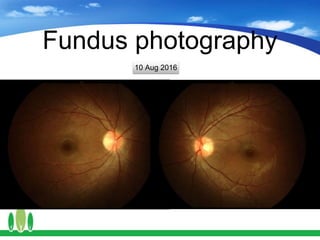
Fundus photography
10 Aug 2016
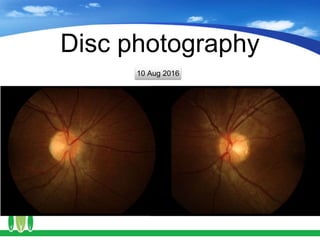
Disc photography
10 Aug 2016
Impaired color vision RE
10 Aug 2016
Color vision
Diffuse visual field defect RE
10 Aug 2016
CT VF 24-2
10 Aug 2016
MRI brain c
orbit
Right orbit seen enhancing optic
10 Aug 201610 Aug 2016
MRI spine
ill-defined multifocal intramedullary lesion C3 to
T10
15 Aug 2016 15 Aug 2016
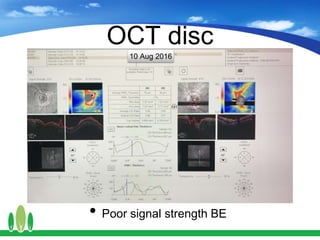
OCT disc
• Poor signal strength BE
10 Aug 2016
Lab
WBC Hb Hct PLT N L
CBC 7800 13.5 38.5 168000 68.3 28
BUN Cr K Na Cl CO2 hs-CRP
9.9 0.7 3.88 142 103.2 22.8 0.36
pH WBC RBC epi
UA 5.5 0-1 2-3 0-1
10 Aug 2016
Lab
Anti nuclear antibody Positive
Homogeneous1:1280
Speckle1:1280
Nuclear Dot 1:80
Anti-Toxoplasma gondi (IGM)
(ELISA)
Negative
Anti-Toxoplasma gondi (IGM)
(ELISA)
0.1
Anti-dsDNA-NcX(Quantitative) 3.2
Anti-dsDNA-NcX Negative
C3 1
C4 0.2
Anti- HIV Non-Reaction
VDRL Non-Reaction
TPHA Negative
10 Aug 2016
CSF protein sugar WBC RBC PMN Mono
CBC 38 64 6 - - -
NMO igG (CSF,serum) :negative
Oligoclonal band in CSF : positive
Quantiferon-TB : Negative
VEP : Slightly abnormal RE
Lab10 Aug 2016
Diagnosis
• Optic neuritis RE (Ddx NMO or MS)
• Intermediate uveitis BE (phlebitis R/O pars
planitis)
• R/O Autoimmune disease
Treatment
•Methylprednisolone 750 mg IV OD * 3
days(11-13 Aug 20/6)
-clinical improved 3 days(VA RE20/125) and
color vision normal
•pred (5) 7*1 oral(11days)
Progress note
Date VA RAPD
24 Aug 2016 RE : Fc' CC 20/200
LE : 20/40 PH not
positive RE
-Pred(5) 7*1
CTVF 24-2 : normal BE
26 Aug 2016 RE : 20/125 PH20/40 positive RE
23 Sep 2016 RE : 20/200 PH20/50 positive RE
28 Sep 2016 RE : 20/200 PH20/40 Negative
27/10/2016 -MRI brain c orbit c spine : slightly
enhancing of optic nerve RE
-MRI spine : No significant change of
lesion
1 Feb 2017 RE 20/125 PH not Negative
CTVF 24-2 : normal BE
color vision : normal BE
14 June 2017 RE 20/125 PH 20/63 Negative
MRI spine
• No significant change of lesion
27 Oct 2016
27 Oct201627 Oct2016
Present illness
1 day PTA : She had left eye pain and pain on eye
movement and suddenly blurred vision, no floater, no
flashing, no history of head/eye trauma, no history of
ocular surgery, no paresthesia/paralysis, no respiratory
symptom, no bowel/bladder symptom
Systemic review
• No fever
• No headache / severe dizziness / seizure /
unconsciousness / depression or mental illness
• No tinnitus
• No oral ulcer/severe sore
throat/tonsilitis/sinusitis/running nose/ abscessed teeth
• No UTI/proteinurea/hematurea/genital herpes
• No muscular pain/arthritis/stiffness/severe back pain
• No alopecia/poliosis/vitilligo/rash
Personal History
• No Smoking
• No ever eaten raw meat / unpasteurized milk / dirty
fruit or veggies
• No contact cat / dog / soil
• No insect bite
• No Hx of contact TB/chronic cough
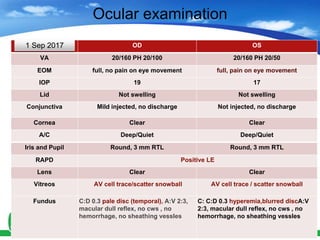
Ocular examination
OD OS
VA 20/160 PH 20/100 20/160 PH 20/50
EOM full, no pain on eye movement full, pain on eye movement
IOP 19 17
Lid Not swelling Not swelling
Conjunctiva Mild injected, no discharge Not injected, no discharge
Cornea Clear Clear
A/C Deep/Quiet Deep/Quiet
Iris and Pupil Round, 3 mm RTL Round, 3 mm RTL
RAPD Positive LE
Lens Clear Clear
Vitreos AV cell trace/scatter snowball AV cell trace / scatter snowball
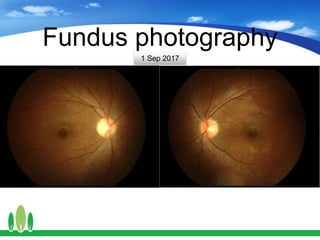
Fundus C:D 0.3 pale disc (temporal), A:V 2:3,
macular dull reflex, no cws , no
hemorrhage, no sheathing vessles
C: C:D 0.3 hyperemia,blurred discA:V
2:3, macular dull reflex, no cws , no
hemorrhage, no sheathing vessles
1 Sep 2017
Fundus photography
1 Sep 2017
Disc photography
1 Sep 2017
Problem Lists
• Young Thai female
• Acute painful visual loss
What is your DDX?
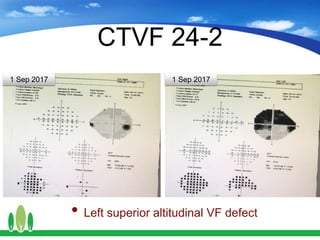
CTVF 24-2
• Left superior altitudinal VF defect
1 Sep 20171 Sep 2017
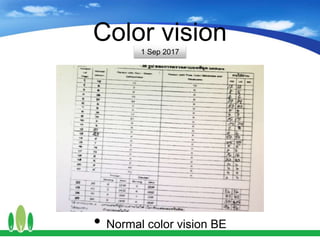
Color vision
• Normal color vision BE
1 Sep 2017
MRI brain c orbit
LE orbit seen enhancing optic nerve
No abnormal brain parenchyma
7 Sep 20177 Sep 2017
MRI spine
• No spine lesion
7 Sep 2017
Lab
WBC Hb Hct PLT N L
CBC 7600 12.6 38.3 238000 69.7 25.4
BUN Cr K Na Cl CO2 hs-CRP
10.2 0.66 3.38 139 101.6 26.1 1.3
pH WBC RBC epi
UA 6 0-1 0-1 0-1
1 Sep 2017
CSF protein sugar WBC RBC PMN Mono
CBC 38 71 6 43 - -
CSF c/s: No growth
NMO igG (CSF,serum) :negative
Oligoclonal band in CSF : positive
VEP : Abnormal RE
Lab
1 Sep 2017
Lab
ENA Profile plus 1 Positive
Anti-Jo-1 Negative
Anti-Ro-52 Negative
Anti-SCL70 Negative
Anti-RNP/Sm Positive 1+
Anti-SSA Negative
Anti-SSB Borderline
Anti-Sm Negative
Anti- HIV Non-Reaction
VDRL Non-Reaction
TPHA Negative
1 Sep 2017
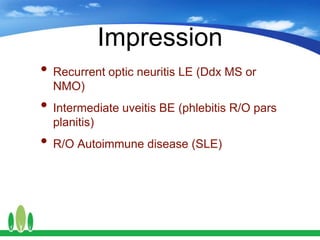
Impression
• Recurrent optic neuritis LE (Ddx MS or
NMO)
• Intermediate uveitis BE (phlebitis R/O pars
planitis)
• R/O Autoimmune disease (SLE)
Treatment
•Methylprednisolone 2 gm IV OD * 3 days(1-
3Sep 2017)
-clinical improved 3 days
•Prednisolone (5) 7*1 oral(11days)
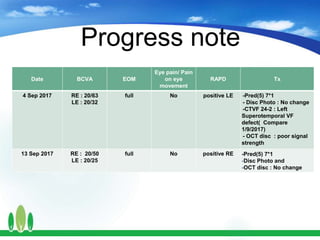
Progress note
Date BCVA EOM
Eye pain/ Pain
on eye
movement
RAPD Tx
4 Sep 2017 RE : 20/63
LE : 20/32
full No positive LE -Pred(5) 7*1
- Disc Photo : No change
-CTVF 24-2 : Left
Superotemporal VF
defect( Compare
1/9/2017)
- OCT disc : poor signal
strength
13 Sep 2017 RE : 20/50
LE : 20/25
full No positive RE -Pred(5) 7*1
-Disc Photo and
-OCT disc : No change
Disc photography
4 Sep 2017
Disc photography
13 Sep 2017
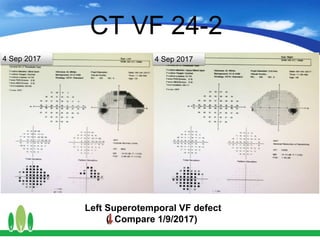
Left Superotemporal VF defect
( Compare 1/9/2017)
4 Sep 2017
CT VF 24-2
4 Sep 2017
OCT disc
4 Sep 2017
OCT discOCT disc
13 Sep 2017
DISCUSSION
Female
Young
History of optic neuritis RE
History of limb weakness
VF defect
Positive RAPD in each attack of effected eye
Color vision defect
Rapid VA gain after an attack
Positive finding on MRI
Positive result of oligoclonal band test
Negative result of NMO IgG
Presence of intermediate uveitis BE
Positive finding
Is it just an ordinary Optic neuritis?
Or Is it NMO!?
or Is it Optic neuritis with MS!?
OPTICNEURITIS
Optic Neuritis is a clinical diagnosis that is made when
a patient presents with
CLINICAL PRESENTATION PRESENC
E
pain with eye movement and/or periorbital discomfort
RAPD
visual field defect
optic nerve swelling (35% anterior disc edema, 65%
retrobulbar)
unilateral decreased visual acuity
OPTICNEURITIS
1.optic neuritis is a clinical diagnosis,
2.typical (unilateral vision decrease, pain with eye movement) optic neuritis will
recover with good visual prognosis by 6-12 months,
3.the final amount of vision recovery is independent of treatment with or without IV
IV steroids
4.oral prednisone alone is CONTRAINDICATED
5.MRI of the brain is a must after an initial episode of optic neuritis
OPTICNEURITIS
Up to 75% of MS patients have at least 1 episode of optic neuritis
The ONTT showed that even without any lesions present
on MRI, there still was a 16% chance of developing MS in
5 years, 22% in 10 years and 25% in 15 years.
At 10 years, the overall risk of MS was 38% after an initial episode of
optic neuritis. That risk is 56% if the MRI had 1 or more lesions.
OPTICNEURITIS
At 15 years, the overall risk of MS was 50% after an initial episode of
optic neuritis and strongly related to presence of lesions on a
baseline non-contrast-enhanced MRI of the brain.
No lesion on MRI brain = 25% chance of
developing MS
1 or more lesions on MRI brain = 72% chance of
developing MS
Talking about first attack
NMO
NMOSD without AQP4-IgG or NMOSD with unknown AQP4-IgG
status
1. At least 2 core clinical characteristics : Optic neuritis +LETM
acute myelitis (disseminated in space)
2. Negative test for AQP4-IgG from best detection method
3. Exclusion of alternative diagnosis
NMO Talking about first attack
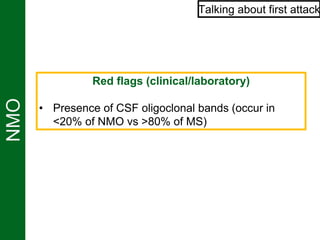
Red flags (clinical/laboratory)
• Presence of CSF oligoclonal bands (occur in
<20% of NMO vs >80% of MS)
NMO Talking about first attack
MS
SPACE TIME
Talking about first attack
MS Talking about first attack
SPACE TIME
She had negative MRI finding after follow up
approximately 30 days from attack
Talking about second attack
• This time she only has left optic nerve enhancement on
MRI
• No spine lesion on MRI
• Negative NMO IgG in serum and CSF
• Positive oligoclonal band
NMO
MS
SPACE TIME
Talking about second attack
• Uveitis is 10 times more common in MS patients
than in general population
• 30% of MS patients have uveitis
• Intermediate uveitis is the most common
manifestation of MS-associated uveitis
• 95% are bilateral
• Most patients develop mild vitritis with
periphlebitis
Chen L, GordonLK. Ocularn manifestations of multiple sclerosis. Curr Opin Ophthalmol.2005;16(5):315-320.
Zein G, Berta A, Foster CS. Multiplesclerosis-associated uveitis. OculImmunol Inflamm. 2004;12(2):137-142.
Evidence supporting MS theory
• Immunological abnormalities in the CSF are common in patients with
optic neuritis
• Frederiksen et al : abnormal CSF were present in 79% of 45 patients
with isolated optic neuritis which 69% were oligoclonal bands
• Soderstrom : oligoclonal bands were present in 69% of patients with
optic neuritis
• Predictive value of CSF oligoclonal bands for the development of CDMS
within 5 years after optic neuritis event : the presence of
oligoclonal bands was associated with the development of
CDMS (P=0.02) which was useful when MRI brain was
normal
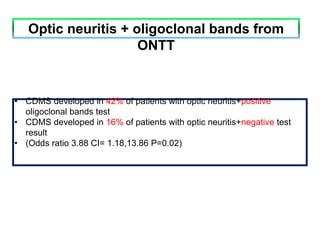
Optic neuritis + oligoclonal bands from
ONTT
• CDMS developed in 42% of patients with optic neuritis+positive
oligoclonal bands test
• CDMS developed in 16% of patients with optic neuritis+negative test
result
• (Odds ratio 3.88 CI= 1.18,13.86 P=0.02)
Optic neuritis + oligoclonal bands from
ONTT
• Among 39 patients with normal MRI brain, CDMS developed in 3 of 11
(27%) patients with oligoclonal bands present but in only 1 of 28% (4%)
without oligoclonal bands
• Among 37 patients with abnormal MRI brain, CDMS developed in 13 of
27 (48%) with oligoclonal bands and in 5 of 10 (50%) without oligoclonal
bands
Optic neuritis + oligoclonal bands from
ONTT
THANK
YOU

Interdepartment compilation

  • 1.
  • 2.
    Case • A 18-year-oldfemale • History of optic neuritis RE (1 yr)
  • 3.
  • 4.
    present illness 1 yrPTA : She was admitted to PMK hospital (10-16 Aug 2016) with acute visual loss RE (RE VA FC'2), no clinical eye pain/pain on eye movement, no floater, no flashing, no Hx of head/eye trauma, No Hx ocular Sx , she had paresthesia both legs, no respiratory/bowel/bladder symptoms
  • 5.
    OD OS VA FC'2PH not improved 20/80-1 PH 20/40-1 EOM full, no pain on eye movement full, no pain on eye movement IOP 12 16 Lid Not swelling Not swelling Conjunctiva No injected, No discharge Not injected, no discharge Cornea Clear Clear A/C Deep/Quiet Deep/Quiet Iris and Pupil Round, 3 mm RTL Round, 3 mm RTL RAPD Positive RE Lens Clear Clear Vitreos No AV cell /scatter vitreous clumping No AV cell / scatter vitreous clumping Fundus C:D 0.3, blurred disc margin, A:V 2:3, macular normal foveal reflex, scatter whitish retinal infiltration, sheathing vessels C:D 0.3, A:V 2:3, macular normal foveal reflex, scatter whitish retinal infiltration, sheathing vessels 10 Aug 2016 Ocular examination
  • 6.
  • 7.
  • 8.
    Impaired color visionRE 10 Aug 2016 Color vision
  • 9.
    Diffuse visual fielddefect RE 10 Aug 2016 CT VF 24-2 10 Aug 2016
  • 10.
    MRI brain c orbit Rightorbit seen enhancing optic 10 Aug 201610 Aug 2016
  • 11.
    MRI spine ill-defined multifocalintramedullary lesion C3 to T10 15 Aug 2016 15 Aug 2016
  • 12.
    OCT disc • Poorsignal strength BE 10 Aug 2016
  • 13.
    Lab WBC Hb HctPLT N L CBC 7800 13.5 38.5 168000 68.3 28 BUN Cr K Na Cl CO2 hs-CRP 9.9 0.7 3.88 142 103.2 22.8 0.36 pH WBC RBC epi UA 5.5 0-1 2-3 0-1 10 Aug 2016
  • 14.
    Lab Anti nuclear antibodyPositive Homogeneous1:1280 Speckle1:1280 Nuclear Dot 1:80 Anti-Toxoplasma gondi (IGM) (ELISA) Negative Anti-Toxoplasma gondi (IGM) (ELISA) 0.1 Anti-dsDNA-NcX(Quantitative) 3.2 Anti-dsDNA-NcX Negative C3 1 C4 0.2 Anti- HIV Non-Reaction VDRL Non-Reaction TPHA Negative 10 Aug 2016
  • 15.
    CSF protein sugarWBC RBC PMN Mono CBC 38 64 6 - - - NMO igG (CSF,serum) :negative Oligoclonal band in CSF : positive Quantiferon-TB : Negative VEP : Slightly abnormal RE Lab10 Aug 2016
  • 16.
    Diagnosis • Optic neuritisRE (Ddx NMO or MS) • Intermediate uveitis BE (phlebitis R/O pars planitis) • R/O Autoimmune disease
  • 17.
    Treatment •Methylprednisolone 750 mgIV OD * 3 days(11-13 Aug 20/6) -clinical improved 3 days(VA RE20/125) and color vision normal •pred (5) 7*1 oral(11days)
  • 18.
    Progress note Date VARAPD 24 Aug 2016 RE : Fc' CC 20/200 LE : 20/40 PH not positive RE -Pred(5) 7*1 CTVF 24-2 : normal BE 26 Aug 2016 RE : 20/125 PH20/40 positive RE 23 Sep 2016 RE : 20/200 PH20/50 positive RE 28 Sep 2016 RE : 20/200 PH20/40 Negative 27/10/2016 -MRI brain c orbit c spine : slightly enhancing of optic nerve RE -MRI spine : No significant change of lesion 1 Feb 2017 RE 20/125 PH not Negative CTVF 24-2 : normal BE color vision : normal BE 14 June 2017 RE 20/125 PH 20/63 Negative
  • 19.
    MRI spine • Nosignificant change of lesion 27 Oct 2016 27 Oct201627 Oct2016
  • 20.
    Present illness 1 dayPTA : She had left eye pain and pain on eye movement and suddenly blurred vision, no floater, no flashing, no history of head/eye trauma, no history of ocular surgery, no paresthesia/paralysis, no respiratory symptom, no bowel/bladder symptom
  • 21.
    Systemic review • Nofever • No headache / severe dizziness / seizure / unconsciousness / depression or mental illness • No tinnitus • No oral ulcer/severe sore throat/tonsilitis/sinusitis/running nose/ abscessed teeth • No UTI/proteinurea/hematurea/genital herpes • No muscular pain/arthritis/stiffness/severe back pain • No alopecia/poliosis/vitilligo/rash
  • 22.
    Personal History • NoSmoking • No ever eaten raw meat / unpasteurized milk / dirty fruit or veggies • No contact cat / dog / soil • No insect bite • No Hx of contact TB/chronic cough
  • 23.
    Ocular examination OD OS VA20/160 PH 20/100 20/160 PH 20/50 EOM full, no pain on eye movement full, pain on eye movement IOP 19 17 Lid Not swelling Not swelling Conjunctiva Mild injected, no discharge Not injected, no discharge Cornea Clear Clear A/C Deep/Quiet Deep/Quiet Iris and Pupil Round, 3 mm RTL Round, 3 mm RTL RAPD Positive LE Lens Clear Clear Vitreos AV cell trace/scatter snowball AV cell trace / scatter snowball Fundus C:D 0.3 pale disc (temporal), A:V 2:3, macular dull reflex, no cws , no hemorrhage, no sheathing vessles C: C:D 0.3 hyperemia,blurred discA:V 2:3, macular dull reflex, no cws , no hemorrhage, no sheathing vessles 1 Sep 2017
  • 24.
  • 25.
  • 26.
    Problem Lists • YoungThai female • Acute painful visual loss What is your DDX?
  • 27.
    CTVF 24-2 • Leftsuperior altitudinal VF defect 1 Sep 20171 Sep 2017
  • 28.
    Color vision • Normalcolor vision BE 1 Sep 2017
  • 29.
    MRI brain corbit LE orbit seen enhancing optic nerve No abnormal brain parenchyma 7 Sep 20177 Sep 2017
  • 30.
    MRI spine • Nospine lesion 7 Sep 2017
  • 31.
    Lab WBC Hb HctPLT N L CBC 7600 12.6 38.3 238000 69.7 25.4 BUN Cr K Na Cl CO2 hs-CRP 10.2 0.66 3.38 139 101.6 26.1 1.3 pH WBC RBC epi UA 6 0-1 0-1 0-1 1 Sep 2017
  • 32.
    CSF protein sugarWBC RBC PMN Mono CBC 38 71 6 43 - - CSF c/s: No growth NMO igG (CSF,serum) :negative Oligoclonal band in CSF : positive VEP : Abnormal RE Lab 1 Sep 2017
  • 33.
    Lab ENA Profile plus1 Positive Anti-Jo-1 Negative Anti-Ro-52 Negative Anti-SCL70 Negative Anti-RNP/Sm Positive 1+ Anti-SSA Negative Anti-SSB Borderline Anti-Sm Negative Anti- HIV Non-Reaction VDRL Non-Reaction TPHA Negative 1 Sep 2017
  • 34.
    Impression • Recurrent opticneuritis LE (Ddx MS or NMO) • Intermediate uveitis BE (phlebitis R/O pars planitis) • R/O Autoimmune disease (SLE)
  • 35.
    Treatment •Methylprednisolone 2 gmIV OD * 3 days(1- 3Sep 2017) -clinical improved 3 days •Prednisolone (5) 7*1 oral(11days)
  • 36.
    Progress note Date BCVAEOM Eye pain/ Pain on eye movement RAPD Tx 4 Sep 2017 RE : 20/63 LE : 20/32 full No positive LE -Pred(5) 7*1 - Disc Photo : No change -CTVF 24-2 : Left Superotemporal VF defect( Compare 1/9/2017) - OCT disc : poor signal strength 13 Sep 2017 RE : 20/50 LE : 20/25 full No positive RE -Pred(5) 7*1 -Disc Photo and -OCT disc : No change
  • 37.
  • 38.
  • 39.
    Left Superotemporal VFdefect ( Compare 1/9/2017) 4 Sep 2017 CT VF 24-2 4 Sep 2017
  • 40.
  • 41.
  • 42.
  • 43.
    Female Young History of opticneuritis RE History of limb weakness VF defect Positive RAPD in each attack of effected eye Color vision defect Rapid VA gain after an attack Positive finding on MRI Positive result of oligoclonal band test Negative result of NMO IgG Presence of intermediate uveitis BE Positive finding
  • 44.
    Is it justan ordinary Optic neuritis? Or Is it NMO!? or Is it Optic neuritis with MS!?
  • 45.
    OPTICNEURITIS Optic Neuritis isa clinical diagnosis that is made when a patient presents with CLINICAL PRESENTATION PRESENC E pain with eye movement and/or periorbital discomfort RAPD visual field defect optic nerve swelling (35% anterior disc edema, 65% retrobulbar) unilateral decreased visual acuity
  • 46.
    OPTICNEURITIS 1.optic neuritis isa clinical diagnosis, 2.typical (unilateral vision decrease, pain with eye movement) optic neuritis will recover with good visual prognosis by 6-12 months, 3.the final amount of vision recovery is independent of treatment with or without IV IV steroids 4.oral prednisone alone is CONTRAINDICATED 5.MRI of the brain is a must after an initial episode of optic neuritis
  • 47.
    OPTICNEURITIS Up to 75%of MS patients have at least 1 episode of optic neuritis The ONTT showed that even without any lesions present on MRI, there still was a 16% chance of developing MS in 5 years, 22% in 10 years and 25% in 15 years. At 10 years, the overall risk of MS was 38% after an initial episode of optic neuritis. That risk is 56% if the MRI had 1 or more lesions.
  • 48.
    OPTICNEURITIS At 15 years,the overall risk of MS was 50% after an initial episode of optic neuritis and strongly related to presence of lesions on a baseline non-contrast-enhanced MRI of the brain. No lesion on MRI brain = 25% chance of developing MS 1 or more lesions on MRI brain = 72% chance of developing MS
  • 49.
    Talking about firstattack NMO NMOSD without AQP4-IgG or NMOSD with unknown AQP4-IgG status 1. At least 2 core clinical characteristics : Optic neuritis +LETM acute myelitis (disseminated in space) 2. Negative test for AQP4-IgG from best detection method 3. Exclusion of alternative diagnosis
  • 50.
    NMO Talking aboutfirst attack Red flags (clinical/laboratory) • Presence of CSF oligoclonal bands (occur in <20% of NMO vs >80% of MS)
  • 51.
    NMO Talking aboutfirst attack
  • 52.
  • 53.
    MS Talking aboutfirst attack SPACE TIME She had negative MRI finding after follow up approximately 30 days from attack
  • 54.
    Talking about secondattack • This time she only has left optic nerve enhancement on MRI • No spine lesion on MRI • Negative NMO IgG in serum and CSF • Positive oligoclonal band NMO
  • 55.
  • 56.
    • Uveitis is10 times more common in MS patients than in general population • 30% of MS patients have uveitis • Intermediate uveitis is the most common manifestation of MS-associated uveitis • 95% are bilateral • Most patients develop mild vitritis with periphlebitis Chen L, GordonLK. Ocularn manifestations of multiple sclerosis. Curr Opin Ophthalmol.2005;16(5):315-320. Zein G, Berta A, Foster CS. Multiplesclerosis-associated uveitis. OculImmunol Inflamm. 2004;12(2):137-142. Evidence supporting MS theory
  • 57.
    • Immunological abnormalitiesin the CSF are common in patients with optic neuritis • Frederiksen et al : abnormal CSF were present in 79% of 45 patients with isolated optic neuritis which 69% were oligoclonal bands • Soderstrom : oligoclonal bands were present in 69% of patients with optic neuritis • Predictive value of CSF oligoclonal bands for the development of CDMS within 5 years after optic neuritis event : the presence of oligoclonal bands was associated with the development of CDMS (P=0.02) which was useful when MRI brain was normal Optic neuritis + oligoclonal bands from ONTT
  • 58.
    • CDMS developedin 42% of patients with optic neuritis+positive oligoclonal bands test • CDMS developed in 16% of patients with optic neuritis+negative test result • (Odds ratio 3.88 CI= 1.18,13.86 P=0.02) Optic neuritis + oligoclonal bands from ONTT
  • 59.
    • Among 39patients with normal MRI brain, CDMS developed in 3 of 11 (27%) patients with oligoclonal bands present but in only 1 of 28% (4%) without oligoclonal bands • Among 37 patients with abnormal MRI brain, CDMS developed in 13 of 27 (48%) with oligoclonal bands and in 5 of 10 (50%) without oligoclonal bands Optic neuritis + oligoclonal bands from ONTT
  • 60.

Editor's Notes

  • #47 thus MRI of the orbit with gadolinium looking for optic nerve enhancement, blood testing for inflammatory or infectious etiologies, and lumbar puncture are not needed for the diagnosis, (IV STEROIDS DO NOT IMPROVE VISUAL OUTCOME, THE NATURAL HISTORY AND PROGNOSIS OF TYPICAL OPTIC NEURITIS IS VERY FAVORABLE WITH OR WITHOUT IV STEROID TREATMENT), because it has been shown to cause more recurrences to the affected eye or new episodes in the contralateral eye compared to placebo or IV steroids followed by oral prednisone because the number of lesions will stratify patients’ risk for developing clinically definite multiple sclerosis (CDMS) after a clinically isolated syndrome (CIS),
  • #48 Since optic neuritis is common among patients who have MS, (up to 75% have at least one episode of optic neuritis in their life time), these patients are at risk for developing CDMS.
  • #49 In patients with CDMS, the median time to diagnosis was 3 years and 34% of the diagnoses were made in the first 2 years whereas 72% were made within 5 years. 25% of patients with no lesions on baseline brain MRI developed MS during follow-up compared with 72% of patients with 1 or more lesions. Baseline factors associated with a lower risk for MS included male sex, optic disc swelling, and atypical features of optic neuritis.
  • #50 NMOSD without AQP4-IgG or NMOSD with unknown AQP4-IgG status At least 2 core clinical characteristics : Optic neuritis +LETM acute myelitis (disseminated in space) Negative test for AQP4-IgG from best detection method
  • #51 NMOSD without AQP4-IgG or NMOSD with unknown AQP4-IgG status At least 2 core clinical characteristics : Optic neuritis +LETM acute myelitis (disseminated in space) Negative test for AQP4-IgG from best detection method