Summer School 2012


Resources
& Memory
      Yuriy Guts
     R&D Engineer

  yuriy.guts@eleks.com
Summer School 2012


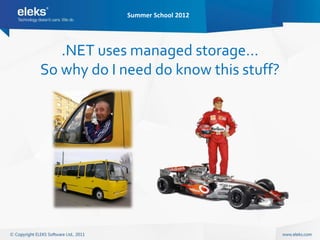
   .NET uses managed storage…
So why do I need do know this stuff?
Summer School 2012


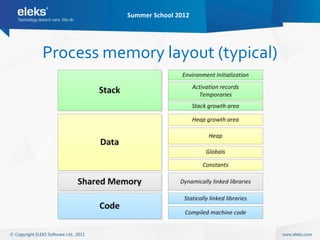
Process memory layout (typical)
Summer School 2012


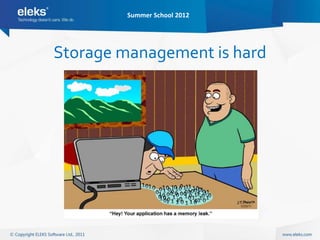
Storage management is hard
Summer School 2012


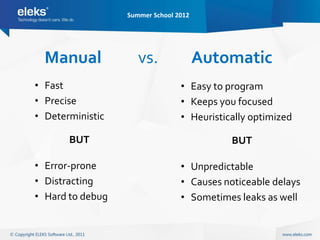
  Manual             vs.               Automatic
• Fast                           • Easy to program
• Precise                        • Keeps you focused
• Deterministic                  • Heuristically optimized

       BUT                                  BUT

• Error-prone                    • Unpredictable
• Distracting                    • Causes noticeable delays
• Hard to debug                  • Sometimes leaks as well
Summer School 2012


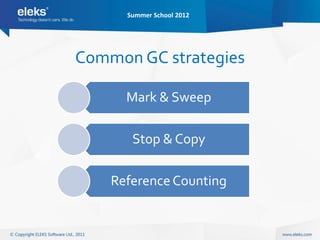
Common GC strategies

      Mark & Sweep

       Stop & Copy

    Reference Counting
Summer School 2012


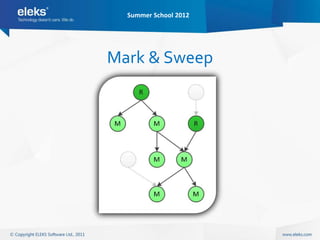
Mark & Sweep
Summer School 2012


                 Advantages
• Keeps objects in their places
• Will work well with pointer arithmetics
Summer School 2012


               Disadvantages
• Can cause heap fragmentation
• Must process every object in the heap
• May require O(n) space to execute
Summer School 2012


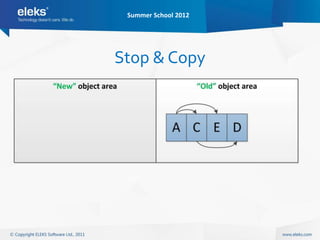
Stop & Copy
Summer School 2012


                 Advantages
• Fast allocation and collection
• Operates only on live objects
• Does not cause fragmentation
Summer School 2012


              Disadvantages
• May require some time and space to rearrange
  pointers on live objects
• Unsuitable for C / C++
Summer School 2012


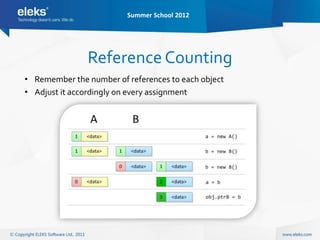
               Reference Counting
• Remember the number of references to each object
• Adjust it accordingly on every assignment
Summer School 2012


                Advantages
• Easy to implement
• Collects garbage incrementally without
  significant delays
Summer School 2012


              Disadvantages
• Unable to clean up circular structures
• Requires atomic operations (expensive)
• Slows down assignment operations
Summer School 2012


            ??      ?
Which approach does .NET use?
Summer School 2012


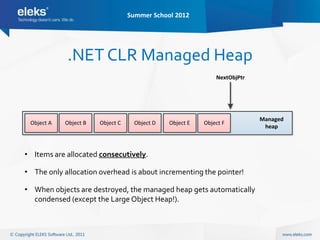
            .NET CLR Managed Heap
                                                             NextObjPtr


                                                                          Managed
 Object A   Object B   Object C    Object D   Object E   Object F
                                                                           heap


• Items are allocated consecutively.

• The only allocation overhead is about incrementing the pointer!

• When objects are destroyed, the managed heap gets automatically
  condensed (except the Large Object Heap!).
Summer School 2012


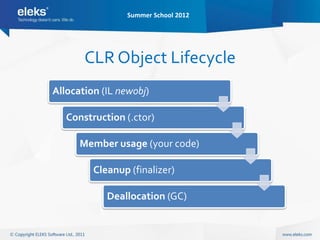
       CLR Object Lifecycle
Allocation (IL newobj)

   Construction (.ctor)

      Member usage (your code)

         Cleanup (finalizer)

            Deallocation (GC)
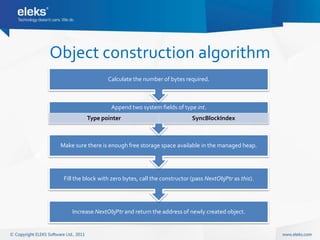
Object construction algorithm
                    Calculate the number of bytes required.


                     Append two system fields of type int.
           Type pointer                                SyncBlockIndex


 Make sure there is enough free storage space available in the managed heap.


  Fill the block with zero bytes, call the constructor (pass NextObjPtr as this).


     Increase NextObjPtr and return the address of newly created object.
Summer School 2012


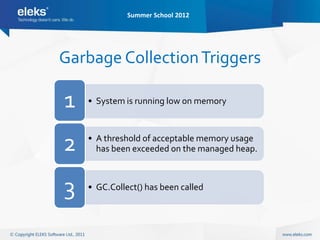
Garbage Collection Triggers

1   • System is running low on memory


2   • A threshold of acceptable memory usage
      has been exceeded on the managed heap.


3   • GC.Collect() has been called
Summer School 2012


 Garbage Collection Algorithm
        Suspend all threads except the one that triggered GC

 Thread 1 [GC’ing]        Thread 2 [suspended]        Thread 3 [suspended]


                 Define application roots (live objects)

Stack roots          GC handles       Static objects       CPU registers


                            Mark & Sweep


               Heap Defragmentation (relocate objects).
Summer School 2012


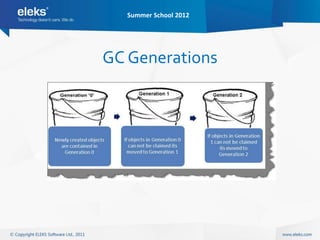
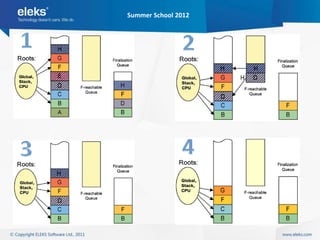
GC Generations
Summer School 2012


 Deterministic Cleanup: IDisposable
[ComVisibleAttribute(true)]
public interface IDisposable
{
  void Dispose();
}


Dispose() — Performs application-defined tasks associated with freeing, releasing,
or resetting resources.
Summer School 2012


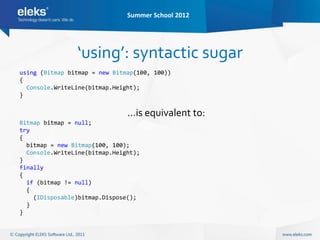
                ‘using’: syntactic sugar
using (Bitmap bitmap = new Bitmap(100, 100))
{
  Console.WriteLine(bitmap.Height);
}


                               …is equivalent to:
Bitmap bitmap = null;
try
{
  bitmap = new Bitmap(100, 100);
  Console.WriteLine(bitmap.Height);
}
finally
{
  if (bitmap != null)
  {
    (IDisposable)bitmap.Dispose();
  }
}
Summer School 2012


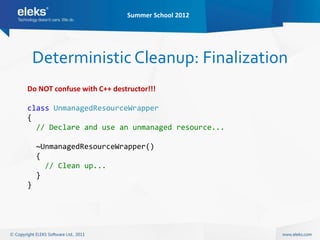
    Deterministic Cleanup: Finalization
Do NOT confuse with C++ destructor!!!

class UnmanagedResourceWrapper
{
  // Declare and use an unmanaged resource...

    ~UnmanagedResourceWrapper()
    {
      // Clean up...
    }
}
Summer School 2012
Summer School 2012


              Some Best Practices

1   • DON’T use IDisposable and/or Finalize unless you really have to (see below).
    • DON’T use Finalize if you do not have unmanaged resources (such as handles).


    • Use IDisposable if your type works with managed resources or contains an
2     IDisposable member.
    • Make sure you call base.Dispose() if base class is IDisposable.


3   • Use IDisposable AND Finalize if your type works with unmanaged resources.
    • Finalize() should always release the resource and not throw any exceptions.
Summer School 2012


 GCHandle Tricks

Lifetime monitoring & control


Pinning objects in memory


Weak references
Summer School 2012


   ??      ?
  Q&A
yuriy.guts@eleks.com
Summer School 2012


Thank you!

ELEKS Summer School 2012: .NET 04 - Resources and Memory

  • 1.
    Summer School 2012 Resources &Memory Yuriy Guts R&D Engineer yuriy.guts@eleks.com
  • 2.
    Summer School 2012 .NET uses managed storage… So why do I need do know this stuff?
  • 3.
    Summer School 2012 Processmemory layout (typical)
  • 4.
    Summer School 2012 Storagemanagement is hard
  • 5.
    Summer School 2012 Manual vs. Automatic • Fast • Easy to program • Precise • Keeps you focused • Deterministic • Heuristically optimized BUT BUT • Error-prone • Unpredictable • Distracting • Causes noticeable delays • Hard to debug • Sometimes leaks as well
  • 6.
    Summer School 2012 CommonGC strategies Mark & Sweep Stop & Copy Reference Counting
  • 7.
  • 8.
    Summer School 2012 Advantages • Keeps objects in their places • Will work well with pointer arithmetics
  • 9.
    Summer School 2012 Disadvantages • Can cause heap fragmentation • Must process every object in the heap • May require O(n) space to execute
  • 10.
  • 11.
    Summer School 2012 Advantages • Fast allocation and collection • Operates only on live objects • Does not cause fragmentation
  • 12.
    Summer School 2012 Disadvantages • May require some time and space to rearrange pointers on live objects • Unsuitable for C / C++
  • 13.
    Summer School 2012 Reference Counting • Remember the number of references to each object • Adjust it accordingly on every assignment
  • 14.
    Summer School 2012 Advantages • Easy to implement • Collects garbage incrementally without significant delays
  • 15.
    Summer School 2012 Disadvantages • Unable to clean up circular structures • Requires atomic operations (expensive) • Slows down assignment operations
  • 16.
    Summer School 2012 ?? ? Which approach does .NET use?
  • 17.
    Summer School 2012 .NET CLR Managed Heap NextObjPtr Managed Object A Object B Object C Object D Object E Object F heap • Items are allocated consecutively. • The only allocation overhead is about incrementing the pointer! • When objects are destroyed, the managed heap gets automatically condensed (except the Large Object Heap!).
  • 18.
    Summer School 2012 CLR Object Lifecycle Allocation (IL newobj) Construction (.ctor) Member usage (your code) Cleanup (finalizer) Deallocation (GC)
  • 19.
    Object construction algorithm Calculate the number of bytes required. Append two system fields of type int. Type pointer SyncBlockIndex Make sure there is enough free storage space available in the managed heap. Fill the block with zero bytes, call the constructor (pass NextObjPtr as this). Increase NextObjPtr and return the address of newly created object.
  • 20.
    Summer School 2012 GarbageCollection Triggers 1 • System is running low on memory 2 • A threshold of acceptable memory usage has been exceeded on the managed heap. 3 • GC.Collect() has been called
  • 21.
    Summer School 2012 Garbage Collection Algorithm Suspend all threads except the one that triggered GC Thread 1 [GC’ing] Thread 2 [suspended] Thread 3 [suspended] Define application roots (live objects) Stack roots GC handles Static objects CPU registers Mark & Sweep Heap Defragmentation (relocate objects).
  • 22.
  • 23.
    Summer School 2012 Deterministic Cleanup: IDisposable [ComVisibleAttribute(true)] public interface IDisposable { void Dispose(); } Dispose() — Performs application-defined tasks associated with freeing, releasing, or resetting resources.
  • 24.
    Summer School 2012 ‘using’: syntactic sugar using (Bitmap bitmap = new Bitmap(100, 100)) { Console.WriteLine(bitmap.Height); } …is equivalent to: Bitmap bitmap = null; try { bitmap = new Bitmap(100, 100); Console.WriteLine(bitmap.Height); } finally { if (bitmap != null) { (IDisposable)bitmap.Dispose(); } }
  • 25.
    Summer School 2012 Deterministic Cleanup: Finalization Do NOT confuse with C++ destructor!!! class UnmanagedResourceWrapper { // Declare and use an unmanaged resource... ~UnmanagedResourceWrapper() { // Clean up... } }
  • 26.
  • 27.
    Summer School 2012 Some Best Practices 1 • DON’T use IDisposable and/or Finalize unless you really have to (see below). • DON’T use Finalize if you do not have unmanaged resources (such as handles). • Use IDisposable if your type works with managed resources or contains an 2 IDisposable member. • Make sure you call base.Dispose() if base class is IDisposable. 3 • Use IDisposable AND Finalize if your type works with unmanaged resources. • Finalize() should always release the resource and not throw any exceptions.
  • 28.
    Summer School 2012 GCHandle Tricks Lifetime monitoring & control Pinning objects in memory Weak references
  • 29.
    Summer School 2012 ?? ? Q&A yuriy.guts@eleks.com
  • 30.