Opportunities
Extended Project
Qualification and
beyond
presented by John Iona @LIASA-SLYSIG Conference 2016
Session Objectives
Plan for the session
• Have an overview of what EPQ is.
• Know how EPQ was run at OAE.
• Have an understanding of the assessment objectives.
• To see how this informs supporting information literacy in the curriculum.
What is EPQ?
A stand-alone qualification aimed at allowing
students to demonstrate their skills including
planning, researching, time-management and
evaluation.
Offered with AQA and Edexcel.
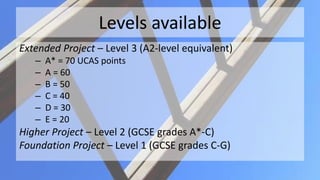
Levels available
Extended Project – Level 3 (A2-level equivalent)
– A* = 70 UCAS points
– A = 60
– B = 50
– C = 40
– D = 30
– E = 20
Higher Project – Level 2 (GCSE grades A*-C)
Foundation Project – Level 1 (GCSE grades C-G)
Know how EPQ is run at OAE.
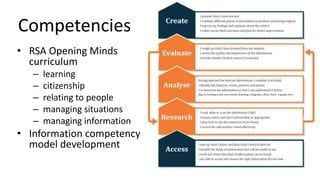
Competencies
• RSA Opening Minds
curriculum
– learning
– citizenship
– relating to people
– managing situations
– managing information
• Information competency
model development
Competences for Relating to People
Leadership – students understand how to relate to other
people in varying contexts in which they might find
themselves, including those where they manage, or are
managed by, others; and how to get things done.
Teamwork – students understand how to operate in
teams and their own capacities for filling different team
roles.
Coaching – students understand how to develop other
people, whether as peer or teacher.
Communication – students develop a range of
techniques for communicating by different means, and
understand how and when to use them.
Emotional intelligence – students develop competence
in managing personal and emotional relationships.
Stress management – students understand and are able
to use varying means of managing stress and conflict
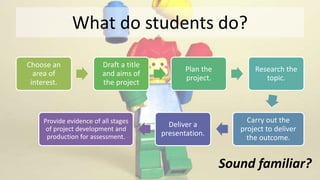
What do students do?
Choose an
area of
interest.
Draft a title
and aims of
the project
Plan the
project.
Research the
topic.
Carry out the
project to deliver
the outcome.
Deliver a
presentation.
Provide evidence of all stages
of project development and
production for assessment.
Sound familiar?
Is marriage obsolete in modern,
secular, British society?
Are Premiership footballers overpaid?
Nature versus nurture: Is evil born or raised?
Is there such a thing as true love?
Is there a correlation between the world’s population and global warming?
Is freedom of information more important than a celebrity’s privacy?
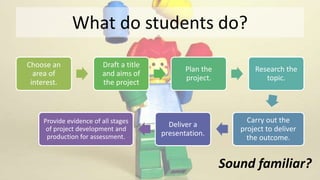
What do students do?
Choose an
area of
interest.
Draft a title
and aims of
the project
Plan the
project.
Research the
topic.
Carry out the
project to deliver
the outcome.
Deliver a
presentation.
Provide evidence of all stages
of project development and
production for assessment.
Sound familiar?
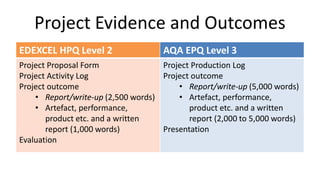
Project Evidence and Outcomes
EDEXCEL HPQ Level 2 AQA EPQ Level 3
Project Proposal Form
Project Activity Log
Project outcome
• Report/write-up (2,500 words)
• Artefact, performance,
product etc. and a written
report (1,000 words)
Evaluation
Project Production Log
Project outcome
• Report/write-up (5,000 words)
• Artefact, performance,
product etc. and a written
report (2,000 to 5,000 words)
Presentation
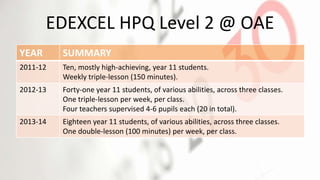
EDEXCEL HPQ Level 2 @ OAE
YEAR SUMMARY
2011-12 Ten, mostly high-achieving, year 11 students.
Weekly triple-lesson (150 minutes).
2012-13 Forty-one year 11 students, of various abilities, across three classes.
One triple-lesson per week, per class.
Four teachers supervised 4-6 pupils each (20 in total).
2013-14 Eighteen year 11 students, of various abilities, across three classes.
One double-lesson (100 minutes) per week, per class.
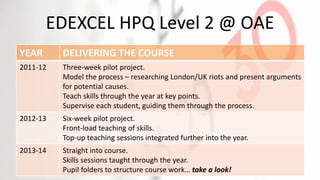
EDEXCEL HPQ Level 2 @ OAE
YEAR DELIVERING THE COURSE
2011-12 Three-week pilot project.
Model the process – researching London/UK riots and present arguments
for potential causes.
Teach skills through the year at key points.
Supervise each student, guiding them through the process.
2012-13 Six-week pilot project.
Front-load teaching of skills.
Top-up teaching sessions integrated further into the year.
2013-14 Straight into course.
Skills sessions taught through the year.
Pupil folders to structure course work… take a look!
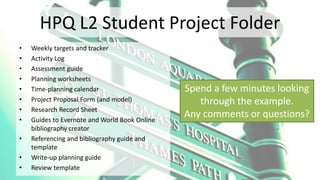
HPQ L2 Student Project Folder
• Weekly targets and tracker
• Activity Log
• Assessment guide
• Planning worksheets
• Time-planning calendar
• Project Proposal Form (and model)
• Research Record Sheet
• Guides to Evernote and World Book Online
bibliography creator
• Referencing and bibliography guide and
template
• Write-up planning guide
• Review template
Spend a few minutes looking
through the example.
Any comments or questions?
AQA EPQ Level 3 @ OAE
YEAR SUMMARY
2012-13 10 high-achieving year 12 students.
Part of AQA Baccalaureate.
Run by Assistant Principal with support from Librarian.
2013-14 Co-ordinate, plan and deliver.
19 mixed-ability year 13 students.
Top-up qualification for students who dropped a course from year 12
who needed UCAS points for course applications.
Challenging approach (for me anyway!)
AQA EPQ Level 3 @ OAE
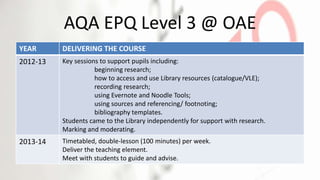
YEAR DELIVERING THE COURSE
2012-13 Key sessions to support pupils including:
beginning research;
how to access and use Library resources (catalogue/VLE);
recording research;
using Evernote and Noodle Tools;
using sources and referencing/ footnoting;
bibliography templates.
Students came to the Library independently for support with research.
Marking and moderating.
2013-14 Timetabled, double-lesson (100 minutes) per week.
Deliver the teaching element.
Meet with students to guide and advise.
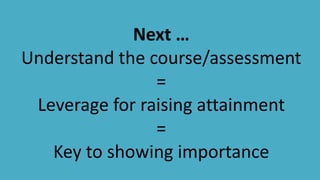
Next …
Understand the course/assessment
=
Leverage for raising attainment
=
Key to showing importance
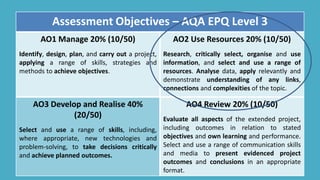
AssessmentAssessment Objectives – AQA EPQ Level 3
AO1 Manage 20% (10/50)
Identify, design, plan, and carry out a project,
applying a range of skills, strategies and
methods to achieve objectives.
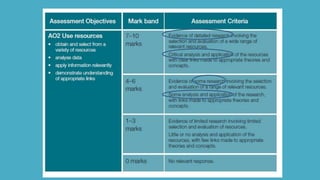
AO2 Use Resources 20% (10/50)
Research, critically select, organise and use
information, and select and use a range of
resources. Analyse data, apply relevantly and
demonstrate understanding of any links,
connections and complexities of the topic.
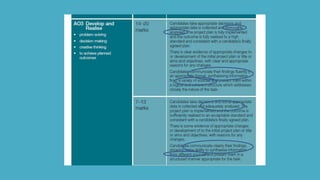
AO3 Develop and Realise 40%
(20/50)
Select and use a range of skills, including,
where appropriate, new technologies and
problem-solving, to take decisions critically
and achieve planned outcomes.
AO4 Review 20% (10/50)
Evaluate all aspects of the extended project,
including outcomes in relation to stated
objectives and own learning and performance.
Select and use a range of communication skills
and media to present evidenced project
outcomes and conclusions in an appropriate
format.
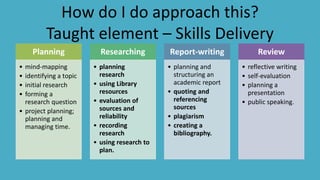
How do I do approach this?
Taught element – Skills Delivery
Planning
• mind-mapping
• identifying a topic
• initial research
• forming a
research question
• project planning;
planning and
managing time.
Researching
• planning
research
• using Library
resources
• evaluation of
sources and
reliability
• recording
research
• using research to
plan.
Report-writing
• planning and
structuring an
academic report
• quoting and
referencing
sources
• plagiarism
• creating a
bibliography.
Review
• reflective writing
• self-evaluation
• planning a
presentation
• public speaking.
What have I got from EPQ?
• Raised the profile (to an extent) of the Library
and Librarian among ALT, staff and pupils.
• Collaboration with, and management of,
teaching staff.
• Insight into information literacy skills within a
course/qualification.
What else have I got from EPQ?
• Responsibility for managing, planning and
delivering a course.
• Understand the planning of a course and
lessons to an exam board specification.
• Engagement with assessment objectives.
• Marking and assessing.
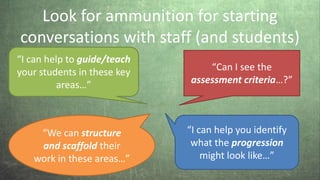
Look for ammunition for starting
conversations with staff (and students)
“I can help to guide/teach
your students in these key
areas…”
“I can help you identify
what the progression
might look like…”
“We can structure
and scaffold their
work in these areas…”
“Can I see the
assessment criteria…?”
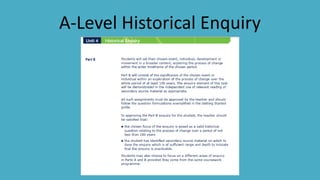
A-Level Historical Enquiry
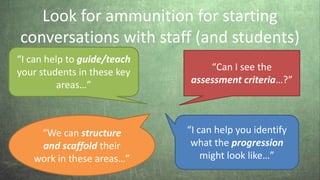
Look for ammunition for starting
conversations with staff (and students)
“I can help to guide/teach
your students in these key
areas…”
“I can help you identify
what the progression
might look like…”
“We can structure
and scaffold their
work in these areas…”
“Can I see the
assessment criteria…?”
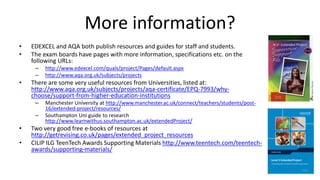
More information?
• EDEXCEL and AQA both publish resources and guides for staff and students.
• The exam boards have pages with more information, specifications etc. on the
following URLs:
– http://www.edexcel.com/quals/project/Pages/default.aspx
– http://www.aqa.org.uk/subjects/projects
• There are some very useful resources from Universities, listed at:
http://www.aqa.org.uk/subjects/projects/aqa-certificate/EPQ-7993/why-
choose/support-from-higher-education-institutions
– Manchester University at http://www.manchester.ac.uk/connect/teachers/students/post-
16/extended-project/resources/
– Southampton Uni guide to research
http://www.learnwithus.southampton.ac.uk/extendedProject/
• Two very good free e-books of resources at
http://getrevising.co.uk/pages/extended_project_resources
• CILIP ILG TeenTech Awards Supporting Materials http://www.teentech.com/teentech-
awards/supporting-materials/
Any questions?
Presented by John Iona.
Blog: Jionalibrarian.wordpress.com
Email: mrjohniona@gmail.com

Opportunities extended project qualification and beyond

  • 1.
  • 2.
    Session Objectives Plan forthe session • Have an overview of what EPQ is. • Know how EPQ was run at OAE. • Have an understanding of the assessment objectives. • To see how this informs supporting information literacy in the curriculum.
  • 3.
    What is EPQ? Astand-alone qualification aimed at allowing students to demonstrate their skills including planning, researching, time-management and evaluation. Offered with AQA and Edexcel.
  • 4.
    Levels available Extended Project– Level 3 (A2-level equivalent) – A* = 70 UCAS points – A = 60 – B = 50 – C = 40 – D = 30 – E = 20 Higher Project – Level 2 (GCSE grades A*-C) Foundation Project – Level 1 (GCSE grades C-G)
  • 5.
    Know how EPQis run at OAE.
  • 6.
    Competencies • RSA OpeningMinds curriculum – learning – citizenship – relating to people – managing situations – managing information • Information competency model development Competences for Relating to People Leadership – students understand how to relate to other people in varying contexts in which they might find themselves, including those where they manage, or are managed by, others; and how to get things done. Teamwork – students understand how to operate in teams and their own capacities for filling different team roles. Coaching – students understand how to develop other people, whether as peer or teacher. Communication – students develop a range of techniques for communicating by different means, and understand how and when to use them. Emotional intelligence – students develop competence in managing personal and emotional relationships. Stress management – students understand and are able to use varying means of managing stress and conflict
  • 8.
    What do studentsdo? Choose an area of interest. Draft a title and aims of the project Plan the project. Research the topic. Carry out the project to deliver the outcome. Deliver a presentation. Provide evidence of all stages of project development and production for assessment. Sound familiar?
  • 9.
    Is marriage obsoletein modern, secular, British society? Are Premiership footballers overpaid? Nature versus nurture: Is evil born or raised? Is there such a thing as true love? Is there a correlation between the world’s population and global warming? Is freedom of information more important than a celebrity’s privacy?
  • 10.
    What do studentsdo? Choose an area of interest. Draft a title and aims of the project Plan the project. Research the topic. Carry out the project to deliver the outcome. Deliver a presentation. Provide evidence of all stages of project development and production for assessment. Sound familiar?
  • 11.
    Project Evidence andOutcomes EDEXCEL HPQ Level 2 AQA EPQ Level 3 Project Proposal Form Project Activity Log Project outcome • Report/write-up (2,500 words) • Artefact, performance, product etc. and a written report (1,000 words) Evaluation Project Production Log Project outcome • Report/write-up (5,000 words) • Artefact, performance, product etc. and a written report (2,000 to 5,000 words) Presentation
  • 13.
    EDEXCEL HPQ Level2 @ OAE YEAR SUMMARY 2011-12 Ten, mostly high-achieving, year 11 students. Weekly triple-lesson (150 minutes). 2012-13 Forty-one year 11 students, of various abilities, across three classes. One triple-lesson per week, per class. Four teachers supervised 4-6 pupils each (20 in total). 2013-14 Eighteen year 11 students, of various abilities, across three classes. One double-lesson (100 minutes) per week, per class.
  • 14.
    EDEXCEL HPQ Level2 @ OAE YEAR DELIVERING THE COURSE 2011-12 Three-week pilot project. Model the process – researching London/UK riots and present arguments for potential causes. Teach skills through the year at key points. Supervise each student, guiding them through the process. 2012-13 Six-week pilot project. Front-load teaching of skills. Top-up teaching sessions integrated further into the year. 2013-14 Straight into course. Skills sessions taught through the year. Pupil folders to structure course work… take a look!
  • 15.
    HPQ L2 StudentProject Folder • Weekly targets and tracker • Activity Log • Assessment guide • Planning worksheets • Time-planning calendar • Project Proposal Form (and model) • Research Record Sheet • Guides to Evernote and World Book Online bibliography creator • Referencing and bibliography guide and template • Write-up planning guide • Review template Spend a few minutes looking through the example. Any comments or questions?
  • 16.
    AQA EPQ Level3 @ OAE YEAR SUMMARY 2012-13 10 high-achieving year 12 students. Part of AQA Baccalaureate. Run by Assistant Principal with support from Librarian. 2013-14 Co-ordinate, plan and deliver. 19 mixed-ability year 13 students. Top-up qualification for students who dropped a course from year 12 who needed UCAS points for course applications. Challenging approach (for me anyway!)
  • 17.
    AQA EPQ Level3 @ OAE YEAR DELIVERING THE COURSE 2012-13 Key sessions to support pupils including: beginning research; how to access and use Library resources (catalogue/VLE); recording research; using Evernote and Noodle Tools; using sources and referencing/ footnoting; bibliography templates. Students came to the Library independently for support with research. Marking and moderating. 2013-14 Timetabled, double-lesson (100 minutes) per week. Deliver the teaching element. Meet with students to guide and advise.
  • 18.
    Next … Understand thecourse/assessment = Leverage for raising attainment = Key to showing importance
  • 19.
    AssessmentAssessment Objectives –AQA EPQ Level 3 AO1 Manage 20% (10/50) Identify, design, plan, and carry out a project, applying a range of skills, strategies and methods to achieve objectives. AO2 Use Resources 20% (10/50) Research, critically select, organise and use information, and select and use a range of resources. Analyse data, apply relevantly and demonstrate understanding of any links, connections and complexities of the topic. AO3 Develop and Realise 40% (20/50) Select and use a range of skills, including, where appropriate, new technologies and problem-solving, to take decisions critically and achieve planned outcomes. AO4 Review 20% (10/50) Evaluate all aspects of the extended project, including outcomes in relation to stated objectives and own learning and performance. Select and use a range of communication skills and media to present evidenced project outcomes and conclusions in an appropriate format.
  • 22.
    How do Ido approach this? Taught element – Skills Delivery Planning • mind-mapping • identifying a topic • initial research • forming a research question • project planning; planning and managing time. Researching • planning research • using Library resources • evaluation of sources and reliability • recording research • using research to plan. Report-writing • planning and structuring an academic report • quoting and referencing sources • plagiarism • creating a bibliography. Review • reflective writing • self-evaluation • planning a presentation • public speaking.
  • 23.
    What have Igot from EPQ? • Raised the profile (to an extent) of the Library and Librarian among ALT, staff and pupils. • Collaboration with, and management of, teaching staff. • Insight into information literacy skills within a course/qualification.
  • 24.
    What else haveI got from EPQ? • Responsibility for managing, planning and delivering a course. • Understand the planning of a course and lessons to an exam board specification. • Engagement with assessment objectives. • Marking and assessing.
  • 25.
    Look for ammunitionfor starting conversations with staff (and students) “I can help to guide/teach your students in these key areas…” “I can help you identify what the progression might look like…” “We can structure and scaffold their work in these areas…” “Can I see the assessment criteria…?”
  • 26.
  • 27.
    Look for ammunitionfor starting conversations with staff (and students) “I can help to guide/teach your students in these key areas…” “I can help you identify what the progression might look like…” “We can structure and scaffold their work in these areas…” “Can I see the assessment criteria…?”
  • 28.
    More information? • EDEXCELand AQA both publish resources and guides for staff and students. • The exam boards have pages with more information, specifications etc. on the following URLs: – http://www.edexcel.com/quals/project/Pages/default.aspx – http://www.aqa.org.uk/subjects/projects • There are some very useful resources from Universities, listed at: http://www.aqa.org.uk/subjects/projects/aqa-certificate/EPQ-7993/why- choose/support-from-higher-education-institutions – Manchester University at http://www.manchester.ac.uk/connect/teachers/students/post- 16/extended-project/resources/ – Southampton Uni guide to research http://www.learnwithus.southampton.ac.uk/extendedProject/ • Two very good free e-books of resources at http://getrevising.co.uk/pages/extended_project_resources • CILIP ILG TeenTech Awards Supporting Materials http://www.teentech.com/teentech- awards/supporting-materials/
  • 29.
    Any questions? Presented byJohn Iona. Blog: Jionalibrarian.wordpress.com Email: mrjohniona@gmail.com