How to Effectively Manage
Your Sales Process
Sales Training
Michael Halper
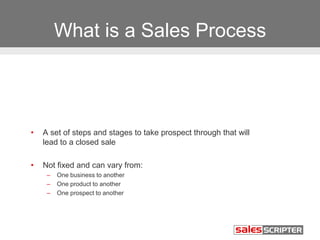
What is a Sales Process
• A set of steps and stages to take prospect through that will
lead to a closed sale
• Not fixed and can vary from:
– One business to another
– One product to another
– One prospect to another
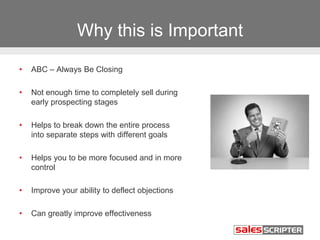
Why this is Important
• ABC – Always Be Closing
• Not enough time to completely sell during
early prospecting stages
• Helps to break down the entire process
into separate steps with different goals
• Helps you to be more focused and in more
control
• Improve your ability to deflect objections
• Can greatly improve effectiveness
Early Sales Process Stages
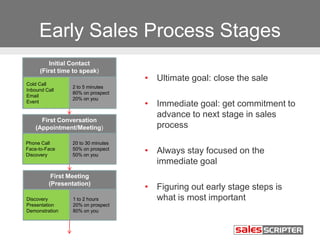
• Ultimate goal: close the sale
• Immediate goal: get commitment to
advance to next stage in sales
process
• Always stay focused on the
immediate goal
• Figuring out early stage steps is
what is most important
Initial Contact
(First time to speak)
Cold Call
Inbound Call
Email
Event
2 to 5 minutes
80% on prospect
20% on you
First Conversation
(Appointment/Meeting)
Phone Call
Face-to-Face
Discovery
20 to 30 minutes
50% on prospect
50% on you
First Meeting
(Presentation)
Discovery
Presentation
Demonstration
1 to 2 hours
20% on prospect
80% on you
Early Sales Process Stages
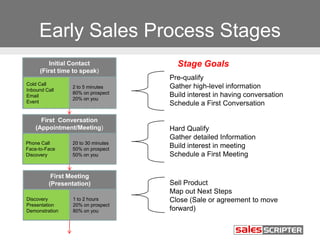
Stage GoalsInitial Contact
(First time to speak)
Cold Call
Inbound Call
Email
Event
2 to 5 minutes
80% on prospect
20% on you
First Conversation
(Appointment/Meeting)
Phone Call
Face-to-Face
Discovery
20 to 30 minutes
50% on prospect
50% on you
First Meeting
(Presentation)
Discovery
Presentation
Demonstration
1 to 2 hours
20% on prospect
80% on you
Pre-qualify
Gather high-level information
Build interest in having conversation
Schedule a First Conversation
Hard Qualify
Gather detailed Information
Build interest in meeting
Schedule a First Meeting
Sell Product
Map out Next Steps
Close (Sale or agreement to move
forward)
Early Sales Process Stages
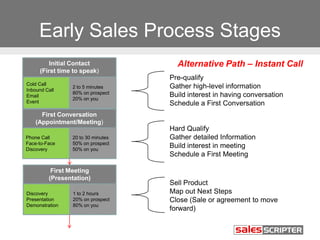
Alternative Path – Instant CallInitial Contact
(First time to speak)
Cold Call
Inbound Call
Email
Event
2 to 5 minutes
80% on prospect
20% on you
First Conversation
(Appointment/Meeting)
Phone Call
Face-to-Face
Discovery
20 to 30 minutes
50% on prospect
50% on you
First Meeting
(Presentation)
Discovery
Presentation
Demonstration
1 to 2 hours
20% on prospect
80% on you
Pre-qualify
Gather high-level information
Build interest in having conversation
Schedule a First Conversation
Hard Qualify
Gather detailed Information
Build interest in meeting
Schedule a First Meeting
Sell Product
Map out Next Steps
Close (Sale or agreement to move
forward)
Splitting Initial Contact and First Conversation
• It can be common for your first contact to flow into a first conversation
• There are benefits from preventing that and having two separate
conversations:
– First call at the time of first contact will be rushed
– Scheduling on another day allows you to put time on the prospects calendar
– The break and scheduling of the meeting will allow you and the prospect to be
more prepared for the first call
– You will have more time and attention to work with
• How to prevent:
– “You are asking very good questions. I actually would like to talk with you about
this in more detail and I have called you out of the blue. Do you have another 20
minutes to go through all of this now or should we put some time on the
calendar to get together?”
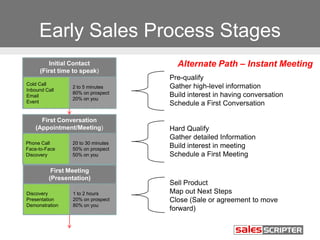
Early Sales Process Stages
Alternate Path – Instant MeetingInitial Contact
(First time to speak)
Cold Call
Inbound Call
Email
Event
2 to 5 minutes
80% on prospect
20% on you
First Conversation
(Appointment/Meeting)
Phone Call
Face-to-Face
Discovery
20 to 30 minutes
50% on prospect
50% on you
First Meeting
(Presentation)
Discovery
Presentation
Demonstration
1 to 2 hours
20% on prospect
80% on you
Pre-qualify
Gather high-level information
Build interest in having conversation
Schedule a First Conversation
Hard Qualify
Gather detailed Information
Build interest in meeting
Schedule a First Meeting
Sell Product
Map out Next Steps
Close (Sale or agreement to move
forward)
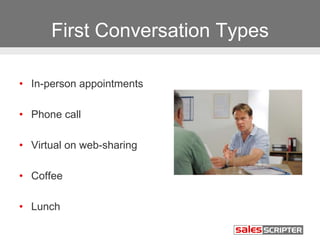
First Conversation Types
• In-person appointments
• Phone call
• Virtual on web-sharing
• Coffee
• Lunch
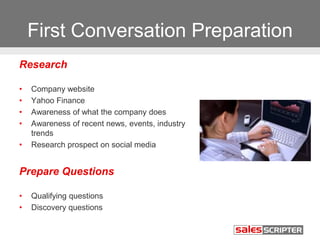
First Conversation Preparation
Research
• Company website
• Yahoo Finance
• Awareness of what the company does
• Awareness of recent news, events, industry
trends
• Research prospect on social media
Prepare Questions
• Qualifying questions
• Discovery questions
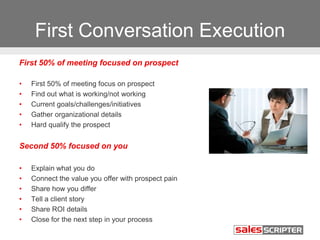
First Conversation Execution
First 50% of meeting focused on prospect
• First 50% of meeting focus on prospect
• Find out what is working/not working
• Current goals/challenges/initiatives
• Gather organizational details
• Hard qualify the prospect
Second 50% focused on you
• Explain what you do
• Connect the value you offer with prospect pain
• Share how you differ
• Tell a client story
• Share ROI details
• Close for the next step in your process
Performing Discovery
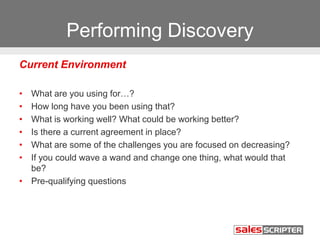
Current Environment
• What are you using for…?
• How long have you been using that?
• What is working well? What could be working better?
• Is there a current agreement in place?
• What are some of the challenges you are focused on decreasing?
• If you could wave a wand and change one thing, what would that
be?
• Pre-qualifying questions
Performing Discovery
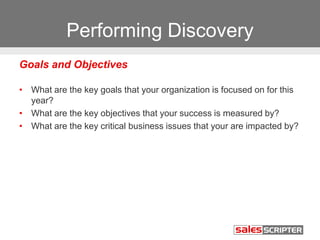
Goals and Objectives
• What are the key goals that your organization is focused on for this
year?
• What are the key objectives that your success is measured by?
• What are the key critical business issues that your are impacted by?
Performing Discovery
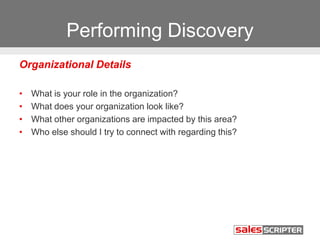
Organizational Details
• What is your role in the organization?
• What does your organization look like?
• What other organizations are impacted by this area?
• Who else should I try to connect with regarding this?
Performing Discovery
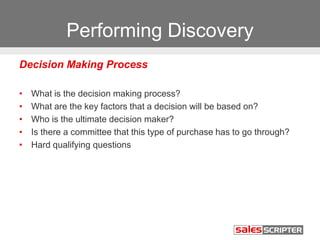
Decision Making Process
• What is the decision making process?
• What are the key factors that a decision will be based on?
• Who is the ultimate decision maker?
• Is there a committee that this type of purchase has to go through?
• Hard qualifying questions
Sales Lead Follow-up
1. Identify the follow-up time
2. Clarify the timing
3. Reconcile time with compelling event
4. Schedule reminders
5. Add to appropriate drip campaign
6. Follow-up at agreed timing
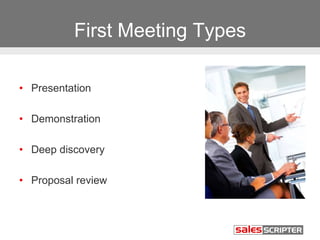
First Meeting Types
• Presentation
• Demonstration
• Deep discovery
• Proposal review
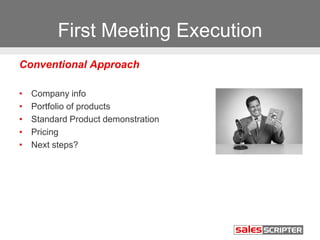
First Meeting Execution
Conventional Approach
• Company info
• Portfolio of products
• Standard Product demonstration
• Pricing
• Next steps?
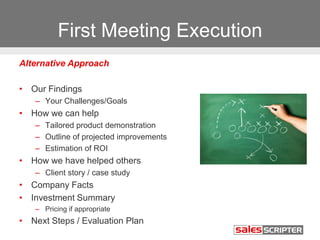
First Meeting Execution
Alternative Approach
• Our Findings
– Your Challenges/Goals
• How we can help
– Tailored product demonstration
– Outline of projected improvements
– Estimation of ROI
• How we have helped others
– Client story / case study
• Company Facts
• Investment Summary
– Pricing if appropriate
• Next Steps / Evaluation Plan
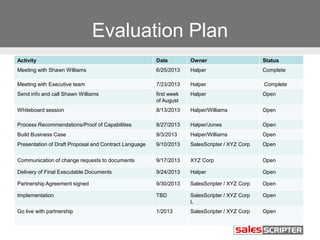
Evaluation Plan
Activity Date Owner Status
Meeting with Shawn Williams 6/25/2013 Halper Complete
Meeting with Executive team 7/23/2013 Halper Complete
Send info and call Shawn Williams first week
of August
Halper Open
Whiteboard session 8/13/2013 Halper/Williams Open
Process Recommendations/Proof of Capabilities 8/27/2013 Halper/Jones Open
Build Business Case 9/3/2013 Halper/Williams Open
Presentation of Draft Proposal and Contract Language 9/10/2013 SalesScripter / XYZ Corp Open
Communication of change requests to documents 9/17/2013 XYZ Corp Open
Delivery of Final Executable Documents 9/24/2013 Halper Open
Partnership Agreement signed 9/30/2013 SalesScripter / XYZ Corp Open
Implementation TBD SalesScripter / XYZ Corp
L
Open
Go live with partnership 1/2013 SalesScripter / XYZ Corp Open
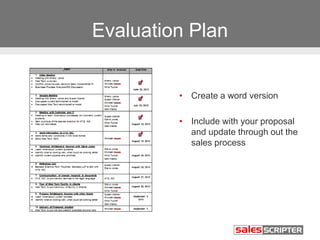
Evaluation Plan
• Create a word version
• Include with your proposal
and update through out the
sales process
Key Takeaways
• Your ultimate goal is to sell your product. Your immediate goal is to get the
prospect to move to the next step in your sales process.
• You will improve your results by staying focused on the immediate goal
• You will need to map out your ideal process to know what your immediate
goals are
• Identify what your initial contact, first call and first meetings look like for your
business
www.salesscripter.com | info@salesscripter.com | 713-802-2026

How to Effectively Manage the Sales Process

  • 1.
    How to EffectivelyManage Your Sales Process Sales Training Michael Halper
  • 2.
    What is aSales Process • A set of steps and stages to take prospect through that will lead to a closed sale • Not fixed and can vary from: – One business to another – One product to another – One prospect to another
  • 3.
    Why this isImportant • ABC – Always Be Closing • Not enough time to completely sell during early prospecting stages • Helps to break down the entire process into separate steps with different goals • Helps you to be more focused and in more control • Improve your ability to deflect objections • Can greatly improve effectiveness
  • 4.
    Early Sales ProcessStages • Ultimate goal: close the sale • Immediate goal: get commitment to advance to next stage in sales process • Always stay focused on the immediate goal • Figuring out early stage steps is what is most important Initial Contact (First time to speak) Cold Call Inbound Call Email Event 2 to 5 minutes 80% on prospect 20% on you First Conversation (Appointment/Meeting) Phone Call Face-to-Face Discovery 20 to 30 minutes 50% on prospect 50% on you First Meeting (Presentation) Discovery Presentation Demonstration 1 to 2 hours 20% on prospect 80% on you
  • 5.
    Early Sales ProcessStages Stage GoalsInitial Contact (First time to speak) Cold Call Inbound Call Email Event 2 to 5 minutes 80% on prospect 20% on you First Conversation (Appointment/Meeting) Phone Call Face-to-Face Discovery 20 to 30 minutes 50% on prospect 50% on you First Meeting (Presentation) Discovery Presentation Demonstration 1 to 2 hours 20% on prospect 80% on you Pre-qualify Gather high-level information Build interest in having conversation Schedule a First Conversation Hard Qualify Gather detailed Information Build interest in meeting Schedule a First Meeting Sell Product Map out Next Steps Close (Sale or agreement to move forward)
  • 6.
    Early Sales ProcessStages Alternative Path – Instant CallInitial Contact (First time to speak) Cold Call Inbound Call Email Event 2 to 5 minutes 80% on prospect 20% on you First Conversation (Appointment/Meeting) Phone Call Face-to-Face Discovery 20 to 30 minutes 50% on prospect 50% on you First Meeting (Presentation) Discovery Presentation Demonstration 1 to 2 hours 20% on prospect 80% on you Pre-qualify Gather high-level information Build interest in having conversation Schedule a First Conversation Hard Qualify Gather detailed Information Build interest in meeting Schedule a First Meeting Sell Product Map out Next Steps Close (Sale or agreement to move forward)
  • 7.
    Splitting Initial Contactand First Conversation • It can be common for your first contact to flow into a first conversation • There are benefits from preventing that and having two separate conversations: – First call at the time of first contact will be rushed – Scheduling on another day allows you to put time on the prospects calendar – The break and scheduling of the meeting will allow you and the prospect to be more prepared for the first call – You will have more time and attention to work with • How to prevent: – “You are asking very good questions. I actually would like to talk with you about this in more detail and I have called you out of the blue. Do you have another 20 minutes to go through all of this now or should we put some time on the calendar to get together?”
  • 8.
    Early Sales ProcessStages Alternate Path – Instant MeetingInitial Contact (First time to speak) Cold Call Inbound Call Email Event 2 to 5 minutes 80% on prospect 20% on you First Conversation (Appointment/Meeting) Phone Call Face-to-Face Discovery 20 to 30 minutes 50% on prospect 50% on you First Meeting (Presentation) Discovery Presentation Demonstration 1 to 2 hours 20% on prospect 80% on you Pre-qualify Gather high-level information Build interest in having conversation Schedule a First Conversation Hard Qualify Gather detailed Information Build interest in meeting Schedule a First Meeting Sell Product Map out Next Steps Close (Sale or agreement to move forward)
  • 9.
    First Conversation Types •In-person appointments • Phone call • Virtual on web-sharing • Coffee • Lunch
  • 10.
    First Conversation Preparation Research •Company website • Yahoo Finance • Awareness of what the company does • Awareness of recent news, events, industry trends • Research prospect on social media Prepare Questions • Qualifying questions • Discovery questions
  • 11.
    First Conversation Execution First50% of meeting focused on prospect • First 50% of meeting focus on prospect • Find out what is working/not working • Current goals/challenges/initiatives • Gather organizational details • Hard qualify the prospect Second 50% focused on you • Explain what you do • Connect the value you offer with prospect pain • Share how you differ • Tell a client story • Share ROI details • Close for the next step in your process
  • 12.
    Performing Discovery Current Environment •What are you using for…? • How long have you been using that? • What is working well? What could be working better? • Is there a current agreement in place? • What are some of the challenges you are focused on decreasing? • If you could wave a wand and change one thing, what would that be? • Pre-qualifying questions
  • 13.
    Performing Discovery Goals andObjectives • What are the key goals that your organization is focused on for this year? • What are the key objectives that your success is measured by? • What are the key critical business issues that your are impacted by?
  • 14.
    Performing Discovery Organizational Details •What is your role in the organization? • What does your organization look like? • What other organizations are impacted by this area? • Who else should I try to connect with regarding this?
  • 15.
    Performing Discovery Decision MakingProcess • What is the decision making process? • What are the key factors that a decision will be based on? • Who is the ultimate decision maker? • Is there a committee that this type of purchase has to go through? • Hard qualifying questions
  • 16.
    Sales Lead Follow-up 1.Identify the follow-up time 2. Clarify the timing 3. Reconcile time with compelling event 4. Schedule reminders 5. Add to appropriate drip campaign 6. Follow-up at agreed timing
  • 17.
    First Meeting Types •Presentation • Demonstration • Deep discovery • Proposal review
  • 18.
    First Meeting Execution ConventionalApproach • Company info • Portfolio of products • Standard Product demonstration • Pricing • Next steps?
  • 19.
    First Meeting Execution AlternativeApproach • Our Findings – Your Challenges/Goals • How we can help – Tailored product demonstration – Outline of projected improvements – Estimation of ROI • How we have helped others – Client story / case study • Company Facts • Investment Summary – Pricing if appropriate • Next Steps / Evaluation Plan
  • 20.
    Evaluation Plan Activity DateOwner Status Meeting with Shawn Williams 6/25/2013 Halper Complete Meeting with Executive team 7/23/2013 Halper Complete Send info and call Shawn Williams first week of August Halper Open Whiteboard session 8/13/2013 Halper/Williams Open Process Recommendations/Proof of Capabilities 8/27/2013 Halper/Jones Open Build Business Case 9/3/2013 Halper/Williams Open Presentation of Draft Proposal and Contract Language 9/10/2013 SalesScripter / XYZ Corp Open Communication of change requests to documents 9/17/2013 XYZ Corp Open Delivery of Final Executable Documents 9/24/2013 Halper Open Partnership Agreement signed 9/30/2013 SalesScripter / XYZ Corp Open Implementation TBD SalesScripter / XYZ Corp L Open Go live with partnership 1/2013 SalesScripter / XYZ Corp Open
  • 21.
    Evaluation Plan • Createa word version • Include with your proposal and update through out the sales process
  • 22.
    Key Takeaways • Yourultimate goal is to sell your product. Your immediate goal is to get the prospect to move to the next step in your sales process. • You will improve your results by staying focused on the immediate goal • You will need to map out your ideal process to know what your immediate goals are • Identify what your initial contact, first call and first meetings look like for your business
  • 23.