Infomagic 
Lin Smith 
Liz Smith
What we know 
• That the English National Curriculum is 
undergoing change 
• That there is mention of NON-FICTION books 
throughout the new guidance 
• That the Scottish and Welsh models already 
have this embedded in their literacy 
strategies
Scotland - the Brave 
• Have had this sewn up for a long time 
http://www.educationscotland.gov.uk/Images/literacy_experiences_outcomes_tcm4-539998.pdf
Northern Ireland 
KS3 Statutory requirements 
Thinking Skills & Personal Capabilities 
•Managing Information 
•Thinking, Problem-solving & Decision-making 
•Being creative 
•Working with others 
•Self-management
Cross-Curricular Skills 
•Communication 
•Using Mathematics 
•Using Information and Communications Technology 
and... 
In addition to Writing, and Talking & Listening, includes 
Reading 
http://www.nicurriculum.org.uk/docs/key_stage_3/statutory_curriculum_ks3.pdf
The Welsh model 
But more of that later! 
Is also 
extensive
English 
The national curriculum for English aims to ensure that all pupils: 
read easily, fluently and with good understanding 
develop the habit of reading widely and often, for both pleasure and 
information 
acquire a wide vocabulary, an understanding of grammar and knowledge of 
linguistic conventions for reading, writing and spoken language 
appreciate our rich and varied literary heritage 
write clearly, accurately and coherently, adapting their language and style in 
and for a range of contexts, purposes and audiences 
use discussion in order to learn; they should be able to elaborate and 
explain clearly their understanding and ideas 
are competent in the arts of speaking and listening, making formal 
presentations, demonstrating to others and participating in debate
How we justify this 
NOT ONLY 
Because - the NC documents say we should! 
BUT ALSO 
Because - it introduces the concept of book navigation which is 
important training for higher level study 
Because – it engages the child who hasn’t yet found stories to enjoy 
Because – it enables the teacher or librarian to assess progress in the 
child’s ability to absorb, assimilate and use information 
http://www.literacytrust.org.uk/assets/0001/9202/Curriculum_Review_and_Planning_Tool.pdf
Key Stage 1 
Emphasis on phonics 
Practice at reading words by sounding and blending 
Teachers should extend student vocabulary by explaining meanings 
Reading 
Pupils should be taught to 
Develop pleasure in reading, motivation to read….. 
listen and discuss wide range of poems, stories and non-fiction 
Familiarity with fairy stories and traditional tales 
Appreciate rhymes and poems learning some by heart 
Writing 
Children should be able 
To name the letters of the alphabet 
Add prefixes and suffixes
Key Stage 2 
Pupils should be applying growing knowledge with both root words and 
exceptions 
They should be taught to demonstrate positive attitudes to reading 
reading differently structured books 
using dictionaries 
increasingly wide range …including fairy stories, myths & legends 
themes and conventions 
Also 
prepare poems and play scripts to read aloud and to perform 
retrieve and record information from non-fiction 
They are expected to be able to both evaluate and edit their work
Opportunities 
to exercise choice in selecting books 
- being taught how to do so 
Although the latter forms part of the non-statutory guidance the use 
of contents pages and indexes is also mentioned. 
By Years 5 and 6 children should be 
-planning their writing and identifying their audience 
-proof reading for spelling and punctuation errors
Punctuation 
Grammar 
Spelling
“This may hurt a little” 
English language 
This will be assessed by exam. Students’ speaking skills will be assessed 
but, as with current GCSEs, will not contribute to the overall grade. The 
assessment will be marked by teachers and reported separately, 
alongside the qualification grade on the certificate. 
Twenty per cent of the marks for the written exams will be allocated to 
accurate spelling, punctuation and grammar. 
English literature 
This will be assessed wholly by exam. 
Five per cent of the marks will be allocated to accurate spelling, 
punctuation and grammar. 
ofqual.gov.uk/documents/summary-on-reforms-to-gcses-from-2015/
Key Stage 3 
Aims 
promote high standards of language and literacy 
a strong command of the spoken and written word, and to 
develop their love of literature through widespread reading for enjoyment. 
read easily, fluently…
And so… 
Pupils should 
develop the habit of reading widely and often, for both pleasure 
and information 
acquire a wide vocabulary, an understanding of grammar and 
knowledge of linguistic conventions 
appreciate our rich and varied literary heritage 
write clearly, accurately and coherently, adapting their language and 
style in and for a range of contexts, purposes and audiences 
use discussion in order to learn; they should be able to elaborate and 
explain clearly their understanding and ideas 
be competent in the arts of speaking and listening, making formal 
presentations, demonstrating to others and participating in debate.
It doesn’t stop there 
They should be taught to write formal and academic essays as well as writing 
imaginatively. 
They should be taught to write for a variety of purposes and audiences across a 
range of contexts. 
They should build up an increasingly wide knowledge of vocabulary and 
grammar. 
Teachers should show pupils how to understand the relationships between 
words. 
Pupils should be taught to control their speaking and writing consciously. 
They should understand and use age appropriate vocabulary. 
It is important that pupils learn the correct grammatical terms in English and 
that these terms are integrated within teaching.
In fact the devil is in the detail 
Pupils should be taught to: 
develop an appreciation and love of reading, and read increasingly challenging 
material independently through: 
reading a wide range of fiction and non-fiction, 
including in particular whole books, 
short stories, poems and plays with a wide coverage of genres, historical periods, 
forms and authors. The range will include high quality works from: 
English literature, both pre -1914 and contemporary, including prose, 
poetry and drama 
Shakespeare (two plays) 
seminal world literature 
choosing and reading books independently for challenge, interest and enjoyment. 
Re-reading books encountered earlier to increase familiarity with them and provide 
a basis for making comparisons. 
understand increasingly challenging texts
And specifically….. 
knowing how language, including figurative language, vocabulary choice, 
grammar, text structure and organisational features, present meaning 
recognising a range of poetic conventions and understanding how these have 
been used 
studying setting, plot, and characterisation, and the effects of these 
understanding how the work of dramatists is communicated effectively through 
performance and how alternative staging allows for different interpretations of a 
play 
making critical comparisons across texts 
studying a range of authors, including at least two authors in depth each year
We also know 
That in all subjects 
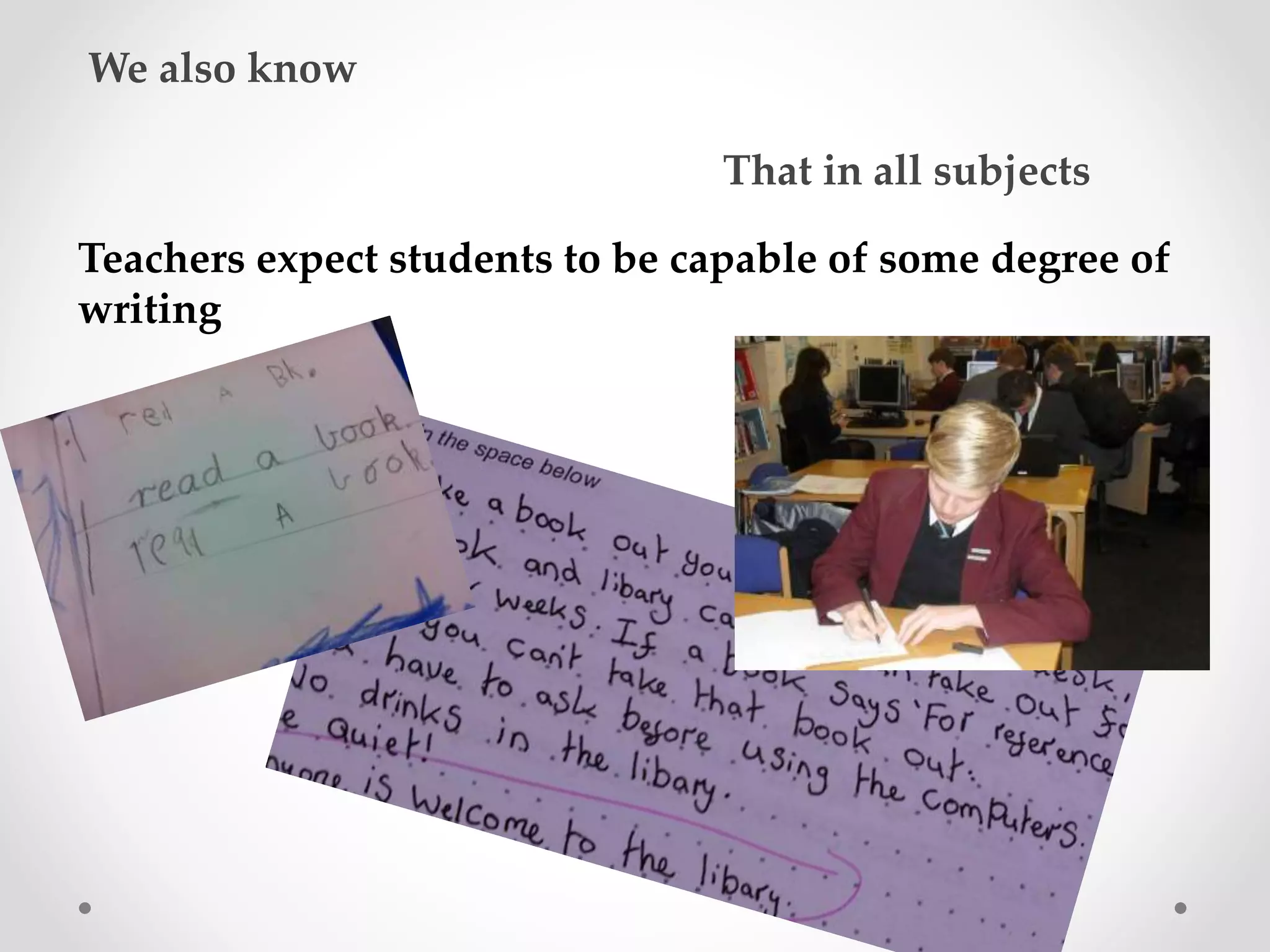
Teachers expect students to be capable of some degree of 
writing
This could be anything 
Non-fiction 
oEvaluations 
oAccounts 
oDescriptions 
oRecords 
oExperiment write-ups 
oAnalysis 
oLetters (persuasive, informative) 
oShort answers using technical vocabulary 
oEssays
The Oword 
Ofsted are likely to make reference to their 2012 document 
‘Moving English Forward’ 
The following slides are taken and adapted from an 
original presentation by kind permission of 
Dave Woodhouse 
http://www.ofsted.gov.uk/resources/moving-english-forward
Ofsted now analyse the performance of different groups 
of students in the school. The groups include:- 
Boys v girls 
Non FSM v FSM 
EAL 
Vulnerable children (CLA plus FSM) 
SEN 
 There are two cross-curricular aspects that 
Ofsted look at:- 
 SMSC (Spiritual, Moral, Social and Cultural) 
aspects of school life 
 Literacy (Reading, Writing, Communication) 
and Numeracy
Benefits of Reading for Enjoyment 
 Improves students’ reading ages 
 Improves students’ vocabulary 
 Improves students’ confidence and self 
esteem that they are readers 
 Improves students’ general knowledge 
 Contributes to students’ emotional 
development - SMSC
Assessing Reading 
• Higher order reading skills and knowledge, 
such as inference, appreciation of style and 
summary 
• How familiar pupils are with a range of texts 
and authors 
• Pupils’ attitudes to, and enjoyment of, 
reading
So... 
How can we use these specific 
references to information literacy 
skills and reading non-fiction/ 
information texts to our 
advantage in school libraries?
2011 
2012 
2013
Rationale 
Opportunities 
for Library 
 
Info 
Literacy 
skills 
Way 
into the 
curric-ulum
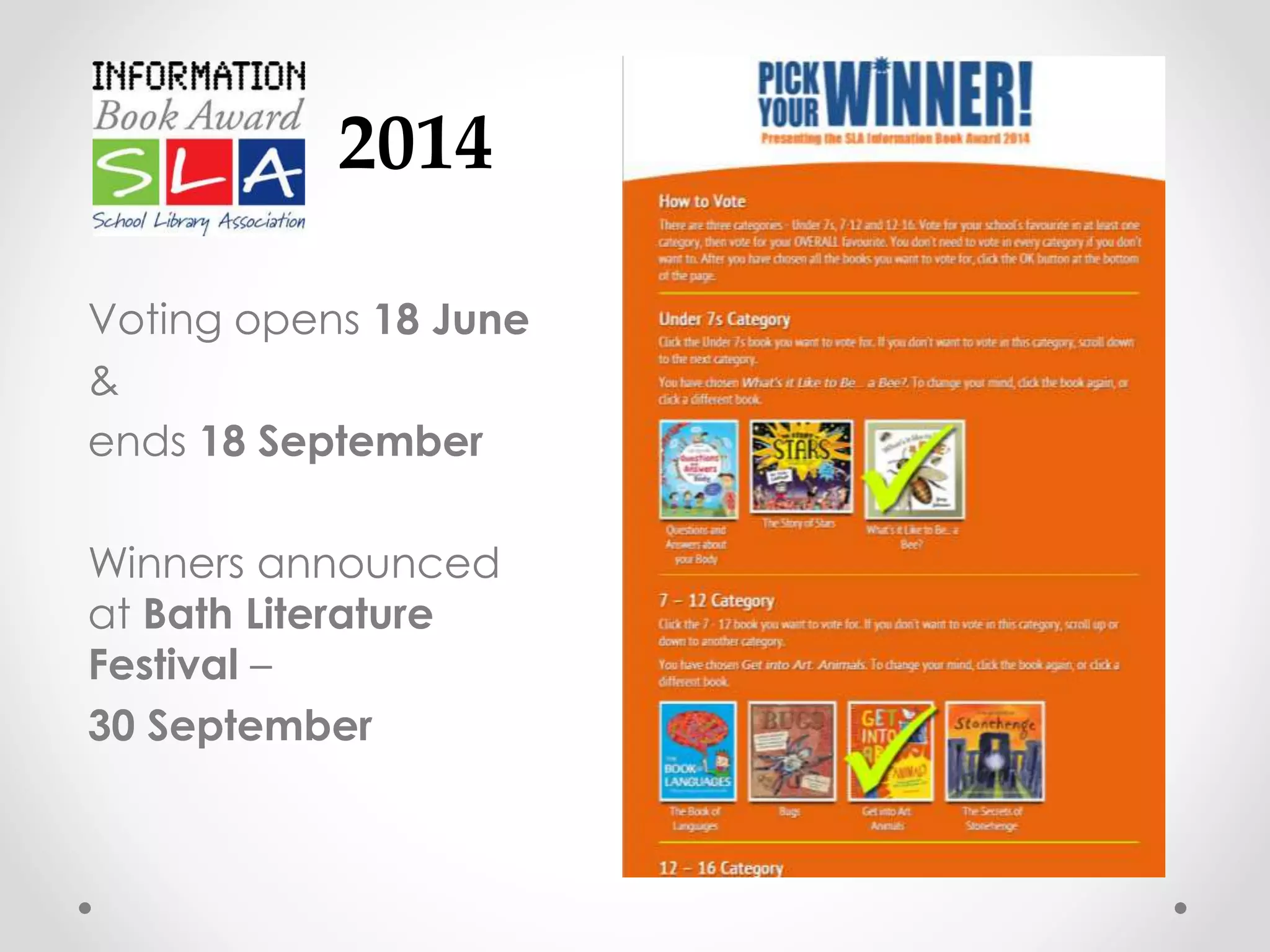
2014 
Voting opens 18 June 
& 
ends 18 September 
Winners announced 
at Bath Literature 
Festival – 
30 September
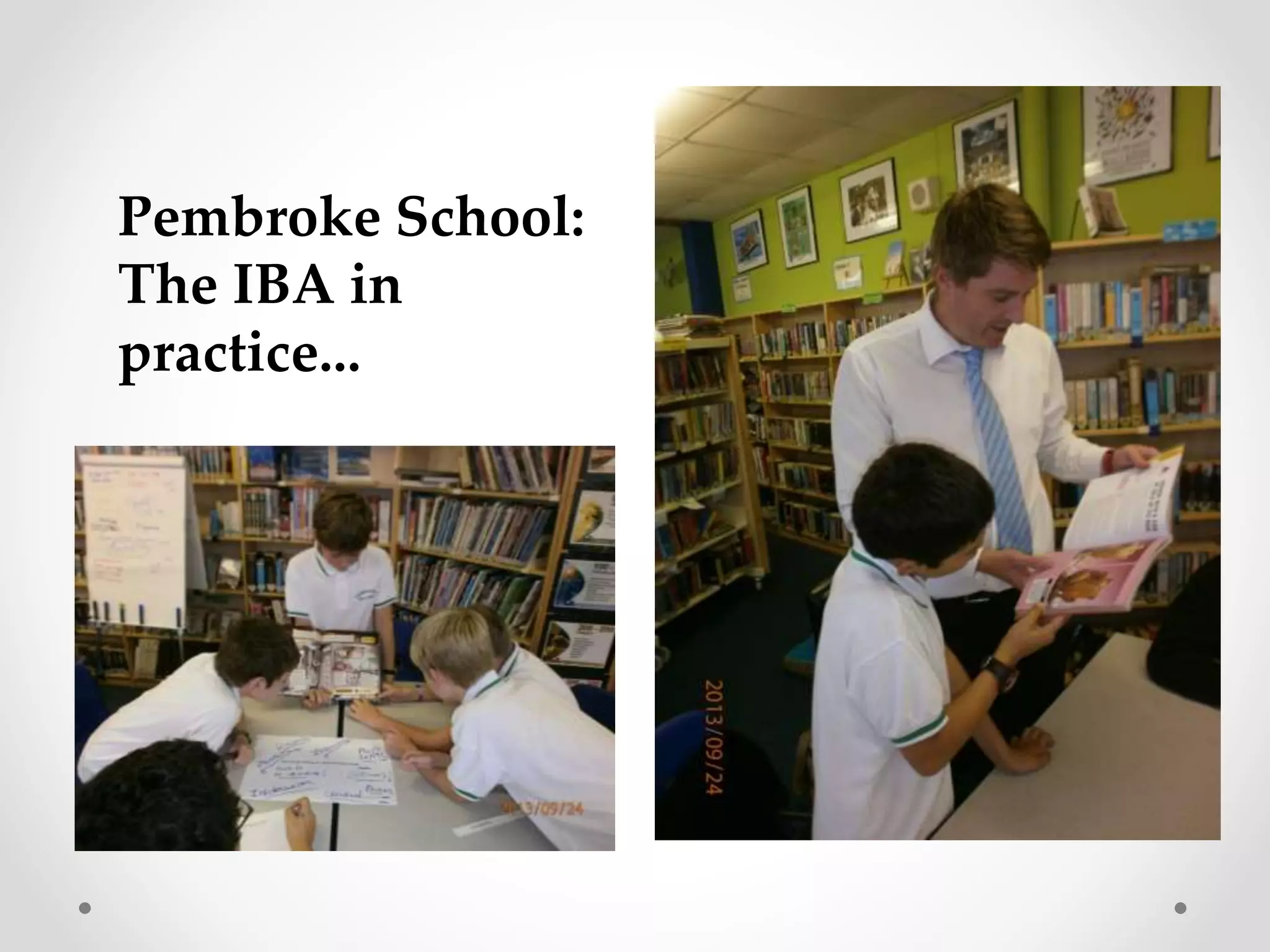
Pembroke School: 
The IBA in 
practice...
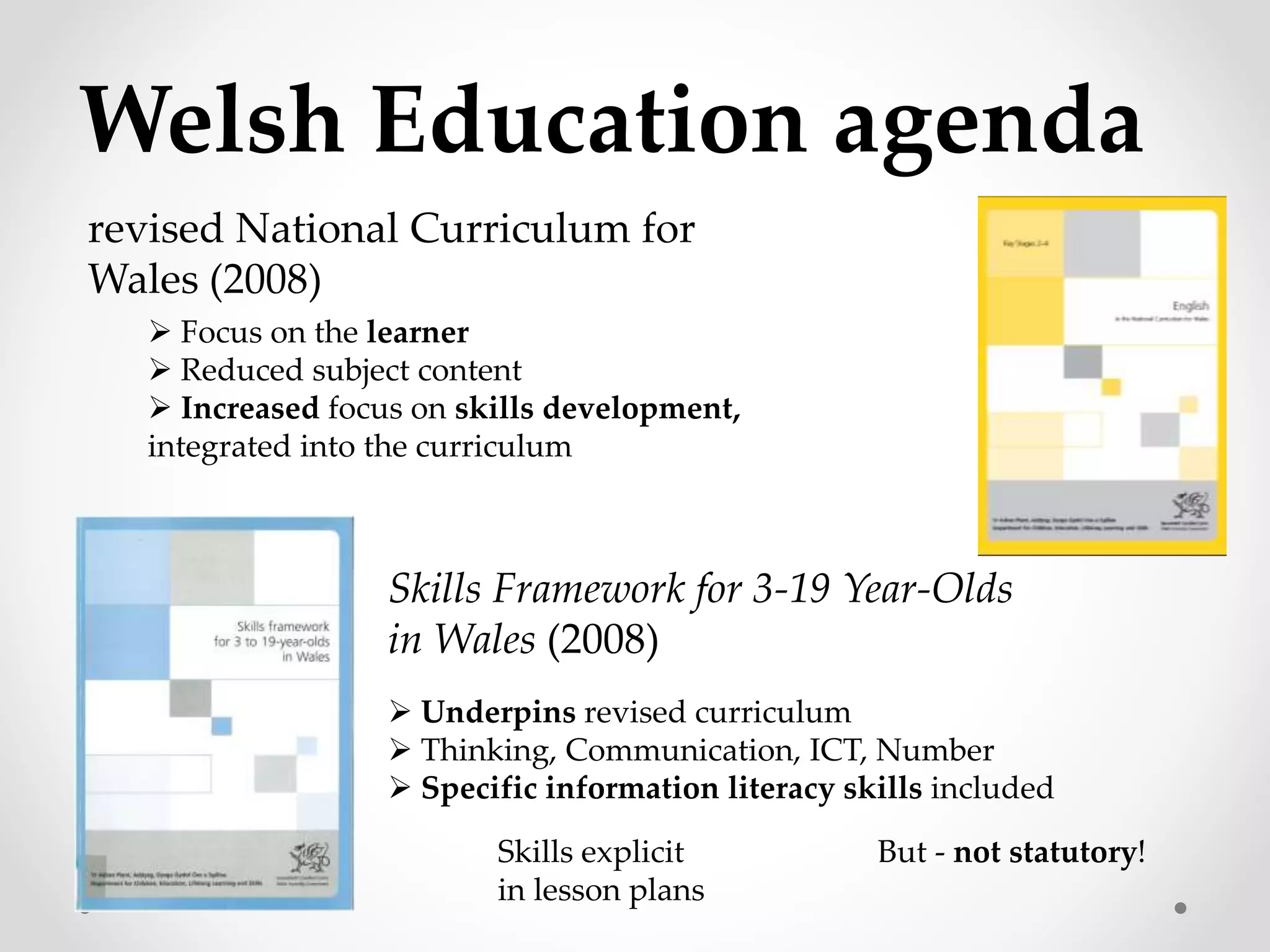
Welsh Education agenda 
revised National Curriculum for 
Wales (2008) 
 Focus on the learner 
 Reduced subject content 
 Increased focus on skills development, 
integrated into the curriculum 
Skills Framework for 3-19 Year-Olds 
in Wales (2008) 
 Underpins revised curriculum 
 Thinking, Communication, ICT, Number 
 Specific information literacy skills included 
Skills explicit But - not statutory! 
in lesson plans
IBA 2011 & 2012 
“Judging the IBA is ideal 
as it enables a scientific 
analysis of the book, 
developing pupils’ 
analytical and 
investigative skills to 
examine how the 
information is presented 
and written.” 
Lyned – Science teacher 
“IBA judging 
engages pupils in 
a collaborative 
reading activity, 
which gives 
context for the 
work on NF texts 
done in class.” 
Catherine – English teacher
2012: 
The Year of the LNF 
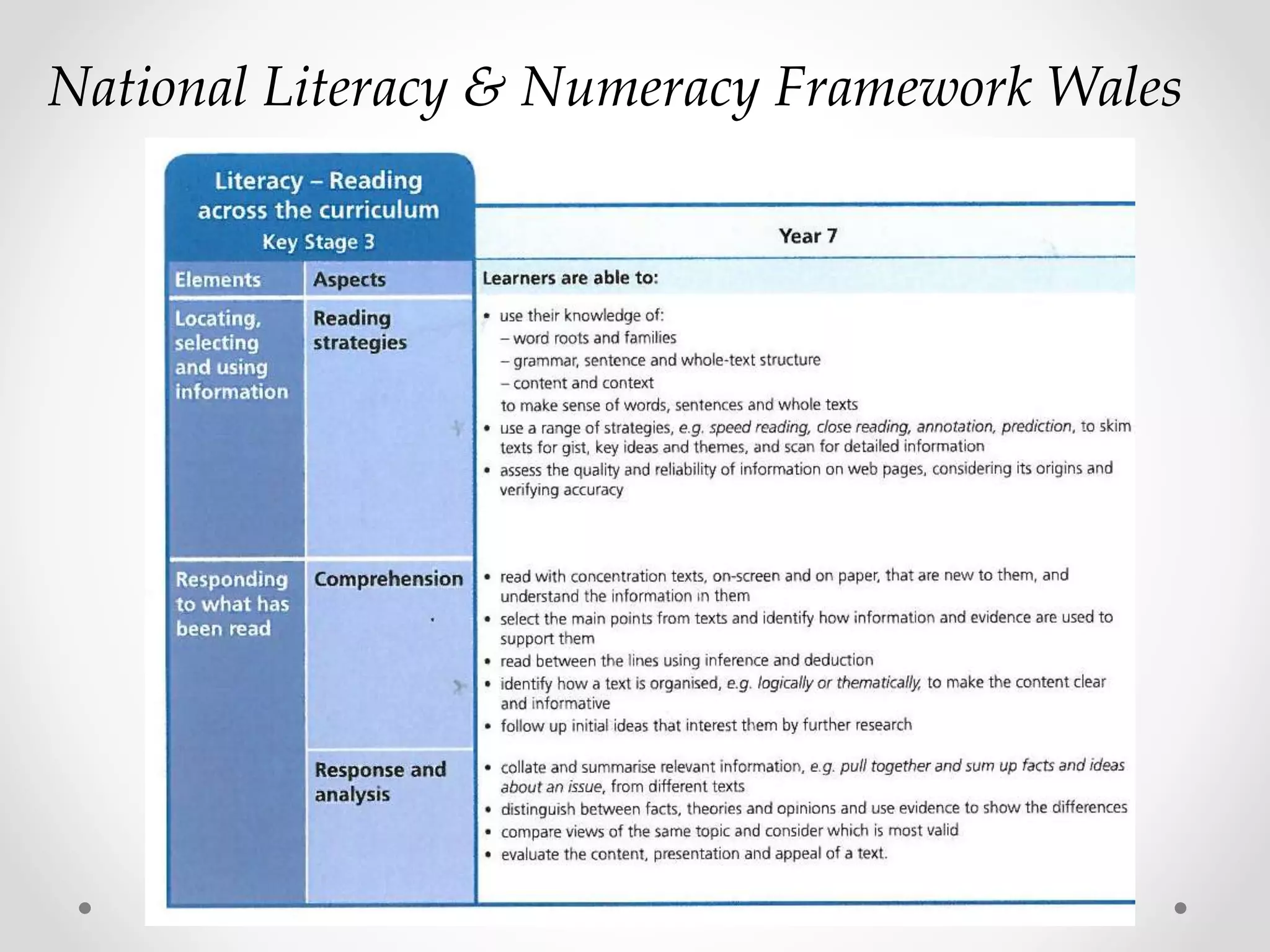
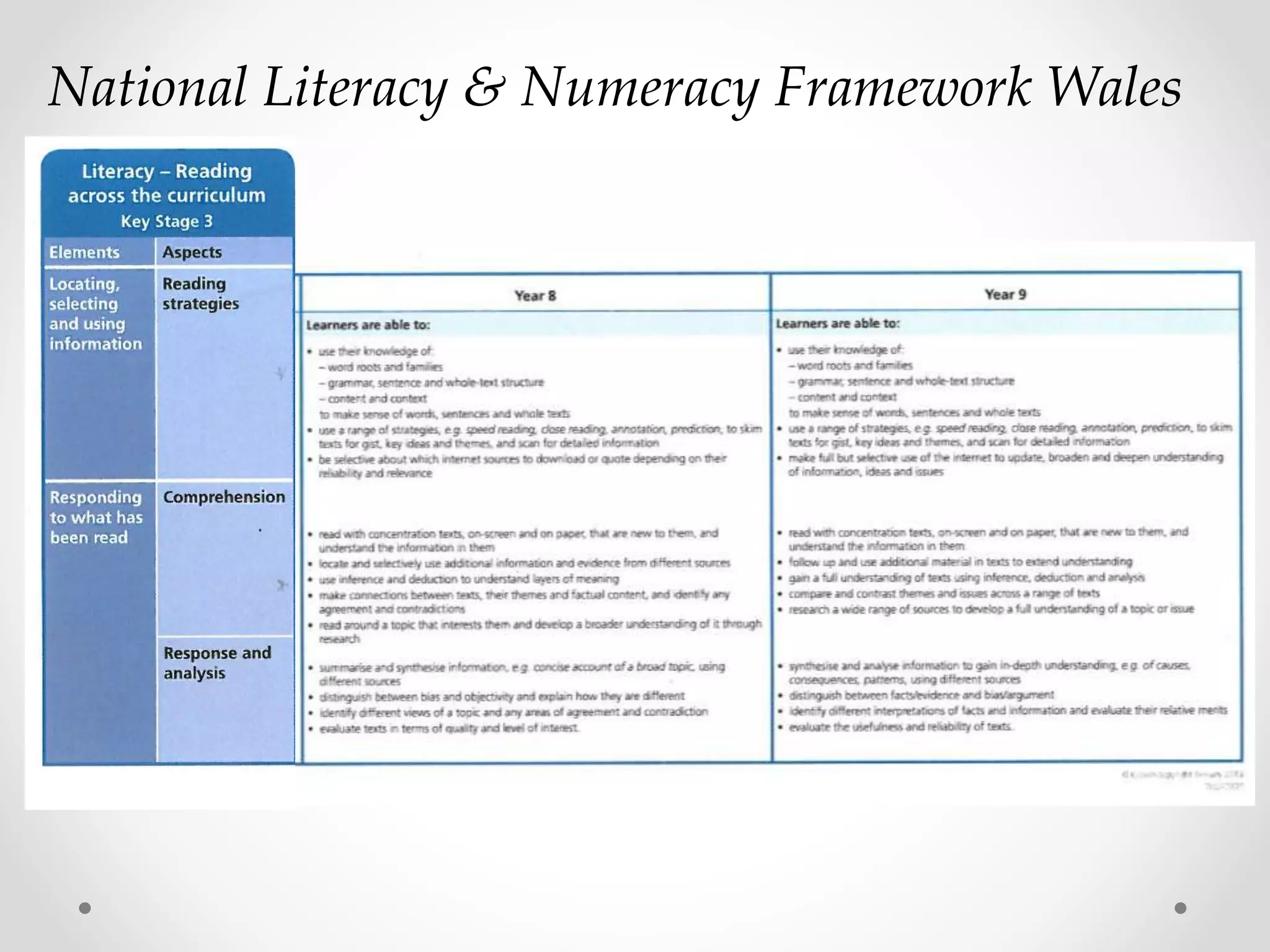
National Literacy & Numeracy Framework Wales 
http://www.bbc.co.uk/news/world-asia-16589052 
Aim: to improve literacy & numeracy levels in Wales 
 Introduced in 2012 
 Statutory curriculum requirement since September 2013 
 Statutory assessment requirement from September 2014 
 All subjects expected to include literacy & numeracy elements to SoWs 
Literacy strands: Reading; Writing & Oracy across the curriculum
National Literacy & Numeracy Framework Wales
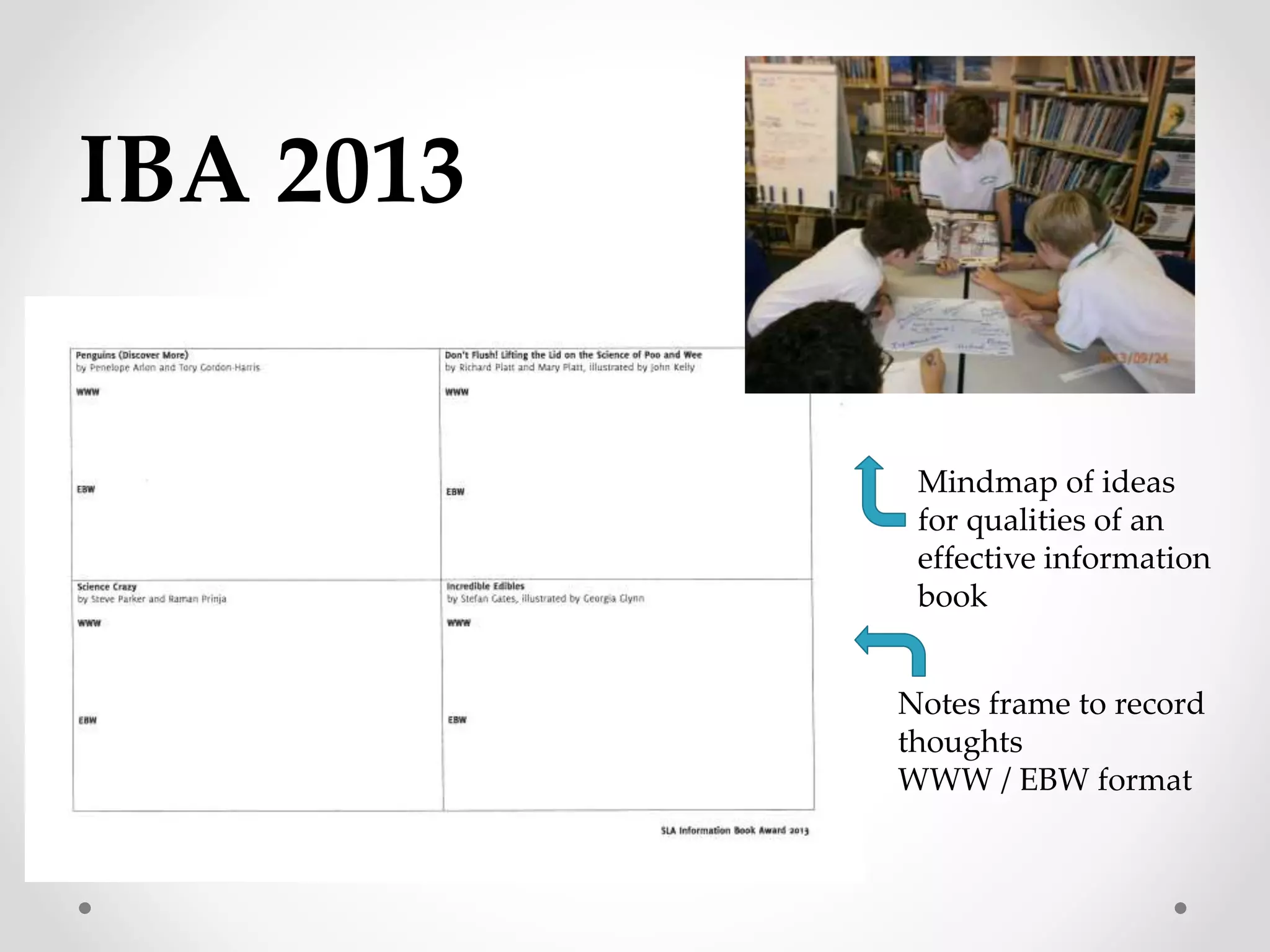
IBA 2013 
Mindmap of ideas 
for qualities of an 
effective information 
book 
Notes frame to record 
thoughts 
WWW / EBW format
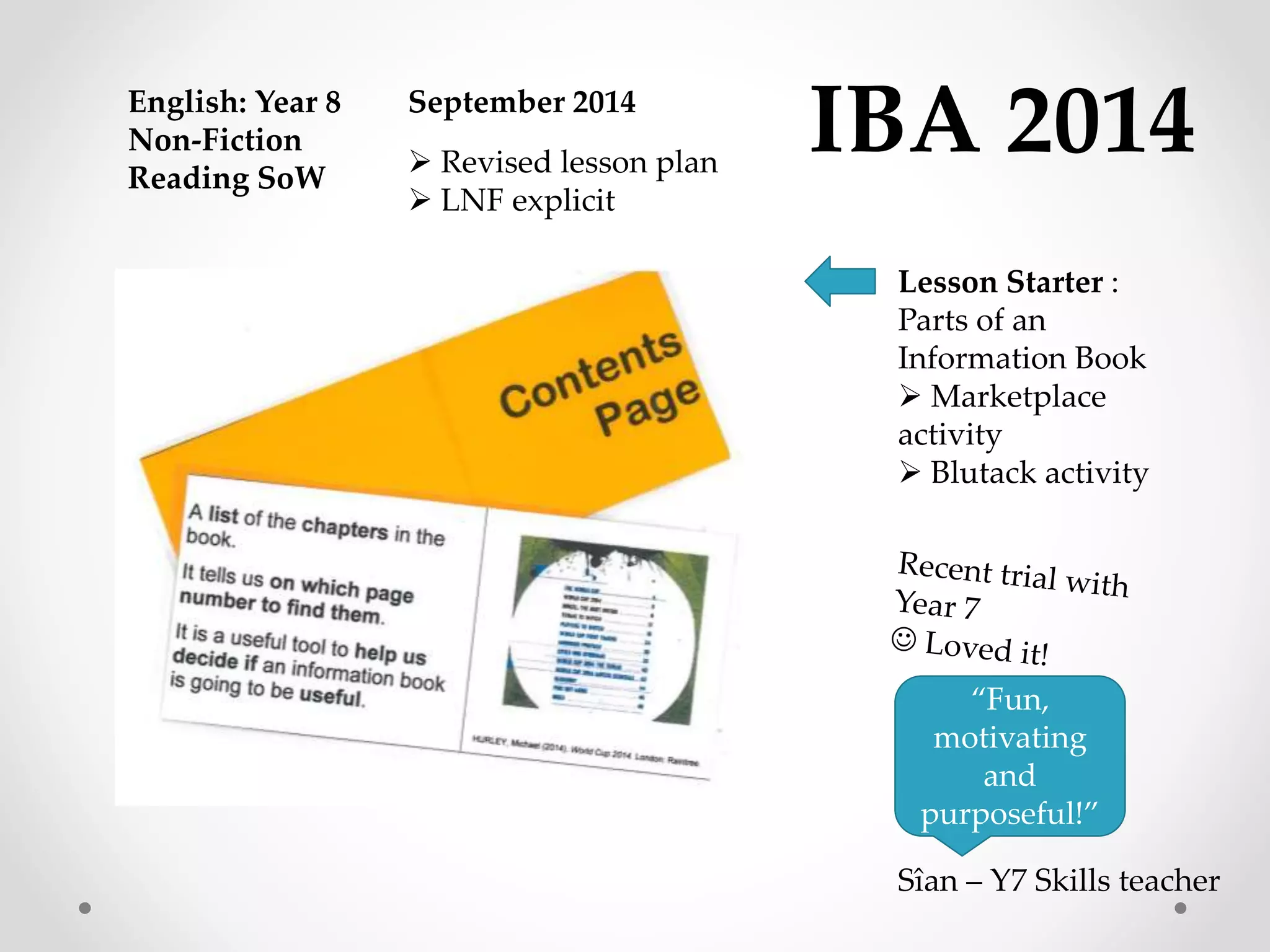
IBA 2014 
Lesson Starter : 
Parts of an 
Information Book 
 Marketplace 
activity 
 Blutack activity 
English: Year 8 
Non-Fiction 
Reading SoW 
September 2014 
“Fun, 
motivating 
and 
purposeful!” 
 Revised lesson plan 
 LNF explicit 
Sîan – Y7 Skills teacher
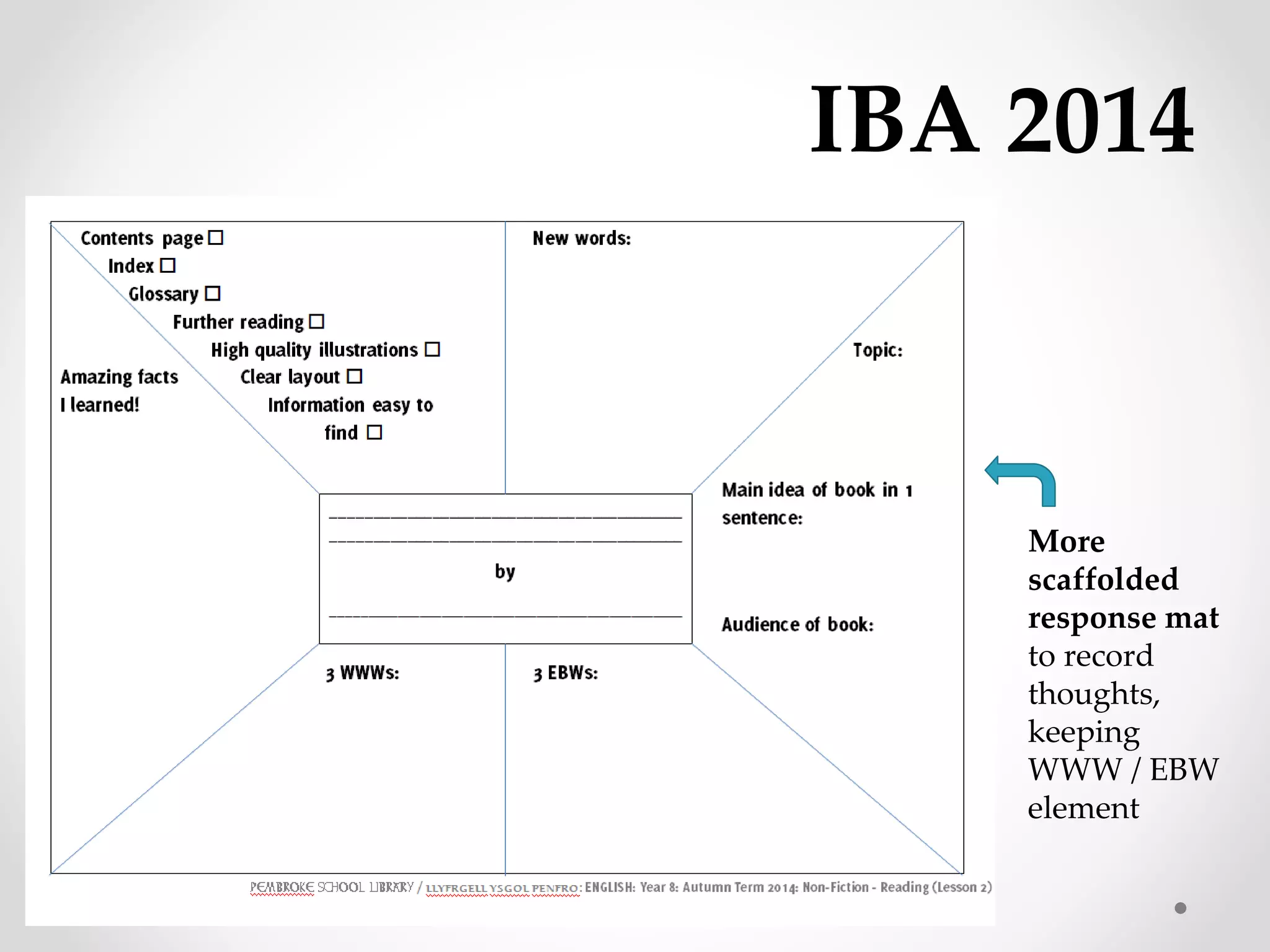
IBA 2014 
More 
scaffolded 
response mat 
to record 
thoughts, 
keeping 
WWW / EBW 
element
Over to you... 
What’s your 
experience of the 
Information Book 
Award?
How can we demonstrate 
student progress in skills 
development?
Questions 
Blue Task 
Ways to assess 
Here is the answer. 
Daffodils are yellow. 
Here is a question. 
What colour are daffodils?
Links 
• http://www.nicurriculum.org.uk/docs/key_stage_3/statutory_curriculum_ks3.pdf 
• WELSH ASSEMBLY GOVERNMENT (2008). Skills Framework for 3-19 Year-Olds. 
Cardiff: Welsh Assembly Government. 
• http://wales.gov.uk/dcells/publications/curriculum_and_assessment/arevisedcurriculu 
mforwales/skillsdevelopment/SKILLS_FRAMEWORK_2007_Engli1.pdf?lang=en 
• http://www.educationscotland.gov.uk/Images/literacy_experiences_outcomes_tcm4- 
539998.pdf 
• https://www.gov.uk/schools-colleges/curriculum-qualifications 
• http://www.literacytrust.org.uk/assets/0001/9202/Curriculum_Review_and_Pla 
nning_Tool.pdf 
• http://ofqual.gov.uk/documents/summary-on-reforms-to-gcses-from-2015/
Lin Smith Liz Smith 
Liz Smith 
Librarian 
Pembroke School 
Email: liz[at]lizsmith.info 
Twitter: @psliz(personal)/ 
@pslib (Library) 
Lin Smith 
Librarian 
Ecclesbourne School 
Email: liblintra[at]gmail.com 
Twitter: @smith_lin

Infomagic: SLA Weekend Course 2014

  • 1.
  • 2.
    What we know • That the English National Curriculum is undergoing change • That there is mention of NON-FICTION books throughout the new guidance • That the Scottish and Welsh models already have this embedded in their literacy strategies
  • 3.
    Scotland - theBrave • Have had this sewn up for a long time http://www.educationscotland.gov.uk/Images/literacy_experiences_outcomes_tcm4-539998.pdf
  • 4.
    Northern Ireland KS3Statutory requirements Thinking Skills & Personal Capabilities •Managing Information •Thinking, Problem-solving & Decision-making •Being creative •Working with others •Self-management
  • 5.
    Cross-Curricular Skills •Communication •Using Mathematics •Using Information and Communications Technology and... In addition to Writing, and Talking & Listening, includes Reading http://www.nicurriculum.org.uk/docs/key_stage_3/statutory_curriculum_ks3.pdf
  • 6.
    The Welsh model But more of that later! Is also extensive
  • 7.
    English The nationalcurriculum for English aims to ensure that all pupils: read easily, fluently and with good understanding develop the habit of reading widely and often, for both pleasure and information acquire a wide vocabulary, an understanding of grammar and knowledge of linguistic conventions for reading, writing and spoken language appreciate our rich and varied literary heritage write clearly, accurately and coherently, adapting their language and style in and for a range of contexts, purposes and audiences use discussion in order to learn; they should be able to elaborate and explain clearly their understanding and ideas are competent in the arts of speaking and listening, making formal presentations, demonstrating to others and participating in debate
  • 8.
    How we justifythis NOT ONLY Because - the NC documents say we should! BUT ALSO Because - it introduces the concept of book navigation which is important training for higher level study Because – it engages the child who hasn’t yet found stories to enjoy Because – it enables the teacher or librarian to assess progress in the child’s ability to absorb, assimilate and use information http://www.literacytrust.org.uk/assets/0001/9202/Curriculum_Review_and_Planning_Tool.pdf
  • 9.
    Key Stage 1 Emphasis on phonics Practice at reading words by sounding and blending Teachers should extend student vocabulary by explaining meanings Reading Pupils should be taught to Develop pleasure in reading, motivation to read….. listen and discuss wide range of poems, stories and non-fiction Familiarity with fairy stories and traditional tales Appreciate rhymes and poems learning some by heart Writing Children should be able To name the letters of the alphabet Add prefixes and suffixes
  • 10.
    Key Stage 2 Pupils should be applying growing knowledge with both root words and exceptions They should be taught to demonstrate positive attitudes to reading reading differently structured books using dictionaries increasingly wide range …including fairy stories, myths & legends themes and conventions Also prepare poems and play scripts to read aloud and to perform retrieve and record information from non-fiction They are expected to be able to both evaluate and edit their work
  • 11.
    Opportunities to exercisechoice in selecting books - being taught how to do so Although the latter forms part of the non-statutory guidance the use of contents pages and indexes is also mentioned. By Years 5 and 6 children should be -planning their writing and identifying their audience -proof reading for spelling and punctuation errors
  • 12.
  • 13.
    “This may hurta little” English language This will be assessed by exam. Students’ speaking skills will be assessed but, as with current GCSEs, will not contribute to the overall grade. The assessment will be marked by teachers and reported separately, alongside the qualification grade on the certificate. Twenty per cent of the marks for the written exams will be allocated to accurate spelling, punctuation and grammar. English literature This will be assessed wholly by exam. Five per cent of the marks will be allocated to accurate spelling, punctuation and grammar. ofqual.gov.uk/documents/summary-on-reforms-to-gcses-from-2015/
  • 14.
    Key Stage 3 Aims promote high standards of language and literacy a strong command of the spoken and written word, and to develop their love of literature through widespread reading for enjoyment. read easily, fluently…
  • 15.
    And so… Pupilsshould develop the habit of reading widely and often, for both pleasure and information acquire a wide vocabulary, an understanding of grammar and knowledge of linguistic conventions appreciate our rich and varied literary heritage write clearly, accurately and coherently, adapting their language and style in and for a range of contexts, purposes and audiences use discussion in order to learn; they should be able to elaborate and explain clearly their understanding and ideas be competent in the arts of speaking and listening, making formal presentations, demonstrating to others and participating in debate.
  • 16.
    It doesn’t stopthere They should be taught to write formal and academic essays as well as writing imaginatively. They should be taught to write for a variety of purposes and audiences across a range of contexts. They should build up an increasingly wide knowledge of vocabulary and grammar. Teachers should show pupils how to understand the relationships between words. Pupils should be taught to control their speaking and writing consciously. They should understand and use age appropriate vocabulary. It is important that pupils learn the correct grammatical terms in English and that these terms are integrated within teaching.
  • 17.
    In fact thedevil is in the detail Pupils should be taught to: develop an appreciation and love of reading, and read increasingly challenging material independently through: reading a wide range of fiction and non-fiction, including in particular whole books, short stories, poems and plays with a wide coverage of genres, historical periods, forms and authors. The range will include high quality works from: English literature, both pre -1914 and contemporary, including prose, poetry and drama Shakespeare (two plays) seminal world literature choosing and reading books independently for challenge, interest and enjoyment. Re-reading books encountered earlier to increase familiarity with them and provide a basis for making comparisons. understand increasingly challenging texts
  • 18.
    And specifically….. knowinghow language, including figurative language, vocabulary choice, grammar, text structure and organisational features, present meaning recognising a range of poetic conventions and understanding how these have been used studying setting, plot, and characterisation, and the effects of these understanding how the work of dramatists is communicated effectively through performance and how alternative staging allows for different interpretations of a play making critical comparisons across texts studying a range of authors, including at least two authors in depth each year
  • 19.
    We also know That in all subjects Teachers expect students to be capable of some degree of writing
  • 20.
    This could beanything Non-fiction oEvaluations oAccounts oDescriptions oRecords oExperiment write-ups oAnalysis oLetters (persuasive, informative) oShort answers using technical vocabulary oEssays
  • 21.
    The Oword Ofstedare likely to make reference to their 2012 document ‘Moving English Forward’ The following slides are taken and adapted from an original presentation by kind permission of Dave Woodhouse http://www.ofsted.gov.uk/resources/moving-english-forward
  • 22.
    Ofsted now analysethe performance of different groups of students in the school. The groups include:- Boys v girls Non FSM v FSM EAL Vulnerable children (CLA plus FSM) SEN  There are two cross-curricular aspects that Ofsted look at:-  SMSC (Spiritual, Moral, Social and Cultural) aspects of school life  Literacy (Reading, Writing, Communication) and Numeracy
  • 23.
    Benefits of Readingfor Enjoyment  Improves students’ reading ages  Improves students’ vocabulary  Improves students’ confidence and self esteem that they are readers  Improves students’ general knowledge  Contributes to students’ emotional development - SMSC
  • 24.
    Assessing Reading •Higher order reading skills and knowledge, such as inference, appreciation of style and summary • How familiar pupils are with a range of texts and authors • Pupils’ attitudes to, and enjoyment of, reading
  • 25.
    So... How canwe use these specific references to information literacy skills and reading non-fiction/ information texts to our advantage in school libraries?
  • 26.
  • 27.
    Rationale Opportunities forLibrary  Info Literacy skills Way into the curric-ulum
  • 28.
    2014 Voting opens18 June & ends 18 September Winners announced at Bath Literature Festival – 30 September
  • 29.
    Pembroke School: TheIBA in practice...
  • 30.
    Welsh Education agenda revised National Curriculum for Wales (2008)  Focus on the learner  Reduced subject content  Increased focus on skills development, integrated into the curriculum Skills Framework for 3-19 Year-Olds in Wales (2008)  Underpins revised curriculum  Thinking, Communication, ICT, Number  Specific information literacy skills included Skills explicit But - not statutory! in lesson plans
  • 31.
    IBA 2011 &2012 “Judging the IBA is ideal as it enables a scientific analysis of the book, developing pupils’ analytical and investigative skills to examine how the information is presented and written.” Lyned – Science teacher “IBA judging engages pupils in a collaborative reading activity, which gives context for the work on NF texts done in class.” Catherine – English teacher
  • 32.
    2012: The Yearof the LNF National Literacy & Numeracy Framework Wales http://www.bbc.co.uk/news/world-asia-16589052 Aim: to improve literacy & numeracy levels in Wales  Introduced in 2012  Statutory curriculum requirement since September 2013  Statutory assessment requirement from September 2014  All subjects expected to include literacy & numeracy elements to SoWs Literacy strands: Reading; Writing & Oracy across the curriculum
  • 33.
    National Literacy &Numeracy Framework Wales
  • 34.
    National Literacy &Numeracy Framework Wales
  • 35.
    IBA 2013 Mindmapof ideas for qualities of an effective information book Notes frame to record thoughts WWW / EBW format
  • 36.
    IBA 2014 LessonStarter : Parts of an Information Book  Marketplace activity  Blutack activity English: Year 8 Non-Fiction Reading SoW September 2014 “Fun, motivating and purposeful!”  Revised lesson plan  LNF explicit Sîan – Y7 Skills teacher
  • 37.
    IBA 2014 More scaffolded response mat to record thoughts, keeping WWW / EBW element
  • 39.
    Over to you... What’s your experience of the Information Book Award?
  • 40.
    How can wedemonstrate student progress in skills development?
  • 41.
    Questions Blue Task Ways to assess Here is the answer. Daffodils are yellow. Here is a question. What colour are daffodils?
  • 43.
    Links • http://www.nicurriculum.org.uk/docs/key_stage_3/statutory_curriculum_ks3.pdf • WELSH ASSEMBLY GOVERNMENT (2008). Skills Framework for 3-19 Year-Olds. Cardiff: Welsh Assembly Government. • http://wales.gov.uk/dcells/publications/curriculum_and_assessment/arevisedcurriculu mforwales/skillsdevelopment/SKILLS_FRAMEWORK_2007_Engli1.pdf?lang=en • http://www.educationscotland.gov.uk/Images/literacy_experiences_outcomes_tcm4- 539998.pdf • https://www.gov.uk/schools-colleges/curriculum-qualifications • http://www.literacytrust.org.uk/assets/0001/9202/Curriculum_Review_and_Pla nning_Tool.pdf • http://ofqual.gov.uk/documents/summary-on-reforms-to-gcses-from-2015/
  • 44.
    Lin Smith LizSmith Liz Smith Librarian Pembroke School Email: liz[at]lizsmith.info Twitter: @psliz(personal)/ @pslib (Library) Lin Smith Librarian Ecclesbourne School Email: liblintra[at]gmail.com Twitter: @smith_lin