Sales call


             Dr. Mohamed Mossad
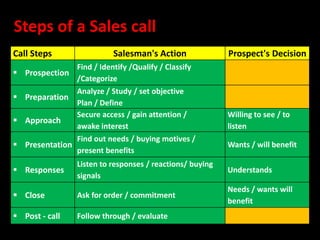
Steps of a Sales call
Call Steps                  Salesman's Action              Prospect's Decision
                 Find / Identify /Qualify / Classify
 Prospection
                 /Categorize
                 Analyze / Study / set objective
 Preparation
                 Plan / Define
                 Secure access / gain attention /          Willing to see / to
 Approach
                 awake interest                            listen
                 Find out needs / buying motives /
 Presentation                                             Wants / will benefit
                 present benefits
                 Listen to responses / reactions/ buying
 Responses                                                Understands
                 signals
                                                           Needs / wants will
 Close          Ask for order / commitment
                                                           benefit
 Post - call    Follow through / evaluate
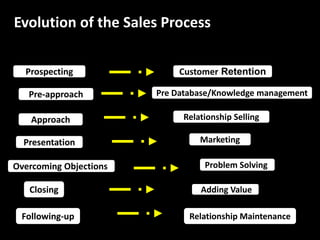
Evolution of the Sales Process

  Prospecting                Customer Retention

   Pre-approach         Pre Database/Knowledge management

    Approach                 Relationship Selling

  Presentation                   Marketing

Overcoming Objections             Problem Solving

   Closing                       Adding Value

 Following‐up                  Relationship Maintenance
Steps of a Sales call

First Step

• Identify the target market
• What segments exist in my territory?
• Who are the potential buyers in these segments?
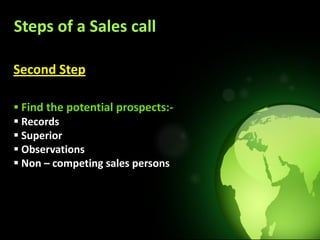
Steps of a Sales call

Second Step

 Find the potential prospects:-
 Records
 Superior
 Observations
 Non – competing sales persons
Steps of a Sales call

Third Step

• Qualify the prospect:-
• Needs
• Financial ability
• Buying decision
• Potentiality
Steps of a Sales call

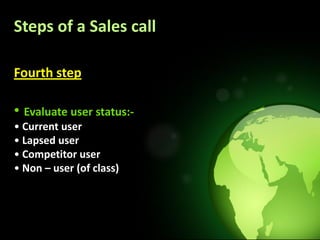
Fourth step

• Evaluate user status:-
• Current user
• Lapsed user
• Competitor user
• Non – user (of class)
Steps of a Sales call

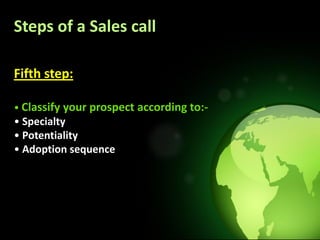
Fifth step:

• Classify your prospect according to:-
• Specialty
• Potentiality
• Adoption sequence
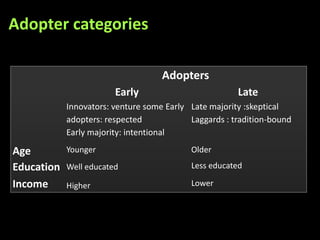
Adopter categories

                                    Adopters
                        Early                          Late
            Innovators: venture some Early Late majority :skeptical
            adopters: respected            Laggards : tradition-bound
            Early majority: intentional

Age         Younger                        Older

Education   Well educated                  Less educated

Income      Higher                         Lower
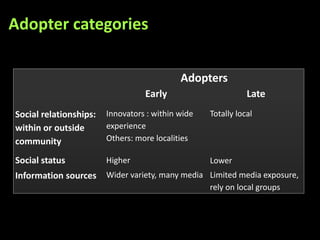
Adopter categories

                                            Adopters
                                  Early                       Late
Social relationships:   Innovators : within wide   Totally local
within or outside       experience
community               Others: more localities

Social status           Higher                     Lower
Information sources     Wider variety, many media Limited media exposure,
                                                  rely on local groups
Preparation
First Part:

• SMART Objectives:

 Specific
 Measurable
 Ambitious / Realistic
 Triggering action / Decision

• Yardstick to measure your success:

 Factor, data, etc. obtained from reliable sources
Preparation

Planning the call:

How do you want to proceed?

 Find out best time to see customer
 Prepare Approach
 Questions / to uncover needs and verify assumptions
 Benefits to satisfy needs
 Responses to possible reactions
 Use of visual aid
 Ways of closing / gaining commitment
 Preparation enhances confidence and lead to more sales
Planning your call strategy


How are you going to achieve your objective?

I.   Finding out the best time.

II. List all of your products strong sales features, benefits, and
    your competitive advantages.
Planning your call strategy

How are you going to achieve your objective?

III. Analyze your competitors:

 Who are your competitors?
   What are the strengths of your competitors?
   Why do people buy from competitors?
   What are their weaknesses?
   Why do customers buy from you and not from competitors?
   What are your competitors doing right?
   How can you imitate their success?
Preparation

Prepare:

 Approach
   Questions to uncover needs and verify assumptions
   Benefits to satisfy needs
   Responses to possible reactions
   Use of visual aid
   Ways of closing / gaining commitments
Approach
Approach


Main goals:
 To gain the prospect's attention
 To stimulate the prospect's interest
 To provide a smooth transition into the presentation
Approach


Three parts of approach

 Introduce yourself and whom you represent
 The purpose of your call
 A question
Approach


Approach Techniques:

 Referral
 Call objective
 Product or service benefit
 Buyer needs
Approach


Avoid negative "Suicidal" approach:

 To apologize in the beginning
 To refer to last negative visit
 To start asking (How is business?) or (May I help you?)
 To begin with close-ended question
Approach


Approach Techniques:

 Utilizing your call objective(s)
 Utilizing a prospect's needs (known or unknown)
 Utilizing a product and / service benefits
Approach
Approach Techniques:

 Utilizing your call objective(s):

 "Good evening Dr. Ali ,summer season is about to start.
When do you need your next order of Parentral Infusions to cover
this season?“

 "Good morning Mr. Salama I am calling on you today to talk
about the new Swiss watch. What are you looking for in a good
watch?“
Approach
Approach Techniques:

 Utilizing a prospect's needs (known or unknown)

 "Good afternoon Mr. Ahmed. I am here today to find out what
is your requirement from us to increase the productivity of your
staff?“


 "Good morning Dr. Hassan I am calling on you today to solve the
problem of the expiry date. How many expired packs do you
have?“
Approach
Approach Techniques:

 Utilizing a product and / service benefits:

 "Good morning Mr. Saad. We offer a 120 days credit facility for
orders placed prior to July 31St . How many packs would you like to
have?“


 "Good afternoon Dr. Salwa. We are granting 20% free goods
which mean an increase in your profit. How many packs would
you like to order?"
Presentation


Main Purpose:

• To "zero in" on the customer's needs / buying motives with
the features and benefits of our proposal (product).

• To be built on a positive two way communication.
Presentation

• First half of presentation:

 To uncover customer's needs by effective use of questions.

• Second half of presentation:

 To start matching product benefits with customer's needs /
wishes in order to find the decisive buying motive.
Presentation

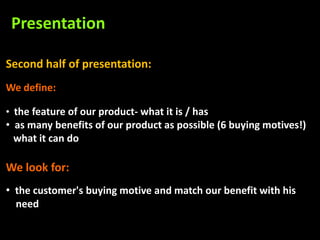
Second half of presentation:
We define:

• the feature of our product- what it is / has
• as many benefits of our product as possible (6 buying motives!)
  what it can do

We look for:
• the customer's buying motive and match our benefit with his
  need
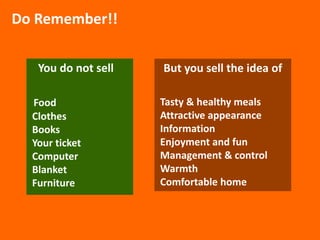
Do Remember!!


   You do not sell   But you sell the idea of

  Food               Tasty & healthy meals
  Clothes            Attractive appearance
  Books              Information
  Your ticket        Enjoyment and fun
  Computer           Management & control
  Blanket            Warmth
  Furniture          Comfortable home
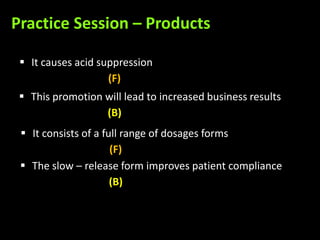
Practice Session – Products

  It causes acid suppression
                    (F)
  This promotion will lead to increased business results
                  (B)
  It consists of a full range of dosages forms
                      (F)
  The slow – release form improves patient compliance
                      (B)
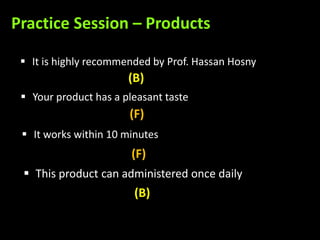
Practice Session – Products

  It is highly recommended by Prof. Hassan Hosny
                       (B)
  Your product has a pleasant taste
                       (F)
  It works within 10 minutes
                        (F)
  This product can administered once daily
                        (B)
Thanks

Sales Call

  • 1.
    Sales call Dr. Mohamed Mossad
  • 2.
    Steps of aSales call Call Steps Salesman's Action Prospect's Decision Find / Identify /Qualify / Classify  Prospection /Categorize Analyze / Study / set objective  Preparation Plan / Define Secure access / gain attention / Willing to see / to  Approach awake interest listen Find out needs / buying motives /  Presentation Wants / will benefit present benefits Listen to responses / reactions/ buying  Responses Understands signals Needs / wants will  Close Ask for order / commitment benefit  Post - call Follow through / evaluate
  • 3.
    Evolution of theSales Process Prospecting Customer Retention Pre-approach Pre Database/Knowledge management Approach Relationship Selling Presentation Marketing Overcoming Objections Problem Solving Closing Adding Value Following‐up Relationship Maintenance
  • 4.
    Steps of aSales call First Step • Identify the target market • What segments exist in my territory? • Who are the potential buyers in these segments?
  • 5.
    Steps of aSales call Second Step  Find the potential prospects:-  Records  Superior  Observations  Non – competing sales persons
  • 6.
    Steps of aSales call Third Step • Qualify the prospect:- • Needs • Financial ability • Buying decision • Potentiality
  • 7.
    Steps of aSales call Fourth step • Evaluate user status:- • Current user • Lapsed user • Competitor user • Non – user (of class)
  • 8.
    Steps of aSales call Fifth step: • Classify your prospect according to:- • Specialty • Potentiality • Adoption sequence
  • 9.
    Adopter categories Adopters Early Late Innovators: venture some Early Late majority :skeptical adopters: respected Laggards : tradition-bound Early majority: intentional Age Younger Older Education Well educated Less educated Income Higher Lower
  • 10.
    Adopter categories Adopters Early Late Social relationships: Innovators : within wide Totally local within or outside experience community Others: more localities Social status Higher Lower Information sources Wider variety, many media Limited media exposure, rely on local groups
  • 11.
    Preparation First Part: • SMARTObjectives:  Specific  Measurable  Ambitious / Realistic  Triggering action / Decision • Yardstick to measure your success:  Factor, data, etc. obtained from reliable sources
  • 12.
    Preparation Planning the call: Howdo you want to proceed?  Find out best time to see customer  Prepare Approach  Questions / to uncover needs and verify assumptions  Benefits to satisfy needs  Responses to possible reactions  Use of visual aid  Ways of closing / gaining commitment  Preparation enhances confidence and lead to more sales
  • 13.
    Planning your callstrategy How are you going to achieve your objective? I. Finding out the best time. II. List all of your products strong sales features, benefits, and your competitive advantages.
  • 14.
    Planning your callstrategy How are you going to achieve your objective? III. Analyze your competitors:  Who are your competitors?  What are the strengths of your competitors?  Why do people buy from competitors?  What are their weaknesses?  Why do customers buy from you and not from competitors?  What are your competitors doing right?  How can you imitate their success?
  • 15.
    Preparation Prepare:  Approach  Questions to uncover needs and verify assumptions  Benefits to satisfy needs  Responses to possible reactions  Use of visual aid  Ways of closing / gaining commitments
  • 16.
  • 17.
    Approach Main goals:  Togain the prospect's attention  To stimulate the prospect's interest  To provide a smooth transition into the presentation
  • 18.
    Approach Three parts ofapproach  Introduce yourself and whom you represent  The purpose of your call  A question
  • 19.
    Approach Approach Techniques:  Referral Call objective  Product or service benefit  Buyer needs
  • 20.
    Approach Avoid negative "Suicidal"approach:  To apologize in the beginning  To refer to last negative visit  To start asking (How is business?) or (May I help you?)  To begin with close-ended question
  • 21.
    Approach Approach Techniques:  Utilizingyour call objective(s)  Utilizing a prospect's needs (known or unknown)  Utilizing a product and / service benefits
  • 22.
    Approach Approach Techniques:  Utilizingyour call objective(s):  "Good evening Dr. Ali ,summer season is about to start. When do you need your next order of Parentral Infusions to cover this season?“  "Good morning Mr. Salama I am calling on you today to talk about the new Swiss watch. What are you looking for in a good watch?“
  • 23.
    Approach Approach Techniques:  Utilizinga prospect's needs (known or unknown)  "Good afternoon Mr. Ahmed. I am here today to find out what is your requirement from us to increase the productivity of your staff?“  "Good morning Dr. Hassan I am calling on you today to solve the problem of the expiry date. How many expired packs do you have?“
  • 24.
    Approach Approach Techniques:  Utilizinga product and / service benefits:  "Good morning Mr. Saad. We offer a 120 days credit facility for orders placed prior to July 31St . How many packs would you like to have?“  "Good afternoon Dr. Salwa. We are granting 20% free goods which mean an increase in your profit. How many packs would you like to order?"
  • 25.
    Presentation Main Purpose: • To"zero in" on the customer's needs / buying motives with the features and benefits of our proposal (product). • To be built on a positive two way communication.
  • 26.
    Presentation • First halfof presentation:  To uncover customer's needs by effective use of questions. • Second half of presentation:  To start matching product benefits with customer's needs / wishes in order to find the decisive buying motive.
  • 27.
    Presentation Second half ofpresentation: We define: • the feature of our product- what it is / has • as many benefits of our product as possible (6 buying motives!) what it can do We look for: • the customer's buying motive and match our benefit with his need
  • 28.
    Do Remember!! You do not sell But you sell the idea of Food Tasty & healthy meals Clothes Attractive appearance Books Information Your ticket Enjoyment and fun Computer Management & control Blanket Warmth Furniture Comfortable home
  • 29.
    Practice Session –Products  It causes acid suppression (F)  This promotion will lead to increased business results (B)  It consists of a full range of dosages forms (F)  The slow – release form improves patient compliance (B)
  • 30.
    Practice Session –Products  It is highly recommended by Prof. Hassan Hosny (B)  Your product has a pleasant taste (F)  It works within 10 minutes (F)  This product can administered once daily (B)
  • 31.