The Information Journey
Sarah Coulbeck: The Grammar School at Leeds (GSAL)

 Emma Hadfield: Thomas Rotherham College (TRC)

        Peter Field: UCL School of Pharmacy
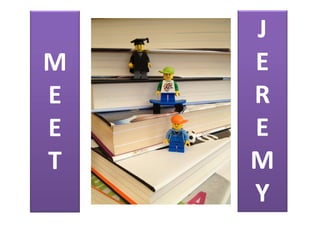
Meet Jeremy   J
M                 E
E                 R
E                 E
T                 M
                  Y
The Grammar School at Leeds (GSAL)


• Independent Grammar School
• 3‐18 year olds:
  – Infant School (pre‐prep)
  – Junior School (prep)
  – Senior School, including Sixth Form
• Whole school library service:
  – Six professional librarians
  – Three library assistants
Plan   Gather   Evaluat
                   e
Did you have lessons on how to use 
 the library at your Junior School?
From GSAL Juniors:    From elsewhere: 
  100% said YES         51% said YES
Is the information you find on the 
        Internet always true?
From GSAL Juniors:    From elsewhere: 
   99% said NO          99% said NO
How would you find information in a 
       non‐fiction book?
  From GSAL Juniors:
71% said use CONTENTS
  70% said use INDEX
                     From elsewhere:
                  56% said use CONTENTS
                    46% said use INDEX
You need to include a bibliography at 
  the end of your work to record the 
   books you have used.  Circle the 
information you would include about 
               a book…
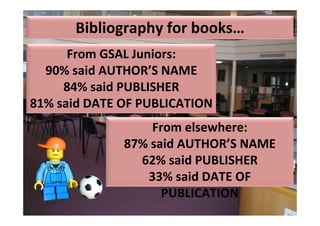
Bibliography for books…
      From GSAL Juniors:
  90% said AUTHOR’S NAME
     84% said PUBLISHER
81% said DATE OF PUBLICATION
                  From elsewhere:
              87% said AUTHOR’S NAME
                62% said PUBLISHER
                 33% said DATE OF 
                    PUBLICATION
You need to include a bibliography at 
  the end of your work to record the 
 websites you have used.  Circle the 
information you would include about 
              a website…
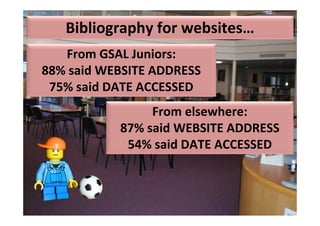
Bibliography for websites…
   From GSAL Juniors:
88% said WEBSITE ADDRESS
 75% said DATE ACCESSED
                From elsewhere:
           87% said WEBSITE ADDRESS
            54% said DATE ACCESSED
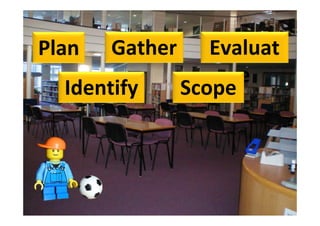
Plan   Gather      Evaluat
                      e
  Identify      Scope
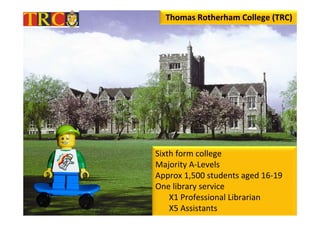
Thomas Rotherham College (TRC)


Sixth form college
Majority A‐Levels
Approx 1,500 students aged 16‐19
One library service
    X1 Professional Librarian
    X5 Assistants
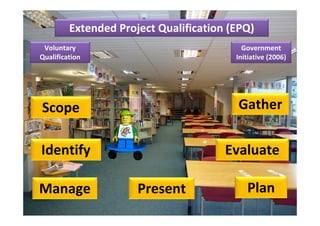
Extended Project Qualification (EPQ)
 Voluntary                                 Government 
Qualification                            Initiative (2006)


Scope                                    Gather

Identify                               Evaluate

Manage                Present               Plan
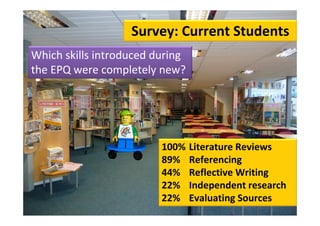
Survey: Current Students
Which skills introduced during 
the EPQ were completely new?


                          100%    Literature Reviews 
                          89%     Referencing
                          44%     Reflective Writing
                          22%     Independent research
                          22%     Evaluating Sources
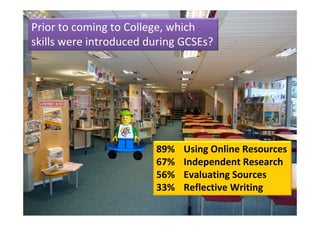
Prior to coming to College, which 
skills were introduced during GCSEs?


                        89%   Using Online Resources
                        67%   Independent Research
                        56%   Evaluating Sources
                        33%   Reflective Writing
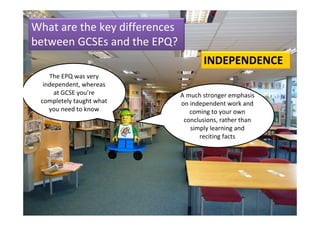
What are the key differences 
between GCSEs and the EPQ?
                                        INDEPENDENCE
    The EPQ was very 
  independent, whereas 
      at GCSE you’re            A much stronger emphasis 
 completely taught what         on independent work and 
    you need to know               coming to your own 
                                 conclusions, rather than 
                                   simply learning and 
                                      reciting facts
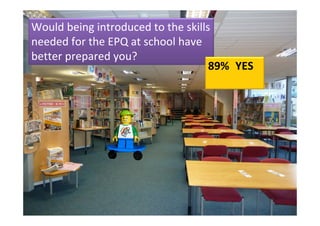
Would being introduced to the skills 
needed for the EPQ at school have 
better prepared you?
                                    89% YES
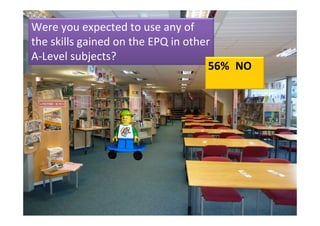
Were you expected to use any of 
the skills gained on the EPQ in other 
A‐Level subjects?
                                     56% NO
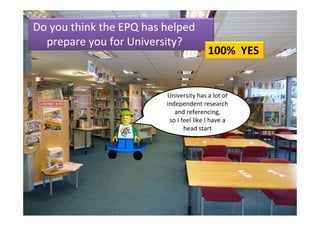
Do you think the EPQ has helped 
  prepare you for University?
                                         100%  YES


                         University has a lot of 
                         independent research 
                            and referencing, 
                          so I feel like I have a 
                                head start
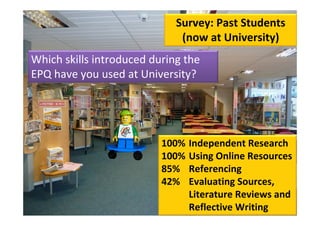
Survey: Past Students 
                              (now at University)
Which skills introduced during the 
EPQ have you used at University?


                          100%   Independent Research
                          100%   Using Online Resources
                          85%    Referencing
                          42%    Evaluating Sources, 
                                 Literature Reviews and 
                                 Reflective Writing
What are the key differences between studying 
at A‐Level and  Undergraduate level?
                                     INDEPENDENCE


                             There is a lot more 
                           independent learning 
                             and coursework is 
                           much more self‐guided
Do you think the EPQ helped 
prepare you for University?
                                        85% YES

    The EPQ was the 
     stepping stone       I have found that the skills 
  between further and    learnt through the EPQ have 
    higher education        been very valuable and 
                           useful, particularly being 
                               able to research 
                                 systematically
UCL School of Pharmacy

• One Undergraduate programme – 4‐year MPharm degree
• 800 undergraduate students
• Merged with UCL in January 2012

• Questionnaire survey:
   – 40 responses from 1st year students
   – 103 responses from 3rd year students
•   MITTERMEYER, D. & QUIRION, D. (2003). Information literacy: Study of incoming first‐year undergraduates in Quebec. 
    Montreal: Conférence des recteurs et des principaux des universités de Québec.
•   SALISBURY, F. & KARASMANIS, S. (2011). Are they ready?  Exploring student information literacy skills in the transition from 
    secondary to tertiary education. Australian Academic & Research Libraries, 42, 43‐58.
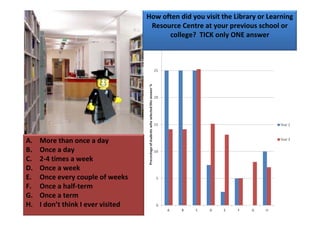
How often did you visit the Library or Learning 
                                     Resource Centre at your previous school or 
                                          college?  TICK only ONE answer


A.   More than once a day
B.   Once a day
C.   2‐4 times a week
D.   Once a week
E.   Once every couple of weeks
F.   Once a half‐term
G.   Once a term
H.   I don’t think I ever visited
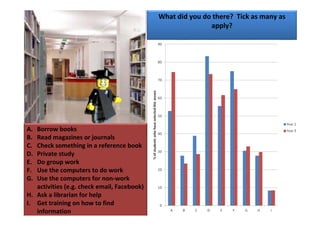
What did you do there?  Tick as many as 
                                                            apply?


A. Borrow books 
B. Read magazines or journals
C. Check something in a reference book
D. Private study
E. Do group work
F. Use the computers to do work
G. Use the computers for non‐work 
   activities (e.g. check email, Facebook)
H. Ask a librarian for help
I. Get training on how to find 
   information
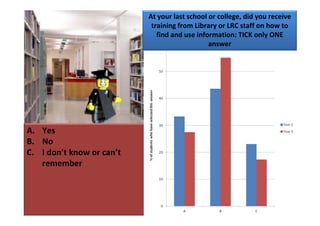
At your last school or college, did you receive 
                             training from Library or LRC staff on how to 
                               find and use information: TICK only ONE 
                                                answer


A. Yes
B. No
C. I don’t know or can’t 
   remember
At your last school or college, did you receive 
                            training from a subject teacher on how to find 
                              and use information: TICK only ONE answer


A. Yes
B. No
C. I don’t know or can’t 
   remember
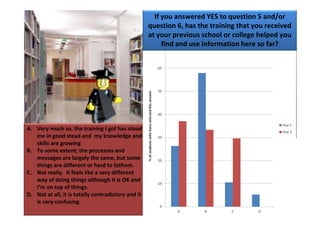
If you answered YES to question 5 and/or 
                                                     question 6, has the training that you received 
                                                     at your previous school or college helped you 
                                                          find and use information here so far?


A. Very much so, the training I got has stood 
   me in good stead and  my knowledge and 
   skills are growing
B. To some extent; the processes and 
   messages are largely the same, but some 
   things are different or hard to fathom.
C. Not really.  It feels like a very different 
   way of doing things although it is OK and 
   I’m on top of things.
D. Not at all, it is totally contradictory and it 
   is very confusing.
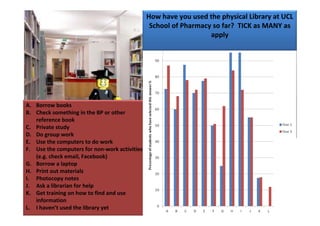
How have you used the physical Library at UCL 
                                                 School of Pharmacy so far?  TICK as MANY as 
                                                                   apply


A. Borrow books 
B. Check something in the BP or other 
   reference book
C. Private study
D. Do group work
E. Use the computers to do work
F. Use the computers for non‐work activities 
   (e.g. check email, Facebook)
G. Borrow a laptop
H. Print out materials
I. Photocopy notes
J. Ask a librarian for help
K. Get training on how to find and use 
   information
L. I haven’t used the library yet
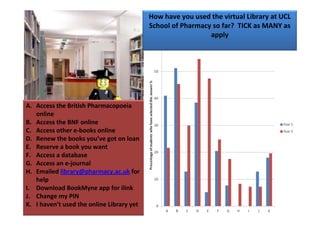
How have you used the virtual Library at UCL 
                                           School of Pharmacy so far?  TICK as MANY as 
                                                             apply


A. Access the British Pharmacopoeia 
   online
B. Access the BNF online
C. Access other e‐books online
D. Renew the books you’ve got on loan
E. Reserve a book you want
F. Access a database
G. Access an e‐journal
H. Emailed library@pharmacy.ac.uk for 
   help
I. Download BookMyne app for ilink
J. Change my PIN
K. I haven’t used the online Library yet
Discussion and Conclusion
• Demonstration of disparity of previous 
  learning experience
• Demonstration of the value of libraries and 
  library staff
• Integration with academic curriculum and 
  changing perceptions of information skills 
References
Irving, C & Crawford, J (2007) A National Information Literacy Framework Scotland Glasgow: Glasgow 
Caledonian University [online] Available at 
http://www.ltscotland.org.uk/Images/information_literacy_framework_draft_tcm4‐433724.pdf
[Retrieved 24 January 2012)

Mittermeyer, D & Quirion, D (2003). Information literacy: Study of incoming first‐year undergraduates 
in Quebec. Montreal: Conférence des recteurs et des principaux des universités de Québec.

Salisbury, F & Karasmanis, S (2011). Are they ready?  Exploring student information literacy skills in the 
transition from secondary to tertiary education. Australian Academic & Research Libraries, 42, 43‐58.

SCONUL (2011) The Seven Pillars of Information Literacy: A Core Model for Higher Education. [online] 
Available at http://www.sconul.ac.uk/groups/information_literacy/publications/coremodel.pdf
[Retrieved 22 March 2012].

Welsh Information Literacy Project (2011) Information Literacy Framework for Wales [online] Cardiff: 
Cardiff University. Available at 
http://librarywales.org/uploads/media/Information_Literacy_Framework_Wales.pdf [Retrieved 24 
January 2012].

Coulbeck Hadfield & Field - The information journey