THEORETICAL FRAMEWORKS:
HIGHER ED, OER, & WRITING
Ron Christiansen, Justin Jory, Jason Pickavance,
Marlena Stanford, and Brittany Stephenson
Salt Lake Community College
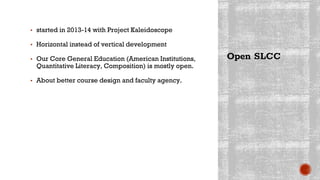
Open SLCC
▪ started in 2013-14 with Project Kaleidoscope
▪ Horizontal instead of vertical development
▪ Our Core General Education (American Institutions,
Quantitative Literacy, Composition) is mostly open.
▪ About better course design and faculty agency.
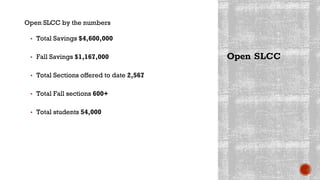
Open SLCC by the numbers
▪ Total Savings $4,600,000
▪ Fall Savings $1,167,000
▪ Total Sections offered to date 2,567
▪ Total Fall sections 600+
▪ Total students 54,000
Open SLCC
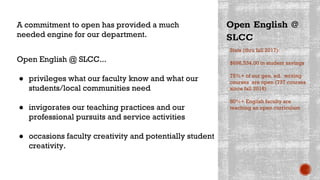
Stats (thru fall 2017):
$696,534.00 in student savings
75%+ of our gen. ed. writing
courses are open (737 courses
since fall 2016)
80%+ English faculty are
teaching an open curriculum
Open English @
SLCC
A commitment to open has provided a much
needed engine for our department.
Open English @ SLCC...
● privileges what our faculty know and what our
students/local communities need
● invigorates our teaching practices and our
professional pursuits and service activities
● occasions faculty creativity and potentially student
creativity.
CASE STUDY: WRITING
THRESHOLDS IN OPEN ENGLISH
In Search of a Responsive Disciplinary Framework
Thresholds in
English @
SLCC
Threshold theory is a theory of teaching and
learning centered on student development
within disciplines:
In certain disciplines there are ‘conceptual gateways’ or
‘portals’ that lead to a previously inaccessible, and
initially perhaps ‘troublesome,’ way of thinking about
something. A new way of understanding, interpreting, or
viewing something may thus emerge--a transformed
internal view of subject matter, subject landscape, or
even world view. (Meyers and Land)
Writing is a form of action.
Through writing we
respond to problems and
can create change in the
world.
Writing is a processes of
deliberation. It involves
identifying and enacting
choices, strategies, and
moves.
THE
AFFORDANCES
OF WRITING
THRESHOLDS FOR
OER
▪ Durable. TCs, once established within our local
context, are hard to dispute.
▪Flexible. TCs can be used for many purposes,
audiences, and contexts.
▪ Responsive. TCs can be taken up in our local context
to discover new disciplinary insights for our students,
our faculty, our community.
▪ Generative. TCs help us generate OERs that also
become durable, flexible and responsive to our local
context.
THE
CHALLENGES OF
WRITING
THRESHOLDS
FOR OER
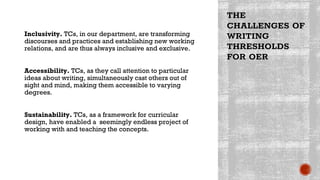
Inclusivity. TCs, in our department, are transforming
discourses and practices and establishing new working
relations, and are thus always inclusive and exclusive.
Accessibility. TCs, as they call attention to particular
ideas about writing, simultaneously cast others out of
sight and mind, making them accessible to varying
degrees.
Sustainability. TCs, as a framework for curricular
design, have enabled a seemingly endless project of
working with and teaching the concepts.
CASE STUDY:
ONLINE PLUS AND OPEN
ENGLISH @SLCC
English 1010:
ONLINE PLUS
MEETS OER
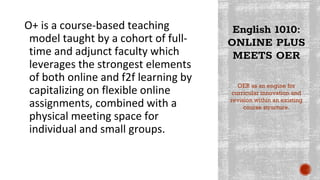
O+ is a course-based teaching
model taught by a cohort of full-
time and adjunct faculty which
leverages the strongest elements
of both online and f2f learning by
capitalizing on flexible online
assignments, combined with a
physical meeting space for
individual and small groups.
OER as an engine for
curricular innovation and
revision within an existing
course structure.
OER AS A
CONNECTING
FORCE
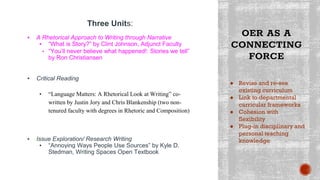
Three Units:
▪ A Rhetorical Approach to Writing through Narrative
▪ “What is Story?” by Clint Johnson, Adjunct Faculty
▪ “You’ll never believe what happened!: Stories we tell”
by Ron Christiansen
▪ Critical Reading
▪ “Language Matters: A Rhetorical Look at Writing” co-
written by Justin Jory and Chris Blankenship (two non-
tenured faculty with degrees in Rhetoric and Composition)
▪ Issue Exploration/ Research Writing
▪ “Annoying Ways People Use Sources” by Kyle D.
Stedman, Writing Spaces Open Textbook
● Revise and re-see
existing curriculum
● Link to departmental
curricular frameworks
● Cohesion with
flexibility
● Plug-in disciplinary and
personal teaching
knowledge
OER
NARRATIVE
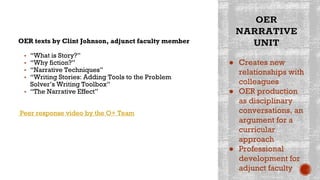
UNITOER texts by Clint Johnson, adjunct faculty member
▪ “What is Story?”
▪ “Why fiction?”
▪ “Narrative Techniques”
▪ “Writing Stories: Adding Tools to the Problem
Solver’s Writing Toolbox”
▪ “The Narrative Effect”
Peer response video by the O+ Team
● Creates new
relationships with
colleagues
● OER production
as disciplinary
conversations, an
argument for a
curricular
approach
● Professional
development for
adjunct faculty
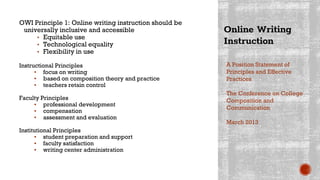
Online Writing
Instruction
OWI Principle 1: Online writing instruction should be
universally inclusive and accessible
▪ Equitable use
▪ Technological equality
▪ Flexibility in use
Instructional Principles
▪ focus on writing
▪ based on composition theory and practice
▪ teachers retain control
Faculty Principles
▪ professional development
▪ compensation
▪ assessment and evaluation
Institutional Principles
▪ student preparation and support
▪ faculty satisfaction
▪ writing center administration
A Position Statement of
Principles and Effective
Practices
The Conference on College
Composition and
Communication
March 2013
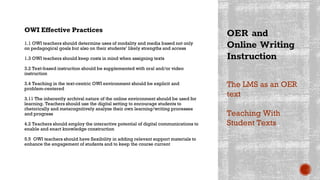
OER and
Online Writing
Instruction
OWI Effective Practices
1.1 OWI teachers should determine uses of modality and media based not only
on pedagogical goals but also on their students’ likely strengths and access
1.3 OWI teachers should keep costs in mind when assigning texts
3.2 Text-based instruction should be supplemented with oral and/or video
instruction
3.4 Teaching in the text-centric OWI environment should be explicit and
problem-centered
3.11 The inherently archival nature of the online environment should be used for
learning. Teachers should use the digital setting to encourage students to
rhetorically and metacognitively analyze their own learning/writing processes
and progress
4.2 Teachers should employ the interactive potential of digital communications to
enable and enact knowledge construction
5.5 OWI teachers should have flexibility in adding relevant support materials to
enhance the engagement of students and to keep the course current
The LMS as an OER
text
Teaching With
Student Texts
CONCLUSION
OER brings us closer to institutional projects and systems that take
collaboration as the forward frame for getting work done in a merit-based
institution that so often values individual work.
But, the institutionalization of OER is already underway. What do we make
of this?

Theoretical frameworks

  • 1.
    THEORETICAL FRAMEWORKS: HIGHER ED,OER, & WRITING Ron Christiansen, Justin Jory, Jason Pickavance, Marlena Stanford, and Brittany Stephenson Salt Lake Community College
  • 2.
    Open SLCC ▪ startedin 2013-14 with Project Kaleidoscope ▪ Horizontal instead of vertical development ▪ Our Core General Education (American Institutions, Quantitative Literacy, Composition) is mostly open. ▪ About better course design and faculty agency.
  • 3.
    Open SLCC bythe numbers ▪ Total Savings $4,600,000 ▪ Fall Savings $1,167,000 ▪ Total Sections offered to date 2,567 ▪ Total Fall sections 600+ ▪ Total students 54,000 Open SLCC
  • 4.
    Stats (thru fall2017): $696,534.00 in student savings 75%+ of our gen. ed. writing courses are open (737 courses since fall 2016) 80%+ English faculty are teaching an open curriculum Open English @ SLCC A commitment to open has provided a much needed engine for our department. Open English @ SLCC... ● privileges what our faculty know and what our students/local communities need ● invigorates our teaching practices and our professional pursuits and service activities ● occasions faculty creativity and potentially student creativity.
  • 5.
    CASE STUDY: WRITING THRESHOLDSIN OPEN ENGLISH In Search of a Responsive Disciplinary Framework
  • 6.
    Thresholds in English @ SLCC Thresholdtheory is a theory of teaching and learning centered on student development within disciplines: In certain disciplines there are ‘conceptual gateways’ or ‘portals’ that lead to a previously inaccessible, and initially perhaps ‘troublesome,’ way of thinking about something. A new way of understanding, interpreting, or viewing something may thus emerge--a transformed internal view of subject matter, subject landscape, or even world view. (Meyers and Land) Writing is a form of action. Through writing we respond to problems and can create change in the world. Writing is a processes of deliberation. It involves identifying and enacting choices, strategies, and moves.
  • 7.
    THE AFFORDANCES OF WRITING THRESHOLDS FOR OER ▪Durable. TCs, once established within our local context, are hard to dispute. ▪Flexible. TCs can be used for many purposes, audiences, and contexts. ▪ Responsive. TCs can be taken up in our local context to discover new disciplinary insights for our students, our faculty, our community. ▪ Generative. TCs help us generate OERs that also become durable, flexible and responsive to our local context.
  • 8.
    THE CHALLENGES OF WRITING THRESHOLDS FOR OER Inclusivity.TCs, in our department, are transforming discourses and practices and establishing new working relations, and are thus always inclusive and exclusive. Accessibility. TCs, as they call attention to particular ideas about writing, simultaneously cast others out of sight and mind, making them accessible to varying degrees. Sustainability. TCs, as a framework for curricular design, have enabled a seemingly endless project of working with and teaching the concepts.
  • 9.
    CASE STUDY: ONLINE PLUSAND OPEN ENGLISH @SLCC
  • 10.
    English 1010: ONLINE PLUS MEETSOER O+ is a course-based teaching model taught by a cohort of full- time and adjunct faculty which leverages the strongest elements of both online and f2f learning by capitalizing on flexible online assignments, combined with a physical meeting space for individual and small groups. OER as an engine for curricular innovation and revision within an existing course structure.
  • 11.
    OER AS A CONNECTING FORCE ThreeUnits: ▪ A Rhetorical Approach to Writing through Narrative ▪ “What is Story?” by Clint Johnson, Adjunct Faculty ▪ “You’ll never believe what happened!: Stories we tell” by Ron Christiansen ▪ Critical Reading ▪ “Language Matters: A Rhetorical Look at Writing” co- written by Justin Jory and Chris Blankenship (two non- tenured faculty with degrees in Rhetoric and Composition) ▪ Issue Exploration/ Research Writing ▪ “Annoying Ways People Use Sources” by Kyle D. Stedman, Writing Spaces Open Textbook ● Revise and re-see existing curriculum ● Link to departmental curricular frameworks ● Cohesion with flexibility ● Plug-in disciplinary and personal teaching knowledge
  • 12.
    OER NARRATIVE UNITOER texts byClint Johnson, adjunct faculty member ▪ “What is Story?” ▪ “Why fiction?” ▪ “Narrative Techniques” ▪ “Writing Stories: Adding Tools to the Problem Solver’s Writing Toolbox” ▪ “The Narrative Effect” Peer response video by the O+ Team ● Creates new relationships with colleagues ● OER production as disciplinary conversations, an argument for a curricular approach ● Professional development for adjunct faculty
  • 13.
    Online Writing Instruction OWI Principle1: Online writing instruction should be universally inclusive and accessible ▪ Equitable use ▪ Technological equality ▪ Flexibility in use Instructional Principles ▪ focus on writing ▪ based on composition theory and practice ▪ teachers retain control Faculty Principles ▪ professional development ▪ compensation ▪ assessment and evaluation Institutional Principles ▪ student preparation and support ▪ faculty satisfaction ▪ writing center administration A Position Statement of Principles and Effective Practices The Conference on College Composition and Communication March 2013
  • 14.
    OER and Online Writing Instruction OWIEffective Practices 1.1 OWI teachers should determine uses of modality and media based not only on pedagogical goals but also on their students’ likely strengths and access 1.3 OWI teachers should keep costs in mind when assigning texts 3.2 Text-based instruction should be supplemented with oral and/or video instruction 3.4 Teaching in the text-centric OWI environment should be explicit and problem-centered 3.11 The inherently archival nature of the online environment should be used for learning. Teachers should use the digital setting to encourage students to rhetorically and metacognitively analyze their own learning/writing processes and progress 4.2 Teachers should employ the interactive potential of digital communications to enable and enact knowledge construction 5.5 OWI teachers should have flexibility in adding relevant support materials to enhance the engagement of students and to keep the course current The LMS as an OER text Teaching With Student Texts
  • 15.
    CONCLUSION OER brings uscloser to institutional projects and systems that take collaboration as the forward frame for getting work done in a merit-based institution that so often values individual work. But, the institutionalization of OER is already underway. What do we make of this?