Metamorphic Petrology
EES 302: (3 credits)
by
Dr Hifzurrahman
Department of Earth And Environmental Sciences IISERBPR,
Odisha, India
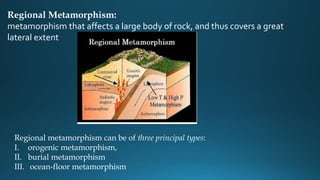
Regional Metamorphism:
metamorphism that affects a large body of rock, and thus covers a great
lateral extent
Regional metamorphism can be of three principal types:
I. orogenic metamorphism,
II. burial metamorphism
III. ocean-floor metamorphism
I. Orogenic Metamorphism: is the type of metamorphism associated with
convergent plate margins.
 Thus it occurs during the development of island arcs, continental arcs, and
continental collision zones.
Dynamo-thermal metamorphism results when temperature and stresses are combined, as in orogenic belts
Orogenic metamorphism = dynamo-thermal
 One or more episodes of orogeny with combined elevated geothermal gradients and
deformation (deviatoric stress).
 Most affected rocks therefore display a definite foliation (slates, phyllites, schists,
gneisses, etc.)
Most significant type of metamorphism affecting the rocks of the continental crust on a large scale.
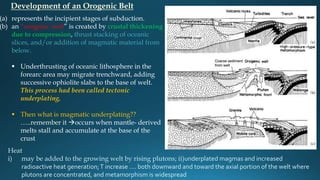
(a) represents the incipient stages of subduction.
(b) an “orogenic welt” is created by crustal thickening
due to compression, thrust stacking of oceanic
slices, and/or addition of magmatic material from
below.
 Underthrusting of oceanic lithosphere in the
forearc area may migrate trenchward, adding
successive ophiolite slabs to the base of welt.
This process had been called tectonic
underplating,
 Then what is magmatic underplating??
…..remember it occurs when mantle- derived
melts stall and accumulate at the base of the
crust
Heat
i) may be added to the growing welt by rising plutons; ii)underplated magmas and increased
radioactive heat generation;T increase …. both downward and toward the axial portion of the welt where
plutons are concentrated, and metamorphism is widespread
Development of an Orogenic Belt
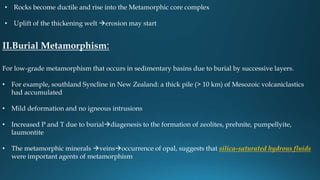
• Rocks become ductile and rise into the Metamorphic core complex
• Uplift of the thickening welt erosion may start
II.Burial Metamorphism:
For low-grade metamorphism that occurs in sedimentary basins due to burial by successive layers.
• For example, southland Syncline in New Zealand: a thick pile (> 10 km) of Mesozoic volcaniclastics
had accumulated
• Mild deformation and no igneous intrusions
• Increased P and T due to burialdiagenesis to the formation of zeolites, prehnite, pumpellyite,
laumontite
• The metamorphic minerals veinsoccurrence of opal, suggests that silica-saturated hydrous fluids
were important agents of metamorphism
IIA: Hydrothermal Metamorphism
Many areas of burial metamorphism are also hydrothermal fields, suggesting an
elevated geothermal gradient and fluids may be important elements
 Hot H2O-rich fluids
 Usually involves metasomatism
 Burial metamorphism occurs in areas that have not experienced significant deformation or
orogeny, restricted to large, relatively undisturbed sedimentary piles away from active
plate margins. Example, The Gulf of Mexico, Bengal Fan (Passive cont. Margin)
 Bengal Fan----- sedimentary pile > 22 km
 Extrapolating ----250-300oC at the base (P ~ 0.6 GPa)
 Areas of burial metamorphism ……areas of orogenic metamorphism…?????
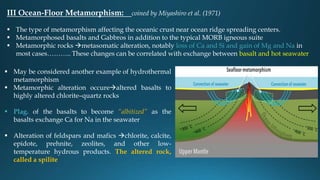
III Ocean-Floor Metamorphism: coined by Miyashiro et al. (1971)
 The type of metamorphism affecting the oceanic crust near ocean ridge spreading centers.
 Metamorphosed basalts and Gabbros in addition to the typical MORB igneous suite
 Metamorphic rocks metasomatic alteration, notably loss of Ca and Si and gain of Mg and Na in
most cases……….. These changes can be correlated with exchange between basalt and hot seawater
 May be considered another example of hydrothermal
metamorphism
 Metamorphic alteration occurealtered basalts to
highly altered chlorite–quartz rocks
 Plag. of the basalts to become “albitized” as the
basalts exchange Ca for Na in the seawater
 Alteration of feldspars and mafics chlorite, calcite,
epidote, prehnite, zeolites, and other low-
temperature hydrous products. The altered rock,
called a spilite
Fault-Zone and Impact Metamorphism
 High rates of deformation and strain with only minor
recrystallization
 Impact metamorphism (Shock Metamorphism) at meteorite (or
other bolide) impact craters
 The shock wave produces high enough pressure to cause
quartz to change its crystal structure to more a dense
polymorph like coesite or stishovite.
 Fault includes zones of distributed shear that can be up to
several kilometers across
 Strain High and T low enough  minerals may be broken,
bent, or crushed without much accompanying recrystallization.
This process is known as cataclasis
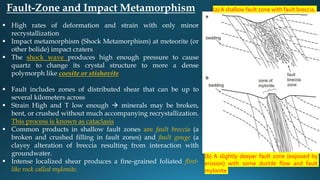
 Common products in shallow fault zones are fault breccia (a
broken and crushed filling in fault zones) and fault gouge (a
clayey alteration of breccia resulting from interaction with
groundwater.
 Intense localized shear produces a fine-grained foliated flint-
like rock called mylonite.
(a) A shallow fault zone with fault breccia.
(b) A slightly deeper fault zone (exposed by
erosion) with some ductile flow and fault
mylonite
Metamorphic Mineral Zones
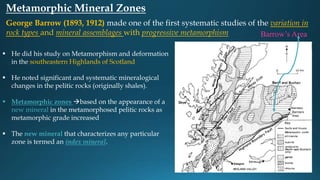
George Barrow (1893, 1912) made one of the first systematic studies of the variation in
rock types and mineral assemblages with progressive metamorphism
 He did his study on Metamorphism and deformation
in the southeastern Highlands of Scotland
 He noted significant and systematic mineralogical
changes in the pelitic rocks (originally shales).
 Metamorphic zones based on the appearance of a
new mineral in the metamorphosed pelitic rocks as
metamorphic grade increased
 The new mineral that characterizes any particular
zone is termed an index mineral.
Barrow’s Area
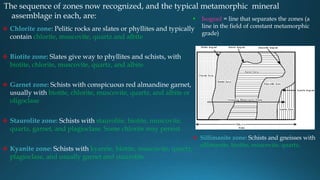
The sequence of zones now recognized, and the typical metamorphic mineral
assemblage in each, are:
 Chlorite zone: Pelitic rocks are slates or phyllites and typically
contain chlorite, muscovite, quartz and albite
 Biotite zone: Slates give way to phyllites and schists, with
biotite, chlorite, muscovite, quartz, and albite
 Garnet zone: Schists with conspicuous red almandine garnet,
usually with biotite, chlorite, muscovite, quartz, and albite or
oligoclase
 Staurolite zone: Schists with staurolite, biotite, muscovite,
quartz, garnet, and plagioclase. Some chlorite may persist
 Kyanite zone: Schists with kyanite, biotite, muscovite, quartz,
plagioclase, and usually garnet and staurolite
 Isograd = line that separates the zones (a
line in the field of constant metamorphic
grade)
 Sillimanite zone: Schists and gneisses with
sillimanite, biotite, muscovite, quartz,
 The P-T conditions referred to as “Barrovian-type” metamorphism (fairly typical of
many belts)
 Barrovian sequence of zones has been recognized in orogenic terranes worldwide.
 When one crosses an isograd, such as the biotite isograd, one enters the biotite zone
 Zones thus have the same name as the isograd that forms the low-grade boundary
of that zone.
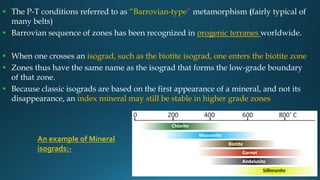
 Because classic isograds are based on the first appearance of a mineral, and not its
disappearance, an index mineral may still be stable in higher grade zones
An example of Mineral
isograds:-