Supercontinents
By Jessie Fifer
What is a
Supercontinent?
 Supercontinent (ˈsuːpəˌkɒntɪnənt)
 A great landmass thought to have existed in the
geological past and to have split into smaller
landmasses, which drifted and formed the present
continents ("Supercontinent definition ," )
 Supercontinent cycles are semiregular groupings of
the planet's landmasses into single or large continents
that remain stable for a period of time, then disperse,
and eventually come back together as new
amalgamated landmasses with a different distribution.
(“Science Online,”).
Vaalbara
 Considered possibly the first continent, since it was
the ONLY continent it is also considered a
Supercontinent
 3.5 billion years ago
 Made of two cratons (rock cores)
 The two cratons are now divided over 2 continents
“aapvaal craton in southern Africa and the Pilbara
craton in northwestern Australia” (Wilkins, 2011).
 Considered Speculative
Ur
 Smallest of Supercontinents
 Existed 3 billion years ago
 “Today, Ur lives on as part of India, Madagascar, and
Australia” (Wilkins, 2011).
 “longest-lived landmass this planet will ever see” (Wilkins,
2011).
 Remained until the break up of Pangea
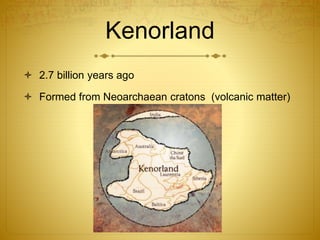
Kenorland
 2.7 billion years ago
 Formed from Neoarchaean cratons (volcanic matter)
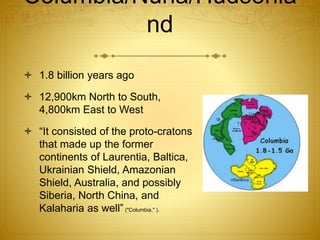
Columbia/Nuna/Hudsonla
nd
 1.8 billion years ago
 12,900km North to South,
4,800km East to West
 “It consisted of the proto-cratons
that made up the former
continents of Laurentia, Baltica,
Ukrainian Shield, Amazonian
Shield, Australia, and possibly
Siberia, North China, and
Kalaharia as well”("Columbia," ).
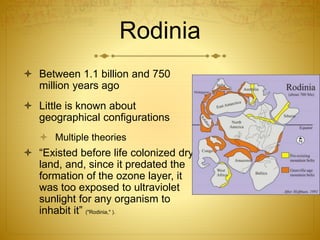
Rodinia
 Between 1.1 billion and 750
million years ago
 Little is known about
geographical configurations
 Multiple theories
 “Existed before life colonized dry
land, and, since it predated the
formation of the ozone layer, it
was too exposed to ultraviolet
sunlight for any organism to
inhabit it” ("Rodinia," ).
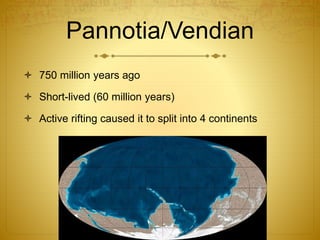
Pannotia/Vendian
 750 million years ago
 Short-lived (60 million years)
 Active rifting caused it to split into 4 continents
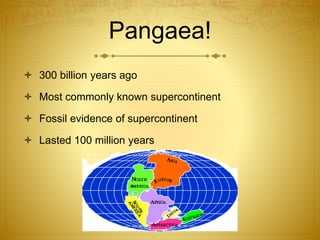
Pangaea!
 300 billion years ago
 Most commonly known supercontinent
 Fossil evidence of supercontinent
 Lasted 100 million years
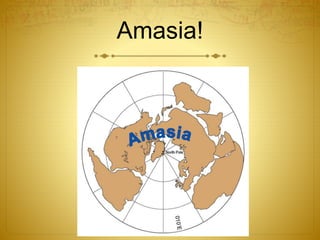
Amasia!
Amasia!
 Science Now states:
 “Over the next few hundred million years, the Arctic Ocean and
the Caribbean Sea will disappear, and Asia will crash into the
Americas forming a supercontinent that will stretch across much
of the Northern Hemisphere. That's the conclusion of a new
analysis of the movements of these giant landmasses.” (Perkins, 2012)
 100 million years from today
 “Over the next few hundred million years, Mitchell says, the
motions of tectonic plates will cause the Arctic Ocean and the
Caribbean Sea to disappear, the western edge of South America
to crowd up against the eastern seaboard, and Australia to slam
into southeastern Asia. It's unclear whether Antarctica will join the
party or be stranded at the South Pole.” (Perkins, 2012)
References
 Supercontinent definition . (n.d.). Retrieved from http://dictionary.reference.com/browse/supercontinent
 Wilkins, A. (2011, January 27). [Web log message]. Retrieved from http://io9.com/5744636/a-geological-history-of-
supercontinents-on-planet-earth
 Kusky, T. Supercontinent cycles. In Science online. Retrieved from http://0-
www.fofweb.com.olinkserver.franklin.edu/activelink2.asp?ItemID=WE40&SID=5&iPin=EESS0234&SingleRecord=True
 Slide 5 Image: http://img1.rnkr-static.com/user_node_img/50012/1000235451/C350/kenorland-natural-features-photo-
u1.jpg
 Slide 6 Image: http://mindblowingscience.com/wp-content/uploads/2012/09/supercontinents.jpg
 Rodinia. (n.d.). Retrieved from http://en.wikipedia.org/wiki/Rodinia
 Columbia. (n.d.). Retrieved from http://en.wikipedia.org/wiki/Columbia_(supercontinent)
 Slide 7 Image: http://www.nvcc.edu/home/cbentley/shenandoah/rodinia.jpg
 Pannotia . (n.d.). Retrieved from http://en.wikipedia.org/wiki/Pannotia
 Perkins, S. (2012, February 8). Meet 'amasia,' the next supercontinent. Science Now, Retrieved from
http://news.sciencemag.org/sciencenow/2012/02/meet-amasia-the-next-supercontin.html

Super Continents

  • 1.
  • 2.
    What is a Supercontinent? Supercontinent (ˈsuːpəˌkɒntɪnənt)  A great landmass thought to have existed in the geological past and to have split into smaller landmasses, which drifted and formed the present continents ("Supercontinent definition ," )  Supercontinent cycles are semiregular groupings of the planet's landmasses into single or large continents that remain stable for a period of time, then disperse, and eventually come back together as new amalgamated landmasses with a different distribution. (“Science Online,”).
  • 3.
    Vaalbara  Considered possiblythe first continent, since it was the ONLY continent it is also considered a Supercontinent  3.5 billion years ago  Made of two cratons (rock cores)  The two cratons are now divided over 2 continents “aapvaal craton in southern Africa and the Pilbara craton in northwestern Australia” (Wilkins, 2011).  Considered Speculative
  • 4.
    Ur  Smallest ofSupercontinents  Existed 3 billion years ago  “Today, Ur lives on as part of India, Madagascar, and Australia” (Wilkins, 2011).  “longest-lived landmass this planet will ever see” (Wilkins, 2011).  Remained until the break up of Pangea
  • 5.
    Kenorland  2.7 billionyears ago  Formed from Neoarchaean cratons (volcanic matter)
  • 6.
    Columbia/Nuna/Hudsonla nd  1.8 billionyears ago  12,900km North to South, 4,800km East to West  “It consisted of the proto-cratons that made up the former continents of Laurentia, Baltica, Ukrainian Shield, Amazonian Shield, Australia, and possibly Siberia, North China, and Kalaharia as well”("Columbia," ).
  • 7.
    Rodinia  Between 1.1billion and 750 million years ago  Little is known about geographical configurations  Multiple theories  “Existed before life colonized dry land, and, since it predated the formation of the ozone layer, it was too exposed to ultraviolet sunlight for any organism to inhabit it” ("Rodinia," ).
  • 8.
    Pannotia/Vendian  750 millionyears ago  Short-lived (60 million years)  Active rifting caused it to split into 4 continents
  • 9.
    Pangaea!  300 billionyears ago  Most commonly known supercontinent  Fossil evidence of supercontinent  Lasted 100 million years
  • 10.
  • 11.
    Amasia!  Science Nowstates:  “Over the next few hundred million years, the Arctic Ocean and the Caribbean Sea will disappear, and Asia will crash into the Americas forming a supercontinent that will stretch across much of the Northern Hemisphere. That's the conclusion of a new analysis of the movements of these giant landmasses.” (Perkins, 2012)  100 million years from today  “Over the next few hundred million years, Mitchell says, the motions of tectonic plates will cause the Arctic Ocean and the Caribbean Sea to disappear, the western edge of South America to crowd up against the eastern seaboard, and Australia to slam into southeastern Asia. It's unclear whether Antarctica will join the party or be stranded at the South Pole.” (Perkins, 2012)
  • 12.
    References  Supercontinent definition. (n.d.). Retrieved from http://dictionary.reference.com/browse/supercontinent  Wilkins, A. (2011, January 27). [Web log message]. Retrieved from http://io9.com/5744636/a-geological-history-of- supercontinents-on-planet-earth  Kusky, T. Supercontinent cycles. In Science online. Retrieved from http://0- www.fofweb.com.olinkserver.franklin.edu/activelink2.asp?ItemID=WE40&SID=5&iPin=EESS0234&SingleRecord=True  Slide 5 Image: http://img1.rnkr-static.com/user_node_img/50012/1000235451/C350/kenorland-natural-features-photo- u1.jpg  Slide 6 Image: http://mindblowingscience.com/wp-content/uploads/2012/09/supercontinents.jpg  Rodinia. (n.d.). Retrieved from http://en.wikipedia.org/wiki/Rodinia  Columbia. (n.d.). Retrieved from http://en.wikipedia.org/wiki/Columbia_(supercontinent)  Slide 7 Image: http://www.nvcc.edu/home/cbentley/shenandoah/rodinia.jpg  Pannotia . (n.d.). Retrieved from http://en.wikipedia.org/wiki/Pannotia  Perkins, S. (2012, February 8). Meet 'amasia,' the next supercontinent. Science Now, Retrieved from http://news.sciencemag.org/sciencenow/2012/02/meet-amasia-the-next-supercontin.html