
GENERAL BIOLOGY
                            HDL 121
                     GENE REGULATION


PREPARED BY:MANEGA


SCHOOL OF MLT
FACULTY OF HEALTH SCIENCE
GENE REGULATION
Learning Outcomes


    After completing this lecture, students will be able to:
       (a) Define gene regulation & operon
       (b) Describe lac operon – operator, promoter &
            terminator
       (c) Explain tryptophan operon


                                                                Topic
                                                               Slide 2 of 10
                               © 2010 Cosmopoint
GENE REGULATION
Topic Outlines


           1.1. Operon

           1.2. Lac Operon

           1.3 Tryptophan Operon


                                                       Slide 3 of 10
                                   © 2010 Cosmopoint
GENE REGULATION

 1.1. Operon

Definition


     Gene regulation: process that cells use to turn the
      information on genes into gene products
     Operon: a functioning unit of key nucleotide sequences
      of DNA including an operator, a common promoter, &
      one or more structural genes, which is controlled as a
      unit to produce messenger RNA (mRNA), in the process
      of transcription by an RNA polymerase


                                                            4
                                                          Slide 4 of 10
GENE REGULATION
    1.1. Operon


Introduction


    How are genes regulated?
     They are turned off if there is no need for the
     enzymes they code for or turned on when the
     environment changes and the enzymes are once
     again needed
    Example
     E. coli in an environment without lactose does not
     produce the enzymes for lactose digestion. When
     lactose is present the enzymes for digestion are
     produced.


                                                            5
                                                          Slide 5 of 10
GENE REGULATION

1.1. Operon


    Why is this off/on switch important?
     Energy is not wasted. It would be similar to having
     all the electrical appliances in your house on at
     once. Which of course would be very wasteful. Also
     unnecessary materials would lead to sluggish
     functioning.


                                                           6
                                                       Slide 6 of 10
GENE REGULATION

1.1. Operon


   How are the genes for a particular metabolic
    pathway turned on or off?
    On the prokaryote chromosome a combination of
    genes and regulatory DNA sequences known as the
    operon accomplishes this.
   An example of an operon discovered by Jacob and
    Monod in E. coli
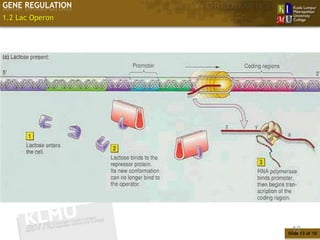
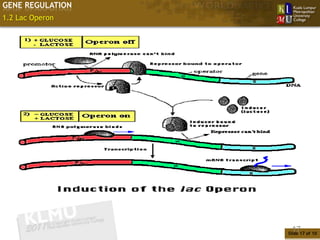
    The lac operon which is off if no lactose is present
    but can be induced to turn on in the presence of
    lactose.


                                                             7
                                                           Slide 7 of 10
GENE REGULATION

1.2 Lac Operon
Lactose Operon

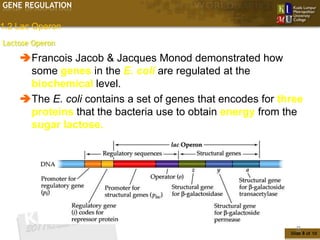
    Francois Jacob & Jacques Monod demonstrated how
     some genes in the E. coli are regulated at the
     biochemical level.
    The E. coli contains a set of genes that encodes for three
     proteins that the bacteria use to obtain energy from the
     sugar lactose.


                                                              8
                                                            Slide 8 of 10
GENE REGULATION
1.2 Lac Operon


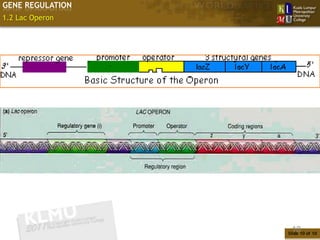
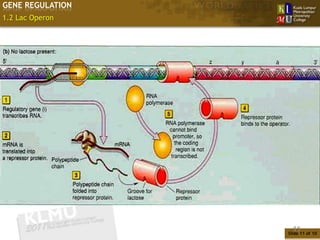
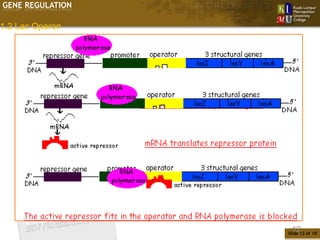
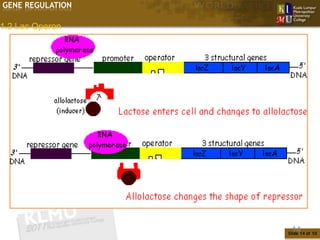
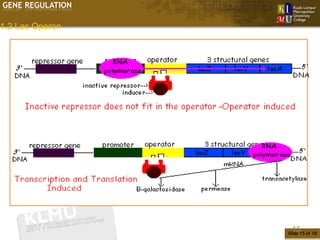
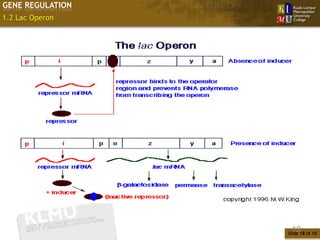
    Repressor/Regulator Gene - Produces a repressor
     protein that fits in the operator to turn the operon
     off
    Promoter - RNA polymerase attaches here to begin
     transcription of the genes
    Operator - The active repressor fits in notches to
     block RNA polymerase and turn off transcription.
    Structural Genes - Metabolic pathway genes with
     code for enzymes to digest lactose


                                                              9
                                                            Slide 9 of 10
GENE REGULATION
1.2 Lac Operon


                   10
                  Slide 10 of 10
GENE REGULATION
1.2 Lac Operon


                    11
                  Slide 11 of 10
GENE REGULATION

1.2 Lac Operon


                   12
                  Slide 12 of 10
GENE REGULATION
1.2 Lac Operon


                   13
                  Slide 13 of 10
GENE REGULATION

1.2 Lac Operon


                   14
                  Slide 14 of 10
GENE REGULATION

1.2 Lac Operon


                   15
                  Slide 15 of 10
GENE REGULATION

1.2 Lac Operon
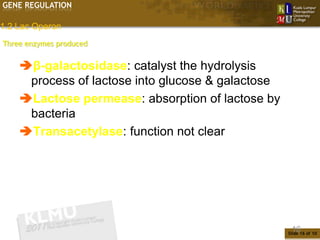
Three enzymes produced


    β-galactosidase: catalyst the hydrolysis
     process of lactose into glucose & galactose
    Lactose permease: absorption of lactose by
     bacteria
    Transacetylase: function not clear


                                                    16
                                                   Slide 16 of 10
GENE REGULATION
1.2 Lac Operon


                   17
                  Slide 17 of 10
GENE REGULATION
1.2 Lac Operon


                   18
                  Slide 18 of 10
GENE REGULATION

1.3 Trypthon Operon

Trp Operon

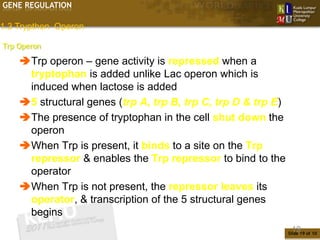
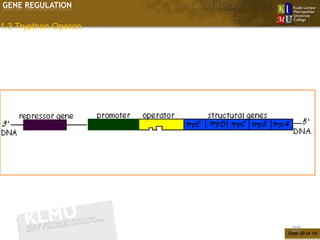
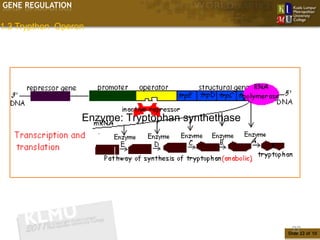
    Trp operon – gene activity is repressed when a
     tryptophan is added unlike Lac operon which is
     induced when lactose is added
    5 structural genes (trp A, trp B, trp C, trp D & trp E)
    The presence of tryptophan in the cell shut down the
     operon
    When Trp is present, it binds to a site on the Trp
     repressor & enables the Trp repressor to bind to the
     operator
    When Trp is not present, the repressor leaves its
     operator, & transcription of the 5 structural genes
     begins
                                                                19
                                                               Slide 19 of 10
GENE REGULATION

1.3 Trypthon Operon


                       20
                      Slide 20 of 10
GENE REGULATION

1.3 Trypthon Operon


                       21
                      Slide 21 of 10
GENE REGULATION

1.3 Trypthon Operon


                  Enzyme: Tryptophan synthethase


                                                    22
                                                   Slide 22 of 10
GENE REGULATION

1.3 Trypthon Lac Operon

Repression

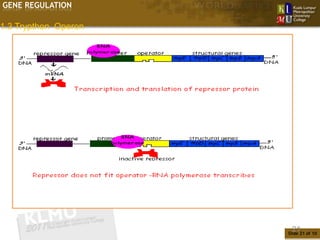
    The repressor for the trp operon is produced upstream
     by the trp R gene, which is continually expressed
    When tryptophan is present, it binds to the tryptophan
     repressor tetramers, & causes a change in
     conformation, which allows the repressor to bind the
     operator, which prevents RNA polymerase from binding
     or transcribing the operon, so tryptophan is not
     produced
    When tryptophan is not present, the repressor cannot
     bind the operator, so transcription can occur.
     Therefore, this is called negative feedback
     mechanism
                                                              23
                                                          Slide 23 of 10

Chapt 07

  • 1.
    GENERAL BIOLOGY HDL 121 GENE REGULATION PREPARED BY:MANEGA SCHOOL OF MLT FACULTY OF HEALTH SCIENCE
  • 2.
    GENE REGULATION Learning Outcomes After completing this lecture, students will be able to: (a) Define gene regulation & operon (b) Describe lac operon – operator, promoter & terminator (c) Explain tryptophan operon Topic Slide 2 of 10 © 2010 Cosmopoint
  • 3.
    GENE REGULATION Topic Outlines 1.1. Operon 1.2. Lac Operon 1.3 Tryptophan Operon Slide 3 of 10 © 2010 Cosmopoint
  • 4.
    GENE REGULATION 1.1.Operon Definition Gene regulation: process that cells use to turn the information on genes into gene products Operon: a functioning unit of key nucleotide sequences of DNA including an operator, a common promoter, & one or more structural genes, which is controlled as a unit to produce messenger RNA (mRNA), in the process of transcription by an RNA polymerase 4 Slide 4 of 10
  • 5.
    GENE REGULATION 1.1. Operon Introduction How are genes regulated? They are turned off if there is no need for the enzymes they code for or turned on when the environment changes and the enzymes are once again needed Example E. coli in an environment without lactose does not produce the enzymes for lactose digestion. When lactose is present the enzymes for digestion are produced. 5 Slide 5 of 10
  • 6.
    GENE REGULATION 1.1. Operon Why is this off/on switch important? Energy is not wasted. It would be similar to having all the electrical appliances in your house on at once. Which of course would be very wasteful. Also unnecessary materials would lead to sluggish functioning. 6 Slide 6 of 10
  • 7.
    GENE REGULATION 1.1. Operon How are the genes for a particular metabolic pathway turned on or off? On the prokaryote chromosome a combination of genes and regulatory DNA sequences known as the operon accomplishes this. An example of an operon discovered by Jacob and Monod in E. coli The lac operon which is off if no lactose is present but can be induced to turn on in the presence of lactose. 7 Slide 7 of 10
  • 8.
    GENE REGULATION 1.2 LacOperon Lactose Operon Francois Jacob & Jacques Monod demonstrated how some genes in the E. coli are regulated at the biochemical level. The E. coli contains a set of genes that encodes for three proteins that the bacteria use to obtain energy from the sugar lactose. 8 Slide 8 of 10
  • 9.
    GENE REGULATION 1.2 LacOperon Repressor/Regulator Gene - Produces a repressor protein that fits in the operator to turn the operon off Promoter - RNA polymerase attaches here to begin transcription of the genes Operator - The active repressor fits in notches to block RNA polymerase and turn off transcription. Structural Genes - Metabolic pathway genes with code for enzymes to digest lactose 9 Slide 9 of 10
  • 10.
    GENE REGULATION 1.2 LacOperon 10 Slide 10 of 10
  • 11.
    GENE REGULATION 1.2 LacOperon 11 Slide 11 of 10
  • 12.
    GENE REGULATION 1.2 LacOperon 12 Slide 12 of 10
  • 13.
    GENE REGULATION 1.2 LacOperon 13 Slide 13 of 10
  • 14.
    GENE REGULATION 1.2 LacOperon 14 Slide 14 of 10
  • 15.
    GENE REGULATION 1.2 LacOperon 15 Slide 15 of 10
  • 16.
    GENE REGULATION 1.2 LacOperon Three enzymes produced β-galactosidase: catalyst the hydrolysis process of lactose into glucose & galactose Lactose permease: absorption of lactose by bacteria Transacetylase: function not clear 16 Slide 16 of 10
  • 17.
    GENE REGULATION 1.2 LacOperon 17 Slide 17 of 10
  • 18.
    GENE REGULATION 1.2 LacOperon 18 Slide 18 of 10
  • 19.
    GENE REGULATION 1.3 TrypthonOperon Trp Operon Trp operon – gene activity is repressed when a tryptophan is added unlike Lac operon which is induced when lactose is added 5 structural genes (trp A, trp B, trp C, trp D & trp E) The presence of tryptophan in the cell shut down the operon When Trp is present, it binds to a site on the Trp repressor & enables the Trp repressor to bind to the operator When Trp is not present, the repressor leaves its operator, & transcription of the 5 structural genes begins 19 Slide 19 of 10
  • 20.
    GENE REGULATION 1.3 TrypthonOperon 20 Slide 20 of 10
  • 21.
    GENE REGULATION 1.3 TrypthonOperon 21 Slide 21 of 10
  • 22.
    GENE REGULATION 1.3 TrypthonOperon Enzyme: Tryptophan synthethase 22 Slide 22 of 10
  • 23.
    GENE REGULATION 1.3 TrypthonLac Operon Repression The repressor for the trp operon is produced upstream by the trp R gene, which is continually expressed When tryptophan is present, it binds to the tryptophan repressor tetramers, & causes a change in conformation, which allows the repressor to bind the operator, which prevents RNA polymerase from binding or transcribing the operon, so tryptophan is not produced When tryptophan is not present, the repressor cannot bind the operator, so transcription can occur. Therefore, this is called negative feedback mechanism 23 Slide 23 of 10