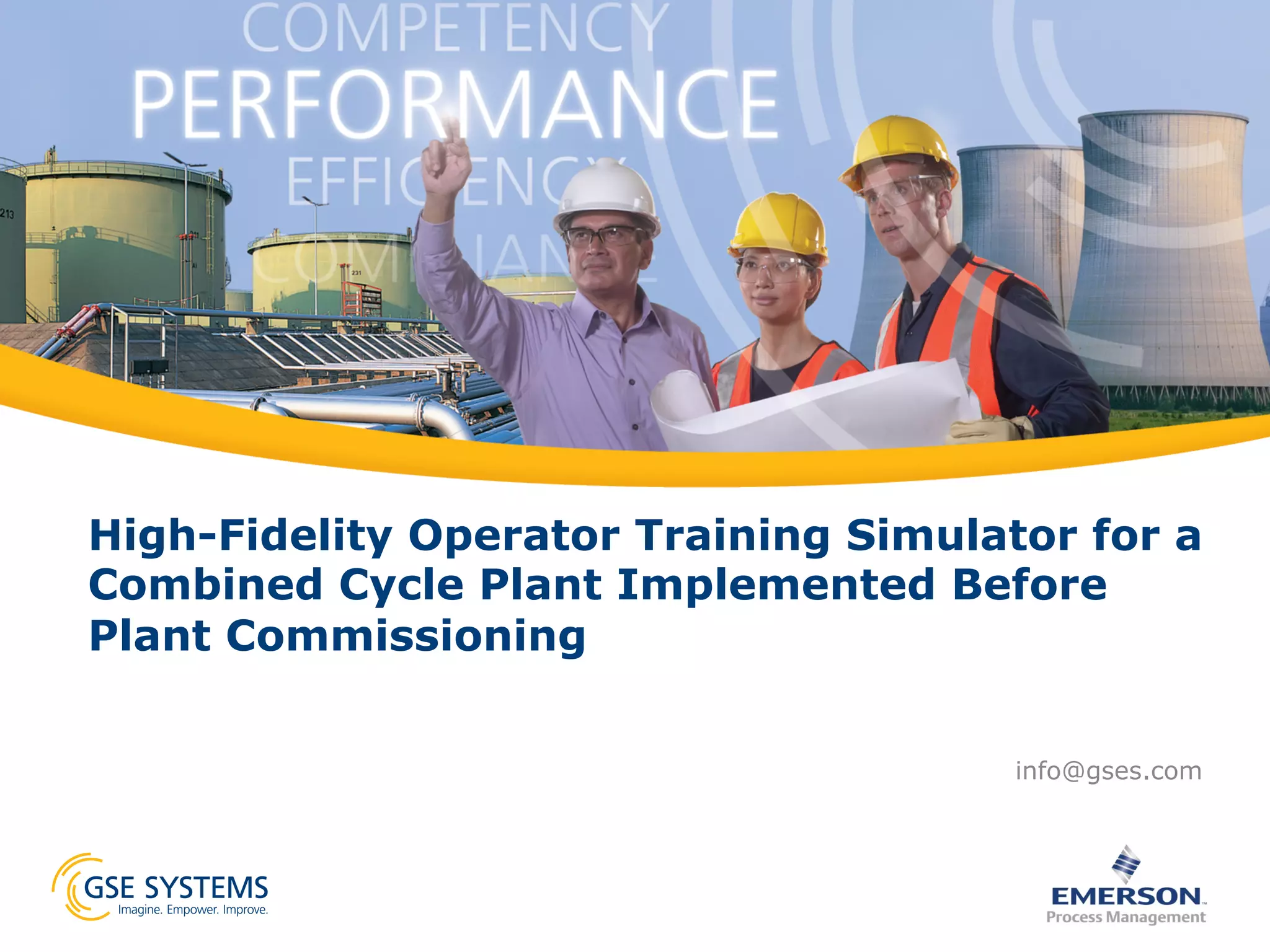

High-Fidelity Operator Training Simulator for a
Combined Cycle Plant Implemented Before
Plant Commissioning
info@gses.com
Overview
•  Simulator project goals & objectives
•  North American project schedule
•  Unique challenges
•  Execution strategy
•  Virtual Ovation™ system
•  Third-party virtual turbine controls
•  High-fidelity modeling approach with JADE™
•  Summary
Simulator Project Objective
•  GSE and Emerson provided a high-fidelity simulator
with models and controls indistinguishable from a
real-time running plant.
•  Simulator allows for extensive DCS testing/tuning and
operator training prior to plant commissioning
•  Simulator allows for testing with third-party turbine
controls and Emerson implemented BOP systems
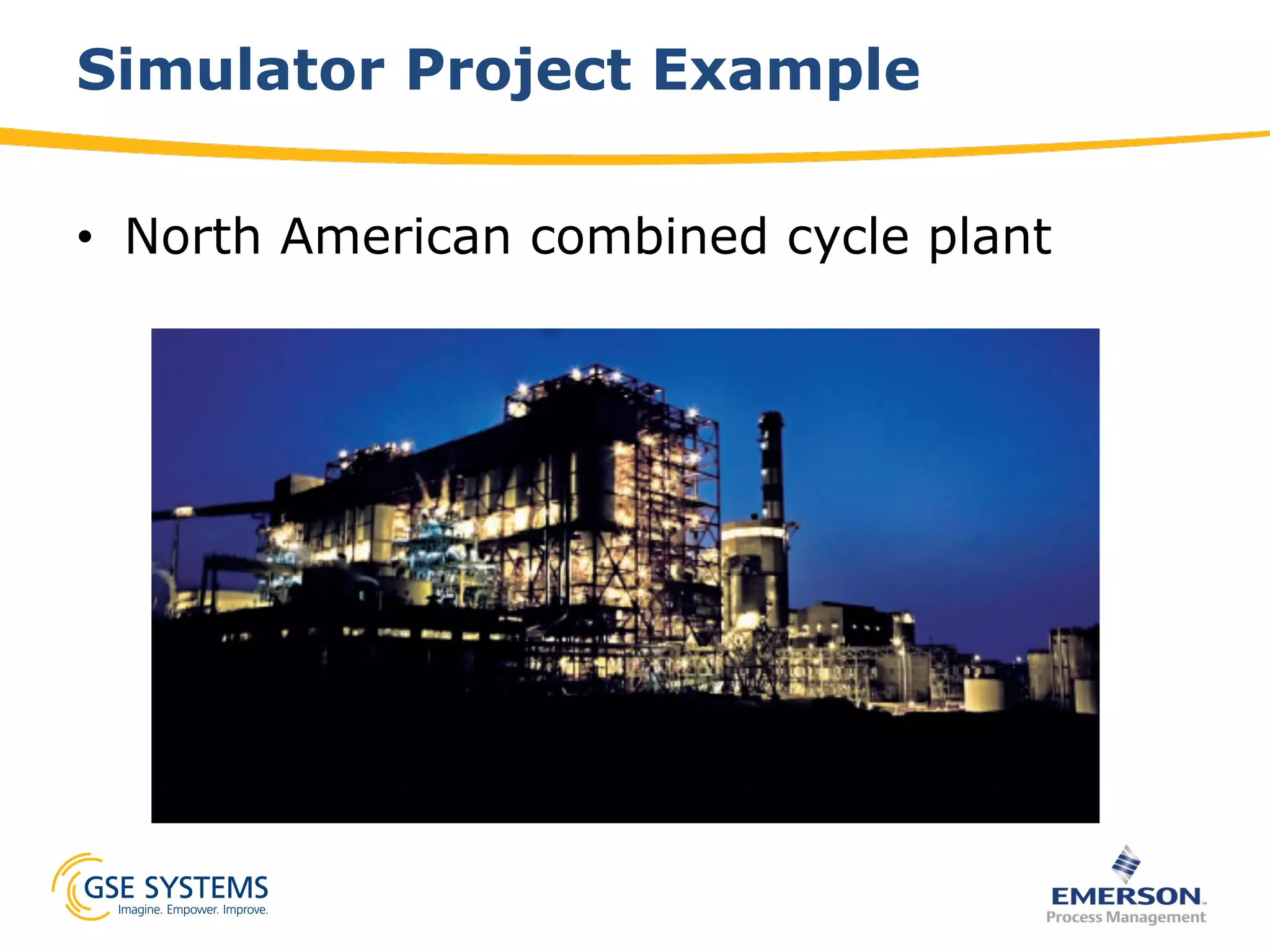
Simulator Project Example
•  North American combined cycle plant
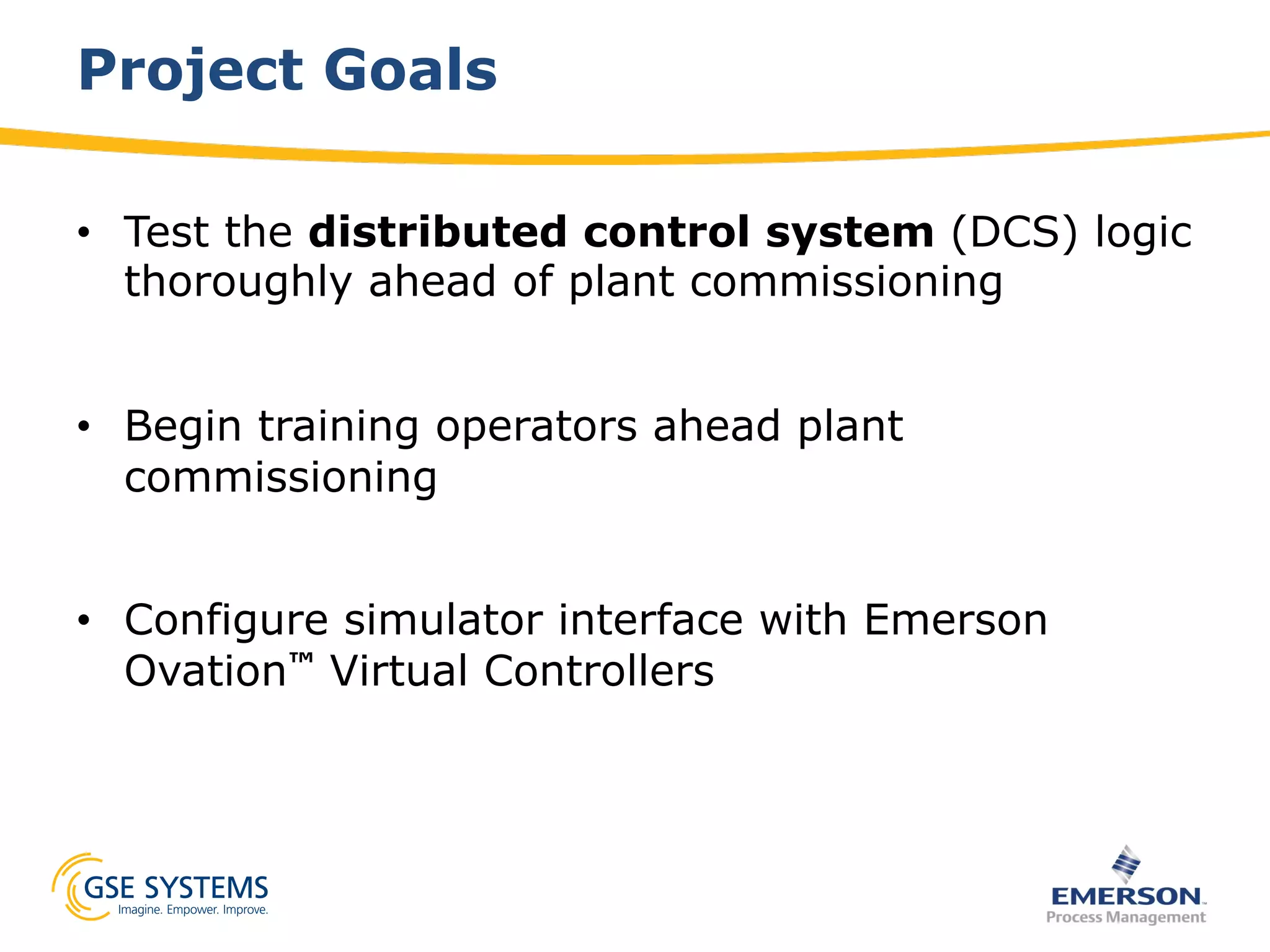
Project Goals
•  Test the distributed control system (DCS) logic
thoroughly ahead of plant commissioning
•  Begin training operators ahead plant
commissioning
•  Configure simulator interface with Emerson
Ovation™ Virtual Controllers
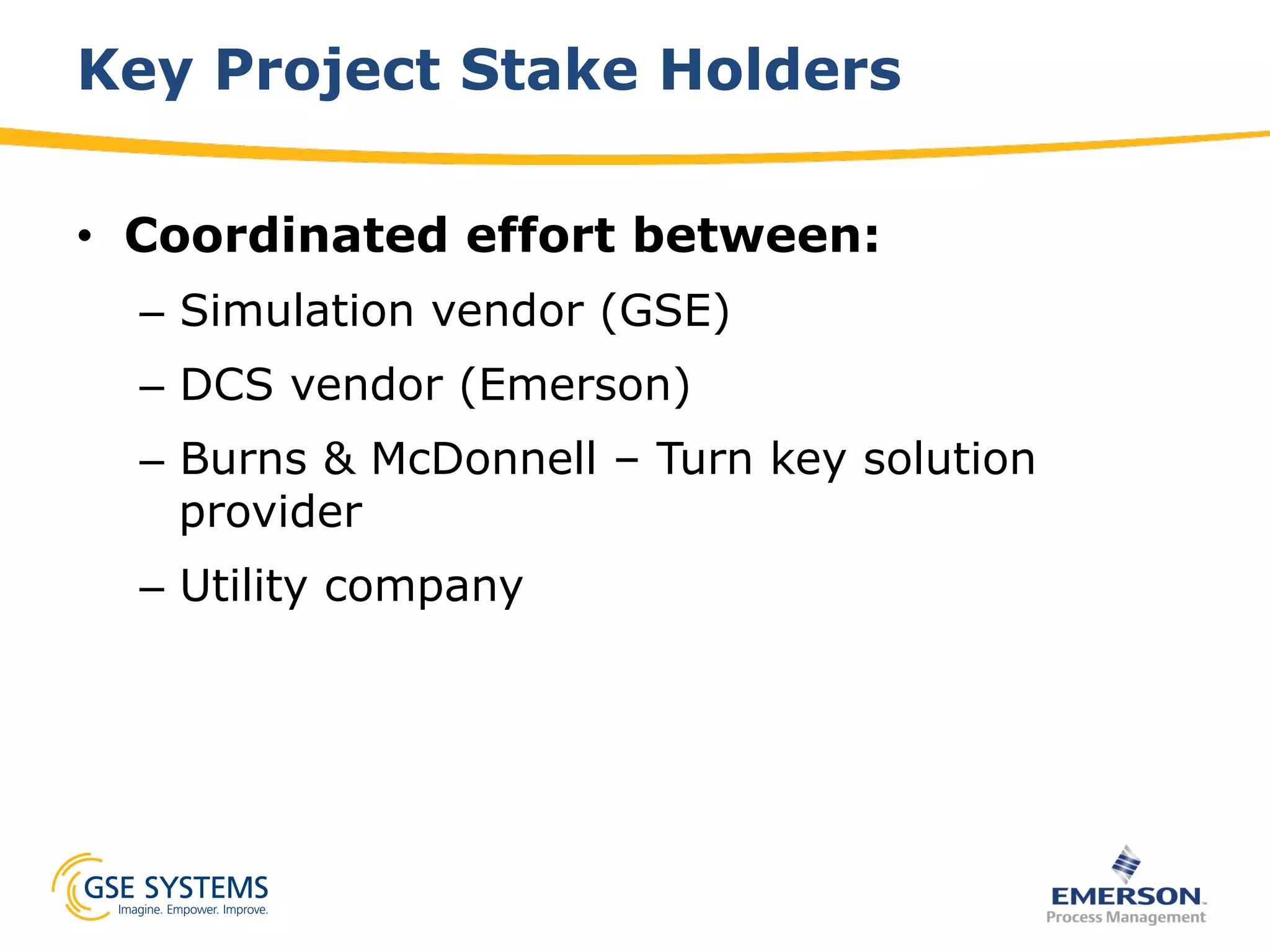
Key Project Stake Holders
•  Coordinated effort between:
–  Simulation vendor (GSE)
–  DCS vendor (Emerson)
–  Burns & McDonnell – Turn key solution
provider
–  Utility company
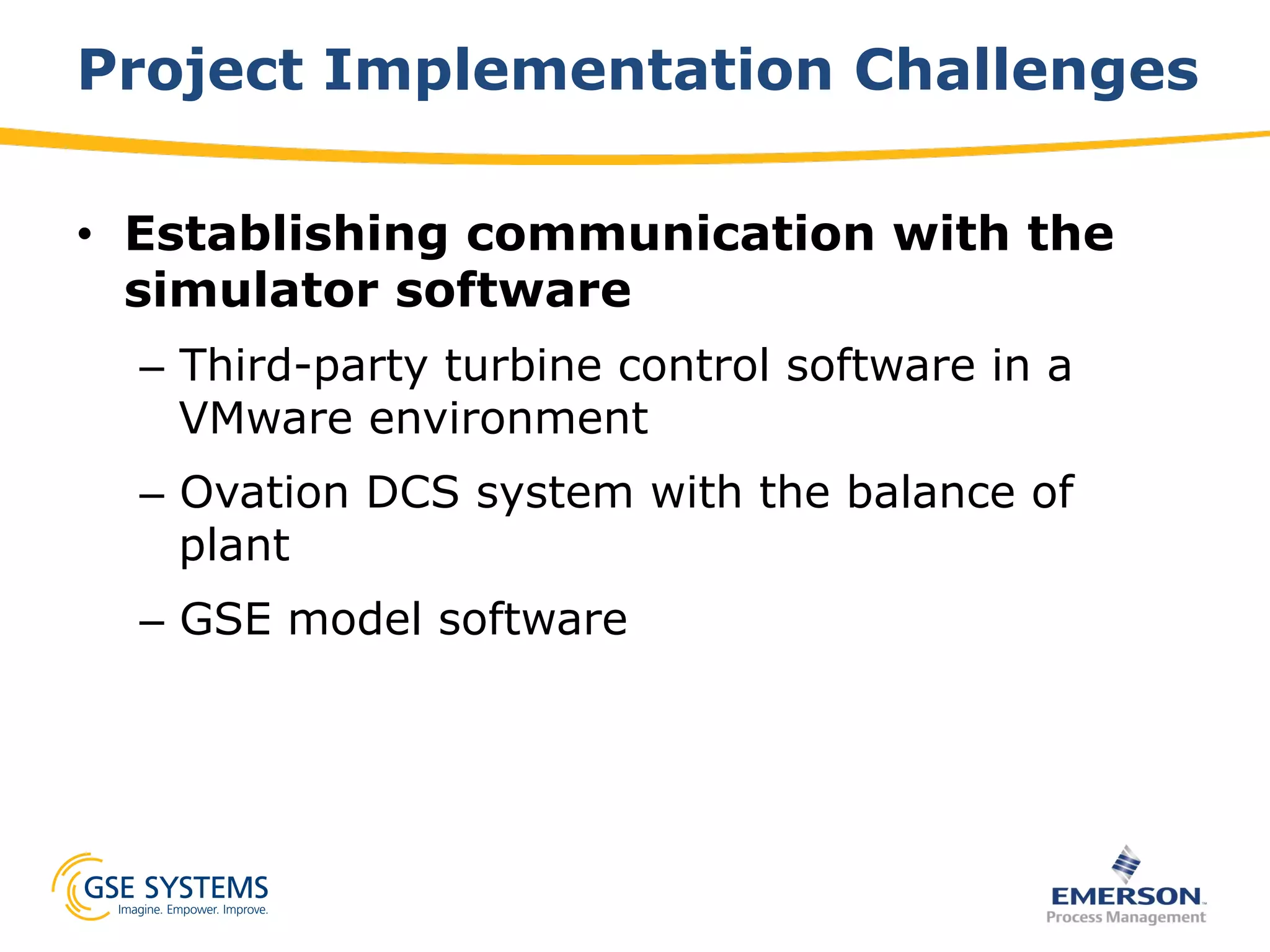
Project Implementation Challenges
•  Establishing communication with the
simulator software
–  Third-party turbine control software in a
VMware environment
–  Ovation DCS system with the balance of
plant
–  GSE model software
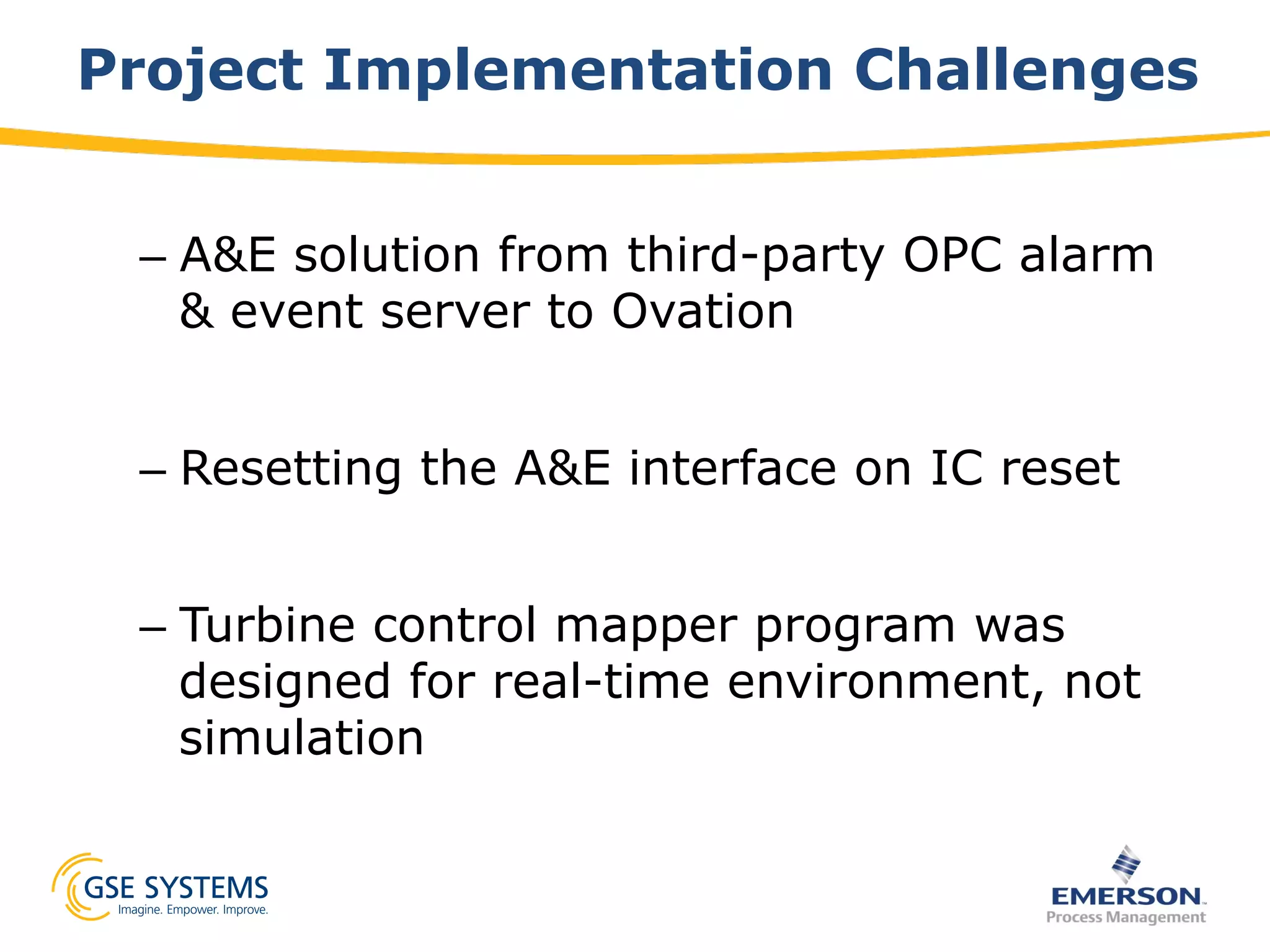
Project Implementation Challenges
– A&E solution from third-party OPC alarm
& event server to Ovation
– Resetting the A&E interface on IC reset
– Turbine control mapper program was
designed for real-time environment, not
simulation
Project Execution Strategy
•  High-resource staffing levels due to compressed
schedule
•  Simulator logistics focused on maximizing
productivity and customer interaction
•  Operator training available ahead of plant startup
•  Simulator retune at site
–  Update the DCS & models with running plant
controls after commissioning is complete
Resource Staffing Levels
•  GSE provides 3 to 4 simulator team engineers.
•  Emerson provides lead project simulation
engineer and one project management lead
engineer.
•  Burns & McDonnell and utility company provide
operators for testing and I&C technicians for the
first initial startup.
•  Third-party turbine control vendor provided
remote and contract support.
Project Schedule
•  Simulator schedule (12 to 14 months)
•  Review external logic outside of the Ovation DCS,
some typical examples include:
–  Smart breakers
–  PLC logic
–  Relay logic
•  Review third-party plant controls (turbines in
VMware environment)
Project Schedule
•  Model acceptance testing (MAT) at GSE proves
the accuracy of models prior to DCS integration.
–  Complete startup with functional controls
–  Reduces schedule risk since models will be fully
tested before linking them to new controls
•  Simulator models interface directly with DCS
controls to verify DCS performance prior to plant
commissioning.
Field Tuning
•  Emerson field service was able to tune the
Ovation BOP logic on the simulator.
•  Drum level controls, steam bypass control loops
and dynamic tuning was completed on the
simulator.
•  Tuning with the real equipment will still be
required, however, the default values have all
been modified and scaling and advanced tuning
has been completed.
Customer Acceptance
•  Factory acceptance testing (FAT) at Emerson
involves Burns & McDonnell and utility plant
operators working directly with the simulation
team to perform startup and shutdown testing.
•  Variances are documented and corrected.
•  Site acceptance testing (SAT) is done at
customer site. This ensures the system performs
the same as it does on the factory floor.
Operator Training and Retune
•  Operator training will begin 4-5 months
ahead of plant startup.
•  Simulator retune will be performed at the
plant site by Emerson and GSE to update
the simulator to the commissioned DCS
controls once the plant has been fully
commissioned.
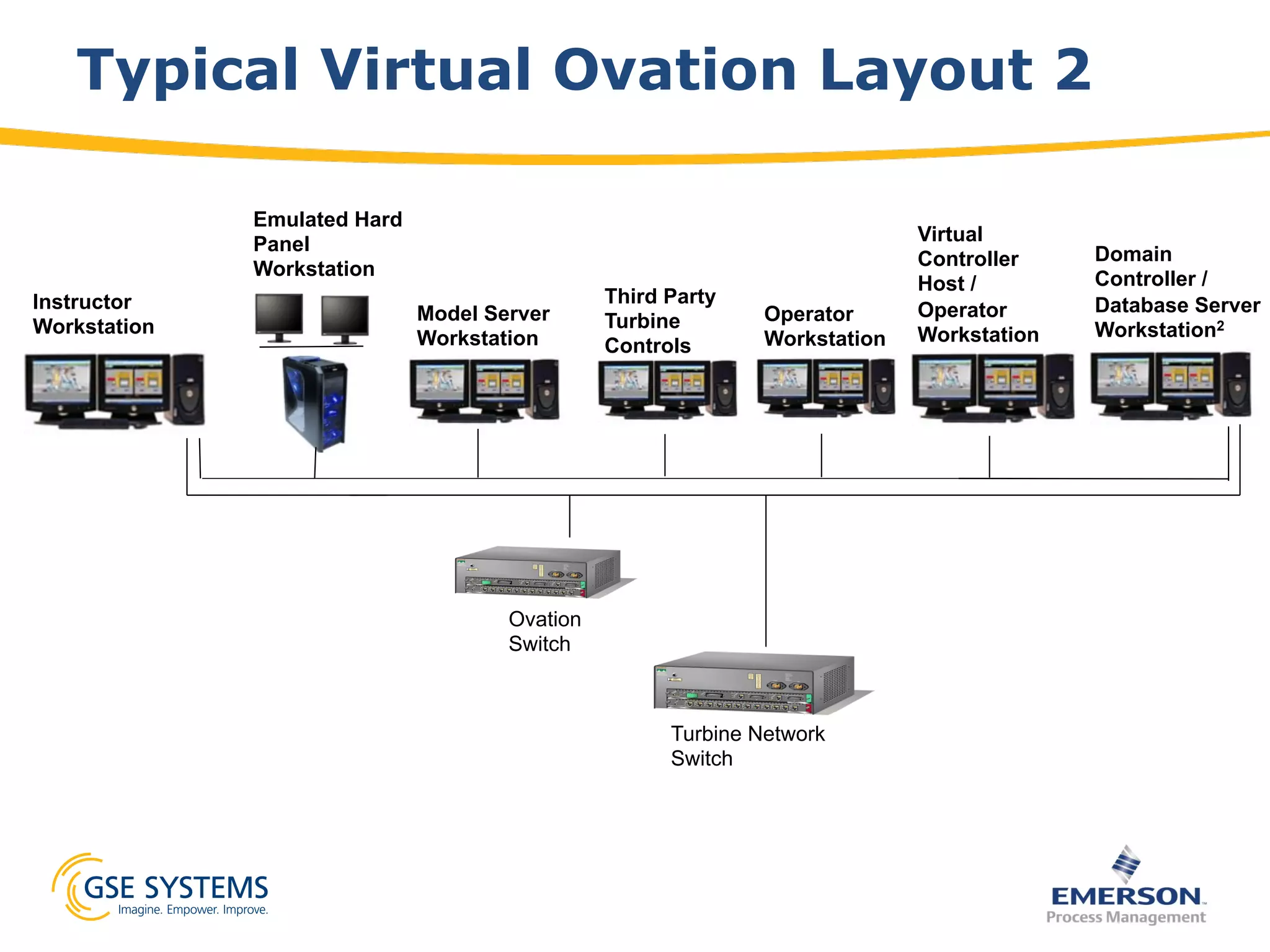
Simulator System Architecture
•  DCS converted to Ovation virtual controller
drops on a virtual controller host (VCH)
•  DCS application software (control logic,
database, and graphics) is installed on the
simulator
Typical Virtual Ovation Layout 2
Model Server
Workstation
Domain
Controller /
Database Server
Workstation2
Operator
Workstation
Third Party
Turbine
Controls
Ovation
Switch
Emulated Hard
Panel
Workstation
Instructor
Workstation
Virtual
Controller
Host /
Operator
Workstation
Turbine Network
Switch
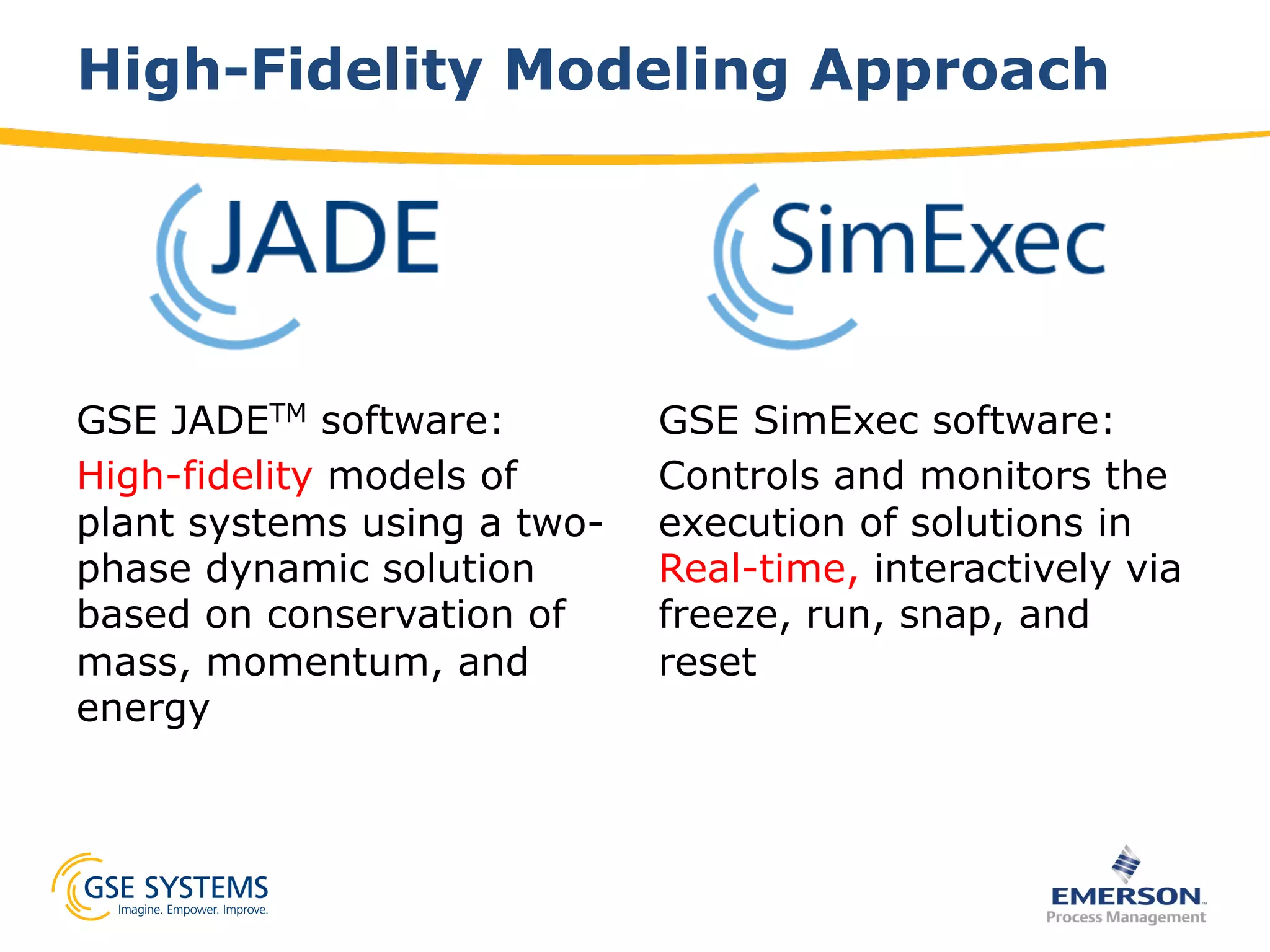
High-Fidelity Modeling Approach
GSE JADETM software:
High-fidelity models of
plant systems using a two-
phase dynamic solution
based on conservation of
mass, momentum, and
energy
GSE SimExec software:
Controls and monitors the
execution of solutions in
Real-time, interactively via
freeze, run, snap, and
reset
Variance Recording System
•  GSE, Emerson, and utility company
communicate using a discrepancy reporting
database accessible via the web,
called Mantis.
•  Allows quick and efficient documentation
and resolution of data requests, model
discrepancies, and DCS discrepancies
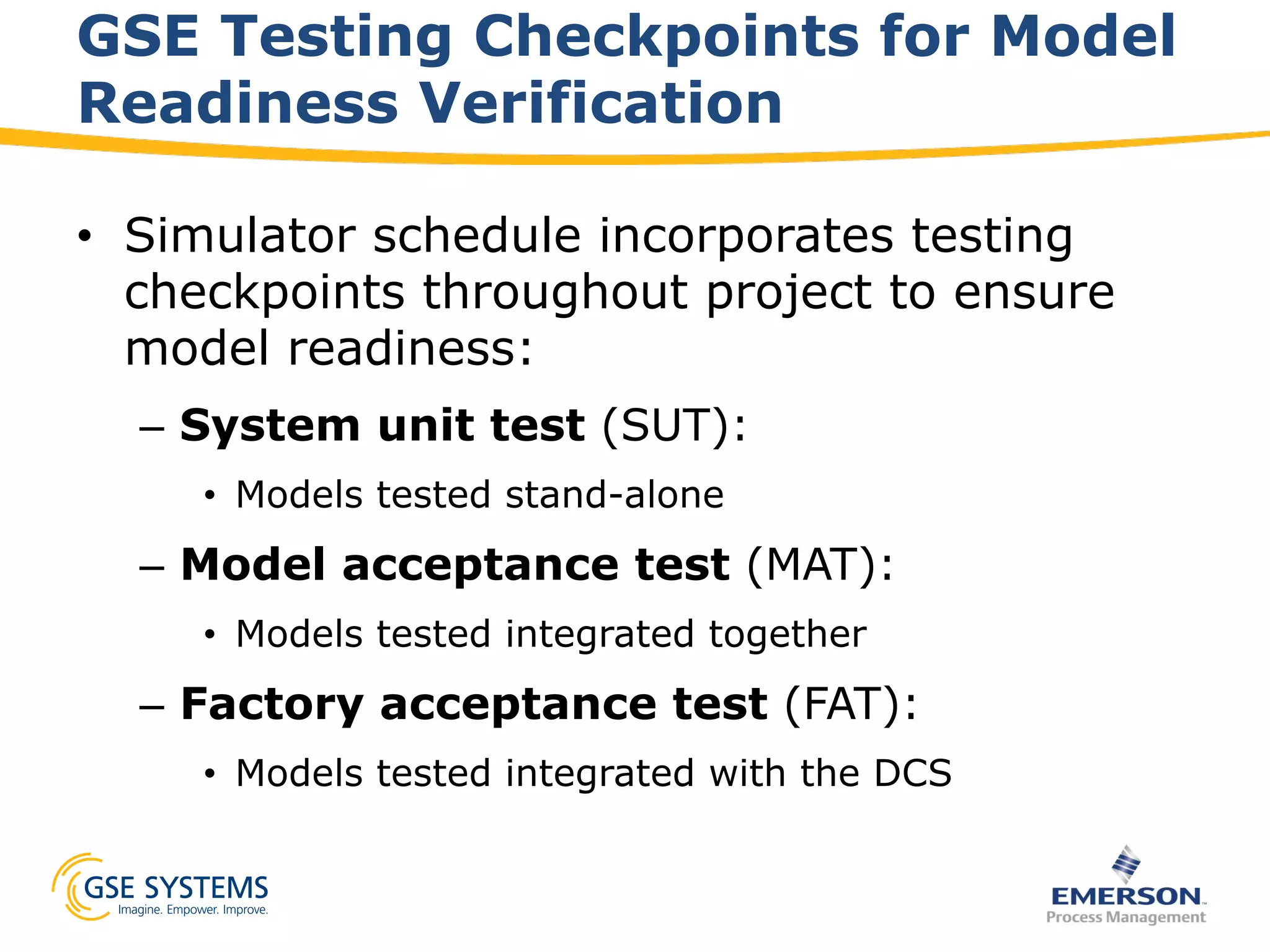
GSE Testing Checkpoints for Model
Readiness Verification
•  Simulator schedule incorporates testing
checkpoints throughout project to ensure
model readiness:
–  System unit test (SUT):
•  Models tested stand-alone
–  Model acceptance test (MAT):
•  Models tested integrated together
–  Factory acceptance test (FAT):
•  Models tested integrated with the DCS
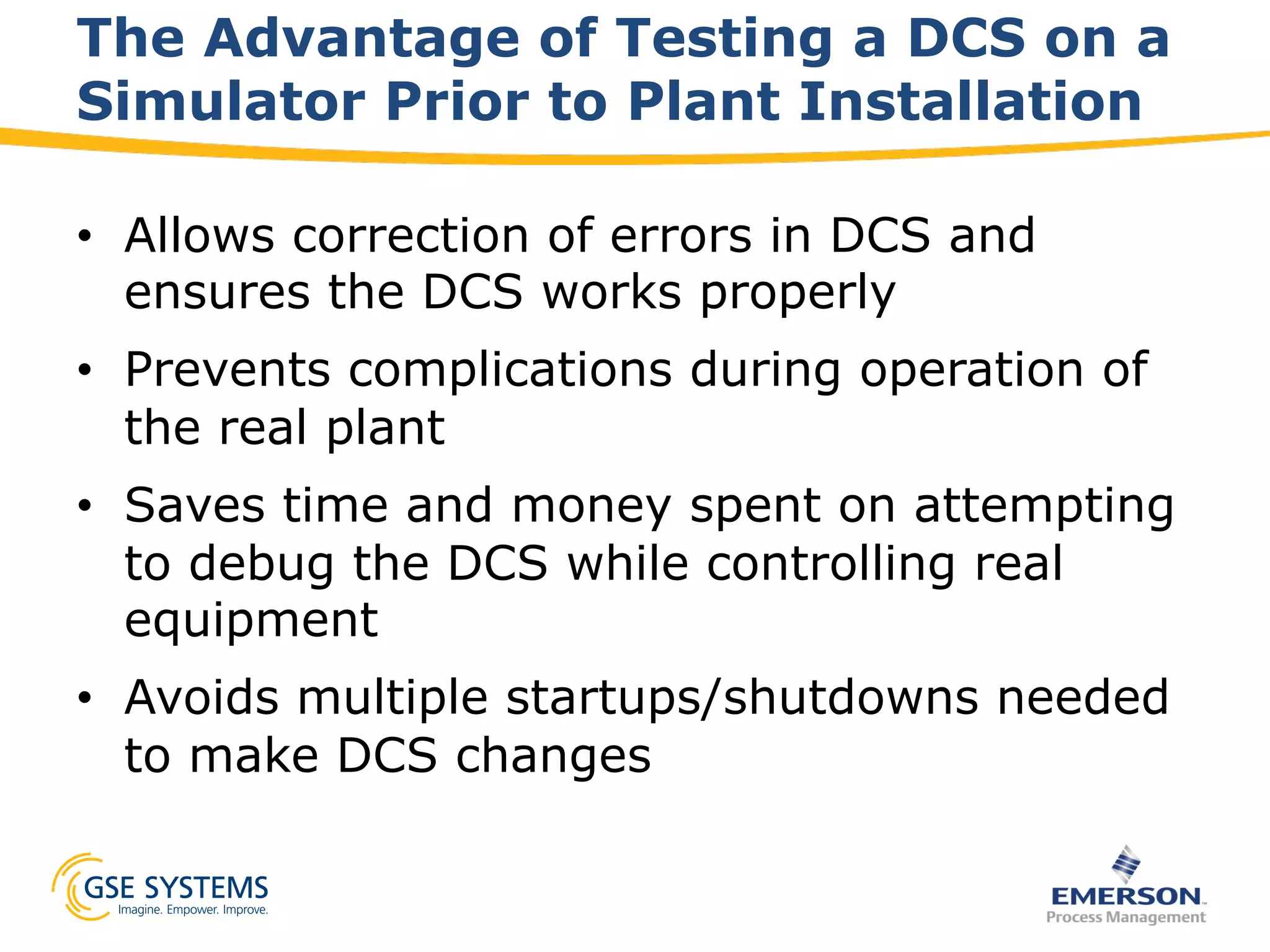
The Advantage of Testing a DCS on a
Simulator Prior to Plant Installation
•  Allows correction of errors in DCS and
ensures the DCS works properly
•  Prevents complications during operation of
the real plant
•  Saves time and money spent on attempting
to debug the DCS while controlling real
equipment
•  Avoids multiple startups/shutdowns needed
to make DCS changes
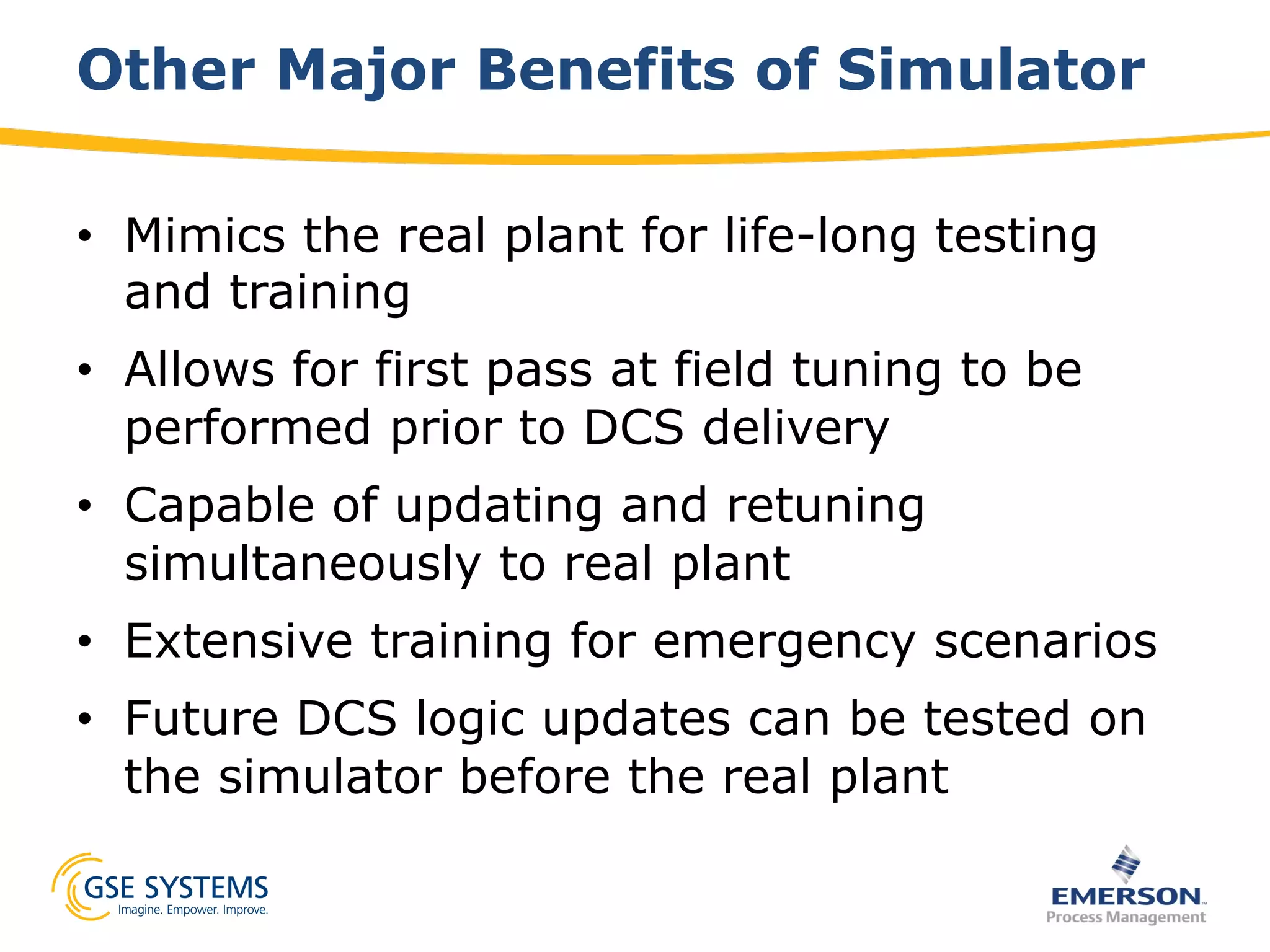
Other Major Benefits of Simulator
•  Mimics the real plant for life-long testing
and training
•  Allows for first pass at field tuning to be
performed prior to DCS delivery
•  Capable of updating and retuning
simultaneously to real plant
•  Extensive training for emergency scenarios
•  Future DCS logic updates can be tested on
the simulator before the real plant
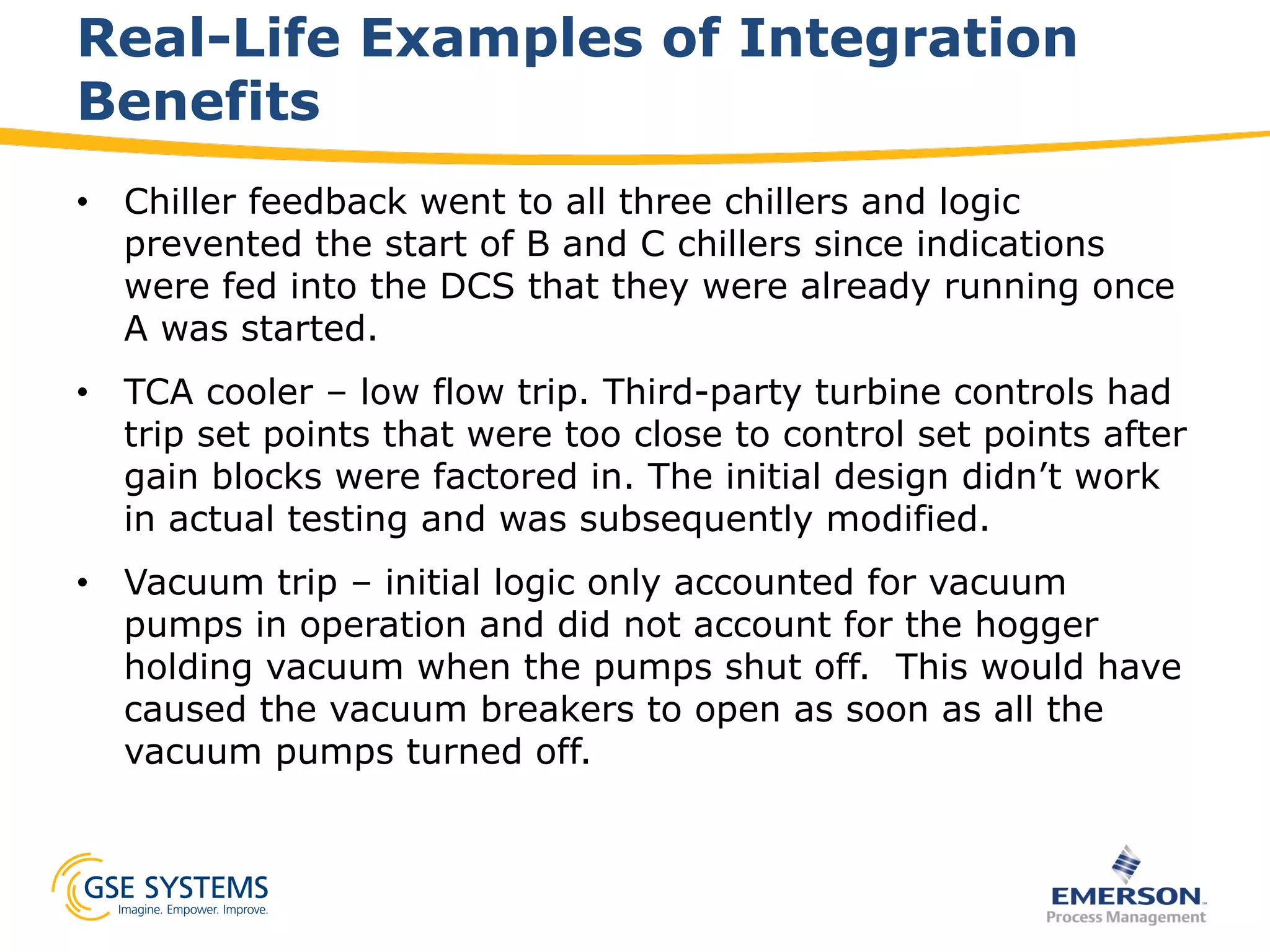
•  Chiller feedback went to all three chillers and logic
prevented the start of B and C chillers since indications
were fed into the DCS that they were already running once
A was started.
•  TCA cooler – low flow trip. Third-party turbine controls had
trip set points that were too close to control set points after
gain blocks were factored in. The initial design didn’t work
in actual testing and was subsequently modified.
•  Vacuum trip – initial logic only accounted for vacuum
pumps in operation and did not account for the hogger
holding vacuum when the pumps shut off. This would have
caused the vacuum breakers to open as soon as all the
vacuum pumps turned off.
Real-Life Examples of Integration
Benefits
Real-Life Examples of Integration
Benefits
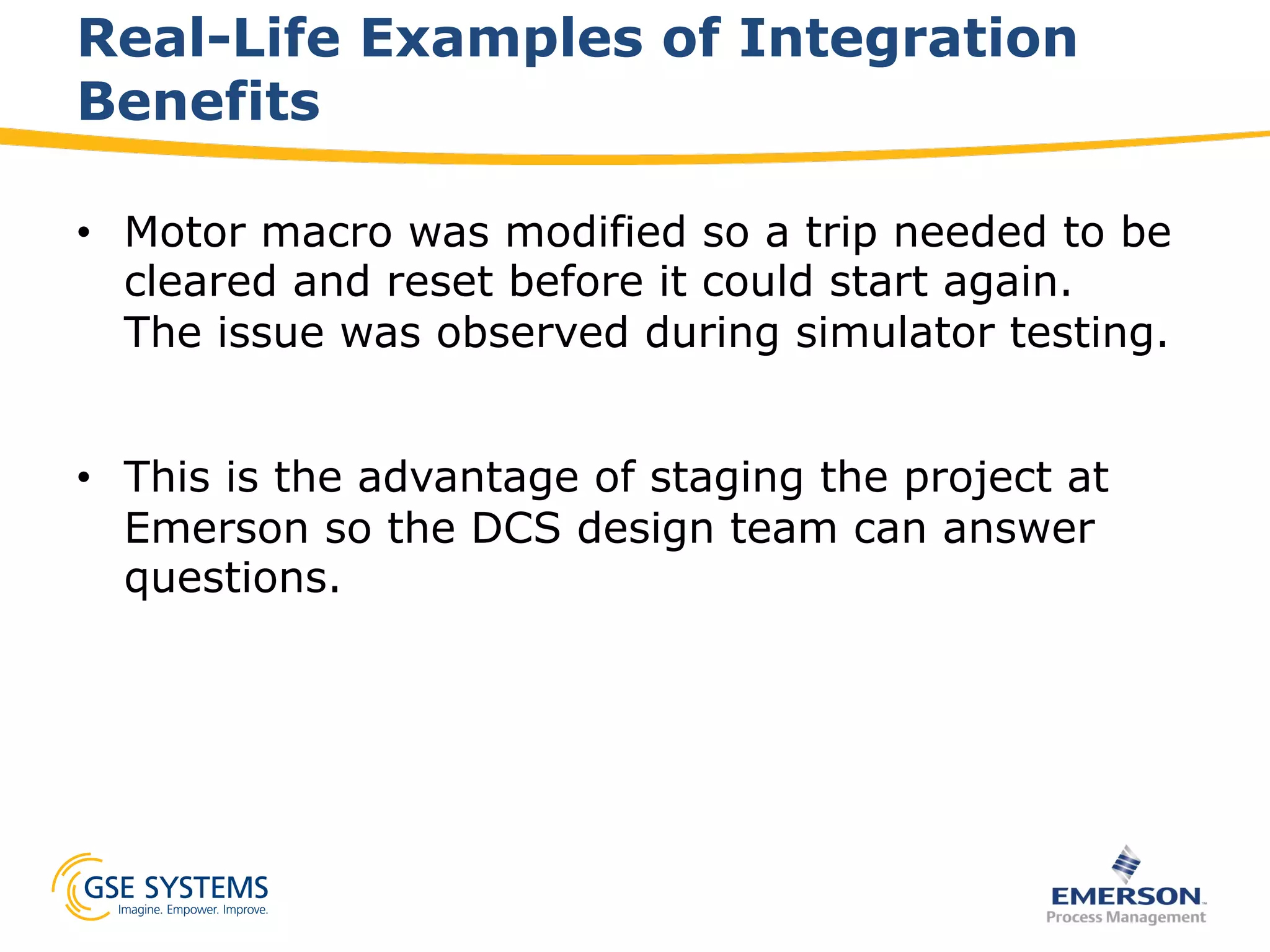
•  Motor macro was modified so a trip needed to be
cleared and reset before it could start again.
The issue was observed during simulator testing.
•  This is the advantage of staging the project at
Emerson so the DCS design team can answer
questions.
Summary
•  Burns & McDonnell, Emerson and GSE have
experience with simulation of a natural gas
fired combined cycle power station.
•  The testing done on the simulator allowed
for training to begin and for startup
procedures to be fine tuned.
Feedback
•  Once plant commissioning is completed
then Burns & McDonnell will advise on
further benefits from having the simulator.
For more information:
Go to: www.GSES.com
Call: 800.638.7912
Email: info@gses.com
Follow us on:
Twitter @GSESystems
Facebook.com/GSESystems

High-Fidelity Operator Training Simulator for CCGT Implemented Before Plant Commissioning

  • 1.
    High-Fidelity Operator TrainingSimulator for a Combined Cycle Plant Implemented Before Plant Commissioning info@gses.com
  • 2.
    Overview •  Simulator projectgoals & objectives •  North American project schedule •  Unique challenges •  Execution strategy •  Virtual Ovation™ system •  Third-party virtual turbine controls •  High-fidelity modeling approach with JADE™ •  Summary
  • 3.
    Simulator Project Objective • GSE and Emerson provided a high-fidelity simulator with models and controls indistinguishable from a real-time running plant. •  Simulator allows for extensive DCS testing/tuning and operator training prior to plant commissioning •  Simulator allows for testing with third-party turbine controls and Emerson implemented BOP systems
  • 4.
    Simulator Project Example • North American combined cycle plant
  • 5.
    Project Goals •  Testthe distributed control system (DCS) logic thoroughly ahead of plant commissioning •  Begin training operators ahead plant commissioning •  Configure simulator interface with Emerson Ovation™ Virtual Controllers
  • 6.
    Key Project StakeHolders •  Coordinated effort between: –  Simulation vendor (GSE) –  DCS vendor (Emerson) –  Burns & McDonnell – Turn key solution provider –  Utility company
  • 7.
    Project Implementation Challenges • Establishing communication with the simulator software –  Third-party turbine control software in a VMware environment –  Ovation DCS system with the balance of plant –  GSE model software
  • 8.
    Project Implementation Challenges – A&Esolution from third-party OPC alarm & event server to Ovation – Resetting the A&E interface on IC reset – Turbine control mapper program was designed for real-time environment, not simulation
  • 9.
    Project Execution Strategy • High-resource staffing levels due to compressed schedule •  Simulator logistics focused on maximizing productivity and customer interaction •  Operator training available ahead of plant startup •  Simulator retune at site –  Update the DCS & models with running plant controls after commissioning is complete
  • 10.
    Resource Staffing Levels • GSE provides 3 to 4 simulator team engineers. •  Emerson provides lead project simulation engineer and one project management lead engineer. •  Burns & McDonnell and utility company provide operators for testing and I&C technicians for the first initial startup. •  Third-party turbine control vendor provided remote and contract support.
  • 11.
    Project Schedule •  Simulatorschedule (12 to 14 months) •  Review external logic outside of the Ovation DCS, some typical examples include: –  Smart breakers –  PLC logic –  Relay logic •  Review third-party plant controls (turbines in VMware environment)
  • 12.
    Project Schedule •  Modelacceptance testing (MAT) at GSE proves the accuracy of models prior to DCS integration. –  Complete startup with functional controls –  Reduces schedule risk since models will be fully tested before linking them to new controls •  Simulator models interface directly with DCS controls to verify DCS performance prior to plant commissioning.
  • 13.
    Field Tuning •  Emersonfield service was able to tune the Ovation BOP logic on the simulator. •  Drum level controls, steam bypass control loops and dynamic tuning was completed on the simulator. •  Tuning with the real equipment will still be required, however, the default values have all been modified and scaling and advanced tuning has been completed.
  • 14.
    Customer Acceptance •  Factoryacceptance testing (FAT) at Emerson involves Burns & McDonnell and utility plant operators working directly with the simulation team to perform startup and shutdown testing. •  Variances are documented and corrected. •  Site acceptance testing (SAT) is done at customer site. This ensures the system performs the same as it does on the factory floor.
  • 15.
    Operator Training andRetune •  Operator training will begin 4-5 months ahead of plant startup. •  Simulator retune will be performed at the plant site by Emerson and GSE to update the simulator to the commissioned DCS controls once the plant has been fully commissioned.
  • 16.
    Simulator System Architecture • DCS converted to Ovation virtual controller drops on a virtual controller host (VCH) •  DCS application software (control logic, database, and graphics) is installed on the simulator
  • 17.
    Typical Virtual OvationLayout 2 Model Server Workstation Domain Controller / Database Server Workstation2 Operator Workstation Third Party Turbine Controls Ovation Switch Emulated Hard Panel Workstation Instructor Workstation Virtual Controller Host / Operator Workstation Turbine Network Switch
  • 18.
    High-Fidelity Modeling Approach GSEJADETM software: High-fidelity models of plant systems using a two- phase dynamic solution based on conservation of mass, momentum, and energy GSE SimExec software: Controls and monitors the execution of solutions in Real-time, interactively via freeze, run, snap, and reset
  • 19.
    Variance Recording System • GSE, Emerson, and utility company communicate using a discrepancy reporting database accessible via the web, called Mantis. •  Allows quick and efficient documentation and resolution of data requests, model discrepancies, and DCS discrepancies
  • 20.
    GSE Testing Checkpointsfor Model Readiness Verification •  Simulator schedule incorporates testing checkpoints throughout project to ensure model readiness: –  System unit test (SUT): •  Models tested stand-alone –  Model acceptance test (MAT): •  Models tested integrated together –  Factory acceptance test (FAT): •  Models tested integrated with the DCS
  • 21.
    The Advantage ofTesting a DCS on a Simulator Prior to Plant Installation •  Allows correction of errors in DCS and ensures the DCS works properly •  Prevents complications during operation of the real plant •  Saves time and money spent on attempting to debug the DCS while controlling real equipment •  Avoids multiple startups/shutdowns needed to make DCS changes
  • 22.
    Other Major Benefitsof Simulator •  Mimics the real plant for life-long testing and training •  Allows for first pass at field tuning to be performed prior to DCS delivery •  Capable of updating and retuning simultaneously to real plant •  Extensive training for emergency scenarios •  Future DCS logic updates can be tested on the simulator before the real plant
  • 23.
    •  Chiller feedbackwent to all three chillers and logic prevented the start of B and C chillers since indications were fed into the DCS that they were already running once A was started. •  TCA cooler – low flow trip. Third-party turbine controls had trip set points that were too close to control set points after gain blocks were factored in. The initial design didn’t work in actual testing and was subsequently modified. •  Vacuum trip – initial logic only accounted for vacuum pumps in operation and did not account for the hogger holding vacuum when the pumps shut off. This would have caused the vacuum breakers to open as soon as all the vacuum pumps turned off. Real-Life Examples of Integration Benefits
  • 24.
    Real-Life Examples ofIntegration Benefits •  Motor macro was modified so a trip needed to be cleared and reset before it could start again. The issue was observed during simulator testing. •  This is the advantage of staging the project at Emerson so the DCS design team can answer questions.
  • 25.
    Summary •  Burns &McDonnell, Emerson and GSE have experience with simulation of a natural gas fired combined cycle power station. •  The testing done on the simulator allowed for training to begin and for startup procedures to be fine tuned.
  • 26.
    Feedback •  Once plantcommissioning is completed then Burns & McDonnell will advise on further benefits from having the simulator.
  • 27.
    For more information: Goto: www.GSES.com Call: 800.638.7912 Email: info@gses.com Follow us on: Twitter @GSESystems Facebook.com/GSESystems