Applying Safety DNA Analytics to
Enhance Your E2E Workforce
Process
info@gses.com
2
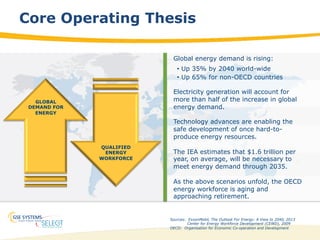
Core Operating Thesis
Sources: ExxonMobil, The Outlook For Energy: A View to 2040, 2013
Center for Energy Workforce Development (CEWD), 2009
OECD: Organisation for Economic Co-operation and Development
Global energy demand is rising:
•  Up 35% by 2040 world-wide
•  Up 65% for non-OECD countries
Electricity generation will account for
more than half of the increase in global
energy demand.
Technology advances are enabling the
safe development of once hard-to-
produce energy resources.
The IEA estimates that $1.6 trillion per
year, on average, will be necessary to
meet energy demand through 2035.
As the above scenarios unfold, the OECD
energy workforce is aging and
approaching retirement.	
  
QUALIFIED
ENERGY
WORKFORCE
GLOBAL
DEMAND FOR
ENERGY
3
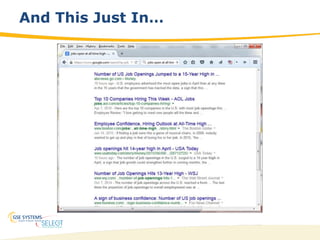
And This Just In…
4
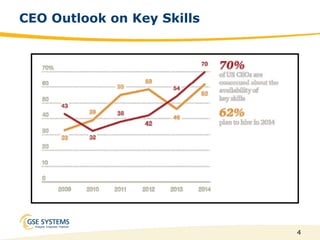
CEO Outlook on Key Skills
5
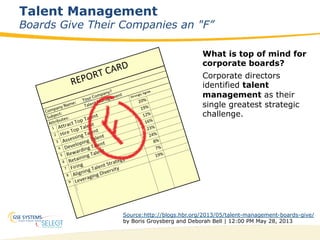
Talent Management
Boards Give Their Companies an "F”
What is top of mind for
corporate boards?
Corporate directors
identified talent
management as their
single greatest strategic
challenge.
Source:http://blogs.hbr.org/2013/05/talent-management-boards-give/
by Boris Groysberg and Deborah Bell | 12:00 PM May 28, 2013
6
What’s Keeping You Up at Night?
7Image Source: Copyrighted property of 123RF Ltd., their Contributors or Licensed Partners and are being used with permission under license. This image may not be copied without permission from 123RF Ltd.
8
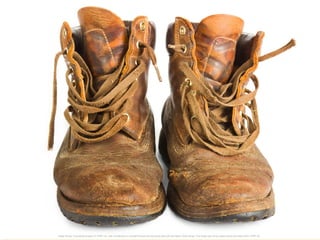
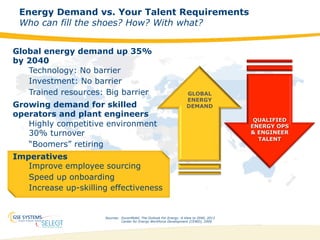
Energy Demand vs. Your Talent Requirements
Who can fill the shoes? How? With what?
Sources: ExxonMobil, The Outlook For Energy: A View to 2040, 2013
Center for Energy Workforce Development (CEWD), 2009
Global energy demand up 35%
by 2040
Technology: No barrier
Investment: No barrier
Trained resources: Big barrier
Growing demand for skilled
operators and plant engineers
Highly competitive environment
30% turnover
“Boomers” retiring
Imperatives
Improve employee sourcing
Speed up onboarding
Increase up-skilling effectiveness
GLOBAL
ENERGY
DEMAND
QUALIFIED
ENERGY OPS
& ENGINEER
TALENT
9Image Source: Copyrighted property of 123RF Ltd., their Contributors or Licensed Partners and are being used with permission under license. This image may not be copied without permission from 123RF Ltd.
10
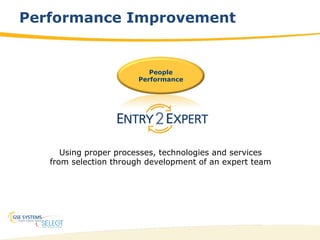
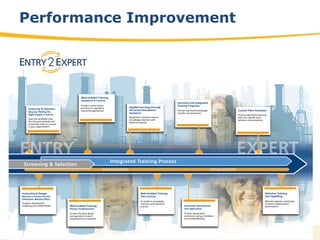
Performance Improvement
People
Performance
Using proper processes, technologies and services
from selection through development of an expert team
11
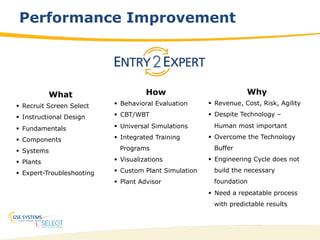
Performance Improvement
What
§  Recruit Screen Select
§  Instructional Design
§  Fundamentals
§  Components
§  Systems
§  Plants
§  Expert-Troubleshooting
How
§  Behavioral Evaluation
§  CBT/WBT
§  Universal Simulations
§  Integrated Training
Programs
§  Visualizations
§  Custom Plant Simulation
§  Plant Advisor
Why
§  Revenue, Cost, Risk, Agility
§  Despite Technology –
Human most important
§  Overcome the Technology
Buffer
§  Engineering Cycle does not
build the necessary
foundation
§  Need a repeatable process
with predictable results
12
Performance Improvement
13
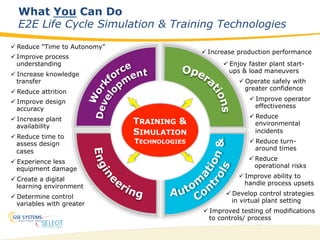
ü Create a digital
learning environment
TRAINING &
SIMULATION
TECHNOLOGIES
What You Can Do
E2E Life Cycle Simulation & Training Technologies
ü Improve design
accuracy
ü Reduce “Time to Autonomy”
ü Reduce attrition
ü Reduce time to
assess design
cases
ü Determine control
variables with greater
effectiveness
ü Reduce turn-
around times
ü Develop control strategies
in virtual plant setting
ü Increase production performance
ü Operate safely with
greater confidence
ü Improve process
understanding
ü Improve operator
effectiveness
ü Increase knowledge
transfer
ü Improve ability to
handle process upsets
ü Enjoy faster plant start-
ups & load maneuvers
ü Improved testing of modifications
to controls/ process
ü Reduce
operational risks
ü Reduce
environmental
incidents
ü Experience less
equipment damage
ü Increase plant
availability
14
6 Important Questions
On the journey to develop employees into autonomous
decision-makers (i.e., make them Experts) how much is 1 less
day of training worth to you?
What does it cost to bring in an “outsider” SME versus
advancing someone from your own “bench?”
How much is a 1% improvement in operator effectiveness
worth to you?
How much would you save if you could eliminate 1 day of
commissioning and startup?
How much would you save if you could eliminate just 1
unplanned shutdown per year?
How much is 1 less reportable incident worth to you?
15
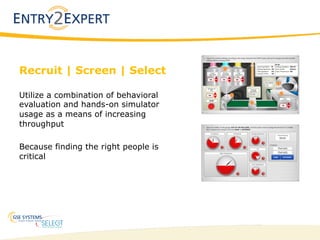
Recruit | Screen | Select
Utilize a combination of behavioral
evaluation and hands-on simulator
usage as a means of increasing
throughput
Because finding the right people is
critical
16
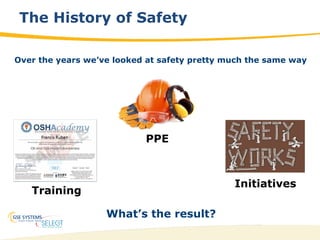
The History of Safety
Over the years we’ve looked at safety pretty much the same way
PPE
Training
Initiatives
What’s the result?
17
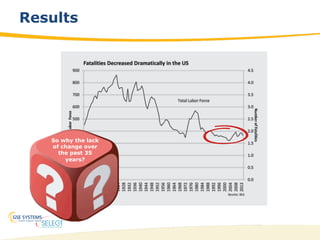
Results
So why the lack
of change over
the past 35
years?
18
Why The Lack of Change?
Continued focus on the same areas!
If nothing changes…
…nothing changes.
19
FTEs Incidents
About 80% of all workplace incidents are caused by around
20% of employees
80/20 Rule
20
•  What makes a person who they are?
•  Why do some students do better than others?
(with the same instructor & using the same curriculum)
•  Why do patients respond differently to identical treatment?
•  Do all your children learn and act in the same manner?
Consider This
21
SafetyDNA
How it’s Done
23
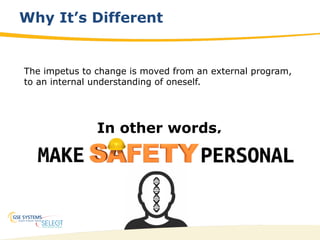
Why It’s Different
The impetus to change is moved from an external program,
to an internal understanding of oneself.
In other words,
24
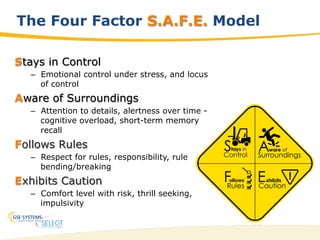
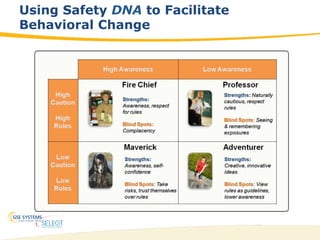
Stays in Control
–  Emotional control under stress, and locus
of control
Aware of Surroundings
–  Attention to details, alertness over time -
cognitive overload, short-term memory
recall
Follows Rules
–  Respect for rules, responsibility, rule
bending/breaking
Exhibits Caution
–  Comfort level with risk, thrill seeking,
impulsivity
The Four Factor S.A.F.E. Model
25
Using Safety DNA to Facilitate
Behavioral Change
26
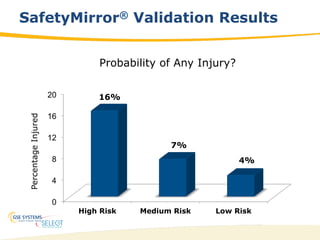
SafetyMirror® Validation Results
0
4
8
12
16
20
High Risk Medium Risk Low Risk
16%
7%
4%
PercentageInjured
Probability of Any Injury?
27
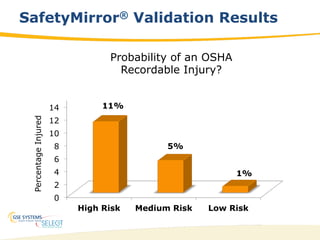
SafetyMirror® Validation Results
0
2
4
6
8
10
12
14
High Risk Medium Risk Low Risk
11%
5%
1%
PercentageInjured
Probability of an OSHA
Recordable Injury?
28
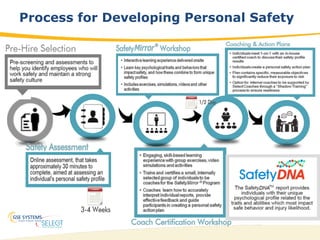
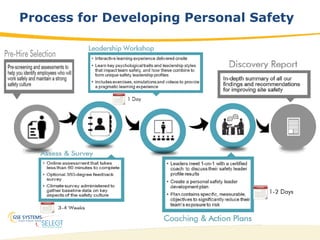
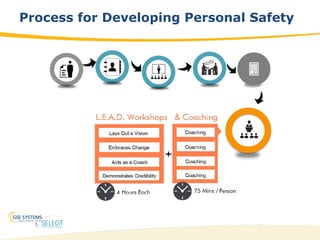
Process for Developing Personal Safety
29
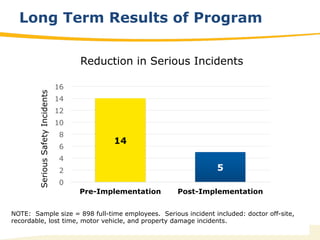
Long Term Results of Program
14
5
0
2
4
6
8
10
12
14
16
Pre-Implementation Post-Implementation
SeriousSafetyIncidents
Reduction in Serious Incidents
NOTE: Sample size = 898 full-time employees. Serious incident included: doctor off-site,
recordable, lost time, motor vehicle, and property damage incidents.
30
It All Starts At The Top…
Environment
Workforce
System
Safety Culture
Safety Performance
Leadership
31
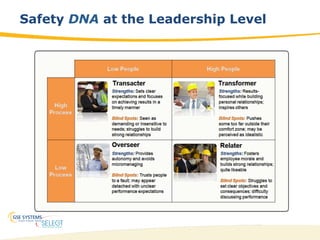
Safety DNA at the Leadership Level
32
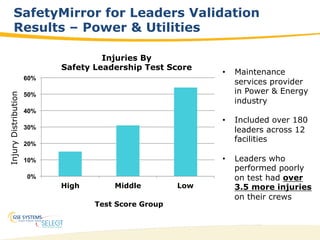
SafetyMirror for Leaders Validation
Results – Power & Utilities
InjuryDistribution
•  Maintenance
services provider
in Power & Energy
industry
•  Included over 180
leaders across 12
facilities
•  Leaders who
performed poorly
on test had over
3.5 more injuries
on their crews
0%
10%
20%
30%
40%
50%
60%
High Middle Low
Injuries By
Safety Leadership Test Score
Test Score Group
33
•  Supervisors in an explosives
manufacturing facility of a
mining services company
•  Supervisors with low safety
leader scores had over 16
times more incidents per
year in their area than
those who did well.
0.0
1.0
2.0
3.0
4.0
5.0
6.0
7.0
8.0
Annual Safety Incident Rate
High Test Score Low Test Score
SafetyMirror for Leaders Validation
Results – Explosives Manufacturing
34
Process for Developing Personal Safety
35
Process for Developing Personal Safety
36
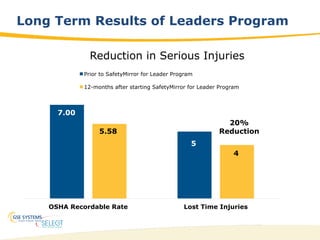
Long Term Results of Leaders Program
7.00
5
5.58
4
OSHA Recordable Rate Lost Time Injuries
Reduction in Serious Injuries
Prior to SafetyMirror for Leader Program
12-months after starting SafetyMirror for Leader Program
20%
Reduction
37
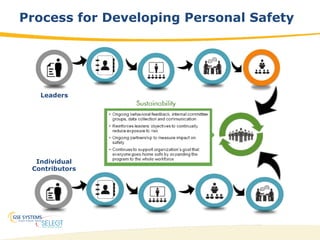
Process for Developing Personal Safety
Leaders
Individual
Contributors
38
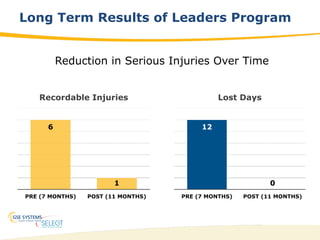
Long Term Results of Leaders Program
6
1
PRE (7 MONTHS) POST (11 MONTHS)
Recordable Injuries
12
0
PRE (7 MONTHS) POST (11 MONTHS)
Lost Days
Reduction in Serious Injuries Over Time
For more information:
Go to: www.GSES.com
Call: +1 800.638.7912
Email: info@gses.com
Follow us on:
Twitter @GSESystems
Facebook.com/GSESystems

Applying Safety DNA Analytics to Enhance Your E2E Workforce Process

  • 1.
    Applying Safety DNAAnalytics to Enhance Your E2E Workforce Process info@gses.com
  • 2.
    2 Core Operating Thesis Sources:ExxonMobil, The Outlook For Energy: A View to 2040, 2013 Center for Energy Workforce Development (CEWD), 2009 OECD: Organisation for Economic Co-operation and Development Global energy demand is rising: •  Up 35% by 2040 world-wide •  Up 65% for non-OECD countries Electricity generation will account for more than half of the increase in global energy demand. Technology advances are enabling the safe development of once hard-to- produce energy resources. The IEA estimates that $1.6 trillion per year, on average, will be necessary to meet energy demand through 2035. As the above scenarios unfold, the OECD energy workforce is aging and approaching retirement.   QUALIFIED ENERGY WORKFORCE GLOBAL DEMAND FOR ENERGY
  • 3.
  • 4.
    4 CEO Outlook onKey Skills
  • 5.
    5 Talent Management Boards GiveTheir Companies an "F” What is top of mind for corporate boards? Corporate directors identified talent management as their single greatest strategic challenge. Source:http://blogs.hbr.org/2013/05/talent-management-boards-give/ by Boris Groysberg and Deborah Bell | 12:00 PM May 28, 2013
  • 6.
  • 7.
    7Image Source: Copyrightedproperty of 123RF Ltd., their Contributors or Licensed Partners and are being used with permission under license. This image may not be copied without permission from 123RF Ltd.
  • 8.
    8 Energy Demand vs.Your Talent Requirements Who can fill the shoes? How? With what? Sources: ExxonMobil, The Outlook For Energy: A View to 2040, 2013 Center for Energy Workforce Development (CEWD), 2009 Global energy demand up 35% by 2040 Technology: No barrier Investment: No barrier Trained resources: Big barrier Growing demand for skilled operators and plant engineers Highly competitive environment 30% turnover “Boomers” retiring Imperatives Improve employee sourcing Speed up onboarding Increase up-skilling effectiveness GLOBAL ENERGY DEMAND QUALIFIED ENERGY OPS & ENGINEER TALENT
  • 9.
    9Image Source: Copyrightedproperty of 123RF Ltd., their Contributors or Licensed Partners and are being used with permission under license. This image may not be copied without permission from 123RF Ltd.
  • 10.
    10 Performance Improvement People Performance Using properprocesses, technologies and services from selection through development of an expert team
  • 11.
    11 Performance Improvement What §  RecruitScreen Select §  Instructional Design §  Fundamentals §  Components §  Systems §  Plants §  Expert-Troubleshooting How §  Behavioral Evaluation §  CBT/WBT §  Universal Simulations §  Integrated Training Programs §  Visualizations §  Custom Plant Simulation §  Plant Advisor Why §  Revenue, Cost, Risk, Agility §  Despite Technology – Human most important §  Overcome the Technology Buffer §  Engineering Cycle does not build the necessary foundation §  Need a repeatable process with predictable results
  • 12.
  • 13.
    13 ü Create a digital learningenvironment TRAINING & SIMULATION TECHNOLOGIES What You Can Do E2E Life Cycle Simulation & Training Technologies ü Improve design accuracy ü Reduce “Time to Autonomy” ü Reduce attrition ü Reduce time to assess design cases ü Determine control variables with greater effectiveness ü Reduce turn- around times ü Develop control strategies in virtual plant setting ü Increase production performance ü Operate safely with greater confidence ü Improve process understanding ü Improve operator effectiveness ü Increase knowledge transfer ü Improve ability to handle process upsets ü Enjoy faster plant start- ups & load maneuvers ü Improved testing of modifications to controls/ process ü Reduce operational risks ü Reduce environmental incidents ü Experience less equipment damage ü Increase plant availability
  • 14.
    14 6 Important Questions Onthe journey to develop employees into autonomous decision-makers (i.e., make them Experts) how much is 1 less day of training worth to you? What does it cost to bring in an “outsider” SME versus advancing someone from your own “bench?” How much is a 1% improvement in operator effectiveness worth to you? How much would you save if you could eliminate 1 day of commissioning and startup? How much would you save if you could eliminate just 1 unplanned shutdown per year? How much is 1 less reportable incident worth to you?
  • 15.
    15 Recruit | Screen| Select Utilize a combination of behavioral evaluation and hands-on simulator usage as a means of increasing throughput Because finding the right people is critical
  • 16.
    16 The History ofSafety Over the years we’ve looked at safety pretty much the same way PPE Training Initiatives What’s the result?
  • 17.
    17 Results So why thelack of change over the past 35 years?
  • 18.
    18 Why The Lackof Change? Continued focus on the same areas! If nothing changes… …nothing changes.
  • 19.
    19 FTEs Incidents About 80%of all workplace incidents are caused by around 20% of employees 80/20 Rule
  • 20.
    20 •  What makesa person who they are? •  Why do some students do better than others? (with the same instructor & using the same curriculum) •  Why do patients respond differently to identical treatment? •  Do all your children learn and act in the same manner? Consider This
  • 21.
  • 22.
  • 23.
    23 Why It’s Different Theimpetus to change is moved from an external program, to an internal understanding of oneself. In other words,
  • 24.
    24 Stays in Control – Emotional control under stress, and locus of control Aware of Surroundings –  Attention to details, alertness over time - cognitive overload, short-term memory recall Follows Rules –  Respect for rules, responsibility, rule bending/breaking Exhibits Caution –  Comfort level with risk, thrill seeking, impulsivity The Four Factor S.A.F.E. Model
  • 25.
    25 Using Safety DNAto Facilitate Behavioral Change
  • 26.
    26 SafetyMirror® Validation Results 0 4 8 12 16 20 HighRisk Medium Risk Low Risk 16% 7% 4% PercentageInjured Probability of Any Injury?
  • 27.
    27 SafetyMirror® Validation Results 0 2 4 6 8 10 12 14 HighRisk Medium Risk Low Risk 11% 5% 1% PercentageInjured Probability of an OSHA Recordable Injury?
  • 28.
  • 29.
    29 Long Term Resultsof Program 14 5 0 2 4 6 8 10 12 14 16 Pre-Implementation Post-Implementation SeriousSafetyIncidents Reduction in Serious Incidents NOTE: Sample size = 898 full-time employees. Serious incident included: doctor off-site, recordable, lost time, motor vehicle, and property damage incidents.
  • 30.
    30 It All StartsAt The Top… Environment Workforce System Safety Culture Safety Performance Leadership
  • 31.
    31 Safety DNA atthe Leadership Level
  • 32.
    32 SafetyMirror for LeadersValidation Results – Power & Utilities InjuryDistribution •  Maintenance services provider in Power & Energy industry •  Included over 180 leaders across 12 facilities •  Leaders who performed poorly on test had over 3.5 more injuries on their crews 0% 10% 20% 30% 40% 50% 60% High Middle Low Injuries By Safety Leadership Test Score Test Score Group
  • 33.
    33 •  Supervisors inan explosives manufacturing facility of a mining services company •  Supervisors with low safety leader scores had over 16 times more incidents per year in their area than those who did well. 0.0 1.0 2.0 3.0 4.0 5.0 6.0 7.0 8.0 Annual Safety Incident Rate High Test Score Low Test Score SafetyMirror for Leaders Validation Results – Explosives Manufacturing
  • 34.
  • 35.
  • 36.
    36 Long Term Resultsof Leaders Program 7.00 5 5.58 4 OSHA Recordable Rate Lost Time Injuries Reduction in Serious Injuries Prior to SafetyMirror for Leader Program 12-months after starting SafetyMirror for Leader Program 20% Reduction
  • 37.
    37 Process for DevelopingPersonal Safety Leaders Individual Contributors
  • 38.
    38 Long Term Resultsof Leaders Program 6 1 PRE (7 MONTHS) POST (11 MONTHS) Recordable Injuries 12 0 PRE (7 MONTHS) POST (11 MONTHS) Lost Days Reduction in Serious Injuries Over Time
  • 39.
    For more information: Goto: www.GSES.com Call: +1 800.638.7912 Email: info@gses.com Follow us on: Twitter @GSESystems Facebook.com/GSESystems