

Humantalents
Employee Productivity
Jayadeva de Silva.M.Sc, FIPM, FITD
Overview
Productivity and Human Behavior
Designing Workers’ Jobs
Empowering Workers
Work Methods Analysis
Work Measurement
Learning Curves
Employees’ Health and Safety
Wrap-Up: What World-Class Companies Do
djayadeva@gmail.com
humantalents-subscribe@yahoogroups.com
1
Humantalents
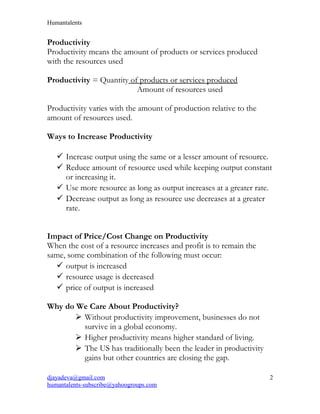
Productivity
Productivity means the amount of products or services produced
with the resources used
Productivity = Quantity of products or services produced
Amount of resources used
Productivity varies with the amount of production relative to the
amount of resources used.
Ways to Increase Productivity
 Increase output using the same or a lesser amount of resource.
 Reduce amount of resource used while keeping output constant
or increasing it.
 Use more resource as long as output increases at a greater rate.
 Decrease output as long as resource use decreases at a greater
rate.
Impact of Price/Cost Change on Productivity
When the cost of a resource increases and profit is to remain the
same, some combination of the following must occur:
 output is increased
 resource usage is decreased
 price of output is increased
Why do We Care About Productivity?
 Without productivity improvement, businesses do not
survive in a global economy.
 Higher productivity means higher standard of living.
 The US has traditionally been the leader in productivity
gains but other countries are closing the gap.
djayadeva@gmail.com
humantalents-subscribe@yahoogroups.com
2
Humantalents
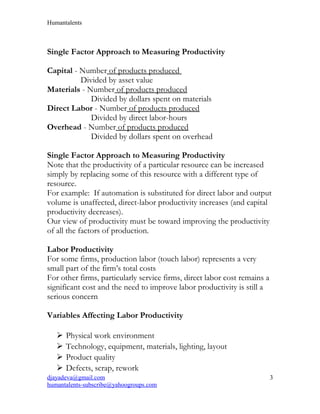
Single Factor Approach to Measuring Productivity
Capital - Number of products produced
Divided by asset value
Materials - Number of products produced
Divided by dollars spent on materials
Direct Labor - Number of products produced
Divided by direct labor-hours
Overhead - Number of products produced
Divided by dollars spent on overhead
Single Factor Approach to Measuring Productivity
Note that the productivity of a particular resource can be increased
simply by replacing some of this resource with a different type of
resource.
For example: If automation is substituted for direct labor and output
volume is unaffected, direct-labor productivity increases (and capital
productivity decreases).
Our view of productivity must be toward improving the productivity
of all the factors of production.
Labor Productivity
For some firms, production labor (touch labor) represents a very
small part of the firm’s total costs
For other firms, particularly service firms, direct labor cost remains a
significant cost and the need to improve labor productivity is still a
serious concern
Variables Affecting Labor Productivity
 Physical work environment
 Technology, equipment, materials, lighting, layout
 Product quality
 Defects, scrap, rework
djayadeva@gmail.com
humantalents-subscribe@yahoogroups.com
3
Humantalents
 Employee job performance
 Employee ability, motivation
 Employee Job Performance
Motivation is perhaps the most complex variable in the productivity
equation.
o Only unsatisfied needs are motivators.
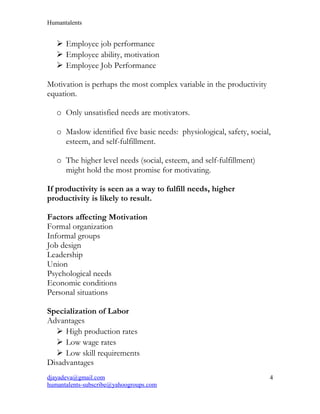
o Maslow identified five basic needs: physiological, safety, social,
esteem, and self-fulfillment.
o The higher level needs (social, esteem, and self-fulfillment)
might hold the most promise for motivating.
If productivity is seen as a way to fulfill needs, higher
productivity is likely to result.
Factors affecting Motivation
Formal organization
Informal groups
Job design
Leadership
Union
Psychological needs
Economic conditions
Personal situations
Specialization of Labor
Advantages
 High production rates
 Low wage rates
 Low skill requirements
Disadvantages
djayadeva@gmail.com
humantalents-subscribe@yahoogroups.com
4
Humantalents
 High turnover, absenteeism, tardiness, grievances, sickness, and
sabotage
 Low production quality at times
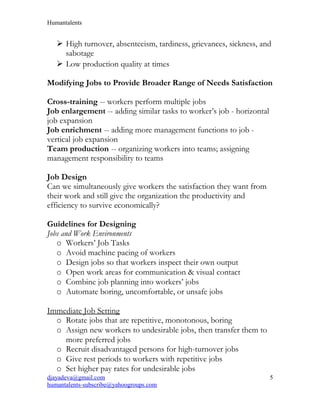
Modifying Jobs to Provide Broader Range of Needs Satisfaction
Cross-training -- workers perform multiple jobs
Job enlargement -- adding similar tasks to worker’s job - horizontal
job expansion
Job enrichment -- adding more management functions to job -
vertical job expansion
Team production -- organizing workers into teams; assigning
management responsibility to teams
Job Design
Can we simultaneously give workers the satisfaction they want from
their work and still give the organization the productivity and
efficiency to survive economically?
Guidelines for Designing
Jobs and Work Environments
o Workers’ Job Tasks
o Avoid machine pacing of workers
o Design jobs so that workers inspect their own output
o Open work areas for communication & visual contact
o Combine job planning into workers’ jobs
o Automate boring, uncomfortable, or unsafe jobs
Immediate Job Setting
o Rotate jobs that are repetitive, monotonous, boring
o Assign new workers to undesirable jobs, then transfer them to
more preferred jobs
o Recruit disadvantaged persons for high-turnover jobs
o Give rest periods to workers with repetitive jobs
o Set higher pay rates for undesirable jobs
djayadeva@gmail.com
humantalents-subscribe@yahoogroups.com
5
Humantalents
Guidelines for Designing Jobs and Work Environments
Larger Work Environment
o Select/train supervisors who openly communicate
o Develop supervisors who are comfortable with a participative
team environment
o Remove physical barriers between management and other
employees
o Create climate that recognizes workers & work teams
o Develop formal/informal channels of communication in all
directions
Empowering Workers
o It is the employees who have control of, and know the most
about, the details of production.
o To get employees to accept this responsibility, managers must
first give employees the authority to act.
o The process of conveying authority from managers to workers
is called worker empowerment.
o Workers accepting responsibility for production can lead to
what is called internal ownership.
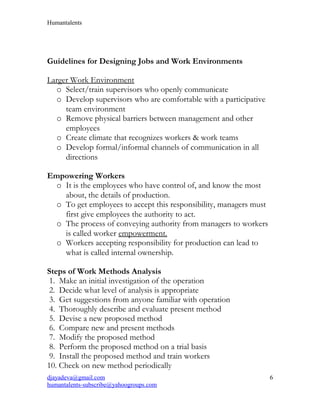
Steps of Work Methods Analysis
1. Make an initial investigation of the operation
2. Decide what level of analysis is appropriate
3. Get suggestions from anyone familiar with operation
4. Thoroughly describe and evaluate present method
5. Devise a new proposed method
6. Compare new and present methods
7. Modify the proposed method
8. Perform the proposed method on a trial basis
9. Install the proposed method and train workers
10. Check on new method periodically
djayadeva@gmail.com
humantalents-subscribe@yahoogroups.com
6
Humantalents
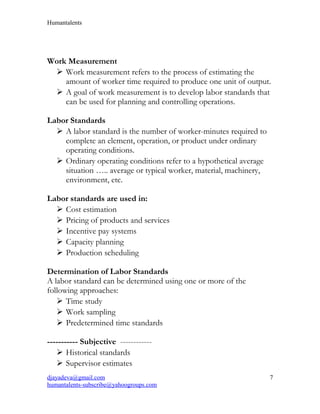
Work Measurement
 Work measurement refers to the process of estimating the
amount of worker time required to produce one unit of output.
 A goal of work measurement is to develop labor standards that
can be used for planning and controlling operations.
Labor Standards
 A labor standard is the number of worker-minutes required to
complete an element, operation, or product under ordinary
operating conditions.
 Ordinary operating conditions refer to a hypothetical average
situation ….. average or typical worker, material, machinery,
environment, etc.
Labor standards are used in:
 Cost estimation
 Pricing of products and services
 Incentive pay systems
 Capacity planning
 Production scheduling
Determination of Labor Standards
A labor standard can be determined using one or more of the
following approaches:
 Time study
 Work sampling
 Predetermined time standards
----------- Subjective ------------
 Historical standards
 Supervisor estimates
djayadeva@gmail.com
humantalents-subscribe@yahoogroups.com
7
Humantalents
Time Study
Suitable Jobs
 Job performed by a single worker in a fixed location
 Job involves repetitive short cycles
 Job expected to continue unchanged for a long period
 Job produces large quantities of output
 Resulting time standard must be very accurate
Time Study
 Analysts use stopwatches to time the operation being
performed by workers
 These observed times are then converted into labor standards
 The labor standards are expressed in minutes per unit of output
for the operation
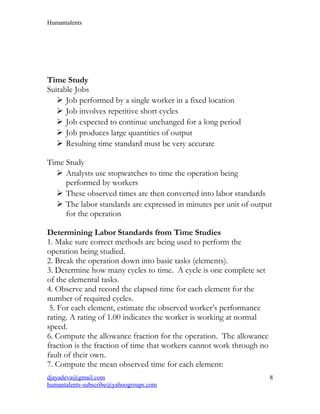
Determining Labor Standards from Time Studies
1. Make sure correct methods are being used to perform the
operation being studied.
2. Break the operation down into basic tasks (elements).
3. Determine how many cycles to time. A cycle is one complete set
of the elemental tasks.
4. Observe and record the elapsed time for each element for the
number of required cycles.
5. For each element, estimate the observed worker’s performance
rating. A rating of 1.00 indicates the worker is working at normal
speed.
6. Compute the allowance fraction for the operation. The allowance
fraction is the fraction of time that workers cannot work through no
fault of their own.
7. Compute the mean observed time for each element:
djayadeva@gmail.com
humantalents-subscribe@yahoogroups.com
8
Humantalents
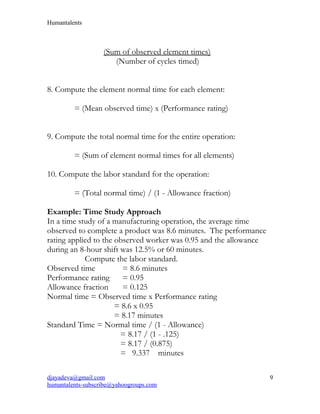
(Sum of observed element times)
(Number of cycles timed)
8. Compute the element normal time for each element:
= (Mean observed time) x (Performance rating)
9. Compute the total normal time for the entire operation:
= (Sum of element normal times for all elements)
10. Compute the labor standard for the operation:
= (Total normal time) / (1 - Allowance fraction)
Example: Time Study Approach
In a time study of a manufacturing operation, the average time
observed to complete a product was 8.6 minutes. The performance
rating applied to the observed worker was 0.95 and the allowance
during an 8-hour shift was 12.5% or 60 minutes.
Compute the labor standard.
Observed time = 8.6 minutes
Performance rating = 0.95
Allowance fraction = 0.125
Normal time = Observed time x Performance rating
= 8.6 x 0.95
= 8.17 minutes
Standard Time = Normal time / (1 - Allowance)
= 8.17 / (1 - .125)
= 8.17 / (0.875)
= 9.337 minutes
djayadeva@gmail.com
humantalents-subscribe@yahoogroups.com
9
Humantalents
Predetermined Time Standards
Commonly used for new operations or new products
When labor standard must be determined in advance of performing
an operation
Utilize data that have been historically developed for basic body
movements, elements of operations, and entire operations
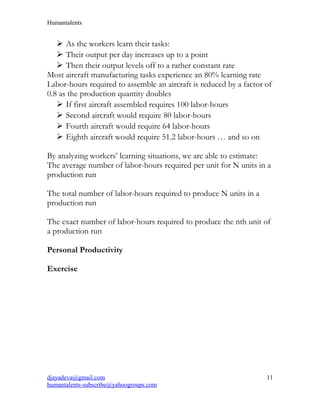
Example
Learning Curves
At the start of production runs:
 Workers are unfamiliar with their tasks
 Time it takes to produce the first few units is high
djayadeva@gmail.com
humantalents-subscribe@yahoogroups.com
10 20 30 40 50 60 70 80 90 100 11010 20 30 40 50 60 70 80 90 100 110 120 130120 130
2020
8080
4040
100100
6060
Unit Number (Unit Number (nn))
120120
Labor-Hours forLabor-Hours for nnth Unitth Unit Aircraft AssemblyAircraft Assembly
80% Learning Curve80% Learning Curve
10
Humantalents
 As the workers learn their tasks:
 Their output per day increases up to a point
 Then their output levels off to a rather constant rate
Most aircraft manufacturing tasks experience an 80% learning rate
Labor-hours required to assemble an aircraft is reduced by a factor of
0.8 as the production quantity doubles
 If first aircraft assembled requires 100 labor-hours
 Second aircraft would require 80 labor-hours
 Fourth aircraft would require 64 labor-hours
 Eighth aircraft would require 51.2 labor-hours … and so on
By analyzing workers’ learning situations, we are able to estimate:
The average number of labor-hours required per unit for N units in a
production run
The total number of labor-hours required to produce N units in a
production run
The exact number of labor-hours required to produce the nth unit of
a production run
Personal Productivity
Exercise
djayadeva@gmail.com
humantalents-subscribe@yahoogroups.com
11
Humantalents
Exercise
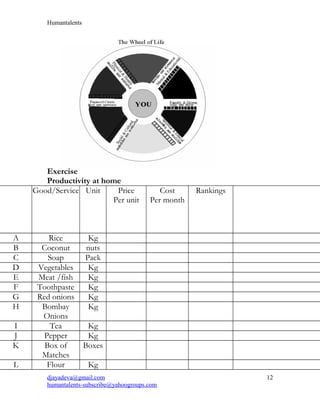
Productivity at home
Good/Service Unit Price
Per unit
Cost
Per month
Rankings
A Rice Kg
B Coconut nuts
C Soap Pack
D Vegetables Kg
E Meat /fish Kg
F Toothpaste Kg
G Red onions Kg
H Bombay
Onions
Kg
I Tea Kg
J Pepper Kg
K Box of
Matches
Boxes
L Flour Kg
djayadeva@gmail.com
humantalents-subscribe@yahoogroups.com
12
Humantalents
M Electricity Units
N Sandal Sticks Bundles
O Coconut oil Bottles
P Salt Kg
Q
R
S
Employee Health & Safety
Several regulations and government agencies monitor and control;
- Safety and health in the workplace. (By State... pro-active)
Worker’s Compensation - safety and health in the workplace. (By
State .... re-active)
Environmental protection outside of the workplace.
(Pro-active)
Safety and Health departments in plant
Wrap-Up:
World-Class Practice
 World class companies recognize employees are of strategic and
tactical importance
 Workers must have problem-solving abilities and be trained,
cross-trained, educated and empowered so that they can work
in teams and respond to customer needs
djayadeva@gmail.com
humantalents-subscribe@yahoogroups.com
13
Humantalents
 Organizational structure must be developed to encourage full
use of employees
 Information is the main media of management
djayadeva@gmail.com
humantalents-subscribe@yahoogroups.com
14

Employee productivity

  • 1.
    Humantalents Employee Productivity Jayadeva deSilva.M.Sc, FIPM, FITD Overview Productivity and Human Behavior Designing Workers’ Jobs Empowering Workers Work Methods Analysis Work Measurement Learning Curves Employees’ Health and Safety Wrap-Up: What World-Class Companies Do djayadeva@gmail.com humantalents-subscribe@yahoogroups.com 1
  • 2.
    Humantalents Productivity Productivity means theamount of products or services produced with the resources used Productivity = Quantity of products or services produced Amount of resources used Productivity varies with the amount of production relative to the amount of resources used. Ways to Increase Productivity  Increase output using the same or a lesser amount of resource.  Reduce amount of resource used while keeping output constant or increasing it.  Use more resource as long as output increases at a greater rate.  Decrease output as long as resource use decreases at a greater rate. Impact of Price/Cost Change on Productivity When the cost of a resource increases and profit is to remain the same, some combination of the following must occur:  output is increased  resource usage is decreased  price of output is increased Why do We Care About Productivity?  Without productivity improvement, businesses do not survive in a global economy.  Higher productivity means higher standard of living.  The US has traditionally been the leader in productivity gains but other countries are closing the gap. djayadeva@gmail.com humantalents-subscribe@yahoogroups.com 2
  • 3.
    Humantalents Single Factor Approachto Measuring Productivity Capital - Number of products produced Divided by asset value Materials - Number of products produced Divided by dollars spent on materials Direct Labor - Number of products produced Divided by direct labor-hours Overhead - Number of products produced Divided by dollars spent on overhead Single Factor Approach to Measuring Productivity Note that the productivity of a particular resource can be increased simply by replacing some of this resource with a different type of resource. For example: If automation is substituted for direct labor and output volume is unaffected, direct-labor productivity increases (and capital productivity decreases). Our view of productivity must be toward improving the productivity of all the factors of production. Labor Productivity For some firms, production labor (touch labor) represents a very small part of the firm’s total costs For other firms, particularly service firms, direct labor cost remains a significant cost and the need to improve labor productivity is still a serious concern Variables Affecting Labor Productivity  Physical work environment  Technology, equipment, materials, lighting, layout  Product quality  Defects, scrap, rework djayadeva@gmail.com humantalents-subscribe@yahoogroups.com 3
  • 4.
    Humantalents  Employee jobperformance  Employee ability, motivation  Employee Job Performance Motivation is perhaps the most complex variable in the productivity equation. o Only unsatisfied needs are motivators. o Maslow identified five basic needs: physiological, safety, social, esteem, and self-fulfillment. o The higher level needs (social, esteem, and self-fulfillment) might hold the most promise for motivating. If productivity is seen as a way to fulfill needs, higher productivity is likely to result. Factors affecting Motivation Formal organization Informal groups Job design Leadership Union Psychological needs Economic conditions Personal situations Specialization of Labor Advantages  High production rates  Low wage rates  Low skill requirements Disadvantages djayadeva@gmail.com humantalents-subscribe@yahoogroups.com 4
  • 5.
    Humantalents  High turnover,absenteeism, tardiness, grievances, sickness, and sabotage  Low production quality at times Modifying Jobs to Provide Broader Range of Needs Satisfaction Cross-training -- workers perform multiple jobs Job enlargement -- adding similar tasks to worker’s job - horizontal job expansion Job enrichment -- adding more management functions to job - vertical job expansion Team production -- organizing workers into teams; assigning management responsibility to teams Job Design Can we simultaneously give workers the satisfaction they want from their work and still give the organization the productivity and efficiency to survive economically? Guidelines for Designing Jobs and Work Environments o Workers’ Job Tasks o Avoid machine pacing of workers o Design jobs so that workers inspect their own output o Open work areas for communication & visual contact o Combine job planning into workers’ jobs o Automate boring, uncomfortable, or unsafe jobs Immediate Job Setting o Rotate jobs that are repetitive, monotonous, boring o Assign new workers to undesirable jobs, then transfer them to more preferred jobs o Recruit disadvantaged persons for high-turnover jobs o Give rest periods to workers with repetitive jobs o Set higher pay rates for undesirable jobs djayadeva@gmail.com humantalents-subscribe@yahoogroups.com 5
  • 6.
    Humantalents Guidelines for DesigningJobs and Work Environments Larger Work Environment o Select/train supervisors who openly communicate o Develop supervisors who are comfortable with a participative team environment o Remove physical barriers between management and other employees o Create climate that recognizes workers & work teams o Develop formal/informal channels of communication in all directions Empowering Workers o It is the employees who have control of, and know the most about, the details of production. o To get employees to accept this responsibility, managers must first give employees the authority to act. o The process of conveying authority from managers to workers is called worker empowerment. o Workers accepting responsibility for production can lead to what is called internal ownership. Steps of Work Methods Analysis 1. Make an initial investigation of the operation 2. Decide what level of analysis is appropriate 3. Get suggestions from anyone familiar with operation 4. Thoroughly describe and evaluate present method 5. Devise a new proposed method 6. Compare new and present methods 7. Modify the proposed method 8. Perform the proposed method on a trial basis 9. Install the proposed method and train workers 10. Check on new method periodically djayadeva@gmail.com humantalents-subscribe@yahoogroups.com 6
  • 7.
    Humantalents Work Measurement  Workmeasurement refers to the process of estimating the amount of worker time required to produce one unit of output.  A goal of work measurement is to develop labor standards that can be used for planning and controlling operations. Labor Standards  A labor standard is the number of worker-minutes required to complete an element, operation, or product under ordinary operating conditions.  Ordinary operating conditions refer to a hypothetical average situation ….. average or typical worker, material, machinery, environment, etc. Labor standards are used in:  Cost estimation  Pricing of products and services  Incentive pay systems  Capacity planning  Production scheduling Determination of Labor Standards A labor standard can be determined using one or more of the following approaches:  Time study  Work sampling  Predetermined time standards ----------- Subjective ------------  Historical standards  Supervisor estimates djayadeva@gmail.com humantalents-subscribe@yahoogroups.com 7
  • 8.
    Humantalents Time Study Suitable Jobs Job performed by a single worker in a fixed location  Job involves repetitive short cycles  Job expected to continue unchanged for a long period  Job produces large quantities of output  Resulting time standard must be very accurate Time Study  Analysts use stopwatches to time the operation being performed by workers  These observed times are then converted into labor standards  The labor standards are expressed in minutes per unit of output for the operation Determining Labor Standards from Time Studies 1. Make sure correct methods are being used to perform the operation being studied. 2. Break the operation down into basic tasks (elements). 3. Determine how many cycles to time. A cycle is one complete set of the elemental tasks. 4. Observe and record the elapsed time for each element for the number of required cycles. 5. For each element, estimate the observed worker’s performance rating. A rating of 1.00 indicates the worker is working at normal speed. 6. Compute the allowance fraction for the operation. The allowance fraction is the fraction of time that workers cannot work through no fault of their own. 7. Compute the mean observed time for each element: djayadeva@gmail.com humantalents-subscribe@yahoogroups.com 8
  • 9.
    Humantalents (Sum of observedelement times) (Number of cycles timed) 8. Compute the element normal time for each element: = (Mean observed time) x (Performance rating) 9. Compute the total normal time for the entire operation: = (Sum of element normal times for all elements) 10. Compute the labor standard for the operation: = (Total normal time) / (1 - Allowance fraction) Example: Time Study Approach In a time study of a manufacturing operation, the average time observed to complete a product was 8.6 minutes. The performance rating applied to the observed worker was 0.95 and the allowance during an 8-hour shift was 12.5% or 60 minutes. Compute the labor standard. Observed time = 8.6 minutes Performance rating = 0.95 Allowance fraction = 0.125 Normal time = Observed time x Performance rating = 8.6 x 0.95 = 8.17 minutes Standard Time = Normal time / (1 - Allowance) = 8.17 / (1 - .125) = 8.17 / (0.875) = 9.337 minutes djayadeva@gmail.com humantalents-subscribe@yahoogroups.com 9
  • 10.
    Humantalents Predetermined Time Standards Commonlyused for new operations or new products When labor standard must be determined in advance of performing an operation Utilize data that have been historically developed for basic body movements, elements of operations, and entire operations Example Learning Curves At the start of production runs:  Workers are unfamiliar with their tasks  Time it takes to produce the first few units is high djayadeva@gmail.com humantalents-subscribe@yahoogroups.com 10 20 30 40 50 60 70 80 90 100 11010 20 30 40 50 60 70 80 90 100 110 120 130120 130 2020 8080 4040 100100 6060 Unit Number (Unit Number (nn)) 120120 Labor-Hours forLabor-Hours for nnth Unitth Unit Aircraft AssemblyAircraft Assembly 80% Learning Curve80% Learning Curve 10
  • 11.
    Humantalents  As theworkers learn their tasks:  Their output per day increases up to a point  Then their output levels off to a rather constant rate Most aircraft manufacturing tasks experience an 80% learning rate Labor-hours required to assemble an aircraft is reduced by a factor of 0.8 as the production quantity doubles  If first aircraft assembled requires 100 labor-hours  Second aircraft would require 80 labor-hours  Fourth aircraft would require 64 labor-hours  Eighth aircraft would require 51.2 labor-hours … and so on By analyzing workers’ learning situations, we are able to estimate: The average number of labor-hours required per unit for N units in a production run The total number of labor-hours required to produce N units in a production run The exact number of labor-hours required to produce the nth unit of a production run Personal Productivity Exercise djayadeva@gmail.com humantalents-subscribe@yahoogroups.com 11
  • 12.
    Humantalents Exercise Productivity at home Good/ServiceUnit Price Per unit Cost Per month Rankings A Rice Kg B Coconut nuts C Soap Pack D Vegetables Kg E Meat /fish Kg F Toothpaste Kg G Red onions Kg H Bombay Onions Kg I Tea Kg J Pepper Kg K Box of Matches Boxes L Flour Kg djayadeva@gmail.com humantalents-subscribe@yahoogroups.com 12
  • 13.
    Humantalents M Electricity Units NSandal Sticks Bundles O Coconut oil Bottles P Salt Kg Q R S Employee Health & Safety Several regulations and government agencies monitor and control; - Safety and health in the workplace. (By State... pro-active) Worker’s Compensation - safety and health in the workplace. (By State .... re-active) Environmental protection outside of the workplace. (Pro-active) Safety and Health departments in plant Wrap-Up: World-Class Practice  World class companies recognize employees are of strategic and tactical importance  Workers must have problem-solving abilities and be trained, cross-trained, educated and empowered so that they can work in teams and respond to customer needs djayadeva@gmail.com humantalents-subscribe@yahoogroups.com 13
  • 14.
    Humantalents  Organizational structuremust be developed to encourage full use of employees  Information is the main media of management djayadeva@gmail.com humantalents-subscribe@yahoogroups.com 14