Business Enterprise Decision-Making
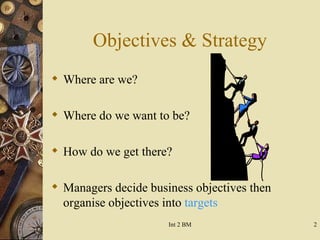
Objectives & Strategy Where are we? Where do we want to be? How do we get there? Managers decide business objectives then organise objectives into  targets
Mission Statements A company’s  raison d’ ê tre Why Define Aims/Objectives? End result to work to Goals motivate people Keeps focus and direction
Mission Statements “We exist to refresh everyone we touch” “We strive to lead in the invention, development and manufacture of the industry's most advanced information technologies“
Types of Decision Strategic Tactical Operational
Strategic Decisions Long term Made by Senior management More general in nature Major policy statements are strategic Examples: What products will business produce? Which market sector will we aim for? Increase market share To have 100% customer satisfaction
Tactical Decisions Short term Made by middle managers in functional areas Based on aims or goals of organisation More detailed and specific May change due to PEST Examples Increase number of employees to cope with workload Re-name business Issue shares to fund new premises Instore promotions
Operational Decisions Day to day, routine decisions Mainly made by low-level managers/supervisors Respond to usually regular problems Examples: Arranging work rotas Dealing with customer complaints Ordering materials from suppliers
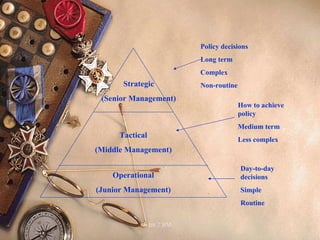
Policy decisions Long term Complex Non-routine How to achieve policy Medium term Less complex Day-to-day decisions Simple Routine Strategic (Senior Management) Tactical (Middle Management) Operational (Junior Management)
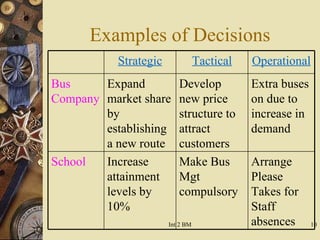
Examples of Decisions Arrange Please Takes for Staff absences Make Bus Mgt compulsory Increase attainment levels by 10% School Extra buses on due to increase in demand Develop new price structure to attract customers Expand market share by establishing a new route Bus Company Operational Tactical Strategic
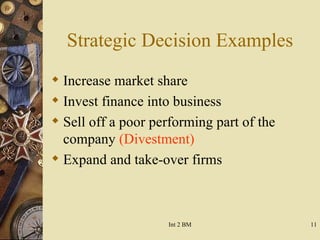
Strategic Decision Examples Increase market share Invest finance into business Sell off a poor performing part of the company  (Divestment) Expand and take-over firms
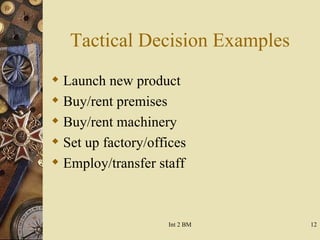
Tactical Decision Examples Launch new product Buy/rent premises Buy/rent machinery Set up factory/offices Employ/transfer staff
Operational Decision Examples Train new members of staff Decide on layout of office Where to advertise jobs Implement production methods Decide on working hours
What is Management? Managers are responsible for  getting things done This involves  delegation  – passing responsibility onto others Managers act on behalf of owners and are accountable to shareholders Managers set objectives for the organisation, and try to achieve them
Fayol’s Role of Manager Plan   – examining the future and drawing up a plan of action Organize  – building up human and material resources and putting plan into action Command  – maintaining worker activity Co-ordinate  – unifying effort between departments Control  – checks on efficiency of plan  Implement  – put into practice
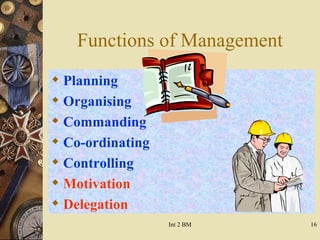
Functions of Management Planning Organising Commanding Co-ordinating Controlling Motivation Delegation
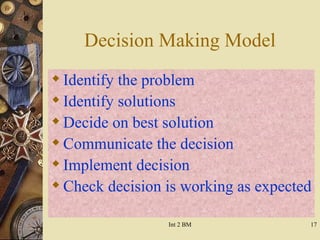
Decision Making Model Identify the problem Identify solutions Decide on best solution Communicate the decision Implement decision Check decision is working as expected

Decision Making Int 2

  • 1.
  • 2.
    Objectives & StrategyWhere are we? Where do we want to be? How do we get there? Managers decide business objectives then organise objectives into targets
  • 3.
    Mission Statements Acompany’s raison d’ ê tre Why Define Aims/Objectives? End result to work to Goals motivate people Keeps focus and direction
  • 4.
    Mission Statements “Weexist to refresh everyone we touch” “We strive to lead in the invention, development and manufacture of the industry's most advanced information technologies“
  • 5.
    Types of DecisionStrategic Tactical Operational
  • 6.
    Strategic Decisions Longterm Made by Senior management More general in nature Major policy statements are strategic Examples: What products will business produce? Which market sector will we aim for? Increase market share To have 100% customer satisfaction
  • 7.
    Tactical Decisions Shortterm Made by middle managers in functional areas Based on aims or goals of organisation More detailed and specific May change due to PEST Examples Increase number of employees to cope with workload Re-name business Issue shares to fund new premises Instore promotions
  • 8.
    Operational Decisions Dayto day, routine decisions Mainly made by low-level managers/supervisors Respond to usually regular problems Examples: Arranging work rotas Dealing with customer complaints Ordering materials from suppliers
  • 9.
    Policy decisions Longterm Complex Non-routine How to achieve policy Medium term Less complex Day-to-day decisions Simple Routine Strategic (Senior Management) Tactical (Middle Management) Operational (Junior Management)
  • 10.
    Examples of DecisionsArrange Please Takes for Staff absences Make Bus Mgt compulsory Increase attainment levels by 10% School Extra buses on due to increase in demand Develop new price structure to attract customers Expand market share by establishing a new route Bus Company Operational Tactical Strategic
  • 11.
    Strategic Decision ExamplesIncrease market share Invest finance into business Sell off a poor performing part of the company (Divestment) Expand and take-over firms
  • 12.
    Tactical Decision ExamplesLaunch new product Buy/rent premises Buy/rent machinery Set up factory/offices Employ/transfer staff
  • 13.
    Operational Decision ExamplesTrain new members of staff Decide on layout of office Where to advertise jobs Implement production methods Decide on working hours
  • 14.
    What is Management?Managers are responsible for getting things done This involves delegation – passing responsibility onto others Managers act on behalf of owners and are accountable to shareholders Managers set objectives for the organisation, and try to achieve them
  • 15.
    Fayol’s Role ofManager Plan – examining the future and drawing up a plan of action Organize – building up human and material resources and putting plan into action Command – maintaining worker activity Co-ordinate – unifying effort between departments Control – checks on efficiency of plan Implement – put into practice
  • 16.
    Functions of ManagementPlanning Organising Commanding Co-ordinating Controlling Motivation Delegation
  • 17.
    Decision Making ModelIdentify the problem Identify solutions Decide on best solution Communicate the decision Implement decision Check decision is working as expected