Page1 of 5
Production & Operations Management:
Operations managementrefers to the activities, decisions and responsibilities ofmanaging the resources which are
dedicated to the production and delivery ofproducts and services.
The part ofan organization that is responsible for this activity is called the operations function and every organization
has one as delivery ofa productand/or service is the reason for existence.
Operations managers are the people who are responsible for overseeing and managing the resources thatmake up
the operations function. The operations function is also responsible for fulfilling customer requests through the
production and delivery ofproducts and services.
OM designs and operates productive systems- systems for getting work done. Operations managers are found in
banks, hospitals, factories and in governmentorganizations. They design system, ensure quality, produce products
and deliver services. They work with customers and suppliers, the latest technology and global partners. The food
we eat, the movie we watch, the book we are reading are provided by the people in operation.
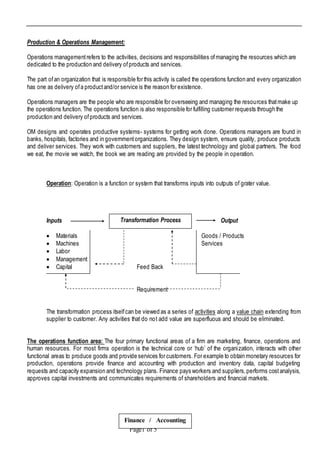
Operation: Operation is a function or system that transforms inputs into outputs of grater value.
Inputs Output
 Materials Goods / Products
 Machines Services
 Labor
 Management
 Capital Feed Back
Requirement
The transformation process itselfcan be viewed as a series of activities along a value chain extending from
supplier to customer. Any activities that do not add value are superfluous and should be eliminated.
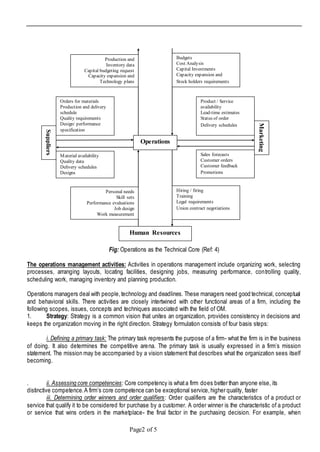
The operations function area: The four primary functional areas of a firm are marketing, finance, operations and
human resources. For most firms operation is the technical core or ‘hub’ of the organization, interacts with other
functional areas to produce goods and provide services for customers. For example to obtain monetary resources for
production, operations provide finance and accounting with production and inventory data, capital budgeting
requests and capacity expansion and technology plans. Finance pays workers and suppliers,performs costanalysis,
approves capital investments and communicates requirements of shareholders and financial markets.
Transformation Process
Finance / Accounting
Page2 of 5
Fig: Operations as the Technical Core (Ref: 4)
The operations management activities: Activities in operations management include organizing work, selecting
processes, arranging layouts, locating facilities, designing jobs, measuring performance, controlling quality,
scheduling work, managing inventory and planning production.
Operations managers deal with people,technology and deadlines. These managers need good technical, conceptual
and behavioral skills. There activities are closely intertwined with other functional areas of a firm, including the
following scopes, issues, concepts and techniques associated with the field of OM.
1. Strategy: Strategy is a common vision that unites an organization, provides consistency in decisions and
keeps the organization moving in the right direction. Strategy formulation consists of four basis steps:
i. Defining a primary task: The primary task represents the purpose of a firm- what the firm is in the business
of doing. It also determines the competitive arena. The primary task is usually expressed in a firm’s mission
statement. The mission may be accompanied by a vision statement that describes what the organization sees itself
becoming.
. ii. Assessing core competencies: Core competency is whata firm does better than anyone else, its
distinctive competence.A firm’s core competence can be exceptional service,higher quality, faster
iii. Determining order winners and order qualifiers: Order qualifiers are the characteristics of a product or
service that qualify it to be considered for purchase by a customer. A order winner is the characteristic of a product
or service that wins orders in the marketplace- the final factor in the purchasing decision. For example, when
Operations
Production and
Inventory data
Capital budgeting request
Capacity expansion and
Technology plans
Budgets
Cost Analysis
Capital Investments
Capacity expansion and
Stock holders requirements
Suppliers
Marketing
Orders for materials
Production and delivery
schedule
Quality requirements
Design/ performance
specification
Product / Service
availability
Lead-time estimates
Status of order
Delivery schedules
Material availability
Quality data
Delivery schedules
Designs
Sales forecasts
Customer orders
Customer feedback
Promotions
Human Resources
Personal needs
Skill sets
Performance evaluations
Job design
Work measurement
Hiring / firing
Training
Legal requirements
Union contract negotiations
Page3 of 5
purchase a CD player customer may determine a price range (order qualifier) and then choose the product with the
mostfeatures (order winner) within the price range. Or they may have a set of features in mind (order qualifiers) and
then select the least expensive CD players ( order winner) that has all the required features.
iv. Positioning the firm: A firm’s positioning strategy defines how it will complete in the marketplace- what
unique value it will deliver to the customer. An effective positioning strategy considers the strengths and we aknesses
of the organization, the needs of the marketplace and the position of competitors.
v. Deploying the strategy: Strategy deployment converts a firm’s positioning strategy and resultant order
winners and order qualifiers into specific performance requirements. Companies struggling to align day-to-day
decisions with corporate strategy have found success with two types ofplanning systems-policy deployment and the
balanced scorecard.
2. Forecasting demand for Products and Services: Forecasting involves using a number of different
methods and quantitative techniques to provide accurate estimates of demand, which are later used to make
production decisions.
3. Production Planning and Scheduling: Production planning represents a major area of decision making in
operations management. ‘ Capacity and Aggregate Planning’, ‘Inventory Management’, ‘Enterprise Resource
Planning’, ‘Just-in-Time and lean Production’ are the topics of production planning and scheduling.
4. Ensuring Quality: Quality underlines all operational decisions. Ensuring quality entails establishing a quality
management system using statistical quality control, improving customer service and managing human resources
wisely. Topics are ‘Statistical Process Control, ‘Quality Management’, and ‘Human Resources in Operations
Management’.
5. Product and Services:
The traditional starting point in the production process in designing the product or service. Decisions related to
design include converting customer requirements to productor service characteristics determining the desired level
of quality, selecting materials and evaluating the resulting production cost.
6. Process & Technology:
A process is a group of related tasks with specific inputs and outputs. Processes exist to create value for the
customer, the shareholders or society. Process design defines what tasks need to be done and how they are to be
coordinated among functions, people and organizations. Plans are developed for acquiring materials, determining
the types of job skills, equipment and technology required and managing the process.
7. Facilities:
The production process that has been designed must be physically housed in a facility and laid out in an effective
manner so that the product can be produced or service delivered as efficiently as possible.
8. Project Management:
Projectmanagementis a technique that breaks down complex processes, schedules activities and ensures that the
project is completed on time and on budget.
9. Managing Supply Chain:
A supply chain encompasses all the facilities, functions and activities involved in producing and delivering a product
or service from the suppliers to the customer.
Page4 of 5
# Operations Management in an E-Business Environment
Trade that occurs over the internet (or any computer network) is called electronic commerce, e-commerce or e-
business.
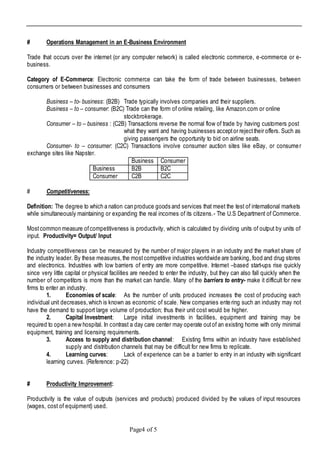
Category of E-Commerce: Electronic commerce can take the form of trade between businesses, between
consumers or between businesses and consumers
Business – to- business: (B2B) Trade typically involves companies and their suppliers.
Business – to – consumer: (B2C) Trade can the form of online retailing, like Amazon.com or online
stockbrokerage.
Consumer – to – business : (C2B) Transactions reverse the normal flow of trade by having customers post
what they want and having businesses acceptor rejecttheir offers. Such as
giving passengers the opportunity to bid on airline seats.
Consumer- to – consumer: (C2C) Transactions involve consumer auction sites like eBay, or consumer
exchange sites like Napster.
Business Consumer
Business B2B B2C
Consumer C2B C2C
# Competitiveness:
Definition: The degree to which a nation can produce goods and services that meet the test of international markets
while simultaneously maintaining or expanding the real incomes of its citizens.- The U.S Department of Commerce.
Mostcommon measure ofcompetitiveness is productivity, which is calculated by dividing units of output by units of
input. Productivity= Output/ Input
Industry competitiveness can be measured by the number of major players in an industry and the market share of
the industry leader. By these measures,the mostcompetitive industries worldwide are banking, food and drug stores
and electronics. Industries with low barriers of entry are more competitive. Internet –based start-ups rise quickly
since very little capital or physical facilities are needed to enter the industry, but they can also fall quickly when the
number of competitors is more than the market can handle. Many of the barriers to entry- make it difficult for new
firms to enter an industry.
1. Economies of scale: As the number of units produced increases the cost of producing each
individual unit decreases,which is known as economic of scale. New companies entering such an industry may not
have the demand to support large volume of production; thus their unit cost would be higher.
2. Capital Investment: Large initial investments in facilities, equipment and training may be
required to open a new hospital. In contrast a day care center may operate outof an existing home with only minimal
equipment, training and licensing requirements.
3. Access to supply and distribution channel: Existing firms within an industry have established
supply and distribution channels that may be difficult for new firms to replicate.
4. Learning curves: Lack of experience can be a barrier to entry in an industry with significant
learning curves. (Reference: p-22)
# Productivity Improvement:
Productivity is the value of outputs (services and products) produced divided by the values of input resources
(wages, cost of equipment) used.
Page5 of 5
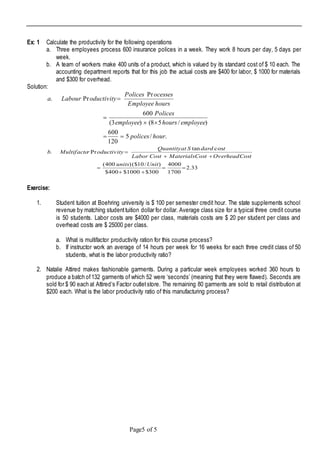
Ex: 1 Calculate the productivity for the following operations
a. Three employees process 600 insurance polices in a week. They work 8 hours per day, 5 days per
week.
b. A team of workers make 400 units of a product, which is valued by its standard cost of $ 10 each. The
accounting department reports that for this job the actual costs are $400 for labor, $ 1000 for materials
and $300 for overhead.
Solution:
./5
120
600
)/58()3(
600
Pr
Pr.
hourpolices
employeehoursemployee
Polices
hoursEmployee
ocessesPolices
oductivityLaboura




33.2
1700
4000
300$1000$400$
)/10($)400(
costan
Pr.





Unitunits
CostOverheadCostMaterialsCostLabor
tdardSatQuantity
oductivityrMultifactob
Exercise:
1. Student tuition at Boehring university is $ 100 per semester credit hour. The state supplements school
revenue by matching studenttuition dollar for dollar. Average class size for a typical three credit course
is 50 students. Labor costs are $4000 per class, materials costs are $ 20 per student per class and
overhead costs are $ 25000 per class.
a. What is multifactor productivity ration for this course process?
b. If instructor work an average of 14 hours per week for 16 weeks for each three credit class of 50
students, what is the labor productivity ratio?
2. Natalie Attired makes fashionable garments. During a particular week employees worked 360 hours to
produce a batch of132 garments of which 52 were ‘seconds’ (meaning that they were flawed). Seconds are
sold for $ 90 each at Attired’s Factor outletstore. The remaining 80 garments are sold to retail distribution at
$200 each. What is the labor productivity ratio of this manufacturing process?

Operations and competitiveness

  • 1.
    Page1 of 5 Production& Operations Management: Operations managementrefers to the activities, decisions and responsibilities ofmanaging the resources which are dedicated to the production and delivery ofproducts and services. The part ofan organization that is responsible for this activity is called the operations function and every organization has one as delivery ofa productand/or service is the reason for existence. Operations managers are the people who are responsible for overseeing and managing the resources thatmake up the operations function. The operations function is also responsible for fulfilling customer requests through the production and delivery ofproducts and services. OM designs and operates productive systems- systems for getting work done. Operations managers are found in banks, hospitals, factories and in governmentorganizations. They design system, ensure quality, produce products and deliver services. They work with customers and suppliers, the latest technology and global partners. The food we eat, the movie we watch, the book we are reading are provided by the people in operation. Operation: Operation is a function or system that transforms inputs into outputs of grater value. Inputs Output  Materials Goods / Products  Machines Services  Labor  Management  Capital Feed Back Requirement The transformation process itselfcan be viewed as a series of activities along a value chain extending from supplier to customer. Any activities that do not add value are superfluous and should be eliminated. The operations function area: The four primary functional areas of a firm are marketing, finance, operations and human resources. For most firms operation is the technical core or ‘hub’ of the organization, interacts with other functional areas to produce goods and provide services for customers. For example to obtain monetary resources for production, operations provide finance and accounting with production and inventory data, capital budgeting requests and capacity expansion and technology plans. Finance pays workers and suppliers,performs costanalysis, approves capital investments and communicates requirements of shareholders and financial markets. Transformation Process Finance / Accounting
  • 2.
    Page2 of 5 Fig:Operations as the Technical Core (Ref: 4) The operations management activities: Activities in operations management include organizing work, selecting processes, arranging layouts, locating facilities, designing jobs, measuring performance, controlling quality, scheduling work, managing inventory and planning production. Operations managers deal with people,technology and deadlines. These managers need good technical, conceptual and behavioral skills. There activities are closely intertwined with other functional areas of a firm, including the following scopes, issues, concepts and techniques associated with the field of OM. 1. Strategy: Strategy is a common vision that unites an organization, provides consistency in decisions and keeps the organization moving in the right direction. Strategy formulation consists of four basis steps: i. Defining a primary task: The primary task represents the purpose of a firm- what the firm is in the business of doing. It also determines the competitive arena. The primary task is usually expressed in a firm’s mission statement. The mission may be accompanied by a vision statement that describes what the organization sees itself becoming. . ii. Assessing core competencies: Core competency is whata firm does better than anyone else, its distinctive competence.A firm’s core competence can be exceptional service,higher quality, faster iii. Determining order winners and order qualifiers: Order qualifiers are the characteristics of a product or service that qualify it to be considered for purchase by a customer. A order winner is the characteristic of a product or service that wins orders in the marketplace- the final factor in the purchasing decision. For example, when Operations Production and Inventory data Capital budgeting request Capacity expansion and Technology plans Budgets Cost Analysis Capital Investments Capacity expansion and Stock holders requirements Suppliers Marketing Orders for materials Production and delivery schedule Quality requirements Design/ performance specification Product / Service availability Lead-time estimates Status of order Delivery schedules Material availability Quality data Delivery schedules Designs Sales forecasts Customer orders Customer feedback Promotions Human Resources Personal needs Skill sets Performance evaluations Job design Work measurement Hiring / firing Training Legal requirements Union contract negotiations
  • 3.
    Page3 of 5 purchasea CD player customer may determine a price range (order qualifier) and then choose the product with the mostfeatures (order winner) within the price range. Or they may have a set of features in mind (order qualifiers) and then select the least expensive CD players ( order winner) that has all the required features. iv. Positioning the firm: A firm’s positioning strategy defines how it will complete in the marketplace- what unique value it will deliver to the customer. An effective positioning strategy considers the strengths and we aknesses of the organization, the needs of the marketplace and the position of competitors. v. Deploying the strategy: Strategy deployment converts a firm’s positioning strategy and resultant order winners and order qualifiers into specific performance requirements. Companies struggling to align day-to-day decisions with corporate strategy have found success with two types ofplanning systems-policy deployment and the balanced scorecard. 2. Forecasting demand for Products and Services: Forecasting involves using a number of different methods and quantitative techniques to provide accurate estimates of demand, which are later used to make production decisions. 3. Production Planning and Scheduling: Production planning represents a major area of decision making in operations management. ‘ Capacity and Aggregate Planning’, ‘Inventory Management’, ‘Enterprise Resource Planning’, ‘Just-in-Time and lean Production’ are the topics of production planning and scheduling. 4. Ensuring Quality: Quality underlines all operational decisions. Ensuring quality entails establishing a quality management system using statistical quality control, improving customer service and managing human resources wisely. Topics are ‘Statistical Process Control, ‘Quality Management’, and ‘Human Resources in Operations Management’. 5. Product and Services: The traditional starting point in the production process in designing the product or service. Decisions related to design include converting customer requirements to productor service characteristics determining the desired level of quality, selecting materials and evaluating the resulting production cost. 6. Process & Technology: A process is a group of related tasks with specific inputs and outputs. Processes exist to create value for the customer, the shareholders or society. Process design defines what tasks need to be done and how they are to be coordinated among functions, people and organizations. Plans are developed for acquiring materials, determining the types of job skills, equipment and technology required and managing the process. 7. Facilities: The production process that has been designed must be physically housed in a facility and laid out in an effective manner so that the product can be produced or service delivered as efficiently as possible. 8. Project Management: Projectmanagementis a technique that breaks down complex processes, schedules activities and ensures that the project is completed on time and on budget. 9. Managing Supply Chain: A supply chain encompasses all the facilities, functions and activities involved in producing and delivering a product or service from the suppliers to the customer.
  • 4.
    Page4 of 5 #Operations Management in an E-Business Environment Trade that occurs over the internet (or any computer network) is called electronic commerce, e-commerce or e- business. Category of E-Commerce: Electronic commerce can take the form of trade between businesses, between consumers or between businesses and consumers Business – to- business: (B2B) Trade typically involves companies and their suppliers. Business – to – consumer: (B2C) Trade can the form of online retailing, like Amazon.com or online stockbrokerage. Consumer – to – business : (C2B) Transactions reverse the normal flow of trade by having customers post what they want and having businesses acceptor rejecttheir offers. Such as giving passengers the opportunity to bid on airline seats. Consumer- to – consumer: (C2C) Transactions involve consumer auction sites like eBay, or consumer exchange sites like Napster. Business Consumer Business B2B B2C Consumer C2B C2C # Competitiveness: Definition: The degree to which a nation can produce goods and services that meet the test of international markets while simultaneously maintaining or expanding the real incomes of its citizens.- The U.S Department of Commerce. Mostcommon measure ofcompetitiveness is productivity, which is calculated by dividing units of output by units of input. Productivity= Output/ Input Industry competitiveness can be measured by the number of major players in an industry and the market share of the industry leader. By these measures,the mostcompetitive industries worldwide are banking, food and drug stores and electronics. Industries with low barriers of entry are more competitive. Internet –based start-ups rise quickly since very little capital or physical facilities are needed to enter the industry, but they can also fall quickly when the number of competitors is more than the market can handle. Many of the barriers to entry- make it difficult for new firms to enter an industry. 1. Economies of scale: As the number of units produced increases the cost of producing each individual unit decreases,which is known as economic of scale. New companies entering such an industry may not have the demand to support large volume of production; thus their unit cost would be higher. 2. Capital Investment: Large initial investments in facilities, equipment and training may be required to open a new hospital. In contrast a day care center may operate outof an existing home with only minimal equipment, training and licensing requirements. 3. Access to supply and distribution channel: Existing firms within an industry have established supply and distribution channels that may be difficult for new firms to replicate. 4. Learning curves: Lack of experience can be a barrier to entry in an industry with significant learning curves. (Reference: p-22) # Productivity Improvement: Productivity is the value of outputs (services and products) produced divided by the values of input resources (wages, cost of equipment) used.
  • 5.
    Page5 of 5 Ex:1 Calculate the productivity for the following operations a. Three employees process 600 insurance polices in a week. They work 8 hours per day, 5 days per week. b. A team of workers make 400 units of a product, which is valued by its standard cost of $ 10 each. The accounting department reports that for this job the actual costs are $400 for labor, $ 1000 for materials and $300 for overhead. Solution: ./5 120 600 )/58()3( 600 Pr Pr. hourpolices employeehoursemployee Polices hoursEmployee ocessesPolices oductivityLaboura     33.2 1700 4000 300$1000$400$ )/10($)400( costan Pr.      Unitunits CostOverheadCostMaterialsCostLabor tdardSatQuantity oductivityrMultifactob Exercise: 1. Student tuition at Boehring university is $ 100 per semester credit hour. The state supplements school revenue by matching studenttuition dollar for dollar. Average class size for a typical three credit course is 50 students. Labor costs are $4000 per class, materials costs are $ 20 per student per class and overhead costs are $ 25000 per class. a. What is multifactor productivity ration for this course process? b. If instructor work an average of 14 hours per week for 16 weeks for each three credit class of 50 students, what is the labor productivity ratio? 2. Natalie Attired makes fashionable garments. During a particular week employees worked 360 hours to produce a batch of132 garments of which 52 were ‘seconds’ (meaning that they were flawed). Seconds are sold for $ 90 each at Attired’s Factor outletstore. The remaining 80 garments are sold to retail distribution at $200 each. What is the labor productivity ratio of this manufacturing process?