Value Chain
Analysis
Presented By:
Himanshu Bahl
HimanshuBahl3@gmail.com
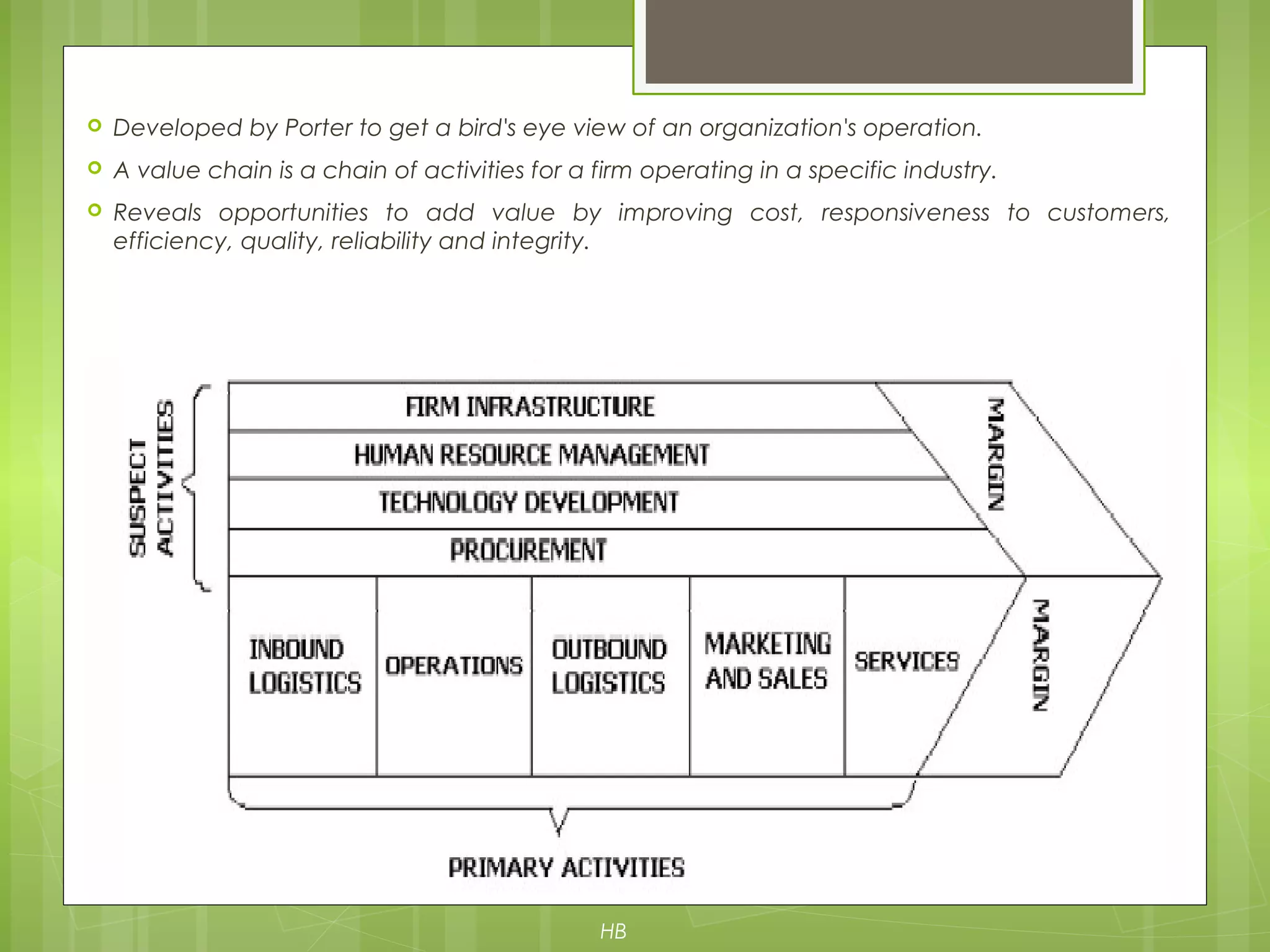
 Developed by Porter to get a bird's eye view of an organization's operation.
 A value chain is a chain of activities for a firm operating in a specific industry.
 Reveals opportunities to add value by improving cost, responsiveness to customers,
efficiency, quality, reliability and integrity.
HB
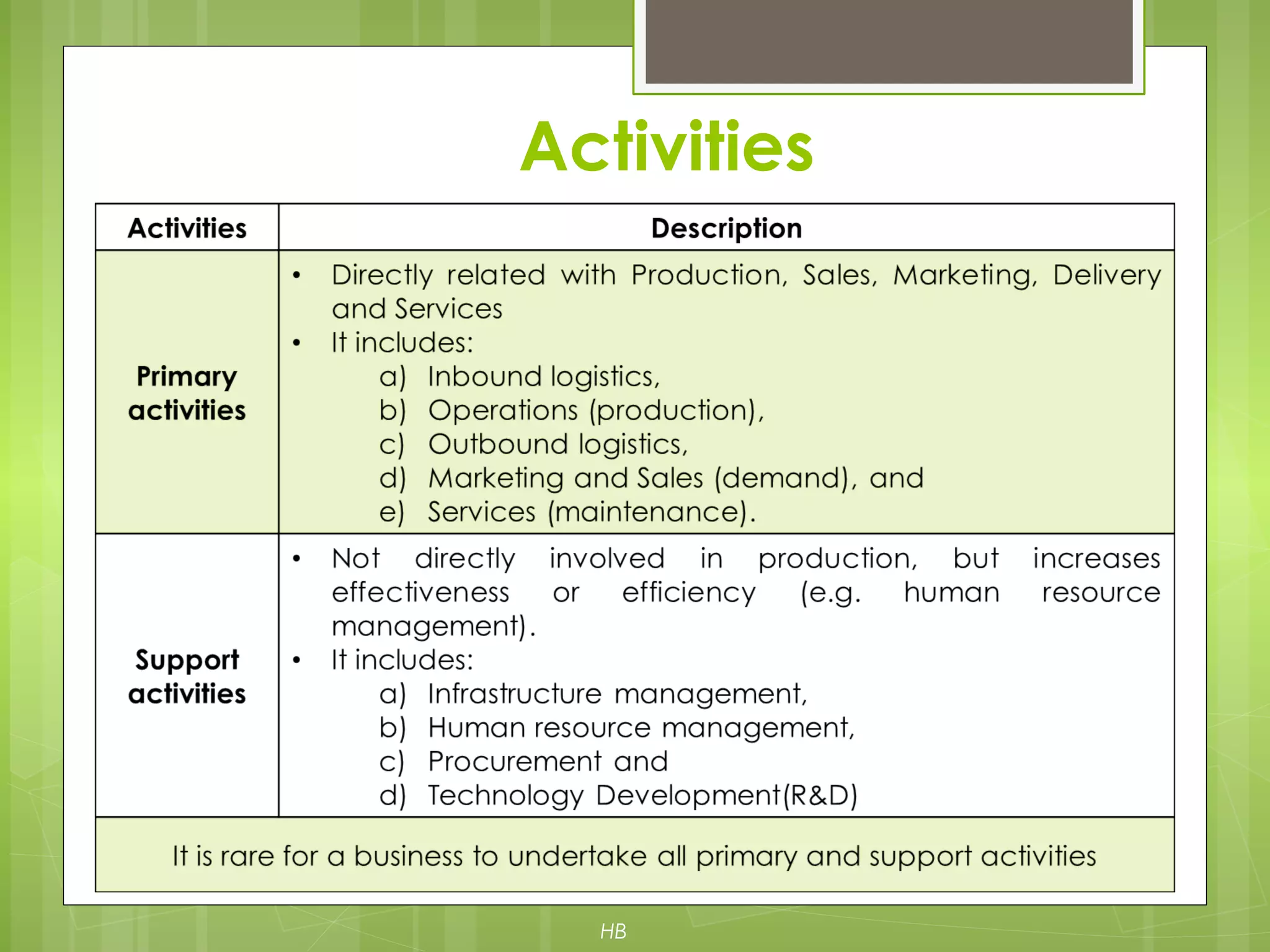
Activities
HB
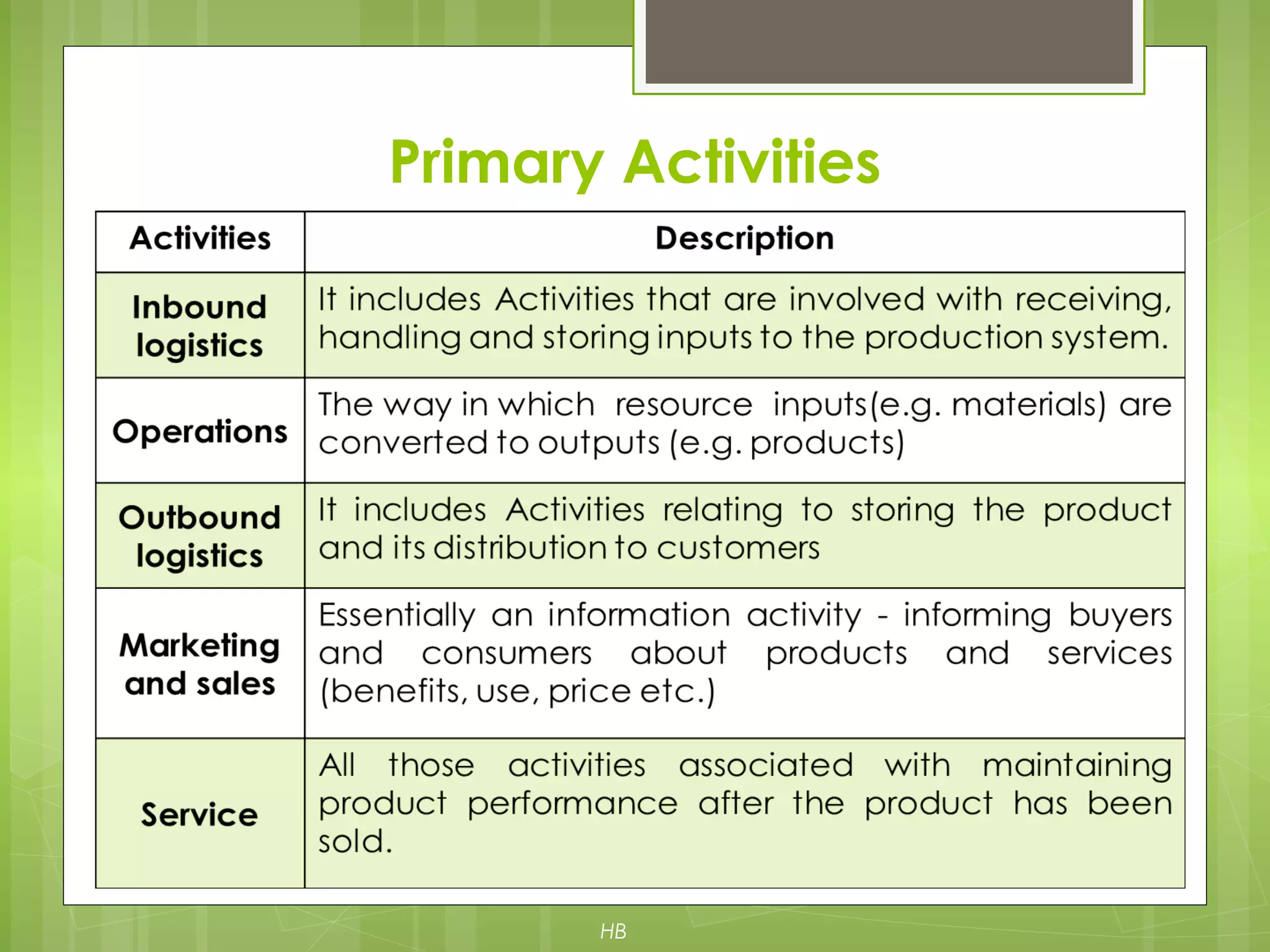
Primary Activities
HB
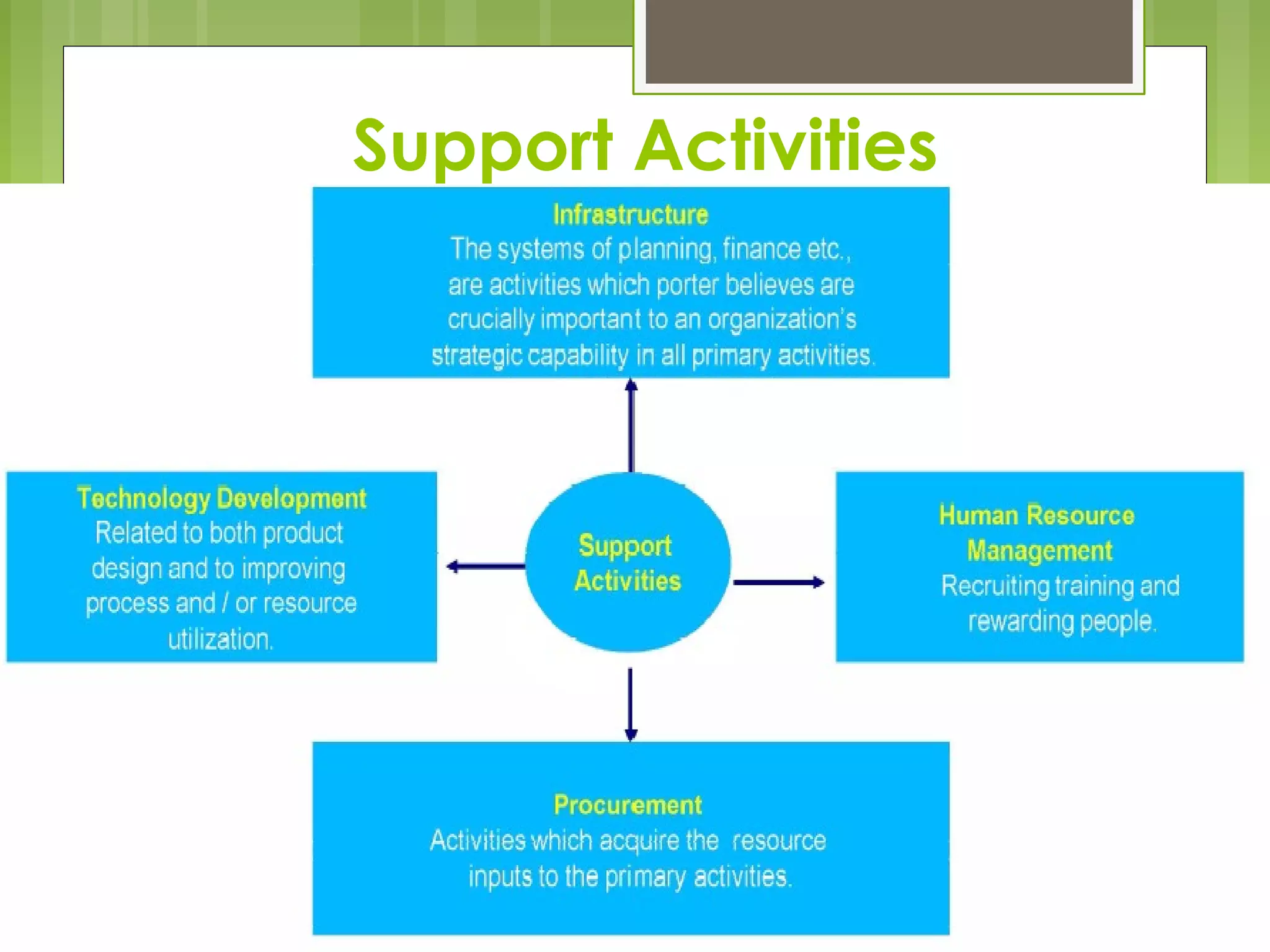
Support Activities
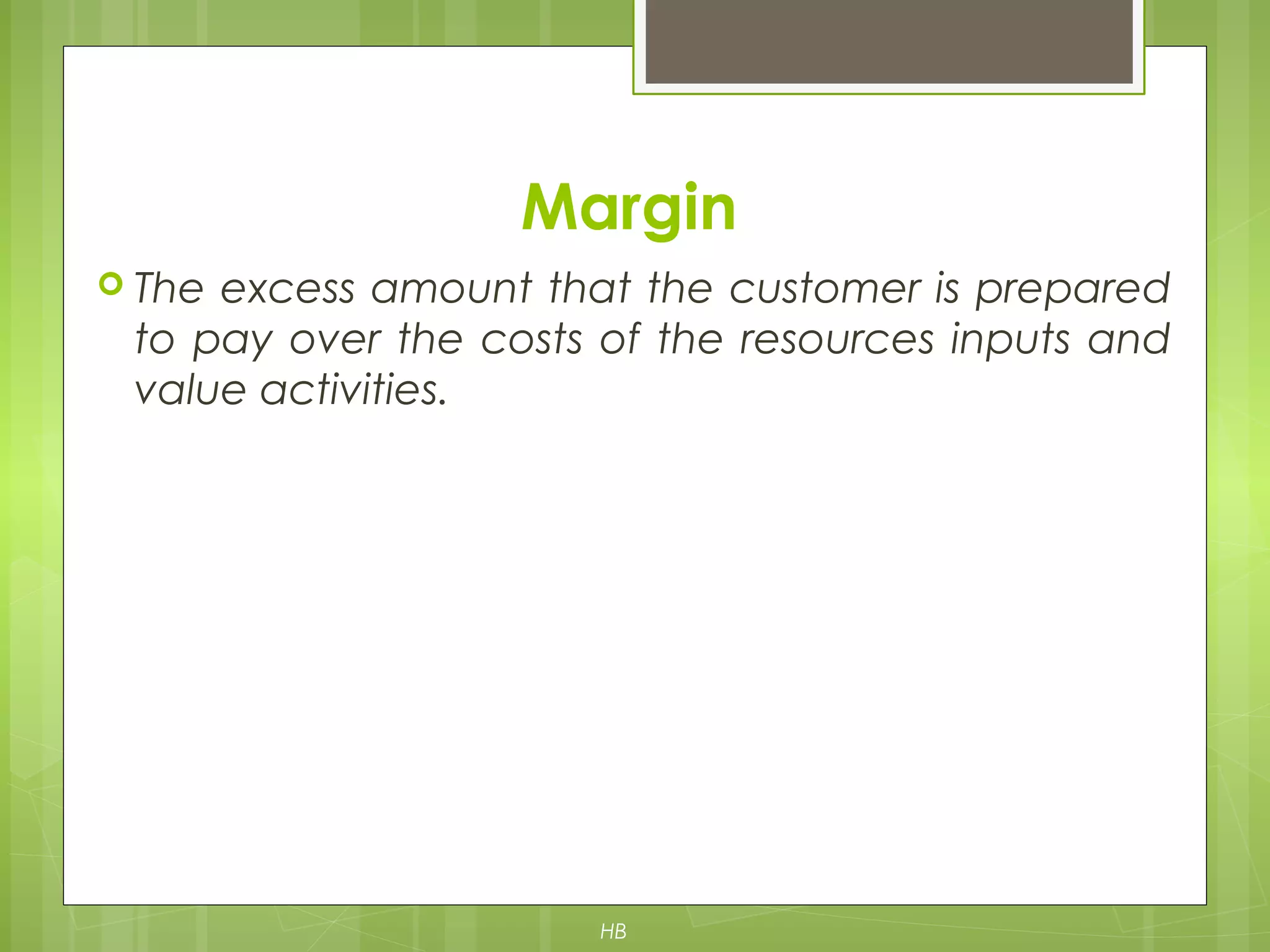
Margin
 The excess amount that the customer is prepared
to pay over the costs of the resources inputs and
value activities.
HB
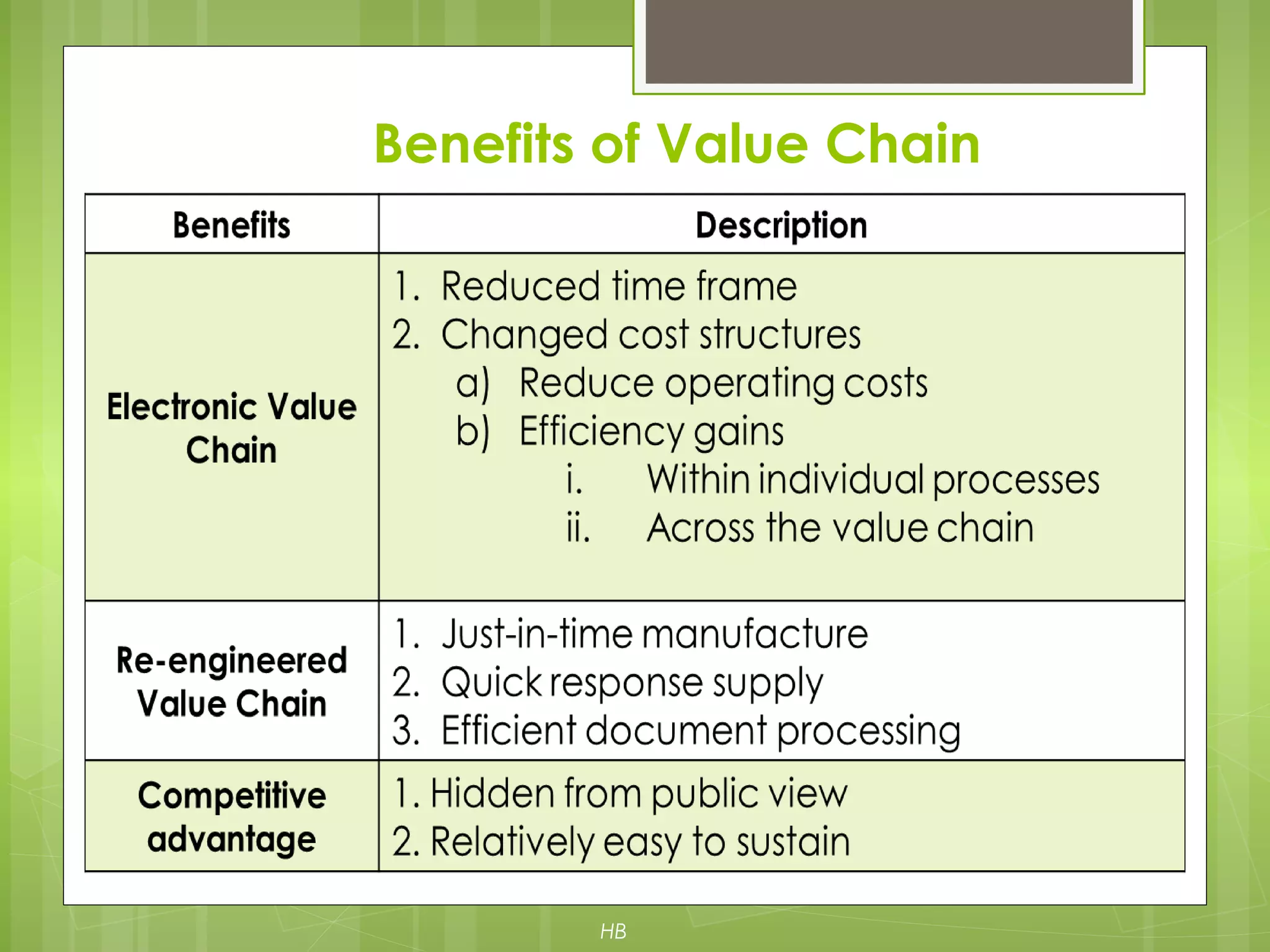
Benefits of Value Chain
HB
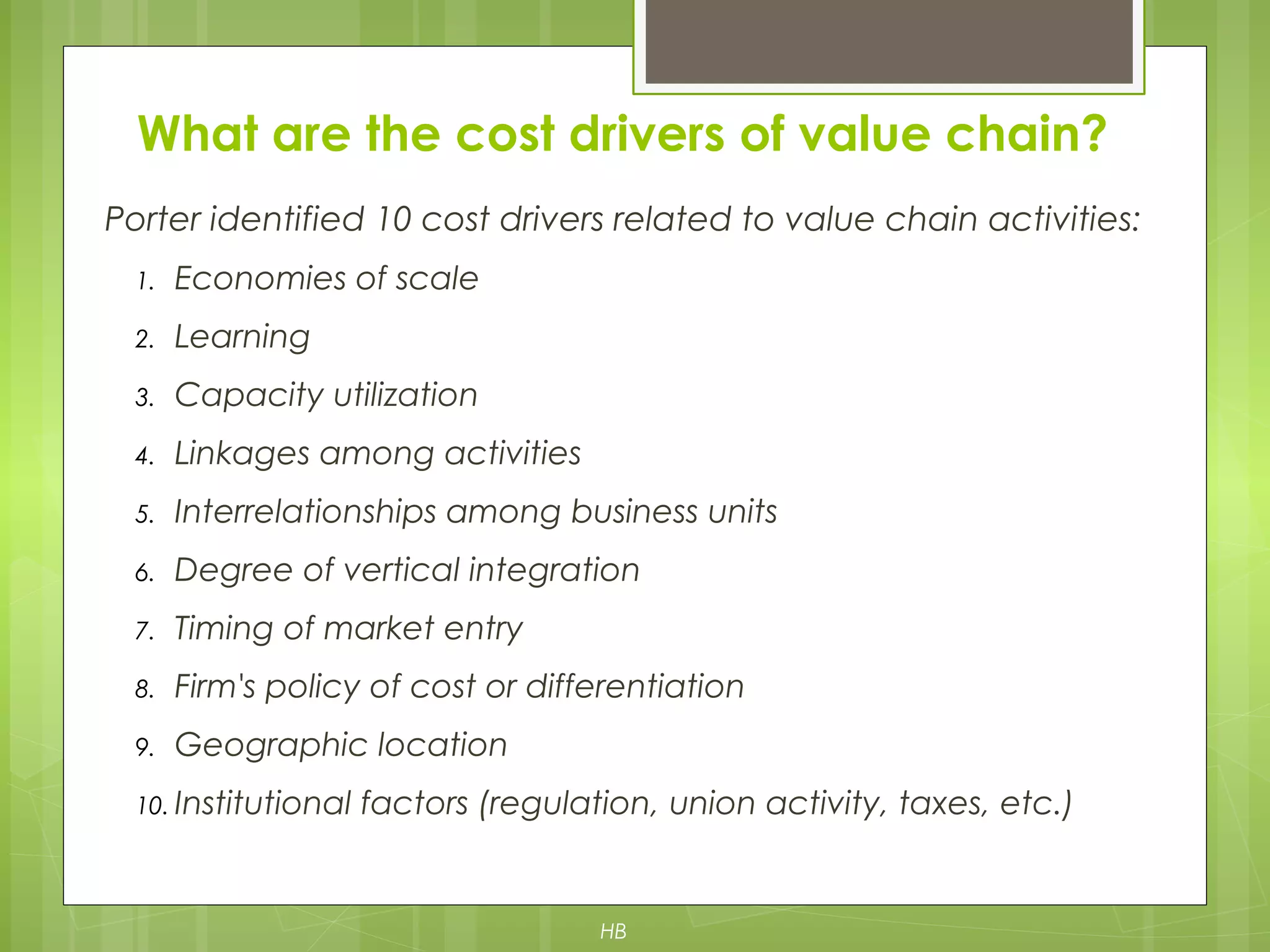
Porter identified 10 cost drivers related to value chain activities:
1. Economies of scale
2. Learning
3. Capacity utilization
4. Linkages among activities
5. Interrelationships among business units
6. Degree of vertical integration
7. Timing of market entry
8. Firm's policy of cost or differentiation
9. Geographic location
10. Institutional factors (regulation, union activity, taxes, etc.)
What are the cost drivers of value chain?
HB
Value Chain
Analysis for
competitive
Advantage
 Firms gain competitive advantage by
a) conceiving of new ways to conduct activities,
b) employing new procedures,
c) implementing new technologies or using
different inputs and
d) exploiting linkage effectively
)Competitive advantage can be secured by
managing the linkage with its suppliers and
customers considering the value chain of these
suppliers and customers
HB
How to perform the analysis?
There are two different approaches on how to perform the analysis, which depend on
what type of competitive advantage a company wants to create (cost or differentiation
advantage). The below lists all the steps needed to achieve cost or differentiation
advantage using VCA.
Cost advantage
This approach is used when organizations try to compete on costs and want to understand
the sources of their cost advantage or disadvantage and what factors drive those costs.
Step 1. Identify the firm’s primary and support activities.
Step 2. Establish the relative importance of each activity in the total cost of the product.
Step 3. Identify cost drivers for each activity.
Step 4. Identify links between activities.
Step 5. Identify opportunities for reducing costs.
Differentiation advantage
The firms that strive to create superior products or services use differentiation advantage
approach
Step 1. Identify the customers’ value-creating activities.
Step 2. Evaluate the differentiation strategies for improving customer value.
Step 3. Identify the best sustainable differentiation.
HB
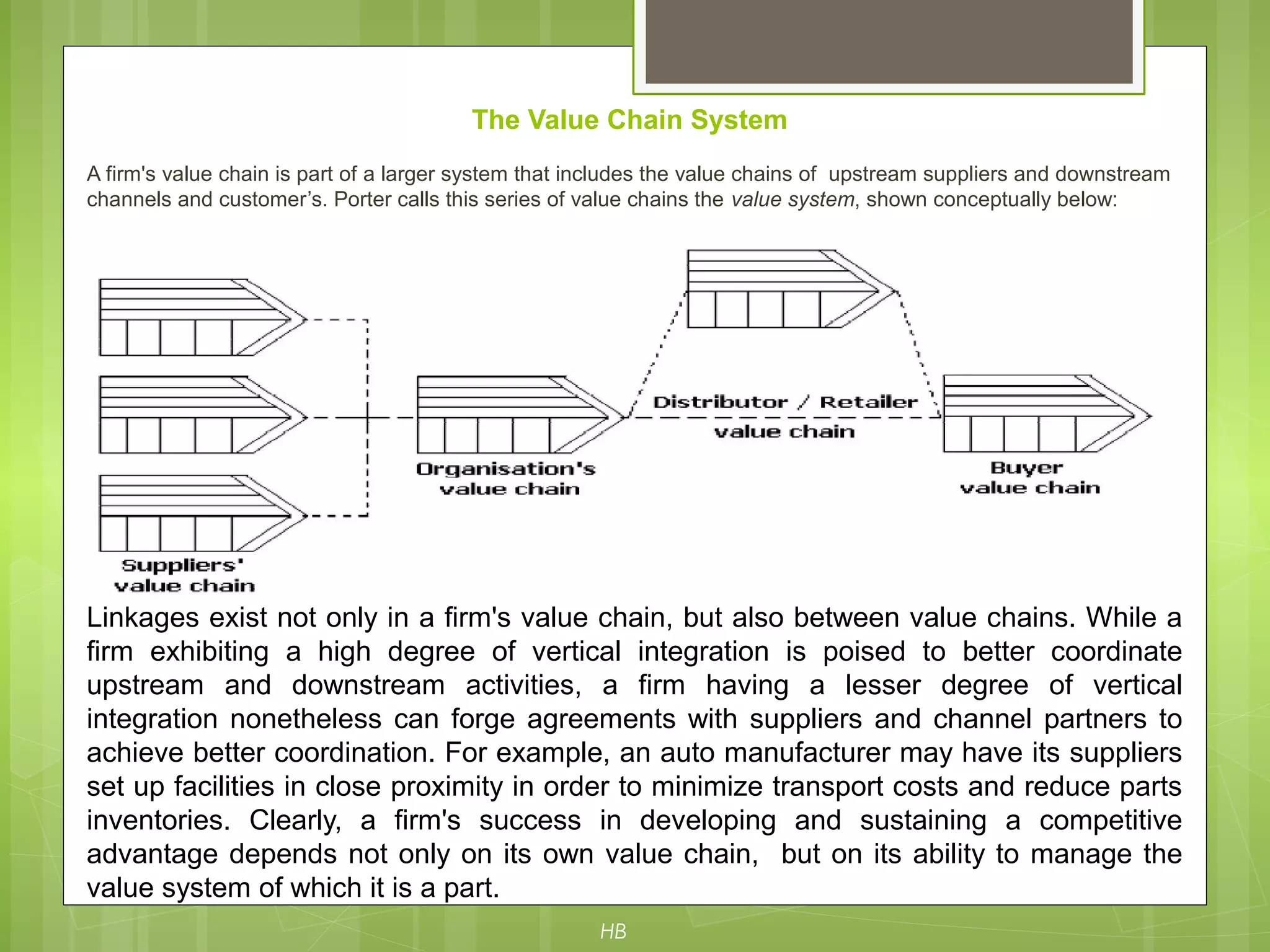
The Value Chain System
A firm's value chain is part of a larger system that includes the value chains of upstream suppliers and downstream
channels and customer’s. Porter calls this series of value chains the value system, shown conceptually below:
Linkages exist not only in a firm's value chain, but also between value chains. While a
firm exhibiting a high degree of vertical integration is poised to better coordinate
upstream and downstream activities, a firm having a lesser degree of vertical
integration nonetheless can forge agreements with suppliers and channel partners to
achieve better coordination. For example, an auto manufacturer may have its suppliers
set up facilities in close proximity in order to minimize transport costs and reduce parts
inventories. Clearly, a firm's success in developing and sustaining a competitive
advantage depends not only on its own value chain, but on its ability to manage the
value system of which it is a part.
HB
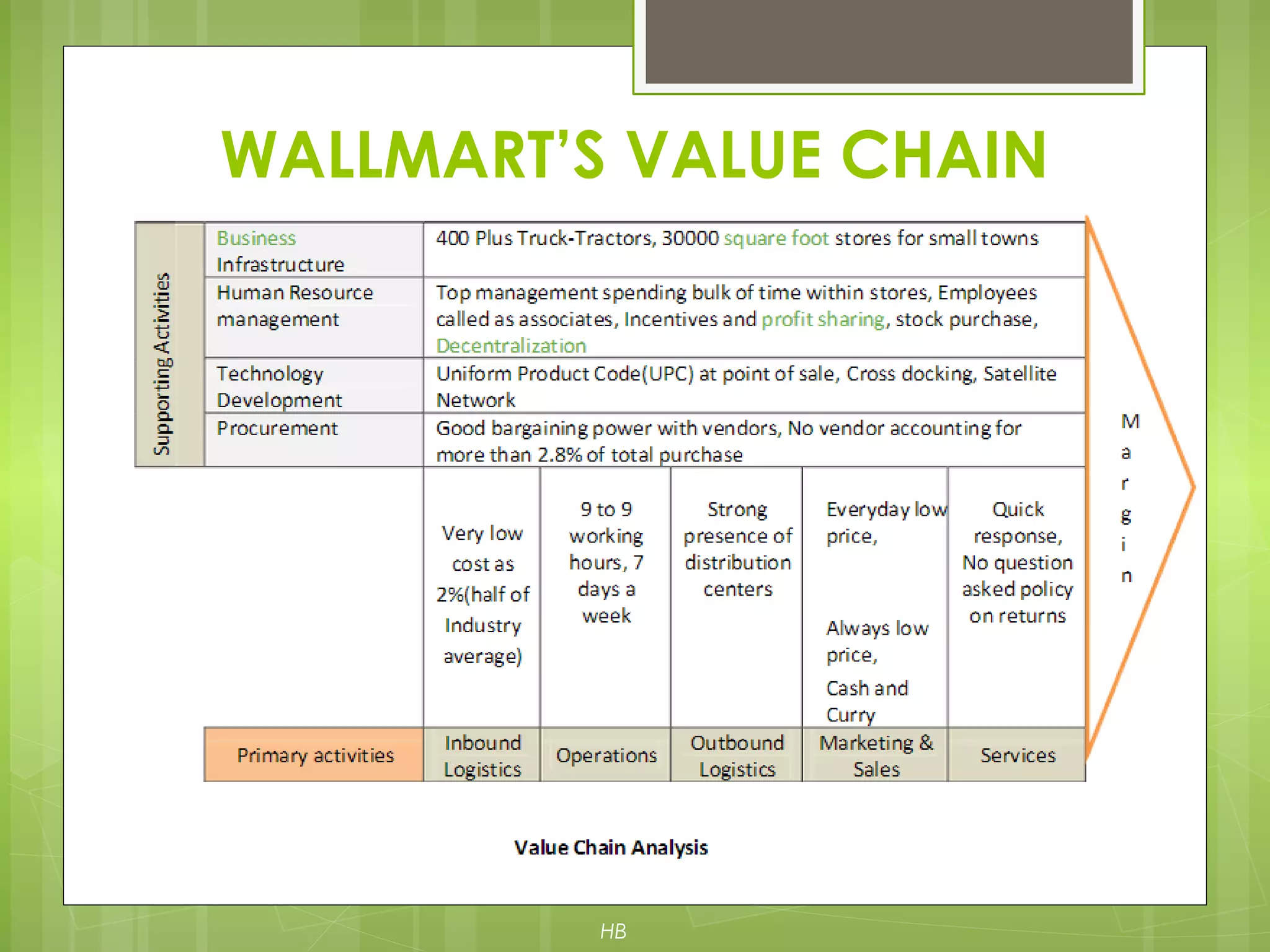
WALLMART’S VALUE CHAIN
HB
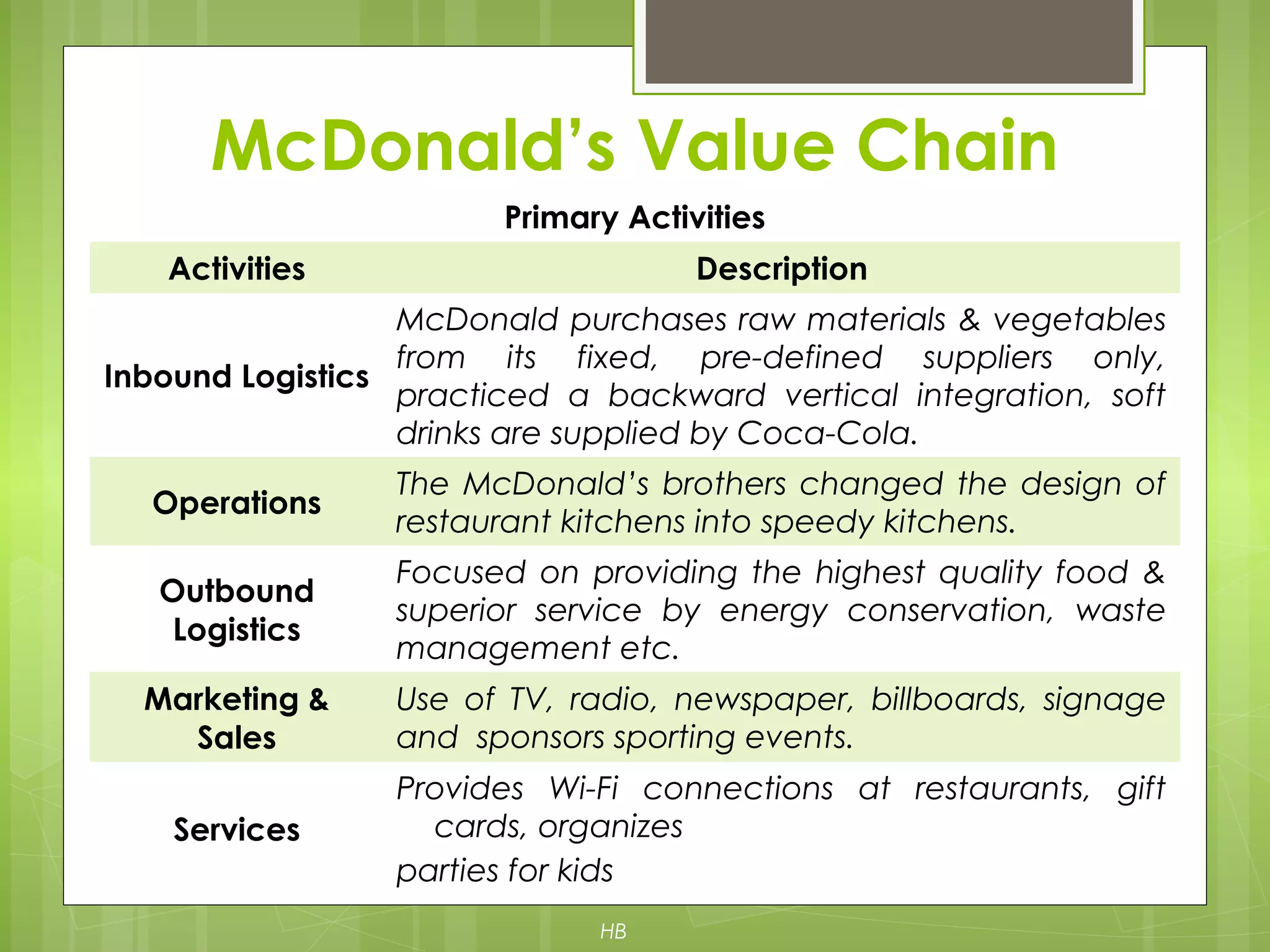
McDonald’s Value Chain
Primary Activities
Activities Description
Inbound Logistics
McDonald purchases raw materials & vegetables
from its fixed, pre-defined suppliers only,
practiced a backward vertical integration, soft
drinks are supplied by Coca-Cola.
Operations
The McDonald’s brothers changed the design of
restaurant kitchens into speedy kitchens.
Outbound
Logistics
Focused on providing the highest quality food &
superior service by energy conservation, waste
management etc.
Marketing &
Sales
Use of TV, radio, newspaper, billboards, signage
and sponsors sporting events.
Services
Provides Wi-Fi connections at restaurants, gift
cards, organizes
parties for kids
HB
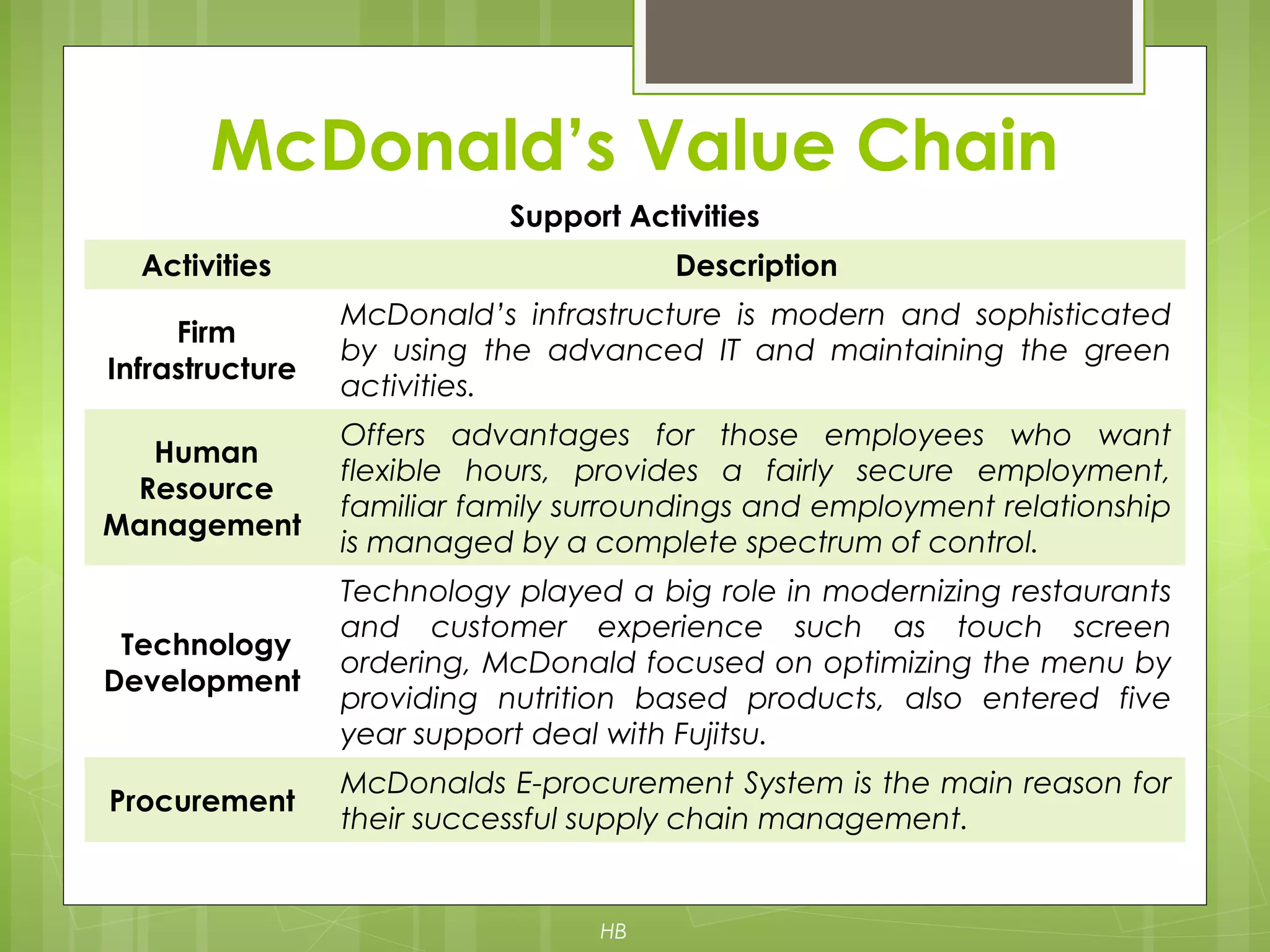
McDonald’s Value Chain
Support Activities
Activities Description
Firm
Infrastructure
McDonald’s infrastructure is modern and sophisticated
by using the advanced IT and maintaining the green
activities.
Human
Resource
Management
Offers advantages for those employees who want
flexible hours, provides a fairly secure employment,
familiar family surroundings and employment relationship
is managed by a complete spectrum of control.
Technology
Development
Technology played a big role in modernizing restaurants
and customer experience such as touch screen
ordering, McDonald focused on optimizing the menu by
providing nutrition based products, also entered five
year support deal with Fujitsu.
Procurement
McDonalds E-procurement System is the main reason for
their successful supply chain management.
HB
Value Creation
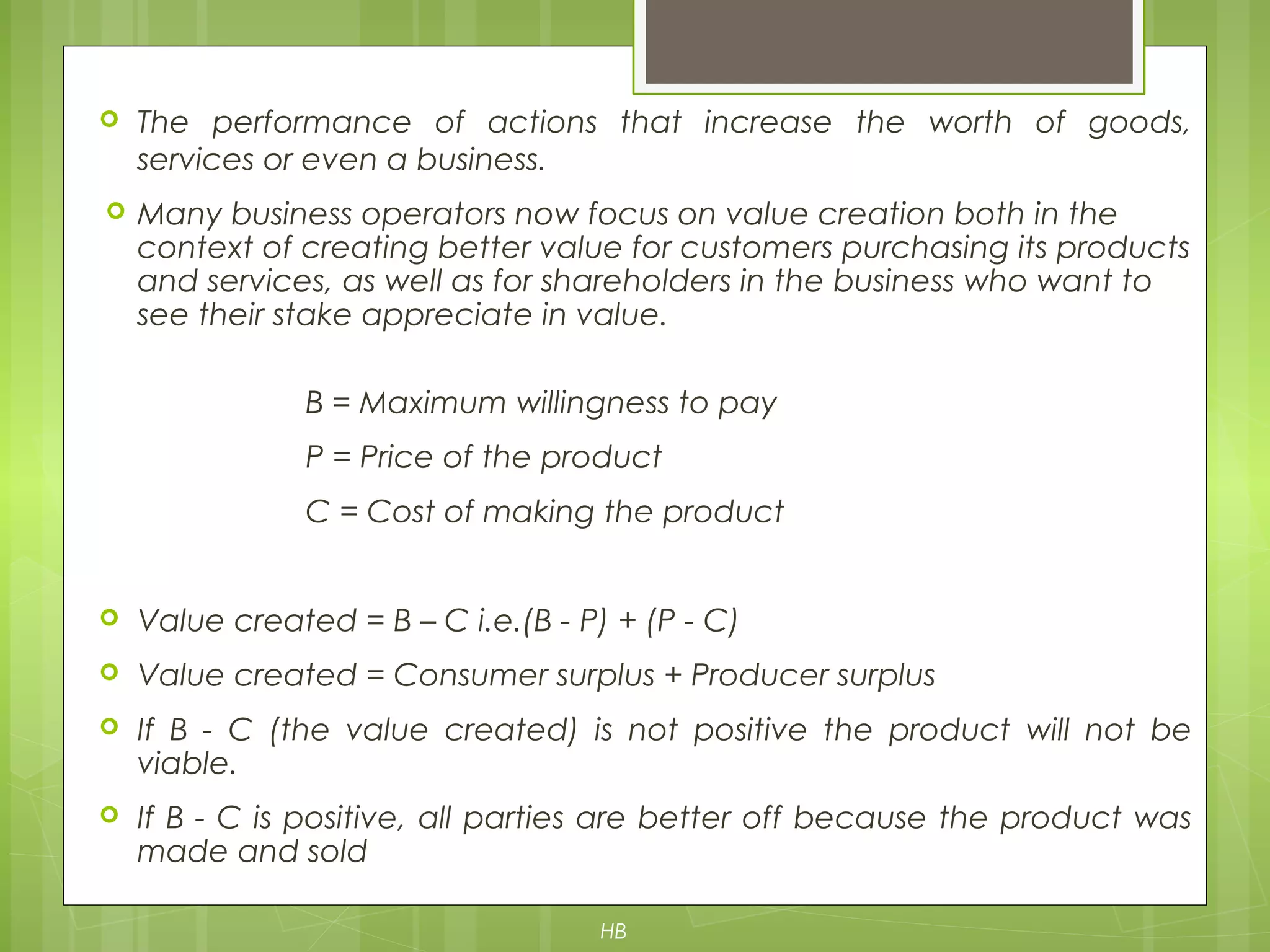
 The performance of actions that increase the worth of goods,
services or even a business.
 Many business operators now focus on value creation both in the
context of creating better value for customers purchasing its products
and services, as well as for shareholders in the business who want to
see their stake appreciate in value.
B = Maximum willingness to pay
P = Price of the product
C = Cost of making the product
 Value created = B – C i.e.(B - P) + (P - C)
 Value created = Consumer surplus + Producer surplus
 If B - C (the value created) is not positive the product will not be
viable.
 If B - C is positive, all parties are better off because the product was
made and sold
HB
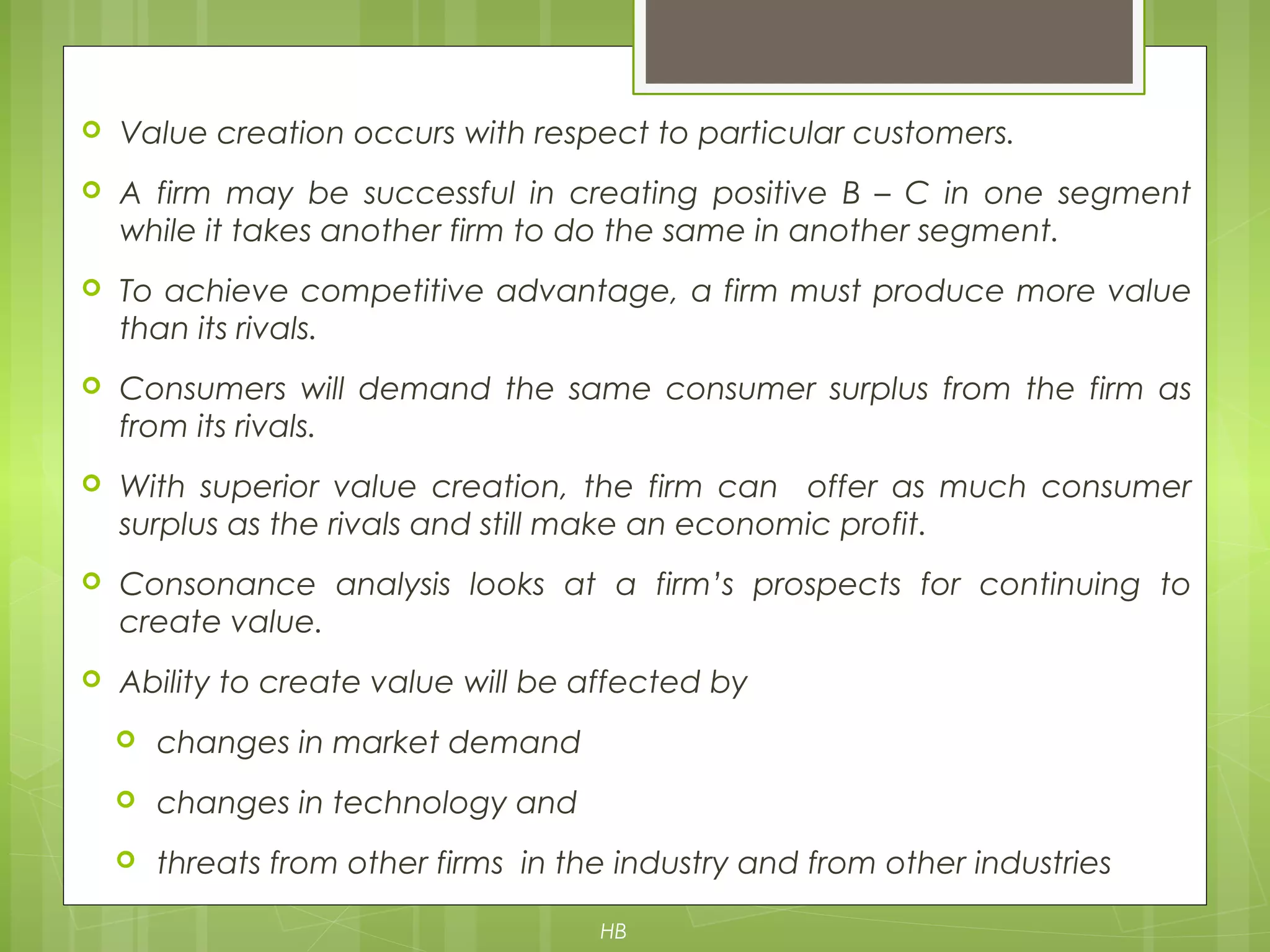
 Value creation occurs with respect to particular customers.
 A firm may be successful in creating positive B – C in one segment
while it takes another firm to do the same in another segment.
 To achieve competitive advantage, a firm must produce more value
than its rivals.
 Consumers will demand the same consumer surplus from the firm as
from its rivals.
 With superior value creation, the firm can offer as much consumer
surplus as the rivals and still make an economic profit.
 Consonance analysis looks at a firm’s prospects for continuing to
create value.
 Ability to create value will be affected by
 changes in market demand
 changes in technology and
 threats from other firms in the industry and from other industries
HB
 International Strategy
 Multinational Strategy
 Global Strategy
 Transnational Strategy
 Strategic Alliance
STRATEGIC CHOICES
HB
Thank You

Value chain Analysis including Value Creation

  • 1.
    Value Chain Analysis Presented By: HimanshuBahl HimanshuBahl3@gmail.com
  • 2.
     Developed byPorter to get a bird's eye view of an organization's operation.  A value chain is a chain of activities for a firm operating in a specific industry.  Reveals opportunities to add value by improving cost, responsiveness to customers, efficiency, quality, reliability and integrity. HB
  • 3.
  • 4.
  • 5.
  • 6.
    Margin  The excessamount that the customer is prepared to pay over the costs of the resources inputs and value activities. HB
  • 7.
  • 8.
    Porter identified 10cost drivers related to value chain activities: 1. Economies of scale 2. Learning 3. Capacity utilization 4. Linkages among activities 5. Interrelationships among business units 6. Degree of vertical integration 7. Timing of market entry 8. Firm's policy of cost or differentiation 9. Geographic location 10. Institutional factors (regulation, union activity, taxes, etc.) What are the cost drivers of value chain? HB
  • 9.
  • 10.
     Firms gaincompetitive advantage by a) conceiving of new ways to conduct activities, b) employing new procedures, c) implementing new technologies or using different inputs and d) exploiting linkage effectively )Competitive advantage can be secured by managing the linkage with its suppliers and customers considering the value chain of these suppliers and customers HB
  • 11.
    How to performthe analysis? There are two different approaches on how to perform the analysis, which depend on what type of competitive advantage a company wants to create (cost or differentiation advantage). The below lists all the steps needed to achieve cost or differentiation advantage using VCA. Cost advantage This approach is used when organizations try to compete on costs and want to understand the sources of their cost advantage or disadvantage and what factors drive those costs. Step 1. Identify the firm’s primary and support activities. Step 2. Establish the relative importance of each activity in the total cost of the product. Step 3. Identify cost drivers for each activity. Step 4. Identify links between activities. Step 5. Identify opportunities for reducing costs. Differentiation advantage The firms that strive to create superior products or services use differentiation advantage approach Step 1. Identify the customers’ value-creating activities. Step 2. Evaluate the differentiation strategies for improving customer value. Step 3. Identify the best sustainable differentiation. HB
  • 12.
    The Value ChainSystem A firm's value chain is part of a larger system that includes the value chains of upstream suppliers and downstream channels and customer’s. Porter calls this series of value chains the value system, shown conceptually below: Linkages exist not only in a firm's value chain, but also between value chains. While a firm exhibiting a high degree of vertical integration is poised to better coordinate upstream and downstream activities, a firm having a lesser degree of vertical integration nonetheless can forge agreements with suppliers and channel partners to achieve better coordination. For example, an auto manufacturer may have its suppliers set up facilities in close proximity in order to minimize transport costs and reduce parts inventories. Clearly, a firm's success in developing and sustaining a competitive advantage depends not only on its own value chain, but on its ability to manage the value system of which it is a part. HB
  • 13.
  • 14.
    McDonald’s Value Chain PrimaryActivities Activities Description Inbound Logistics McDonald purchases raw materials & vegetables from its fixed, pre-defined suppliers only, practiced a backward vertical integration, soft drinks are supplied by Coca-Cola. Operations The McDonald’s brothers changed the design of restaurant kitchens into speedy kitchens. Outbound Logistics Focused on providing the highest quality food & superior service by energy conservation, waste management etc. Marketing & Sales Use of TV, radio, newspaper, billboards, signage and sponsors sporting events. Services Provides Wi-Fi connections at restaurants, gift cards, organizes parties for kids HB
  • 15.
    McDonald’s Value Chain SupportActivities Activities Description Firm Infrastructure McDonald’s infrastructure is modern and sophisticated by using the advanced IT and maintaining the green activities. Human Resource Management Offers advantages for those employees who want flexible hours, provides a fairly secure employment, familiar family surroundings and employment relationship is managed by a complete spectrum of control. Technology Development Technology played a big role in modernizing restaurants and customer experience such as touch screen ordering, McDonald focused on optimizing the menu by providing nutrition based products, also entered five year support deal with Fujitsu. Procurement McDonalds E-procurement System is the main reason for their successful supply chain management. HB
  • 16.
  • 17.
     The performanceof actions that increase the worth of goods, services or even a business.  Many business operators now focus on value creation both in the context of creating better value for customers purchasing its products and services, as well as for shareholders in the business who want to see their stake appreciate in value. B = Maximum willingness to pay P = Price of the product C = Cost of making the product  Value created = B – C i.e.(B - P) + (P - C)  Value created = Consumer surplus + Producer surplus  If B - C (the value created) is not positive the product will not be viable.  If B - C is positive, all parties are better off because the product was made and sold HB
  • 18.
     Value creationoccurs with respect to particular customers.  A firm may be successful in creating positive B – C in one segment while it takes another firm to do the same in another segment.  To achieve competitive advantage, a firm must produce more value than its rivals.  Consumers will demand the same consumer surplus from the firm as from its rivals.  With superior value creation, the firm can offer as much consumer surplus as the rivals and still make an economic profit.  Consonance analysis looks at a firm’s prospects for continuing to create value.  Ability to create value will be affected by  changes in market demand  changes in technology and  threats from other firms in the industry and from other industries HB
  • 19.
     International Strategy Multinational Strategy  Global Strategy  Transnational Strategy  Strategic Alliance STRATEGIC CHOICES HB
  • 20.

Editor's Notes

  • #2 <number>
  • #3 <number>
  • #4 <number>