1_URL:
https://scholar.google.com/citations?user=EFBaeOsAAAAJ&hl=en&oi=ao
2_gen.lib.rus.ec:
http://libgen.rs/search.php?req=principles+of+managerial+finance&open=0&res=25&view
=simple&phrase=1&column=title
3_Slideshare:
https://www2.slideshare.net/search/slideshow?searchfrom=header&q=aminullah+assagaf
+&ud=any&ft=all&lang=**&sort=
4_Youtube_
https://www.youtube.com/channel/UC26u-Ys3fjKlcJAACrsnAeQ/videos
OPERATIONAL MANAGEMENT
6 Januari 20232
Dosen: Prof. Dr. Dr. H. Aminullah Assagaf, SE., MS., MM.,M.Ak
HP: 08113543409, Email: assagaf29@yahoo.com
Introduction to Operations and
Supply Chain Management
Chapter 1
Lecture outline







What operations and supply chain managers
Operations function
Evolution of operations management
Globalization and competitiveness
Operations
Strategy and organization of the text
do
Learning objectives for this course
1-2
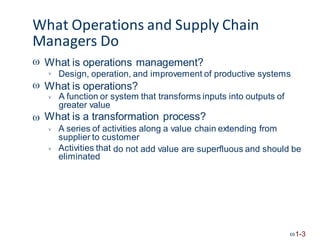
What Operations and Supply Chain
Managers Do
 What is operations management?
Design, operation, and improvement of productive systems

 What is operations?
A function or system that transforms inputs into outputs of
greater value
What is a transformation process?


A series of activities along a value chain extending from
supplier to customer

Activities that
eliminated
do not add value are superfluous and should be

1-3
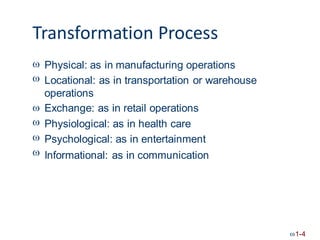
Transformation Process


Physical: as in manufacturing operations
Locational: as in transportation or warehouse
operations
Exchange: as in retail operations
Physiological: as in health care
Psychological: as in entertainment



 Informational: as in communication
1-4
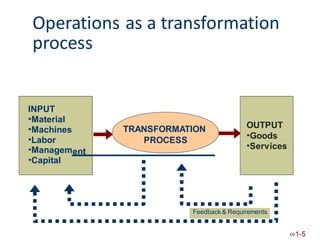
Operations
process
as a transformation
•Goods
1-5
Feedback & Requirements
OUTPUT
•Services
INPUT
•Material
•Machines
•Labor
•Managem
•Capital
ent
TRANSFORMATION
PROCESS
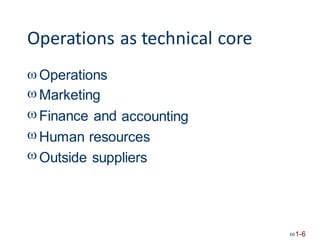
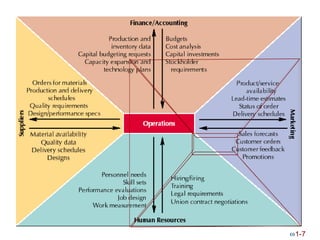
Operations as technical core





Operations
Marketing
Finance and accounting
Human resources
Outside suppliers
1-6
1-7
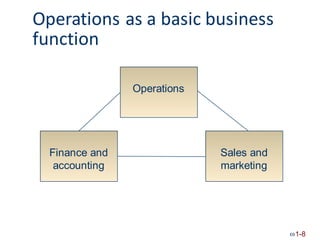
Operations
function
as a basic business
Operations
Finance and Sales and
accounting marketing
1-8
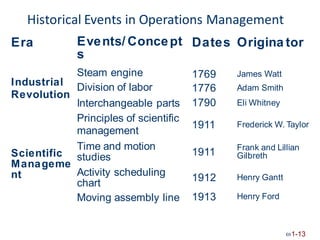
Historical Events in Operations Management
Era Events/ Concept
s
Steam engine
Division of labor
Dates Origina tor
1769
1776
1790
James Watt
Adam Smith
Eli Whitney
Industrial
Revolution
Interchangeable parts
Principles of scientific
management
Time and motion
studies
Activity scheduling
chart
Moving assembly line
1911 Frederick W. Taylor
Frank and Lillian
Gilbreth
1911
Scientific
Manageme
nt 1912
1913
Henry Gantt
Henry Ford
1-13
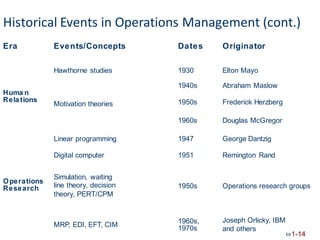
Historical Events in Operations Management (cont.)
Era Events/Concepts Dates Originator
Hawthorne studies 1930 Elton Mayo
1940s Abraham Maslow
Huma n
Relations 1950s Frederick Herzberg
Motivation theories
1960s Douglas McGregor
Linear programming 1947 George Dantzig
Digital computer 1951 Remington Rand
Simulation, waiting
line theory, decision
theory, PERT/CPM
Operations
Research 1950s Operations research groups
Joseph Orlicky, IBM
and others
1960s,
1970s
MRP, EDI, EFT, CIM
1-14
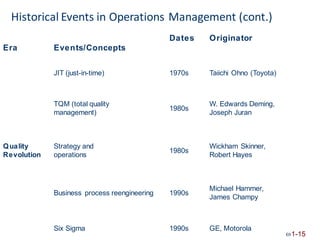
Historical Events in Operations Management (cont.)
Dates Originator
Era Events/Concepts
JIT (just-in-time) 1970s Taiichi Ohno (Toyota)
TQM (total quality
management)
W. Edwards Deming,
Joseph Juran
1980s
Quality
Revolution
Strategy and
operations
Wickham Skinner,
Robert Hayes
1980s
Michael Hammer,
James Champy
Business process reengineering 1990s
Six Sigma 1990s GE, Motorola
1-15
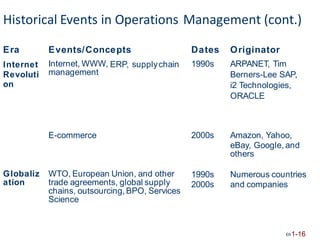
Historical Events in Operations Management (cont.)
Era
Internet
Revoluti
on
Events/Concepts Dates
1990s
Originator
ARPANET, Tim
Berners-Lee SAP,
i2 Technologies,
ORACLE
Internet, WWW,
management
ERP, supplychain
E-commerce 2000s Amazon, Yahoo,
eBay, Google, and
others
Globaliz
ation
WTO, European Union, and other
trade agreements, global supply
chains, outsourcing,BPO, Services
Science
1990s
2000s
Numerous countries
and companies
1-16
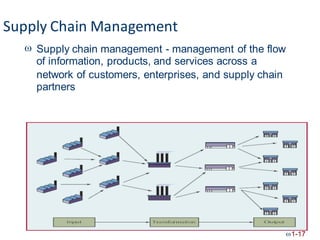
Supply Chain Management
 Supply chain management - management of the flow
of information, products, and services across a
network of
partners
customers, enterprises, and supply chain
1-17
Globalization and Competitiveness
 Why “go global”?
favorable cost
access to international markets
response to changes in demand
reliable sources of supply
latest trends and technologies





 Increased globalization
results from the Internet and falling trade barriers

1-18
Productivity and Competitiveness
Competitiveness

degree to which a nation can produce goods and
services that meet the test of international markets
Productivity


ratio of output to input

 Output
sales made, products produced, customers served,
meals delivered, or calls answered
Input


labor hours, investment in equipment, material usage,
or square footage

1-19
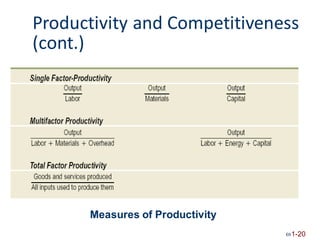
Productivity
(cont.)
and Competitiveness
Measures of Productivity
1-20
Productivity and Competitiveness
(cont.)
Retrenching

productivity is increasing, but both output and input
decrease with input decreasing at a faster rate
Assumption that more input would cause output
increase at the same rate

 to
certain limits to the amount of output may not be
considered

output produced is emphasized,
increased inventories
not output sold;

1-21
Strategy and Operations
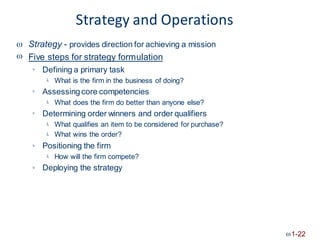
Strategy - provides direction for achieving a mission
Five steps for strategy formulation


Defining a primary task

What is the firm in the business of doing?

Assessingcore competencies

What does the firm do better than anyone else?

Determining order winners and order qualifiers

What qualifies an item to be considered for purchase?
What wins the order?


Positioning the firm

How will the firm compete?

Deploying the strategy

1-22
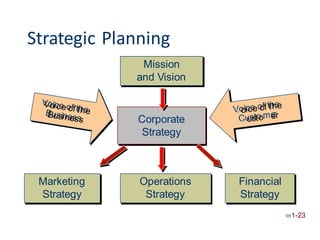
Mission
and Vision
Corporate
Strategy
Operations
Strategy
Marketing
Strategy
Financial
Strategy
Strategic Planning
1-23
Financial
Strategy
Operations
Strategy
Marketing
Strategy
Corporate
Strategy
Mission
and Vision
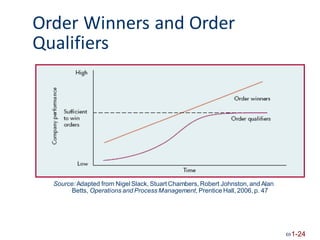
Order Winners
Qualifiers
and Order
Source: Adapted from Nigel Slack, Stuart Chambers, Robert Johnston, and Alan
Betts, Operations and Process Management, Prentice Hall, 2006, p. 47
1-24
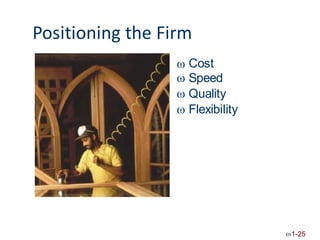
Positioning the Firm
Cost
Speed
Quality
Flexibility




1-25
Positioning the Firm: Cost
 Waste elimination
relentlessly pursuing the removal of all waste

 Examination of cost structure
looking at the entire cost structure for reduction
potential
Lean production


providing low costs
operations
through disciplined

1-26
Positioning the Firm: Speed



Fast moves, fast adaptations, tight linkages
Internet - conditioned customers to expect immediate responses
Service organizations - always competed on speed
(McDonald’s, LensCrafters, and Federal Express)
Manufacturers - time-based competition: build-to-order
production and efficient supply chains

 Fashion industry - two-week design-to-rack lead time of
Filipino retailer ex. Bench
1-27
Positioning the Firm: Quality
 Minimizing defect rates or conforming to design
specifications; please the customer
Ritz-Carlton - one customer at a time

Service system is designed to “move heaven and earth”
customer
Every employee is empowered to satisfy a guest’s wish
to satisfy


Teams at all levels set objectives and devise quality action plans

Each hotel has a quality leader

1-28
Positioning the Firm:
Flexibility
 Ability to adjust to changes in product mix,
production volume, or design
National Bicycle Industrial Company

offers 11,231,862 variations
delivers within two weeks at costs only 10% above
standard models


mass
parts
customization: the mass production of customized

1-29
Balanced Scorecard
Balanced scorecard

measuring more than financial performance

finances
customers
processes
learning and growing




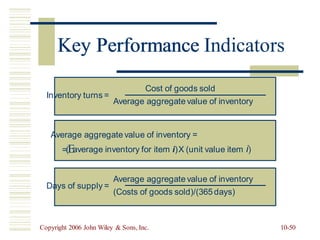
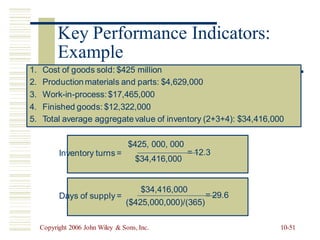
 Key performance indicators
a set of measures that help managers
performance in critical areas
evaluate

1-32
O
Op
pe
e a
a o
on
ns
s M
Ma
an
na
ag
ge
em
me
en
n
Decision Analysis
Roberta Russell & Bernard W. Taylor, III
Operations Management
Chapter 1 Supplement
• Decision Analysis
• Decision Making without Probabilities
• Decision Analysis with Excel
• Decision Analysis with OM Tools
• Decision Making with Probabilities
• Expected Value of Perfect Information
• Sequential Decision Tree
Supplement 1-44
Lecture Outline
• Quantitative methods
• a set of tools for operations manager
• Decision analysis
• a set of quantitative decision-making
techniques for decision situations in which
uncertainty exists
• Example of an uncertain situation
• demand for a product may vary between 0 and 200
units, depending on the state of market
Supplement 1-45
Decision Analysis
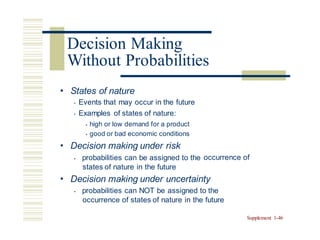
• States of nature
• Events that may occur in the future
• Examples of states of nature:
• high or low demand for a product
• good or bad economic conditions
Decision making under risk
• probabilities can be assigned to the
states of nature in the future
•
occurrence of
• Decision making under uncertainty
• probabilities can NOT be assigned to the
occurrence of states of nature in the future
Supplement 1-46
Decision Making
Without Probabilities
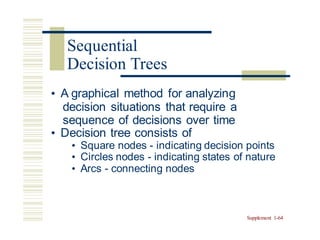
• A graphical method for analyzing
decision situations that require a
sequence of decisions over time
• Decision tree consists of
• Square nodes - indicating decision points
• Circles nodes - indicating states of nature
• Arcs - connecting nodes
Supplement 1-64
Sequential
Decision Trees
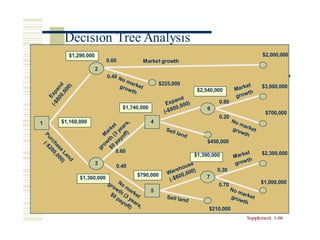
0.60 Market growth
$700,000
0.30
$1,000,000
0.70
Supplement 1-66
$2,540,000
Decision Tree Analysis
$1,290,000 $2,000,000
2
0.40
$225,000
$3,000,000
0.80
$1,740,000 6
0.20
1 $1,160,000 4
$450,000
0.60
$1,390,000 $2,300,000
3
0.40
$1,360,000
$790,000 7
5
$210,000
Operations Strategy
Chapter 2
Four Steps for Strategy
Formulation
Defining a primary task



What is the firm in the business of doing?
◼
Assessing core competencies
What does the firm do better than anyone else?
◼
Determining order winners and order qualifiers
What wins the
What qualifies
order?
an item to be
firm
◼
◼ considered for purchase?
Positioning the

How will the firm compete?
◼
Copyright 2006 John Wiley & Sons, Inc. 2-3
Four Steps for Strate
Competitive Priorities
Cost
Quality
Flexibility
Speed




Copyright 2006 John Wiley & Sons, Inc. 2-4
Competitive Prioriti
Competitive Priorities:
Cost
Lincoln Electric

reduced costs by $10 million a year for 10 years
skilled machine operators save the company millions
would have been spent on automated equipment
◼
that
◼
Southwest Airlines

one type of airplane facilitates crew changes, record-
keeping, maintenance, and inventory costs
direct flights mean no baggage transfers
$30 million annual savings in travel agent commissions
requiring customers to contact the airline directly
◼
◼
by
◼
Copyright 2006 John Wiley & Sons, Inc. 2-5
Competitive Prioriti
Competitive Priorities:
Quality
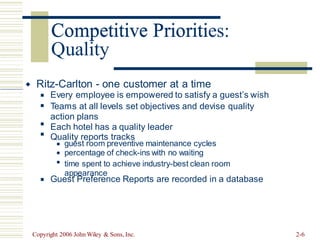
Ritz-Carlton - one customer at a time

Every employee is empowered to satisfy a guest’s wish
Teams at all levels set objectives and devise quality
action plans
Each hotel has a quality leader
Quality reports tracks
◼
◼
◼
◼
guest room preventive maintenance cycles
percentage of check-ins with no waiting
time spent to achieve industry-best clean room
appearance
⚫
⚫
⚫
Guest Preference Reports are recorded in a database
◼
Copyright 2006 John Wiley & Sons, Inc. 2-6
Competitive Prioriti
Competitive Priorities:
Flexibility
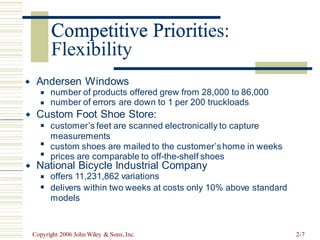
Andersen Windows

number of products offered grew from 28,000 to 86,000
number of errors are down to 1 per 200 truckloads
◼
◼
Custom Foot Shoe Store:

customer’s feet are scanned electronically to capture
measurements
custom shoes are mailed to the customer’shome in weeks
prices are comparable to off-the-shelf shoes
◼
◼
◼
National Bicycle Industrial Company

offers 11,231,862 variations
delivers within two weeks at costs only 10% above standard
models
◼
◼
Copyright 2006 John Wiley & Sons, Inc. 2-7
Competitive Prioriti
Competitive Priorities:
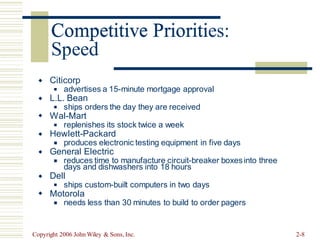
Speed
Citicorp

advertises a 15-minute mortgage approval
◼
L.L. Bean


ships orders the day they are received
◼
Wal-Mart
replenishes its stock twice a week
◼
Hewlett-Packard

produces electronic testing equipment in five days
◼
General Electric

reduces time to manufacture circuit-breaker boxesinto three
◼
days and dishwashers into 18 hours
Dell


ships custom-built computers in two days
◼
Motorola
needs less than 30 minutes to build to order pagers
◼
Copyright 2006 John Wiley & Sons, Inc. 2-8
Competitive Prioriti
Corporate Strategy
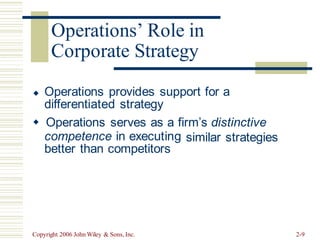
Operations provides support for a
differentiated strategy

 Operations serves as a firm’s distinctive
competence in executing
better than competitors
similar strategies
Copyright 2006 John Wiley & Sons, Inc. 2-9
Operations’ Role in
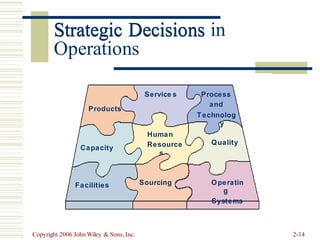
Strategic Decisions in
Operations
Service s Process
and
Technolog
y
Products
Human
Resource
s
Quality
Capacity
Sourcing Operatin
g
Systems
Facilities
Copyright 2006 John Wiley & Sons, Inc. 2-14
Strategic Decisions
Products and Services
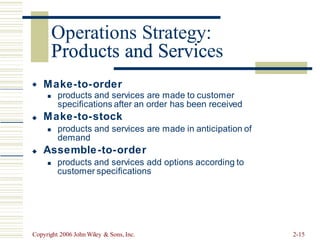
Make-to-order

products and services are made to customer
specifications after an order has been received
Make-to-stock
◼

products and services are made in anticipation of
demand
Assemble-to-order
◼

products and services add options according to
customer specifications
◼
Copyright 2006 John Wiley & Sons, Inc. 2-15
Operations Strategy:
Products and Servic
Processes and technology
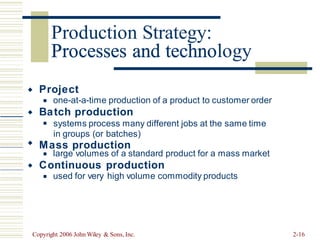
Project

one-at-a-time production of a product to customer order
◼
Batch production

systems process many different jobs at the same time
in groups (or batches)
Mass production
◼

large volumes of a standard product for a mass market
◼
Continuous production

used for very high volume commodity products
◼
Copyright 2006 John Wiley & Sons, Inc. 2-16
Production Strategy:
Processes and techno
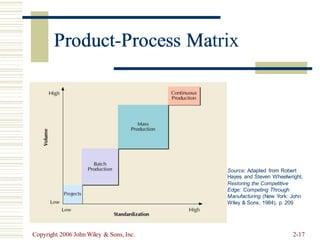
Product-Process Matrix
Source: Adapted from Robert
Hayes and Steven Wheelwright,
Restoring the Competitive
Edge: Competing Through
Manufacturing (New York: John
Wiley & Sons, 1984), p. 209
Copyright 2006 John Wiley & Sons, Inc. 2-17
Product-Process Ma
Copyright 2006 John Wiley & Sons, Inc. 2-18
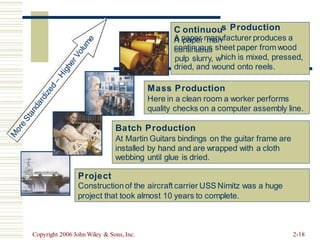
project that took almost 10 years to complete.
s Production
A paper manufacturer produces a
continuous sheet paper from wood
hich is mixed, pressed,
dried, and wound onto reels.
Mass Production
Here in a clean room a worker performs
quality checks on a computer assembly line.
Batch Production
At Martin Guitars bindings on the guitar frame are
installed by hand and are wrapped with a cloth
webbing until glue is dried.
Project
Constructionof the aircraft carrier USS Nimitz was a huge
C ontinuou
A paper man
continuous
pulp slurry, w
Processes and Technology
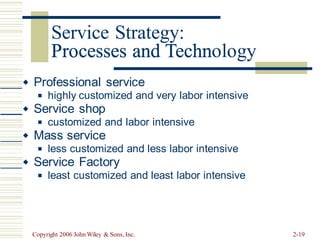
Professional service

highly customized and very labor intensive
◼
Service shop

customized and labor intensive
◼
Mass service

less customized and less labor intensive
◼
Service Factory

least customized and least labor intensive
◼
Copyright 2006 John Wiley & Sons, Inc. 2-19
Service Strategy:
Processes and Techn
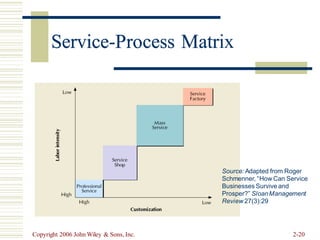
Service-Process Matrix
Source: Adapted from Roger
Schmenner, “How Can Service
Businesses Survive and
Prosper?” SloanManagement
Review 27(3):29
Copyright 2006 John Wiley & Sons, Inc. 2-20
Service-Process Matr
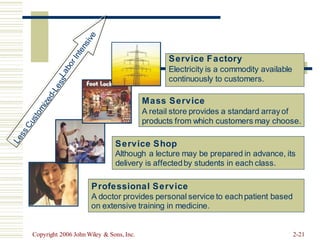
Copyright 2006 John Wiley & Sons, Inc. 2-21
on extensive training in medicine.
delivery is affectedby students in each class.
Service Factory
Electricity is a commodity available
continuously to customers.
Mass Service
A retail store provides a standard array of
products from which customers may choose.
Service Shop
Although a lecture may be prepared in advance, its
Professional Service
A doctor provides personal service to eachpatient based
Capacity and Facility
 Capacity strategic decisions include:
When, how much, and in what form to alter
◼
capacity
Facility strategic decisions include:

whether demand should be met with a few large
◼
facilities or with several smaller ones
whether facilities should focus on serving certain
geographic regions, product lines, or customers
facility location can also be a strategic decision
◼
◼
Copyright 2006 John Wiley & Sons, Inc. 2-22
Operations Strategy:
Human Resources
What is skill levels and degree of autonomy
required to operate production system?
What are training requirements and selection
criteria?
What are policies on performance evaluations,
compensation, and incentives?





Will workers be salaried, paid
paid a piece rate?
Will profit sharing be allowed,
criteria?
an hourly
and if so,
rate, or
on what
Copyright 2006 John Wiley & Sons, Inc. 2-23
Operations Strategy:
Human Resources (cont.)
Will workers perform individual tasks or work
in teams?
Will they have supervisors or work in self-
managed work groups?
How many levels of management will be
required?
Will extensive worker training be necessary?
Should workforce be cross-trained?
What efforts will be made in terms of
retention?






Copyright 2006 John Wiley & Sons, Inc. 2-24
Operations Strategy:
Human Resources (c
Quality
What is target level of quality for our
products and services?
How will it be measured?
How will employees be involved with
quality?



 What will be the responsibilities
quality department?
of the
Copyright 2006 John Wiley & Sons, Inc. 2-25
Operations Strategy:
Quality (cont.)
What types of systems will be set up to
ensure quality?

How
How
How
will
will
will
quality awareness be maintained?
quality efforts be evaluated?


 customer perceptions of quality be
determined?
How will decisions
affect quality?
in other functional areas

Copyright 2006 John Wiley & Sons, Inc. 2-26
Operations Strategy:
Sourcing
Vertical integration

degree to which a firm produces parts that go
◼
into its products
Strategic Decisions

How much of work should be done outside
firm?
the
◼
On what basis should particular items
made in-house?
When should items be outsourced?
How should suppliers be selected?
be
◼
◼
◼
Copyright 2006 John Wiley & Sons, Inc. 2-27
Operations Strategy:
Sourcing (cont.)
What type of relationship should be
maintained with suppliers?
What is expected from suppliers?
How many suppliers should be used?
◼
◼
◼
How can quality and dependability
suppliers be ensured?
of
◼
How can suppliers
collaborate?
be encouraged to
◼
Copyright 2006 John Wiley & Sons, Inc. 2-28
Operations Strategy:
Operating Systems
How will operating systems execute
decisions?
How to align information technology
strategic
and



operations strategic goals?
How information technology supports both
customer and worker demands for rapid access,
storage, and retrieval of information?
How information technology support decisions
making process related to inventory levels,
scheduling priorities, and reward systems?

Copyright 2006 John Wiley & Sons, Inc. 2-29
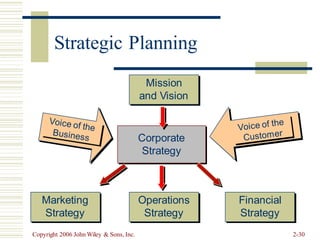
Operations Strategy:
Copyright 2006 John Wiley & Sons, Inc. 2-30
Financial
Strategy
Operations
Strategy
Marketing
Strategy
Corporate
Strategy
Mission
and Vision
Strategic Planning
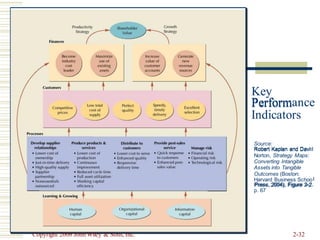
Performance
Indicators
Robert Kaplan and David
l
Press, 2004), Figure 3-2,
Copyright 2006 John Wiley & Sons, Inc. 2-32
Key
Perform
Source:
Robert Kaplan and Davi
Norton, Strategy Maps:
Converting Intangible
Assets into Tangible
Outcomes (Boston:
Harvard Business Schoo
Press, 2004), Figure 3-2
p. 67
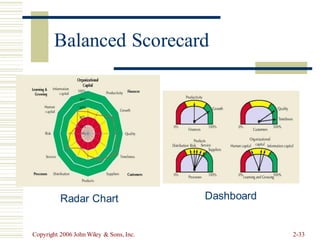
Dashboard
Radar Chart
Copyright 2006 John Wiley & Sons, Inc. 2-33
Balanced Scorecard
Operations
Global markets, global sourcing, and
global operations
Virtual companies





Greater choice, more
Emphasis on service
Speed and flexibility
individualism
Copyright 2006 John Wiley & Sons, Inc. 2-34
Issues and Trends in
Operations (cont.)
Supply chains
Collaborative commerce
Technological advances
Knowledge and ability to





learn
Environmental and
responsibilities
social
Copyright 2006 John Wiley & Sons, Inc. 2-35
Issues and Trends in
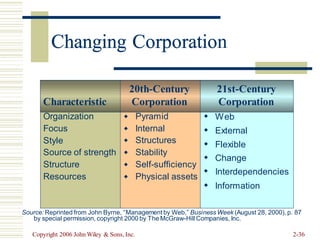
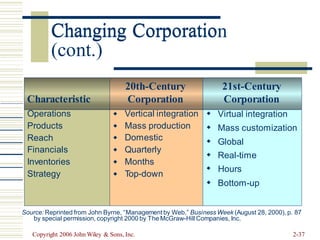
Changing Corporation
20th-Century 21st-Century
Characteristic Corporation Corporation
 Interdependencies
Source: Reprinted from John Byrne, “Management by Web,” Business Week (August 28, 2000), p. 87
by special permission, copyright 2000 by The McGraw-Hill Companies, Inc.
Copyright 2006 John Wiley & Sons, Inc. 2-36
Organization
Focus
Style
Source of strength
Structure
Resources
 Pyramid
 Internal
 Structures
 Stability
 Self-sufficiency
 Physical assets
 Web
 External
 Flexible
 Change
 Information
Changing Corporatio
Changing Corporation
(cont.)
20th-Century 21st-Century
Characteristic Corporation Corporation
 Hours
Source: Reprinted from John Byrne, “Management by Web,” Business Week (August 28, 2000), p. 87
by special permission, copyright 2000 by The McGraw-Hill Companies, Inc.
Copyright 2006 John Wiley & Sons, Inc. 2-37
Operations
Products
Reach
Financials
Inventories
Strategy
 Vertical integration
 Mass production
 Domestic
 Quarterly
 Months
 Top-down
 Virtual integration
 Mass customization
 Global
 Real-time
 Bottom-up
Changing Corporatio
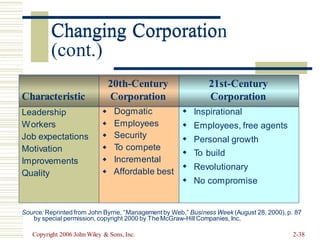
Changing Corporation
(cont.)
20th-Century 21st-Century
Characteristic Corporation Corporation
Leadership
Workers
Job expectations
Motivation
Improvements
Quality
Source: Reprinted from John Byrne, “Management by Web,” Business Week (August 28, 2000), p. 87
by special permission, copyright 2000 by The McGraw-Hill Companies, Inc.
Copyright 2006 John Wiley & Sons, Inc. 2-38
 Dogmatic
 Employees
 Security
 To compete
 Incremental
 Affordable best
 Inspirational
 Employees, free agents
 Personal growth
 To build
 Revolutionary
 No compromise
Changing Corporatio
Quality Management
Chapter 3
Meaning of Quality
Total Quality Management
Quality Improvement and
Employees


 Role of
Strategic Implications
Six Sigma
of TQM


Copyright 2006 John Wiley & Sons, Inc. 3-2
Lecture Outline
Lecture Outline (cont.)
TQM in Service Companies
Cost of Quality
Quality Management and Productivity
Identifying Quality Problems and Causes




 Quality Awards
Standards
ISO 9000
and Setting Quality

Copyright 2006 John Wiley & Sons, Inc. 3-3
Lecture Outline (con
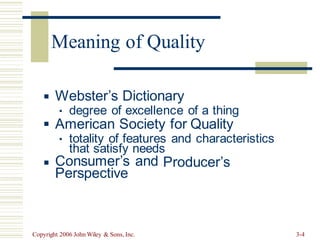
Webster’s Dictionary
▪
▪
degree of excellence of a thing
▪
American Society for Quality
totality of features and characteristics
▪
that satisfy needs
Consumer’s and
Perspective
Producer’s
▪
Copyright 2006 John Wiley & Sons, Inc. 3-4
Meaning of Quality
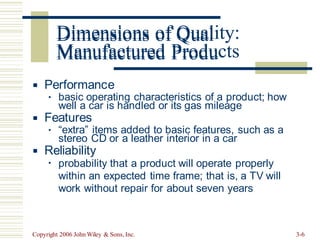
Dimensions of Quality:
Manufactured Products
Performance
▪
basic operating characteristics of a product; how
▪
well a car is handled or its gas mileage
Features
▪
“extra” items added to basic features, such as a
▪
stereo CD or a leather interior in a car
Reliability
▪
probability that a product will operate properly
within an expected time frame; that is, a TV will
work without repair for about seven years
▪
Copyright 2006 John Wiley & Sons, Inc. 3-6
Dimensions of Qual
Manufactured Produ
Dimensions of Quality:
Manufactured Products (cont.)
Conformance
degree to which a product meets pre–established
standards
Durability
▪
▪
▪
▪
how long product lasts before replacement
▪
Serviceability
ease of getting repairs, speed of repairs,
and competence of repair person
courtesy
▪
Copyright 2006 John Wiley & Sons, Inc. 3-7
Dimensions of Qual
Manufactured Produ
Dimensions of Quality:
Manufactured Products (cont.)
Aesthetics
▪
how a product looks, feels, sounds,
▪
smells, or tastes
Safety
▪
assurance that customerwill not suffer
injury or harm from a product; an
especially important consideration for
▪
automobiles
Perceptions
▪
subjective perceptions based on brand
name, advertising, and the like
▪
Copyright 2006 John Wiley & Sons, Inc. 3-8
Dimensions of Qualit
Manufactured Produ
Dimensions of Quality:
Service
Time and Timeliness
▪
How long must a customer wait for service,
and is it completed on time?
Is an overnight package delivered overnight?
▪
▪
Completeness:
▪
Is everything customer asked for provided?
Is a mail order from a catalogue company
complete when delivered?
▪
▪
Copyright 2006 John Wiley & Sons, Inc. 3-9
Dimensions of Qual
Dimensions of Quality:
Service (cont.)
Courtesy:
▪
How are customers treated by employees?
Are catalogue phone operators nice and are
their voices pleasant?
▪
▪
Consistency
▪
Is the same level of service provided to each
customer each time?
Is your newspaper delivered on time every
morning?
▪
▪
Copyright 2006 John Wiley & Sons, Inc. 3-10
Dimensions of Qual
Dimensions of Quality:
Service (cont.)
Accessibility and convenience
▪
How easy is it to obtain service?
Does a service representative answer you calls
▪
quickly?
▪
Accuracy
▪
Is the service performed right every time?
Is your bank or credit card statement correct every month?
▪
▪
Responsiveness
▪
How well does the company react to unusual situations?
How well is a telephone operator able to respond to a
customer’s questions?
▪
▪
Copyright 2006 John Wiley & Sons, Inc. 3-11
Dimensions of Qualit
A Final Perspective
Consumer’s and producer’s
▪
perspectives depend on each other
Consumer’s perspective: PRICE
Producer’s perspective: COST
Consumer’s view must dominate
▪
▪
▪
Copyright 2006 John Wiley & Sons, Inc. 3-13
Meaning of Quality:
Total Quality Management
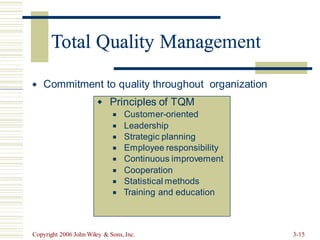
Commitment to quality throughout organization

Copyright 2006 John Wiley & Sons, Inc. 3-15
 Principles of TQM
◼ Customer-oriented
◼ Leadership
◼ Strategic planning
◼ Employee responsibility
◼ Continuous improvement
◼ Cooperation
◼ Statistical methods
◼ Training and education
Total Quality Manag
Copyright 2006 John Wiley & Sons, Inc. 3-18
1. Create constancy of purpose
2. Adopt philosophy of prevention
3. Cease mass inspection
4. Select a few suppliers based on
quality
5. Constantly improve system and
workers
Deming’s 14 Points
Deming’s 14 Points (cont.)
Copyright 2006 John Wiley & Sons, Inc. 3-19
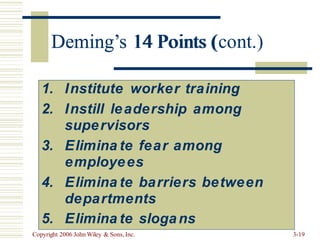
1. Institute worker training
2. Instill leadership among
supervisors
3. Elimina te fear among
employees
4. Elimina te barriers between
departments
5. Elimina te slogans
Deming’s 14 Points (
Deming’s 14 Points (cont.)
Copyright 2006 John Wiley & Sons, Inc. 3-20
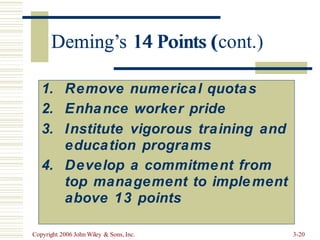
1. Remove numerical quotas
2. Enhance worker pride
3. Institute vigorous training and
education programs
4. Develop a commitment from
top management to implement
above 13 points
Deming’s 14 Points (
and Role of Employees
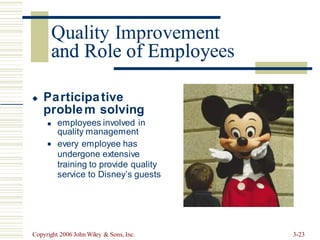
Participative
problem solving

employees involved in
quality management
every employee has
undergone extensive
training to provide quality
service to Disney’s guests
◼
◼
Copyright 2006 John Wiley & Sons, Inc. 3-23
Quality Improvement
and Role of Employ
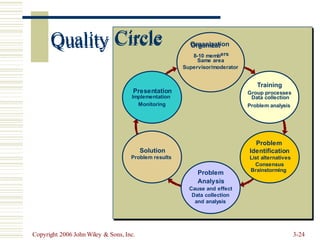
Quality
Presentation Group processes
Monitoring Problem analysis
Copyright 2006 John Wiley & Sons, Inc. 3-24
Circle Organization
ers
Same area
Supervisor/moderator
Training
Implementation Data collection
Problem
Solution Identification
Problem results List alternatives
Consensus
Problem Brainstorming
Analysis
Cause and effect
Data collection
and analysis
Quality Circle Organizat
8-10 memb
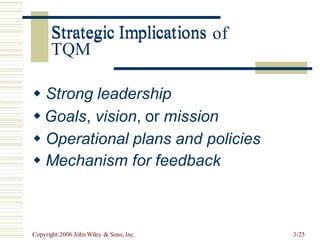
Strategic Implications
TQM
of
 Strong leadership
 Goals, vision, or mission
 Operational plans and policies
 Mechanism for feedback
Copyright 2006 John Wiley & Sons, Inc. 3-25
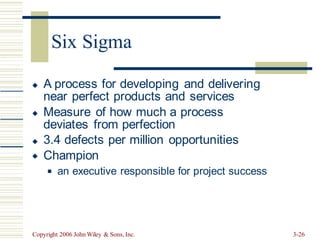
Strategic Implications
A process for developing and delivering
near perfect products and services
Measure of how much a process
deviates from perfection
3.4 defects per million opportunities
Champion




an executive responsible for project success
◼
Copyright 2006 John Wiley & Sons, Inc. 3-26
Six Sigma
Copyright 2006 John Wiley & Sons, Inc. 3-28
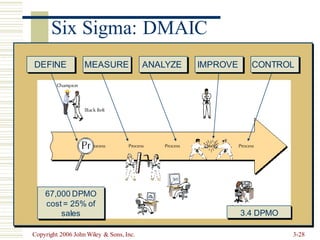
Six Sigma: DMAIC
DEFINE MEASURE ANALYZE IMPROVE CONTROL
67,000 DPMO
cost = 25% of
sales 3.4 DPMO
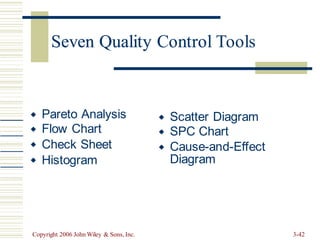
Seven Quality Control Tools
Pareto Analysis
Flow Chart
Check Sheet
Histogram




Scatter Diagram
SPC Chart
Cause-and-Effect
Diagram



Copyright 2006 John Wiley & Sons, Inc. 3-42
Seven Quality Control
Copyright 2006 John Wiley & Sons, Inc. 3-43
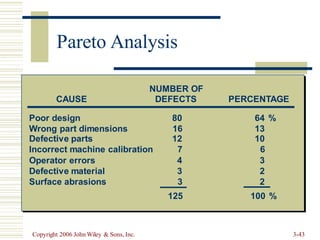
NUMBER OF
CAUSE DEFECTS PERCENTAGE
Poor design 80 64 %
Wrong part dimensions 16 13
Defective parts 12 10
Incorrect machine calibration 7 6
Operator errors 4 3
Defective material 3 2
Surface abrasions 3 2
125 100 %
Pareto Analysis
10
Copyright 2006 John Wiley & Sons, Inc. 3-44
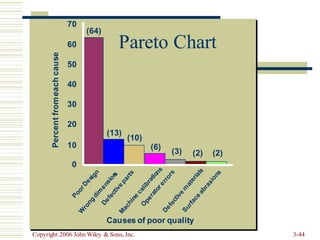
Percent
from
each
cause
(64)
(13)
(6)
70
60 Pareto Chart
50
40
30
20
(10)
(3) (2) (2)
0
Causes of poor quality
Finish
Finish
Copyright 2006 John Wiley & Sons, Inc. 3-45
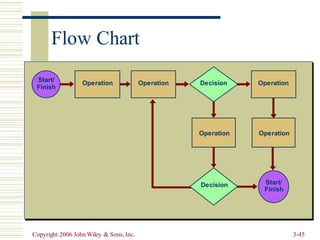
Flow Chart
Start/ Operation Operation Decision Operation
Operation Operation
Decision Start/
Copyright 2006 John Wiley & Sons, Inc. 3-46
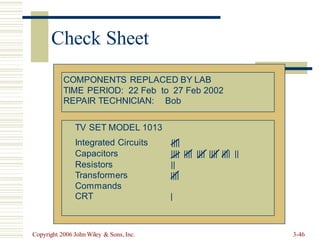
COMPONENTS REPLACED BY LAB
TIME PERIOD: 22 Feb to 27 Feb 2002
REPAIR TECHNICIAN: Bob
TV SET MODEL 1013
Integrated Circuits ||||
Capacitors |||| |||| |||| |||| |||| ||
Resistors ||
Transformers ||||
Commands
CRT |
Check Sheet
0
Copyright 2006 John Wiley & Sons, Inc. 3-47
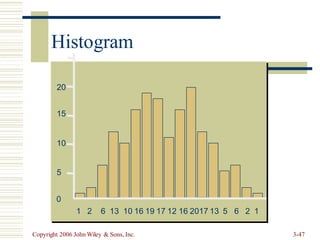
20
15
10
5
1 2 6 13 10 16 19 17 12 16 2017 13 5 6 2 1
Histogram
Copyright 2006 John Wiley & Sons, Inc. 3-48
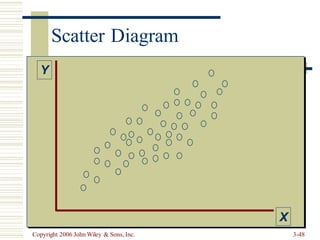
Scatter Diagram
Y
X
Control Chart
Copyright 2006 John Wiley & Sons, Inc. 3-49
Number
of
defects
C
24
21
18
15
12
9
6
3
UCL = 23.35
c = 12.67
LCL = 1.99
2 4 6 8 10 12 14 16
Sample number
Defective from vendor Poor process design
control
Not to specifications management
Copyright 2006 John Wiley & Sons, Inc. 3-50
Cause-and-Effect Diagram
Measurement Human Machines
Faulty
testing equipment Poor supervision Out of adjustment
Incorrect specifications Lack of concentration Tooling problems
Improper methods Inadequate training Old / worn
Quality
Inaccurate
Problem
temperature
Ineffective quality
Dust and Dirt Material- Deficiencies
handling problems in product
design
Environment Materials Process
Created in 1987 to stimulate growth of
quality management in the United States
Categories
Leadership
Information and analysis
Strategic planning
Human resource
Focus
Process management
Business results
Customer and market focus
◼
◼
◼
◼
◼
◼
◼
◼
Copyright 2006 John Wiley & Sons, Inc. 3-51
Baldrige Award
Implications of ISO
Companies
9000 for U.S.
Many overseas companies
will not do business with a
supplier unless it has ISO
9000 certification
ISO 9000 accreditation
ISO registrars



 A total commitment to
is required throughout
organization
quality
an
Copyright 2006 John Wiley & Sons, Inc. 3-55
Implications of ISO 9000
O
Op
pe
ea
a o
on
ns
sM
Ma
an
na
ag
ge
em
me
en
n
Product Design
Chapter 4
•Design Process
•Concurrent Design
•Technology in Design
•Design Reviews
•Design for Environment
•Design for Robustness
•Quality Function Deployment
4-187
Lecture Outline
• Effective design can provide a competitive
edge
• matches product or service characteristics with
customer requirements
• ensures that customer requirements are met in the
simplest and least costly manner
• reduces time required to design a new product or
service
• minimizes revisions necessary to make a design
workable
Copyright 2009 John Wiley & Sons, Inc. 4-188
Design Process
Design Process (cont.)
•Product design
• defines appearance of product
• sets standards for performance
• specifies which materials are to be used
• determines dimensions and tolerances
4-189
Design Process (cont
• A new approach to
design that involves
•
•
Involves suppliers
Incorporates production
process
Uses a price-minus
simultaneous design of
products and processes
by design teams •
system
Scheduling and
management can be
complex as tasks are
done in parallel
Uses technology to aid
design
•
• Improves quality of
design decisions
early
•
4-207
Concurrent Design
Technology in Design
• Computer Aided Design (CAD)
• assists in creation, modification, and
a design
analysis of
• computer-aided engineering (CAE)
• tests and analyzes designs on computer screen
• computer-aided manufacturing (CAD/CAM)
• ultimate design-to-manufacture connection
• product life cycle management (PLM)
• managing entire lifecycle of a product
• collaborative product design (CPD)
4-208
Technology in Desig
Collaborative Product Design
• A software system for collaborative design and
development among trading partners
With PML, manages product data, sets up project
workspaces, and follows life cycle of the product
•
• Accelerates product development, helps to resolve
product launch issues, and improves quality
Designers can
• conduct virtual review sessions
• test “what if” scenarios
• assign and track design issues
• communicate with multiple tiers of suppliers
• create, store, and manage project documents
of design
•
4-209
Collaborative Product
(CPD)
• Review designs to prevent failures and
ensure value
• Failure mode and effects analysis (FMEA)
• a systematic method of analyzing product
failures
• Fault tree analysis (FTA)
• a visual method for analyzing interrelationships
among failures
• Value analysis (VA)
• helps eliminate unnecessary features and
functions
4-210
Design Review
Design for Environment and
Extended Producer Responsibility
• Design for environment
• designing a product from material that can be recycled
• design from recycled material
• design for ease of repair
• minimize packaging
• minimize material and energy used during manufacture,
consumption and disposal
Extended producer responsibility
• holds companies responsible for their product even after
useful life
•
its
4-215
Design for Environmen
Extended Producer Res
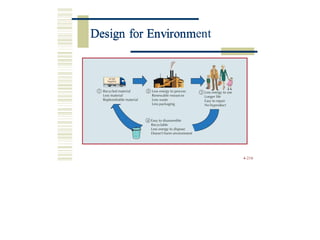
Design for Environment
4-216
Design for Environm
• Ability to meet present needs without compromising
those of future generations
• Green
• Use
product design
fewer materials
• Use recycled materials or recovered components
• Don't assume natural materials are always better
• Don't forget energy consumption
• Extend useful life of product
• Involve entire supply chain
• Change paradigm of design
Source: Adapted from the Business
Social Responsibility Web site,
w ww.bsr.org, accessed April1, 2007. 4-217
Sustainability
• Translates voice of customer into technical
design requirements
• Displays requirements in matrix diagrams
• first matrix called “house of quality”
• series of connected houses
4-218
Quality Function
Deployment (QFD)
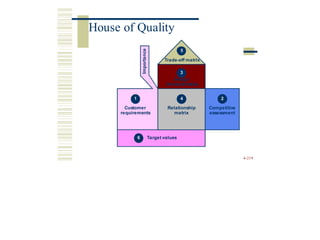
5
Trade-off matrix
characteristics
4-219
Importance
1
Customer
requirements
3
Design
4
Relationship
matrix
2
Competitive
assessment
6 Target values
House of Quality
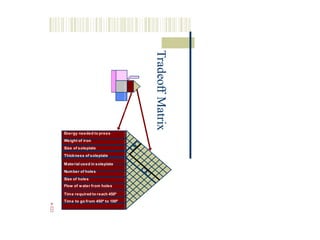
Material used in soleplate
+
+
-
-
+
4-222
Thickness of soleplate
Number of holes
Size of holes
Flow of water from holes
Time required to reach 450º
Time to go from 450º to 100º
Energy needed to press
Weight of iron
Size of soleplate
Tradeoff
Matrix
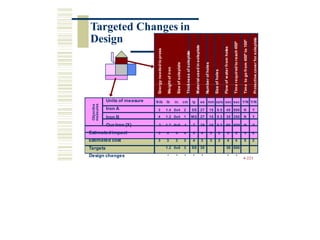
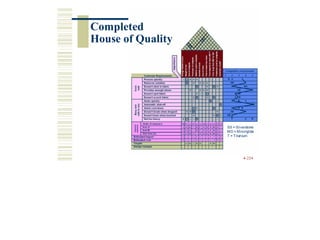
Our Iron (X) 2 1.7 9x5 4 T 35 15 0.7 50 600 N Y
Estimated impact
Design changes * * * * * * *
4-223
Obj
ective
measures
Energy
needed
to
press
Weight
of
iron
Size
of
soleplate
Thickness
of
soleplate
Material
used
in
soleplate
Num
ber
of
holes
Size
of
holes
Flow
of
w
ater
from
holes
Tim
e
required
to
reach
450º
Tim
e
to
go
from
450º
to
100º
Protective
cover
for
soleplate
Units of measure ft-lb lb in. cm ty ea mm oz/s sec sec Y/N Y/N
Iron A 3 1.4 8x4 2 SS 27 15 0.5 45 500 N Y
Iron B 4 1.2 8x4 1 MG 27 15 0.3 35 350 N Y
3 4 4 4 5 4 3 2 5 5 3 0
Estimated cost 3 3 3 3 4 3 3 3 4 4 5 2
Targets 1.2 8x5 3 SS 30 30 500
Targeted Changes in
Design
SS = Silverstone
MG = Mirorrglide
T = Titanium
4-224
Completed
House of Quality
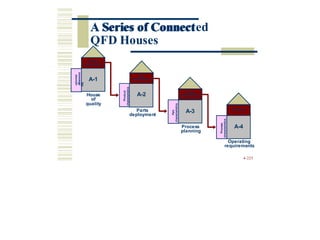
A Series of Connected
characteristics
House
of
quality
Parts
deployment
Process
planning
Operating
requirements
4-225
ustomer
uirements
Product
characteristics
Part
characteristics
Process
characteristics
Operations
A-4
Process
characteristics
A-3
A-2
Part
Product
characteristics
A-1
C
req
A Series of Connect
QFD Houses
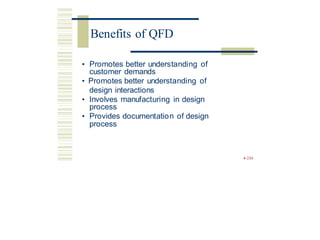
• Promotes better understanding of
customer demands
• Promotes better understanding of
design interactions
• Involves manufacturing in design
process
• Provides documentation of design
process
4-226
Benefits of QFD
s
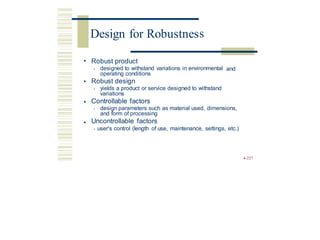
• Robust product
• designed to withstand variations in environmental
operating conditions
Robust design
and
•
• yields a product or service designed to withstand
variations
Controllable factors
• design parameters such as material used, dimensions,
and form of processing
Uncontrollable factors
• user's control (length of use, maintenance, settings, etc.)
•
•
4-227
Design for Robustnes
s (cont.)
• Tolerance
• allowable ranges of variation in the dimension of
part
a
• Consistency
• consistent errors are easier to correct than random
errors
• parts within tolerances may yield assemblies that
are not within limits
• consumers prefer product characteristics near their
ideal values
4-228
Design for Robustnes
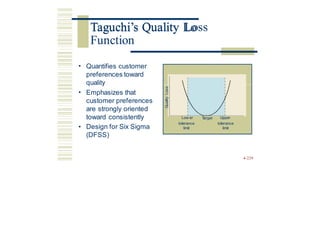
Taguchi’s Quality Loss
• Quantifies customer
preferences toward
quality
• Emphasizes that
customer preferences
are strongly oriented
toward consistently
Design for Six Sigma
(DFSS)
•
4-229
Quality
Loss
Low er T
arget Upper
tolerance tolerance
limit limit
Taguchi’s Quality Lo
Function
Service Design
Chapter 5
•Service Economy
•Characteristics of Services
•Service Design Process
•Tools for Service Design
•Waiting Line Analysis for
Service Improvement
5-232
Lecture Outline
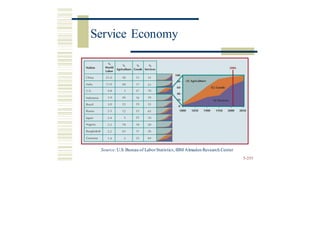
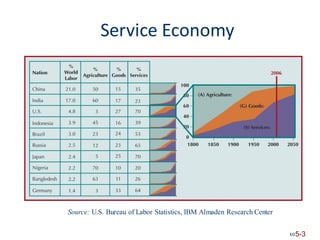
Source:U.S.Bureau of LaborStatistics,IBM Almaden Research Center
5-233
Service Economy
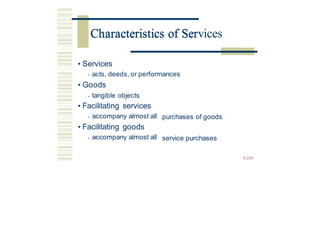
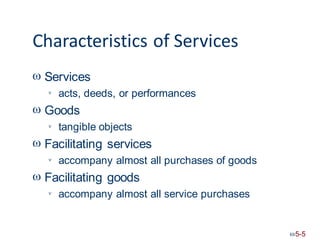
Characteristics of Services
• Services
• acts, deeds, or performances
• Goods
• tangible objects
• Facilitating services
• accompany almost all
• Facilitating goods
• accompany almost all
purchases of goods
service purchases
5-235
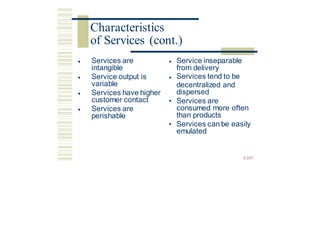
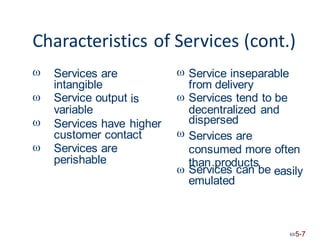
Characteristics of Ser
• Services are
intangible
Service output is
variable
• Service inseparable
from delivery
Services tend to be
• •
decentralized and
dispersed
Services are
consumed more
than products
Services can be
emulated
• Services have higher
customer contact
Services are
perishable
•
often
•
• easily
5-237
Characteristics
of Services (cont.)
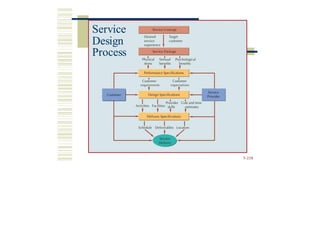
Process
5-238
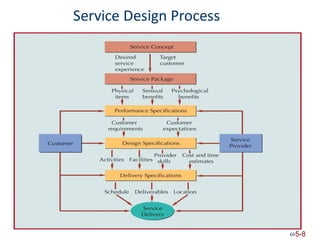
Service
Design
• Service concept
• purpose of a service; it defines target
market and customer experience
• Service package
• mixture of physical items, sensual
benefits, and psychological benefits
• Service specifications
• performance specifications
• design specifications
• delivery specifications
5-239
Service Design
Process (cont.)
Tools for Service Design
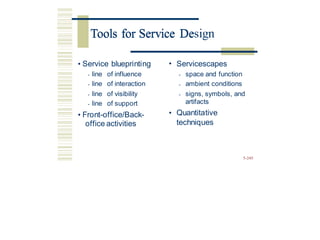
• Service blueprinting • Servicescapes
• line
• line
of
of
influence
interaction
space and function
ambient conditions
•
•
• line
• line
of
of
visibility
support
signs, symbols,
artifacts
Quantitative
techniques
and
•
•
• Front-office/Back-
office activities
5-245
Tools for Service De
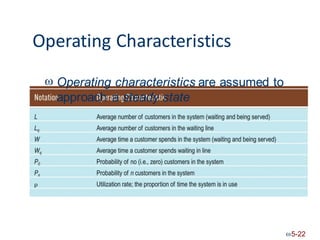
• Operating characteristics
• average values for characteristics that describe
performance of waiting line system
• Queue
• a single waiting line
• Waiting line system
• consists of arrivals, servers, and waiting line
structure
• Calling population
• source of customers; infinite or finite
5-248
Elements of
Waiting Line Analysis
Waiting Line Analysis (cont.)
• Arrival rate (λ)
• frequency at which customers arrive at a waiting line
according to a probability distribution, usually Poisson
Service time (µ)
•
• time required to serve a customer, usually described by
negative exponential distribution
Service rate must be shorter than arrival rate (λ <
Queue discipline
• order in which customers are served
Infinite queue
• can be of any length; length of a finite queue is limited
•
•
µ)
•
5-250
Elements of
Waiting Line Analysis
Waiting Line Analysis (cont.)
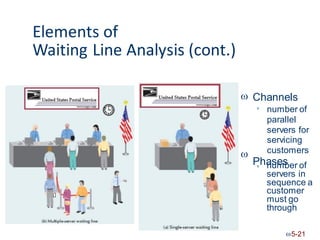
• Channels
• number of
parallel
servers for
servicing
customers
• Phases
• number of
servers in
sequence a
customer
must go
through
5-251
Elements of
Waiting Line Analysis
Service Design
Chapter 5
Lecture outline





Service economy
Characteristics of services
Service design process
Tools for service design
Waiting line analysis
improvement
for service
5-2
Service Economy
Source: U.S. Bureau of Labor Statistics, IBM Almaden Research Center
5-3
Characteristics of Services
 Services
acts, deeds, or performances

 Goods
tangible objects

 Facilitating services
accompany almost all purchases of goods

 Facilitating goods
accompany almost all service purchases

5-5
Characteristics of Services (cont.)
 
Services are Service inseparable
intangible
Service output
from delivery
Services tend to be
dispersed
Services are
consumed more often
than products
 
is
variable decentralized and
 Services have higher

customer contact
Services are
perishable

 Services can be
emulated
easily
5-7
Service Design Process
5-8
Service Design Process (cont.)
 Service concept
purpose of a service; it defines target market
customer experience
Service package
and


mixture of physical items, sensual
psychological benefits
Service specifications
benefits, and


performance specifications
design specifications
delivery specifications



5-9
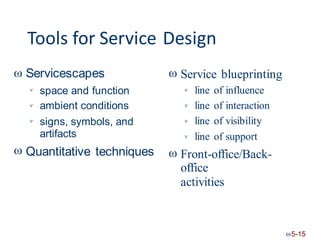
Tools for Service
Servicescapes
Design
  Service blueprinting
space and function
ambient conditions
line of influence
line of interaction
line of visibility
line of support
 
 
signs, symbols,
artifacts
and
 

 Quantitative techniques  Front-office/Back-
office
activities
5-15
Elements of Waiting Line Analysis
 Operating characteristics
average values for characteristics that describe
performance of waiting line system
Queue


a single waiting line

 Waiting line system
consists of arrivals, servers, and waiting
structure
Calling population
line


source of customers; infinite or finite

5-18
Elements of
Waiting Line Analysis (cont.)
 Arrival rate (λ)
frequency at which customers arrive at a waiting line
according to a probability distribution, usually Poisson
Service time (μ)


time required to serve a customer, usually described by
negative exponential distribution
Service rate must be shorter than arrival rate (λ <
Queue discipline



μ)
order in which customers are served

 Infinite queue
can be of any length; length of a finite queue is limited

5-20
Elements of
Waiting Line Analysis (cont.)
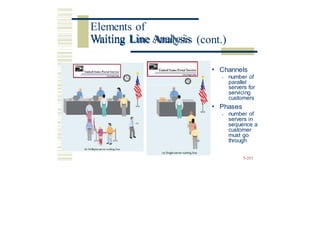
 Channels
number of
parallel
servers for
servicing
customers
Phases


number of
servers in
sequence a
customer
must go
through

5-21
Operating Characteristics
 Operating characteristics are assumed to
approach a steady state
5-22
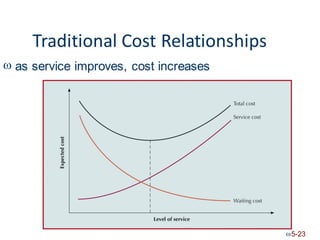
Traditional Cost Relationships
 as service improves, cost increases
5-23
Psychology of Waiting
 Disney
Waiting rooms

magazines and
newspapers
televisions
costumed characters
mobile vendors
accurate wait times




Bank of America
 
mirrors special passes
 
Supermarkets

magazines
“impulse purchases”


5-24
Psychology of Waiting (cont.)
 Preferential treatment
Grocery stores: express lanes for customers with
few purchases
Airlines/car rental agencies: special cards available
to frequent-users or for an additional fee


Phone retailers: route calls to more or less

experienced salespeople based on customer’s
sales history
 Critical service providers
services of police department, fire department,
waiting is unacceptable; cost is not important
etc.


5-25
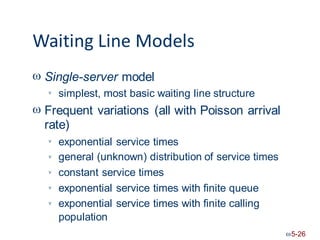
Waiting Line Models
 Single-server model
simplest, most basic waiting line structure

 Frequent variations (all with Poisson arrival
rate)
exponential service times
general (unknown) distribution of service times
constant service times
exponential service times with finite queue
exponential service times with finite calling
population





5-26
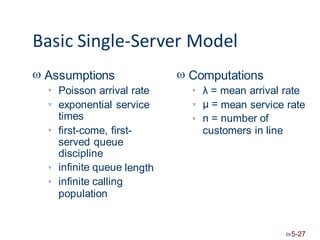
Basic Single-Server Model
 
Assumptions Computations
Poisson arrival rate λ =
μ =
n =
mean arrival rate
 
exponential
times
service mean service
number of
rate
 

first-come, first- customers in line

served queue
discipline
infinite queue
infinite calling
population
length


5-27
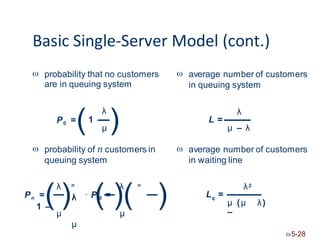
Basic Single-Server Model (cont.)
 
probability that no customers
are in queuing system
average number of customers
in queuing system
P0 =
( )
λ
–
λ
1 L =
μ μ – λ
 
probability of n customers in average number of customers
queuing system in waiting line
Pn =
( )λ ∙ P
(0 =
)( )
λ λ λ2
n n
L =
λ q
μ (μ
–
λ)
1 –
μ μ
μ
5-28
Basic Single-Server Model (cont.)
 
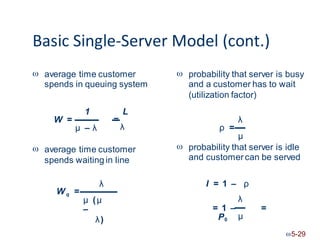
average time customer
spends in queuing system
probability that server is busy
and a customer has to wait
(utilization factor)
1 L
λ
W = = λ
ρ =
μ – λ
μ
 probability that server is idle
and customercan be served
 average time customer
spends waiting in line
λ I = 1 – ρ
λ
Wq =
μ (μ
–
λ)
= 1 –
P0
=
μ
5-29
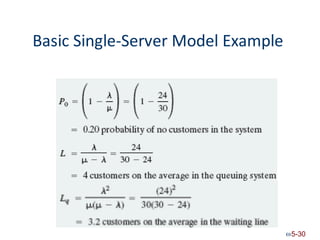
Basic Single-Server Model Example
5-30
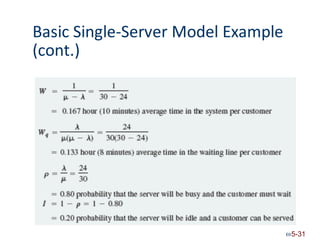
Basic Single-Server
(cont.)
Model Example
5-31
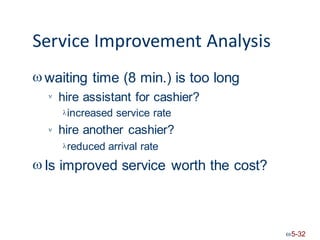
Service Improvement Analysis
 waiting time (8 min.) is too long
hire assistant for cashier?
increased service rate
hire another cashier?
reduced arrival rate


 Is improved service worth the cost?
5-32
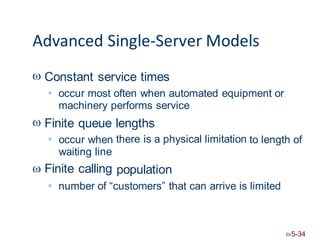
Advanced Single-Server Models
 Constant service times
occur most often when automated equipment
machinery performs service
or

 Finite queue lengths
there is a physical limitation
occur when
waiting line
Finite calling
to length of

 population
number of “customers” that can arrive is limited

5-34
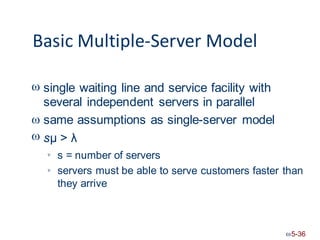
Basic Multiple-Server Model
 single waiting line and service facility with
several independent servers in parallel
same assumptions as single-server model
sμ > λ


s = number of servers
servers must be able to
they arrive

serve customers faster than

5-36
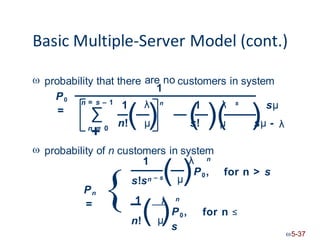
Basic Multiple-Server Model (cont.)
 probability that there are no
1
customers in system
P0
=
= s – 1
∑
n
+
= 0
1 1 sμ
λ λ
n s
n!( μ
) (
s! )(
μ )
sμ - λ
 probability of n customers in system
1 λ n
– s( μ)P0,
{
for n > s
s!sn
1
Pn
= λ n
( )P0, for n ≤
n! μ
s
5-37
n
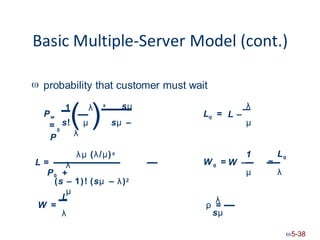
Basic Multiple-Server Model (cont.)
 probability that customer must wait
1
( λ
)
s sμ λ
Pw
=
P
Lq = L –
s! μ sμ – μ
0
λ
λμ (λ/μ)s 1 Lq
L = Wq = W – =
λ
μ λ
P0 +
(s – 1)!
μ
(sμ – λ)2
L λ
W = ρ =
sμ
λ
5-38
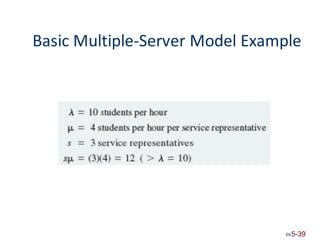
Basic Multiple-Server Model Example
5-39
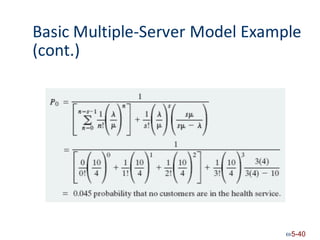
Basic Multiple-Server
(cont.)
Model Example
5-40
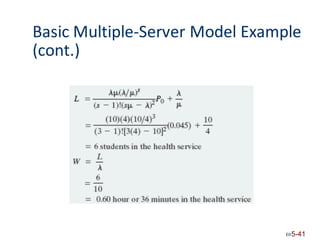
Basic Multiple-Server
(cont.)
Model Example
5-41
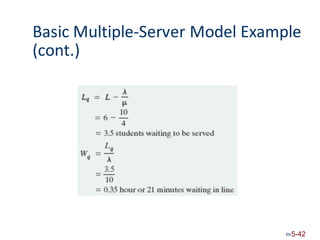
Basic Multiple-Server
(cont.)
Model Example
5-42
Basic Multiple-Server
(cont.)
Model Example
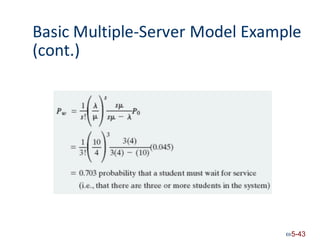
5-43
Basic Multiple-Server
Example (cont.)
Model
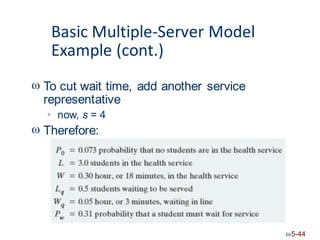
 To cut wait time,
representative
add another service
now, s = 4

 Therefore:
5-44
Processes and Technology
Chapter 6
•Process Planning
•Process Analysis
•Process Innovation
•Technology Decisions
6-277
Lecture Outline
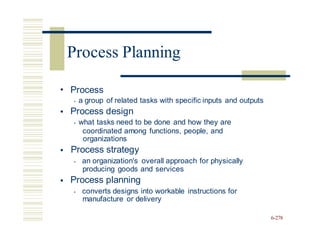
• Process
• a group of related tasks with specific inputs and outputs
Process design
• what tasks need to be done and how they are
•
coordinated among functions, people, and
organizations
Process strategy
• an organization's overall approach for physically
producing goods and services
Process planning
• converts designs into workable instructions for
manufacture or delivery
•
•
6-278
Process Planning
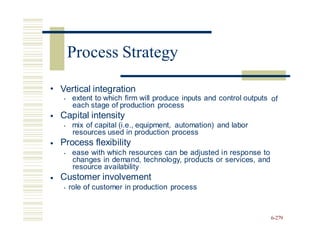
• Vertical integration
• extent to which firm will produce inputs and control outputs
each stage of production process
Capital intensity
of
•
• mix of capital (i.e., equipment, automation) and labor
resources used in production process
Process flexibility
• ease with which resources can be adjusted in response to
changes in demand, technology, products or services, and
resource availability
Customer involvement
• role of customer in production process
•
•
6-279
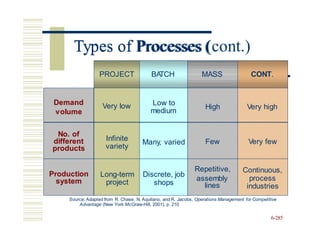
Process Strategy
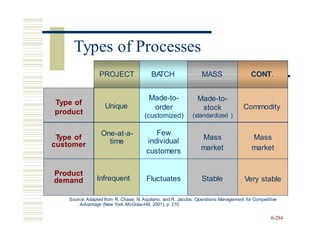
PROJECT BA
TCH MASS CONT.
individual
Source: Adapted from R. Chase, N. Aquilano, and R. Jacobs, Operations Management for Competitive
Advantage (New York:McGraw-Hill, 2001), p. 210
6-284
Type of
product
Unique
Made-to-
order
(customized)
Made-to-
stock
(standardized )
Commodity
Type of
customer
Product
demand
One-at-a-
time
Infrequent
Mass
market
Mass
market
Very stable
Few
customers
Fluctuates Stable
Types of Processes
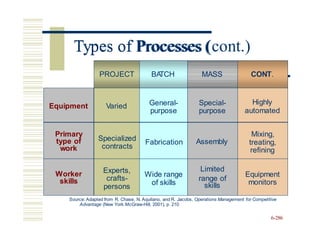
Types of Processes (cont.)
PROJECT BA
TCH MASS CONT.
assembly
Source: Adapted from R. Chase, N. Aquilano, and R. Jacobs, Operations Management for Competitive
Advantage (New York:McGraw-Hill, 2001), p. 210
6-285
Demand
volume
Very low Low to
medium
High Very high
No. of
different
products
Production
system
Infinite
variety
Long-term
project
Few Very few
Continuous,
process
industries
Many, varied
Discrete, job
shops
Repetitive,
lines
Types of Processes (
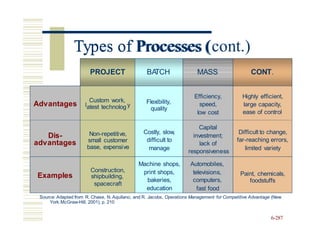
Types of Processes (cont.)
PROJECT BA
TCH MASS CONT.
automated
refining
range of
Source: Adapted from R. Chase, N. Aquilano, and R. Jacobs, Operations Management for Competitive
Advantage (New York:McGraw-Hill, 2001), p. 210
6-286
Equipment Varied General-
purpose
Special-
purpose
Highly
Primary
type of
work
Worker
skills
Specialized
contracts
Experts,
crafts-
persons
Assembly
Mixing,
treating,
Equipment
monitors
Fabrication
Wide range
of skills
Limited
skills
Types of Processes (
Types of Processes (cont.)
PROJECT BA
TCH MASS CONT.
large capacity,
atest technolog
far-reaching errors,
televisions,
shipbuilding,
fast food
Source: Adapted from R. Chase, N. Aquilano, and R. Jacobs, Operations Management for Competitive Advantage (New
York:McGraw-Hill, 2001), p. 210
6-287
Advantages l
Custom work,
y
Flexibility,
quality
Efficiency,
speed,
low cost
Highly efficient,
ease of control
Dis-
advantages
Examples
Non-repetitive,
small customer
base, expensive
Construction,
spacecraft
Costly, slow,
difficult to
manage
Capital
investment;
lack of
responsiveness
Difficult to change,
limited variety
Paint, chemicals,
foodstuffs
Machine shops,
print shops,
bakeries,
education
Automobiles,
computers,
Types of Processes (
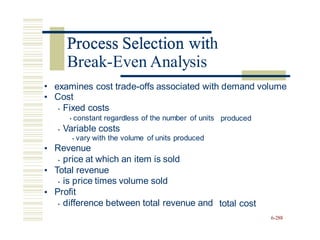
Process Selection with
•
•
examines cost trade-offs associated with
Cost
• Fixed costs
• constant regardless of the number of units
demand volume
produced
• Variable costs
• vary with the volume of units produced
Revenue
• price at which an item is sold
Total revenue
• is price times volume sold
Profit
• difference between total revenue and
•
•
•
total cost
6-288
Process Selection wit
Break-Even Analysis
Process Selection with
(cont.)
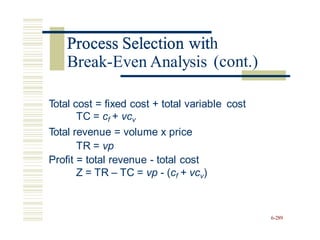
Total cost = fixed cost + total variable
TC = cf + vcv
cost
Total revenue = volume x price
TR = vp
Profit = total revenue - total cost
Z = TR – TC = vp - (cf + vcv)
6-289
Process Selection wit
Break-Even Analysis
Process Selection with
Break-Even Analysis (cont.)
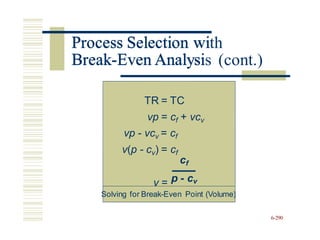
vp = cf + vcv
cf
Solving for Break-Even Point (Volume)
6-290
TR = TC
vp - vcv = cf
v(p - cv) = cf
v = p - cv
Process Selection wi
Break-Even Analysi
Break-Even Analysis: Example
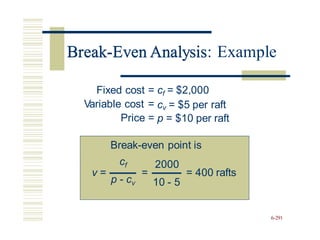
Fixed cost
Variable cost
Price
=
=
=
cf = $2,000
cv = $5 per raft
p = $10 per raft
v = = = 400 rafts
6-291
Break-even point is
cf 2000
p - cv 10 - 5
Break-Even Analysis
Break-Even Analysis: Graph
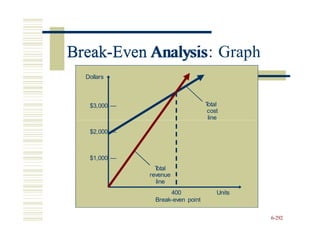
cost
line
6-292
Dollars
$3,000 — T
otal
$2,000 —
$1,000 —
T
otal
revenue
line
400 Units
Break-even point
Break-Even Analysis
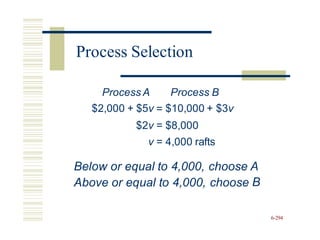
Process A
$2,000 + $5v
Process B
$10,000 + $3v
=
$2v
v
=
=
$8,000
4,000 rafts
Below or equal to 4,000, choose A
B
Above or equal to 4,000, choose
6-294
Process Selection
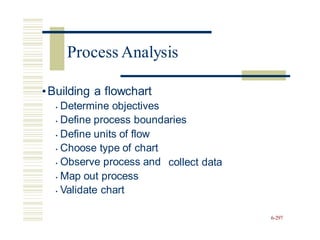
•Building a flowchart
• Determine objectives
• Define process boundaries
• Define units of flow
• Choose type of chart
• Observe process and
• Map out process
• Validate chart
collect data
6-297
Process Analysis
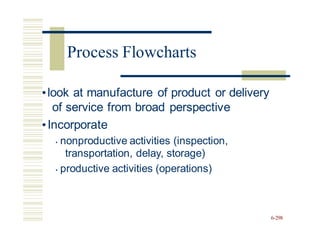
•look at manufacture of product or delivery
of service from broad perspective
•Incorporate
• nonproductive activities (inspection,
transportation, delay, storage)
• productive activities (operations)
6-298
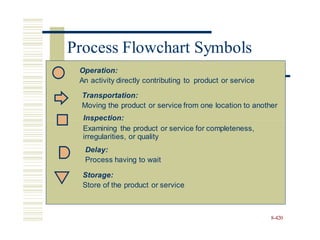
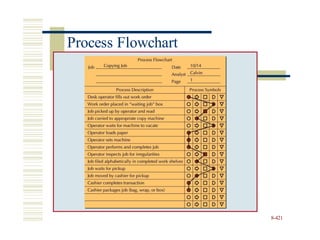
Process Flowcharts
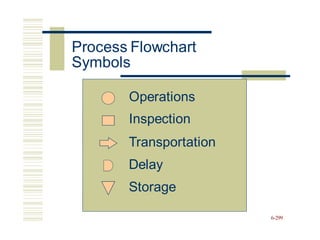
Operations
Inspection
6-299
Transportation
Delay
Storage
Process Flowchart
Symbols
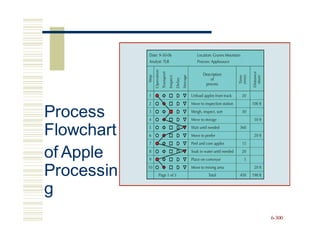
Process
Flowchart
of Apple
Processin
g
6-300
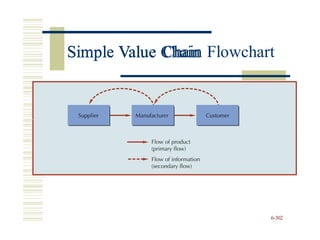
Simple Value Chain Flowchart
6-302
Simple Value Chain
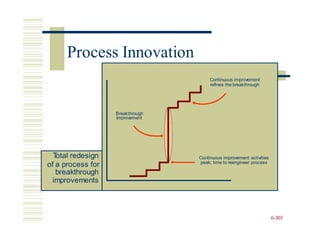
of a process for
6-303
Continuous improvement
refines the breakthrough
Breakthrough
Improvement
Continuous improvement activities
peak; time to reengineer process
T
otal redesign
breakthrough
improvements
Process Innovation
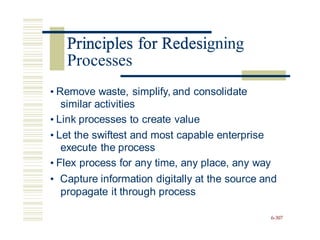
Principles for Redesigning
• Remove waste, simplify, and consolidate
similar activities
• Link processes to create value
• Let the swiftest and most capable enterprise
execute the process
• Flex process for any time, any place, any way
• Capture information digitally at the source and
propagate it through process
6-307
Principles for Redesi
Processes
Principles for Redesigning
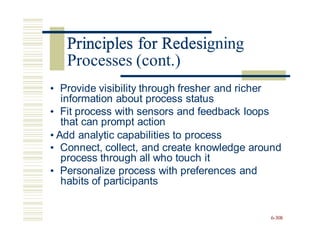
• Provide visibility through fresher and richer
information about process status
• Fit process with sensors and feedback loops
that can prompt action
• Add analytic capabilities to process
• Connect, collect, and create knowledge around
process through all who touch it
• Personalize process with preferences and
habits of participants
6-308
Principles for Redesi
Processes (cont.)
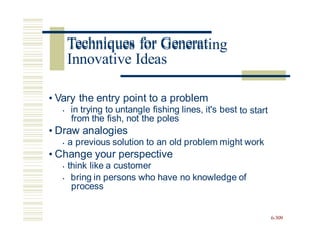
Techniques for Generating
• Vary the entry point to a problem
• in trying to untangle fishing lines, it's best
from the fish, not the poles
to start
• Draw analogies
• a previous solution to an old problem might work
• Change your perspective
• think like a customer
• bring in persons who have no knowledge of
process
6-309
Techniques for Generat
Innovative Ideas
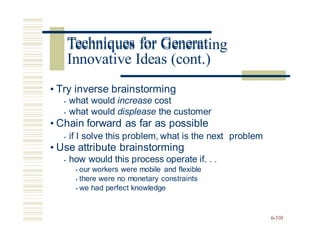
Techniques for Generating
• Try inverse brainstorming
• what would increase cost
• what would displease the customer
• Chain forward as far as possible
• if I solve this problem, what is the next
• Use attribute brainstorming
• how would this process operate if. . .
• our workers were mobile and flexible
• there were no monetary constraints
• we had perfect knowledge
problem
6-310
Techniques for Generat
Innovative Ideas (cont.)
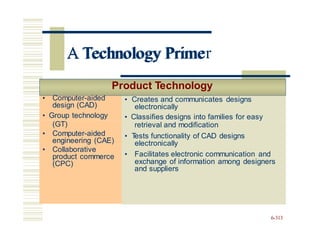
• Computer-aided
design (CAD)
• Group technology
(GT)
• Computer-aided
engineering (CAE)
• Collaborative
product commerce
(CPC)
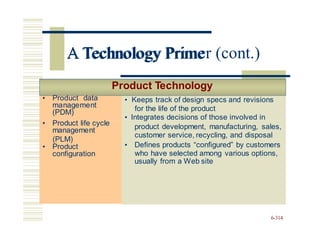
A Technology Primer
Product Technology
electronically
electronically
exchange of information among designers
6-313
• Computer-aided
design (CAD)
• Group technology
• Creates and communicates designs
• Classifies designs into families for easy
(GT)
• Computer-aided
engineering (CAE)
• Collaborative
product commerce
(CPC)
retrieval and modification
• T
ests functionality of CAD designs
• Facilitates electronic communication and
and suppliers
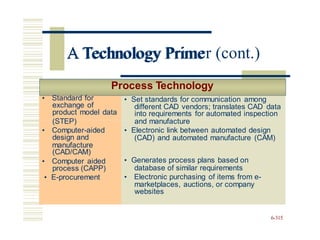
A Technology Prime
• Product data
management
(PDM)
• Product life cycle
management
(PLM)
• Product
configuration
A Technology Primer (cont.)
Product Technology
for the life of the product
customer service, recycling, and disposal
(PLM)
who have selected among various options,
6-314
• Product data
management
(PDM)
• Keeps track of design specs and revisions
• Integrates decisions of those involved in
• Product life cycle
management
• Product
configuration
product development, manufacturing, sales,
• Defines products “configured” by customers
usually from a Web site
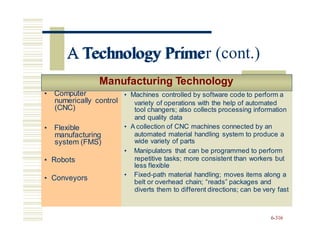
A Technology Prime
• Standard for
exchange of
product model data
(STEP)
• Computer-aided
design and
manufacture
(CAD/CAM)
• Computer aided
process (CAPP)
• E-procurement
A Technology Primer (cont.)
Process Technology
different CAD vendors; translates CAD data
(CAD) and automated manufacture (CAM)
manufacture
database of similar requirements
marketplaces, auctions, or company
6-315
• Standard for
exchange of
product model data
• Set standards for communication among
into requirements for automated inspection
(STEP)
• Computer-aided
design and
(CAD/CAM)
• Computer aided
process (CAPP)
• E-procurement
and manufacture
• Electronic link between automated design
• Generates process plans based on
• Electronic purchasing of items from e-
websites
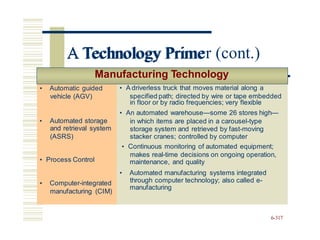
A Technology Prime
• Computer
numerically control
(CNC)
• Flexible
manufacturing
system (FMS)
• Robots
• Conveyors
A Technology Primer (cont.)
Manufacturing Technology
variety of operations with the help of automated
automated material handling system to produce a
less flexible
belt or overhead chain; “reads” packages and
6-316
• Computer
numerically control
(CNC)
• Machines controlled by software code to perform a
tool changers; also collects processing information
and quality data
• Flexible
manufacturing
system (FMS)
• Robots
• Conveyors
• A collection of CNC machines connected by an
wide variety of parts
• Manipulators that can be programmed to perform
repetitive tasks; more consistent than workers but
• Fixed-path material handling; moves items along a
diverts them to different directions; can be very fast
A Technology Prime
• Automatic guided
vehicle (AGV)
• Automated storage
and retrieval system
(ASRS)
• Process Control
• Computer-integrated
manufacturing (CIM)
A Technology Primer (cont.)
Manufacturing Technology
specified path; directed by wire or tape embedded
• Automated storage
maintenance, and quality
manufacturing
6-317
• Automatic guided
vehicle (AGV)
• A driverless truck that moves material along a
in floor or by radio frequencies; very flexible
• An automated warehouse—some 26 stores high—
and retrieval system
(ASRS)
• Process Control
• Computer-integrated
manufacturing (CIM)
in which items are placed in a carousel-type
storage system and retrieved by fast-moving
stacker cranes; controlled by computer
• Continuous monitoring of automated equipment;
makes real-time decisions on ongoing operation,
• Automated manufacturing systems integrated
through computer technology; also called e-
A Technology Prime
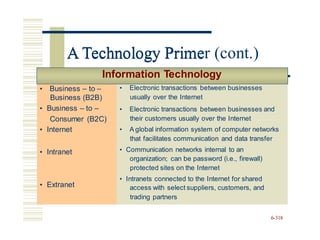
• Business – to –
Business (B2B)
• Business – to –
Consumer (B2C)
• Internet
• Intranet
• Extranet
A Technology Primer (cont.)
Information Technology
Consumer (B2C)
organization; can be password (i.e., firewall)
access with select suppliers, customers, and
6-318
• Business – to –
Business (B2B)
• Business – to –
• Electronic transactions between businesses
usually over the Internet
• Electronic transactions between businesses and
their customers usually over the Internet
• Internet
• Intranet
• Extranet
• A global information system of computer networks
that facilitates communication and data transfer
• Communication networks internal to an
protected sites on the Internet
• Intranets connected to the Internet for shared
trading partners
A Technology Prime
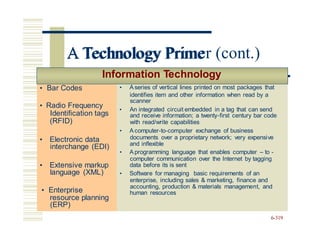
• Bar Codes
• Radio Frequency
Identification tags
(RFID)
• Electronic data
interchange (EDI)
• Extensive markup
language (XML)
• Enterprise
resource planning
(ERP)
A Technology Primer (cont.)
Information Technology
identifies item and other information when read by a
• An integrated circuit embedded in a tag that can send
(RFID)
and inflexible
data before its is sent
human resources
resource planning
6-319
• Bar Codes
• Radio Frequency
Identification tags
• A series of vertical lines printed on most packages that
scanner
and receive information; a twenty-first century bar code
• Electronic data
interchange (EDI)
• Extensive markup
language (XML)
• Enterprise
(ERP)
with read/write capabilities
• A computer-to-computer exchange of business
documents over a proprietary network; very expensive
• A programming language that enables computer – to -
computer communication over the Internet by tagging
• Software for managing basic requirements of an
enterprise, including sales & marketing, finance and
accounting, production & materials management, and
A Technology Prime
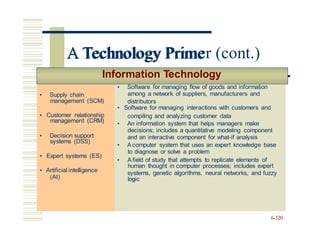
• Supply chain
management (SCM)
• Customer relationship
management (CRM)
• Decision support
systems (DSS)
• Expert systems (ES)
• Artificial intelligence
(AI)
A Technology Primer (cont.)
Information Technology
distributors
compiling and analyzing customer data
and an interactive component for what-if analysis
• A field of study that attempts to replicate elements of
systems, genetic algorithms, neural networks, and fuzzy
6-320
• Supply chain
management (SCM)
• Customer relationship
• Software for managing flow of goods and information
among a network of suppliers, manufacturers and
• Software for managing interactions with customers and
management (CRM)
• Decision support
systems (DSS)
• Expert systems (ES)
• Artificial intelligence
(AI)
• An information system that helps managers make
decisions; includes a quantitative modeling component
• A computer system that uses an expert knowledge base
to diagnose or solve a problem
human thought in computer processes; includes expert
logic
A Technology Prime
O
Op
pe
e a
a o
on
ns
s M
Ma
an
na
ag
ge
em
me
en
n
Capacity and Facilities
Chapter 7
• Capacity Planning
• Basic Layouts
• Designing Process Layouts
• Designing Service Layouts
• Designing Product Layouts
• Hybrid Layouts
Lecture Outline
• Maximum capability to produce
• Capacity planning
• establishes overall level of productive
resources for a firm
• 3 basic strategies for timing of capacity
expansion in relation to steady growth in
demand (lead, lag, and average)
Capacity
• Capacity increase depends on
• volume and certainty of anticipated demand
• strategic objectives
• costs of expansion and operation
• Best operating level
• % of capacity utilization that minimizes unit costs
• Capacity cushion
• % of capacity held in reserve for unexpected
occurrences
Capacity (cont.)
• it costs less per unit to produce high levels of
output
• fixed costs can be spread over a larger number of
units
• production or operating costs do not increase
linearly with output levels
• quantity discounts are available for material
purchases
• operating efficiency increases as workers gain
experience
Economies of Scale
Best Operating Level for a Hotel
Best Operating Level f
• Process layouts
• group similar activities together
according to process or function they
perform
• Product layouts
• arrange activities in line according to
sequence of operations for a particular
product or service
• Fixed-position layouts
• are used for projects in which product
cannot be moved
BASIC LAYOUTS
Process Layout in Services
Women’s
lingerie
Shoes Housewares
Women’s
dresses
Cosmetics
and jewelry
Children’s
department
Women’s
sportswear
Entry and
display area
Men’s
department
Process Layout in Se
Manufacturing Process Layout
Manufacturing Proce
In
Out
A Product Layout
Fixed-Position Layouts
• Typical of projects in
which product produced
is too fragile, bulky, or
heavy to move
• Equipment, workers,
materials, other
resources brought to the
site
Low equipment utilization
Highly skilled labor
Typically low fixed cost
Often high variable costs
•
•
•
•
7-335
Fixed-Position Layo
Designing Process Layouts
• Goal: minimize material handling costs
• Block Diagramming
• minimize nonadjacent loads
• use when quantitative data is
• Relationship Diagramming
• based on location preference
• use when quantitative data is
available
between areas
not available
Designing Process L
• Must be both attractive and functional
Types
• Free flow layouts
• encourage browsing, increase impulse purchasing, are flexible
•
and visually appealing
• Grid layouts
• encourage customer familiarity, are low cost, easy to clean and
secure, and good for repeat customers
• Loop and Spine layouts
• both increase customer sightlines and exposure to products,
while encouraging customer to circulate through the entire
store
Designing Service
Layouts
Types of Store Layouts
• Objective
• Balance the assembly line
Line balancing
• tries to equalize the amount of work at each
•
workstation
Precedence requirements
• physical restrictions on the order in which operations
are performed
Cycle time
• maximum amount of time a product is allowed to
spend at each workstation
•
•
Designing Product
Layouts
Cd = desired units of output
Cd = (120 units)
= = 4 minutes
Cd 120
production time available
(8 hours x 60 minutes / hour)
480
Cycle Time Example
Time
• Cycle time = max time spent at any station
• Flow time = time to complete all stations
4 minutes 4 minutes 4 minutes
Flow time = 4 + 4 + 4 = 12 minutes
Cycle time = max (4, 4, 4) = 4 minutes
3
2
1
Flow Time vs Cycle
Efficiency of Line and Balance Delay
Efficiency workstations
• Balance
∑ ∑
ti ti
nCa Cd
time of line
ti = completion time for element i
Efficiency of Line and Balance Dela
Minimum number of
i i
∑ti ∑ ti
delay
• total idle
time of lin
• calculated
as (1 -
efficiency)
E = i = 1
N = i = 1
where
j = number of work elements
n = actual number of workstations
Ca = actual cycle time
Cd = desired cycle time
dure
1.
2.
3.
Draw and label a precedence diagram
Calculate desired cycle time required for line
Calculate theoretical minimum number of
workstations
4. Group elements into workstations, recognizing
time and precedence constraints
Calculate efficiency of line
Determine if theoretical minimum number of
cycle
5.
6.
workstations or an acceptable efficiency level has
been reached. If not, go back to step 4.
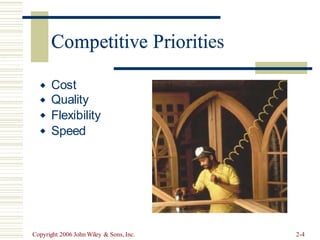
Line Balancing Proce
B
0.4
Line Balancing: Example
WORK ELEMENT PRECEDENCE TIME (MIN)
A Press out sheet of fruit — 0.1
B Cut into strips A 0.2
C Outline fun shapes A 0.4
D Roll up and package B, C 0.3
0.2
0.1 A D 0.3
C
Cd = = = 0.4 minute
Line Balancing: Example (cont.)
WORK ELEMENT PRECEDENCE TIME (MIN)
A Press out sheet of fruit — 0.1
B Cut into strips A 0.2
C Outline fun shapes A 0.4
D Roll up and package B, C 0.3
40 hours x 60 minutes / hour 2400
6,000 units 6000
N = 0.1 + 0.2 + 0.3 + 0.4 = 1.0 = 2.5 � 3 workstations
0.4 0.4
N = 2.5
0.4
Line Balancing: Example (cont.)
REMAINING REMAINING
WORKSTATION ELEMENT TIME ELEMENTS
1 A 0.3 B, C
B 0.1 C, D
2 C 0.0 D
3 D 0.1 none
B
0.2
0.1 A D 0.3
C
Cd = 0.4
Line Balancing: Example (cont.)
Cd = 0.4
N = 2.5
1.2
3(0.4)
E =
0.1 + 0.2 + 0.3 + 0.4
=
1.0
= 0.833 = 83.3%
Work Work Work
station 1 station 2 station 3
A, B C D
0.3 0.4 0.3
minute minute minute
Line Balancing: Examp
• Cellular layouts
• group dissimilar machines into work centers (called cells)
that process families of parts with similar shapes or
processing requirements
• Production flow analysis (PFA)
• reorders part routing matrices to identify families of parts
with similar processing requirements
Flexible manufacturing system
• automated machining and material handling systems
which can produce an enormous variety of items
Mixed-model assembly line
• processes more than one product model in one line
•
•
Hybrid Layouts
Original Process Layout
Assembly
4 6 7 9
5 8
2
1 3
10 12
11
A B C Raw materials
Original Process Layou
Revised Cellular Layout
11
Assembly
8 10 9 12
4 Cell 1 Cell 2 6 Cell 3
7
2 1 3 5
A B C
Raw materials
Revised Cellular Layou
F x x x
Reordered Routing Matrix
Parts
Machines
1 2 4 8 10 3 6 9 5 7 11 12
A
D
x x x x x
x x x x x
C
G
B
x x x
x x x x
x x x x
x x x
x x x
H
E
Advantages and Disadvantages
• Advantages
• Reduced material
handling and transit
• Reduced setup time
• Disadvantages
Inadequate part families
Poorly balanced cells
•
time •
Expanded training and
scheduling of workers
Increased capital
investment
•
• Reduced work-in-
process inventory
• Better use of human
resources
• Easier to control
• Easier to automate
•
Advantages and Disadv
of Cellular Layouts
• FMS consists of numerous programmable
machine tools connected by an automated
material handling system and controlled
a common computer network
by
•
•
FMS combines flexibility with efficiency
FMS layouts differ based on
• variety of parts that the system can process
• size of parts processed
• average processing time required for part
completion
Flexible Manufacturing
Systems (FMS)
• Produce multiple models in any order
on one assembly line
• Issues in mixed model lines
• Line balancing
• U-shaped lines
• Flexible workforce
• Model sequencing
Mixed Model
Assembly Lines
O
Op
pe
e a
a o
on
ns
s M
Ma
an
na
ag
ge
em
me
en
n
Facility Location Models
Chapter 7 Supplement
• Types of Facilities
• Site Selection: Where to Locate
•Location Analysis Techniques
Supplement 7-374
Lecture Outline
Human Resources
Chapter 8
•
•
Human Resources and Quality Management
Changing Nature of Human Resources
Management
• Contemporary Trends in Human Resources
Management
Employee Compensation
Managing Diversity in Workplace
Job Design
Job Analysis
Learning Curves
•
•
•
•
•
8-403
Lecture Outline
Human Resources and Quality
• Employees play important
role in quality management
Malcolm Baldrige National
Quality Award winners have
• Employees have power to
make decisions that will
improve quality and customer
service
•
a
pervasive human resource
focus
Employee training and
• Strategic goals for quality and
customer satisfaction require
teamwork and
participation
group
•
education are recognized
necessary long-term
investments
as
8-404
Human Resources and
Management
Changing Nature of Human
Resources Management
• Scientific management
• Breaking down jobs into
elemental activities and
simplifying job design
• Assembly-line
• Production meshed with
management
principles of scientific
• Jobs
• Comprise a set of tasks,
elements, and job motions
(basic physical
movements)
In a piece-rate wage
system, pay is based on
output
• Advantages of task
specialization
• High output, low costs,
and minimal training
Disadvantages of task
specialization
• Boredom, lack of
motivation, and physical
and mental fatigue
•
•
8-405
Changing Nature of
Resources Managem
Employee Motivation
•Motivation •Improving Motivation
(cont.)
•design of jobs to fit employee
•work responsibility
•empowerment
•willingness to work hard because
that effort satisfies an employee
need
•Improving Motivation
•positive reinforcement and
feedback
•restructuring of jobs when
necessary
•rewards based on company as
well as individual performance
•achievement of company goals
•effective organization
discipline
and
•fair treatment of people
•satisfaction of employee needs
•setting of work-related goals
8-406
Employee Motivatio
f
Self-
actualization
Esteem
Social
Safety/Security
Physiological (financial)
• Advancement
8-407
Douglas McGregor’s
Theory X and Theory Y
Frederick Herzberg’s
Hygiene/Motivation
Theories
•Theory X Employee
• Dislikes work
•Hygiene Factors
• Company policies
• Must be coerced
• Shirks responsibility
• Little ambition
• Security top motivator
•Theory Y Employee
• Work is natural
• Self-directed
• Controlled
• Accepts responsibility
• Makes good decisions
• Supervision
• Working conditions
• Interpersonal relations
• Salary, status, security
•Motivation Factors
• Achievement
• Recognition
• Job interest
• Responsibility
• Growth
Abraham Maslow’s
Pyramid of Human
Needs
Evolution of Theories o
Employee Motivation
Contemporary Trends in
Human Resources Management
• Job training
• extensive and varied
• two of Deming’s 14 points
refer to employee
education and training
• Empowerment
giving employees
authority to make
decisions
•
• Cross Training • Teams
• an employee
than one job
Job rotation
learns more group of employees work
on problems in their
immediate work area
•
•
• horizontal movement
between two or more jobs
according to a plan
8-408
Contemporary Trend
Human Resources M
Contemporary Trends in Human
Resources Management (cont.)
• Job enrichment
• vertical enlargement
• allows employees control
over their work
• Alternative workplace
• nontraditional work location
Telecommuting
•
employees work
electronically from a
location they choose
Temporary and part-time
employees
• horizontal enlargement
• an employee is assigned a
complete unit of work with
defined start and end
Flexible time
• part of a daily work
schedule in which
employees can choose
time of arrival and
departure
•
•
•
mostly in fast-food and
restaurant chains, retail
companies, package delivery
services, and financial firms
•
8-409
Contemporary Trends i
Resources Managemen
Employee Compensation
• Types of pay
• hourly wage
• the longer someone works, the more s/he is paid
• individual incentive or piece rate
• employees are paid for the number of units
during the workday
• straight salary
• common form of payment for management
• commissions
• usually applied to sales and salespeople
they produce
8-410
Employee Compe
Employee Compensation (cont.)
•Gainsharing
• an incentive plan joins employees
in a common effort to achieve
company goals in which they
share in the gains
•Profit sharing
• sets aside a portion of profits
employees at year’s end
for
8-411
Employee Compensati
Managing Diversity in
• Workforce has become more diverse
• 4 out of every 10 people entering workforce during
the decade from 1998 to 2008 will be members of
minority groups
• In 2000 U.S. Census showed
primarily Hispanic and Asian,
majorities
• Companies must develop a
to managing diversity
that some minorities,
are becoming
strategic approach
8-412
Managing Diversity i
Workplace
• Affirmative action • Managing diversity
an outgrowth of laws and
regulations
government initiated and
mandated
process of creating a work
environment in which all
employees can contribute
to their full potential in
• •
•
order to achieve a
company’s goals
voluntary in nature, not
mandated
seeks to improve internal
communications and
interpersonal
relationships, resolve
conflict, and increase
product quality,
productivity, and efficiency
8-413
contains goals and
timetables designed to
increase level of
participation by women
and minorities to attain
parity levels in a
company’s workforce
not directly concerned
with increasing company
success or increasing
profits
•
•
•
•
Affirmative Actions vs.
Managing Diversity
Diversity Management Programs
• Education
• Awareness
• Communication
• Fairness
• Commitment
8-414
Diversity Management
Global Diversity Issues
• Cultural, language, geography
• significant barriers to managing a globally diverse workforce
E-mails, faxes, Internet, phones, air travel
• make managing a global workforce possible but not
•
necessarily effective
How to deal with diversity?
• identify critical cultural elements
• learn informal rules of communication
• use a third party who is better able to bridge cultural gap
• become culturally aware and learn foreign language
• teach employees cultural norm of organization
•
8-415
Global Diversity Issu
Attributes of Good Job Design
• An appropriate degree
repetitiveness
An appropriate degree
attention and mental
of • Goals and achievement
feedback
A perceived contribution
• of •
to a useful product or
absorption
Some employee
responsibility for
decisions and discretion
Employee control over
their own job
service
Opportunities for
and friendships
Some influence over the
in groups
Use of skills
• •
personal relationships
• •
way work is carried out
•
8-416
Attributes of Good J
Factors in Job Design
• Task analysis
• how tasks fit together to form a job
Worker analysis
• determining worker capabilities and responsibilities
•
for a
job
Environment analysis
• physical characteristics and location of a job
Ergonomics
• fitting task to person in a work environment
Technology and automation
• broadened scope of job design
•
•
•
8-417
Factors in Job Desig
Elements of Job Design
8-418
Elements of Job Desi
•Method Analysis (work methods)
• Study methods used in the work included in
the job to see how it should be done
• Primary tools are a variety of charts that
illustrate in different
process is done
ways how a job or work
8-419
Job Analysis
8-420
Process Flowchart Symbols
Operation:
An activity directly contributing to product or service
Transportation:
Moving the product or service from one location to another
Inspection:
Examining the product or service for completeness,
irregularities, or quality
Delay:
Process having to wait
Storage:
Store of the product or service
8-421
Process Flowchart
Worker- Accept card
Machine
Chart
Begin photo process
–
Photo/card processed
Idle
8-422
– 9
Date 10/14
Photo Machine
–
–
1
2
3
Key in customer data
on card
Feed data card in
Position customer for phot
2.6
0.4
1.0
Idle
– o Idle
4
5
6
7
8
Take picture
Idle
Inspect card & trim edges
0.6
3.4
1.2
–
–
–
–
Job Photo-Id Cards
Time Time
(min) Operator (min)
Worker-Machine Chart: Summary
8-423
Summary
Work
Idle
Operator Time % Photo Machine Time %
5.8 63
3.4 37
4.8 52
4.4 48
Total 9.2 min 100% 9.2 Min 100%
Worker-Machine Chart
• Used to ensure efficiency of motion in
a job
• Frank & Lillian Gilbreth
• Find one "best way" to do task
• Use videotape to study motions
8-424
Motion Study
General Guidelines for
• Efficient Use Of Human Body
• Work
•simplified, rhythmic and symmetric
• Hand/arm motions
•coordinated and simultaneous
Employ full extent of physical capabilities
Conserve energy
•use machines, minimize distances, use momentum
T
asks
•simple, minimal eye contact and muscular effort, no
unnecessary motions, delays or idleness
•
•
•
8-425
General Guidelines f
Motion Study
General Guidelines for
• Efficient Arrangement of Workplace
• T
ools, material, equipment - designated, easily accessible
location
Comfortable and healthy seating and work area
•
• Efficient Use of Equipment
•
•
•
Equipment and mechanized tools enhance worker abilities
Use foot-operated equipment to relieve hand/arm stress
Construct and arrange equipment to fit worker use
8-426
General Guidelines f
Motion Study
• Illustrates
improvement rate of
workers as a job is
repeated
• Processing time per
unit decreases by a
constant percentage
each time output
doubles
8-427
Processing
time
per
unit
Units produced
Learning Curves
Learning Curves (cont.)
8-428
Time required for the nth unit =
tn = t1nb
where:
tn = time required for nth unit produced
t1 = time required for first unit produced
n = cumulative number of units produced
b = ln r where r is the learning curve percentage
ln 2 (decimal coefficient)
Learning Curves (co
8-429
Contract to produce 36 computers. t1
= 18 hours, learning rate = 80% What
is time for 9th, 18th, 36th units?
t9 = (18)(9)ln(0.8)/ln 2 = (18)(9)-0.322
= (18)/(9)0.322 = (18)(0.493) = 8.874hrs
t18 = (18)(18)ln(0.8)/ln 2 = (18)(0.394) = 7.092hrs
t36 = (18)(36)ln(0.8)/ln 2 = (18)(0.315) = 5.674hrs
Learning Curve Effect
8-430
Processing
time
per
unit
Learning Curve for Mass
Production Job
End of improvement
Standard
time
Units produced
Learning Curves (cont.)
• Advantages
• planning labor
• planning budget
• Limitations
product modifications
negate learning curve
effect
•
• determining
scheduling
requirements
improvement can derive
from sources besides
learning
industry-derived learning
curve rates may be
inappropriate
•
•
8-431
Learning Curves (cont.
O
Op
pe
e a
a o
on
ns
s M
Ma
an
na
ag
ge
em
me
en
n
Work Measurement
Chapter 8 Supplement
• Time Studies
• Work Sampling
Supplement 8-433
Lecture Outline
O
Op
pe
e a
a o
on
ns
s M
Ma
an
na
ag
ge
em
me
en
n
Project Management
Chapter 9
•Project Planning
•Project Scheduling
•Project Control
•CPM/PERT
•Probabilistic Activity Times
•Microsoft Project
•Project Crashing and Time-Cost
Trade-off
9-451
Lecture Outline
Project Management Process
9-453
Project Management Pr
(cont.)
• Objective
• Scope
• Contract requirements
• Schedules
• Resources
• Personnel
• Control
• Risk and problem analysis
9-455
Project Elements
Project Team and Project Manager
• Project team
• made up of individuals from various areas and
departments within a company
• Matrix organization
• a team structure with members from functional
areas, depending on skills required
• Project manager
• most important member of project team
9-456
Project Team and Proje
Scope Statement and Work
•Scope statement
• a document that provides an understanding,
justification, and expected result of a project
•Statement of work
• written description of objectives of a project
•Work breakdown structure (WBS)
• breaks down a project into components,
subcomponents, activities, and tasks
9-457
Scope Statement and
Breakdown Structure
•Steps
• Define activities
• Sequence
• Techniques
Gantt chart
CPM/PERT
•
•
activities
• Estimate
Microsoft Project
•
time
• Develop schedule
9-461
Project Scheduling
• Graph or bar chart with a bar for each
project activity that shows passage of
time
• Provides visual display of project
schedule
• Slack
• amount of time an activity can be delayed
without delaying the project
9-462
Gantt Chart
• Time management
• Cost management
• Quality management
• Performance management
• Earned Value Analysis
• a standard procedure for numerically measuring a
project’s progress, forecasting its completion date and
cost and measuring schedule and budget variation
• Communication
• Enterprise project management
9-464
Project Control
• Critical Path Method (CPM)
• DuPont & Remington-Rand (1956)
• Deterministic task times
• Activity-on-node network construction
• Project Evaluation and Review Technique
(PERT)
• US Navy, Booz, Allen & Hamilton
• Multiple task time estimates; probabilistic
• Activity-on-arrow network construction
9-465
CPM/PERT
• Activity-on-node (AON)
• nodes represent activities,
and arrows show
precedence relationships
Activity-on-arrow (AOA)
•
• arrows represent activities
and nodes are events for
points in time
Event
• completion or beginning
of an activity in a project
Dummy
• two or more activities
cannot share same start
and end nodes
•
•
9-466
Node
1 2 3
Branch
Project Network
AOA Project Network for
Lay Dummy
house work
3 1
Design house Order and
financing materials paint carpet
9-467
3
foundation
2 0 Build Finish
1 2 4 3 6 1 7
and obtain receive Select 1 1 Select
5
AOA Project Network
a House
Concurrent Activities
Lay
Dummy
2 0
2 3
2 4
Order material
9-468
Lay foundation 3
foundation
1
Order material
(a) Incorrectprecedence (b) Correct precedence
relationship relationship
ConcurrentActiviti
AON Network for House
Finish work
3
2
1 1
and obtain
5 1
Select carpet
1
1
Select paint
materials
9-469
Start
Lay foundations Build house
2 4
7
3
Design house 3 6
financing
Order and receive
AON Network for H
Building Project
4
2
1 1
5 1
1
3 + 2 + 3 + 1 = 9 months
through a network
3 + 2 + 1 + 1 + 1 = 8 months
3 + 1 + 3 + 1 = 8 months
completion time
3 + 1 + 1 + 1 + 1 = 7 months
9-470
Start
Critical Path
2 3
7
3
3 6
1
A: 1-2-4-7 • Critical path
B: 1-2-5-6-7 • Longest path
C: 1-3-4-7 • Minimum project
D: 1-3-5-6-7
Finish at 9 months
3
2
1 1
5 1
1
Start at 3 months
9-471
Start
Start at 5 months
2 4
7 Finish
3
3 6
1 Start at 6 months
Activity Start Times
• Earliest start time (ES)
• earliest time an activity can start
• ES = maximum EF of immediate predecessors
Forward pass
•
• starts at beginning of CPM/PERT network
determine earliest activity times
Earliest finish time (EF)
• earliest time an activity can finish
• earliest start time plus activity time
• EF= ES + t
to
•
9-473
Activity Scheduling
Activity Scheduling (cont.)
• Latest start time (LS)
• Latest time an activity can start without delaying
critical path time
• LS= LF - t
• Latest finish time (LF)
• latest time an activity can be completed without
delaying critical path time
• LF = minimum LS of immediate predecessors
Backward pass
• Determines latest activity times by starting at the
of CPM/PERT network and working forward
•
end
9-475
Activity Scheduling (
timates
• Beta distribution
• a probability distribution traditionally used in
CPM/PERT
Mean (expected time): t =
b - a
6
9-478
a + 4m + b
6
2
V
ariance: 2 =
where
a = optimistic estimate
m = most likely time estimate
b = pessimistic time estimate
Probabilistic Time Es
Equipment testing
installation
1 4
debugging
training
development
Manual 1,4,7
2 3,7,11
Start
System
changeover
3 6 System
9-480
Project Network with Probabilistic
Time Estimates: Example
Equipment
and modification
6,8,10 2,4,12 System Final
System
8 10
testing
3,6,9
5 11
Finish
Position 2,3,4 9 1,10,13
recruiting
Job Training 2,4,6
1,3,5 3,4,5 testing
Orientation
7
2,2,2
Activity Time Estimates
2 3 6 9 6 1.00
11 1 10 13 9 4.00
9-481
TIME ESTIMATES (WKS) MEAN TIME VARIANCE
ACTIVITY a m b t б2
1 6 8 10 8 0.44
3 1 3 5 3 0.44
4 2 4 12 5 2.78
5 2 3 4 3 0.11
6 3 4 5 4 0.11
7 2 2 2 2 0.00
8 3 7 11 7 1.78
9 2 4 6 4 0.44
10 1 4 7 4 1.00
Activity Time Estim
11 9 4.00 16 25 16 25 0
9-482
Activity Early, Late Times,
and Slack
ACTIVITY t б ES EF LS LF S
1 8 0.44 0 8 1 9 1
2 6 1.00 0 6 0 6 0
3 3 0.44 0 3 2 5 2
4 5 2.78 8 13 16 21 8
5 3 0.11 6 9 6 9 0
6 4 0.11 3 7 5 9 2
7 2 0.00 3 5 14 16 11
8 7 1.78 9 16 9 16 0
9 4 0.44 9 13 12 16 3
10 4 1.00 13 17 21 25 8
6
9-483
4 12 16
9 16 25
Earliest, Latest, and Slack
1 0 8 4 8 13
8 1 9 5 16 21
Critical Path
10 13 17
8 9 16
1 0 3
Start 2 0 6 Finish
7 9 16
0 6
5 6 9 11 16 25
3 0 3
3 2 5
3 6 9 9 9 13
6 3 7
4 5 9
7 3 5
2 14 16
2
б2
2 + б5
2 б8
2 б11
2
= + +
9-484
Total project variance
= 1.00 + 0.11 + 1.78 + 4.00
= 6.89 weeks
Z =
9-486
Probabilistic Network Analysis
Determine probability that project is
completed within specified time
x -
where
= tp = project mean time
= project standard deviation
x = proposed project time
Z = number of standard deviations x
is from mean
• Crashing
• reducing project time by expending additional
resources
• Crash time
• an amount of time an activity is reduced
• Crash cost
• cost of reducing activity time
• Goal
• reduce project duration at minimum cost
9-500
Project Crashing
Project Network for Building
12
8
1 4
5 4
4
9-501
2 4
7
12
3 6
4
Project Network for
a House
Crash cost
Slope = crash cost per week
$3,000 –
–
9-502
Normal Time and Cost
vs. Crash Time and Cost
$7,000 –
$6,000 –
$5,000 – Crashed activity
$4,000 –
Normal activity
Normal cost
$2,000 –
$1,000 – Crash time Normal time
| | | | | | |
0 2 4 6 8 10 12 14 Weeks
ple
$75,000 $110,700
9-503
TOTAL
NORMAL CRASH ALLOWABLE CRASH
TIME TIME NORMAL CRASH CRASH TIME COST PER
ACTIVITY (WEEKS) (WEEKS) COST COST (WEEKS) WEEK
1 12 7 $3,000 $5,000 5 $400
2 8 5 2,000 3,500 3 500
3 4 3 4,000 7,000 1 3,000
4 12 9 50,000 71,000 3 7,000
5 4 1 500 1,100 3 200
6 4 1 500 1,100 3 200
7 4 3 15,000 22,000 1 7,000
Project Crashing: Exam
36 weeks
$700
12
8
$3000
$200
$7000
$500
$700
12
8
7
31 weeks
$2000
9-504
$500 $7000
2 4
7
1 4
12
$400 3 6
4 5 4
4 $200
Project Duration:
FROM …
TO…
2 4
7
1 4
$400 3 6
4 5 4
4 $200
$3000 $200
Project Duration:
Additional Cost:
Time-Cost Relationship
• Crashing costs increase as project
duration decreases
• Indirect costs increase as project
duration increases
• Reduce project length as long as
crashing costs are less than indirect
costs
9-505
Time-Cost Relation
Total project cost
9-506
Cost
($)
Time-Cost Tradeoff
Minimum cost = optimal project time
Indirect cost
Direct cost
Crashing Time
Project duration
Ope a onsManagemen
Supply Chain Management
Strategy and Design
Chapter 10
•The Management of Supply Chains
•Information Technology: A Supply Chain
Enabler
•Supply Chain Integration
•Supply Chain Management (SCM)
Software
•Measuring Supply Chain Performance
10-508
Lecture Outline
All facilities, functions, and activities
associated with flow and transformation
of goods and services from raw materials
to customer, as well as the associated
information flows
An integrated group of processes to
“source,” “make,” and “deliver” products
10-509
Supply Chains
10-510
Supply Chain Illustration
Supply Chain Processes
10-513
Supply Chain Proces
• Managing flow of information through supply
chain in order to attain the level of
synchronization that will make it more
responsive to customer needs while lowering
costs
• Keys to effective SCM
• information
• communication
• cooperation
• trust
10-516
Supply Chain
Management (SCM)
Supply Chain for Service
• More difficult than manufacturing
• Does not focus on the flow of physical goods
• Focuses on human resources and support
services
• More compact and less extended
10-514
Supply Chain for Servi
Providers
• Value chain
• every step from raw materials to the eventual end user
• ultimate goal is delivery of maximum value to the end user
Supply chain
•
• activities that get raw materials and subassemblies into
manufacturing operation
• ultimate goal is same as that of value chain
Demand chain
• increase value for any part or all of chain
Terms are used interchangeably
Value
•
•
•
• creation of value for customer is important aspect
chain management
of supply
10-515
Value Chains
Uncertainty and Inventory
• Factors that contribute to
uncertainty
• One goal in SCM:
• respond to uncertainty
customer demand
without creating costly
excess inventory
in
inaccurate demand
forecasting
•
long variable lead times
late deliveries
incomplete shipments
product changes
batch ordering
price fluctuations and
discounts
inflated orders
•
• Negative effects
uncertainty
• lateness
of •
•
•
• incomplete
Inventory
orders •
• •
• insurance against supply
chain uncertainty •
10-517
Supply Chain
Uncertainty and Invent
Information Technology:
A Supply Chain Enabler
•
•
Information links all aspects of supply chain
E-business
• replacement of physical business processes with
ones
electronic
• Electronic data interchange (EDI)
• a computer-to-computer exchange of business documents
Bar code and point-of-sale
• data creates an instantaneous computer record of a sale
•
10-520
Information Technolog
A Supply Chain Enable
Information Technology:
A Supply Chain Enabler (cont.)
• Radio frequency identification (RFID)
• technology can send product data from an item to a reader
via radio waves
Internet
•
• allows companies to communicate with suppliers,
customers, shippers and other businesses around the world
instantaneously
Build-to-order (BTO)
• direct-sell-to-customers model via the Internet; extensive
communication with suppliers and customer
•
10-521
Information Technolog
A Supply Chain Enable
Supply Chain Integration
• Information sharing among supply chain
members
• Reduced bullwhip effect
• Early problem detection
• Faster response
• Builds trust and confidence
Collaborative planning, forecasting,
replenishment, and design
• Reduced bullwhip effect
• Lower costs (material, logistics, operating,
• Higher capacity utilization
• Improved customer service levels
•
etc.)
10-525
Supply Chain Integra
Supply Chain Integration (cont.)
• Coordinated workflow, production
operations, procurement
• Production efficiencies
• Fast response
and
• Improved service
• Quicker to market
Adopt new business models
technologies
• Penetration of new markets
• Creation of new products
• Improved efficiency
• Mass customization
• and
10-526
Supply Chain Integrati
Supply Chain Management
•Enterprise resource planning (ERP)
• software that integrates the components of a
company by sharing and organizing
information and data
10-528
Supply Chain Manage
(SCM) Software
Forecasting,
and Replenishment (CPFR)
• Process for two or more companies
a supply chain to synchronize their
demand forecasts into a single plan
meet customer demand
in
to
• Parties electronically exchange
• past sales trends
• point-of-sale data
• on-hand inventory
• scheduled promotions
• forecasts
10-527
Collaborative Planning,
and Replenishment (CP
Key Performance Indicators
• Metrics used to measure supply chain performance
• Inventory turnover
Cost of goods sold
Inventory turns
Average aggregate value of inventory
• Total value (at cost) of inventory
Average aggregate value of inventory ∑(average inventory for item i) (unit value item i)
• Days of supply
Average aggregate value of inventory
Days of supply
(Cost of goods sold)/(365 days)
• Fill rate: fraction of orders filled by a distribution center within a
specific time period
10-529
Key Performance Ind
Computing
Key
Performance
Indicators
10-530
Process Control and SCOR
• Process Control
• not only for manufacturing operations
• can be used in any processes of supply chain
• Supply Chain Operations Reference (SCOR)
• a cross industry supply chain diagnostic tool
maintained by the Supply Chain Council
10-531
Process Control and
10-532
SCOR
SCOR
(cont.)
10-533
 Procurement
purchase of goods and services from suppliers

 On-demand (direct response) delivery
requires supplier to deliver goods when
demanded by customer
Continuous replenishment


supplying orders in a short period of time
according to a predetermined schedule
Cross-enterprise teams coordinate
processes between company and supplier


Copyright 2006 John Wiley & Sons, Inc. 10-28
Suppliers
 Sourcing
selection of suppliers

 Outsourcing
purchase of goods and services from an
outside supplier
Core competencies


what a company does best

 Single sourcing
a company purchases goods and services
from only a few (or one) suppliers

Copyright 2006 John Wiley & Sons, Inc. 10-29
Outsourcing
 Direct purchase from suppliers over the
Internet
 Direct products go directly into production
process a product, indirect products not
E-marketplaces

web sites where companies and suppliers conduct
business-to-business activities
Reverse auction


a company posts orders on the Internet for
suppliers to bid on

Copyright 2006 John Wiley & Sons, Inc. 10-31
E-Procurement
Encompasses all channels, processes, and
functions, including warehousing and
transportation, that a product passes
way to final customer
Often called logistics
Logistics
on its


 transportation and distribution of
and services
goods


Driving force today is speed
Particularly important for Internet dot-coms
Copyright 2006 John Wiley & Sons, Inc. 10-36
Distribution
(DC)
DCs are some of the largest business
facilities in the United States
Trend is for more frequent orders in
smaller quantities
Flow-through facilities and automated
material handling
Postponement



final assembly and product configuration
may be done at the DC
Copyright 2006 John Wiley & Sons, Inc. 10-38
Distribution Centers
and Warehousing
Warehouse Management
Highly automated system that runs day-to-day
operations of a DC
Controls item putaway, picking,
shipping
Features
packing, and






transportation management
order management
yard management
labor management
warehouse optimization
Copyright 2006 John Wiley & Sons, Inc. 10-39
Warehouse Manage
Systems
Enterprise Resource Planning (ERP)
software that integrates components
company by sharing and organizing
information and data
SAP was first ERP software
mySAP.com
of a



web enabled modules that
between companies along
allow collaboration
the supply chain
Copyright 2006 John Wiley & Sons, Inc. 10-47
SCM Software
Measuring Supply Chain
 Key performance indicators
inventory turnover

cost of annual sales per inventory unit

inventory days of supply

total value of all items being held in inventory

fill rate

fraction of orders filled by a distribution center
a specific time period
within

Copyright 2006 John Wiley & Sons, Inc. 10-49
Measuring Supply Cha
Performance
Key Performance Indicators
Inventory turns =
Average aggregate value of inventory =
Days of supply =
Copyright 2006 John Wiley & Sons, Inc. 10-50
Average aggregate value of inventory
(Costs of goods sold)/(365 days)
=(average inventory for item i)X (unit value item i)
Cost of goods sold
Average aggregate value of inventory
Key Performance I
= 12.3
Inventory turns =
= 29.6
Days of supply =
Copyright 2006 John Wiley & Sons, Inc. 10-51
$34,416,000
($425,000,000)/(365)
$425, 000, 000
$34,416,000
Key Performance Indicators:
Example
1. Cost of goods sold: $425 million
2. Production materials and parts: $4,629,000
3. Work-in-process:$17,465,000
4. Finished goods: $12,322,000
5. Total average aggregate value of inventory (2+3+4): $34,416,000
Other Measures of Supply Chain
Process Control
used to monitor and control any process in
supply chain
Supply Chain Operations Reference
(SCOR)


establish targets to achieve “best in class”
performance

Copyright 2006 John Wiley & Sons, Inc. 10-52
Other Measures of S
Performance
SCOR Model Processes
Make
Transform
product to a
finished state to
meet planned
or actual
demand
Deliver
Plan Source
Procure goods
and services to
meet planned
or actual
demand
Provide products
to meet demand,
including order
management,
transportation
Develop a course
of action that best
meets sourcing,
production and
delivery
requirements
and distribution
Return
Return
products,
post-delivery
customer
support
Copyright 2006 John Wiley & Sons, Inc. 10-53
SCOR Model Proce
Global Supply Chain
Procurement and Distribution
Chapter 11
Procurement
E-Procurement
Distribution
Transportation




 The Global Supply Chain
Copyright 2009 John Wiley & Sons, Inc. 11-2
Lecture Outline
The purchase of goods and services from suppliers
Cross enterprise teams


coordinate processes between a company and its supplier
◼
On-demand (direct-response) delivery

requires the supplier to deliver goods when demanded by
customer
Continuous replenishment
the
◼

supplying orders in a short
predetermined schedule
period of time according to a
◼
Copyright 2009 John Wiley & Sons, Inc. 11-3
Procurement
Sourcing


selection of suppliers
◼
Outsourcing
purchase of goods and services from an
◼
outside supplier
Core competencies


what a company does best
◼
Single sourcing
a company purchases goods and services
from only a few (or one) suppliers
◼
Copyright 2009 John Wiley & Sons, Inc. 11-4
Outsourcing
Direct purchase from suppliers over the
Internet, by using software packages or
through e-marketplaces, e-hubs, and
trading exchanges

Can streamline
purchase order
and
and
speed up the
transaction process

Copyright 2009 John Wiley & Sons, Inc. 11-6
E-Procurement
E-Procurement (cont.)
What can companies buy over
Internet?
the

Manufacturing inputs
◼
the raw materials and components that go
directly into the production process of the product
Operating inputs
▪
◼
maintenance, repair,
services
and operation goods and
▪
Copyright 2009 John Wiley & Sons, Inc. 11-7
E-Procurement (cont
E-Procurement (cont.)
E-marketplaces (e-hubs)

Websites where companies and suppliers
conduct business-to-business activities
Reverse auction
◼

process used by e-marketplaces for buyers
to purchase items; company posts orders on
the internet for suppliers to bid on
◼
Copyright 2009 John Wiley & Sons, Inc. 11-8
E-Procurement (cont
▪ Encompasses all channels, processes, and
functions, including warehousing and transportation,
that a product passes on its way to final customer
Order fulfillment
▪
▪ process of ensuring on-time delivery of an order
▪ Logistics
▪ transportation and distribution of goods
services
and
▪
▪
Driving force today is speed
Particularly important for Internet dot-coms
Copyright 2009 John Wiley & Sons, Inc. 11-9
Distribution
(DC)
and Warehousing
▪ DCs are
facilities
Trend is
some of the largest business
in the United States
for more frequent orders in
▪
smaller quantities
Flow-through facilities and automated
material handling
Postponement
▪
▪
▪ final assembly and product configuration
may be done at the DC
Copyright 2009 John Wiley & Sons, Inc. 11-10
Distribution Centers
Warehouse Management
Systems
▪ Highly automated system that runs day-to-day
operations of a DC
▪ Controls item putaway, picking,
shipping
Features
packing, and
▪
▪
▪
▪
▪
▪
transportation management
order management
yard management
labor management
warehouse optimization
Copyright 2009 John Wiley & Sons, Inc. 11-11
Warehouse Manage
Vendor-Managed Inventory
▪ Manufacturers generate orders, not distributors
retailers
Stocking information is accessed using EDI
A first step towards supply chain collaboration
or
▪
▪
▪ Increased
service
speed, reduced errors, and improved
Copyright 2009 John Wiley & Sons, Inc. 11-13
Vendor-Managed Inve
and
g
▪ Collaborative planning, forecasting, and
replenishment create greater economies
scale
Internet-based exchange of data and
information
of
▪
▪ Significant decrease in inventory levels and
costs and more efficient logistics
Companies focus on core competencies
▪
Copyright 2009 John Wiley & Sons, Inc. 11-14
Collaborative Logistics
Distribution Outsourcin
Rail

low-value, high-density, bulk
products, raw materials,
intermodal containers
not as economical for small
loads, slower, less flexible
◼
◼
than trucking
Trucking

main mode of freight
transport in U.S.
small loads, point-to-point
service, flexible
More reliable, less damage
than rails; more expensive
than rails for long distance
◼
◼
◼
Copyright 2009 John Wiley & Sons, Inc. 11-15
Transportation
Transportation (cont.)
Air
most expensive and fastest, mode of
freight transport
lightweight, small packages <500 lbs
high-value, perishable and critical
goods
less theft
◼
◼
◼
◼
Package Delivery
small packages
fast and reliable
increased with e-Business
primary shipping mode for Internet
companies
◼
◼
◼
◼
Copyright 2009 John Wiley & Sons, Inc. 11-16
Transportation (con
Transportation (cont.)
Water
low-cost shipping mode
primary means of international shipping
U.S. waterways
slowest shipping mode
◼
◼
◼
◼
Intermodal
combines several modes of shipping-
◼
truck, water and rail
key component is containers
◼
Pipeline
transport oil and products in liquid
high capital cost, economical use
long life and low operating cost
form
◼
◼
◼
Copyright 2009 John Wiley & Sons, Inc. 11-17
Transportation (con
Internet Transportation
Exchanges
▪ Bring together shippers and
carriers
Initial contact, negotiations,
auctions
Examples
▪www.nte.com
▪www.freightquote.com
▪
▪
Copyright 2009 John Wiley & Sons, Inc. 11-18
Internet Transportati
▪ International trade barriers have
fallen
New trade agreements
▪
▪ To compete globally requires
effective supply chain
Information technology is an
“enabler” of global trade
an
▪
Copyright 2009 John Wiley & Sons, Inc. 11-19
Global Supply Chain
▪
▪
Proliferation of trade agreements
Nations form trading groups
▪no tariffs or duties within group
▪charge uniform tariffs to nonmembers
Member nations have a competitive
advantage within the group
Trade specialists
▪include freight forwarders, customs house
▪
▪
brokers,
export packers, and export management and trading
companies
Copyright 2009 John Wiley & Sons, Inc. 11-22
Duties and Tariffs
Web-based International Trade
Logistic Systems
International trade logistics web-based software
systems reduce obstacles to global trade

convert language and currency
provide information on tariffs, duties, and customs processes
◼
◼
attach appropriate weights, measurements, and unit prices
individual products ordered over the Web
incorporate transportation costs and conversion rates
to
◼
◼
calculate shipping costs
order
track global shipments
online while a company enters an
◼
◼
Copyright 2009 John Wiley & Sons, Inc. 11-25
Web-based Internation
lization for
U.S. Companies
Two significant changes

passage of NAFTA
admission of China in WTO
◼
◼
Mexico

cheap labor and relatively short shipping time
◼
China

cheaper labor and longer work week, but lengthy
shipping time
Major supply chains have moved to China
◼
◼
Copyright 2009 John Wiley & Sons, Inc. 11-26
Recent Trends in Globa
in the Global Supply Chain
World’s premier sources of supply
Abundance of low-wage labor
World’s fastest growing market



 Regulatory changes
market
Increased exporting
products
have liberalized its
of higher technology

Copyright 2009 John Wiley & Sons, Inc. 11-27
China’s Increasing Role
Forecasting
Chapter 12
•Strategic Role of Forecasting in Supply
Chain Management
•Components of Forecasting Demand
•Time Series Methods
•Forecast Accuracy
•Time Series Forecasting Using Excel
•Regression Methods
12-576
Lecture Outline
•
•
Predicting the future
Qualitative forecast methods
• subjective
Quantitative forecast
methods
•
• based on
formulas
mathematical
12-577
Forecasting
•Quality Management
• Accurately forecasting customer demand
a key to providing good quality service
is
•Strategic Planning
• Successful strategic planning requires
accurate forecasts of future products and
markets
12-579
Forecasting
Methods
•Depend on
• time frame
• demand behavior
• causes of behavior
12-580
Types of Forecasting
•Indicates how far into the future is
forecast
• Short- to mid-range forecast
•typically encompasses the immediate future
•daily up to two years
• Long-range forecast
•usually encompasses a period of time longer
than two years
12-581
Time Frame
• Trend
• a gradual, long-term up or down movement of
demand
• Random variations
• movements in demand that do not follow a pattern
• Cycle
• an up-and-down repetitive movement in demand
• Seasonal pattern
• an up-and-down repetitive movement in demand
occurring periodically
12-582
Demand Behavior
12-583
Demand
Demand
Demand
Demand
Forms of Forecast Movement
Random
movement
Time
Time
(a) Trend (b) Cycle
Time
Time
(c) Seasonal pattern (d) Trend with seasonal pattern
• Time series
• statistical techniques that use historical demand data
to predict future demand
• Regression methods
• attempt to develop a mathematical relationship
between demand and factors that cause its behavior
• Qualitative
• use management judgment, expertise, and opinion to
predict future demand
12-584
Forecasting Methods
•Management, marketing, purchasing,
and engineering are sources for internal
qualitative forecasts
•Delphi method
• involves soliciting forecasts about
technological advances from experts
12-585
Qualitative Methods
model that seems
No
Is accuracy of
12-586
acceptable?
planning horizon
and measure forecast
on additional qualitative
8b. Select new
adjust parameters of
Forecasting Process
1. Identify the 2. Collect historical 3. Plot data and
identify purpose of forecast data
patterns
6. Check forecast 5. Develop/compute
accuracy with one or forecast for period of
more measures historical data
4. Select a forecast
appropriate for data
7.
forecast forecast model or
existing model
Yes
8a. Forecast over 9. Adjust forecast based 10. Monitor results
information and insight accuracy
• Assume that what has occurred in the past will
continue to occur in the future
• Relate the forecast to only one factor - time
• Include
• moving average
• exponential smoothing
• linear trend line
12-587
Time Series
• Naive forecast
• demand in current period is used as next period’s
forecast
• Simple moving average
• uses average demand for a fixed sequence of
periods
• stable demand with no pronounced behavioral
patterns
• Weighted moving average
• weights are assigned to most recent data
12-588
Moving Average
FORECAST
MONTH PER MONTH
Feb 9
10
20
12-589
ORDERS
MONTH PER MONTH FORECA
Jan 120 -
Mar 100
90
Apr 7
15
00
May 110
75
June 5
10
10
July 7 50
Aug 130
75
Sept 110
30
Oct 9
10
10
90
Nov -
Moving Average:
Naïve Approach
Simple Moving Average
Di
i = 1
12-590
n
MAn =
n
where
n = number of periods in
the moving average
Di = demand in period i
Simple Moving Aver
3-month Simple Moving Average
3
ORDERS MOVING
AVERAGE
Di
MONTH
Jan
Feb
PER MONTH
120
90
i = 1
MA3 =
–
–
3
Mar
Apr
May
June
July
Aug
Sept
Oct
Nov
100
75
110
50
75
130
110
90
-
–
103.3
88.3
95.0
78.3
78.3
85.0
105.0
110.0
90 + 110
3
+ 130
=
= 110 orders
for Nov
12-591
3-month Simple Moving
5-month Simple Moving Average
ORDERS MOVING
AVERAGE 5
MONTH
Jan
Feb
PER MONTH
120
90
Di
–
–
i = 1
MA5 =
5
Mar
Apr
May
June
July
Aug
Sept
Oct
Nov
100
75
110
50
75
130
110
90
-
–
–
–
99.0
85.0
82.0
88.0
95.0
91.0
90 + 110 + 130+75+50
= 5
= 91 orders
for Nov
12-592
5-month Simple Moving
25 –
12-593
Orders Smoothing Effects
150 –
125 – 5-month
100 –
75 –
50 – 3-month
Actual
0 – | | | | | | | | | | |
Jan Feb Mar Apr May June July Aug Sept Oct Nov
Month
Weighted Moving Average
n
Wi Di
Adjusts moving average
method to more
closely reflect data
fluctuations
WMAn =
i = 1
where
Wi = the weight for period i,
between 0 and
percent
100
Wi = 1.00
12-594
Weighted Moving Ave
Weighted Moving Average Example
October 50% 90
i = 1
12-595
MONTH WEIGHT DATA
August 17% 130
September 33% 110
3
November Forecast WMA3 = Wi Di
= (0.50)(90) + (0.33)(110) + (0.17)(130)
= 103.4 orders
y = a + bx
where
a = intercept
b = slope of the line
x = time period
y = forecast for
demand for period x
n
y = = mean of the y values
n
12-606
xy - nxy
x2 - nx2 b =
a = y - b x
where
n = number of periods
x =
x
= mean of the x values
y
Linear Trend Line
e
12-607
x2
1 73 37 1
2 40 80 4
3 41 123 9
4 37 148 16
5 45 225 25
6 50 300 36
7 43 301 49
8 47 376 64
9 56 504 81
10 52 520 100
11 55 605 121
12 54 648 144
78 557 3867 650
Least Squares Exampl
x(PERIOD) y(DEMAND) xy
Least Squares Example
12
y = = 46.42
12
b = = =1.72
12-608
78
x = = 6.5
557
xy - nxy 3867 - (12)(6.5)(46.42)
x2 - nx2 650 - 12(6.5)2
a = y - bx
= 46.42 - (1.72)(6.5) = 35.2
Least Squares Exam
(cont.)
Period
0 –
12-609
Demand Linear trend line y = 35.2 + 1.72x
Forecast for period 13 y = 35.2 + 1.72(13) = 57.56 units
70 –
60 –
Actual
50 –
40 –
Linear trend line
30 –
20 –
10 – | | | | | | | | | | | | |
1 2 3 4 5 6 7 8 9 10 11 12 13
Statistical Control Charts
(Dt - Ft)2
= n - 1
Using we can calculate statistical control
limits for the forecast error
Control limits are typically set at 3
12-621
Statistical Control Ch
12.24
6.12
0 –
-6.12
-12.24
-18.39
12-622
Errors
Statistical Control Charts
18.39 –
12.24
6.12
UCL = +3
–
–
0
-6.12
-12.24
-18.39
LCL = -3
–
–
–
| | | | | | | | | | | | |
0 1 2 3 4 5 6 7 8 9 10 11 12
Period
Time Series Forecasting using Excel
•Excel can be used to develop forecasts:
• Moving average
• Exponential smoothing
• Adjusted exponential
• Linear trend line
smoothing
12-623
Time Series Forecasting
y = a + bx a = y - b x
xy - nxy
b =
x2 - nx2
where
a = intercept
b = slope of the line
x
x = n = mean of the x data
y
y = n = mean of the y data
12-630
Linear Regression
12-631
Linear Regression Example
x y
(WINS) (ATTENDANCE) xy x2
4 36.3 145.2 16
6 40.1 240.6 36
6 41.2 247.2 36
8 53.0 424.0 64
6 44.0 264.0 36
7 45.6 319.2 49
5 39.0 195.0 25
7 47.5 332.5 49
49 346.7 2167.7 311
Linear Regression Example (cont.)
8
8
= 4.06
12-632
49
x = = 6.125
346.9y = = 43.36
xy - nxy2 b =
x2 - nx2
(2,167.7) - (8)(6.=
125)(43.36)
(311) - (8)(6.125)2
a = y - bx
= 43.36 - (4.06)(6.125)
= 18.46
Linear Regression Exam
6
60
0,
,0
00
00
0 –
Wins, x
12-633
Attendance,
y
Linear Regression Example (cont.)
Regression equation Attendance forecast for 7 wins
y = 18.46 + 4.06x y = 18.46 + 4.06(7)
= 46.88, or 46,880
50,000 –
40,000 –
30,000 –
Linear regression line,
20,000 – y = 18.46 + 4.06x
10,000 –
| | | | | | | | | | |
0 1 2 3 4 5 6 7 8 9 10
12-639
Multiple Regression
Study the relationship of demand to two or more independent
variables
y = 0 + 1x1 + 2x2 … + kxk
where
0 = the intercept
1, … , k = parameters for the
independent variables
x1, … , xk = independent variables
Inventory Management
Chapter 13






Elements of Inventory Management
Inventory Control Systems
Economic Order Quantity Models
Quantity Discounts
Reorder Point
Order Quantity
System
for a Periodic Inventory
Copyright 2006 John Wiley & Sons, Inc. 12-2
Lecture Outline
 Stock of items kept to meet future
demand
Purpose of inventory management

how many units to order

when to order

Copyright 2006 John Wiley & Sons, Inc. 12-3
What Is Inventory?



Raw materials
Purchased parts and supplies
Work-in-process (partially
products (WIP)
Items being transported
Tools and equipment
completed)


Copyright 2006 John Wiley & Sons, Inc. 12-4
Types of Inventory
Inventory and Supply Chain
 Bullwhip effect
demand information is distorted
from the end-use customer
as it moves away

higher safety stock inventories to are stored
compensate
Seasonal or cyclical demand
to





Inventory provides independence from vendors
Take advantage of price discounts
Inventory provides independence between
stages and avoids work stop-pages
Copyright 2006 John Wiley & Sons, Inc. 12-5
Inventory and Supply
Management
 Customers usually perceive quality
service as availability of goods they want
when they want them
Inventory must be sufficient to provide

high-quality customer service in TQM
Copyright 2006 John Wiley & Sons, Inc. 12-7
Inventory and Quality
Management
 Carrying cost
 cost of holding an item in inventory
 Ordering cost
 cost of replenishing inventory
 Shortage cost
 temporary or permanent loss of
when demand cannot be met
sales
Copyright 2006 John Wiley & Sons, Inc. 12-8
Inventory Costs
Inventory Control Systems
 Continuous system (fixed-
order-quantity)
 constant amount ordered
when inventory declines to
predetermined level
 Periodic system (fixed-time-
period)
 order place
amount after fixed passage of
time
Copyright 2006 John Wiley & Sons, Inc. 12-9
d for variable
Inventory Control Syst
Economic Order Quantity
 EOQ
optimal order quantity that will
minimize total inventory costs
Basic EOQ model


 Production quantity model
Copyright 2006 John Wiley & Sons, Inc. 12-13
Economic Order Quant
(EOQ) Models
 Demand is known with certainty and
is constant over time
No shortages are allowed
Lead time for the receipt of orders is
constant
Order quantity is received all at once



Copyright 2006 John Wiley & Sons, Inc. 12-14
Assumptions of Basic
EOQ Model
time time
placed receipt placed receipt
Copyright 2006 John Wiley & Sons, Inc. 12-15
Inventory
Level
Demand
Inventory Order Cycle
Order quantity, Q
rate
Reorder point, R
0 Lead Lead Time
Order Order Order Order
Annual ordering cost =
Annual carrying cost =
Total cost = +
Copyright 2006 John Wiley & Sons, Inc. 12-16
EOQ Cost Model
Co - cost of placing order D - annual demand
Cc - annual per-unit carrying cost Q - order quantity
CoD
Q
CcQ
2
CoD CcQ
Q 2
costs at optimal point
TC = +
=
= +
o
Q2 =
c
Q2
2
Qopt =
Cc
Copyright 2006 John Wiley & Sons, Inc. 12-17
Deriving Qopt
CoD CcQ
Q 2
TC CoD Cc
Q Q2 2
C0D Cc
0 = +
2CoD
Qopt =
Proving equality of
CoD CcQ
Q 2
2C D
C
2CoD
Cc
EOQ Cost Model
cost ($)
Minimum 2
Qopt
Copyright 2006 John Wiley & Sons, Inc. 12-18
Total Cost
Carrying Cost =
Ordering Cost =
EOQ Cost Model (cont.)
Annual
Slope = 0
CcQ
total cost
CoD
Q
Optimal order Order Quantity, Q
Qopt = TCmin = +
Qopt = TCmin = +
(0.75) 2,000 2
Copyright 2006 John Wiley & Sons, Inc. 12-19
EOQ Example
Cc = $0.75 per yard Co = $150 D = 10,000 yards
2CoD CoD CcQ
Cc Q 2
2(150)(10,000) (150)(10,000) (0.75)(2,000)
Qopt = 2,000 yards TCmin = $750 + $750 = $1,500
Orders per year = D/Qopt Order cycle time = 311 days/(D/Qopt)
= 10,000/2,000 = 311/5
= 5 orders/year = 62.2 store days
 An inventory system in which an order is
received gradually, as inventory is
simultaneously being depleted
AKA non-instantaneous receipt model

assumption that Q is received all at once is relaxed

 p - daily rate at which an order is received over
time, a.k.a. production rate
d - daily rate at which inventory is demanded

Copyright 2006 John Wiley & Sons, Inc. 12-20
Production Quantity
Model
Q
inventory
(1-d/p)
receipt receipt
receipt period
Copyright 2006 John Wiley & Sons, Inc. 12-21
invent
Production Quantity Model
(cont.)
Inventory
level
Maximum
Q(1-d/p)
inventory
level
Average
2 level
0
Begin End Time
Order order order
Production Quantity Model
p
p o
Q d C 1 -
Average inventory level = 1 -
TC = + 1 - p
Q 2
Copyright 2006 John Wiley & Sons, Inc. 12-22
p = production rate d = demand rate
Maximum inventory level = Q -
Q
d
= Q 1 -
d
2C D
Qopt = d
2 p c p
CoD CcQ d
Production Quantity
(cont.)
Production Quantity Model:
2CoD 2(150)(10,000)
Qopt = = = 2,256.8 yards
32.2
d
Cc 1 - 0.75 1 -
150
p
CoD
Q
CcQ
2
d
TC = + 1 - = $1,329
p
2,256.8
150
Q
p
Production run = = = 15.05 days per order
Copyright 2006 John Wiley & Sons, Inc. 12-23
Cc = $0.75 per yard Co = $150 D = 10,000 yards
d = 10,000/311 = 32.2 yards per day p = 150 yards per day
Production Quantity M
Example
Production Quantity Model:
2,256.8
Q
p 150
Copyright 2006 John Wiley & Sons, Inc. 12-24
Number of production runs =
D
=
10,000
= 4.43 runs/year
Maximum inventory level = Q 1 -
d
= 2,256.8 1 - 32.2
= 1,772 yards
Production Quantity
Example (cont.)
Price per unit decreases
quantity increases
as order
CoD
Q
CcQ
2
TC = + + PD
where
P = per unit price of the item
D = annual demand
Copyright 2006 John Wiley & Sons, Inc. 12-25
Quantity Discounts
TC (d1 =$8 )
Copyright 2006 John Wiley & Sons, Inc. 12-26
Inventory
cost
($)
ORDERSIZE PRICE
200+ 6 (d )
Quantity Discount Model (cont.)
0 - 99 $10 TC = ($10 )
100 – 199 8 (d1)
2
TC (d2 = $6 )
Carrying cost
Ordering cost
Q(d1 ) = 100 Qopt Q(d2 ) = 200
Co = $2,500
$190 per computer
200
Cc
D
=
=
90+ 900
Qopt = = = 72.5 PCs
CcQopt
CoD
2
Qopt
CcQ
CoD
2
Q
Copyright 2006 John Wiley & Sons, Inc. 12-27
Quantity Discount: Example
QUANTITY PRICE
1 - 49 $1,400
50 - 89 1,100
2CoD 2(2500)(200)
Cc
190
For Q = 72.5
TC = + + PD = $233,784
For Q = 90
TC = + + PD = $194,105
Level of inventory at which a new order
is placed
R = dL
where
d =
L =
demand rate
lead time
per period
Copyright 2006 John Wiley & Sons, Inc. 12-28
Reorder Point
Reorder Point: Example
Demand = 10,000 yards/year
Store open 311 days/year
Daily demand = 10,000 / 311
yards/day
Lead time = L = 10 days
= 32.154
R = dL = (32.154)(10) = 321.54 yards
Copyright 2006 John Wiley & Sons, Inc. 12-29
Reorder Point: Ex
 Safety stock
 buffer added to on hand inventory during lead
time
 Stockout
 an inventory shortage
 Service level
 probability that the inventory
lead time will meet demand
available during
Copyright 2006 John Wiley & Sons, Inc. 12-30
Safety Stocks
t, R
R
0
Copyright 2006 John Wiley & Sons, Inc. 12-31
Inventory
level
Variable Demand with
a Reorder Point
Reo
poin
n
Q
rder
LT LT
Time
SafetyStock
0
Copyright 2006 John Wiley & Sons, Inc. 12-32
Inventory
level Reorder Point with
a Safety Stock
Reorder
point, R
Q
LT LT
Time
R = dL + z L
d
where
d
L
d
z
=
=
=
=
average daily demand
lead time
the standard deviation of daily demand
number of standard deviations
corresponding to the service level
probability
safety stock
z L =
d
Copyright 2006 John Wiley & Sons, Inc. 12-33
Reorder Point With
Variable Demand
Copyright 2006 John Wiley & Sons, Inc. 12-35
The carpet store wants a reorder point with a 95%
service level and a 5% stockout probability
d = 30 yards per day
L = 10 days
d = 5 yards per day
For a 95% service level, z = 1.65
R = dL + z d L Safety stock = z d L
= 30(10) + (1.65)(5)( 10) = (1.65)(5)( 10)
= 326.1 yards = 26.1 yards
Reorder Point for
Variable Demand
Periodic Inventory System
Copyright 2006 John Wiley & Sons, Inc. 12-36
Q = d(tb + L) + z d tb + L - I
where
d = average demand rate
tb = the fixed time between orders
L = lead time
d = standard deviation of demand
z d tb + L = safety stock
I = inventory level
Order Quantity for a
Periodic Inventory Sy
Fixed-Period Model with
Copyright 2006 John Wiley & Sons, Inc. 12-37
d = 6 bottles per day
d = 1.2 bottles
tb = 60 days
L = 5 days
I = 8 bottles
z = 1.65 (for a 95% service level)
Q = d(tb + L) + z d tb + L - I
= (6)(60 + 5) + (1.65)(1.2) 60 + 5 - 8
= 397.96 bottles
Fixed-Period Model w
Variable Demand
Ope a onsManagemen
Sales and Operations Planning
Chapter 14
• The Sales and Operations Planning
Process
• Strategies for Adjusting Capacity
• Strategies for Managing Demand
• Quantitative Techniques for Aggregate
Planning
• Hierarchical Nature of Planning
• Aggregate Planning for Services
14-704
Lecture Outline
Planning
• Determines the resource capacity needed to
meet demand over an intermediate time
horizon
• Aggregate refers to sales and operations planning
for product lines or families
• Sales and Operations planning (S&OP) matches
supply and demand
Objectives
• Establish a company wide game plan for allocating
resources
• Develop an economic strategy for meeting
demand
•
14-705
Sales and Operations
anning
14-706
Sales and Operations Pl
Process
The Monthly S&OP Planning
14-707
The Monthly S&OP Pl
Process
Meeting Demand Strategies
• Adjusting capacity
• Resources necessary to meet demand
are acquired and maintained over the
time horizon of the plan
• Minor variations in demand are handled
with overtime or under-time
• Managing demand
• Proactive demand management
14-708
Meeting Demand Str
Strategies for Adjusting Capacity
• Level production
• Producing at a constant
and using inventory to
absorb fluctuations in
demand
• Overtime and under-time
• Increasing or decreasing
rate
working hours
Subcontracting
•
• Let outside companies
complete the work
Part-time workers
• Hiring part time workers to
complete the work
Backordering
• Providing the service or
product at a later time period
• Chase demand
• Hiring and firing workers
match demand
Peak demand
to •
•
• Maintaining resources for
high-demand levels •
14-709
Strategies for Adjustin
14-710
Units
Demand
Production
Time
Level Production
14-711
Units
Demand
Production
Time
Chase Demand
Strategies for Managing Demand
• Shifting demand into
other time periods
• Incentives
• Sales promotions
• Advertising campaigns
Offering products or
services with counter-
cyclical demand patterns
Partnering with suppliers
to reduce information
distortion along the
supply chain
•
•
14-712
Strategies for Managin
Quantitative Techniques For AP
• Pure Strategies
• Mixed Strategies
• Linear Programming
• Transportation Method
• Other Quantitative
Techniques
14-713
Quantitative Technique
Example:
QUARTER SALES FORECAST (LB)
Spring
Summer
Fall
Winter
80,000
50,000
120,000
150,000
Hiring
Firing
cost = $100 per worker
cost = $500 per worker
Inventory carrying cost = $0.50 pound per quarter
Regular production cost per pound = $2.00
Production per employee = 1,000 pounds per quarter
Beginning work force = 100 workers
14-714
Pure Strategies
4
SALES PRODUCTION
QUARTER FORECAST PLAN INVENTORY
Spring
Summer
Fall
Winter
80,000
50,000
120,000
150,000
100,000
100,000
100,000
100,000
20,000
70,000
50,000
0
400,000 140,000
Cost of Level Production Strategy
(400,000 X $2.00) + (140,00 X $.50) = $870,000
14-715
Level Production Strategy
Level production
(50,000 + 120,000 + 150,000 + 80,000)
= 100,000 pounds
gy
SALES PRODUCTION WORKERS
NEEDED
WORKERS
HIRED
WORKERS
FIRED
QUARTER FORECAST PLAN
Spring 80,000
50,000
80,000
50,000
80
50
0
0
20
30
Summer
Fall 120,000
150,000
120,000
150,000
120
150
70
30
0
0
Winter
100 50
Cost
X $2.00)
of Chase Demand Strategy
(400,000 + (100 x $100) + (50 x $500) = $835,000
14-716
Chase Demand Strate
• Combination of Level Production and
Chase Demand strategies
• Examples of management policies
• no more than x% of the workforce can be
laid off in one quarter
• inventory levels cannot exceed x dollars
• Many industries may simply shut down
manufacturing during the low demand
season and schedule employee
vacations during that time
14-719
Mixed Strategy
General Linear Programming (LP)
•LP gives an optimal solution, but demand
and costs must be linear
•Let
• Wt = workforce size for period t
• Pt =units produced in period t
• It =units in inventory at the end of period t
fired for period t
hired for period t
• Ft =number of workers
• Ht = number of workers
14-722
General Linear Progra
Model
14-723
LP MODEL
Minimize Z = $100 (H1 + H2 + H3 + H4)
+ $500 (F1 + F2 + F3 + F4)
+ $0.50 (I1 + I2 + I3 + I4)
+ $2 (P1 + P2 + P3 + P4)
Subject to
P1 - I1 = 80,000 (1)
Demand I1 + P2 - I2 = 50,000 (2)
constraints I2 + P3 - I3 = 120,000 (3)
I3 + P4 - I4 = 150,000 (4)
Production 1000 W1 = P1 (5)
constraints 1000 W2 = P2 (6)
1000 W3 = P3 (7)
1000 W4 = P4 (8)
100 + H1 - F1 = W1 (9)
Work force W1 + H2 - F2 = W2 (10)
constraints W2 + H3 - F3 = W3 (11)
W3 + H4 - F4 = W4 (12)
EXPECTED
DEMAND
REGULAR
CAPACITY
OVERTIME
CAPACITY
SUBCONTRACT
CAPACITY
QUARTER
1
2
900
1500
1000
1200
100
150
500
500
3
4
1600
3000
1300
1300
200
200
500
500
Regular production cost per unit $20
$25
$28
$3
300 units
Overtime production cost per unit
Subcontracting cost per unit
Inventory holding cost per unit
Beginning inventory
per period
14-726
Transportation Method
Burruss’Production Plan
REGULAR
PRODUCTION
SUB-
CONTRACT
ENDING
INVENTORY
PERIOD DEMAND OVERTIME
1 900 1000 100 0 500
2
3
4
Total
1500
1600
3000
7000
1200
1300
1300
4800
150
200
200
650
250
500
500
1250
600
1000
0
2100
14-728
Burruss’Production P
Other Quantitative Techniques
•Linear decision rule (LDR)
•Search decision rule (SDR)
•Management coefficients model
14-730
Other Quantitative T
Hierarchical Nature of Planning
Production
Planning
Capacity
Planning
Resource
Level
Items
Product lines
or families Plants
Critical
work
centers
Individual
products
All
work
centers
Components
Input/
output
control
Manufacturing
operations
Individual
machines
• Disaggregation: process of breaking an aggregate plan into more detailed plans
14-731
Shop
floor
schedule
Capacity
requirements
plan
Material
requirements
plan
Rough-cut
capacity
plan
Master
production
schedule
Resource
requirements
plan
Sales and
Operations
Plan
Collaborative Planning
•Sharing information and synchronizing
production across supply chain
•Part of CPFR (collaborative planning,
forecasting, and replenishment)
• involves selecting products to be jointly
managed, creating a single forecast of
customer demand, and synchronizing
production across supply chain
14-732
Collaborative Planni
(ATP)
•
•
Quantity of items that can be promised to customer
Difference between planned production and customer
orders already received
A
T in period 1 = (On-hand quantity + MPS in period 1) –
(CO until the next period of planned production)
A
TP in period n = (MPS in period n) –
(CO until the next period of planned production)
• Capable-to-promise
• quantity of items that can be produced and mad available at
a later date
14-733
Available-to-Promise
r Services
1. Most services cannot be inventoried
2. Demand for services is difficult to predict
3. Capacity is also difficult to predict
4. Service capacity must be provided at the
appropriate place and time
5. Labor is usually the most constraining
resource for services
14-738
Aggregate Planning fo
14-739
Yield Management
nt.)
14-740
Yield Management (co
3 .30 .70
Cu + Co 75 + 70
14-741
Yield Management: Example
NO-SHOWS PROBABILITY P(N < X)
0 .15 .00
1 .25 .15
2 .30 .40 .517
Optimal probability of no-shows
P(n < x) Cu = 75 = .517
Hotel should be overbooked by two rooms
O
Op
pe
e a
a o
on
ns
s M
Ma
an
na
ag
ge
em
me
en
n
Linear Programming
Chapter 14 Supplement
• Model Formulation
• Graphical Solution Method
• Linear Programming Model Solution
• Solving Linear Programming Problems
with Excel
• Sensitivity Analysis
Supplement 14-743
Lecture Outline
Linear Programming (LP)
A model consisting of linear relationships
representing a firm’s objective and resource constraints
LP is a mathematical modeling technique used to determine a
level of operational activity in order to achieve an objective,
subject to restrictions called constraints
Supplement 14-744
Linear Programming
LP Model Formulation
• Decision variables
• mathematical symbols representing levels of
operation
Objective function
activity of an
•
• a linear relationship reflecting the objective of an operation
• most frequent objective of business firms is to maximize profit
• most frequent objective of individual operational units (such as
a production or packaging department) is to minimize cost
Constraint
• a linear relationship representing a restriction on decision
making
•
Supplement 14-748
LP Model Formulati
LP Model Formulation (cont.)
Max/min z = c1x1 + c2x2 + ... + cnxn
subject to:
a11x1 a12x2
+ + ... + a1nxn (≤, =, ≥) b1
a21x1 a22x2
:
+ + ... + a2nxn (≤, =, ≥) b2
an1x1 + an2x2 + ... + annxn (≤, =, ≥) bn
xj = decision variables
bi = constraint levels
cj = objective function coefficients
aij = constraint coefficients
Supplement 14-749
LP Model Formulati
Resource Planning
Chapter 15
• Material Requirements Planning (MRP)
• Capacity Requirements Planning (CRP)
• Enterprise Resource Planning (ERP)
• Customer Relationship Management (CRM)
• Supply Chain Management (SCM)
• Product Lifecycle Management (PLM)
15-768
Lecture Outline
•Computerized inventory control and
production planning system
•When to use MRP?
• Dependent demand items
• Discrete demand items
• Complex products
• Job shop production
• Assemble-to-order environments
15-770
Material Requirements
Planning (MRP)
Discrete demand
400 –
300 –
200 –
100 –
15-771
No.
of
tables
No.
of
tables
Demand Characteristics
Independentdemand Dependent demand
100 x 1 =
100 tabletops
100 tables 100 x 4 = 400 table legs
Continuous demand
400 –
300 –
200 –
100 –
1 2 3 4 5
Week M T W Th F M T W Th F
Requirements
15-772
production
Material Master
schedule
Planning
Product
structure
file
Material
requirements
planning
Item
master
file
Planned
order
releases
Work Purchase Rescheduling
orders orders notices
MRP Inputs and Outputs
• Inputs
• Master production
schedule
• Outputs
Planned order
releases
•
Work orders
Purchase orders
Rescheduling notices
• Product structure file •
•
• Item master file
•
15-773
MRP Inputs and Out
hedule
• Drives MRP process with a schedule of
finished products
• Quantities represent production not demand
• Quantities may consist of a combination of
customer orders and demand forecasts
• Quantities represent what needs to be
produced, not what can be produced
• Quantities represent end items that may or
may not be finished products
15-774
Master Production Sc
Master Production Schedule
PERIOD
4
MPS ITEM 1 2 3 5
Pencil Case 125 125 125 125 125
Clipboard
Lapboard
Lapdesk
85
75
0
95
120
50
120
47
0
100
20
50
100
17
0
15-775
Master Production
(cont.)
MRP Processes
• Exploding the
of material
bill • Netting
process of subtracting on-
hand quantities and
scheduled receipts from
•
• Netting out inventory
•
•
Lot sizing
Time-phasing
requirements
gross requirements to
produce net requirements
Lot sizing
• determining the quantities
in which items are usually
made or purchased
•
15-786
MRP Proces
MRP Matrix
15-787
MRP Matri
Lot Sizing in MRP Systems
•Lot-for-lot ordering policy
•Fixed-size lot ordering policy
• Minimum order quantities
• Maximum order quantities
• Multiple order quantities
• Economic order quantity
• Periodic order quantity
15-801
Lot Sizing in MRP S
Advanced Lot Sizing Rules: EOQ
2(30)(60 minimum order quantity
EOQ 60
1
T
otal cost of EOQ = (2 X $60) + [(10 + 50 + 40) X $1)] = $220
15-804
Advanced Lot Sizing R
Advanced Lot Sizing Rules: POQ
periods worth of requirements
POQ Q / d 60/30 2
T
otal cost of POQ = (2 X $60) + [(20 + 40) X $1] = $180
15-805
Advanced Lot Sizing R
•Creates a load profile
•Identifies under-loads and over-loads
•Inputs
• Planned order releases
• Routing file
• Open orders file
15-808
Capacity Requirements
Planning (CRP)
15-809
orders
requirements
file
CRP
MRP planned
order
releases
Routing Capacity Open
planning file
Load profile for
each process
•
•
Maximum capability to produce
Rated Capacity
• Theoretical output that could be attained if a process were
operating at full speed without interruption, exceptions, or
downtime
Effective Capacity
• Takes into account the efficiency with which a particular
product or customer can be processed and the utilization of
the scheduled hours or work
•
Effective Daily Capacity = (no. of machines or workers) x
(hours per shift) x (no. of shifts) x (utilization) x ( efficiency)
15-810
Calculating Capacity
(cont.)
• Utilization
• Percent of available time spent working
Efficiency
• How well a machine or worker performs compared
•
to a
standard output level
Load
• Standard hours of work assigned to a facility
Load Percent
• Ratio of load to capacity
load
•
•
Load Percent = x 100%
capacity
15-811
Calculating Capacity
Load Profiles
•graphical comparison of load versus
capacity
•Leveling underloaded conditions:
• Acquire more work
• Pull work ahead that is scheduled for later
time periods
• Reduce normal capacity
15-812
Load Profile
Reducing Over-load Conditions
1.
2.
Eliminating unnecessary requirements
Rerouting jobs to alternative machines,
workers, or work centers
Splitting lots between two or more machines
3.
4.
5.
6.
7.
8.
Increasing normal capacity
Subcontracting
Increasing efficiency of the operation
Pushing work back to later time periods
Revising master schedule
15-813
Reducing Over-load
80 –
60 –
50 –
40 –
30 –
20 –
10 –
0 –
15-814
Hours
of
capacity
Initial Load Profile
120 –
110 –
100 –
90 –
70 –
60
50
40
30
20
10
0
Normal
capacity
1 2 3 4 5 6
Time (weeks)
80 –
60 – extra
50 –
40 –
30 –
20 –
10 –
0 –
• Load leveling
• process of balancing underloads and overloads
15-815
Hours
of
capacity Adjusted Load Profile
120 –
110 –
100 –
90 –
70 – Work
an
Push back
50
40
30
20
10
0
Pull ahead shift
Push back Normal
capacity
Overtime
1 2 3 4 5 6
Time (weeks)
Relaxing MRP Assumptions
• Material is not always the most constraining
resource
• Lead times can vary
• Not every transaction needs to be recorded
• Shop floor may require a more sophisticated
scheduling system
• Scheduling in advance may not be appropriate
for on-demand production.
15-816
Relaxing MRP Assu
Enterprise Resource Planning
• Software that organizes and manages
a company’s business processes by
• sharing information across functional
areas
• integrating business processes
• facilitating customer interaction
• providing benefit to global companies
15-817
Enterprise Resource Pl
(ERP)
Source: Adapted from Joseph Brady, Ellen Monk, and Bret Wagner, Concepts in
Enterprise Resource Planning (Boston: Course T
echnology, 2001), pp. 7–12
15-818
Organizational Data Flows
15-819
ERP’s Central Database
Selected Enterprise Software
15-820
Selected Enterprise Sof
Vendors
• Analyze business processes
• Choose modules to implement
• Which processes have the biggest impact on
customer relations?
• Which process would benefit the most from
integration?
• Which processes should be standardized?
• Align level of sophistication
• Finalize delivery and access
• Link with external partners
15-821
ERP Implementation
•Software that
• Plans and executes business processes
• Involves customer interaction
• Changes focus from managing products
managing customers
• Analyzes point-of-sale data for patterns
used to predict future behavior
to
15-822
Customer Relationship
Management (CRM)
Supply Chain Management
• Software that plans and executes business
processes related to supply chains
• Includes
• Supply chain planning
• Supply chain execution
• Supplier relationship management
• Distinctions between ERP and SCM are
becoming increasingly blurred
15-823
Supply Chain Manag
Product Lifecycle Management
•Software that
• Incorporates new product
development and product
design and
life cycle
management
• Integrates customers and suppliers in the
design process though the entire product life
cycle
15-824
Product Lifecycle Man
(PLM)
1
15
5-
-8
82
25
5
ERP and Software Systems
ERP and Software Syst
• Application programming interfaces (APIs)
• give other programs well-defined ways of speaking to
them
Enterprise Application Integration (EAI) solutions
•
• EDI is being replaced by XML, business
language of Internet
Service-oriented architecture (SOA)
• collection of “services” that communicate with
other within software or between software
•
each
15-826
Connectivity
Ope a onsManagemen
Lean Systems
Chapter 16
•
•
•
Basic Elements of Lean Production
Benefits of Lean Production
Implementing Lean Production
•
•
•
•
•
Lean Services
Leaning the Supply Chain
Lean
Lean
Lean
Six Sigma
and the Environment
Consumption
16-828
Lecture Outline
• Doing more with less inventory, fewer
workers, less space
• Just-in-time (JIT)
• smoothing the flow of material to arrive
just as it is needed
• "JIT" and "Lean Production" are used
interchangeably
• Muda
• waste, anything other than that which
adds value to product or service
16-829
Lean Production
16-830
Waste in Operations
Waste in Operations (cont.)
16-831
Waste in Operations
Waste in Operations (cont.)
16-832
Waste in Operations
1.
2.
3.
4.
Flexible resources
Cellular layouts
Pull system
Kanbans
5.
6.
7.
8.
9.
Small lots
Quick setups
Uniform production levels
Quality at the source
Total productive
maintenance
Supplier networks
10.
16-833
Basic Elements
• Multifunctional workers
• perform more than one job
• general-purpose machines perform
several basic functions
• Cycle time
• time required for the worker to complete
one pass through the operations
assigned
• Takt time
• paces production to customer demand
16-834
Flexible Resources
• Manufacturing cells
• comprised of dissimilar machines brought
together to manufacture a family of parts
• Cycle time is adjusted to match takt time
by changing worker paths
16-836
Cellular Layouts
• Material is pulled through the system when
needed
• Reversal of traditional push system where
material is pushed according to a schedule
• Forces cooperation
• Prevent over and underproduction
• While push systems rely on a predetermined
schedule, pull systems rely on customer
requests
16-839
Pull System
• Card which indicates standard quantity
of production
• Derived from two-bin inventory system
• Maintain discipline of pull production
• Authorize production and movement of
goods
16-840
Kanbans
• Signal kanban
• Production kanban
a triangular kanban
used to signal
production at the
• authorizes production
goods
of •
• Withdrawal kanban
previous workstation
Material kanban
• used to order material
advance of a process
Supplier kanban
• rotates between the
factory and suppliers
• authorizes movement
goods
of
•
• Kanban square in
• a marked area designated
to hold items •
16-843
Types of Kanban
•Require less space and capital
investment
•Move processes closer together
•Make quality problems easier to
detect
•Make processes more dependent
on each other
16-849
Small Lots
Components of Lead Time
• Processing time
• Reduce number of items
• Move time
or improve efficiency
• Reduce distances, simplify movements,
routings
• Waiting time
• Better scheduling, sufficient capacity
• Setup time
• Generally the biggest bottleneck
standardize
16-852
Components of Lead
• SMED Principles
• Internal setup
• Can be performed
only when a
Separate internal setup from
external setup
Convert internal setup to external
•
process is stopped
External setup
• Can be performed
in advance
•
setup
Streamline all aspects of setup
Perform setup activities in
parallel or eliminate them entirely
•
•
•
16-853
Quick Setups
Uniform Production Levels
• Result from smoothing production
requirements on final assembly line
Kanban systems can handle +/- 10%
demand changes
•
• Reduce variability with more accurate
forecasts
Smooth demand across planning
horizon
Mixed-model assembly steadies
component production
•
•
16-857
Uniform Production
• Visual control
• makes problems
• Jidoka
• authority to stop the
production line
Andons
visible
•
• Poka-yokes
call lights that signal
quality problems
Under-capacity
scheduling
•
• prevent defects
occurring
Kaizen
from
•
•
• a system of continuous
improvement; "change for
the good of all"
leaves time for planning,
problem solving, and
maintenance
•
16-859
Quality at the Source
•One of the keys to an effective Kaizen is
finding the root cause of a problem and
eliminating it
•A practice of asking "why?" repeatedly
until the underlying cause is identified
(usually requiring five questions)
•Simple, yet powerful technique for finding
the root cause of a problem
16-863
5 Whys
•Breakdown maintenance
• Repairs to make failed machine operational
•Preventive maintenance
• System of periodic inspection and
maintenance to keep machines operating
•TPM combines preventive maintenance
and total quality concepts
16-864
Total Productive
Maintenance (TPM)
• Design products that can be easily produced
on existing machines
• Design machines for easier operation,
changeover, maintenance
• Train and retrain workers to operate machines
• Purchase machines that maximize productive
potential
• Design preventive maintenance plan spanning
life of machine
16-865
TPM Requirements
not obvious; aisles, workstations, & equipment
Floors, walls, stairs, equipment, & surfaces not
monitoring the first not known; checklists missing; quantities and
of daily 5S inspections not performed; number
16-866
5S Scan Goal Eliminate or Correct
Seiri(sort) Keep only what you
need
Unneeded equipment, tools, furniture;
unneeded items on walls, bulletins; items
blocking aisles or stacked in corners;
unneeded inventory, supplies, parts; safety
hazards
Seiton(set in order)
Seisou (shine)
A place for
everything and
everything in its
place
Cleaning, and looking
Items not in their correct places; correct places
locations not indicated; items not put away
immediately after use
for ways to keep clean; cleaning materials not easily
accessible; lines, labels, signs broken or
unclean; other cleaning problems
Necessary information not visible; standards
Seiketsu
clean and organized
Maintaining and
(standardize)
Shisuke (sustain)
three categories
Sticking to the rules
limits not easily recognizable; items can’t be
located within 30 seconds
Number of workers without 5S training; number
of personal items not stored; number of times
job aids not available or up-to-date
• Long-term supplier contracts
• Synchronized production
• Supplier certification
• Mixed loads and frequent deliveries
• Precise delivery schedules
• Standardized, sequenced delivery
• Locating in close proximity to the customer
16-867
Supplier Networks
• Reduced inventory
• Improved quality
• Lower costs
• Reduced space requirements
• Shorter lead time
• Increased productivity
16-868
Benefits of Lean
Production
• Greater flexibility
• Better relations with suppliers
• Simplified scheduling and control activities
• Increased capacity
• Better use of human resources
• More product variety
16-869
Benefits of Lean
Production (cont.)
roduction
•Use lean production to finely tune an
operating system
•Somewhat different in USA than Japan
•Lean production is still evolving
•Lean production is not for everyone
16-870
Implementing Lean P
•Basic elements of lean
production apply equally to
services
•Most prevalent applications
• lean
• lean
• lean
retailing
banking
health care
16-871
Lean Services
Leaning the Supply Chain
• "pulling"a smooth flow of material through a
series of suppliers to support frequent
replenishment orders and changes in customer
demand
• Firms need to share information and
coordinate demand forecasts, production
planning, and inventory replenishment with
suppliers and supplier’s suppliers throughout
supply chain
16-872
Leaning the Supply
Leaning the Supply Chain (cont.)
•Steps in Leaning the Supply Chain:
• Build a highly collaborative business
environment
• Adopt the
system
technology to support your
16-873
Leaning the Supply Ch
• Lean and Six Sigma are natural partners for
process improvement
• Lean
• Eliminates waste and creates flow
• More continuous improvement
• Six Sigma
• Reduces variability and enhances process
capabilities
• Requires breakthrough improvements
16-874
Lean Six Sigma
Lean and the Environment
•Lean’s mandate to eliminate waste and
operate only with those resources that
are absolutely necessary aligns well with
environmental initiatives
•Environmental waste is often an indicator
of poor process design and inefficient
production
16-875
Lean and the Environ
EPA Recommendations
• Commit to eliminate environmental waste through lean
implementation
Recognize new improvement opportunities by
incorporating environmental, heath and safety (EHS)
•
icons and data into value stream maps
Involve staff with EHS expertise in planning
Find and drive out environmental wastes in specific
process by using lean process-improvement tools
Empower and enable workers to eliminate
environmental wastes in their work areas
•
•
•
16-876
EPA Recommendati
• Consumptions process involves locating,
buying, installing, using, maintaining, repairing,
and recycling.
• Lean Consumption seeks to:
• Provide customers what they want, where and
when they want it
• Resolve customer problems quickly and completely
• Reduce the number of problems customers need to
solve
16-877
Lean Consumption
Ope a onsManagemen
Scheduling
Chapter 17
•
•
•
Objectives in Scheduling
Loading
Sequencing
•
•
•
•
Monitoring
Advanced Planning and
Theory of Constraints
Employee Scheduling
Scheduling Systems
17-879
Lecture Outline
•Last stage of planning before production
occurs
•Specifies when labor, equipment, and
facilities are needed
product or provide a
to produce
service
a
17-880
What is Scheduling?
Scheduled Operations
• Process Industry
• Linear programming
• EOQ with non-instantaneous
replenishment
• Batch Production
Aggregate planning
Master scheduling
•
•
• Mass Production
• Assembly line balancing
Project
• Project -scheduling
techniques (PERT, CPM)
Material requirements
planning (MRP)
Capacity requirements
planning (CRP)
•
• •
17-881
Scheduled Operation
Objectives in Scheduling
• Meet customer due
dates
•
•
Minimize overtime
Maximize machine
labor utilization
or
• Minimize job lateness
•
•
Minimize
Minimize
time
Minimize
system
response time
completion
•
•
Minimize idle time
Minimize work-in-
process inventory
• time in the
17-882
Objectives in Schedu
Shop Floor Control (SFC)
• scheduling and monitoring of day-to-day production
in a job shop
also called production control and production
activity control (PAC)
•
• usually performed by production control department
Loading
•
Check availability of material, machines, and labor
Sequencing
Release work orders to shop and issue dispatch lists for
individual machines
Monitoring
Maintain progress reports on each job until it is complete
•
•
•
•
•
17-883
Shop Floor Control (
•Process of assigning work to limited
resources
•Perform work with most efficient
resources
•Use assignment method of linear
programming to determine allocation
17-884
Loading
1. Perform row reductions
• subtract minimum value in each
row from all other row values
2. Perform column reductions
4. If number of lines equals number
of rows in matrix, then optimum
solution has been found. Make
assignments where zeros appear
Else modify matrix
•
• subtract minimum value in each
column from all other column
values
3. Cross out all zeros in matrix
• use minimum number of
horizontal and vertical lines
subtract minimum uncrossed value
from all uncrossed values
add it to all cells where two lines
intersect
other values in matrix remain
unchanged
•
•
•
5. Repeat steps 3 and 4 until
optimum solution is reached
17-885
Assignment Method
Assignment Method: Example
17-886
Initial PROJECT
Matrix 1 2 3 4
Bryan 10 5 6 10
Kari 6 2 4 6
Noah 7 6 5 6
Chris 9 5 4 10
Row reduction Column reduction Cover all zeros
5 0 1 5 3 0 1 4 3 0 1 4
4 0 2 4 2 0 2 3 2 0 2 3
2 1 0 1 0 1 0 0 0 1 0 0
5 1 0 6 3 1 0 5 3 1 0 5
Number lines number of rows so modify matrix
Assignment Method: E
Project Cost = (5 + 6 + 4 + 6) X $100 = $2,100
17-887
Assignment Method: Example (cont.)
Modify matrix Cover all zeros
1 0 1 2 1 0 1 2
0 0 2 1 0 0 2 1
0 3 2 0 0 3 2 0
1 1 0 3 1 1 0 3
Number of lines = number of rows so at optimal solution
PROJECT PROJECT
1 2 3 4 1 2 3 4
Bryan 1 0 1 2 Bryan 10 5 6 10
Kari 0 0 2 1 Kari 6 2 4 6
Noah 0 3 2 0 Noah 7 6 5 6
Chris 1 1 0 3 Chris 9 5 4 10
Prioritize jobs assigned to a resource
If no order specified use first-come first-served (FCFS)
Other Sequencing Rules
FCFS - first-come, first-served
LCFS - last come, first served
DDA
TE - earliest due date CUSTPR
- highest customer priority SETUP -
similar required setups SLACK -
smallest slack
CR - smallest critical ratio
SPT - shortest processing time
LPT - longest processing time
17-888
Sequencing
Simple Sequencing Rules
17-891
PROCESSING DUE
JOB TIME DATE
A 5 10
B 10 15
C 2 5
D 8 12
E 6 8
Simple Sequencing Ru
A 0 5 5 10 0
17-892
FCFS START PROCESSING COMPLETION DUE
SEQUENCE TIME TIME TIME DATE TARDINESS
B 5 10 15 15 0
C 15 2 17 5 12
D 17 8 25 12 13
E 25 6 31 8 23
Total 93 48
Average 93/5 = 18.60 48/5 = 9.6
Simple Sequencing
Rules: FCFS
17-893
DDATE START PROCESSING COMPLETION DUE
SEQUENCE TIME TIME TIME DATE TARDINESS
C 0 2 2 5 0
E 2 6 8 8 0
A 8 5 13 10 3
D 13 8 21 12 9
B 21 10 31 15 16
Total 75 28
Average 75/5 = 15.00 28/5 = 5.6
Simple Sequencing
Rules: DDATE
17-895
SPT START PROCESSING COMPLETION DUE
SEQUENCE TIME TIME TIME DATE TARDINESS
C 0 2 2 5 0
A 2 5 7 10 0
E 7 6 13 8 5
D 13 8 21 12 9
B 21 10 31 15 16
Total 74 30
Average 74/5 = 14.80 30/5 = 6
Simple Sequencing
Rules: SPT
5.6 3 16
17-896
AVERAGE AVERAGE NO. OF MAXIMUM
RULE COMPLETION TIME TARDINESS JOBS TARDY TARDINESS
FCFS 18.60 9.6 3 23
DDATE 15.00 5.6 3
SLACK 16.40 6.8 4 16
SPT 14.80 6.0 3 16
Simple Sequencing
Rules: Summary
Guidelines for Selecting a
1.
2.
3.
SPT most useful when shop is highly congested
Use SLACK for periods of normal activity
Use DDATE when only small tardiness values can
be tolerated
Use LPT if subcontracting is anticipated
Use FCFS when operating at low-capacity levels
Do not use SPT to sequence jobs that have to be
assembled with other jobs at a later date
4.
5.
6.
17-900
Guidelines for Selectin
Sequencing Rule
•Work package
• Shop paperwork that travels with a job
•Gantt Chart
• Shows both planned and completed
activities against a time scale
•Input/Output Control
• Monitors the input and output
work center
from each
17-901
Monitoring
17-902
Facility
Gantt Chart
Job 32B
3 Behind schedule
Job 23C
2 Ahead of schedule
Job 11C Job 12A
1 On schedule
1 2 3 4 5 6 8 9 10 11 12 Days
Today’s Date
Key: Planned activity
Completed activity
20 10 5 0
17-903
Input/Output Control
Input/Output Report
PERIOD 1 2 3 4 TOTAL
Planned input 65 65 70 70 270
Actual input 0
Deviation 0
Planned output 75 75 75 75 300
Actual output 0
Deviation 0
Backlog 30
17-904
Input/Output Control (cont.)
Input/Output Report
PERIOD 1 2 3 4 TOTAL
Planned input 65 65 70 70 270
Actual input 60 60 65 65 250
Deviation -5 -5 -5 -5 -20
Planned output 75 75 75 75 300
Actual output 75 75 65 65 280
Deviation -0 -0 -10 -10 -20
Backlog 30 15 0 0 0
•Infinite - assumes infinite capacity
• Loads without regard to capacity
• Then levels the load and sequences jobs
•Finite - assumes finite (limited) capacity
• Sequences jobs as part of the loading
decision
• Resources are never loaded beyond
capacity
17-905
Advanced Planning and
Scheduling Systems
Scheduling Systems (cont.)
• Advanced planning and scheduling (APS)
• Add-ins to ERP systems
• Constraint-based programming(CBP) identifies a
solution space and evaluates alternatives
• Genetic algorithms based on natural selection
properties of genetics
• Manufacturing execution system (MES) monitors
status, usage, availability, quality
17-906
Advanced Planning and
Scheduling Systems (c
• Not all resources are used evenly
• Concentrate on the” bottleneck” resource
• Synchronize flow through the bottleneck
• Use process and transfer batch sizes to
move product through facility
17-907
Theory of Constraints
• Drum
• Bottleneck, beating to set the pace of production for
the rest of the system
• Buffer
• Inventory placed in front of the bottleneck to ensure
it is always kept busy
• Determines output or throughput of the system
• Rope
• Communication signal; tells processes upstream
when they should begin production
17-908
Drum-Buffer-Rope
TOC Scheduling Procedure
• Identify bottleneck
• Schedule job first whose lead time to
bottleneck is less than or equal to
bottleneck processing time
• Forward schedule bottleneck machine
• Backward schedule other machines to
sustain bottleneck schedule
• Transfer in batch sizes smaller than
process batch size
17-909
TOC Scheduling Pro
D3 3 5
C3 2 15
B3 1 7
B2 2 3 C2 1 10 D2 2 8
B1 1 5 C1 3 2 D1 3 10
Synchronous ij k l Operation j of item i performed at
Manufacturing nutes
17-910
B C D
B3 1 7 C3
B2 2 3 C2
B1 1 5 C1
Key: i Item i
ij k l Operation j of item i perfor
machine center k takes l mi
to process
A
Demand = 100A’s
Machine setup time = 60 minutes
* Bottleneck
17-911
MACHINE 1 MACHINE 2 MACHINE 3
B1 5 B2 3 C1 2
B3 7 C3 15 D3 5
C2 10 D2 8 D1 10
Sum 22 26* 17
Synchronous
Manufacturing (cont.)
Completion 2737
17-912
Synchronous Manufacturing (cont.)
Machine 1 Setup Setup
C2 B1 B3
2 1002 1562
2322
Idle
Machine 2 Setup Setup
C3 B2 D2
12 1512 1872 2732
Machine 3
Setup Setup
C1 D1 Idle D3
0 200 1260 1940
time
Employee Scheduling
• Labor is very flexible
resource
Scheduling workforce is
•
complicated, repetitive
task
Assignment method can
be used
Heuristics are commonly
used
•
•
17-913
Employee Schedulin
Employee Scheduling Heuristic
1. Let N = no. of workers available
Di = demand for workers on day i
X = day working
O = day off
Assign the first N - D1 workers day 1 off. Assign the next N - D2
2.
workers day 2 off. Continue in a similar manner until all days are
have been scheduled
3. If number of workdays for full time employee < 5, assign
remaining workdays so consecutive days off are possible
4. Assign any remaining work to part-time employees
5. If consecutive days off are desired, consider switching schedules
among days with the same demand requirements
17-914
Employee Scheduling
Automated Scheduling Systems
• Staff Scheduling
• Schedule Bidding
• Schedule
Optimization
17-918
Automated Scheduli
2_Ch1-17_Operations Management_6 Jan 2023.pdf

2_Ch1-17_Operations Management_6 Jan 2023.pdf

  • 1.
  • 2.
    Introduction to Operationsand Supply Chain Management Chapter 1
  • 3.
    Lecture outline        What operationsand supply chain managers Operations function Evolution of operations management Globalization and competitiveness Operations Strategy and organization of the text do Learning objectives for this course 1-2
  • 4.
    What Operations andSupply Chain Managers Do  What is operations management? Design, operation, and improvement of productive systems   What is operations? A function or system that transforms inputs into outputs of greater value What is a transformation process?   A series of activities along a value chain extending from supplier to customer  Activities that eliminated do not add value are superfluous and should be  1-3
  • 5.
    Transformation Process   Physical: asin manufacturing operations Locational: as in transportation or warehouse operations Exchange: as in retail operations Physiological: as in health care Psychological: as in entertainment     Informational: as in communication 1-4
  • 6.
    Operations process as a transformation •Goods 1-5 Feedback& Requirements OUTPUT •Services INPUT •Material •Machines •Labor •Managem •Capital ent TRANSFORMATION PROCESS
  • 7.
    Operations as technicalcore      Operations Marketing Finance and accounting Human resources Outside suppliers 1-6
  • 8.
  • 9.
    Operations function as a basicbusiness Operations Finance and Sales and accounting marketing 1-8
  • 10.
    Historical Events inOperations Management Era Events/ Concept s Steam engine Division of labor Dates Origina tor 1769 1776 1790 James Watt Adam Smith Eli Whitney Industrial Revolution Interchangeable parts Principles of scientific management Time and motion studies Activity scheduling chart Moving assembly line 1911 Frederick W. Taylor Frank and Lillian Gilbreth 1911 Scientific Manageme nt 1912 1913 Henry Gantt Henry Ford 1-13
  • 11.
    Historical Events inOperations Management (cont.) Era Events/Concepts Dates Originator Hawthorne studies 1930 Elton Mayo 1940s Abraham Maslow Huma n Relations 1950s Frederick Herzberg Motivation theories 1960s Douglas McGregor Linear programming 1947 George Dantzig Digital computer 1951 Remington Rand Simulation, waiting line theory, decision theory, PERT/CPM Operations Research 1950s Operations research groups Joseph Orlicky, IBM and others 1960s, 1970s MRP, EDI, EFT, CIM 1-14
  • 12.
    Historical Events inOperations Management (cont.) Dates Originator Era Events/Concepts JIT (just-in-time) 1970s Taiichi Ohno (Toyota) TQM (total quality management) W. Edwards Deming, Joseph Juran 1980s Quality Revolution Strategy and operations Wickham Skinner, Robert Hayes 1980s Michael Hammer, James Champy Business process reengineering 1990s Six Sigma 1990s GE, Motorola 1-15
  • 13.
    Historical Events inOperations Management (cont.) Era Internet Revoluti on Events/Concepts Dates 1990s Originator ARPANET, Tim Berners-Lee SAP, i2 Technologies, ORACLE Internet, WWW, management ERP, supplychain E-commerce 2000s Amazon, Yahoo, eBay, Google, and others Globaliz ation WTO, European Union, and other trade agreements, global supply chains, outsourcing,BPO, Services Science 1990s 2000s Numerous countries and companies 1-16
  • 14.
    Supply Chain Management Supply chain management - management of the flow of information, products, and services across a network of partners customers, enterprises, and supply chain 1-17
  • 15.
    Globalization and Competitiveness Why “go global”? favorable cost access to international markets response to changes in demand reliable sources of supply latest trends and technologies       Increased globalization results from the Internet and falling trade barriers  1-18
  • 16.
    Productivity and Competitiveness Competitiveness  degreeto which a nation can produce goods and services that meet the test of international markets Productivity   ratio of output to input   Output sales made, products produced, customers served, meals delivered, or calls answered Input   labor hours, investment in equipment, material usage, or square footage  1-19
  • 17.
  • 18.
    Productivity and Competitiveness (cont.) Retrenching  productivityis increasing, but both output and input decrease with input decreasing at a faster rate Assumption that more input would cause output increase at the same rate   to certain limits to the amount of output may not be considered  output produced is emphasized, increased inventories not output sold;  1-21
  • 19.
    Strategy and Operations Strategy- provides direction for achieving a mission Five steps for strategy formulation   Defining a primary task  What is the firm in the business of doing?  Assessingcore competencies  What does the firm do better than anyone else?  Determining order winners and order qualifiers  What qualifies an item to be considered for purchase? What wins the order?   Positioning the firm  How will the firm compete?  Deploying the strategy  1-22
  • 20.
  • 21.
    Order Winners Qualifiers and Order Source:Adapted from Nigel Slack, Stuart Chambers, Robert Johnston, and Alan Betts, Operations and Process Management, Prentice Hall, 2006, p. 47 1-24
  • 22.
  • 23.
    Positioning the Firm:Cost  Waste elimination relentlessly pursuing the removal of all waste   Examination of cost structure looking at the entire cost structure for reduction potential Lean production   providing low costs operations through disciplined  1-26
  • 24.
    Positioning the Firm:Speed    Fast moves, fast adaptations, tight linkages Internet - conditioned customers to expect immediate responses Service organizations - always competed on speed (McDonald’s, LensCrafters, and Federal Express) Manufacturers - time-based competition: build-to-order production and efficient supply chains   Fashion industry - two-week design-to-rack lead time of Filipino retailer ex. Bench 1-27
  • 25.
    Positioning the Firm:Quality  Minimizing defect rates or conforming to design specifications; please the customer Ritz-Carlton - one customer at a time  Service system is designed to “move heaven and earth” customer Every employee is empowered to satisfy a guest’s wish to satisfy   Teams at all levels set objectives and devise quality action plans  Each hotel has a quality leader  1-28
  • 26.
    Positioning the Firm: Flexibility Ability to adjust to changes in product mix, production volume, or design National Bicycle Industrial Company  offers 11,231,862 variations delivers within two weeks at costs only 10% above standard models   mass parts customization: the mass production of customized  1-29
  • 27.
    Balanced Scorecard Balanced scorecard  measuringmore than financial performance  finances customers processes learning and growing      Key performance indicators a set of measures that help managers performance in critical areas evaluate  1-32
  • 28.
    O Op pe e a a o on ns sM Ma an na ag ge em me en n Decision Analysis Roberta Russell & Bernard W. Taylor, III Operations Management Chapter 1 Supplement
  • 29.
    • Decision Analysis •Decision Making without Probabilities • Decision Analysis with Excel • Decision Analysis with OM Tools • Decision Making with Probabilities • Expected Value of Perfect Information • Sequential Decision Tree Supplement 1-44 Lecture Outline
  • 30.
    • Quantitative methods •a set of tools for operations manager • Decision analysis • a set of quantitative decision-making techniques for decision situations in which uncertainty exists • Example of an uncertain situation • demand for a product may vary between 0 and 200 units, depending on the state of market Supplement 1-45 Decision Analysis
  • 31.
    • States ofnature • Events that may occur in the future • Examples of states of nature: • high or low demand for a product • good or bad economic conditions Decision making under risk • probabilities can be assigned to the states of nature in the future • occurrence of • Decision making under uncertainty • probabilities can NOT be assigned to the occurrence of states of nature in the future Supplement 1-46 Decision Making Without Probabilities
  • 32.
    • A graphicalmethod for analyzing decision situations that require a sequence of decisions over time • Decision tree consists of • Square nodes - indicating decision points • Circles nodes - indicating states of nature • Arcs - connecting nodes Supplement 1-64 Sequential Decision Trees
  • 33.
    0.60 Market growth $700,000 0.30 $1,000,000 0.70 Supplement1-66 $2,540,000 Decision Tree Analysis $1,290,000 $2,000,000 2 0.40 $225,000 $3,000,000 0.80 $1,740,000 6 0.20 1 $1,160,000 4 $450,000 0.60 $1,390,000 $2,300,000 3 0.40 $1,360,000 $790,000 7 5 $210,000
  • 35.
  • 36.
    Four Steps forStrategy Formulation Defining a primary task    What is the firm in the business of doing? ◼ Assessing core competencies What does the firm do better than anyone else? ◼ Determining order winners and order qualifiers What wins the What qualifies order? an item to be firm ◼ ◼ considered for purchase? Positioning the  How will the firm compete? ◼ Copyright 2006 John Wiley & Sons, Inc. 2-3 Four Steps for Strate
  • 37.
  • 38.
    Competitive Priorities: Cost Lincoln Electric  reducedcosts by $10 million a year for 10 years skilled machine operators save the company millions would have been spent on automated equipment ◼ that ◼ Southwest Airlines  one type of airplane facilitates crew changes, record- keeping, maintenance, and inventory costs direct flights mean no baggage transfers $30 million annual savings in travel agent commissions requiring customers to contact the airline directly ◼ ◼ by ◼ Copyright 2006 John Wiley & Sons, Inc. 2-5 Competitive Prioriti
  • 39.
    Competitive Priorities: Quality Ritz-Carlton -one customer at a time  Every employee is empowered to satisfy a guest’s wish Teams at all levels set objectives and devise quality action plans Each hotel has a quality leader Quality reports tracks ◼ ◼ ◼ ◼ guest room preventive maintenance cycles percentage of check-ins with no waiting time spent to achieve industry-best clean room appearance ⚫ ⚫ ⚫ Guest Preference Reports are recorded in a database ◼ Copyright 2006 John Wiley & Sons, Inc. 2-6 Competitive Prioriti
  • 40.
    Competitive Priorities: Flexibility Andersen Windows  numberof products offered grew from 28,000 to 86,000 number of errors are down to 1 per 200 truckloads ◼ ◼ Custom Foot Shoe Store:  customer’s feet are scanned electronically to capture measurements custom shoes are mailed to the customer’shome in weeks prices are comparable to off-the-shelf shoes ◼ ◼ ◼ National Bicycle Industrial Company  offers 11,231,862 variations delivers within two weeks at costs only 10% above standard models ◼ ◼ Copyright 2006 John Wiley & Sons, Inc. 2-7 Competitive Prioriti
  • 41.
    Competitive Priorities: Speed Citicorp  advertises a15-minute mortgage approval ◼ L.L. Bean   ships orders the day they are received ◼ Wal-Mart replenishes its stock twice a week ◼ Hewlett-Packard  produces electronic testing equipment in five days ◼ General Electric  reduces time to manufacture circuit-breaker boxesinto three ◼ days and dishwashers into 18 hours Dell   ships custom-built computers in two days ◼ Motorola needs less than 30 minutes to build to order pagers ◼ Copyright 2006 John Wiley & Sons, Inc. 2-8 Competitive Prioriti
  • 42.
    Corporate Strategy Operations providessupport for a differentiated strategy   Operations serves as a firm’s distinctive competence in executing better than competitors similar strategies Copyright 2006 John Wiley & Sons, Inc. 2-9 Operations’ Role in
  • 43.
    Strategic Decisions in Operations Services Process and Technolog y Products Human Resource s Quality Capacity Sourcing Operatin g Systems Facilities Copyright 2006 John Wiley & Sons, Inc. 2-14 Strategic Decisions
  • 44.
    Products and Services Make-to-order  productsand services are made to customer specifications after an order has been received Make-to-stock ◼  products and services are made in anticipation of demand Assemble-to-order ◼  products and services add options according to customer specifications ◼ Copyright 2006 John Wiley & Sons, Inc. 2-15 Operations Strategy: Products and Servic
  • 45.
    Processes and technology Project  one-at-a-timeproduction of a product to customer order ◼ Batch production  systems process many different jobs at the same time in groups (or batches) Mass production ◼  large volumes of a standard product for a mass market ◼ Continuous production  used for very high volume commodity products ◼ Copyright 2006 John Wiley & Sons, Inc. 2-16 Production Strategy: Processes and techno
  • 46.
    Product-Process Matrix Source: Adaptedfrom Robert Hayes and Steven Wheelwright, Restoring the Competitive Edge: Competing Through Manufacturing (New York: John Wiley & Sons, 1984), p. 209 Copyright 2006 John Wiley & Sons, Inc. 2-17 Product-Process Ma
  • 47.
    Copyright 2006 JohnWiley & Sons, Inc. 2-18 project that took almost 10 years to complete. s Production A paper manufacturer produces a continuous sheet paper from wood hich is mixed, pressed, dried, and wound onto reels. Mass Production Here in a clean room a worker performs quality checks on a computer assembly line. Batch Production At Martin Guitars bindings on the guitar frame are installed by hand and are wrapped with a cloth webbing until glue is dried. Project Constructionof the aircraft carrier USS Nimitz was a huge C ontinuou A paper man continuous pulp slurry, w
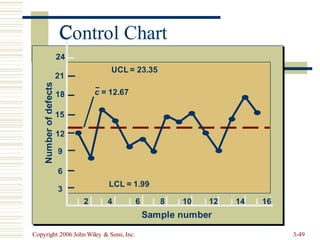
  • 48.
    Processes and Technology Professionalservice  highly customized and very labor intensive ◼ Service shop  customized and labor intensive ◼ Mass service  less customized and less labor intensive ◼ Service Factory  least customized and least labor intensive ◼ Copyright 2006 John Wiley & Sons, Inc. 2-19 Service Strategy: Processes and Techn
  • 49.
    Service-Process Matrix Source: Adaptedfrom Roger Schmenner, “How Can Service Businesses Survive and Prosper?” SloanManagement Review 27(3):29 Copyright 2006 John Wiley & Sons, Inc. 2-20 Service-Process Matr
  • 50.
    Copyright 2006 JohnWiley & Sons, Inc. 2-21 on extensive training in medicine. delivery is affectedby students in each class. Service Factory Electricity is a commodity available continuously to customers. Mass Service A retail store provides a standard array of products from which customers may choose. Service Shop Although a lecture may be prepared in advance, its Professional Service A doctor provides personal service to eachpatient based
  • 51.
    Capacity and Facility Capacity strategic decisions include: When, how much, and in what form to alter ◼ capacity Facility strategic decisions include:  whether demand should be met with a few large ◼ facilities or with several smaller ones whether facilities should focus on serving certain geographic regions, product lines, or customers facility location can also be a strategic decision ◼ ◼ Copyright 2006 John Wiley & Sons, Inc. 2-22 Operations Strategy:
  • 52.
    Human Resources What isskill levels and degree of autonomy required to operate production system? What are training requirements and selection criteria? What are policies on performance evaluations, compensation, and incentives?      Will workers be salaried, paid paid a piece rate? Will profit sharing be allowed, criteria? an hourly and if so, rate, or on what Copyright 2006 John Wiley & Sons, Inc. 2-23 Operations Strategy:
  • 53.
    Human Resources (cont.) Willworkers perform individual tasks or work in teams? Will they have supervisors or work in self- managed work groups? How many levels of management will be required? Will extensive worker training be necessary? Should workforce be cross-trained? What efforts will be made in terms of retention?       Copyright 2006 John Wiley & Sons, Inc. 2-24 Operations Strategy: Human Resources (c
  • 54.
    Quality What is targetlevel of quality for our products and services? How will it be measured? How will employees be involved with quality?     What will be the responsibilities quality department? of the Copyright 2006 John Wiley & Sons, Inc. 2-25 Operations Strategy:
  • 55.
    Quality (cont.) What typesof systems will be set up to ensure quality?  How How How will will will quality awareness be maintained? quality efforts be evaluated?    customer perceptions of quality be determined? How will decisions affect quality? in other functional areas  Copyright 2006 John Wiley & Sons, Inc. 2-26 Operations Strategy:
  • 56.
    Sourcing Vertical integration  degree towhich a firm produces parts that go ◼ into its products Strategic Decisions  How much of work should be done outside firm? the ◼ On what basis should particular items made in-house? When should items be outsourced? How should suppliers be selected? be ◼ ◼ ◼ Copyright 2006 John Wiley & Sons, Inc. 2-27 Operations Strategy:
  • 57.
    Sourcing (cont.) What typeof relationship should be maintained with suppliers? What is expected from suppliers? How many suppliers should be used? ◼ ◼ ◼ How can quality and dependability suppliers be ensured? of ◼ How can suppliers collaborate? be encouraged to ◼ Copyright 2006 John Wiley & Sons, Inc. 2-28 Operations Strategy:
  • 58.
    Operating Systems How willoperating systems execute decisions? How to align information technology strategic and    operations strategic goals? How information technology supports both customer and worker demands for rapid access, storage, and retrieval of information? How information technology support decisions making process related to inventory levels, scheduling priorities, and reward systems?  Copyright 2006 John Wiley & Sons, Inc. 2-29 Operations Strategy:
  • 59.
    Copyright 2006 JohnWiley & Sons, Inc. 2-30 Financial Strategy Operations Strategy Marketing Strategy Corporate Strategy Mission and Vision Strategic Planning
  • 60.
    Performance Indicators Robert Kaplan andDavid l Press, 2004), Figure 3-2, Copyright 2006 John Wiley & Sons, Inc. 2-32 Key Perform Source: Robert Kaplan and Davi Norton, Strategy Maps: Converting Intangible Assets into Tangible Outcomes (Boston: Harvard Business Schoo Press, 2004), Figure 3-2 p. 67
  • 61.
    Dashboard Radar Chart Copyright 2006John Wiley & Sons, Inc. 2-33 Balanced Scorecard
  • 62.
    Operations Global markets, globalsourcing, and global operations Virtual companies      Greater choice, more Emphasis on service Speed and flexibility individualism Copyright 2006 John Wiley & Sons, Inc. 2-34 Issues and Trends in
  • 63.
    Operations (cont.) Supply chains Collaborativecommerce Technological advances Knowledge and ability to      learn Environmental and responsibilities social Copyright 2006 John Wiley & Sons, Inc. 2-35 Issues and Trends in
  • 64.
    Changing Corporation 20th-Century 21st-Century CharacteristicCorporation Corporation  Interdependencies Source: Reprinted from John Byrne, “Management by Web,” Business Week (August 28, 2000), p. 87 by special permission, copyright 2000 by The McGraw-Hill Companies, Inc. Copyright 2006 John Wiley & Sons, Inc. 2-36 Organization Focus Style Source of strength Structure Resources  Pyramid  Internal  Structures  Stability  Self-sufficiency  Physical assets  Web  External  Flexible  Change  Information Changing Corporatio
  • 65.
    Changing Corporation (cont.) 20th-Century 21st-Century CharacteristicCorporation Corporation  Hours Source: Reprinted from John Byrne, “Management by Web,” Business Week (August 28, 2000), p. 87 by special permission, copyright 2000 by The McGraw-Hill Companies, Inc. Copyright 2006 John Wiley & Sons, Inc. 2-37 Operations Products Reach Financials Inventories Strategy  Vertical integration  Mass production  Domestic  Quarterly  Months  Top-down  Virtual integration  Mass customization  Global  Real-time  Bottom-up Changing Corporatio
  • 66.
    Changing Corporation (cont.) 20th-Century 21st-Century CharacteristicCorporation Corporation Leadership Workers Job expectations Motivation Improvements Quality Source: Reprinted from John Byrne, “Management by Web,” Business Week (August 28, 2000), p. 87 by special permission, copyright 2000 by The McGraw-Hill Companies, Inc. Copyright 2006 John Wiley & Sons, Inc. 2-38  Dogmatic  Employees  Security  To compete  Incremental  Affordable best  Inspirational  Employees, free agents  Personal growth  To build  Revolutionary  No compromise Changing Corporatio
  • 68.
  • 69.
    Meaning of Quality TotalQuality Management Quality Improvement and Employees    Role of Strategic Implications Six Sigma of TQM   Copyright 2006 John Wiley & Sons, Inc. 3-2 Lecture Outline
  • 70.
    Lecture Outline (cont.) TQMin Service Companies Cost of Quality Quality Management and Productivity Identifying Quality Problems and Causes      Quality Awards Standards ISO 9000 and Setting Quality  Copyright 2006 John Wiley & Sons, Inc. 3-3 Lecture Outline (con
  • 71.
    Webster’s Dictionary ▪ ▪ degree ofexcellence of a thing ▪ American Society for Quality totality of features and characteristics ▪ that satisfy needs Consumer’s and Perspective Producer’s ▪ Copyright 2006 John Wiley & Sons, Inc. 3-4 Meaning of Quality
  • 72.
    Dimensions of Quality: ManufacturedProducts Performance ▪ basic operating characteristics of a product; how ▪ well a car is handled or its gas mileage Features ▪ “extra” items added to basic features, such as a ▪ stereo CD or a leather interior in a car Reliability ▪ probability that a product will operate properly within an expected time frame; that is, a TV will work without repair for about seven years ▪ Copyright 2006 John Wiley & Sons, Inc. 3-6 Dimensions of Qual Manufactured Produ
  • 73.
    Dimensions of Quality: ManufacturedProducts (cont.) Conformance degree to which a product meets pre–established standards Durability ▪ ▪ ▪ ▪ how long product lasts before replacement ▪ Serviceability ease of getting repairs, speed of repairs, and competence of repair person courtesy ▪ Copyright 2006 John Wiley & Sons, Inc. 3-7 Dimensions of Qual Manufactured Produ
  • 74.
    Dimensions of Quality: ManufacturedProducts (cont.) Aesthetics ▪ how a product looks, feels, sounds, ▪ smells, or tastes Safety ▪ assurance that customerwill not suffer injury or harm from a product; an especially important consideration for ▪ automobiles Perceptions ▪ subjective perceptions based on brand name, advertising, and the like ▪ Copyright 2006 John Wiley & Sons, Inc. 3-8 Dimensions of Qualit Manufactured Produ
  • 75.
    Dimensions of Quality: Service Timeand Timeliness ▪ How long must a customer wait for service, and is it completed on time? Is an overnight package delivered overnight? ▪ ▪ Completeness: ▪ Is everything customer asked for provided? Is a mail order from a catalogue company complete when delivered? ▪ ▪ Copyright 2006 John Wiley & Sons, Inc. 3-9 Dimensions of Qual
  • 76.
    Dimensions of Quality: Service(cont.) Courtesy: ▪ How are customers treated by employees? Are catalogue phone operators nice and are their voices pleasant? ▪ ▪ Consistency ▪ Is the same level of service provided to each customer each time? Is your newspaper delivered on time every morning? ▪ ▪ Copyright 2006 John Wiley & Sons, Inc. 3-10 Dimensions of Qual
  • 77.
    Dimensions of Quality: Service(cont.) Accessibility and convenience ▪ How easy is it to obtain service? Does a service representative answer you calls ▪ quickly? ▪ Accuracy ▪ Is the service performed right every time? Is your bank or credit card statement correct every month? ▪ ▪ Responsiveness ▪ How well does the company react to unusual situations? How well is a telephone operator able to respond to a customer’s questions? ▪ ▪ Copyright 2006 John Wiley & Sons, Inc. 3-11 Dimensions of Qualit
  • 78.
    A Final Perspective Consumer’sand producer’s ▪ perspectives depend on each other Consumer’s perspective: PRICE Producer’s perspective: COST Consumer’s view must dominate ▪ ▪ ▪ Copyright 2006 John Wiley & Sons, Inc. 3-13 Meaning of Quality:
  • 79.
    Total Quality Management Commitmentto quality throughout organization  Copyright 2006 John Wiley & Sons, Inc. 3-15  Principles of TQM ◼ Customer-oriented ◼ Leadership ◼ Strategic planning ◼ Employee responsibility ◼ Continuous improvement ◼ Cooperation ◼ Statistical methods ◼ Training and education Total Quality Manag
  • 80.
    Copyright 2006 JohnWiley & Sons, Inc. 3-18 1. Create constancy of purpose 2. Adopt philosophy of prevention 3. Cease mass inspection 4. Select a few suppliers based on quality 5. Constantly improve system and workers Deming’s 14 Points
  • 81.
    Deming’s 14 Points(cont.) Copyright 2006 John Wiley & Sons, Inc. 3-19 1. Institute worker training 2. Instill leadership among supervisors 3. Elimina te fear among employees 4. Elimina te barriers between departments 5. Elimina te slogans Deming’s 14 Points (
  • 82.
    Deming’s 14 Points(cont.) Copyright 2006 John Wiley & Sons, Inc. 3-20 1. Remove numerical quotas 2. Enhance worker pride 3. Institute vigorous training and education programs 4. Develop a commitment from top management to implement above 13 points Deming’s 14 Points (
  • 84.
    and Role ofEmployees Participative problem solving  employees involved in quality management every employee has undergone extensive training to provide quality service to Disney’s guests ◼ ◼ Copyright 2006 John Wiley & Sons, Inc. 3-23 Quality Improvement and Role of Employ
  • 85.
    Quality Presentation Group processes MonitoringProblem analysis Copyright 2006 John Wiley & Sons, Inc. 3-24 Circle Organization ers Same area Supervisor/moderator Training Implementation Data collection Problem Solution Identification Problem results List alternatives Consensus Problem Brainstorming Analysis Cause and effect Data collection and analysis Quality Circle Organizat 8-10 memb
  • 86.
    Strategic Implications TQM of  Strongleadership  Goals, vision, or mission  Operational plans and policies  Mechanism for feedback Copyright 2006 John Wiley & Sons, Inc. 3-25 Strategic Implications
  • 87.
    A process fordeveloping and delivering near perfect products and services Measure of how much a process deviates from perfection 3.4 defects per million opportunities Champion     an executive responsible for project success ◼ Copyright 2006 John Wiley & Sons, Inc. 3-26 Six Sigma
  • 88.
    Copyright 2006 JohnWiley & Sons, Inc. 3-28 Six Sigma: DMAIC DEFINE MEASURE ANALYZE IMPROVE CONTROL 67,000 DPMO cost = 25% of sales 3.4 DPMO
  • 89.
    Seven Quality ControlTools Pareto Analysis Flow Chart Check Sheet Histogram     Scatter Diagram SPC Chart Cause-and-Effect Diagram    Copyright 2006 John Wiley & Sons, Inc. 3-42 Seven Quality Control
  • 90.
    Copyright 2006 JohnWiley & Sons, Inc. 3-43 NUMBER OF CAUSE DEFECTS PERCENTAGE Poor design 80 64 % Wrong part dimensions 16 13 Defective parts 12 10 Incorrect machine calibration 7 6 Operator errors 4 3 Defective material 3 2 Surface abrasions 3 2 125 100 % Pareto Analysis
  • 91.
    10 Copyright 2006 JohnWiley & Sons, Inc. 3-44 Percent from each cause (64) (13) (6) 70 60 Pareto Chart 50 40 30 20 (10) (3) (2) (2) 0 Causes of poor quality
  • 92.
    Finish Finish Copyright 2006 JohnWiley & Sons, Inc. 3-45 Flow Chart Start/ Operation Operation Decision Operation Operation Operation Decision Start/
  • 93.
    Copyright 2006 JohnWiley & Sons, Inc. 3-46 COMPONENTS REPLACED BY LAB TIME PERIOD: 22 Feb to 27 Feb 2002 REPAIR TECHNICIAN: Bob TV SET MODEL 1013 Integrated Circuits |||| Capacitors |||| |||| |||| |||| |||| || Resistors || Transformers |||| Commands CRT | Check Sheet
  • 94.
    0 Copyright 2006 JohnWiley & Sons, Inc. 3-47 20 15 10 5 1 2 6 13 10 16 19 17 12 16 2017 13 5 6 2 1 Histogram
  • 95.
    Copyright 2006 JohnWiley & Sons, Inc. 3-48 Scatter Diagram Y X
  • 96.
    Control Chart Copyright 2006John Wiley & Sons, Inc. 3-49 Number of defects C 24 21 18 15 12 9 6 3 UCL = 23.35 c = 12.67 LCL = 1.99 2 4 6 8 10 12 14 16 Sample number
  • 97.
    Defective from vendorPoor process design control Not to specifications management Copyright 2006 John Wiley & Sons, Inc. 3-50 Cause-and-Effect Diagram Measurement Human Machines Faulty testing equipment Poor supervision Out of adjustment Incorrect specifications Lack of concentration Tooling problems Improper methods Inadequate training Old / worn Quality Inaccurate Problem temperature Ineffective quality Dust and Dirt Material- Deficiencies handling problems in product design Environment Materials Process
  • 98.
    Created in 1987to stimulate growth of quality management in the United States Categories Leadership Information and analysis Strategic planning Human resource Focus Process management Business results Customer and market focus ◼ ◼ ◼ ◼ ◼ ◼ ◼ ◼ Copyright 2006 John Wiley & Sons, Inc. 3-51 Baldrige Award
  • 99.
    Implications of ISO Companies 9000for U.S. Many overseas companies will not do business with a supplier unless it has ISO 9000 certification ISO 9000 accreditation ISO registrars     A total commitment to is required throughout organization quality an Copyright 2006 John Wiley & Sons, Inc. 3-55 Implications of ISO 9000
  • 101.
  • 102.
    •Design Process •Concurrent Design •Technologyin Design •Design Reviews •Design for Environment •Design for Robustness •Quality Function Deployment 4-187 Lecture Outline
  • 103.
    • Effective designcan provide a competitive edge • matches product or service characteristics with customer requirements • ensures that customer requirements are met in the simplest and least costly manner • reduces time required to design a new product or service • minimizes revisions necessary to make a design workable Copyright 2009 John Wiley & Sons, Inc. 4-188 Design Process
  • 104.
    Design Process (cont.) •Productdesign • defines appearance of product • sets standards for performance • specifies which materials are to be used • determines dimensions and tolerances 4-189 Design Process (cont
  • 105.
    • A newapproach to design that involves • • Involves suppliers Incorporates production process Uses a price-minus simultaneous design of products and processes by design teams • system Scheduling and management can be complex as tasks are done in parallel Uses technology to aid design • • Improves quality of design decisions early • 4-207 Concurrent Design
  • 106.
    Technology in Design •Computer Aided Design (CAD) • assists in creation, modification, and a design analysis of • computer-aided engineering (CAE) • tests and analyzes designs on computer screen • computer-aided manufacturing (CAD/CAM) • ultimate design-to-manufacture connection • product life cycle management (PLM) • managing entire lifecycle of a product • collaborative product design (CPD) 4-208 Technology in Desig
  • 107.
    Collaborative Product Design •A software system for collaborative design and development among trading partners With PML, manages product data, sets up project workspaces, and follows life cycle of the product • • Accelerates product development, helps to resolve product launch issues, and improves quality Designers can • conduct virtual review sessions • test “what if” scenarios • assign and track design issues • communicate with multiple tiers of suppliers • create, store, and manage project documents of design • 4-209 Collaborative Product (CPD)
  • 108.
    • Review designsto prevent failures and ensure value • Failure mode and effects analysis (FMEA) • a systematic method of analyzing product failures • Fault tree analysis (FTA) • a visual method for analyzing interrelationships among failures • Value analysis (VA) • helps eliminate unnecessary features and functions 4-210 Design Review
  • 109.
    Design for Environmentand Extended Producer Responsibility • Design for environment • designing a product from material that can be recycled • design from recycled material • design for ease of repair • minimize packaging • minimize material and energy used during manufacture, consumption and disposal Extended producer responsibility • holds companies responsible for their product even after useful life • its 4-215 Design for Environmen Extended Producer Res
  • 110.
  • 111.
    • Ability tomeet present needs without compromising those of future generations • Green • Use product design fewer materials • Use recycled materials or recovered components • Don't assume natural materials are always better • Don't forget energy consumption • Extend useful life of product • Involve entire supply chain • Change paradigm of design Source: Adapted from the Business Social Responsibility Web site, w ww.bsr.org, accessed April1, 2007. 4-217 Sustainability
  • 112.
    • Translates voiceof customer into technical design requirements • Displays requirements in matrix diagrams • first matrix called “house of quality” • series of connected houses 4-218 Quality Function Deployment (QFD)
  • 113.
  • 114.
    Material used insoleplate + + - - + 4-222 Thickness of soleplate Number of holes Size of holes Flow of water from holes Time required to reach 450º Time to go from 450º to 100º Energy needed to press Weight of iron Size of soleplate Tradeoff Matrix
  • 115.
    Our Iron (X)2 1.7 9x5 4 T 35 15 0.7 50 600 N Y Estimated impact Design changes * * * * * * * 4-223 Obj ective measures Energy needed to press Weight of iron Size of soleplate Thickness of soleplate Material used in soleplate Num ber of holes Size of holes Flow of w ater from holes Tim e required to reach 450º Tim e to go from 450º to 100º Protective cover for soleplate Units of measure ft-lb lb in. cm ty ea mm oz/s sec sec Y/N Y/N Iron A 3 1.4 8x4 2 SS 27 15 0.5 45 500 N Y Iron B 4 1.2 8x4 1 MG 27 15 0.3 35 350 N Y 3 4 4 4 5 4 3 2 5 5 3 0 Estimated cost 3 3 3 3 4 3 3 3 4 4 5 2 Targets 1.2 8x5 3 SS 30 30 500 Targeted Changes in Design
  • 116.
    SS = Silverstone MG= Mirorrglide T = Titanium 4-224 Completed House of Quality
  • 117.
    A Series ofConnected characteristics House of quality Parts deployment Process planning Operating requirements 4-225 ustomer uirements Product characteristics Part characteristics Process characteristics Operations A-4 Process characteristics A-3 A-2 Part Product characteristics A-1 C req A Series of Connect QFD Houses
  • 118.
    • Promotes betterunderstanding of customer demands • Promotes better understanding of design interactions • Involves manufacturing in design process • Provides documentation of design process 4-226 Benefits of QFD
  • 119.
    s • Robust product •designed to withstand variations in environmental operating conditions Robust design and • • yields a product or service designed to withstand variations Controllable factors • design parameters such as material used, dimensions, and form of processing Uncontrollable factors • user's control (length of use, maintenance, settings, etc.) • • 4-227 Design for Robustnes
  • 120.
    s (cont.) • Tolerance •allowable ranges of variation in the dimension of part a • Consistency • consistent errors are easier to correct than random errors • parts within tolerances may yield assemblies that are not within limits • consumers prefer product characteristics near their ideal values 4-228 Design for Robustnes
  • 121.
    Taguchi’s Quality Loss •Quantifies customer preferences toward quality • Emphasizes that customer preferences are strongly oriented toward consistently Design for Six Sigma (DFSS) • 4-229 Quality Loss Low er T arget Upper tolerance tolerance limit limit Taguchi’s Quality Lo Function
  • 122.
  • 123.
    •Service Economy •Characteristics ofServices •Service Design Process •Tools for Service Design •Waiting Line Analysis for Service Improvement 5-232 Lecture Outline
  • 124.
    Source:U.S.Bureau of LaborStatistics,IBMAlmaden Research Center 5-233 Service Economy
  • 125.
    Characteristics of Services •Services • acts, deeds, or performances • Goods • tangible objects • Facilitating services • accompany almost all • Facilitating goods • accompany almost all purchases of goods service purchases 5-235 Characteristics of Ser
  • 126.
    • Services are intangible Serviceoutput is variable • Service inseparable from delivery Services tend to be • • decentralized and dispersed Services are consumed more than products Services can be emulated • Services have higher customer contact Services are perishable • often • • easily 5-237 Characteristics of Services (cont.)
  • 127.
  • 128.
    • Service concept •purpose of a service; it defines target market and customer experience • Service package • mixture of physical items, sensual benefits, and psychological benefits • Service specifications • performance specifications • design specifications • delivery specifications 5-239 Service Design Process (cont.)
  • 129.
    Tools for ServiceDesign • Service blueprinting • Servicescapes • line • line of of influence interaction space and function ambient conditions • • • line • line of of visibility support signs, symbols, artifacts Quantitative techniques and • • • Front-office/Back- office activities 5-245 Tools for Service De
  • 130.
    • Operating characteristics •average values for characteristics that describe performance of waiting line system • Queue • a single waiting line • Waiting line system • consists of arrivals, servers, and waiting line structure • Calling population • source of customers; infinite or finite 5-248 Elements of Waiting Line Analysis
  • 131.
    Waiting Line Analysis(cont.) • Arrival rate (λ) • frequency at which customers arrive at a waiting line according to a probability distribution, usually Poisson Service time (µ) • • time required to serve a customer, usually described by negative exponential distribution Service rate must be shorter than arrival rate (λ < Queue discipline • order in which customers are served Infinite queue • can be of any length; length of a finite queue is limited • • µ) • 5-250 Elements of Waiting Line Analysis
  • 132.
    Waiting Line Analysis(cont.) • Channels • number of parallel servers for servicing customers • Phases • number of servers in sequence a customer must go through 5-251 Elements of Waiting Line Analysis
  • 134.
  • 135.
    Lecture outline      Service economy Characteristicsof services Service design process Tools for service design Waiting line analysis improvement for service 5-2
  • 136.
    Service Economy Source: U.S.Bureau of Labor Statistics, IBM Almaden Research Center 5-3
  • 137.
    Characteristics of Services Services acts, deeds, or performances   Goods tangible objects   Facilitating services accompany almost all purchases of goods   Facilitating goods accompany almost all service purchases  5-5
  • 138.
    Characteristics of Services(cont.)   Services are Service inseparable intangible Service output from delivery Services tend to be dispersed Services are consumed more often than products   is variable decentralized and  Services have higher  customer contact Services are perishable   Services can be emulated easily 5-7
  • 139.
  • 140.
    Service Design Process(cont.)  Service concept purpose of a service; it defines target market customer experience Service package and   mixture of physical items, sensual psychological benefits Service specifications benefits, and   performance specifications design specifications delivery specifications    5-9
  • 141.
    Tools for Service Servicescapes Design  Service blueprinting space and function ambient conditions line of influence line of interaction line of visibility line of support     signs, symbols, artifacts and     Quantitative techniques  Front-office/Back- office activities 5-15
  • 142.
    Elements of WaitingLine Analysis  Operating characteristics average values for characteristics that describe performance of waiting line system Queue   a single waiting line   Waiting line system consists of arrivals, servers, and waiting structure Calling population line   source of customers; infinite or finite  5-18
  • 143.
    Elements of Waiting LineAnalysis (cont.)  Arrival rate (λ) frequency at which customers arrive at a waiting line according to a probability distribution, usually Poisson Service time (μ)   time required to serve a customer, usually described by negative exponential distribution Service rate must be shorter than arrival rate (λ < Queue discipline    μ) order in which customers are served   Infinite queue can be of any length; length of a finite queue is limited  5-20
  • 144.
    Elements of Waiting LineAnalysis (cont.)  Channels number of parallel servers for servicing customers Phases   number of servers in sequence a customer must go through  5-21
  • 145.
    Operating Characteristics  Operatingcharacteristics are assumed to approach a steady state 5-22
  • 146.
    Traditional Cost Relationships as service improves, cost increases 5-23
  • 147.
    Psychology of Waiting Disney Waiting rooms  magazines and newspapers televisions costumed characters mobile vendors accurate wait times     Bank of America   mirrors special passes   Supermarkets  magazines “impulse purchases”   5-24
  • 148.
    Psychology of Waiting(cont.)  Preferential treatment Grocery stores: express lanes for customers with few purchases Airlines/car rental agencies: special cards available to frequent-users or for an additional fee   Phone retailers: route calls to more or less  experienced salespeople based on customer’s sales history  Critical service providers services of police department, fire department, waiting is unacceptable; cost is not important etc.   5-25
  • 149.
    Waiting Line Models Single-server model simplest, most basic waiting line structure   Frequent variations (all with Poisson arrival rate) exponential service times general (unknown) distribution of service times constant service times exponential service times with finite queue exponential service times with finite calling population      5-26
  • 150.
    Basic Single-Server Model  Assumptions Computations Poisson arrival rate λ = μ = n = mean arrival rate   exponential times service mean service number of rate    first-come, first- customers in line  served queue discipline infinite queue infinite calling population length   5-27
  • 151.
    Basic Single-Server Model(cont.)   probability that no customers are in queuing system average number of customers in queuing system P0 = ( ) λ – λ 1 L = μ μ – λ   probability of n customers in average number of customers queuing system in waiting line Pn = ( )λ ∙ P (0 = )( ) λ λ λ2 n n L = λ q μ (μ – λ) 1 – μ μ μ 5-28
  • 152.
    Basic Single-Server Model(cont.)   average time customer spends in queuing system probability that server is busy and a customer has to wait (utilization factor) 1 L λ W = = λ ρ = μ – λ μ  probability that server is idle and customercan be served  average time customer spends waiting in line λ I = 1 – ρ λ Wq = μ (μ – λ) = 1 – P0 = μ 5-29
  • 153.
  • 154.
  • 155.
    Service Improvement Analysis waiting time (8 min.) is too long hire assistant for cashier? increased service rate hire another cashier? reduced arrival rate    Is improved service worth the cost? 5-32
  • 156.
    Advanced Single-Server Models Constant service times occur most often when automated equipment machinery performs service or   Finite queue lengths there is a physical limitation occur when waiting line Finite calling to length of   population number of “customers” that can arrive is limited  5-34
  • 157.
    Basic Multiple-Server Model single waiting line and service facility with several independent servers in parallel same assumptions as single-server model sμ > λ   s = number of servers servers must be able to they arrive  serve customers faster than  5-36
  • 158.
    Basic Multiple-Server Model(cont.)  probability that there are no 1 customers in system P0 = = s – 1 ∑ n + = 0 1 1 sμ λ λ n s n!( μ ) ( s! )( μ ) sμ - λ  probability of n customers in system 1 λ n – s( μ)P0, { for n > s s!sn 1 Pn = λ n ( )P0, for n ≤ n! μ s 5-37 n
  • 159.
    Basic Multiple-Server Model(cont.)  probability that customer must wait 1 ( λ ) s sμ λ Pw = P Lq = L – s! μ sμ – μ 0 λ λμ (λ/μ)s 1 Lq L = Wq = W – = λ μ λ P0 + (s – 1)! μ (sμ – λ)2 L λ W = ρ = sμ λ 5-38
  • 160.
  • 161.
  • 162.
  • 163.
  • 164.
  • 165.
    Basic Multiple-Server Example (cont.) Model To cut wait time, representative add another service now, s = 4   Therefore: 5-44
  • 167.
  • 168.
    •Process Planning •Process Analysis •ProcessInnovation •Technology Decisions 6-277 Lecture Outline
  • 169.
    • Process • agroup of related tasks with specific inputs and outputs Process design • what tasks need to be done and how they are • coordinated among functions, people, and organizations Process strategy • an organization's overall approach for physically producing goods and services Process planning • converts designs into workable instructions for manufacture or delivery • • 6-278 Process Planning
  • 170.
    • Vertical integration •extent to which firm will produce inputs and control outputs each stage of production process Capital intensity of • • mix of capital (i.e., equipment, automation) and labor resources used in production process Process flexibility • ease with which resources can be adjusted in response to changes in demand, technology, products or services, and resource availability Customer involvement • role of customer in production process • • 6-279 Process Strategy
  • 171.
    PROJECT BA TCH MASSCONT. individual Source: Adapted from R. Chase, N. Aquilano, and R. Jacobs, Operations Management for Competitive Advantage (New York:McGraw-Hill, 2001), p. 210 6-284 Type of product Unique Made-to- order (customized) Made-to- stock (standardized ) Commodity Type of customer Product demand One-at-a- time Infrequent Mass market Mass market Very stable Few customers Fluctuates Stable Types of Processes
  • 172.
    Types of Processes(cont.) PROJECT BA TCH MASS CONT. assembly Source: Adapted from R. Chase, N. Aquilano, and R. Jacobs, Operations Management for Competitive Advantage (New York:McGraw-Hill, 2001), p. 210 6-285 Demand volume Very low Low to medium High Very high No. of different products Production system Infinite variety Long-term project Few Very few Continuous, process industries Many, varied Discrete, job shops Repetitive, lines Types of Processes (
  • 173.
    Types of Processes(cont.) PROJECT BA TCH MASS CONT. automated refining range of Source: Adapted from R. Chase, N. Aquilano, and R. Jacobs, Operations Management for Competitive Advantage (New York:McGraw-Hill, 2001), p. 210 6-286 Equipment Varied General- purpose Special- purpose Highly Primary type of work Worker skills Specialized contracts Experts, crafts- persons Assembly Mixing, treating, Equipment monitors Fabrication Wide range of skills Limited skills Types of Processes (
  • 174.
    Types of Processes(cont.) PROJECT BA TCH MASS CONT. large capacity, atest technolog far-reaching errors, televisions, shipbuilding, fast food Source: Adapted from R. Chase, N. Aquilano, and R. Jacobs, Operations Management for Competitive Advantage (New York:McGraw-Hill, 2001), p. 210 6-287 Advantages l Custom work, y Flexibility, quality Efficiency, speed, low cost Highly efficient, ease of control Dis- advantages Examples Non-repetitive, small customer base, expensive Construction, spacecraft Costly, slow, difficult to manage Capital investment; lack of responsiveness Difficult to change, limited variety Paint, chemicals, foodstuffs Machine shops, print shops, bakeries, education Automobiles, computers, Types of Processes (
  • 175.
    Process Selection with • • examinescost trade-offs associated with Cost • Fixed costs • constant regardless of the number of units demand volume produced • Variable costs • vary with the volume of units produced Revenue • price at which an item is sold Total revenue • is price times volume sold Profit • difference between total revenue and • • • total cost 6-288 Process Selection wit Break-Even Analysis
  • 176.
    Process Selection with (cont.) Totalcost = fixed cost + total variable TC = cf + vcv cost Total revenue = volume x price TR = vp Profit = total revenue - total cost Z = TR – TC = vp - (cf + vcv) 6-289 Process Selection wit Break-Even Analysis
  • 177.
    Process Selection with Break-EvenAnalysis (cont.) vp = cf + vcv cf Solving for Break-Even Point (Volume) 6-290 TR = TC vp - vcv = cf v(p - cv) = cf v = p - cv Process Selection wi Break-Even Analysi
  • 178.
    Break-Even Analysis: Example Fixedcost Variable cost Price = = = cf = $2,000 cv = $5 per raft p = $10 per raft v = = = 400 rafts 6-291 Break-even point is cf 2000 p - cv 10 - 5 Break-Even Analysis
  • 179.
    Break-Even Analysis: Graph cost line 6-292 Dollars $3,000— T otal $2,000 — $1,000 — T otal revenue line 400 Units Break-even point Break-Even Analysis
  • 180.
    Process A $2,000 +$5v Process B $10,000 + $3v = $2v v = = $8,000 4,000 rafts Below or equal to 4,000, choose A B Above or equal to 4,000, choose 6-294 Process Selection
  • 181.
    •Building a flowchart •Determine objectives • Define process boundaries • Define units of flow • Choose type of chart • Observe process and • Map out process • Validate chart collect data 6-297 Process Analysis
  • 182.
    •look at manufactureof product or delivery of service from broad perspective •Incorporate • nonproductive activities (inspection, transportation, delay, storage) • productive activities (operations) 6-298 Process Flowcharts
  • 183.
  • 184.
  • 185.
    Simple Value ChainFlowchart 6-302 Simple Value Chain
  • 186.
    of a processfor 6-303 Continuous improvement refines the breakthrough Breakthrough Improvement Continuous improvement activities peak; time to reengineer process T otal redesign breakthrough improvements Process Innovation
  • 187.
    Principles for Redesigning •Remove waste, simplify, and consolidate similar activities • Link processes to create value • Let the swiftest and most capable enterprise execute the process • Flex process for any time, any place, any way • Capture information digitally at the source and propagate it through process 6-307 Principles for Redesi Processes
  • 188.
    Principles for Redesigning •Provide visibility through fresher and richer information about process status • Fit process with sensors and feedback loops that can prompt action • Add analytic capabilities to process • Connect, collect, and create knowledge around process through all who touch it • Personalize process with preferences and habits of participants 6-308 Principles for Redesi Processes (cont.)
  • 189.
    Techniques for Generating •Vary the entry point to a problem • in trying to untangle fishing lines, it's best from the fish, not the poles to start • Draw analogies • a previous solution to an old problem might work • Change your perspective • think like a customer • bring in persons who have no knowledge of process 6-309 Techniques for Generat Innovative Ideas
  • 190.
    Techniques for Generating •Try inverse brainstorming • what would increase cost • what would displease the customer • Chain forward as far as possible • if I solve this problem, what is the next • Use attribute brainstorming • how would this process operate if. . . • our workers were mobile and flexible • there were no monetary constraints • we had perfect knowledge problem 6-310 Techniques for Generat Innovative Ideas (cont.)
  • 191.
    • Computer-aided design (CAD) •Group technology (GT) • Computer-aided engineering (CAE) • Collaborative product commerce (CPC) A Technology Primer Product Technology electronically electronically exchange of information among designers 6-313 • Computer-aided design (CAD) • Group technology • Creates and communicates designs • Classifies designs into families for easy (GT) • Computer-aided engineering (CAE) • Collaborative product commerce (CPC) retrieval and modification • T ests functionality of CAD designs • Facilitates electronic communication and and suppliers A Technology Prime
  • 192.
    • Product data management (PDM) •Product life cycle management (PLM) • Product configuration A Technology Primer (cont.) Product Technology for the life of the product customer service, recycling, and disposal (PLM) who have selected among various options, 6-314 • Product data management (PDM) • Keeps track of design specs and revisions • Integrates decisions of those involved in • Product life cycle management • Product configuration product development, manufacturing, sales, • Defines products “configured” by customers usually from a Web site A Technology Prime
  • 193.
    • Standard for exchangeof product model data (STEP) • Computer-aided design and manufacture (CAD/CAM) • Computer aided process (CAPP) • E-procurement A Technology Primer (cont.) Process Technology different CAD vendors; translates CAD data (CAD) and automated manufacture (CAM) manufacture database of similar requirements marketplaces, auctions, or company 6-315 • Standard for exchange of product model data • Set standards for communication among into requirements for automated inspection (STEP) • Computer-aided design and (CAD/CAM) • Computer aided process (CAPP) • E-procurement and manufacture • Electronic link between automated design • Generates process plans based on • Electronic purchasing of items from e- websites A Technology Prime
  • 194.
    • Computer numerically control (CNC) •Flexible manufacturing system (FMS) • Robots • Conveyors A Technology Primer (cont.) Manufacturing Technology variety of operations with the help of automated automated material handling system to produce a less flexible belt or overhead chain; “reads” packages and 6-316 • Computer numerically control (CNC) • Machines controlled by software code to perform a tool changers; also collects processing information and quality data • Flexible manufacturing system (FMS) • Robots • Conveyors • A collection of CNC machines connected by an wide variety of parts • Manipulators that can be programmed to perform repetitive tasks; more consistent than workers but • Fixed-path material handling; moves items along a diverts them to different directions; can be very fast A Technology Prime
  • 195.
    • Automatic guided vehicle(AGV) • Automated storage and retrieval system (ASRS) • Process Control • Computer-integrated manufacturing (CIM) A Technology Primer (cont.) Manufacturing Technology specified path; directed by wire or tape embedded • Automated storage maintenance, and quality manufacturing 6-317 • Automatic guided vehicle (AGV) • A driverless truck that moves material along a in floor or by radio frequencies; very flexible • An automated warehouse—some 26 stores high— and retrieval system (ASRS) • Process Control • Computer-integrated manufacturing (CIM) in which items are placed in a carousel-type storage system and retrieved by fast-moving stacker cranes; controlled by computer • Continuous monitoring of automated equipment; makes real-time decisions on ongoing operation, • Automated manufacturing systems integrated through computer technology; also called e- A Technology Prime
  • 196.
    • Business –to – Business (B2B) • Business – to – Consumer (B2C) • Internet • Intranet • Extranet A Technology Primer (cont.) Information Technology Consumer (B2C) organization; can be password (i.e., firewall) access with select suppliers, customers, and 6-318 • Business – to – Business (B2B) • Business – to – • Electronic transactions between businesses usually over the Internet • Electronic transactions between businesses and their customers usually over the Internet • Internet • Intranet • Extranet • A global information system of computer networks that facilitates communication and data transfer • Communication networks internal to an protected sites on the Internet • Intranets connected to the Internet for shared trading partners A Technology Prime
  • 197.
    • Bar Codes •Radio Frequency Identification tags (RFID) • Electronic data interchange (EDI) • Extensive markup language (XML) • Enterprise resource planning (ERP) A Technology Primer (cont.) Information Technology identifies item and other information when read by a • An integrated circuit embedded in a tag that can send (RFID) and inflexible data before its is sent human resources resource planning 6-319 • Bar Codes • Radio Frequency Identification tags • A series of vertical lines printed on most packages that scanner and receive information; a twenty-first century bar code • Electronic data interchange (EDI) • Extensive markup language (XML) • Enterprise (ERP) with read/write capabilities • A computer-to-computer exchange of business documents over a proprietary network; very expensive • A programming language that enables computer – to - computer communication over the Internet by tagging • Software for managing basic requirements of an enterprise, including sales & marketing, finance and accounting, production & materials management, and A Technology Prime
  • 198.
    • Supply chain management(SCM) • Customer relationship management (CRM) • Decision support systems (DSS) • Expert systems (ES) • Artificial intelligence (AI) A Technology Primer (cont.) Information Technology distributors compiling and analyzing customer data and an interactive component for what-if analysis • A field of study that attempts to replicate elements of systems, genetic algorithms, neural networks, and fuzzy 6-320 • Supply chain management (SCM) • Customer relationship • Software for managing flow of goods and information among a network of suppliers, manufacturers and • Software for managing interactions with customers and management (CRM) • Decision support systems (DSS) • Expert systems (ES) • Artificial intelligence (AI) • An information system that helps managers make decisions; includes a quantitative modeling component • A computer system that uses an expert knowledge base to diagnose or solve a problem human thought in computer processes; includes expert logic A Technology Prime
  • 200.
    O Op pe e a a o on ns sM Ma an na ag ge em me en n Capacity and Facilities Chapter 7
  • 201.
    • Capacity Planning •Basic Layouts • Designing Process Layouts • Designing Service Layouts • Designing Product Layouts • Hybrid Layouts Lecture Outline
  • 202.
    • Maximum capabilityto produce • Capacity planning • establishes overall level of productive resources for a firm • 3 basic strategies for timing of capacity expansion in relation to steady growth in demand (lead, lag, and average) Capacity
  • 203.
    • Capacity increasedepends on • volume and certainty of anticipated demand • strategic objectives • costs of expansion and operation • Best operating level • % of capacity utilization that minimizes unit costs • Capacity cushion • % of capacity held in reserve for unexpected occurrences Capacity (cont.)
  • 204.
    • it costsless per unit to produce high levels of output • fixed costs can be spread over a larger number of units • production or operating costs do not increase linearly with output levels • quantity discounts are available for material purchases • operating efficiency increases as workers gain experience Economies of Scale
  • 205.
    Best Operating Levelfor a Hotel Best Operating Level f
  • 206.
    • Process layouts •group similar activities together according to process or function they perform • Product layouts • arrange activities in line according to sequence of operations for a particular product or service • Fixed-position layouts • are used for projects in which product cannot be moved BASIC LAYOUTS
  • 207.
    Process Layout inServices Women’s lingerie Shoes Housewares Women’s dresses Cosmetics and jewelry Children’s department Women’s sportswear Entry and display area Men’s department Process Layout in Se
  • 208.
  • 209.
  • 210.
    Fixed-Position Layouts • Typicalof projects in which product produced is too fragile, bulky, or heavy to move • Equipment, workers, materials, other resources brought to the site Low equipment utilization Highly skilled labor Typically low fixed cost Often high variable costs • • • • 7-335 Fixed-Position Layo
  • 211.
    Designing Process Layouts •Goal: minimize material handling costs • Block Diagramming • minimize nonadjacent loads • use when quantitative data is • Relationship Diagramming • based on location preference • use when quantitative data is available between areas not available Designing Process L
  • 212.
    • Must beboth attractive and functional Types • Free flow layouts • encourage browsing, increase impulse purchasing, are flexible • and visually appealing • Grid layouts • encourage customer familiarity, are low cost, easy to clean and secure, and good for repeat customers • Loop and Spine layouts • both increase customer sightlines and exposure to products, while encouraging customer to circulate through the entire store Designing Service Layouts
  • 213.
  • 214.
    • Objective • Balancethe assembly line Line balancing • tries to equalize the amount of work at each • workstation Precedence requirements • physical restrictions on the order in which operations are performed Cycle time • maximum amount of time a product is allowed to spend at each workstation • • Designing Product Layouts
  • 215.
    Cd = desiredunits of output Cd = (120 units) = = 4 minutes Cd 120 production time available (8 hours x 60 minutes / hour) 480 Cycle Time Example
  • 216.
    Time • Cycle time= max time spent at any station • Flow time = time to complete all stations 4 minutes 4 minutes 4 minutes Flow time = 4 + 4 + 4 = 12 minutes Cycle time = max (4, 4, 4) = 4 minutes 3 2 1 Flow Time vs Cycle
  • 217.
    Efficiency of Lineand Balance Delay Efficiency workstations • Balance ∑ ∑ ti ti nCa Cd time of line ti = completion time for element i Efficiency of Line and Balance Dela Minimum number of i i ∑ti ∑ ti delay • total idle time of lin • calculated as (1 - efficiency) E = i = 1 N = i = 1 where j = number of work elements n = actual number of workstations Ca = actual cycle time Cd = desired cycle time
  • 218.
    dure 1. 2. 3. Draw and labela precedence diagram Calculate desired cycle time required for line Calculate theoretical minimum number of workstations 4. Group elements into workstations, recognizing time and precedence constraints Calculate efficiency of line Determine if theoretical minimum number of cycle 5. 6. workstations or an acceptable efficiency level has been reached. If not, go back to step 4. Line Balancing Proce
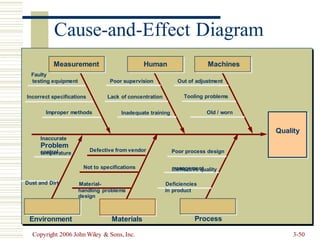
  • 219.
    B 0.4 Line Balancing: Example WORKELEMENT PRECEDENCE TIME (MIN) A Press out sheet of fruit — 0.1 B Cut into strips A 0.2 C Outline fun shapes A 0.4 D Roll up and package B, C 0.3 0.2 0.1 A D 0.3 C
  • 220.
    Cd = == 0.4 minute Line Balancing: Example (cont.) WORK ELEMENT PRECEDENCE TIME (MIN) A Press out sheet of fruit — 0.1 B Cut into strips A 0.2 C Outline fun shapes A 0.4 D Roll up and package B, C 0.3 40 hours x 60 minutes / hour 2400 6,000 units 6000 N = 0.1 + 0.2 + 0.3 + 0.4 = 1.0 = 2.5 � 3 workstations 0.4 0.4
  • 221.
    N = 2.5 0.4 LineBalancing: Example (cont.) REMAINING REMAINING WORKSTATION ELEMENT TIME ELEMENTS 1 A 0.3 B, C B 0.1 C, D 2 C 0.0 D 3 D 0.1 none B 0.2 0.1 A D 0.3 C Cd = 0.4
  • 222.
    Line Balancing: Example(cont.) Cd = 0.4 N = 2.5 1.2 3(0.4) E = 0.1 + 0.2 + 0.3 + 0.4 = 1.0 = 0.833 = 83.3% Work Work Work station 1 station 2 station 3 A, B C D 0.3 0.4 0.3 minute minute minute Line Balancing: Examp
  • 223.
    • Cellular layouts •group dissimilar machines into work centers (called cells) that process families of parts with similar shapes or processing requirements • Production flow analysis (PFA) • reorders part routing matrices to identify families of parts with similar processing requirements Flexible manufacturing system • automated machining and material handling systems which can produce an enormous variety of items Mixed-model assembly line • processes more than one product model in one line • • Hybrid Layouts
  • 224.
    Original Process Layout Assembly 46 7 9 5 8 2 1 3 10 12 11 A B C Raw materials Original Process Layou
  • 225.
    Revised Cellular Layout 11 Assembly 810 9 12 4 Cell 1 Cell 2 6 Cell 3 7 2 1 3 5 A B C Raw materials Revised Cellular Layou
  • 226.
    F x xx Reordered Routing Matrix Parts Machines 1 2 4 8 10 3 6 9 5 7 11 12 A D x x x x x x x x x x C G B x x x x x x x x x x x x x x x x x H E
  • 227.
    Advantages and Disadvantages •Advantages • Reduced material handling and transit • Reduced setup time • Disadvantages Inadequate part families Poorly balanced cells • time • Expanded training and scheduling of workers Increased capital investment • • Reduced work-in- process inventory • Better use of human resources • Easier to control • Easier to automate • Advantages and Disadv of Cellular Layouts
  • 228.
    • FMS consistsof numerous programmable machine tools connected by an automated material handling system and controlled a common computer network by • • FMS combines flexibility with efficiency FMS layouts differ based on • variety of parts that the system can process • size of parts processed • average processing time required for part completion Flexible Manufacturing Systems (FMS)
  • 229.
    • Produce multiplemodels in any order on one assembly line • Issues in mixed model lines • Line balancing • U-shaped lines • Flexible workforce • Model sequencing Mixed Model Assembly Lines
  • 230.
    O Op pe e a a o on ns sM Ma an na ag ge em me en n Facility Location Models Chapter 7 Supplement
  • 231.
    • Types ofFacilities • Site Selection: Where to Locate •Location Analysis Techniques Supplement 7-374 Lecture Outline
  • 233.
  • 234.
    • • Human Resources andQuality Management Changing Nature of Human Resources Management • Contemporary Trends in Human Resources Management Employee Compensation Managing Diversity in Workplace Job Design Job Analysis Learning Curves • • • • • 8-403 Lecture Outline
  • 235.
    Human Resources andQuality • Employees play important role in quality management Malcolm Baldrige National Quality Award winners have • Employees have power to make decisions that will improve quality and customer service • a pervasive human resource focus Employee training and • Strategic goals for quality and customer satisfaction require teamwork and participation group • education are recognized necessary long-term investments as 8-404 Human Resources and Management
  • 236.
    Changing Nature ofHuman Resources Management • Scientific management • Breaking down jobs into elemental activities and simplifying job design • Assembly-line • Production meshed with management principles of scientific • Jobs • Comprise a set of tasks, elements, and job motions (basic physical movements) In a piece-rate wage system, pay is based on output • Advantages of task specialization • High output, low costs, and minimal training Disadvantages of task specialization • Boredom, lack of motivation, and physical and mental fatigue • • 8-405 Changing Nature of Resources Managem
  • 237.
    Employee Motivation •Motivation •ImprovingMotivation (cont.) •design of jobs to fit employee •work responsibility •empowerment •willingness to work hard because that effort satisfies an employee need •Improving Motivation •positive reinforcement and feedback •restructuring of jobs when necessary •rewards based on company as well as individual performance •achievement of company goals •effective organization discipline and •fair treatment of people •satisfaction of employee needs •setting of work-related goals 8-406 Employee Motivatio
  • 238.
    f Self- actualization Esteem Social Safety/Security Physiological (financial) • Advancement 8-407 DouglasMcGregor’s Theory X and Theory Y Frederick Herzberg’s Hygiene/Motivation Theories •Theory X Employee • Dislikes work •Hygiene Factors • Company policies • Must be coerced • Shirks responsibility • Little ambition • Security top motivator •Theory Y Employee • Work is natural • Self-directed • Controlled • Accepts responsibility • Makes good decisions • Supervision • Working conditions • Interpersonal relations • Salary, status, security •Motivation Factors • Achievement • Recognition • Job interest • Responsibility • Growth Abraham Maslow’s Pyramid of Human Needs Evolution of Theories o Employee Motivation
  • 239.
    Contemporary Trends in HumanResources Management • Job training • extensive and varied • two of Deming’s 14 points refer to employee education and training • Empowerment giving employees authority to make decisions • • Cross Training • Teams • an employee than one job Job rotation learns more group of employees work on problems in their immediate work area • • • horizontal movement between two or more jobs according to a plan 8-408 Contemporary Trend Human Resources M
  • 240.
    Contemporary Trends inHuman Resources Management (cont.) • Job enrichment • vertical enlargement • allows employees control over their work • Alternative workplace • nontraditional work location Telecommuting • employees work electronically from a location they choose Temporary and part-time employees • horizontal enlargement • an employee is assigned a complete unit of work with defined start and end Flexible time • part of a daily work schedule in which employees can choose time of arrival and departure • • • mostly in fast-food and restaurant chains, retail companies, package delivery services, and financial firms • 8-409 Contemporary Trends i Resources Managemen
  • 241.
    Employee Compensation • Typesof pay • hourly wage • the longer someone works, the more s/he is paid • individual incentive or piece rate • employees are paid for the number of units during the workday • straight salary • common form of payment for management • commissions • usually applied to sales and salespeople they produce 8-410 Employee Compe
  • 242.
    Employee Compensation (cont.) •Gainsharing •an incentive plan joins employees in a common effort to achieve company goals in which they share in the gains •Profit sharing • sets aside a portion of profits employees at year’s end for 8-411 Employee Compensati
  • 243.
    Managing Diversity in •Workforce has become more diverse • 4 out of every 10 people entering workforce during the decade from 1998 to 2008 will be members of minority groups • In 2000 U.S. Census showed primarily Hispanic and Asian, majorities • Companies must develop a to managing diversity that some minorities, are becoming strategic approach 8-412 Managing Diversity i Workplace
  • 244.
    • Affirmative action• Managing diversity an outgrowth of laws and regulations government initiated and mandated process of creating a work environment in which all employees can contribute to their full potential in • • • order to achieve a company’s goals voluntary in nature, not mandated seeks to improve internal communications and interpersonal relationships, resolve conflict, and increase product quality, productivity, and efficiency 8-413 contains goals and timetables designed to increase level of participation by women and minorities to attain parity levels in a company’s workforce not directly concerned with increasing company success or increasing profits • • • • Affirmative Actions vs. Managing Diversity
  • 245.
    Diversity Management Programs •Education • Awareness • Communication • Fairness • Commitment 8-414 Diversity Management
  • 246.
    Global Diversity Issues •Cultural, language, geography • significant barriers to managing a globally diverse workforce E-mails, faxes, Internet, phones, air travel • make managing a global workforce possible but not • necessarily effective How to deal with diversity? • identify critical cultural elements • learn informal rules of communication • use a third party who is better able to bridge cultural gap • become culturally aware and learn foreign language • teach employees cultural norm of organization • 8-415 Global Diversity Issu
  • 247.
    Attributes of GoodJob Design • An appropriate degree repetitiveness An appropriate degree attention and mental of • Goals and achievement feedback A perceived contribution • of • to a useful product or absorption Some employee responsibility for decisions and discretion Employee control over their own job service Opportunities for and friendships Some influence over the in groups Use of skills • • personal relationships • • way work is carried out • 8-416 Attributes of Good J
  • 248.
    Factors in JobDesign • Task analysis • how tasks fit together to form a job Worker analysis • determining worker capabilities and responsibilities • for a job Environment analysis • physical characteristics and location of a job Ergonomics • fitting task to person in a work environment Technology and automation • broadened scope of job design • • • 8-417 Factors in Job Desig
  • 249.
    Elements of JobDesign 8-418 Elements of Job Desi
  • 250.
    •Method Analysis (workmethods) • Study methods used in the work included in the job to see how it should be done • Primary tools are a variety of charts that illustrate in different process is done ways how a job or work 8-419 Job Analysis
  • 251.
    8-420 Process Flowchart Symbols Operation: Anactivity directly contributing to product or service Transportation: Moving the product or service from one location to another Inspection: Examining the product or service for completeness, irregularities, or quality Delay: Process having to wait Storage: Store of the product or service
  • 252.
  • 253.
    Worker- Accept card Machine Chart Beginphoto process – Photo/card processed Idle 8-422 – 9 Date 10/14 Photo Machine – – 1 2 3 Key in customer data on card Feed data card in Position customer for phot 2.6 0.4 1.0 Idle – o Idle 4 5 6 7 8 Take picture Idle Inspect card & trim edges 0.6 3.4 1.2 – – – – Job Photo-Id Cards Time Time (min) Operator (min)
  • 254.
    Worker-Machine Chart: Summary 8-423 Summary Work Idle OperatorTime % Photo Machine Time % 5.8 63 3.4 37 4.8 52 4.4 48 Total 9.2 min 100% 9.2 Min 100% Worker-Machine Chart
  • 255.
    • Used toensure efficiency of motion in a job • Frank & Lillian Gilbreth • Find one "best way" to do task • Use videotape to study motions 8-424 Motion Study
  • 256.
    General Guidelines for •Efficient Use Of Human Body • Work •simplified, rhythmic and symmetric • Hand/arm motions •coordinated and simultaneous Employ full extent of physical capabilities Conserve energy •use machines, minimize distances, use momentum T asks •simple, minimal eye contact and muscular effort, no unnecessary motions, delays or idleness • • • 8-425 General Guidelines f Motion Study
  • 257.
    General Guidelines for •Efficient Arrangement of Workplace • T ools, material, equipment - designated, easily accessible location Comfortable and healthy seating and work area • • Efficient Use of Equipment • • • Equipment and mechanized tools enhance worker abilities Use foot-operated equipment to relieve hand/arm stress Construct and arrange equipment to fit worker use 8-426 General Guidelines f Motion Study
  • 258.
    • Illustrates improvement rateof workers as a job is repeated • Processing time per unit decreases by a constant percentage each time output doubles 8-427 Processing time per unit Units produced Learning Curves
  • 259.
    Learning Curves (cont.) 8-428 Timerequired for the nth unit = tn = t1nb where: tn = time required for nth unit produced t1 = time required for first unit produced n = cumulative number of units produced b = ln r where r is the learning curve percentage ln 2 (decimal coefficient) Learning Curves (co
  • 260.
    8-429 Contract to produce36 computers. t1 = 18 hours, learning rate = 80% What is time for 9th, 18th, 36th units? t9 = (18)(9)ln(0.8)/ln 2 = (18)(9)-0.322 = (18)/(9)0.322 = (18)(0.493) = 8.874hrs t18 = (18)(18)ln(0.8)/ln 2 = (18)(0.394) = 7.092hrs t36 = (18)(36)ln(0.8)/ln 2 = (18)(0.315) = 5.674hrs Learning Curve Effect
  • 261.
    8-430 Processing time per unit Learning Curve forMass Production Job End of improvement Standard time Units produced
  • 262.
    Learning Curves (cont.) •Advantages • planning labor • planning budget • Limitations product modifications negate learning curve effect • • determining scheduling requirements improvement can derive from sources besides learning industry-derived learning curve rates may be inappropriate • • 8-431 Learning Curves (cont.
  • 263.
    O Op pe e a a o on ns sM Ma an na ag ge em me en n Work Measurement Chapter 8 Supplement
  • 264.
    • Time Studies •Work Sampling Supplement 8-433 Lecture Outline
  • 266.
    O Op pe e a a o on ns sM Ma an na ag ge em me en n Project Management Chapter 9
  • 267.
    •Project Planning •Project Scheduling •ProjectControl •CPM/PERT •Probabilistic Activity Times •Microsoft Project •Project Crashing and Time-Cost Trade-off 9-451 Lecture Outline
  • 268.
  • 269.
    • Objective • Scope •Contract requirements • Schedules • Resources • Personnel • Control • Risk and problem analysis 9-455 Project Elements
  • 270.
    Project Team andProject Manager • Project team • made up of individuals from various areas and departments within a company • Matrix organization • a team structure with members from functional areas, depending on skills required • Project manager • most important member of project team 9-456 Project Team and Proje
  • 271.
    Scope Statement andWork •Scope statement • a document that provides an understanding, justification, and expected result of a project •Statement of work • written description of objectives of a project •Work breakdown structure (WBS) • breaks down a project into components, subcomponents, activities, and tasks 9-457 Scope Statement and Breakdown Structure
  • 272.
    •Steps • Define activities •Sequence • Techniques Gantt chart CPM/PERT • • activities • Estimate Microsoft Project • time • Develop schedule 9-461 Project Scheduling
  • 273.
    • Graph orbar chart with a bar for each project activity that shows passage of time • Provides visual display of project schedule • Slack • amount of time an activity can be delayed without delaying the project 9-462 Gantt Chart
  • 274.
    • Time management •Cost management • Quality management • Performance management • Earned Value Analysis • a standard procedure for numerically measuring a project’s progress, forecasting its completion date and cost and measuring schedule and budget variation • Communication • Enterprise project management 9-464 Project Control
  • 275.
    • Critical PathMethod (CPM) • DuPont & Remington-Rand (1956) • Deterministic task times • Activity-on-node network construction • Project Evaluation and Review Technique (PERT) • US Navy, Booz, Allen & Hamilton • Multiple task time estimates; probabilistic • Activity-on-arrow network construction 9-465 CPM/PERT
  • 276.
    • Activity-on-node (AON) •nodes represent activities, and arrows show precedence relationships Activity-on-arrow (AOA) • • arrows represent activities and nodes are events for points in time Event • completion or beginning of an activity in a project Dummy • two or more activities cannot share same start and end nodes • • 9-466 Node 1 2 3 Branch Project Network
  • 277.
    AOA Project Networkfor Lay Dummy house work 3 1 Design house Order and financing materials paint carpet 9-467 3 foundation 2 0 Build Finish 1 2 4 3 6 1 7 and obtain receive Select 1 1 Select 5 AOA Project Network a House
  • 278.
    Concurrent Activities Lay Dummy 2 0 23 2 4 Order material 9-468 Lay foundation 3 foundation 1 Order material (a) Incorrectprecedence (b) Correct precedence relationship relationship ConcurrentActiviti
  • 279.
    AON Network forHouse Finish work 3 2 1 1 and obtain 5 1 Select carpet 1 1 Select paint materials 9-469 Start Lay foundations Build house 2 4 7 3 Design house 3 6 financing Order and receive AON Network for H Building Project
  • 280.
    4 2 1 1 5 1 1 3+ 2 + 3 + 1 = 9 months through a network 3 + 2 + 1 + 1 + 1 = 8 months 3 + 1 + 3 + 1 = 8 months completion time 3 + 1 + 1 + 1 + 1 = 7 months 9-470 Start Critical Path 2 3 7 3 3 6 1 A: 1-2-4-7 • Critical path B: 1-2-5-6-7 • Longest path C: 1-3-4-7 • Minimum project D: 1-3-5-6-7
  • 281.
    Finish at 9months 3 2 1 1 5 1 1 Start at 3 months 9-471 Start Start at 5 months 2 4 7 Finish 3 3 6 1 Start at 6 months Activity Start Times
  • 282.
    • Earliest starttime (ES) • earliest time an activity can start • ES = maximum EF of immediate predecessors Forward pass • • starts at beginning of CPM/PERT network determine earliest activity times Earliest finish time (EF) • earliest time an activity can finish • earliest start time plus activity time • EF= ES + t to • 9-473 Activity Scheduling
  • 283.
    Activity Scheduling (cont.) •Latest start time (LS) • Latest time an activity can start without delaying critical path time • LS= LF - t • Latest finish time (LF) • latest time an activity can be completed without delaying critical path time • LF = minimum LS of immediate predecessors Backward pass • Determines latest activity times by starting at the of CPM/PERT network and working forward • end 9-475 Activity Scheduling (
  • 284.
    timates • Beta distribution •a probability distribution traditionally used in CPM/PERT Mean (expected time): t = b - a 6 9-478 a + 4m + b 6 2 V ariance: 2 = where a = optimistic estimate m = most likely time estimate b = pessimistic time estimate Probabilistic Time Es
  • 285.
    Equipment testing installation 1 4 debugging training development Manual1,4,7 2 3,7,11 Start System changeover 3 6 System 9-480 Project Network with Probabilistic Time Estimates: Example Equipment and modification 6,8,10 2,4,12 System Final System 8 10 testing 3,6,9 5 11 Finish Position 2,3,4 9 1,10,13 recruiting Job Training 2,4,6 1,3,5 3,4,5 testing Orientation 7 2,2,2
  • 286.
    Activity Time Estimates 23 6 9 6 1.00 11 1 10 13 9 4.00 9-481 TIME ESTIMATES (WKS) MEAN TIME VARIANCE ACTIVITY a m b t б2 1 6 8 10 8 0.44 3 1 3 5 3 0.44 4 2 4 12 5 2.78 5 2 3 4 3 0.11 6 3 4 5 4 0.11 7 2 2 2 2 0.00 8 3 7 11 7 1.78 9 2 4 6 4 0.44 10 1 4 7 4 1.00 Activity Time Estim
  • 287.
    11 9 4.0016 25 16 25 0 9-482 Activity Early, Late Times, and Slack ACTIVITY t б ES EF LS LF S 1 8 0.44 0 8 1 9 1 2 6 1.00 0 6 0 6 0 3 3 0.44 0 3 2 5 2 4 5 2.78 8 13 16 21 8 5 3 0.11 6 9 6 9 0 6 4 0.11 3 7 5 9 2 7 2 0.00 3 5 14 16 11 8 7 1.78 9 16 9 16 0 9 4 0.44 9 13 12 16 3 10 4 1.00 13 17 21 25 8
  • 288.
    6 9-483 4 12 16 916 25 Earliest, Latest, and Slack 1 0 8 4 8 13 8 1 9 5 16 21 Critical Path 10 13 17 8 9 16 1 0 3 Start 2 0 6 Finish 7 9 16 0 6 5 6 9 11 16 25 3 0 3 3 2 5 3 6 9 9 9 13 6 3 7 4 5 9 7 3 5 2 14 16
  • 289.
    2 б2 2 + б5 2б8 2 б11 2 = + + 9-484 Total project variance = 1.00 + 0.11 + 1.78 + 4.00 = 6.89 weeks
  • 290.
    Z = 9-486 Probabilistic NetworkAnalysis Determine probability that project is completed within specified time x - where = tp = project mean time = project standard deviation x = proposed project time Z = number of standard deviations x is from mean
  • 291.
    • Crashing • reducingproject time by expending additional resources • Crash time • an amount of time an activity is reduced • Crash cost • cost of reducing activity time • Goal • reduce project duration at minimum cost 9-500 Project Crashing
  • 292.
    Project Network forBuilding 12 8 1 4 5 4 4 9-501 2 4 7 12 3 6 4 Project Network for a House
  • 293.
    Crash cost Slope =crash cost per week $3,000 – – 9-502 Normal Time and Cost vs. Crash Time and Cost $7,000 – $6,000 – $5,000 – Crashed activity $4,000 – Normal activity Normal cost $2,000 – $1,000 – Crash time Normal time | | | | | | | 0 2 4 6 8 10 12 14 Weeks
  • 294.
    ple $75,000 $110,700 9-503 TOTAL NORMAL CRASHALLOWABLE CRASH TIME TIME NORMAL CRASH CRASH TIME COST PER ACTIVITY (WEEKS) (WEEKS) COST COST (WEEKS) WEEK 1 12 7 $3,000 $5,000 5 $400 2 8 5 2,000 3,500 3 500 3 4 3 4,000 7,000 1 3,000 4 12 9 50,000 71,000 3 7,000 5 4 1 500 1,100 3 200 6 4 1 500 1,100 3 200 7 4 3 15,000 22,000 1 7,000 Project Crashing: Exam
  • 295.
    36 weeks $700 12 8 $3000 $200 $7000 $500 $700 12 8 7 31 weeks $2000 9-504 $500$7000 2 4 7 1 4 12 $400 3 6 4 5 4 4 $200 Project Duration: FROM … TO… 2 4 7 1 4 $400 3 6 4 5 4 4 $200 $3000 $200 Project Duration: Additional Cost:
  • 296.
    Time-Cost Relationship • Crashingcosts increase as project duration decreases • Indirect costs increase as project duration increases • Reduce project length as long as crashing costs are less than indirect costs 9-505 Time-Cost Relation
  • 297.
    Total project cost 9-506 Cost ($) Time-CostTradeoff Minimum cost = optimal project time Indirect cost Direct cost Crashing Time Project duration
  • 299.
    Ope a onsManagemen SupplyChain Management Strategy and Design Chapter 10
  • 300.
    •The Management ofSupply Chains •Information Technology: A Supply Chain Enabler •Supply Chain Integration •Supply Chain Management (SCM) Software •Measuring Supply Chain Performance 10-508 Lecture Outline
  • 301.
    All facilities, functions,and activities associated with flow and transformation of goods and services from raw materials to customer, as well as the associated information flows An integrated group of processes to “source,” “make,” and “deliver” products 10-509 Supply Chains
  • 302.
  • 303.
  • 304.
    • Managing flowof information through supply chain in order to attain the level of synchronization that will make it more responsive to customer needs while lowering costs • Keys to effective SCM • information • communication • cooperation • trust 10-516 Supply Chain Management (SCM)
  • 305.
    Supply Chain forService • More difficult than manufacturing • Does not focus on the flow of physical goods • Focuses on human resources and support services • More compact and less extended 10-514 Supply Chain for Servi Providers
  • 306.
    • Value chain •every step from raw materials to the eventual end user • ultimate goal is delivery of maximum value to the end user Supply chain • • activities that get raw materials and subassemblies into manufacturing operation • ultimate goal is same as that of value chain Demand chain • increase value for any part or all of chain Terms are used interchangeably Value • • • • creation of value for customer is important aspect chain management of supply 10-515 Value Chains
  • 307.
    Uncertainty and Inventory •Factors that contribute to uncertainty • One goal in SCM: • respond to uncertainty customer demand without creating costly excess inventory in inaccurate demand forecasting • long variable lead times late deliveries incomplete shipments product changes batch ordering price fluctuations and discounts inflated orders • • Negative effects uncertainty • lateness of • • • • incomplete Inventory orders • • • • insurance against supply chain uncertainty • 10-517 Supply Chain Uncertainty and Invent
  • 308.
    Information Technology: A SupplyChain Enabler • • Information links all aspects of supply chain E-business • replacement of physical business processes with ones electronic • Electronic data interchange (EDI) • a computer-to-computer exchange of business documents Bar code and point-of-sale • data creates an instantaneous computer record of a sale • 10-520 Information Technolog A Supply Chain Enable
  • 309.
    Information Technology: A SupplyChain Enabler (cont.) • Radio frequency identification (RFID) • technology can send product data from an item to a reader via radio waves Internet • • allows companies to communicate with suppliers, customers, shippers and other businesses around the world instantaneously Build-to-order (BTO) • direct-sell-to-customers model via the Internet; extensive communication with suppliers and customer • 10-521 Information Technolog A Supply Chain Enable
  • 310.
    Supply Chain Integration •Information sharing among supply chain members • Reduced bullwhip effect • Early problem detection • Faster response • Builds trust and confidence Collaborative planning, forecasting, replenishment, and design • Reduced bullwhip effect • Lower costs (material, logistics, operating, • Higher capacity utilization • Improved customer service levels • etc.) 10-525 Supply Chain Integra
  • 311.
    Supply Chain Integration(cont.) • Coordinated workflow, production operations, procurement • Production efficiencies • Fast response and • Improved service • Quicker to market Adopt new business models technologies • Penetration of new markets • Creation of new products • Improved efficiency • Mass customization • and 10-526 Supply Chain Integrati
  • 312.
    Supply Chain Management •Enterpriseresource planning (ERP) • software that integrates the components of a company by sharing and organizing information and data 10-528 Supply Chain Manage (SCM) Software
  • 313.
    Forecasting, and Replenishment (CPFR) •Process for two or more companies a supply chain to synchronize their demand forecasts into a single plan meet customer demand in to • Parties electronically exchange • past sales trends • point-of-sale data • on-hand inventory • scheduled promotions • forecasts 10-527 Collaborative Planning, and Replenishment (CP
  • 314.
    Key Performance Indicators •Metrics used to measure supply chain performance • Inventory turnover Cost of goods sold Inventory turns Average aggregate value of inventory • Total value (at cost) of inventory Average aggregate value of inventory ∑(average inventory for item i) (unit value item i) • Days of supply Average aggregate value of inventory Days of supply (Cost of goods sold)/(365 days) • Fill rate: fraction of orders filled by a distribution center within a specific time period 10-529 Key Performance Ind
  • 315.
  • 316.
    Process Control andSCOR • Process Control • not only for manufacturing operations • can be used in any processes of supply chain • Supply Chain Operations Reference (SCOR) • a cross industry supply chain diagnostic tool maintained by the Supply Chain Council 10-531 Process Control and
  • 317.
  • 318.
  • 319.
     Procurement purchase ofgoods and services from suppliers   On-demand (direct response) delivery requires supplier to deliver goods when demanded by customer Continuous replenishment   supplying orders in a short period of time according to a predetermined schedule Cross-enterprise teams coordinate processes between company and supplier   Copyright 2006 John Wiley & Sons, Inc. 10-28 Suppliers
  • 320.
     Sourcing selection ofsuppliers   Outsourcing purchase of goods and services from an outside supplier Core competencies   what a company does best   Single sourcing a company purchases goods and services from only a few (or one) suppliers  Copyright 2006 John Wiley & Sons, Inc. 10-29 Outsourcing
  • 321.
     Direct purchasefrom suppliers over the Internet  Direct products go directly into production process a product, indirect products not E-marketplaces  web sites where companies and suppliers conduct business-to-business activities Reverse auction   a company posts orders on the Internet for suppliers to bid on  Copyright 2006 John Wiley & Sons, Inc. 10-31 E-Procurement
  • 322.
    Encompasses all channels,processes, and functions, including warehousing and transportation, that a product passes way to final customer Often called logistics Logistics on its    transportation and distribution of and services goods   Driving force today is speed Particularly important for Internet dot-coms Copyright 2006 John Wiley & Sons, Inc. 10-36 Distribution
  • 323.
    (DC) DCs are someof the largest business facilities in the United States Trend is for more frequent orders in smaller quantities Flow-through facilities and automated material handling Postponement    final assembly and product configuration may be done at the DC Copyright 2006 John Wiley & Sons, Inc. 10-38 Distribution Centers and Warehousing
  • 324.
    Warehouse Management Highly automatedsystem that runs day-to-day operations of a DC Controls item putaway, picking, shipping Features packing, and       transportation management order management yard management labor management warehouse optimization Copyright 2006 John Wiley & Sons, Inc. 10-39 Warehouse Manage Systems
  • 325.
    Enterprise Resource Planning(ERP) software that integrates components company by sharing and organizing information and data SAP was first ERP software mySAP.com of a    web enabled modules that between companies along allow collaboration the supply chain Copyright 2006 John Wiley & Sons, Inc. 10-47 SCM Software
  • 326.
    Measuring Supply Chain Key performance indicators inventory turnover  cost of annual sales per inventory unit  inventory days of supply  total value of all items being held in inventory  fill rate  fraction of orders filled by a distribution center a specific time period within  Copyright 2006 John Wiley & Sons, Inc. 10-49 Measuring Supply Cha Performance
  • 327.
    Key Performance Indicators Inventoryturns = Average aggregate value of inventory = Days of supply = Copyright 2006 John Wiley & Sons, Inc. 10-50 Average aggregate value of inventory (Costs of goods sold)/(365 days) =(average inventory for item i)X (unit value item i) Cost of goods sold Average aggregate value of inventory Key Performance I
  • 328.
    = 12.3 Inventory turns= = 29.6 Days of supply = Copyright 2006 John Wiley & Sons, Inc. 10-51 $34,416,000 ($425,000,000)/(365) $425, 000, 000 $34,416,000 Key Performance Indicators: Example 1. Cost of goods sold: $425 million 2. Production materials and parts: $4,629,000 3. Work-in-process:$17,465,000 4. Finished goods: $12,322,000 5. Total average aggregate value of inventory (2+3+4): $34,416,000
  • 329.
    Other Measures ofSupply Chain Process Control used to monitor and control any process in supply chain Supply Chain Operations Reference (SCOR)   establish targets to achieve “best in class” performance  Copyright 2006 John Wiley & Sons, Inc. 10-52 Other Measures of S Performance
  • 330.
    SCOR Model Processes Make Transform productto a finished state to meet planned or actual demand Deliver Plan Source Procure goods and services to meet planned or actual demand Provide products to meet demand, including order management, transportation Develop a course of action that best meets sourcing, production and delivery requirements and distribution Return Return products, post-delivery customer support Copyright 2006 John Wiley & Sons, Inc. 10-53 SCOR Model Proce
  • 332.
    Global Supply Chain Procurementand Distribution Chapter 11
  • 333.
    Procurement E-Procurement Distribution Transportation      The GlobalSupply Chain Copyright 2009 John Wiley & Sons, Inc. 11-2 Lecture Outline
  • 334.
    The purchase ofgoods and services from suppliers Cross enterprise teams   coordinate processes between a company and its supplier ◼ On-demand (direct-response) delivery  requires the supplier to deliver goods when demanded by customer Continuous replenishment the ◼  supplying orders in a short predetermined schedule period of time according to a ◼ Copyright 2009 John Wiley & Sons, Inc. 11-3 Procurement
  • 335.
    Sourcing   selection of suppliers ◼ Outsourcing purchaseof goods and services from an ◼ outside supplier Core competencies   what a company does best ◼ Single sourcing a company purchases goods and services from only a few (or one) suppliers ◼ Copyright 2009 John Wiley & Sons, Inc. 11-4 Outsourcing
  • 336.
    Direct purchase fromsuppliers over the Internet, by using software packages or through e-marketplaces, e-hubs, and trading exchanges  Can streamline purchase order and and speed up the transaction process  Copyright 2009 John Wiley & Sons, Inc. 11-6 E-Procurement
  • 337.
    E-Procurement (cont.) What cancompanies buy over Internet? the  Manufacturing inputs ◼ the raw materials and components that go directly into the production process of the product Operating inputs ▪ ◼ maintenance, repair, services and operation goods and ▪ Copyright 2009 John Wiley & Sons, Inc. 11-7 E-Procurement (cont
  • 338.
    E-Procurement (cont.) E-marketplaces (e-hubs)  Websiteswhere companies and suppliers conduct business-to-business activities Reverse auction ◼  process used by e-marketplaces for buyers to purchase items; company posts orders on the internet for suppliers to bid on ◼ Copyright 2009 John Wiley & Sons, Inc. 11-8 E-Procurement (cont
  • 339.
    ▪ Encompasses allchannels, processes, and functions, including warehousing and transportation, that a product passes on its way to final customer Order fulfillment ▪ ▪ process of ensuring on-time delivery of an order ▪ Logistics ▪ transportation and distribution of goods services and ▪ ▪ Driving force today is speed Particularly important for Internet dot-coms Copyright 2009 John Wiley & Sons, Inc. 11-9 Distribution
  • 340.
    (DC) and Warehousing ▪ DCsare facilities Trend is some of the largest business in the United States for more frequent orders in ▪ smaller quantities Flow-through facilities and automated material handling Postponement ▪ ▪ ▪ final assembly and product configuration may be done at the DC Copyright 2009 John Wiley & Sons, Inc. 11-10 Distribution Centers
  • 341.
    Warehouse Management Systems ▪ Highlyautomated system that runs day-to-day operations of a DC ▪ Controls item putaway, picking, shipping Features packing, and ▪ ▪ ▪ ▪ ▪ ▪ transportation management order management yard management labor management warehouse optimization Copyright 2009 John Wiley & Sons, Inc. 11-11 Warehouse Manage
  • 342.
    Vendor-Managed Inventory ▪ Manufacturersgenerate orders, not distributors retailers Stocking information is accessed using EDI A first step towards supply chain collaboration or ▪ ▪ ▪ Increased service speed, reduced errors, and improved Copyright 2009 John Wiley & Sons, Inc. 11-13 Vendor-Managed Inve
  • 343.
    and g ▪ Collaborative planning,forecasting, and replenishment create greater economies scale Internet-based exchange of data and information of ▪ ▪ Significant decrease in inventory levels and costs and more efficient logistics Companies focus on core competencies ▪ Copyright 2009 John Wiley & Sons, Inc. 11-14 Collaborative Logistics Distribution Outsourcin
  • 344.
    Rail  low-value, high-density, bulk products,raw materials, intermodal containers not as economical for small loads, slower, less flexible ◼ ◼ than trucking Trucking  main mode of freight transport in U.S. small loads, point-to-point service, flexible More reliable, less damage than rails; more expensive than rails for long distance ◼ ◼ ◼ Copyright 2009 John Wiley & Sons, Inc. 11-15 Transportation
  • 345.
    Transportation (cont.) Air most expensiveand fastest, mode of freight transport lightweight, small packages <500 lbs high-value, perishable and critical goods less theft ◼ ◼ ◼ ◼ Package Delivery small packages fast and reliable increased with e-Business primary shipping mode for Internet companies ◼ ◼ ◼ ◼ Copyright 2009 John Wiley & Sons, Inc. 11-16 Transportation (con
  • 346.
    Transportation (cont.) Water low-cost shippingmode primary means of international shipping U.S. waterways slowest shipping mode ◼ ◼ ◼ ◼ Intermodal combines several modes of shipping- ◼ truck, water and rail key component is containers ◼ Pipeline transport oil and products in liquid high capital cost, economical use long life and low operating cost form ◼ ◼ ◼ Copyright 2009 John Wiley & Sons, Inc. 11-17 Transportation (con
  • 347.
    Internet Transportation Exchanges ▪ Bringtogether shippers and carriers Initial contact, negotiations, auctions Examples ▪www.nte.com ▪www.freightquote.com ▪ ▪ Copyright 2009 John Wiley & Sons, Inc. 11-18 Internet Transportati
  • 348.
    ▪ International tradebarriers have fallen New trade agreements ▪ ▪ To compete globally requires effective supply chain Information technology is an “enabler” of global trade an ▪ Copyright 2009 John Wiley & Sons, Inc. 11-19 Global Supply Chain
  • 349.
    ▪ ▪ Proliferation of tradeagreements Nations form trading groups ▪no tariffs or duties within group ▪charge uniform tariffs to nonmembers Member nations have a competitive advantage within the group Trade specialists ▪include freight forwarders, customs house ▪ ▪ brokers, export packers, and export management and trading companies Copyright 2009 John Wiley & Sons, Inc. 11-22 Duties and Tariffs
  • 350.
    Web-based International Trade LogisticSystems International trade logistics web-based software systems reduce obstacles to global trade  convert language and currency provide information on tariffs, duties, and customs processes ◼ ◼ attach appropriate weights, measurements, and unit prices individual products ordered over the Web incorporate transportation costs and conversion rates to ◼ ◼ calculate shipping costs order track global shipments online while a company enters an ◼ ◼ Copyright 2009 John Wiley & Sons, Inc. 11-25 Web-based Internation
  • 351.
    lization for U.S. Companies Twosignificant changes  passage of NAFTA admission of China in WTO ◼ ◼ Mexico  cheap labor and relatively short shipping time ◼ China  cheaper labor and longer work week, but lengthy shipping time Major supply chains have moved to China ◼ ◼ Copyright 2009 John Wiley & Sons, Inc. 11-26 Recent Trends in Globa
  • 352.
    in the GlobalSupply Chain World’s premier sources of supply Abundance of low-wage labor World’s fastest growing market     Regulatory changes market Increased exporting products have liberalized its of higher technology  Copyright 2009 John Wiley & Sons, Inc. 11-27 China’s Increasing Role
  • 354.
  • 355.
    •Strategic Role ofForecasting in Supply Chain Management •Components of Forecasting Demand •Time Series Methods •Forecast Accuracy •Time Series Forecasting Using Excel •Regression Methods 12-576 Lecture Outline
  • 356.
    • • Predicting the future Qualitativeforecast methods • subjective Quantitative forecast methods • • based on formulas mathematical 12-577 Forecasting
  • 357.
    •Quality Management • Accuratelyforecasting customer demand a key to providing good quality service is •Strategic Planning • Successful strategic planning requires accurate forecasts of future products and markets 12-579 Forecasting
  • 358.
    Methods •Depend on • timeframe • demand behavior • causes of behavior 12-580 Types of Forecasting
  • 359.
    •Indicates how farinto the future is forecast • Short- to mid-range forecast •typically encompasses the immediate future •daily up to two years • Long-range forecast •usually encompasses a period of time longer than two years 12-581 Time Frame
  • 360.
    • Trend • agradual, long-term up or down movement of demand • Random variations • movements in demand that do not follow a pattern • Cycle • an up-and-down repetitive movement in demand • Seasonal pattern • an up-and-down repetitive movement in demand occurring periodically 12-582 Demand Behavior
  • 361.
    12-583 Demand Demand Demand Demand Forms of ForecastMovement Random movement Time Time (a) Trend (b) Cycle Time Time (c) Seasonal pattern (d) Trend with seasonal pattern
  • 362.
    • Time series •statistical techniques that use historical demand data to predict future demand • Regression methods • attempt to develop a mathematical relationship between demand and factors that cause its behavior • Qualitative • use management judgment, expertise, and opinion to predict future demand 12-584 Forecasting Methods
  • 363.
    •Management, marketing, purchasing, andengineering are sources for internal qualitative forecasts •Delphi method • involves soliciting forecasts about technological advances from experts 12-585 Qualitative Methods
  • 364.
    model that seems No Isaccuracy of 12-586 acceptable? planning horizon and measure forecast on additional qualitative 8b. Select new adjust parameters of Forecasting Process 1. Identify the 2. Collect historical 3. Plot data and identify purpose of forecast data patterns 6. Check forecast 5. Develop/compute accuracy with one or forecast for period of more measures historical data 4. Select a forecast appropriate for data 7. forecast forecast model or existing model Yes 8a. Forecast over 9. Adjust forecast based 10. Monitor results information and insight accuracy
  • 365.
    • Assume thatwhat has occurred in the past will continue to occur in the future • Relate the forecast to only one factor - time • Include • moving average • exponential smoothing • linear trend line 12-587 Time Series
  • 366.
    • Naive forecast •demand in current period is used as next period’s forecast • Simple moving average • uses average demand for a fixed sequence of periods • stable demand with no pronounced behavioral patterns • Weighted moving average • weights are assigned to most recent data 12-588 Moving Average
  • 367.
    FORECAST MONTH PER MONTH Feb9 10 20 12-589 ORDERS MONTH PER MONTH FORECA Jan 120 - Mar 100 90 Apr 7 15 00 May 110 75 June 5 10 10 July 7 50 Aug 130 75 Sept 110 30 Oct 9 10 10 90 Nov - Moving Average: Naïve Approach
  • 368.
    Simple Moving Average Di i= 1 12-590 n MAn = n where n = number of periods in the moving average Di = demand in period i Simple Moving Aver
  • 369.
    3-month Simple MovingAverage 3 ORDERS MOVING AVERAGE Di MONTH Jan Feb PER MONTH 120 90 i = 1 MA3 = – – 3 Mar Apr May June July Aug Sept Oct Nov 100 75 110 50 75 130 110 90 - – 103.3 88.3 95.0 78.3 78.3 85.0 105.0 110.0 90 + 110 3 + 130 = = 110 orders for Nov 12-591 3-month Simple Moving
  • 370.
    5-month Simple MovingAverage ORDERS MOVING AVERAGE 5 MONTH Jan Feb PER MONTH 120 90 Di – – i = 1 MA5 = 5 Mar Apr May June July Aug Sept Oct Nov 100 75 110 50 75 130 110 90 - – – – 99.0 85.0 82.0 88.0 95.0 91.0 90 + 110 + 130+75+50 = 5 = 91 orders for Nov 12-592 5-month Simple Moving
  • 371.
    25 – 12-593 Orders SmoothingEffects 150 – 125 – 5-month 100 – 75 – 50 – 3-month Actual 0 – | | | | | | | | | | | Jan Feb Mar Apr May June July Aug Sept Oct Nov Month
  • 372.
    Weighted Moving Average n WiDi Adjusts moving average method to more closely reflect data fluctuations WMAn = i = 1 where Wi = the weight for period i, between 0 and percent 100 Wi = 1.00 12-594 Weighted Moving Ave
  • 373.
    Weighted Moving AverageExample October 50% 90 i = 1 12-595 MONTH WEIGHT DATA August 17% 130 September 33% 110 3 November Forecast WMA3 = Wi Di = (0.50)(90) + (0.33)(110) + (0.17)(130) = 103.4 orders
  • 374.
    y = a+ bx where a = intercept b = slope of the line x = time period y = forecast for demand for period x n y = = mean of the y values n 12-606 xy - nxy x2 - nx2 b = a = y - b x where n = number of periods x = x = mean of the x values y Linear Trend Line
  • 375.
    e 12-607 x2 1 73 371 2 40 80 4 3 41 123 9 4 37 148 16 5 45 225 25 6 50 300 36 7 43 301 49 8 47 376 64 9 56 504 81 10 52 520 100 11 55 605 121 12 54 648 144 78 557 3867 650 Least Squares Exampl x(PERIOD) y(DEMAND) xy
  • 376.
    Least Squares Example 12 y= = 46.42 12 b = = =1.72 12-608 78 x = = 6.5 557 xy - nxy 3867 - (12)(6.5)(46.42) x2 - nx2 650 - 12(6.5)2 a = y - bx = 46.42 - (1.72)(6.5) = 35.2 Least Squares Exam (cont.)
  • 377.
    Period 0 – 12-609 Demand Lineartrend line y = 35.2 + 1.72x Forecast for period 13 y = 35.2 + 1.72(13) = 57.56 units 70 – 60 – Actual 50 – 40 – Linear trend line 30 – 20 – 10 – | | | | | | | | | | | | | 1 2 3 4 5 6 7 8 9 10 11 12 13
  • 378.
    Statistical Control Charts (Dt- Ft)2 = n - 1 Using we can calculate statistical control limits for the forecast error Control limits are typically set at 3 12-621 Statistical Control Ch
  • 379.
    12.24 6.12 0 – -6.12 -12.24 -18.39 12-622 Errors Statistical ControlCharts 18.39 – 12.24 6.12 UCL = +3 – – 0 -6.12 -12.24 -18.39 LCL = -3 – – – | | | | | | | | | | | | | 0 1 2 3 4 5 6 7 8 9 10 11 12 Period
  • 380.
    Time Series Forecastingusing Excel •Excel can be used to develop forecasts: • Moving average • Exponential smoothing • Adjusted exponential • Linear trend line smoothing 12-623 Time Series Forecasting
  • 381.
    y = a+ bx a = y - b x xy - nxy b = x2 - nx2 where a = intercept b = slope of the line x x = n = mean of the x data y y = n = mean of the y data 12-630 Linear Regression
  • 382.
    12-631 Linear Regression Example xy (WINS) (ATTENDANCE) xy x2 4 36.3 145.2 16 6 40.1 240.6 36 6 41.2 247.2 36 8 53.0 424.0 64 6 44.0 264.0 36 7 45.6 319.2 49 5 39.0 195.0 25 7 47.5 332.5 49 49 346.7 2167.7 311
  • 383.
    Linear Regression Example(cont.) 8 8 = 4.06 12-632 49 x = = 6.125 346.9y = = 43.36 xy - nxy2 b = x2 - nx2 (2,167.7) - (8)(6.= 125)(43.36) (311) - (8)(6.125)2 a = y - bx = 43.36 - (4.06)(6.125) = 18.46 Linear Regression Exam
  • 384.
    6 60 0, ,0 00 00 0 – Wins, x 12-633 Attendance, y LinearRegression Example (cont.) Regression equation Attendance forecast for 7 wins y = 18.46 + 4.06x y = 18.46 + 4.06(7) = 46.88, or 46,880 50,000 – 40,000 – 30,000 – Linear regression line, 20,000 – y = 18.46 + 4.06x 10,000 – | | | | | | | | | | | 0 1 2 3 4 5 6 7 8 9 10
  • 385.
    12-639 Multiple Regression Study therelationship of demand to two or more independent variables y = 0 + 1x1 + 2x2 … + kxk where 0 = the intercept 1, … , k = parameters for the independent variables x1, … , xk = independent variables
  • 387.
  • 388.
          Elements of InventoryManagement Inventory Control Systems Economic Order Quantity Models Quantity Discounts Reorder Point Order Quantity System for a Periodic Inventory Copyright 2006 John Wiley & Sons, Inc. 12-2 Lecture Outline
  • 389.
     Stock ofitems kept to meet future demand Purpose of inventory management  how many units to order  when to order  Copyright 2006 John Wiley & Sons, Inc. 12-3 What Is Inventory?
  • 390.
       Raw materials Purchased partsand supplies Work-in-process (partially products (WIP) Items being transported Tools and equipment completed)   Copyright 2006 John Wiley & Sons, Inc. 12-4 Types of Inventory
  • 391.
    Inventory and SupplyChain  Bullwhip effect demand information is distorted from the end-use customer as it moves away  higher safety stock inventories to are stored compensate Seasonal or cyclical demand to      Inventory provides independence from vendors Take advantage of price discounts Inventory provides independence between stages and avoids work stop-pages Copyright 2006 John Wiley & Sons, Inc. 12-5 Inventory and Supply Management
  • 392.
     Customers usuallyperceive quality service as availability of goods they want when they want them Inventory must be sufficient to provide  high-quality customer service in TQM Copyright 2006 John Wiley & Sons, Inc. 12-7 Inventory and Quality Management
  • 393.
     Carrying cost cost of holding an item in inventory  Ordering cost  cost of replenishing inventory  Shortage cost  temporary or permanent loss of when demand cannot be met sales Copyright 2006 John Wiley & Sons, Inc. 12-8 Inventory Costs
  • 394.
    Inventory Control Systems Continuous system (fixed- order-quantity)  constant amount ordered when inventory declines to predetermined level  Periodic system (fixed-time- period)  order place amount after fixed passage of time Copyright 2006 John Wiley & Sons, Inc. 12-9 d for variable Inventory Control Syst
  • 395.
    Economic Order Quantity EOQ optimal order quantity that will minimize total inventory costs Basic EOQ model    Production quantity model Copyright 2006 John Wiley & Sons, Inc. 12-13 Economic Order Quant (EOQ) Models
  • 396.
     Demand isknown with certainty and is constant over time No shortages are allowed Lead time for the receipt of orders is constant Order quantity is received all at once    Copyright 2006 John Wiley & Sons, Inc. 12-14 Assumptions of Basic EOQ Model
  • 397.
    time time placed receiptplaced receipt Copyright 2006 John Wiley & Sons, Inc. 12-15 Inventory Level Demand Inventory Order Cycle Order quantity, Q rate Reorder point, R 0 Lead Lead Time Order Order Order Order
  • 398.
    Annual ordering cost= Annual carrying cost = Total cost = + Copyright 2006 John Wiley & Sons, Inc. 12-16 EOQ Cost Model Co - cost of placing order D - annual demand Cc - annual per-unit carrying cost Q - order quantity CoD Q CcQ 2 CoD CcQ Q 2
  • 399.
    costs at optimalpoint TC = + = = + o Q2 = c Q2 2 Qopt = Cc Copyright 2006 John Wiley & Sons, Inc. 12-17 Deriving Qopt CoD CcQ Q 2 TC CoD Cc Q Q2 2 C0D Cc 0 = + 2CoD Qopt = Proving equality of CoD CcQ Q 2 2C D C 2CoD Cc EOQ Cost Model
  • 400.
    cost ($) Minimum 2 Qopt Copyright2006 John Wiley & Sons, Inc. 12-18 Total Cost Carrying Cost = Ordering Cost = EOQ Cost Model (cont.) Annual Slope = 0 CcQ total cost CoD Q Optimal order Order Quantity, Q
  • 401.
    Qopt = TCmin= + Qopt = TCmin = + (0.75) 2,000 2 Copyright 2006 John Wiley & Sons, Inc. 12-19 EOQ Example Cc = $0.75 per yard Co = $150 D = 10,000 yards 2CoD CoD CcQ Cc Q 2 2(150)(10,000) (150)(10,000) (0.75)(2,000) Qopt = 2,000 yards TCmin = $750 + $750 = $1,500 Orders per year = D/Qopt Order cycle time = 311 days/(D/Qopt) = 10,000/2,000 = 311/5 = 5 orders/year = 62.2 store days
  • 402.
     An inventorysystem in which an order is received gradually, as inventory is simultaneously being depleted AKA non-instantaneous receipt model  assumption that Q is received all at once is relaxed   p - daily rate at which an order is received over time, a.k.a. production rate d - daily rate at which inventory is demanded  Copyright 2006 John Wiley & Sons, Inc. 12-20 Production Quantity Model
  • 403.
    Q inventory (1-d/p) receipt receipt receipt period Copyright2006 John Wiley & Sons, Inc. 12-21 invent Production Quantity Model (cont.) Inventory level Maximum Q(1-d/p) inventory level Average 2 level 0 Begin End Time Order order order
  • 404.
    Production Quantity Model p po Q d C 1 - Average inventory level = 1 - TC = + 1 - p Q 2 Copyright 2006 John Wiley & Sons, Inc. 12-22 p = production rate d = demand rate Maximum inventory level = Q - Q d = Q 1 - d 2C D Qopt = d 2 p c p CoD CcQ d Production Quantity (cont.)
  • 405.
    Production Quantity Model: 2CoD2(150)(10,000) Qopt = = = 2,256.8 yards 32.2 d Cc 1 - 0.75 1 - 150 p CoD Q CcQ 2 d TC = + 1 - = $1,329 p 2,256.8 150 Q p Production run = = = 15.05 days per order Copyright 2006 John Wiley & Sons, Inc. 12-23 Cc = $0.75 per yard Co = $150 D = 10,000 yards d = 10,000/311 = 32.2 yards per day p = 150 yards per day Production Quantity M Example
  • 406.
    Production Quantity Model: 2,256.8 Q p150 Copyright 2006 John Wiley & Sons, Inc. 12-24 Number of production runs = D = 10,000 = 4.43 runs/year Maximum inventory level = Q 1 - d = 2,256.8 1 - 32.2 = 1,772 yards Production Quantity Example (cont.)
  • 407.
    Price per unitdecreases quantity increases as order CoD Q CcQ 2 TC = + + PD where P = per unit price of the item D = annual demand Copyright 2006 John Wiley & Sons, Inc. 12-25 Quantity Discounts
  • 408.
    TC (d1 =$8) Copyright 2006 John Wiley & Sons, Inc. 12-26 Inventory cost ($) ORDERSIZE PRICE 200+ 6 (d ) Quantity Discount Model (cont.) 0 - 99 $10 TC = ($10 ) 100 – 199 8 (d1) 2 TC (d2 = $6 ) Carrying cost Ordering cost Q(d1 ) = 100 Qopt Q(d2 ) = 200
  • 409.
    Co = $2,500 $190per computer 200 Cc D = = 90+ 900 Qopt = = = 72.5 PCs CcQopt CoD 2 Qopt CcQ CoD 2 Q Copyright 2006 John Wiley & Sons, Inc. 12-27 Quantity Discount: Example QUANTITY PRICE 1 - 49 $1,400 50 - 89 1,100 2CoD 2(2500)(200) Cc 190 For Q = 72.5 TC = + + PD = $233,784 For Q = 90 TC = + + PD = $194,105
  • 410.
    Level of inventoryat which a new order is placed R = dL where d = L = demand rate lead time per period Copyright 2006 John Wiley & Sons, Inc. 12-28 Reorder Point
  • 411.
    Reorder Point: Example Demand= 10,000 yards/year Store open 311 days/year Daily demand = 10,000 / 311 yards/day Lead time = L = 10 days = 32.154 R = dL = (32.154)(10) = 321.54 yards Copyright 2006 John Wiley & Sons, Inc. 12-29 Reorder Point: Ex
  • 412.
     Safety stock buffer added to on hand inventory during lead time  Stockout  an inventory shortage  Service level  probability that the inventory lead time will meet demand available during Copyright 2006 John Wiley & Sons, Inc. 12-30 Safety Stocks
  • 413.
    t, R R 0 Copyright 2006John Wiley & Sons, Inc. 12-31 Inventory level Variable Demand with a Reorder Point Reo poin n Q rder LT LT Time
  • 414.
    SafetyStock 0 Copyright 2006 JohnWiley & Sons, Inc. 12-32 Inventory level Reorder Point with a Safety Stock Reorder point, R Q LT LT Time
  • 415.
    R = dL+ z L d where d L d z = = = = average daily demand lead time the standard deviation of daily demand number of standard deviations corresponding to the service level probability safety stock z L = d Copyright 2006 John Wiley & Sons, Inc. 12-33 Reorder Point With Variable Demand
  • 416.
    Copyright 2006 JohnWiley & Sons, Inc. 12-35 The carpet store wants a reorder point with a 95% service level and a 5% stockout probability d = 30 yards per day L = 10 days d = 5 yards per day For a 95% service level, z = 1.65 R = dL + z d L Safety stock = z d L = 30(10) + (1.65)(5)( 10) = (1.65)(5)( 10) = 326.1 yards = 26.1 yards Reorder Point for Variable Demand
  • 417.
    Periodic Inventory System Copyright2006 John Wiley & Sons, Inc. 12-36 Q = d(tb + L) + z d tb + L - I where d = average demand rate tb = the fixed time between orders L = lead time d = standard deviation of demand z d tb + L = safety stock I = inventory level Order Quantity for a Periodic Inventory Sy
  • 418.
    Fixed-Period Model with Copyright2006 John Wiley & Sons, Inc. 12-37 d = 6 bottles per day d = 1.2 bottles tb = 60 days L = 5 days I = 8 bottles z = 1.65 (for a 95% service level) Q = d(tb + L) + z d tb + L - I = (6)(60 + 5) + (1.65)(1.2) 60 + 5 - 8 = 397.96 bottles Fixed-Period Model w Variable Demand
  • 420.
    Ope a onsManagemen Salesand Operations Planning Chapter 14
  • 421.
    • The Salesand Operations Planning Process • Strategies for Adjusting Capacity • Strategies for Managing Demand • Quantitative Techniques for Aggregate Planning • Hierarchical Nature of Planning • Aggregate Planning for Services 14-704 Lecture Outline
  • 422.
    Planning • Determines theresource capacity needed to meet demand over an intermediate time horizon • Aggregate refers to sales and operations planning for product lines or families • Sales and Operations planning (S&OP) matches supply and demand Objectives • Establish a company wide game plan for allocating resources • Develop an economic strategy for meeting demand • 14-705 Sales and Operations
  • 423.
  • 424.
    The Monthly S&OPPlanning 14-707 The Monthly S&OP Pl Process
  • 425.
    Meeting Demand Strategies •Adjusting capacity • Resources necessary to meet demand are acquired and maintained over the time horizon of the plan • Minor variations in demand are handled with overtime or under-time • Managing demand • Proactive demand management 14-708 Meeting Demand Str
  • 426.
    Strategies for AdjustingCapacity • Level production • Producing at a constant and using inventory to absorb fluctuations in demand • Overtime and under-time • Increasing or decreasing rate working hours Subcontracting • • Let outside companies complete the work Part-time workers • Hiring part time workers to complete the work Backordering • Providing the service or product at a later time period • Chase demand • Hiring and firing workers match demand Peak demand to • • • Maintaining resources for high-demand levels • 14-709 Strategies for Adjustin
  • 427.
  • 428.
  • 429.
    Strategies for ManagingDemand • Shifting demand into other time periods • Incentives • Sales promotions • Advertising campaigns Offering products or services with counter- cyclical demand patterns Partnering with suppliers to reduce information distortion along the supply chain • • 14-712 Strategies for Managin
  • 430.
    Quantitative Techniques ForAP • Pure Strategies • Mixed Strategies • Linear Programming • Transportation Method • Other Quantitative Techniques 14-713 Quantitative Technique
  • 431.
    Example: QUARTER SALES FORECAST(LB) Spring Summer Fall Winter 80,000 50,000 120,000 150,000 Hiring Firing cost = $100 per worker cost = $500 per worker Inventory carrying cost = $0.50 pound per quarter Regular production cost per pound = $2.00 Production per employee = 1,000 pounds per quarter Beginning work force = 100 workers 14-714 Pure Strategies
  • 432.
    4 SALES PRODUCTION QUARTER FORECASTPLAN INVENTORY Spring Summer Fall Winter 80,000 50,000 120,000 150,000 100,000 100,000 100,000 100,000 20,000 70,000 50,000 0 400,000 140,000 Cost of Level Production Strategy (400,000 X $2.00) + (140,00 X $.50) = $870,000 14-715 Level Production Strategy Level production (50,000 + 120,000 + 150,000 + 80,000) = 100,000 pounds
  • 433.
    gy SALES PRODUCTION WORKERS NEEDED WORKERS HIRED WORKERS FIRED QUARTERFORECAST PLAN Spring 80,000 50,000 80,000 50,000 80 50 0 0 20 30 Summer Fall 120,000 150,000 120,000 150,000 120 150 70 30 0 0 Winter 100 50 Cost X $2.00) of Chase Demand Strategy (400,000 + (100 x $100) + (50 x $500) = $835,000 14-716 Chase Demand Strate
  • 434.
    • Combination ofLevel Production and Chase Demand strategies • Examples of management policies • no more than x% of the workforce can be laid off in one quarter • inventory levels cannot exceed x dollars • Many industries may simply shut down manufacturing during the low demand season and schedule employee vacations during that time 14-719 Mixed Strategy
  • 435.
    General Linear Programming(LP) •LP gives an optimal solution, but demand and costs must be linear •Let • Wt = workforce size for period t • Pt =units produced in period t • It =units in inventory at the end of period t fired for period t hired for period t • Ft =number of workers • Ht = number of workers 14-722 General Linear Progra Model
  • 436.
    14-723 LP MODEL Minimize Z= $100 (H1 + H2 + H3 + H4) + $500 (F1 + F2 + F3 + F4) + $0.50 (I1 + I2 + I3 + I4) + $2 (P1 + P2 + P3 + P4) Subject to P1 - I1 = 80,000 (1) Demand I1 + P2 - I2 = 50,000 (2) constraints I2 + P3 - I3 = 120,000 (3) I3 + P4 - I4 = 150,000 (4) Production 1000 W1 = P1 (5) constraints 1000 W2 = P2 (6) 1000 W3 = P3 (7) 1000 W4 = P4 (8) 100 + H1 - F1 = W1 (9) Work force W1 + H2 - F2 = W2 (10) constraints W2 + H3 - F3 = W3 (11) W3 + H4 - F4 = W4 (12)
  • 437.
    EXPECTED DEMAND REGULAR CAPACITY OVERTIME CAPACITY SUBCONTRACT CAPACITY QUARTER 1 2 900 1500 1000 1200 100 150 500 500 3 4 1600 3000 1300 1300 200 200 500 500 Regular production costper unit $20 $25 $28 $3 300 units Overtime production cost per unit Subcontracting cost per unit Inventory holding cost per unit Beginning inventory per period 14-726 Transportation Method
  • 438.
    Burruss’Production Plan REGULAR PRODUCTION SUB- CONTRACT ENDING INVENTORY PERIOD DEMANDOVERTIME 1 900 1000 100 0 500 2 3 4 Total 1500 1600 3000 7000 1200 1300 1300 4800 150 200 200 650 250 500 500 1250 600 1000 0 2100 14-728 Burruss’Production P
  • 439.
    Other Quantitative Techniques •Lineardecision rule (LDR) •Search decision rule (SDR) •Management coefficients model 14-730 Other Quantitative T
  • 440.
    Hierarchical Nature ofPlanning Production Planning Capacity Planning Resource Level Items Product lines or families Plants Critical work centers Individual products All work centers Components Input/ output control Manufacturing operations Individual machines • Disaggregation: process of breaking an aggregate plan into more detailed plans 14-731 Shop floor schedule Capacity requirements plan Material requirements plan Rough-cut capacity plan Master production schedule Resource requirements plan Sales and Operations Plan
  • 441.
    Collaborative Planning •Sharing informationand synchronizing production across supply chain •Part of CPFR (collaborative planning, forecasting, and replenishment) • involves selecting products to be jointly managed, creating a single forecast of customer demand, and synchronizing production across supply chain 14-732 Collaborative Planni
  • 442.
    (ATP) • • Quantity of itemsthat can be promised to customer Difference between planned production and customer orders already received A T in period 1 = (On-hand quantity + MPS in period 1) – (CO until the next period of planned production) A TP in period n = (MPS in period n) – (CO until the next period of planned production) • Capable-to-promise • quantity of items that can be produced and mad available at a later date 14-733 Available-to-Promise
  • 443.
    r Services 1. Mostservices cannot be inventoried 2. Demand for services is difficult to predict 3. Capacity is also difficult to predict 4. Service capacity must be provided at the appropriate place and time 5. Labor is usually the most constraining resource for services 14-738 Aggregate Planning fo
  • 444.
  • 445.
  • 446.
    3 .30 .70 Cu+ Co 75 + 70 14-741 Yield Management: Example NO-SHOWS PROBABILITY P(N < X) 0 .15 .00 1 .25 .15 2 .30 .40 .517 Optimal probability of no-shows P(n < x) Cu = 75 = .517 Hotel should be overbooked by two rooms
  • 447.
    O Op pe e a a o on ns sM Ma an na ag ge em me en n Linear Programming Chapter 14 Supplement
  • 448.
    • Model Formulation •Graphical Solution Method • Linear Programming Model Solution • Solving Linear Programming Problems with Excel • Sensitivity Analysis Supplement 14-743 Lecture Outline
  • 449.
    Linear Programming (LP) Amodel consisting of linear relationships representing a firm’s objective and resource constraints LP is a mathematical modeling technique used to determine a level of operational activity in order to achieve an objective, subject to restrictions called constraints Supplement 14-744 Linear Programming
  • 450.
    LP Model Formulation •Decision variables • mathematical symbols representing levels of operation Objective function activity of an • • a linear relationship reflecting the objective of an operation • most frequent objective of business firms is to maximize profit • most frequent objective of individual operational units (such as a production or packaging department) is to minimize cost Constraint • a linear relationship representing a restriction on decision making • Supplement 14-748 LP Model Formulati
  • 451.
    LP Model Formulation(cont.) Max/min z = c1x1 + c2x2 + ... + cnxn subject to: a11x1 a12x2 + + ... + a1nxn (≤, =, ≥) b1 a21x1 a22x2 : + + ... + a2nxn (≤, =, ≥) b2 an1x1 + an2x2 + ... + annxn (≤, =, ≥) bn xj = decision variables bi = constraint levels cj = objective function coefficients aij = constraint coefficients Supplement 14-749 LP Model Formulati
  • 453.
  • 454.
    • Material RequirementsPlanning (MRP) • Capacity Requirements Planning (CRP) • Enterprise Resource Planning (ERP) • Customer Relationship Management (CRM) • Supply Chain Management (SCM) • Product Lifecycle Management (PLM) 15-768 Lecture Outline
  • 455.
    •Computerized inventory controland production planning system •When to use MRP? • Dependent demand items • Discrete demand items • Complex products • Job shop production • Assemble-to-order environments 15-770 Material Requirements Planning (MRP)
  • 456.
    Discrete demand 400 – 300– 200 – 100 – 15-771 No. of tables No. of tables Demand Characteristics Independentdemand Dependent demand 100 x 1 = 100 tabletops 100 tables 100 x 4 = 400 table legs Continuous demand 400 – 300 – 200 – 100 – 1 2 3 4 5 Week M T W Th F M T W Th F
  • 457.
  • 458.
    MRP Inputs andOutputs • Inputs • Master production schedule • Outputs Planned order releases • Work orders Purchase orders Rescheduling notices • Product structure file • • • Item master file • 15-773 MRP Inputs and Out
  • 459.
    hedule • Drives MRPprocess with a schedule of finished products • Quantities represent production not demand • Quantities may consist of a combination of customer orders and demand forecasts • Quantities represent what needs to be produced, not what can be produced • Quantities represent end items that may or may not be finished products 15-774 Master Production Sc
  • 460.
    Master Production Schedule PERIOD 4 MPSITEM 1 2 3 5 Pencil Case 125 125 125 125 125 Clipboard Lapboard Lapdesk 85 75 0 95 120 50 120 47 0 100 20 50 100 17 0 15-775 Master Production (cont.)
  • 461.
    MRP Processes • Explodingthe of material bill • Netting process of subtracting on- hand quantities and scheduled receipts from • • Netting out inventory • • Lot sizing Time-phasing requirements gross requirements to produce net requirements Lot sizing • determining the quantities in which items are usually made or purchased • 15-786 MRP Proces
  • 462.
  • 463.
    Lot Sizing inMRP Systems •Lot-for-lot ordering policy •Fixed-size lot ordering policy • Minimum order quantities • Maximum order quantities • Multiple order quantities • Economic order quantity • Periodic order quantity 15-801 Lot Sizing in MRP S
  • 464.
    Advanced Lot SizingRules: EOQ 2(30)(60 minimum order quantity EOQ 60 1 T otal cost of EOQ = (2 X $60) + [(10 + 50 + 40) X $1)] = $220 15-804 Advanced Lot Sizing R
  • 465.
    Advanced Lot SizingRules: POQ periods worth of requirements POQ Q / d 60/30 2 T otal cost of POQ = (2 X $60) + [(20 + 40) X $1] = $180 15-805 Advanced Lot Sizing R
  • 466.
    •Creates a loadprofile •Identifies under-loads and over-loads •Inputs • Planned order releases • Routing file • Open orders file 15-808 Capacity Requirements Planning (CRP)
  • 467.
  • 468.
    • • Maximum capability toproduce Rated Capacity • Theoretical output that could be attained if a process were operating at full speed without interruption, exceptions, or downtime Effective Capacity • Takes into account the efficiency with which a particular product or customer can be processed and the utilization of the scheduled hours or work • Effective Daily Capacity = (no. of machines or workers) x (hours per shift) x (no. of shifts) x (utilization) x ( efficiency) 15-810 Calculating Capacity
  • 469.
    (cont.) • Utilization • Percentof available time spent working Efficiency • How well a machine or worker performs compared • to a standard output level Load • Standard hours of work assigned to a facility Load Percent • Ratio of load to capacity load • • Load Percent = x 100% capacity 15-811 Calculating Capacity
  • 470.
    Load Profiles •graphical comparisonof load versus capacity •Leveling underloaded conditions: • Acquire more work • Pull work ahead that is scheduled for later time periods • Reduce normal capacity 15-812 Load Profile
  • 471.
    Reducing Over-load Conditions 1. 2. Eliminatingunnecessary requirements Rerouting jobs to alternative machines, workers, or work centers Splitting lots between two or more machines 3. 4. 5. 6. 7. 8. Increasing normal capacity Subcontracting Increasing efficiency of the operation Pushing work back to later time periods Revising master schedule 15-813 Reducing Over-load
  • 472.
    80 – 60 – 50– 40 – 30 – 20 – 10 – 0 – 15-814 Hours of capacity Initial Load Profile 120 – 110 – 100 – 90 – 70 – 60 50 40 30 20 10 0 Normal capacity 1 2 3 4 5 6 Time (weeks)
  • 473.
    80 – 60 –extra 50 – 40 – 30 – 20 – 10 – 0 – • Load leveling • process of balancing underloads and overloads 15-815 Hours of capacity Adjusted Load Profile 120 – 110 – 100 – 90 – 70 – Work an Push back 50 40 30 20 10 0 Pull ahead shift Push back Normal capacity Overtime 1 2 3 4 5 6 Time (weeks)
  • 474.
    Relaxing MRP Assumptions •Material is not always the most constraining resource • Lead times can vary • Not every transaction needs to be recorded • Shop floor may require a more sophisticated scheduling system • Scheduling in advance may not be appropriate for on-demand production. 15-816 Relaxing MRP Assu
  • 475.
    Enterprise Resource Planning •Software that organizes and manages a company’s business processes by • sharing information across functional areas • integrating business processes • facilitating customer interaction • providing benefit to global companies 15-817 Enterprise Resource Pl (ERP)
  • 476.
    Source: Adapted fromJoseph Brady, Ellen Monk, and Bret Wagner, Concepts in Enterprise Resource Planning (Boston: Course T echnology, 2001), pp. 7–12 15-818 Organizational Data Flows
  • 477.
  • 478.
  • 479.
    • Analyze businessprocesses • Choose modules to implement • Which processes have the biggest impact on customer relations? • Which process would benefit the most from integration? • Which processes should be standardized? • Align level of sophistication • Finalize delivery and access • Link with external partners 15-821 ERP Implementation
  • 480.
    •Software that • Plansand executes business processes • Involves customer interaction • Changes focus from managing products managing customers • Analyzes point-of-sale data for patterns used to predict future behavior to 15-822 Customer Relationship Management (CRM)
  • 481.
    Supply Chain Management •Software that plans and executes business processes related to supply chains • Includes • Supply chain planning • Supply chain execution • Supplier relationship management • Distinctions between ERP and SCM are becoming increasingly blurred 15-823 Supply Chain Manag
  • 482.
    Product Lifecycle Management •Softwarethat • Incorporates new product development and product design and life cycle management • Integrates customers and suppliers in the design process though the entire product life cycle 15-824 Product Lifecycle Man (PLM)
  • 483.
    1 15 5- -8 82 25 5 ERP and SoftwareSystems ERP and Software Syst
  • 484.
    • Application programminginterfaces (APIs) • give other programs well-defined ways of speaking to them Enterprise Application Integration (EAI) solutions • • EDI is being replaced by XML, business language of Internet Service-oriented architecture (SOA) • collection of “services” that communicate with other within software or between software • each 15-826 Connectivity
  • 486.
    Ope a onsManagemen LeanSystems Chapter 16
  • 487.
    • • • Basic Elements ofLean Production Benefits of Lean Production Implementing Lean Production • • • • • Lean Services Leaning the Supply Chain Lean Lean Lean Six Sigma and the Environment Consumption 16-828 Lecture Outline
  • 488.
    • Doing morewith less inventory, fewer workers, less space • Just-in-time (JIT) • smoothing the flow of material to arrive just as it is needed • "JIT" and "Lean Production" are used interchangeably • Muda • waste, anything other than that which adds value to product or service 16-829 Lean Production
  • 489.
  • 490.
    Waste in Operations(cont.) 16-831 Waste in Operations
  • 491.
    Waste in Operations(cont.) 16-832 Waste in Operations
  • 492.
    1. 2. 3. 4. Flexible resources Cellular layouts Pullsystem Kanbans 5. 6. 7. 8. 9. Small lots Quick setups Uniform production levels Quality at the source Total productive maintenance Supplier networks 10. 16-833 Basic Elements
  • 493.
    • Multifunctional workers •perform more than one job • general-purpose machines perform several basic functions • Cycle time • time required for the worker to complete one pass through the operations assigned • Takt time • paces production to customer demand 16-834 Flexible Resources
  • 494.
    • Manufacturing cells •comprised of dissimilar machines brought together to manufacture a family of parts • Cycle time is adjusted to match takt time by changing worker paths 16-836 Cellular Layouts
  • 495.
    • Material ispulled through the system when needed • Reversal of traditional push system where material is pushed according to a schedule • Forces cooperation • Prevent over and underproduction • While push systems rely on a predetermined schedule, pull systems rely on customer requests 16-839 Pull System
  • 496.
    • Card whichindicates standard quantity of production • Derived from two-bin inventory system • Maintain discipline of pull production • Authorize production and movement of goods 16-840 Kanbans
  • 497.
    • Signal kanban •Production kanban a triangular kanban used to signal production at the • authorizes production goods of • • Withdrawal kanban previous workstation Material kanban • used to order material advance of a process Supplier kanban • rotates between the factory and suppliers • authorizes movement goods of • • Kanban square in • a marked area designated to hold items • 16-843 Types of Kanban
  • 498.
    •Require less spaceand capital investment •Move processes closer together •Make quality problems easier to detect •Make processes more dependent on each other 16-849 Small Lots
  • 499.
    Components of LeadTime • Processing time • Reduce number of items • Move time or improve efficiency • Reduce distances, simplify movements, routings • Waiting time • Better scheduling, sufficient capacity • Setup time • Generally the biggest bottleneck standardize 16-852 Components of Lead
  • 500.
    • SMED Principles •Internal setup • Can be performed only when a Separate internal setup from external setup Convert internal setup to external • process is stopped External setup • Can be performed in advance • setup Streamline all aspects of setup Perform setup activities in parallel or eliminate them entirely • • • 16-853 Quick Setups
  • 501.
    Uniform Production Levels •Result from smoothing production requirements on final assembly line Kanban systems can handle +/- 10% demand changes • • Reduce variability with more accurate forecasts Smooth demand across planning horizon Mixed-model assembly steadies component production • • 16-857 Uniform Production
  • 502.
    • Visual control •makes problems • Jidoka • authority to stop the production line Andons visible • • Poka-yokes call lights that signal quality problems Under-capacity scheduling • • prevent defects occurring Kaizen from • • • a system of continuous improvement; "change for the good of all" leaves time for planning, problem solving, and maintenance • 16-859 Quality at the Source
  • 503.
    •One of thekeys to an effective Kaizen is finding the root cause of a problem and eliminating it •A practice of asking "why?" repeatedly until the underlying cause is identified (usually requiring five questions) •Simple, yet powerful technique for finding the root cause of a problem 16-863 5 Whys
  • 504.
    •Breakdown maintenance • Repairsto make failed machine operational •Preventive maintenance • System of periodic inspection and maintenance to keep machines operating •TPM combines preventive maintenance and total quality concepts 16-864 Total Productive Maintenance (TPM)
  • 505.
    • Design productsthat can be easily produced on existing machines • Design machines for easier operation, changeover, maintenance • Train and retrain workers to operate machines • Purchase machines that maximize productive potential • Design preventive maintenance plan spanning life of machine 16-865 TPM Requirements
  • 506.
    not obvious; aisles,workstations, & equipment Floors, walls, stairs, equipment, & surfaces not monitoring the first not known; checklists missing; quantities and of daily 5S inspections not performed; number 16-866 5S Scan Goal Eliminate or Correct Seiri(sort) Keep only what you need Unneeded equipment, tools, furniture; unneeded items on walls, bulletins; items blocking aisles or stacked in corners; unneeded inventory, supplies, parts; safety hazards Seiton(set in order) Seisou (shine) A place for everything and everything in its place Cleaning, and looking Items not in their correct places; correct places locations not indicated; items not put away immediately after use for ways to keep clean; cleaning materials not easily accessible; lines, labels, signs broken or unclean; other cleaning problems Necessary information not visible; standards Seiketsu clean and organized Maintaining and (standardize) Shisuke (sustain) three categories Sticking to the rules limits not easily recognizable; items can’t be located within 30 seconds Number of workers without 5S training; number of personal items not stored; number of times job aids not available or up-to-date
  • 507.
    • Long-term suppliercontracts • Synchronized production • Supplier certification • Mixed loads and frequent deliveries • Precise delivery schedules • Standardized, sequenced delivery • Locating in close proximity to the customer 16-867 Supplier Networks
  • 508.
    • Reduced inventory •Improved quality • Lower costs • Reduced space requirements • Shorter lead time • Increased productivity 16-868 Benefits of Lean Production
  • 509.
    • Greater flexibility •Better relations with suppliers • Simplified scheduling and control activities • Increased capacity • Better use of human resources • More product variety 16-869 Benefits of Lean Production (cont.)
  • 510.
    roduction •Use lean productionto finely tune an operating system •Somewhat different in USA than Japan •Lean production is still evolving •Lean production is not for everyone 16-870 Implementing Lean P
  • 511.
    •Basic elements oflean production apply equally to services •Most prevalent applications • lean • lean • lean retailing banking health care 16-871 Lean Services
  • 512.
    Leaning the SupplyChain • "pulling"a smooth flow of material through a series of suppliers to support frequent replenishment orders and changes in customer demand • Firms need to share information and coordinate demand forecasts, production planning, and inventory replenishment with suppliers and supplier’s suppliers throughout supply chain 16-872 Leaning the Supply
  • 513.
    Leaning the SupplyChain (cont.) •Steps in Leaning the Supply Chain: • Build a highly collaborative business environment • Adopt the system technology to support your 16-873 Leaning the Supply Ch
  • 514.
    • Lean andSix Sigma are natural partners for process improvement • Lean • Eliminates waste and creates flow • More continuous improvement • Six Sigma • Reduces variability and enhances process capabilities • Requires breakthrough improvements 16-874 Lean Six Sigma
  • 515.
    Lean and theEnvironment •Lean’s mandate to eliminate waste and operate only with those resources that are absolutely necessary aligns well with environmental initiatives •Environmental waste is often an indicator of poor process design and inefficient production 16-875 Lean and the Environ
  • 516.
    EPA Recommendations • Committo eliminate environmental waste through lean implementation Recognize new improvement opportunities by incorporating environmental, heath and safety (EHS) • icons and data into value stream maps Involve staff with EHS expertise in planning Find and drive out environmental wastes in specific process by using lean process-improvement tools Empower and enable workers to eliminate environmental wastes in their work areas • • • 16-876 EPA Recommendati
  • 517.
    • Consumptions processinvolves locating, buying, installing, using, maintaining, repairing, and recycling. • Lean Consumption seeks to: • Provide customers what they want, where and when they want it • Resolve customer problems quickly and completely • Reduce the number of problems customers need to solve 16-877 Lean Consumption
  • 519.
  • 520.
    • • • Objectives in Scheduling Loading Sequencing • • • • Monitoring AdvancedPlanning and Theory of Constraints Employee Scheduling Scheduling Systems 17-879 Lecture Outline
  • 521.
    •Last stage ofplanning before production occurs •Specifies when labor, equipment, and facilities are needed product or provide a to produce service a 17-880 What is Scheduling?
  • 522.
    Scheduled Operations • ProcessIndustry • Linear programming • EOQ with non-instantaneous replenishment • Batch Production Aggregate planning Master scheduling • • • Mass Production • Assembly line balancing Project • Project -scheduling techniques (PERT, CPM) Material requirements planning (MRP) Capacity requirements planning (CRP) • • • 17-881 Scheduled Operation
  • 523.
    Objectives in Scheduling •Meet customer due dates • • Minimize overtime Maximize machine labor utilization or • Minimize job lateness • • Minimize Minimize time Minimize system response time completion • • Minimize idle time Minimize work-in- process inventory • time in the 17-882 Objectives in Schedu
  • 524.
    Shop Floor Control(SFC) • scheduling and monitoring of day-to-day production in a job shop also called production control and production activity control (PAC) • • usually performed by production control department Loading • Check availability of material, machines, and labor Sequencing Release work orders to shop and issue dispatch lists for individual machines Monitoring Maintain progress reports on each job until it is complete • • • • • 17-883 Shop Floor Control (
  • 525.
    •Process of assigningwork to limited resources •Perform work with most efficient resources •Use assignment method of linear programming to determine allocation 17-884 Loading
  • 526.
    1. Perform rowreductions • subtract minimum value in each row from all other row values 2. Perform column reductions 4. If number of lines equals number of rows in matrix, then optimum solution has been found. Make assignments where zeros appear Else modify matrix • • subtract minimum value in each column from all other column values 3. Cross out all zeros in matrix • use minimum number of horizontal and vertical lines subtract minimum uncrossed value from all uncrossed values add it to all cells where two lines intersect other values in matrix remain unchanged • • • 5. Repeat steps 3 and 4 until optimum solution is reached 17-885 Assignment Method
  • 527.
    Assignment Method: Example 17-886 InitialPROJECT Matrix 1 2 3 4 Bryan 10 5 6 10 Kari 6 2 4 6 Noah 7 6 5 6 Chris 9 5 4 10 Row reduction Column reduction Cover all zeros 5 0 1 5 3 0 1 4 3 0 1 4 4 0 2 4 2 0 2 3 2 0 2 3 2 1 0 1 0 1 0 0 0 1 0 0 5 1 0 6 3 1 0 5 3 1 0 5 Number lines number of rows so modify matrix Assignment Method: E
  • 528.
    Project Cost =(5 + 6 + 4 + 6) X $100 = $2,100 17-887 Assignment Method: Example (cont.) Modify matrix Cover all zeros 1 0 1 2 1 0 1 2 0 0 2 1 0 0 2 1 0 3 2 0 0 3 2 0 1 1 0 3 1 1 0 3 Number of lines = number of rows so at optimal solution PROJECT PROJECT 1 2 3 4 1 2 3 4 Bryan 1 0 1 2 Bryan 10 5 6 10 Kari 0 0 2 1 Kari 6 2 4 6 Noah 0 3 2 0 Noah 7 6 5 6 Chris 1 1 0 3 Chris 9 5 4 10
  • 529.
    Prioritize jobs assignedto a resource If no order specified use first-come first-served (FCFS) Other Sequencing Rules FCFS - first-come, first-served LCFS - last come, first served DDA TE - earliest due date CUSTPR - highest customer priority SETUP - similar required setups SLACK - smallest slack CR - smallest critical ratio SPT - shortest processing time LPT - longest processing time 17-888 Sequencing
  • 530.
    Simple Sequencing Rules 17-891 PROCESSINGDUE JOB TIME DATE A 5 10 B 10 15 C 2 5 D 8 12 E 6 8 Simple Sequencing Ru
  • 531.
    A 0 55 10 0 17-892 FCFS START PROCESSING COMPLETION DUE SEQUENCE TIME TIME TIME DATE TARDINESS B 5 10 15 15 0 C 15 2 17 5 12 D 17 8 25 12 13 E 25 6 31 8 23 Total 93 48 Average 93/5 = 18.60 48/5 = 9.6 Simple Sequencing Rules: FCFS
  • 532.
    17-893 DDATE START PROCESSINGCOMPLETION DUE SEQUENCE TIME TIME TIME DATE TARDINESS C 0 2 2 5 0 E 2 6 8 8 0 A 8 5 13 10 3 D 13 8 21 12 9 B 21 10 31 15 16 Total 75 28 Average 75/5 = 15.00 28/5 = 5.6 Simple Sequencing Rules: DDATE
  • 533.
    17-895 SPT START PROCESSINGCOMPLETION DUE SEQUENCE TIME TIME TIME DATE TARDINESS C 0 2 2 5 0 A 2 5 7 10 0 E 7 6 13 8 5 D 13 8 21 12 9 B 21 10 31 15 16 Total 74 30 Average 74/5 = 14.80 30/5 = 6 Simple Sequencing Rules: SPT
  • 534.
    5.6 3 16 17-896 AVERAGEAVERAGE NO. OF MAXIMUM RULE COMPLETION TIME TARDINESS JOBS TARDY TARDINESS FCFS 18.60 9.6 3 23 DDATE 15.00 5.6 3 SLACK 16.40 6.8 4 16 SPT 14.80 6.0 3 16 Simple Sequencing Rules: Summary
  • 535.
    Guidelines for Selectinga 1. 2. 3. SPT most useful when shop is highly congested Use SLACK for periods of normal activity Use DDATE when only small tardiness values can be tolerated Use LPT if subcontracting is anticipated Use FCFS when operating at low-capacity levels Do not use SPT to sequence jobs that have to be assembled with other jobs at a later date 4. 5. 6. 17-900 Guidelines for Selectin Sequencing Rule
  • 536.
    •Work package • Shoppaperwork that travels with a job •Gantt Chart • Shows both planned and completed activities against a time scale •Input/Output Control • Monitors the input and output work center from each 17-901 Monitoring
  • 537.
    17-902 Facility Gantt Chart Job 32B 3Behind schedule Job 23C 2 Ahead of schedule Job 11C Job 12A 1 On schedule 1 2 3 4 5 6 8 9 10 11 12 Days Today’s Date Key: Planned activity Completed activity
  • 538.
    20 10 50 17-903 Input/Output Control Input/Output Report PERIOD 1 2 3 4 TOTAL Planned input 65 65 70 70 270 Actual input 0 Deviation 0 Planned output 75 75 75 75 300 Actual output 0 Deviation 0 Backlog 30
  • 539.
    17-904 Input/Output Control (cont.) Input/OutputReport PERIOD 1 2 3 4 TOTAL Planned input 65 65 70 70 270 Actual input 60 60 65 65 250 Deviation -5 -5 -5 -5 -20 Planned output 75 75 75 75 300 Actual output 75 75 65 65 280 Deviation -0 -0 -10 -10 -20 Backlog 30 15 0 0 0
  • 540.
    •Infinite - assumesinfinite capacity • Loads without regard to capacity • Then levels the load and sequences jobs •Finite - assumes finite (limited) capacity • Sequences jobs as part of the loading decision • Resources are never loaded beyond capacity 17-905 Advanced Planning and Scheduling Systems
  • 541.
    Scheduling Systems (cont.) •Advanced planning and scheduling (APS) • Add-ins to ERP systems • Constraint-based programming(CBP) identifies a solution space and evaluates alternatives • Genetic algorithms based on natural selection properties of genetics • Manufacturing execution system (MES) monitors status, usage, availability, quality 17-906 Advanced Planning and Scheduling Systems (c
  • 542.
    • Not allresources are used evenly • Concentrate on the” bottleneck” resource • Synchronize flow through the bottleneck • Use process and transfer batch sizes to move product through facility 17-907 Theory of Constraints
  • 543.
    • Drum • Bottleneck,beating to set the pace of production for the rest of the system • Buffer • Inventory placed in front of the bottleneck to ensure it is always kept busy • Determines output or throughput of the system • Rope • Communication signal; tells processes upstream when they should begin production 17-908 Drum-Buffer-Rope
  • 544.
    TOC Scheduling Procedure •Identify bottleneck • Schedule job first whose lead time to bottleneck is less than or equal to bottleneck processing time • Forward schedule bottleneck machine • Backward schedule other machines to sustain bottleneck schedule • Transfer in batch sizes smaller than process batch size 17-909 TOC Scheduling Pro
  • 545.
    D3 3 5 C32 15 B3 1 7 B2 2 3 C2 1 10 D2 2 8 B1 1 5 C1 3 2 D1 3 10 Synchronous ij k l Operation j of item i performed at Manufacturing nutes 17-910 B C D B3 1 7 C3 B2 2 3 C2 B1 1 5 C1 Key: i Item i ij k l Operation j of item i perfor machine center k takes l mi to process A
  • 546.
    Demand = 100A’s Machinesetup time = 60 minutes * Bottleneck 17-911 MACHINE 1 MACHINE 2 MACHINE 3 B1 5 B2 3 C1 2 B3 7 C3 15 D3 5 C2 10 D2 8 D1 10 Sum 22 26* 17 Synchronous Manufacturing (cont.)
  • 547.
    Completion 2737 17-912 Synchronous Manufacturing(cont.) Machine 1 Setup Setup C2 B1 B3 2 1002 1562 2322 Idle Machine 2 Setup Setup C3 B2 D2 12 1512 1872 2732 Machine 3 Setup Setup C1 D1 Idle D3 0 200 1260 1940 time
  • 548.
    Employee Scheduling • Laboris very flexible resource Scheduling workforce is • complicated, repetitive task Assignment method can be used Heuristics are commonly used • • 17-913 Employee Schedulin
  • 549.
    Employee Scheduling Heuristic 1.Let N = no. of workers available Di = demand for workers on day i X = day working O = day off Assign the first N - D1 workers day 1 off. Assign the next N - D2 2. workers day 2 off. Continue in a similar manner until all days are have been scheduled 3. If number of workdays for full time employee < 5, assign remaining workdays so consecutive days off are possible 4. Assign any remaining work to part-time employees 5. If consecutive days off are desired, consider switching schedules among days with the same demand requirements 17-914 Employee Scheduling
  • 550.
    Automated Scheduling Systems •Staff Scheduling • Schedule Bidding • Schedule Optimization 17-918 Automated Scheduli