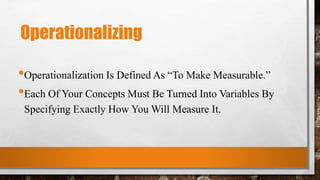
Operationalization is defining concepts and variables so they can be measured quantitatively or qualitatively. To operationalize a variable, researchers must specify how it will be defined and measured in their study. This provides a clear and objective definition and allows other researchers to replicate the study. For example, when studying the effect of media violence on aggression, the variables "media violence" and "aggression" need to be clearly defined as they will be operationalized and measured in the study. The operationalization process involves beginning with a concept, deciding on a data collection method, determining the necessary detail level, selecting a recording format, and validating the measure.

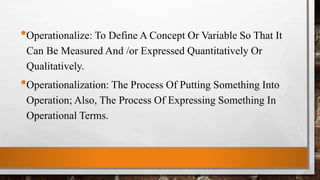
•Operationalize: To DefineA Concept Or Variable So That It
Can Be Measured And /or Expressed Quantitatively Or
Qualitatively.
•Operationalization: The Process Of Putting Something Into
Operation; Also, The Process Of Expressing Something In
Operational Terms.
4.
OPERATIONAL VARIABLES
•Operational Variables(Or Operationalizing Definitions) Refer To How You Will
Define And Measure A Specific Variable As It Is Used In Your Study.
•Operationalization Has The Great Advantage That It Generally Provides A Clear
And Objective Definition Of Even Complex Variables. It Also Makes It Easier
For Other Researchers To Replicate A Study And Check For Reliability.
5.
EXAMPLES OF OPERATIONALVARIABLES
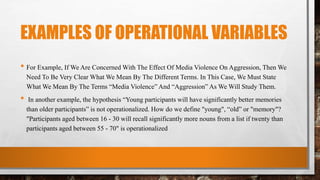
• For Example, If We Are Concerned With The Effect Of Media Violence On Aggression, Then We
Need To Be Very Clear What We Mean By The Different Terms. In This Case, We Must State
What We Mean By The Terms “Media Violence” And “Aggression” As We Will Study Them.
• In another example, the hypothesis “Young participants will have significantly better memories
than older participants” is not operationalized. How do we define "young", “old” or "memory"?
"Participants aged between 16 - 30 will recall significantly more nouns from a list if twenty than
participants aged between 55 - 70" is operationalized
6.
THE OPERATIONALIZATION PROCESS
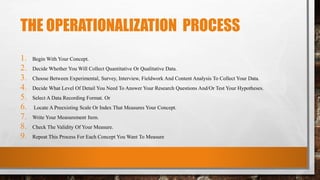
1.Begin With Your Concept.
2. Decide Whether You Will Collect Quantitative Or Qualitative Data.
3. Choose Between Experimental, Survey, Interview, Fieldwork And Content Analysis To Collect Your Data.
4. Decide What Level Of Detail You Need To Answer Your Research Questions And/Or Test Your Hypotheses.
5. Select A Data Recording Format. Or
6. Locate A Preexisting Scale Or Index That Measures Your Concept.
7. Write Your Measurement Item.
8. Check The Validity Of Your Measure.
9. Repeat This Process For Each Concept You Want To Measure