By
Dr.Kanagaraj Easwaran
Associate Professor and Head
Department of Social Work
School of Social Sciences
Mizoram University
Aizawl -796 004.
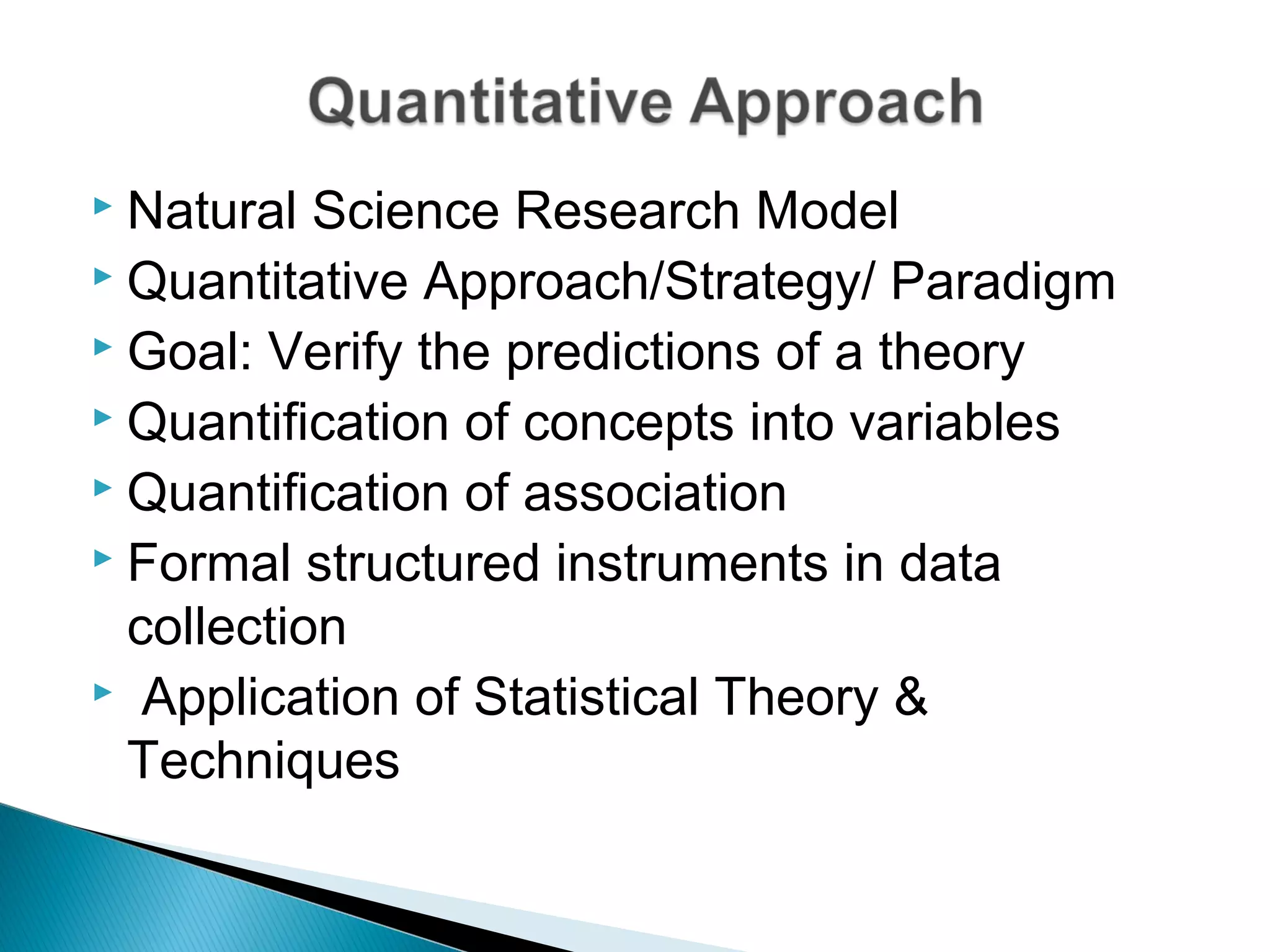
 Natural Science Research Model
 Quantitative Approach/Strategy/ Paradigm
 Goal: Verify the predictions of a theory
 Quantification of concepts into variables
 Quantification of association
 Formal structured instruments in data
collection
 Application of Statistical Theory &
Techniques
Theory Hypotheses
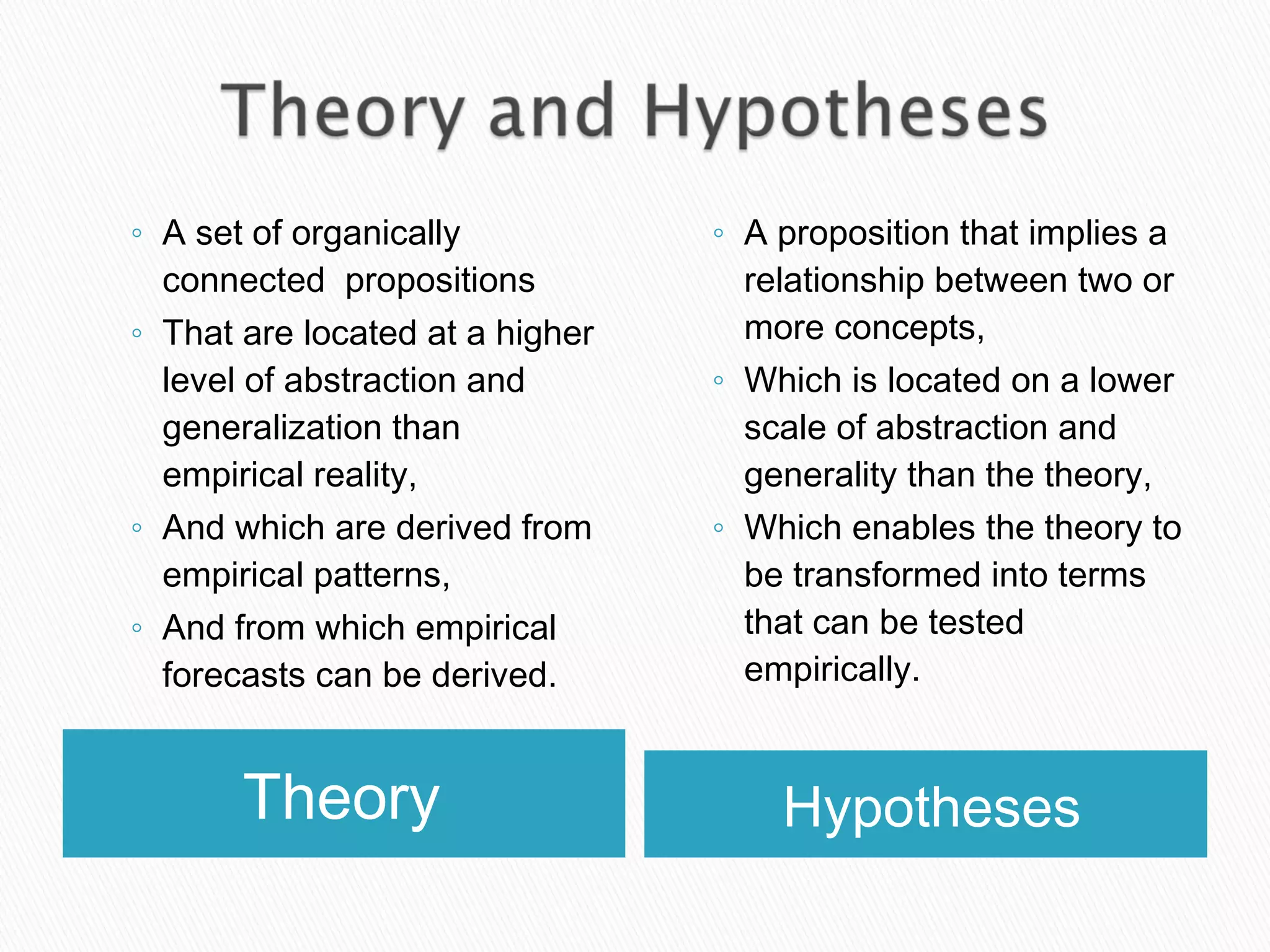
◦ A set of organically
connected propositions
◦ That are located at a higher
level of abstraction and
generalization than
empirical reality,
◦ And which are derived from
empirical patterns,
◦ And from which empirical
forecasts can be derived.
◦ A proposition that implies a
relationship between two or
more concepts,
◦ Which is located on a lower
scale of abstraction and
generality than the theory,
◦ Which enables the theory to
be transformed into terms
that can be tested
empirically.
 Semantic content(meaning) of linguistic
signs and mental images(Corbetta 2003)
 " a mental image we use as summary
device for bringing together observations
and experiences that seem to have
nothing in common [...] they do not exist
in the real world, so they can't be
measured directly" (Babbie, 1989)
 "Conceptualization : Process of specifying the
vague mental imagery of our concepts [by] sorting
out the kinds of observations and measurements
that will be appropriate for our research" (Babbie,
1989).
 Operationalisation: development of specific
research procedures (operations) that will result in
empirical observations representing those
concepts in the real world" Babbie (1989)
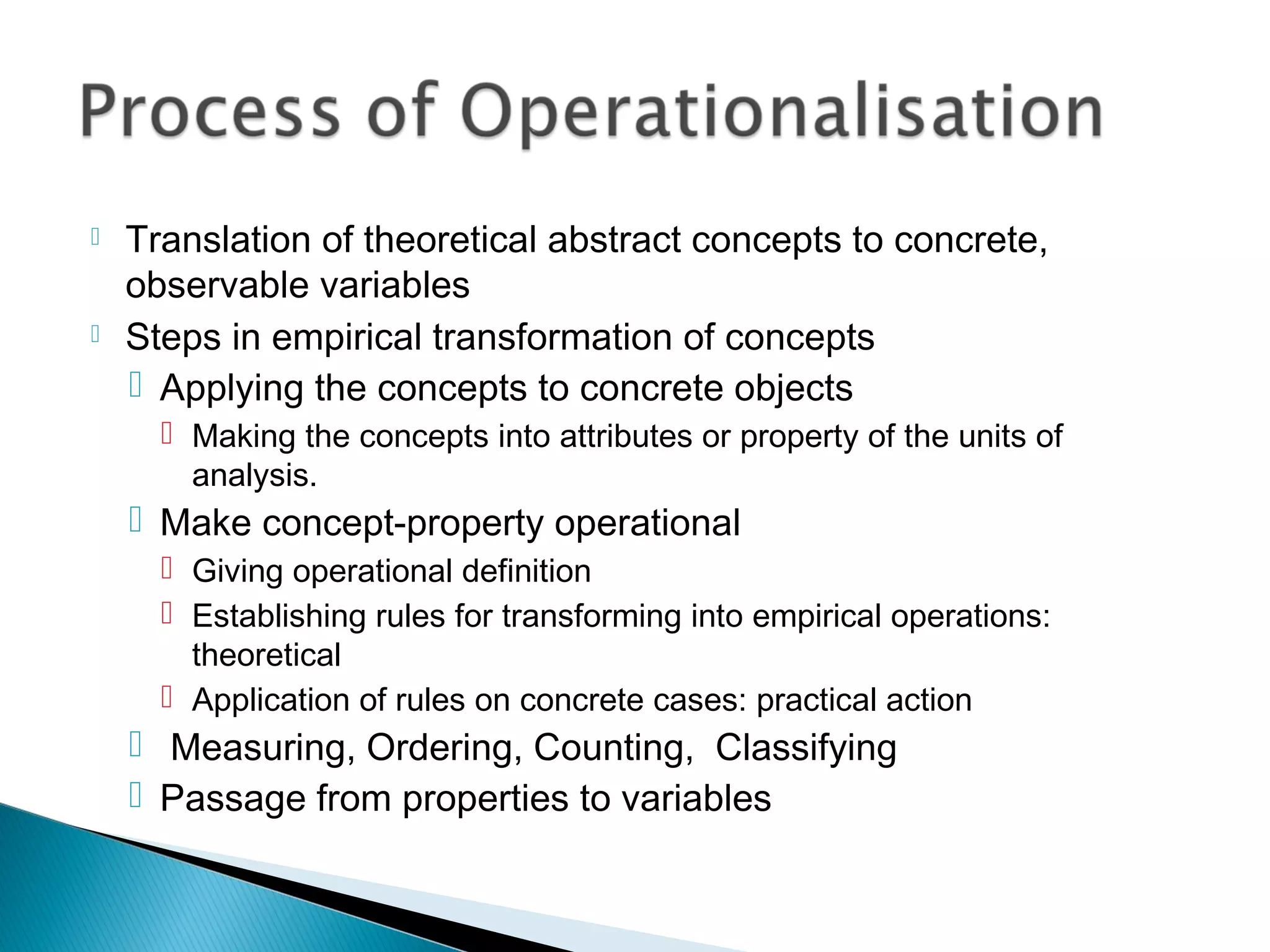
 Translation of theoretical abstract concepts to concrete,
observable variables
 Steps in empirical transformation of concepts
 Applying the concepts to concrete objects
 Making the concepts into attributes or property of the units of
analysis.
 Make concept-property operational
 Giving operational definition
 Establishing rules for transforming into empirical operations:
theoretical
 Application of rules on concrete cases: practical action
 Measuring, Ordering, Counting, Classifying
 Passage from properties to variables
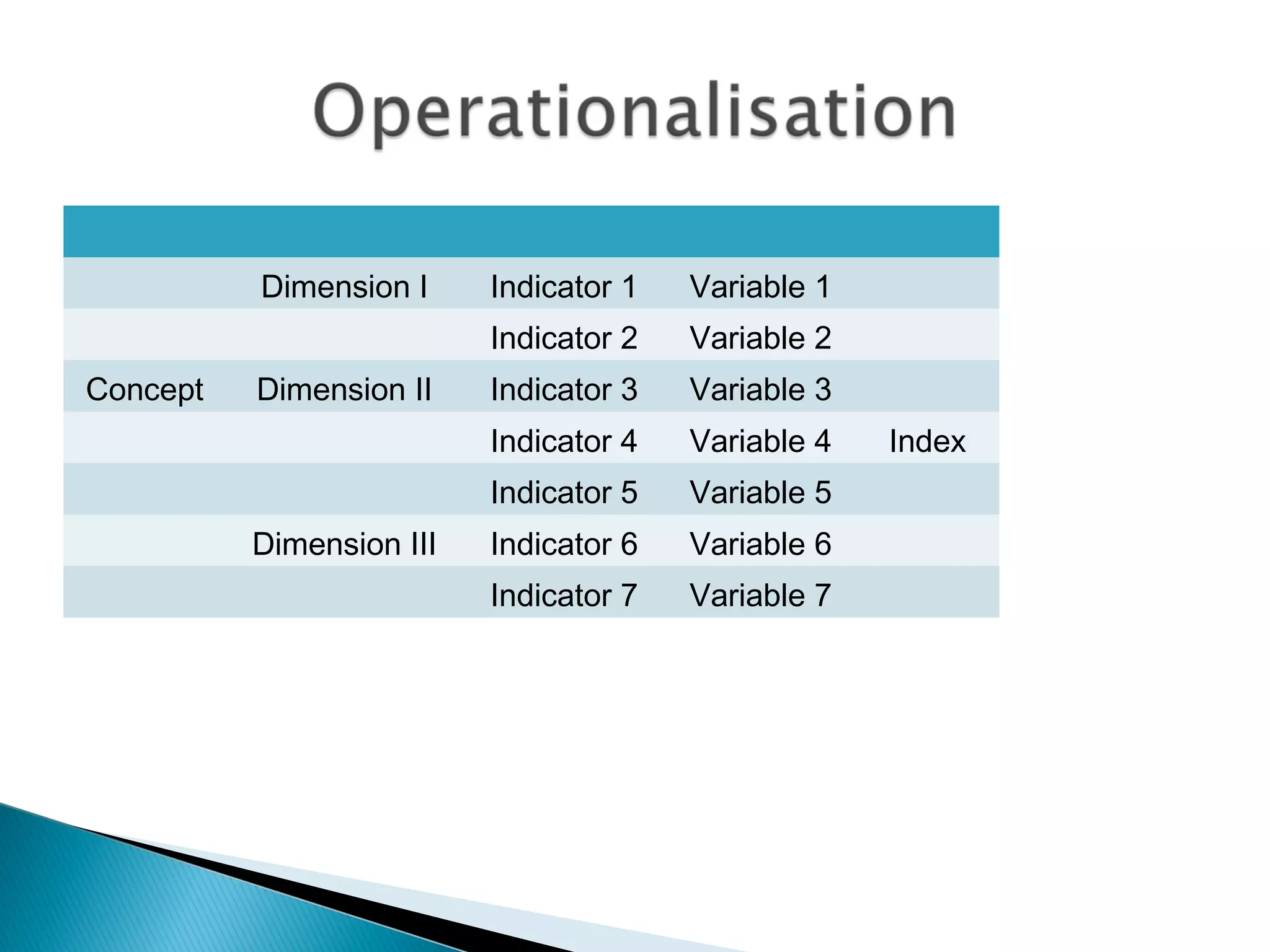
Dimension I Indicator 1 Variable 1
Indicator 2 Variable 2
Concept Dimension II Indicator 3 Variable 3
Indicator 4 Variable 4 Index
Indicator 5 Variable 5
Dimension III Indicator 6 Variable 6
Indicator 7 Variable 7
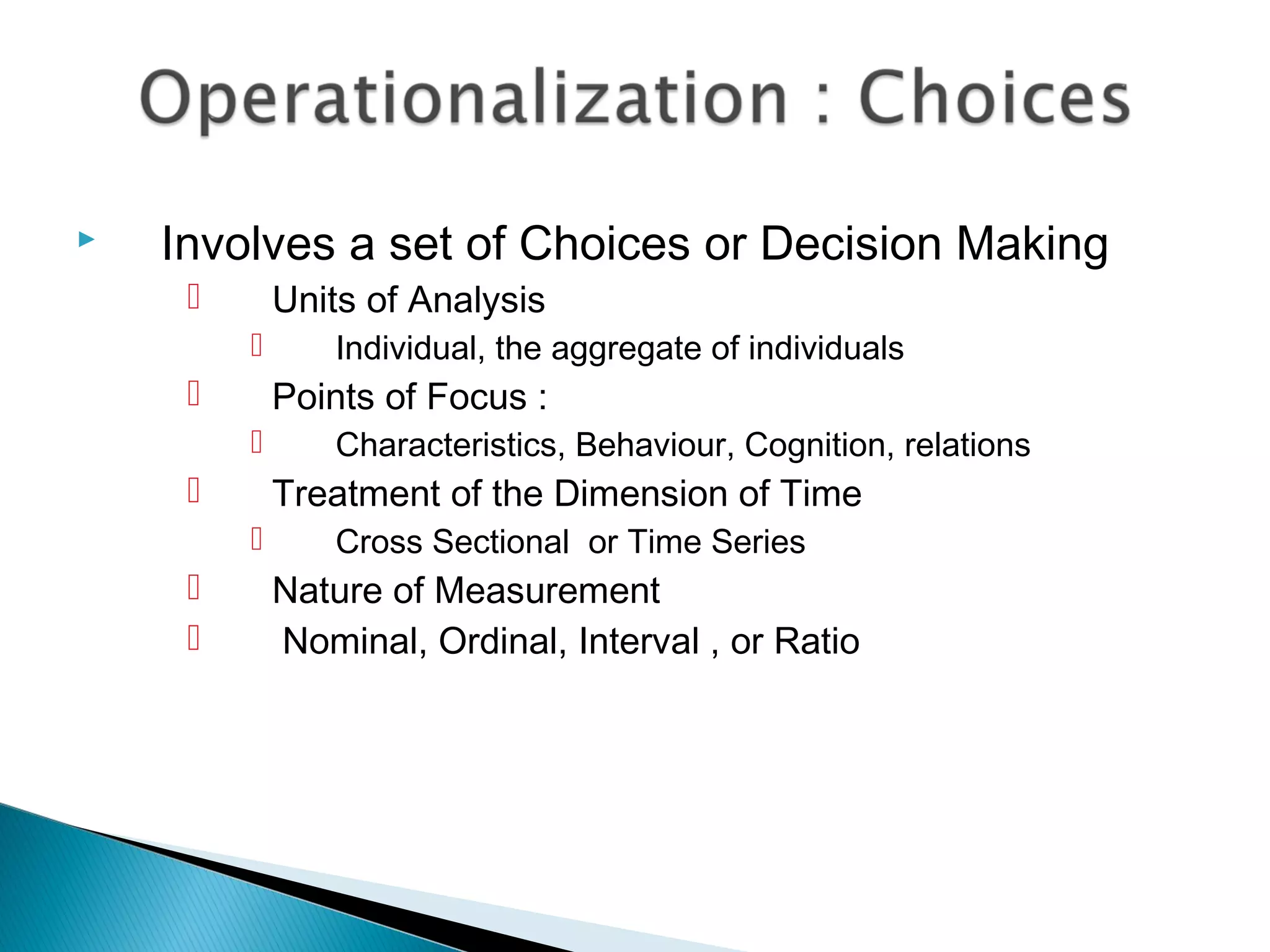
 Involves a set of Choices or Decision Making
 Units of Analysis
 Individual, the aggregate of individuals
 Points of Focus :
 Characteristics, Behaviour, Cognition, relations
 Treatment of the Dimension of Time
 Cross Sectional or Time Series
 Nature of Measurement
 Nominal, Ordinal, Interval , or Ratio
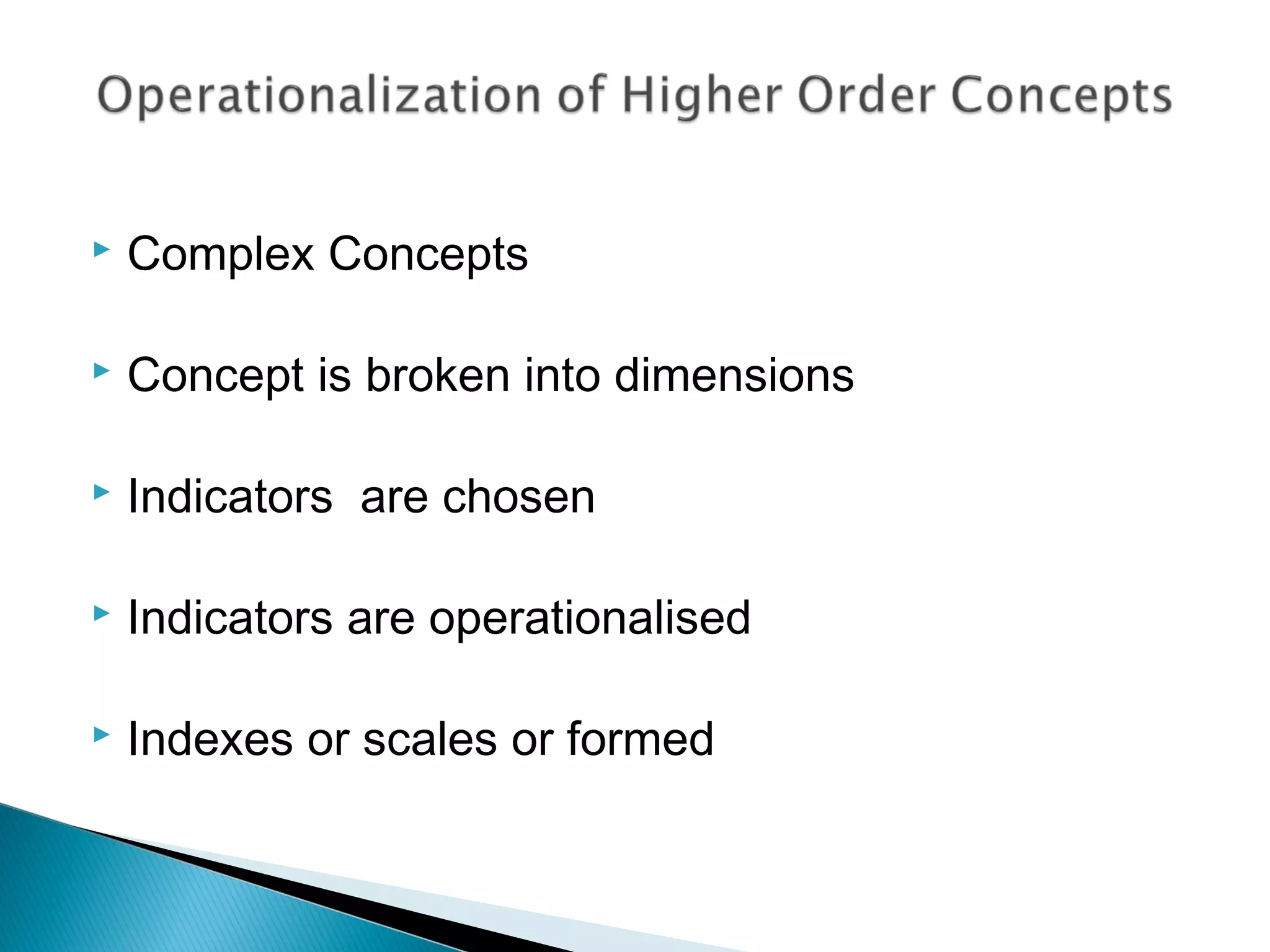
 Complex Concepts
 Concept is broken into dimensions
 Indicators are chosen
 Indicators are operationalised
 Indexes or scales or formed
 Consistency of a measure of a concept
◦ Stability over time
◦ Internal reliability or consistency
◦ Inter-observed consistency
 Validity: Whether an indicator or set of indicators
that is devised to gauge a concept really
measures the concept. – Truthfulness
 Face Validity
 Concurrent Validity: Criterion
 Convergent: Other Measures of the same concept
Measurement
Causality
Generalization
Replication
 World of Nature vs Social World
 Phenomenological
 Self Reflection
 Consciousness
 Meaning
 Measurement Process Artificial
 Connection Concepts and Measures not real
 Measurement by fiat
 Differences in respondents interpretation
 No Connection between Research and Every Day
Life: Instruments
 Static view of Life: Analysis of Relationship
between variables
◦ Ideal Typical Representation
◦ Variation or Differences
◦ Reverse operationalisation
◦ Inductive Conceptualisation: Factor Analysis
Questions Please
THANK YOU

03 quantitative method

  • 1.
    By Dr.Kanagaraj Easwaran Associate Professorand Head Department of Social Work School of Social Sciences Mizoram University Aizawl -796 004.
  • 2.
     Natural ScienceResearch Model  Quantitative Approach/Strategy/ Paradigm  Goal: Verify the predictions of a theory  Quantification of concepts into variables  Quantification of association  Formal structured instruments in data collection  Application of Statistical Theory & Techniques
  • 4.
    Theory Hypotheses ◦ Aset of organically connected propositions ◦ That are located at a higher level of abstraction and generalization than empirical reality, ◦ And which are derived from empirical patterns, ◦ And from which empirical forecasts can be derived. ◦ A proposition that implies a relationship between two or more concepts, ◦ Which is located on a lower scale of abstraction and generality than the theory, ◦ Which enables the theory to be transformed into terms that can be tested empirically.
  • 5.
     Semantic content(meaning)of linguistic signs and mental images(Corbetta 2003)  " a mental image we use as summary device for bringing together observations and experiences that seem to have nothing in common [...] they do not exist in the real world, so they can't be measured directly" (Babbie, 1989)
  • 6.
     "Conceptualization :Process of specifying the vague mental imagery of our concepts [by] sorting out the kinds of observations and measurements that will be appropriate for our research" (Babbie, 1989).  Operationalisation: development of specific research procedures (operations) that will result in empirical observations representing those concepts in the real world" Babbie (1989)
  • 7.
     Translation oftheoretical abstract concepts to concrete, observable variables  Steps in empirical transformation of concepts  Applying the concepts to concrete objects  Making the concepts into attributes or property of the units of analysis.  Make concept-property operational  Giving operational definition  Establishing rules for transforming into empirical operations: theoretical  Application of rules on concrete cases: practical action  Measuring, Ordering, Counting, Classifying  Passage from properties to variables
  • 8.
    Dimension I Indicator1 Variable 1 Indicator 2 Variable 2 Concept Dimension II Indicator 3 Variable 3 Indicator 4 Variable 4 Index Indicator 5 Variable 5 Dimension III Indicator 6 Variable 6 Indicator 7 Variable 7
  • 9.
     Involves aset of Choices or Decision Making  Units of Analysis  Individual, the aggregate of individuals  Points of Focus :  Characteristics, Behaviour, Cognition, relations  Treatment of the Dimension of Time  Cross Sectional or Time Series  Nature of Measurement  Nominal, Ordinal, Interval , or Ratio
  • 10.
     Complex Concepts Concept is broken into dimensions  Indicators are chosen  Indicators are operationalised  Indexes or scales or formed
  • 11.
     Consistency ofa measure of a concept ◦ Stability over time ◦ Internal reliability or consistency ◦ Inter-observed consistency  Validity: Whether an indicator or set of indicators that is devised to gauge a concept really measures the concept. – Truthfulness  Face Validity  Concurrent Validity: Criterion  Convergent: Other Measures of the same concept
  • 12.
  • 13.
     World ofNature vs Social World  Phenomenological  Self Reflection  Consciousness  Meaning  Measurement Process Artificial  Connection Concepts and Measures not real  Measurement by fiat  Differences in respondents interpretation  No Connection between Research and Every Day Life: Instruments  Static view of Life: Analysis of Relationship between variables
  • 14.
    ◦ Ideal TypicalRepresentation ◦ Variation or Differences ◦ Reverse operationalisation ◦ Inductive Conceptualisation: Factor Analysis
  • 15.
  • 16.